
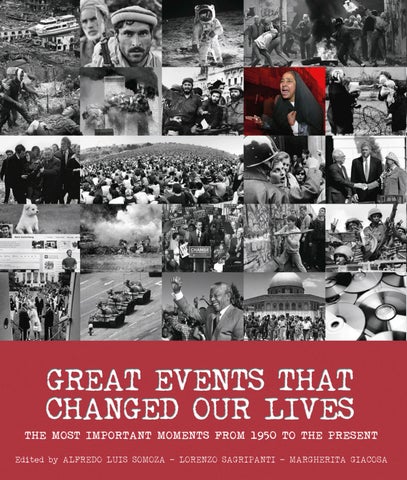
Great Events that Changed Our Lives

Page 1


The Cuban Revolution

1959 - Cuba

It was not yet dawn on January 1st, 1959, when the Cuban dictator Fulgencio Batista gathered his family, his closest collaborators, chests of money and jewels, and made for the runway at the Columbia barracks on the outskirts of Havana. He was off to a very comfortable exile. At a New Year’s Eve party the night before, Batista had celebrated with friends and family, but everyone knew that his regime was finished. The turning point occurred two days earlier, on December 29th, when guerillas led by Che Guevara derailed and captured an armored train that represented the last hope of bringing reinforcements to the strategic city of Santa Clara. Immediately afterward, the garrison was forced to surrender to Che Guevara.

In March, 1952, Batista, to avoid holding presidential elections, seized power in a coup. Fidel Castro, a young lawyer already politically active with the Orthodox Party, petitioned the Supreme Court, but his appeal was dismissed. In the following months Castro began to organize a movement to overthrow the dictator. July 26th, 1953, marked its baptism of fire with an attack on the Moncada barracks in Santiago de Cuba. The revolutionaries were defeated: many died in the fighting, while others were arrested, tortured, killed. Castro, his brother RaĂșl, and a few other conspirators were captured a few days later and sentenced to several years in prison on Isla de Pinos. After being released in an amnesty in May, 1955, they went into exile in Mexico, where they prepared for their return. In Mexico they were joined by an Argentinian doctor,

The new Cuban leader smokes a cigar while he talks to reporters during a press conference in New York. Images were one of the most important elements of the Revolution, from the time when the barbudos were fighting on the Sierra. The Cuban photographer Alberto Korda would later contribute to creating the myth of Che Guevara, immortalizing him in the famous photo in the beret with the star.

The First Man in Space

1961 - Baikonur, Soviet Union

An aluminum ball approximately 2 feet in diameter, two transmitters, some batteries, two long antennas: this was Sputnik 1. The date was October 4th, 1957, and no human artifact had ever left the atmosphere. By the 4th January of the next year, Sputnik had completed 1,400 orbits at 560 miles above the Earth. It then fell back into the atmosphere. Meanwhile the Soviet Astronautics had sent the first living being into space in November 1957. Laika was a small female dog; she died shortly after the launch. Sputnik 5 took up 2 dogs, 42 mice, and various vegetables; they came back to earth safely two days later. Sputniks 9 and 10 were the dress rehearsals of the Vostok program: both Sputniks transported a mannequin and a dog. The dogs came back safe and sound; the mannequins were undamaged. It was the 1961, and now everything was ready. April 12th: on the morning of the launch, Yuri Gagarin slept until half past five, as usual, and had a breakfast of sausage, currant jelly, and coffee with his backup pilot, Gherman Titov. Then both proceeded toward the Baikonur Cosmodrome, the site of all the Sputnik launches, 125 miles east of Lake Aral, in central Asia. They wore thermal underwear and an orange suit equipped with every convenience (ventilation, pressurization, sanitation, feeding, etc.). Through the white helmet with the words CCCP (USSR) printed over the brow one could glimpse Yuri’s clear eyes and smiling face. Everything he did that morning before finally being sealed into the module would become a routine superstitiously followed by all subsequent Soviet astronauts, from the haircut two days before launch to the signing of the hotel room door, and so on. Yuri never stopped smiling, at least until the last photo taken of him before the hatch of Vostok 1 closed.

The countdown seemed to proceed faster than the clock. On the platform the rocket engines switched on with an enormous cloud of exhaust fumes that would gradually become familiar to everyone, as television cameras showed the launches of space missions. The rocket rose safely into the sky, dropping its various stages, until finally the capsule entered open space. Yuri was in orbit and began to talk. He talked to his technicians at Baikonur, but he also told the world about Earth seen from space: about oceans, chains of mountains, great rivers, and big cities, which he described as gold dust. Throughout the world, people looked up at the sky in search of signs of the spaceship. Some were moved to tears when they heard the cosmonaut’s voice.

Yuri Gagarin flew for 108 minutes, completing an orbit, at 17,000 mph, 120-190 miles from the surface of the Earth. He landed without problems on the western Russian plain leaving his smile on one of the most important events in human history.

The Vision of Martin Luther King Jr.

1963 - United States

“I have a dream that one day this nation will rise up and live out the true meaning of its creed: We hold these truths to be self-evident, that all men are created equal.” These are among the most famous words of Martin Luther King Jr., spoken before a huge crowd in one of the most moving speeches in history, at the end of the March on Washington on August 28th, 1963. They represent the spiritual testament of this Baptist minister whose actions would awaken the political consciousness of the black population of the United States and lead to the passing of the Civil Rights Act (1964), which officially marked the end of racial segregation in the country. The Reverend Martin Luther King was born in Atlanta on January 15th, 1929, and dedicated his life to the struggle against the racial discrimination suffered by black people in the United States. But he also fought against every form of injustice, not only that based on skin color: he was opposed to the war in Vietnam. He was himself the son of a Baptist minister, and became a minister in the Dexter Avenue Church in Montgomery, Alabama, one of the most racist states in the US. At the age of 14, he was traveling on a bus. Because he was black, he was forced to give up his seat to a white man and remain standing for the trip of 85 miles. That experience would never leave him: from that moment on, he organized demonstrations, sit-ins, and political movements against discrimination. He was arrested several times, imprisoned, beaten up, and the object of several assassination attempts, but he never surrendered and would become the interlocutor of Presidents John F. Kennedy and Lyndon B. Johnson on the theme of civil rights. For the FBI, which suspected him of communist sympathies, he was “the most dangerous and effective Negro leader in the country.” In August 1963, he was among the organizers of the extraordinary march on Washington “for work and freedom”: it attracted almost 250,000 people and marked a turning point for the Civil Rights Movement. However, he was opposed by some prominent African American leaders who did not accept the peaceful protests that King organized.

After concluding what would become his most famous speech, Martin Luther King Jr. salutes the huge crowd filling the National Mall on the occasion of the March on Washington. It was the most successful moment in his anti-racist policy, which was able to unite not only African Americans but also Hispanic Americans and whites. His dream of building a more just country has partly been achieved.

A first aid post where some US Marines wounded during gunfire recover. Among them is Artillery Sergeant Jeremiah Purdie (center).

The Assassination of Malcolm X

1965 - New York, United States

The stage of the Audubon Ballroom, in Manhattan, was riddled with bullets: Malcolm X lay there, dying. A man had come up to him and shot him in the chest with a sawed-off shotgun. Two other men had shot him from close range with semi-automatic pistols. Just a few moments before he had been preparing to address an audience of 400 people, many of whom were enchanted by his charisma and effortless eloquence. His wife, Betty, and their children were also present. Some people tried to save him, but in vain. On February 21st, 1965, Malcolm X’s tumultuous life came to an end, with a tragic epilogue: the police surgeon who performed the autopsy counted twenty-one gunshot wounds on the victim’s body. The instigators and assassins were members of the Nation of Islam, a radical organization of which Malcolm X had been a outspoken member up to the previous year. But how had Malcolm X risen to such prominence? Malcolm Little was born in 1925 in Omaha, Nebraska. His father was a Baptist minister, his mother a secretary, and there were nine in his family. Poverty drove him to seek easy money with drug dealing and robbery. He soon ended up in prison. There he converted to Islam and became an avid reader. He intended to fight for the emancipation of African Americans, whose rights in the US were trampled on. The man who up to then had been an anonymous delinquent studied to be a preacher, on his own terms: he described himself as a Communist and wrote a letter to President Truman in opposition to the Korean War. He removed ‘Little’ from his name, since it was a shameful legacy of the slave era in which slaves took the names of their white masters. In its place, he used a simple X. After being released from prison, he joined the Nation of Islam. He became the spokesman for millions of African Americans who placed their hopes of liberation in the ideology and rhetoric he espoused. Malcolm X was eloquent, but also good-looking and attractive. People listened to him, believed in him. He used strong words to eloquently express his radical theses: he advocated the birth of a black (and Islamic) nation to be achieved through armed struggle. In 1964 he made his pilgrimage to Mecca: it was the beginning of his umpteenth change of direction, the last transformation. He would come to adhere to the line of Martin Luther King, who was against violence, which Malcolm X had always considered an integral part of life. In fact, as a child he had seen members of the Ku Klux Klan spread death and pain in the name of white supremacy. In a twist of fate, it was this final transformation, one toward moderation, that cost him his life.

Malcolm X, the spokesman for the political and religious movement the Nation of Islam, takes part in a Harlem rally against racial discrimination in Birmingham, Alabama, on May 14th, 1963. He is pointing as he makes his accusation of the systematic violation of civil rights and violence against the African Americans, which in the American South is still commonplace.

The First Moon Landing

1969 - Moon

“That’s one small step for a man, one giant leap for mankind.” It was July 20th, 1969, and the commander of the Apollo 11 Mission, Neil Armstrong, had just stepped down from the last rung of the lunar module Eagle: for the first time, a human stepped onto the moon. After 20 minutes, he was followed by his second-in-command, Buzz Aldrin, while the third astronaut, Michael Collins, piloted the Columbia module in a lunar orbit. The first two explorers remained on Earth’s satellite for two and a half hours: they walked 200 feet, and planted an American flag and a plaque reading: “Here men from the planet Earth set foot on the moon for the first time. July 1969 A.D. We came in peace, in the name of all humanity.” The signatures that would remain there were those of Armstrong, Aldrin, Collins and the then President of the United States, Richard Nixon. NASA’s footage was broadcast on radio and television throughout the world and seen by about 450 million people.

The Space Race had begun years before. For the two superpowers of the era, the US and the USSR, competition in space had political and military significance. The Soviets had sent the first man into space, Yuri Gagarin, and had also seemed to be ahead in the race to the moon, in particular with the unmanned spaceship Luna 9, which landed on the moon on February 3rd, 1966. But the United States recovered with the Surveyor program, sending robotic spacecraft to photograph the moon’s surface in order to decide the most suitable place for landing. Then with the Pioneer project they overtook their rivals, and with the Apollo missions they were able to win the race.

Neil Armstrong had been a navy pilot. After serving in the Korean War, he become a test pilot. In 1962 he was chosen for the Apollo program. His extraordinary professionalism and his mild manner made him suitable for the delicate mission.

The last time a human walked on the moon’s surface was with the Apollo 17 mission on December 11th, 1972. It was the American astronaut Eugene Cernan who made that ‘small step’. Since then space agencies throughout the world seem to have lost interest in the moon.

Many missions have been organized aiming at research and study after Armstrong’s walk on the Moon. However, robot probes mainly have done the work of photographing and taking soil samples. Recently Europe, China, Japan, and India have begun to compete with the United States and Russia in the space race.

An Israeli army tank maneuvering in the Sinai Desert, at the end of the Yom Kippur War. The place was Rephidim, where in the Book of Exodus Moses’ people clashed with the Amalekites during their progress toward the Promised Land. Between 1973 and 1975, Rephidim was also the Israelis’ westernmost outpost, guarding over the Egyptian lines.

The Yom Kippur War and the Oil Crisis

1973 - Israel, Egypt & Syria

In Hebrew Yom Kippur means “Day of Atonement.” It is one of the most deeply felt religious holidays in Judaism, and occurs in late September or early October. It is a day on which activities and communication are limited to emergency services. In 1973 Yom Kippur fell on October 6th. On that day Egypt and Syria attacked Israel, with the support of troops and matĂ©riel from neighboring Arab countries (Jordan, Iraq, Saudi Arabia, Libya, Tunisia, Algeria, and Morocco) and even from Cuba. The most powerful arms supplier, the Soviet Union, even backed the offensive. The objective: to win back the territory lost six years before in the Six-Day War. Egypt wanted to recover the Sinai and Gaza, while Syria wanted the Golan Heights.

There was a vast gap between the size of the armed forces in the field, as in the previous Arab-Israeli wars: 400,000 men on the Israeli side and more than a million on the other. Furthermore, the Arabs were able to count on twice the quantity of arms. The strategies of the Six-Day War were reversed: Israel played a waiting game, since Golda Meir, the head of the government, was reluctant to launch a pre-emptive strike, for fear of losing American support. The Arabs, on the other hand, revealed nothing in the weeks leading up to the operation, and managed to avoid

of the US Embassy in Tehran were held hostage by Islamic militants who had the full support of Iranian authorities. The Americans were only freed after long negotiations and the failure of a US military raid. President Jimmy Carter’s popularity was affected by the management of the diplomatic crisis: he was defeated by Ronald Reagan in the 1980 election. The outbreak of revolution in Iran, in fact, had strong repercussions on geopolitics that were not only of concern to the US. In a strategically crucial area, Khomeini created a precedent that would completely transform Iranian culture in the decades to come, and also change the balance of power in the Middle East. He inspired future religious movements in the Islamic world.

102-103 The attack on the US embassy, on November 4th, 1979, definitively compromised the relations between Iran and the United States. The Stars and Stripes was burned to the cry of “death to America.” This scene connected to the days of the hostage crisis has been repeated more recently.

103 These images were seen throughout the world: the US hostages, blindfolded and with their hands tied, were shown to the crowd and on television channels to symbolize the humiliation of the US. The hostages would be held for 444 days.

and waving their identity cards in the air. Twenty thousand people passed through the gates, some of them only for a few minutes, to feel the exhilaration of such a long hoped-for victory. There were passionate celebrations, but no trouble. A new horizon had suddenly opened; strangers embraced in the street, emotional and full of optimism. Rivers of beer flowed everywhere, with everyone drinking, releasing a tension that had lasted for 28 years. And then they attacked the Wall: water from fire hydrants the only weak response by the police hardly discouraged the Berliners’ surge of enthusiasm. The strongest among them used pickaxes to tear down the concrete barrier: with every blow, fears and restrictions collapsed, and silences and prohibitions were shattered.

The real demolition took place the following year, with cranes and bulldozers; some pieces of the Wall were auctioned, others were used to build roads, while some small fragments became relics of a time that had fortunately ended. A first real step toward reunification had been completed. On October 3rd, 1990, after long international negotiations between the powers concerned, the end of the German Democratic Republic was declared and Germany was re-united.

The Mauerspechte, the so-called ‘Wall Woodpeckers’, were already at work on the morning of November 10th, 1989, demolishing the wall with picks. They continued for the next few days and weeks, obtaining wall fragments as souvenirs.

The Creation of the Internet

1991 - Geneva, Switzerland

The first studies for the creation of a geographical network of computers were carried out by the US Department of Defense in the 1960s. For the Armed Forces it was a strategic project which would reinforce the links between various units. Almost immediately, the first academic networks were created, sponsored by the DoD: they connected computers placed in various universities.

Underlying the development of the network was the engineer Paul Baran’s idea to send fragmented information in many small independent packets. Unlike in telephone communication, these packets could reach their destination in a random order and by following different geographical routes, rather than in the form of unitary blocks. Every individual package contained instructions for reassembling the message: the computer receiving only had to wait for all the packets to arrive to combine them in the correct order. Although this idea was opposed for many years, it would become a fundamental mechanism for the Internet.

The number of computers linked in a network increased. At the same time, HTML, the ‘language’ of the web, was invented in Geneva, at the CERN, the European organization for nuclear research. There the British physicist Tim Berners-Lee, together with his colleague Robert Cailliau, invented the World Wide Web (WWW or W3) between 1990 and 1991. The same network, the great worldwide spider’s web of information, is still used today, sharing HTML as its base language.

The first website, created in 1991, was that of the CERN. But it would take a few more years before the new technology could be found in personal computers everywhere: it was a revolution in communication, connecting humanity in real time.

The network of Internet connections involves both cable and a wireless transmission. It uses all the materials and methods made possible by the technology: copper wire, optical fibers and radio frequencies; from the bands of domestic devices to cellular networks to communications with the support of satellites. The number of devices connected to the network today is estimated to be about 25 billion.

January, 2011. In her close-up, a Tunisian woman protests vehemently. She is

draped in the red flag of her country.

Brexit

2016 - United Kingdom

The United Kingdom’s withdrawal from the European Union was an unprecedented socio-political event. In fact, since the process of European integration began in 1957 with the Treaty of Rome or EEC Treaty, no country had ever asked to leave the European Community or the European Union as it was renamed in 1993. Opposing membership in this institution, which necessarily requires ceding sovereignty, has always been the ideological heritage of English nationalist formations that found their spokesperson in Nigel Farage’s UK Independence Party. The political novelty of recent decades has been the broadening of this position to include important sectors of the Conservative Party.

Tory Prime Minister David Cameron called the referendum that pitted supporters of Leave, who wanted to withdraw from the European Union, against those who wanted to Remain and maintain the status quo. On June 23, 2016, the No to Europe front prevailed, with 51.9 percent of the vote. The result divided the country geographically, with Scotland, Northern Ireland and the capital, London, in favor of staying in the EU, and the rest of England and Wales choosing to withdraw. The political crisis led to the resignation of Cameron, who was initially in favor of leaving and then against it, and of the government of Theresa May. Downing Street immediately began negotiations with the European Union regarding exit strategies but after Parliament rejected the agreements May reached with the European Commission, she was replaced in 2019 by Boris Johnson.

The transition period ended at 11 p.m. London time on January 31, 2020. The United Kingdom’s membership had lasted 47 years. Brexit would impose restrictions on the movement of people entering the United Kingdom. This was an issue of extreme importance for many of those who had expressed themselves in favor of Brexit. In fact, Community regulations would have favored an unregulated influx of immigrants and a consequent shortage of jobs. The facilitations and benefits of the single market and the customs union no longer exist. Only time will tell what effect this drastic decision will have on the British economy.

The faces of the so-called Maastricht Rebels, members of the Conservative Party (Tories) and originators of Brexit, appear on these cardboard cut-outs on show in London. Before Brexit, a member country had never chosen to leave the European Union. The negotiations for an agreed withdrawal between the United Kingdom and the EU have turned out to be more complex than expected.

Turn static files into dynamic content formats.
Create a flipbook