TONGJIUNIVERSITY
1 《富春山居图》(《剩山图》部分),黄公望,1347—1351年,现藏于浙江省博物馆
Dwelling in the Fuchun Mountains (The Remaining Mountain scroll), Huang Gongwang, 1347–1351, Zhejiang Provincial Museum in Hangzhou

TONGJIUNIVERSITY


15
无锡寄畅园,2018年4月,彩色照片是记录古典园林最直接、最常用的方式之一
Jichang Garden (Solace-Imbued Garden) in Wuxi, China, April 2018, colour photographs are one of the most direct and common ways to record classical gardens
TONGJIUNIVERSITY

continuously by different groups, different eras and different regions.
The Chinese classical garden is the combined work of nature and humans. It is a typical ‘clearly defined landscape‘, reflecting the unique aesthetic of ‘naturally, above nature’ in Chinese classical culture and the artistic pursuit of ancient Chinese cultural elites. Chinese classical gardens are profound and long-standing. They have been continuously improved during the development of more than two thousand years, forming a complete planning, design, construction and even system of aesthetics. They have also influenced gardening practices in Asia, Europe, and countries and regions of other continents and achieved a unique position in the history of gardens in the world. In China, a large number of classical gardens are still preserved. They are the precious evidence of the brilliant achievements of ancient Chinese landscape civilisation, and they are an important part of the treasure of all human culture and art. Therefore, the scientific and comprehensive record of the heritage of Chinese classical gardens is self-evident.
Due to various reasons, the records of classical gardens in Chinese history are mostly written, and there are few drawings. Many garden drawings pay more attention to artistic expression and ignore the imitation of specific forms, which brings difficulties to us to intuitively understand and study Chinese classical gardens today. From the perspective of protecting garden heritage, the systematic investigation and recording of classical garden heritage by modern surveying and mapping began in China in the 1930s. The famous garden experts, such as Liu Dunzhen, Tong Jun and Chen Congzhou, conducted systematic investigation and mapping of
classical garden remains, leaving many maps and records, which not only provided important information for later classical garden research and restoration, but also became important historical documents. Since the founding of People’s Republic of China, with the strengthening of the concept of cultural relics protection, the National Cultural Relics Department has gradually begun to do filed investigation on the ancient garden heritage, and established systematic garden records and archives. At the same time, colleges and universities with architecture and landscape architecture in China have opened courses related to ancient gardens, and organised surveying and mapping internships according to the academic tradition of architectural education. The survey covers most of the country and has formed more and more achievements. A large number of surveys have accumulated a wealth of information. Many classical gardens have been recorded and used in related research and protection practices, which played an important role in promoting the modern conservation of China’s classical garden heritage.
However, if we re-examine the records of Chinese classical gardens from the perspective of contemporary cultural heritage conservation, we will find that the current results have certain limitations. First is the accuracy of the recorded data. Limited by traditional measuring methods with tape measure, theodolite and level gauge as the main tools, the integrity and accuracy of ancient garden surveying data are insufficient, especially for irregular components such as pools, rockeries and terrain. The previous main method to measure key points is flawed and it is impossible to accurately measure and depict more complex garden spatial information. For example, in the existing garden drawings,
TONGJIUNIVERSITY

Aerial photo-a of Heyuan Garden, June 2019


23 何维键的第四代嫡孙在蝴蝶厅前合影,1935年.
来源:扬州何园管理处提供
He Weijian's great-grandsons in front of the Butterfly Hall, 1935.
Source: Management Office of Heyuan Garden, Yangzhou
公共使用时期(1944—1959年)
1945年抗日战争胜利以后,国民党政府以日伪财 产接收何园,没收归公,并在此开办了私立祝同中 学。1946—1947年,何园由淮安中学使用,其间园林 中的许多建筑都被用作教学场地。1950年,中国人民 解放军苏北军区医院进驻何园,次年迁至淮安。1953 年,江苏省军区文化速成中学进驻何园,之后华东军区 第五速成中学、南京军区第五速成中学、部队第二十文 化速成中学又先后驻用何园。这一时期园内的古建筑遭 到一定程度的损坏。
遗产保护时期(1959年至今)
1959年开始,扬州市政府将何园北部园林部分交给市 园林管理部门整修并于10月1日将其对外开放。1962 年5月,扬州市人民委员会将何园(寄啸山庄)列为文 物保护单位。1963年,后花园及祠堂以外部分交给国 防部第七研究所驻用,之后又先后为六机部七院第五研 究所(705所)、六机部七院第十研究院(710所)所驻 用。1969年,扬州市革命委员会将何园园林部分交给 扬州无线电厂,其中一些主要厅馆用作车间,由于缺 少养护,导致一些古树死亡。1972年,六机部七院第 二十三研究所(723所)由青岛迁至扬州,利用何园内
TONGJIUNIVERSITY
the tenth year of Guangxu reign (1884), He Weijian purchased the artificial Taihu Lake stone mountain area (i.e. Small-Rock Mountain Retreat) where Wu Huimo lived, and made it an independent small garden. The Ancestor Hall of He’s family was then built in the east. At this point, the overall pattern of Heyuan Garden had been established.
In the twenty-seventh year of the Guangxu reign (1901), 66-year-old He Weijian moved his family to Shanghai to invest in banking, a coal-iron plant, a mining company, a school and other businesses. Heyuan Garden was handed over to a housekeeper. He Weijian’s eldest son, He Shenghao, returned to Heyuan Garden in 1935 to reduce his living expenses. When Japan launched a full-scale invasion of China in 1937, He Shenghao fled to Shanghai again. In 1944, the descendants of He returned to Heyuan Garden. In the same year, they sold all the parts of the garden except the four courtyards on the east side of the Small-Rock Mountain Retreat to the traitor Yin Rugeng, and opened another gate in Huayuan Lane. The two compartments were separated by a new brick wall, which ended the history of what had been He’s private homestead for 61 years.
The period of public use (1944–1959)
After the victory of the War of Resistance against Japanese Aggression in 1945, the Kuomintang government reclaimed the garden as a property from the puppet government of Japan. The confiscated garden was returned to the public and was used to accommodate the private Zhutong Middle School. In 1946–1947, Heyuan Garden was then used by Huai’an Middle School. During this period many buildings in the garden were used as teaching spaces. In 1950, the People’s Liberation Army’s
Subei Military Region Hospital was stationed in Heyuan Garden, but then moved to Huai’an in the following year. In 1953, the Jiangsu Province Military Region Culture Accelerated Middle School entered Heyuan Garden, and then the Fifth Accelerated Middle School of the East China Military Region, the Fifth Accelerated Middle School of the Nanjing Military Region, and the 20th Accelerated Middle School of the Forces were successively stationed there. The occupation led to some damage of the historic buildings.
The period of cultural heritage conservation (1959–present)
Beginning in 1959, the Yangzhou Municipal Government handed over the northern part of Heyuan Garden to the city's garden management department for renovation and opened this part to the public on 1 October. Heyuan Garden was listed as the municipal cultural heritage site by the People’s Committee of Yangzhou in May 1962. In 1963, the majority of the garden except the northern precinct and the ancestral hall was handed over to the Seventh Research Institute of the Ministry of National Defense. Later, it was successively used by the Fifth Research Institute and the Tenth Research Institute of the Seventh Academy of the Sixth Ministry of Mechanical Industry (Institute 705 and Institute 710). In 1969, the Yangzhou Revolutionary Committee handed over the northern part of garden to the Yangzhou Radio Factory. Some of the main halls were used as workshops, and some old trees died due to lack of maintenance. In 1972, the Twenty-third Research Institute of the Seventh Academy of the Sixth Ministry of Mechanical Industry (Institute 723) moved from Qingdao to Yangzhou, using
TONGJIUNIVERSITY


Point cloud model of Heyuan Garden
Elevation of Shangyue Building and the Western-Style Building
TONGJIUNIVERSITY

Magnolia grandiflora L.
Shangyue Building (Moon-Viewing Building)
Western-Style Building


TONGJIUNIVERSITY


Aerial photo of the West Garden, June 2019


Isometric of the East Garden
TONGJIUNIVERSITY


Aerial photo of the south-western part of Heyuan Garden, June 2019
图书在版编目(CIP)数据
数字化园林遗产图录 : 扬州何园 = Garden
Heritage Digital Document: Heyuan Garden / Yangzhou : 汉英对照 / 杨晨, (澳) 李·夏特 (Leigh Shutter) 著. -- 上海 : 同济大学出版社, 2020.6
ISBN 978-7-5608-8932-0
Ⅰ. ①数… Ⅱ. ①杨… ②李… Ⅲ. ①古典园林-文 化遗产-数字化-扬州-图录 Ⅳ. ①K928.73
中国版本图书馆CIP数据核字(2019)第288755号 联合国教科文组织世界遗产中国项目研究 世界遗产与文化景观·数字档案系列
丛书主编:韩锋
Research Projects on UNESCO World Heritage in China World Heritage and Cultural Landscapes — Digital Documentation Series
Editor-in-Chief: Han Feng
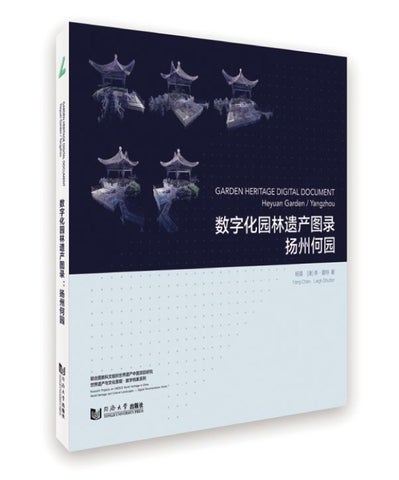
数字化园林遗产图录:扬州何园
Garden Heritage Digital Document: Heyuan Garden / Yangzhou
杨晨 [澳]李·夏特 著
Yang Chen, Leigh Shutter
出版人 华春荣
策 划 江 岱
责任编辑 朱笑黎
责任校对 徐春莲
书籍设计 杨 晨 李·夏特
封面设计 徐文馨
出版发行 同济大学出版社 www.tongjipress.com.cn
(地址:上海市四平路1239 号 邮编:200092 电话:021-65985622)
经 销 全国各地新华书店
印 刷 上海安枫印务有限公司
TONGJIUNIVERSITYPRESS
ISBN 978-7-5608-8932-0
Publisher: Hua Chunrong
Initiated by: Jiang Dai
开 本 787mm×1092mm 1/12
印 张 18
字 数 454 000
版 次 2020年6月第1版 2020年6月第1次印刷
书 号 ISBN 978-7-5608-8932-0
定 价 188元
本书若有印装质量问题,请向本社发行部调换
版权所有 侵权必究
Editor: Zhu Xiaoli
Proofreading: Xu Chunlian
Book Design: Yang Chen, Leigh Shutter
Book Cover Design: Xu Wenxin
Published in June 2020, by Tongji University Press, 1239, Siping Road, Shanghai, China, 200092 www.tongjipress.com.cn
All rights reserved