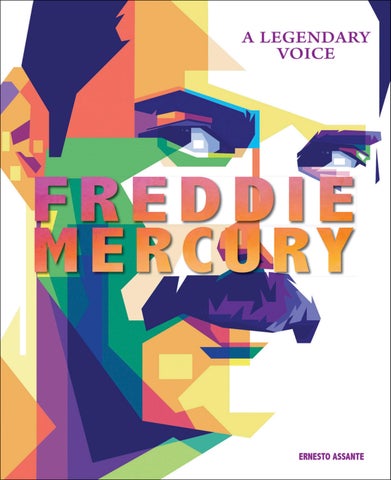
THE BEGINNING: FROM FARROKH TO FREDDIE page 10 AND THEN THEY BECAME “QUEEN” page 28
4
EIGHTIES AND POP page 108
3
THE GLORIOUS SEVENTIES page 44
5
THE MYTH AND THE END page 186
“It would be so boring to be seventy,” he once said about himself. “I’ve lived a full life and even if I were to die tomorrow, I wouldn’t give a damn.”
It was in 1987 that Freddie Mercury offered this succinct assessment of his life. A mere four years later he would be dead, having become a legend, won a place in the Rock & Roll Hall of Fame, and concluded an extraordinary career as a singer and the leader of Queen. It was with it that he experienced the stages of an adventure that began at a moment of exceptional turmoil, the golden age of rock, when, in the traumatic wake of the Beatles’ breakup, the music scene was packed with the likes of Pink Floyd, Led Zeppelin, John Lennon, Crosby
GLAM, PROG, HARD ROCK
ONE GREAT VOICE for every kinf of music
Stills Nash & Young, the cutting-edge David Bowie, and the black music of Stevie Wonder, in short, at the height of the rock and soul renaissance of the early seventies. Above all, he brought with him his eccentric genius as a performer, and, with the others, hit the stage with glam, power, electrifying entertainment, but also a handful of deeply melodic hits capable of moving even a more sentimental audience.
5
6
Freddie Mercury (1946-1991) wearing his signature crown during one of the band’s concerts in 1986.
Freddie Mercury on the bandstand in Wembley Arena during a 1984 Queen concert in London.
Ultimately, it was three super powerful rockers—Brian May, John Deacon and Roger Taylor—behind a decadent bon vivant like Mercury, who loved the ballet and classical music; the union of these four led to a creative mix that proved explosive as the various components of Queen magnificently joined forces to transcend genres and styles, trends and eras. Freddie Mercury’s story brings together rock, dance, glam, classical music and opera, and ballads, all animated by a taste for excess and energy, by a sensational desire to play “with” the public and not “for” the public, as demonstrated at concerts.
The story of the singer and his band is the STORY OF THE TWO DECADES that lefts its mark on rock culture
Mercury’s musical background includes the sounds of the seventies and the beat of the eighties, the desire to amaze and strike straight at the heart, as well as legendary and unforgettable songs and riffs. And there’s an entire universe, represented by his figure and voice, by his dreams and visions, by his craziness and passions. We shall try to recount the fascinating story of his success, decline, rebirth, all intertwined until the end with the history of “Queen,” a band that reigned over rock and pop with magnanimous benevolence.
9 Mercury in concert in the Seventies. With sequins and glitter, Freddie Mercury represented the desire to exaggerate, to turn everything into a spectacle, to combine music with a vision that was part of the music itself..
At Ealing Art College, meanwhile, Freddie developed a close friendship with Tim Staffell, a classmate but also a singer and bass player in another rock band, 1984, which had managed to find various engagements—even as backup for Jimi Hendrix at Imperial College—and which featured Brian May, a young guitarist, likewise from Feltham, who was obsessed with astrophysics. When 1984 broke up, May and Staffell started another group, Smile, which was also joined by drummer Roger Meddows-Taylor.
Left without a band, Freddie Bulsara not only began following Smile, but even moved into the house that Tim, Roger and Brian shared on Ferry Road in Barnes. More importantly, he tried over an over again to convince his friend Staffell to let him join the group as a second singer. Often attending the band’s rehearsals, he went to its concerts and became friends with everybody, particularly Roger Taylor. In order to scrape together some cash, the two set up a booth in Kensington Market, where they sold not only used clothing, but also “outfits”
designed by Freddie as well as his drawings. Since they didn’t exactly have a knack for business, the booth soon closed down. The young men then started working for Alan Mair, the owner of another “booth” at Kensington Market that often attracted rock stars searching for “cool” shoes and boots, especially the high-heeled glitzy kind suitable for the new glam rock scene.
Among his clients was David Bowie – fresh from his success with “Space Oddity”—who met Freddie here for the first time. Mair presented the young Bowie with a free pair of boots, and it was Freddie who handed them to him. Already a fan of the musician, he told him that he had seen him perform live and asked whether he could help him in some way with the concert that Bowie was planning at Ealing Art College. Bowie took a liking to him and asked him to assist with the stage set-up. Freddie agreed. Thus began a story that would end a dozen years later in the recording studio. But Bowie was not his idol: the rock star whom Freddie revered above all others— ever since his 1967 London debut—was Jimi Hendrix.
18 Queen – John Deacon, Roger Taylor, Brian May and Freddie Mercury in the early Seventies.
The beauty of it all was that Mercury, May, Taylor, and Deacon’s band was not really like any other; it consisted of four educated guys, some still at university, working towards a college degree or a PhD. They were not a bunch of young do-nothings who had taken up instruments simply to avoid looking for work; they were all competent and motivated, and believed that making music was not only beautiful and fun, but necessary.
In short, they were a “cultured” band to whose shared baggage they all contributed the culture that they had acquired. At the beginning of their adventure, this baggage even made them seem a bit uppity, and perhaps deep inside they really were as they were less interested in following fashion than in focusing on themselves, their potential, and their talents. As Mercury said, “We didn’t want to be a band for everyone, just for the chosen few who truly understood what we were doing.” To be clear, none of them were all that much into school (save May, who did receive his doctorate in astrophysics many years later), none of them wanted a regular 9-to-5 job—not even Mercury, who was perhaps the least intellectual of the four, but the only one with an art diploma. Once the band assumed its definitive form with Deacon, however, they all decided to leave behind their studies in order to devote themselves, in no uncertain terms, to music.
They had no desire to be a rock band for everybody—only for those who truly understood them
24-25 Queen members relaxing on their instrument cases in a photo shot in the Seventies, around the time when they were recording their Jazz album.
John Anthony convinced the owners of Trident Studios to offer them a contract. And Queen began recording.
Arriving to lend the band a hand was John Anthony, an important producer, whom Freddie met one Saturday afternoon while hanging out on King’s Road and convinced to come listen to the band. Anthony was impressed by Queen, took it under his wing, and soon convinced Barry and Norman Sheffield, owners of the legendary Trident Studios in Soho (where, for the record, all the great bands, from the Beatles to Frank Zappa, had recorded), to sign on as the management company that would produce and promote the band.
After a long period of indecision, the four accepted the offer and, for the first time, found themselves working at one of the world’s most important recording studios. Still, It was not as though they had it at their beck and call:
“They made us work during our breaks, in our spare time,” says Brian May. “Whenever a great artist like Bowie finished early, they called us, and we came running to take advantage of the empty studio. Or we would work at night, from 3 to 7 a.m. We did get some full days, but only through sheer chance.” But it was thus, in bits and pieces, that the four managed to record the songs of their first album. Meanwhile, EMI, which had listened to their first demos, finally decided to take a chance on them.
33 Designed by Freddie Mercury, Queen’s full logo incorporates various symbols, such as the zodiac signs of the band’s members.
FREDDIE HAD THE VOICE OF A BARITONE BUT HAD NO PROBLEM SINGING AS A DELICATE TENOR OR EVEN IN A NEARLY FEMALE FALSETTO
As everyone knew, the richness and versatility of Queen’s sound depended largely on the lead singer’s amazing vocal skills. Universally regarded as one of the greatest voices in rock (and beyond) in terms of range and technical virtuosity, Freddie was labeled a baritone by experts, but he could shift quite smoothly to the soft tones of a tenor, and swing all the way up to a falsetto, a register generally reserved for female voices. What everyone since Freddie’s childhood had considered a defect—hyperdontia, a genetic condition that causes a person to have extra teeth in his mouth—turned out to be an advantage. Those four additional teeth, of which he was ashamed, and which made him cover his mouth with his hand whenever he smiled, became a “magic key” that unlocked an extraordinary vocal qualities. It was to those extra teeth that had altered his mouth, that Freddie attributed his vocal gifts. And it was the very fear of losing these prodigious abilities that prevented the singer from ever taking any measure to correct the defect. His vocal style was as rich and mixed as the wide range of influences evident in his compositions and the band, in general. A great fan of Elvis, he used to quip: “After Elvis Presley, it’s all parody, isn’t it?”.
39 Freddie Mercury photographed in Japan during an interview for Music Life magazine in June 1974.
But Mercury also really appreciated the folk singer Jim Croce as well as John Lennon, Robert Plant and, as already noted, Jimi Hendrix, whom he called “his idol” and from whom he derived his inspiration for the unbridled theatricality of his live performance. (In tribute, but clearly also as a statement of his own artistry, Freddie once observed, “Somehow, through his live performance, he managed to sum up every aspect of a rock star’s job. He can’t be compared to anyone. Either you have magic, or you don’t. Nobody can match him.”) But Freddie also absorbed some of the Eastern sounds of singers like Lata Mangeshkar, who, though though less famous worldwide than those mentioned above, he had discovered as an adolescent in India.
Inevitably an admirer—as were all his peers—not only of the Fab 4, but also of the Rolling Stones, The Who, and Black Sabbath, which along with Zeppelin formed the inner nucleus of English hard rock, Freddie also adored the flashy Broadway musicals of Liza Minnelli as well as classical music, which surfaces not infrequently in Queen’s complex arrangements, and, of course, opera along with the vocal harmonies of the Beatles and the Beach Boys. By the time Freddie arrived on the scene, however, rock was changing and glam exploding. Indeed, discarding much of the trappings of the previous decade, he opted for the dazzle of glitter, preferring high heels and flashy outfits to hippy “poverty,” and ostrich plumes and nail polish hard rock machismo. On the other hand, there was progressive rock, that is, the evolution of all the intellectual aspects of rock. Prog exuded culture, drew on sophisticated and refined literature and theater, flirted with the avant-garde and jazz, was often bombastic and ostentations, as well as fantastical and dream-like. It mixed everything together with the extraordinary technical skills of individual musicians and made it impossible for listeners to dance or make any noise near the stage, before which they were expected to listen in silence and remain seated. This was the music of Genesis, King Crimson, Yes, and Gentle Giant. Glam, by contrast, was flamboyant and popular, unintellectual and colorful, loud and entertaining, over the top and electrifying. Certainly futuristic as he preferred the science fiction of B-rated movies to the legends of
Prog, and because the musicians’ clothing (in retrospect, it seems unbelievable) was actually sewn out of shiny, reflective material—more like aluminum than silk—so the costumes were more like space suits than formal attire. And then there were the shoes, the platform soles, super high heels….this was the music of Bowie/Ziggy Stardust, of Gary Glitter and Sweet, of T. Rex’s Marc Bolan, of Mott the Hoople, Suzi Quatro, and sophisticated Roxy Music.
A nice melting pot of sounds that was quite different from theirs, united, perhaps, less by common musical inspiration than by blatant theatricality, overt sexual ambiguity, and unconventional costumes. In any case, fellow glam singers—Bowie, Bolan and Ferry—definitely had an impact on the development of Mercury’s vocal style and the unexpected melodious pandering of his rock, as, in some cases, did his generous concessions to melodrama, so panned by his detractors.
THE GLAM ERA EXPLODED AND FREDDIE BECAME A BRILLIANT AND SPECTACULAR STAR
40 Freddie Mercury in concert with Queen at Earl’s Court in London in 1977.
But the beauty was that Mercury, May, Taylor, and Deacon were the perfect synthesis of all that was bubbling in the cauldron of rock at the dawn of the seventies. Queen was glam; all four of its members wore flashy stage clothes, but they also played hard rock, did not look down on progressive, and knew how to promote pop hits. With his unique personality and inimitable voice, Mercury was all this rolled together.
Despite openly admitting that he had difficulty reading the notes of a score and that he was not an excellent musician, Freddie composed at least 51 of the 180 songs recorded by Queen—plus those in his two solo albums—managing to convey through them a multifaceted and heterogeneous musical universe that few in the world of twentiethcentury music had succeeded in doing.
When composiing, Freddie used primarily the piano, which he had studied as a child, and which he also played live during concerts.
When discussing the first album, we spoke of the influence of Beatles-inspired melodies, of hard rock and glam, progressive/art rock, vaudeville/musicals, and blues/gospel. Yet in the course of his frenetic evolution as a musician, Mercury also appropriated Dixieland jazz and ragtime, classical, lyrical and later, even electronic music, Moroder’s funk and disco, as well as the playfulness of calypso, touches of flamenco, and some afro percussion—which he performed between the stadium chants and the metallic flashes of glam for the immense audience of so-called “arena rock —a term that could be said to have been coined to convey (just barely) the magnificent yet equally grandiose flamboyance of a larger than life group/performer if ever there was one.
When composing he primarily used the grand piano, which he also played live in Queen concerts, but he also lavished somewhat less time on the guitar, the harpsichord, and later, the electronic keyboard and synthesizer, once these become part of the group’s apparatus in 1980. In short he was an accomplished musician from every point of view.
42 Freddie Mercury in Japanese garb on stage at the Forum in Inglewood, California, during a Queen concert in March, 1977.
96-97 John Deacon and Freddie Mercury on stage at Madison Square Garden on February 5th, 1977. Brian May brought his parents and wife Chrissie to New York on a Concorde flight to celebrate the occasion.
THIS FAMOUS COSTUME INSPIRED BY NIJINSKY was among Freddie’s favorites
98 and 99 Two moments at the concert held at Copenhagen’s Broendby Hall on May 12th, 1977. Freddie Mercury is dressed in the harlequin suit inspired by the Russian ballet dancer Nijinsky. In 2015, the historic costume was sold at auction for $35,000.
146-147 A nice close-up of the Queen lead singer having his mustache clipped before going on stage in 1982.
QUEEN DIDN’T PLAY “FOR” THE PUBLIC BUT “WITH” THE PUBLIC, AND LIVE AID WAS PERFECT PROOF OF THIS
But the “Magic Tour,” the reunited group’s next, fourteenth, and final tour—in hindsight a legendary swan song—broke an absolute record in terms of fan audiences: all in all it attracted over a million spectators during its 26 engagements, not including the United States, where censorship of the “I Want to Break Free” video had strained the band’s relations with the world’s largest rock market. In Europe, however, the number of spectators at the August 9th, 1986 concert in Knebworth Park alone amounted to 200,000. The band also won the prize for staging the first rock concert beyond the Iron Curtain; at the Népstadion in Budapest, Queen brought together over 80,000 young people from all over the Balkans.
Freddie came out on stage wrapped in a royal red cloak and wearing a crown. Unfortunately, in 1987 Freddie was diagnosed as HIV-positive, but the singer who has devoted his life to endless success and fame kept his disease under wraps until nearly 24 hours before departing from this world.
In the Queen: Days of Our Lives documentary, manager Jim Beach expresses his embarrassment at having been the first to learn of the singer’s drama and at having kept it hidden from everyone, even his friends and closest collaborators in accordance with Freddie’s specific directive.. However, as Brian May recalls in the documentary, suspicions that Freddie was suffering from some kind of health issues did not take long to spread, at least among his bandmates, until Freddie himself decided to make them privy to the situation.
His Queen friends agreed on the necessity of protecting Freddie from the voracious curiosity of the British tabloids and thus kept his secret from spreading outside the team, dissimulating and shamelessly lying whenever necessary, as May and Taylor recall, about his health. Freddie wished not to disturb the band’s equilibrium, but rather to continue writing his—their—music until the end, as long as he could.
In 1987, after participating in the drafting of Dave Clark’s sci-fi musical Time (1986) by composing and occasionally performing the ballad of the same name as well as the song “In My Defense,” he did a cover version of “The Great Pretender” by the doo-wop star of the The Platters.
Released as a single, it peaked at No. 4 on the UK charts and ultimately became one of the greatest hits of his solo career. “Few people really knew Freddie,” says Freestone; “To prove that he was truly a pretender, a ‘deceiver,’ the singer brought back the various characters he had played in the videos that he had made with Queen or as a solo artist. Showing them all together was tantamount to admitting that he had spent his entire career ‘pretending.’ Finding the costumes that had been used in the past, now stored in various places, including Freddie’s and Diana Moseley’s lofts, and having Freddie wear them again was a challenge.”
193 Freddie raising his crown during a Queen concert in 1986.
The tragedy had a positive effect on relations within Queen, tightening the bonds within the band and helping them overcome the disagreements that could well have split the four as they rode the wave of global success and made artistic decisions that were probably not to everyone’s liking. The joint decision to attribute all songs on every album from the The Miracle through Innuendo to all four of them rather than to individual authors, dates to this period.