
Equestrian

Page 1


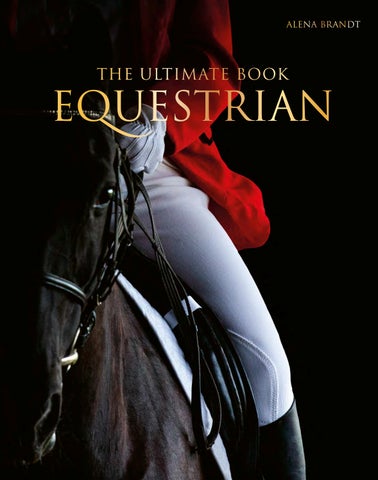
THE ULTIMATE BOOK EQUESTRIAN

Riding creates moments where rider and horse become one

Even in interactions with people, communication occurs beyond words. At times, a rider merely needs to think of a specific exercise, and the horse instinctively responds. In these instances, we truly experience the essence of harmony. Throughout this book, various equestrians share how this profound connection between human and horse can shape an entire riding career.

Horses were first domesticated approximately 5,000 years ago, serving humanity ever since. They have influenced entire cultures, carried mounted warriors into battle, and transported heavy loads. Today, they primarily serve as partners in leisure and sport, as well as mirrors, companions, and teachers. Over the years, a remarkable diversity has emerged in riding styles, disciplines, and horse and pony breeds. Entire professions, crafts, and traditions have developed in response to the horse.

This book invites you to be inspired—to celebrate the beauty of horses, explore their expressiveness, and reflect on the unique connection they share with us humans.

Koniks and others

Wild horses of Europe and the world

Koniks are expressive ponies from Poland, easily recognized by the distinctive black dorsal stripe along their backs. Standing at approximately 53 inches tall, they are compact and resilient. In Poland, Germany, and the Netherlands, Koniks can be found living either wild or semi-wild in family groups. Observations reveal that stallions exhibit remarkable care and attention towards the young.

The myth of the Tarpan

For many years, Koniks were believed to be direct descendants of the Tarpan, which were thought to be the last wild horses of Europe. However, genetic analyses have disproven this notion, suggesting that Tarpans were likely not a distinct wild form but rather feral domesticated horses. Current research focuses on the role of Koniks as effective landscape managers, helping to maintain open grasslands and promote biodiversity.

Rare beauties living freely

On Sable Island in Canada ponies abandoned by settlers have formed their own distinct population. With their flowing manes and complete isolation, they have come to symbolize wild freedom.

In the Namib Desert feral domesticated horses roam near Garub, having survived decades of isolation within the diamond exclusion zone and near an old water borehole. These horses have adapted to the harsh climate of the region.

In Ethiopia, a herd of about 30 wild horses inhabits Kundudo Mountain in the eastern part of the country, recognized as a protected area by the local community.

In southern France, semi-wild Camargue horses thrive in the marshy meadows of the Rhône Delta. These horses, distinguished by their graywhite coats, are also protected, with various projects allowing tourists to observe them in their natural habitat.

Przewalski’s horses are the only true wild horses remaining today. Once driven to extinction in the wild, they have been successfully reintroduced and now live autonomously in regions such as Mongolia, Kazakhstan, Ukraine, and Belarus, often in national parks and the exclusion zone of Chernobyl.

 A wary Konik galloping and showing the characteristic dark dorsal stripe along its back.

 More relaxed than wild: Przewalski’s horses typically have a short upright mane.

What special moments have you experienced with the horses?

I’ve experienced countless special moments with the horses. I’m always moved by the trust they place in me. Even after a three-day journey to a fair, filled with excitement and chaos, they remain mentally connected, following me through the crowd. Each time a foal is born and the mares allow me to assist, it feels like a privilege. Even the more timid horses show a willingness to trust me in their space.

How are the foals raised at the stud?

The environment in which the mares and stallions live significantly influences the foals. I firmly believe that a good upbringing begins before birth, with proper care for the parents. The horses live in herds on expansive pastures, where the mares provide a sense of security for the young. This nurturing environment shapes them for life. The foals often lie down to sleep and can wander a bit further from their mothers, demonstrating the protection they feel within the herd.

And when does a young Lusitano start training?

I separate the foals from their mothers at around eight to ten months but allow them more time in the protected herd, even though it can be a financial strain. After weaning, they begin to learn the basics. I gently introduce them to the halter and teach them to yield to pressure—all done with patience and never through force or stress. I give the foals time to think and process. By the time they reach four years old, they start their training as riding horses. With such thorough preparation, the rest of the training process tends to go smoothly.

 A kiss for the stud Mom. The foals are sociable and curious about humans.
 United in dance: Leonie Bühlmann rides her palomino stallion Flamenco.

Masters of classical equestrianism

Traveling through the centuries

In classical equestrianism, the horse is regarded as a valued partner deserving of respect, with the primary aim of maintaining its physical and mental well-being. This philosophy can be traced back to Xenophon in ancient Greece. In Europe, particularly from the 16th century onward, riding masters further refined the training of both horses and riders, establishing a foundation that remains relevant today.

Salomon de La Broue (1530–1610, France)

Gentle riding aids

"A light touch in the mouth ensures lightness of movement in the whole horse."

De La Broue emphasized the importance of protecting the horse’s mouth, advocating against the forceful pulling of reins and the use of spurs.

16th Century

Antoine de Pluvinel (1555–1620, France)

The horse also teaches the rider

"The horse must be guided by love, not by fear."

As the riding instructor to King Louis XIII of France, de Pluvinel highlighted the profound lessons riders can learn about themselves through their interactions with horses. He was also the first to train horses between two pillars.

 Riders of the Spanish Riding School wear the empire uniform and the bicorne, a historical hat with upturned edges, during a performance.

Western riding, rodeo and working equitation

Skill, speed and competition

Sitting comfortably in the saddle, reins held in one hand, the horse responds to the slightest shifts in weight—this is the essence of Western riding. This working style is deeply rooted in its origins of herding cattle on ranches. It relies on precise signaling, where aids are given and immediately released once the horse responds, conserving energy for both horse and rider. However, when the arena transforms into a rodeo, calmness is replaced by pure adrenaline.

Rodeo: A thrill for cowboys and cowgirls

As the gate opens, the spectacle begins. Dust swirls into the air as the horse bucks, and the cowboy clings tightly to its back. Ultimately, everyone ends up on the ground; the only question is when—and that’s what makes it thrilling. Rodeo riders must hold on for eight seconds to be considered winners, and those who fall quickly roll to the side to avoid being kicked.

Why does the horse buck?

The rodeo embodies the enduring myth of the Wild West, but it is increasingly facing criticism. Animal rights activists argue that horses buck due to pain and excessive stress. Cowboys counter this by explaining that the animals have learned to associate a trained "bucking signal" with the flank strap.

Despite the controversies, rodeo remains a grand spectacle, especially in the USA. Events are infused with a festive atmosphere, complete with music, beer stands, and patriotic flair. For cowboys, preserving their pride is paramount; losing one’s hat is considered the greatest disgrace.

Barrel racing: World champion at 68 years old

In addition to bucking bronco events, barrel racing adds another layer of excitement. This fastpaced competition requires horse and rider to navigate three barrels in a specified order. In a remarkable feat, American rider Mary Burger made history in 2017 by becoming world champion at the age of 68—a truly impressive accomplishment!

Luxurious hotels

Bathing with horses in crystal-clear waters and riding along ancient paths to explore cultural treasures—there are places in the world where horseback riding becomes an unforgettable experience.

Luxurious stud farms, resorts with their own riding schools, and hotels nestled in spectacular natural landscapes invite you to discover unique horse breeds, immerse yourself in new cultures, and traverse extraordinary terrains. Embark on a magical journey on horseback, where you can be inspired by majestic mountain ranges and stunning tropical islands.

 Reiki retreats with horses: Unforgettable moments on the Indonesian Island of Sumba.

Imprint

Equestrian: The Ultimate Book

Text by Alena Brandt

Editorial Coordination by Nadine Weinhold

Project Management and Art Direction by Susanne Maute, mcp concept GmbH

Translation by Claire Jackson

Proofreading by Stephanie Keil

Design and Layout by mcp concept GmbH

Production by Alwine Krebber

Color Separation by Jens Grundei

Printed in the Czech Republic by Finidr

Published by gestalten, Berlin 2025 ISBN 978-3-96171-745-3

1st printing, 2026

The German edition is available under ISBN 978-3-96171-767-5.

© teNeues, an Imprint of Die Gestalten Verlag GmbH & Co. KG, Berlin 2025

All rights reserved. No part of this publication may be reproduced or transmitted in any form or by any means, electronic or mechanical, including photocopy or any storage and retrieval system, without permission in writing from the publisher.

No part of this book may be used or reproduced in any manner for the purpose of training artificial intelligence technologies or systems. This work is reserved from text and data mining (Article 4(3) Directive (EU) 2019/790).

Respect copyrights, encourage creativity!

For more information and to order books, please visit www.teneues.com and www.gestalten.com

Die Gestalten Verlag GmbH & Co. KG

Mariannenstrasse 9–10 10999 Berlin, Germany hello@gestalten.com

Krefeld Office

Uerdinger Str. 265 / Villa Pattberg 47800 Krefeld, Germany verlag@teneues.com

teNeues Press Department press@gestalten.com

Bibliographic information published by the Deutsche Nationalbibliothek. The Deutsche Nationalbibliothek lists this publication in the Deutsche Nationalbibliografie; detailed bibliographic data is available online at www.dnb.de

Turn static files into dynamic content formats.
Create a flipbook