Dayton Eugene Egger

Page 1


CONTENTS

Introduction

Richard Blythe 6

Foreword – Simultaneity & Experience: The Drawings of Gene Egger

Kenneth Frampton 8

Acknowledgments 10

Means of Design Learning

Dayton Eugene Egger 14

Study Abroad: The Educational Legacy at Virginia Tech

Dayton Eugene Egger 16

Travel SkeTcheS — europe 20

Learning to See Steven + Cathi House (House + House Architects) 144

Storytelling, The Lines of Gene Egger

Mitzi Vernon 148

Never a Day Without a Line: Traveling Sketchbooks and Education of Architects

Paul Emmons 152

Field Studies

Mark Blizard 156

Learning by Observing Michael OBrien 162

Travel SkeTcheS — NorTh america 164

Timelessness and Currency: Drawing as an Embodied Signature

Gregory A. Luhan 200

Travel SkeTcheS — europe programS, 1969-2018 208

Afterword – The Pedagogy of the Sketch

Frank H. Weiner 232

Contributors 236

FOREWORD

SimulTaNeiTy & experieNce: The DrawiNgS of geNe egger

The monuments of Europe are being worn out by Kodaks. Anonymous Circa 1950

and that digital technology is now so advanced that one is hard-pressed to get even a thumbnail sketch out of the average student of architecture. The computer, the cell phone, and the internet carry everything before them and with this onslaught perception itself is subtly transformed in ways that we don’t fully understand. Thus, it is possible for students today to dismiss most drawings as anachronistic exercises; however, these interpretations would be fallacious.

The drawings of Dayton Eugene (Gene) Egger represent the simultaneity of experience as a device for creative empowerment – particularly at those moments when the artist sets us before the interstitial labyrinth of the traditional European city which today we are barely able to perceive, let alone represent or maintain. These are travel sketches which continually trace the displacement of the human subject in space. As in the case of Egger’s x-ray renderings of Le Corbusier’s Ronchamp Chapel going so far as to attempt an existential dissolution of its space as this may be experienced in time, both within and without, thereby simulating the trope of a doubly exposed negative which digital photography no longer permits. At times the draughtsman’s acute observation of detail draws our attention away from the displacement of space to focus on incidental detail, such as the syncopated patterning of a piece of tilework. This intentional distraction inescapably evokes the flow of time via a constant allusion to ruination either real or imagined.

Egger’s cut-away perspective provokes the imagination through fictions as if a seismic event that, had it taken place, would have engulfed the artist himself. The shaky ink line, evidently a signature, serves as an aide memoire, through which the author retains the experiential moment of a particularly moving spatial episode. In this regard, Egger’s sketches inextricably depict places as a series of dimensional complexities from vantage

LE THORONET ABBEY - CLOISTER

France, Le Thoronet (Undated)

Pen and Ink Drawing on Fabriano Paper

33.02 cm x 48.26 cm (13 in x 19 in)

France, Nimes (Undated)

Pen and Ink Drawing with Pencil on Fabriano Paper

33.02 cm x 48.26 cm (13 in x 19 in)

MAISON CARRE
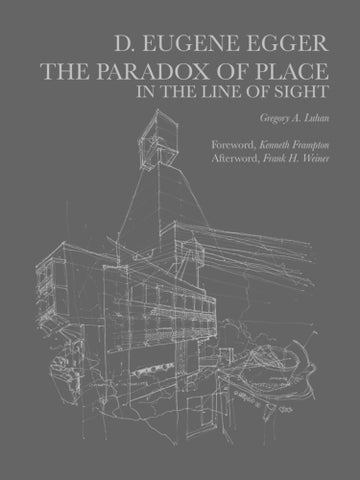
THE PARADOX OF PLACE: IN THE LINE OF SIGHT

FERRY FROM GREECE

Greece, Appia (10 August 1973)

Pen and Ink Drawing on Fabriano Paper 33.02 cm x 48.26 cm (13 in x 19 in)

PASSAGE - 01

Italy, Assisi (17 June 1992)

Pen and Ink Drawing on Fabriano Paper

33.02 cm x 48.26 cm (13 in x 19 in)

THE PARADOX OF PLACE: IN THE LINE OF SIGHT

CHIOSTRO SAN LORENZO - IL CHIOSTRO DEI CANONICI - BIBLIOTECA MEDICEA LAURENZIANA

Italy, Florence (October 1996)

Pen and Ink Drawing on Fabriano Paper

33.02 cm x 48.26 cm (13 in x 19 in)

THE PARADOX OF PLACE: IN THE LINE OF SIGHT

- DUOMO VIEW VIA DEL STUDIO - 01

Italy, Florence (Undated)

Pen and Ink Drawing on Fabriano Paper

33.02 cm x 48.26 cm (13 in x 19 in)

FIRENZA

Italy, San Gimignano

Pen and Ink Drawing with Watercolor Wash on Fabriano Paper

33.02 cm x 48.26 cm (13 in x 19 in)

PIAZZA CISTERNA - SAN GIMIGNANO
(Undated)

THE PARADOX OF PLACE: IN THE LINE OF SIGHT

Pen

33.02 cm x 48.26 cm (13 in x 19 in)

PIAZZA DEL DUOMO
Italy, San Gimignano (Undated)
and Ink Drawing with Watercolor Wash on Fabriano Paper

LEARNING TO SEE

Steven House + Cathi House

throughout his work as an educator, an architect, a traveler, and an artist. His poetic vision of the world is an inspiration to all of us and an extraordinary gift to the students fortunate enough to travel and learn to see with him. It is this “learning to see” that embodies his core belief as an educator. As Gene says, “Traveling with architecture students for many years has heightened my interest in how one might record the personal confrontation with the “place of a place” to include the monument nestled within. Rapidly advancing digital media, notwithstanding, I have embraced the sketchbook as a visual journal to record and strengthen one’s confrontation with vital, visual phenomena, not only the historical precedence of a named place.” Drawing is his vehicle to understanding what it is he is seeing – a way of seeing beyond the obvious to something much more profound – to the essence of a place – and capturing that moment of spontaneous awareness, not only on paper, but also within himself.

Gene sees everything about the world as an opportunity to learn, experience, and feel deeply. He views the world around him through the eyes of an architect. He knows that there is no better way to capture a place than to draw it. As he states, “From ‘points of view,’ hand drawing secures a lasting memory of the place and moments of decisions that structure a scene or an idea. My belief is that a vivid ‘storage of memories,’ a Herman Hertzberger notion, helps our students of architecture to fully appreciate the manageable complexity of transforming matter and ideas into ordered, habitable environments.” His inspiring exhibition takes the viewer on a personal journey throughout the globe and eloquently describes the inspiration and process behind the creation of dozens of his beautiful drawings. Gene Egger has the remarkable ability to delineate, with pen and paper, sketches that are poetic, thoughtful, and captivating. They illustrate a life’s work, recording the environment through a few carefully placed lines on paper.

There are many ways of expression, of documenting the world, of developing and sharing a personal vision. Photography, painting, sketching, writing, dancing – each has its use, tools, limits, and possibilities. However, it is the art of the travel sketch that

Steven House + Cathi House

FIELD STUDIES

iN reTroSpecT, iT may Seem obviouS: all True jourNeyS begiN from The Same porT Indeed, I carry certain places and certain teachers with me – although they often seem indistinct. Appearing as vague recollections or fragmentary images, they still, at a profound level, shape my gestures and thoughts. The design laboratory at Virginia Tech as taught by Professor Egger has remained cogent, retaining its coherence and over time, becoming even more vital in my own practice and teaching. Each semester as I set out once again, I draw from a vast catalog of experiences, images and examples. They remain potent though uncertain and never definitive: as I look closely, passing them back and forth in my mind, I continue to make discoveries. Discussions on architecture or education always seem to return to those early laboratories whose form was structured on the unspoken pedagogy of the sketchbook. The sketchbook became the site of architectural inquiry, a means of gathering images and ideas and a lens to focus and refine thought. I recall Professor Egger, in a lecture several years after those first foundation laboratories, stressing that design was a dialectic practice whose center is the slow observation and inquiry into the presence of a place. The first instrument of practice is observation. For Egger, the chosen media for this encounter are the sketchbook and the pen. As with all instruments, these conjointly take measure of the habitable environment and transform our perception of it. The sketchbook is a mode of probing, of seeing the “horizon of meanings” beyond and beneath the surface appearance of things.1 And in so doing, each sketch also explores the complex nature of our experience. The city is more than an incidental setting for Egger’s practice; it is the central source. In wandering through the streets of an unfamiliar city or returning again to the slowly decaying towns of western Virginia, he discovers fundamental questions about architectural presence, design, and education. Each sketch offers a new perspective and an opportunity to grasp, with a little more lucidity, some rare or fleeting thought. The fabric of artifacts and spaces that form the deep tissue of material culture face him with the accumulated density of a history.2 The city becomes a laboratory and a teacher where we search for worthy questions, where connections are made between unlikely or seemingly

EARLY COMPANY TOWNS OF THE VIRGINIAS - POCAHONTAS APPROACH - 02

United States, Virginia, Pocahontas (1982)

Pen and Ink Drawing on Fabriano Paper

33.02 cm x 48.26 cm (13 in x 19 in)

THE PARADOX OF PLACE: IN THE LINE OF SIGHT

EARLY COMPANY TOWNS OF THE VIRGINIAS - POCAHONTAS APPROACH - 03

United States, Virginia, Pocahontas (1982)

Pen and Ink Drawing on Fabriano Paper

33.02 cm x 48.26 cm (13 in x 19 in)

STUDY ABROAD - EUROPE PROGRAMS - 1969-2018

EUROPE PROGRAMS - 1969-2018 | ASSISI - 01

Europe, Italy, Assisi - Steven House (13 July 1982)

Pen and Ink Drawing with Watercolor Wash on Fabriano Paper

33.02 cm x 48.26 cm (13 in x 19 in)

EUROPE PROGRAMS - 1969-2018 | ASSISI - 02

Europe, Italy, Assisi - Cathi House (14 July 1982)

Pen and Ink Drawing on Fabriano Paper

33.02 cm x 48.26 cm (13 in x 19 in)

THE PARADOX OF PLACE: IN THE LINE OF SIGHT

Turn static files into dynamic content formats.
Create a flipbook
Issuu converts static files into: digital portfolios, online yearbooks, online catalogs, digital photo albums and more. Sign up and create your flipbook.