
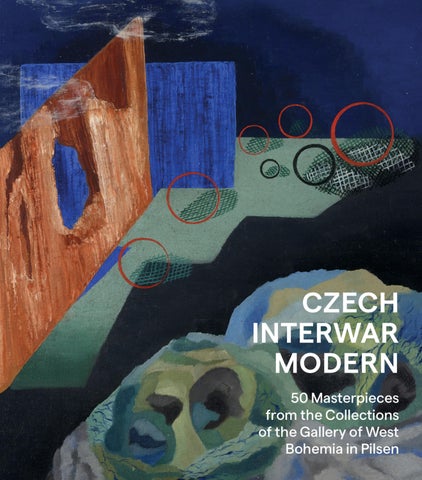
Czech Interwar Modern

Page 1


Václav

(Krušovice 1885–1954 Prague)

Third-Class from Kladno (1923)

Oil on canvas, 99.5 × 79.5 cm

Signed bottom right: RABAS 23

Inv. no. O 0609

Purchased in 1965

Although Václav Rabas is best known as a landscape painter, he created several works addressing social themes during the early 1920s. The striking 1923 painting Third-Class from Kladno stands out among them, as the artist turns to a motif drawn from mundane, everyday life. Set in the austere surroundings of a basic carriage, the painting depicts several male and female figures representing different social classes seated on hard wooden benches. The central figure is a man with a thick moustache wearing a dark coat and hat, who appears to be looking at the viewer; this impression, however, is disrupted by the black round glasses worn by blind people at the time. He is likely a war invalid, while the boy sitting on his lap may be understood as his companion and source of support. The social dimension of Rabas’s painting is also enhanced by its title: the town of Kladno, located west of Prague, was a predominantly working-class region, and third-class train travel evokes the social marginalisation of the poor working classes. This theme was widely popularised by Honoré Daumier in his 1862–1864 work Le Wagon de troisième classe (Third-Class Carriage), which exists in several variations. Daumier’s painting undoubtedly influenced the entire European art scene. Moreover, in the same year that Rabas’s work was created, the French artist held a solo exhibition at the Salon Topič in Prague, although the Third-Class Carriage was not displayed there. Evidence of Daumier’s influence can be observed in the Czech art scene as early as the beginning of the twentieth century, for example, in Bohuslav Kubišta’s 1908 painting Cestující třetí třídou (Third-Class Passengers). Unlike Kubišta, whose relaxed painting in Fauvist colour palette also reveals a conscious nod to Edvard Munch’s works, Rabas’s monumental work draws more inspiration from social civilism and German Neue Sachlichkeit (New Objectivity). This movement was at its peak at the time and appealed to Rabas and his contemporaries (Miloslav Holý, Karel Holan, Pravoslav Kotík and Karel Kotrba), partly because it aligned with their social beliefs. RM

Miloslav Holý

(Prague 1897–1974 Prague)

One-Armed Ice Cream Seller (1923)

Oil on canvas, 97 × 106 cm

Signed bottom right: M. Holý II 23

Inv. no. O 0560

Purchased in 1964

The painter and graphic artist Miloslav Holý painted One-Armed Ice Cream Seller at a time when social themes began to appear in his work, with a focus on the position and fate of the individual in society. This work was created two years before he founded the Sociální skupina Ho–Ho–Ko–Ko (Ho–Ho–Ko–Ko Social Group) with his friends, the painters Karel Holan and Pravoslav Kotík, and the sculptor Karel Kotrba. The group, whose name referred to the initial letters of its members’ surnames, systematically developed the aforementioned tendencies. In the painting, Holý depicts a scene relating to a popular entertainment and leisure activity of the time: a visit to the cinema. This is alluded to by the blue wooden hut bearing the inscription ‘RAF’, the last three letters of the word biograf (the Czech word for a cinema). After watching the film, visitors to the cramped auditoriums liked to refresh themselves with ice cream, especially in the hot summer months. The theme is built upon a harmonious and refined composition. Its frame, emphasised by striking blue, red and green accents, directs the viewer’s gaze to the centre of the scene, where three figures are grouped. The figure of the one-armed ice cream seller brings a social dimension to this otherwise peaceful genre scene, reminding us that war veterans with disabilities were also part of the First Czechoslovak Republic society. They struggled to find their place in everyday life after returning from the front. Miloslav Holý, himself an active participant in the fighting during the First World War, was wounded and recovered in a military hospital in Pardubice, where he met a number of patients with such disabilities. The painting can be interpreted as a commentary on the social reality of the time. Having a job meant maintaining one’s honour, staying connected to society and being an active part of it. This work is one of the earliest examples of a new approach to realistic representation. It also reflects broader artistic trends of the time, particularly German Neue Sachlichkeit (New Objectivity) and civilism. These movements became prominent in Czech visual art during the first half of the 20th century. RM

Turn static files into dynamic content formats.
Create a flipbook
Czech Interwar Modern by ACC Art Books - Issuu