
Connecting with your Essence

Page 1


Mia Leijssen

Connecting with your essence

A Path to Awareness and Healing

www.lannoo.com

Register on our website and we will send you a regular newsletter with information on new books and interesting, exclusive offers.

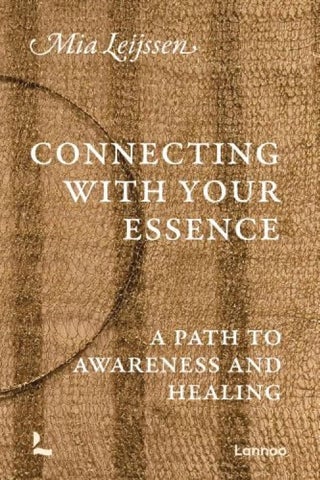
Cover illustration: Bernadette Van de Maele, ONENESS

Design: Studio Lannoo

Translation UK English: Judy Moore

© Lannoo Uitgeverij, Tielt, Belgium en Mia Leijssen, 2025

ISBN 978 90 209 6237 8 — D/2025/45/568 — NUR 770

All rights reserved. No part of this publication may be reproduced or transmitted in any form or by any means, electronic or mechanical, including printing, photocopying, recording, or information storage. Text and data mining of (parts of) this publication is strictly prohibited.

All rights are reserved, including those for text and data mining, AI training and similar technologies.

Introduction 9

Awareness 9

Nature as a mirror of life energy 10

Sense of purpose 11

Wealth of experience 12

Chapter 1.

Finding your Essential Self 15

Process loneliness 15

Focusing 18

Focusing compared to other approaches 22

Awareness of inner felt knowing 24

Language and awareness 25

Life happens 26

Essential self and historical self 28

Your idiosyncratic way 30

Chapter 2.

Awareness of Life Energy 33

Looking through a space telescope 33

Living more consciously through your own becoming 35

Awareness of paradoxes 37

Nature and body in which varieties of life energy become perceptible 38

Chapter 3.

Solid and clearly perceptible 41

Earth 41

Meaning and imagination 44

Water 47

‘What is going on here and now?’ 51

Space for movement 53

Chapter 4.

Beyond gravity 57

Fire 57

Awareness of your fire energy 60

Transforming 63

Paradox old and new 66

Transformation and grief 67

Chapter 5.

Widening perspective 75

Air 75

Inner space 77

Moving to a wider perspective 78

Generating new energy 82

Noticing vibration 85

Play-wise practice 88

Chapter 6.

Actualising Pure Qualities 93

Subtle energy 93

Light and darkness 94

Eyes and ears 97

Love Power 100

The body as a living process 103

Imbalance in pure qualities 105

Archetypes 107

Rituals 109

Guidance on a spiritual path 111

Deeper connection 112

Your own keys 115

Chapter 7.

Interlude: Personal morning ritual 121

Physical needs 121

Altarpiece 122

Chanting 122

Religiously homeless 123

Maria 124

Belonging to something big and unnameable 125

Field of Love 127

Infinitely connected 128

Coda 2025 129

Chapter 8. Beyond the Known 131

The Essential Self speaks 131

Re-minding you of your destiny 135

Karma and energies beyond death 137

Dealing with incomprehensible experiences 140

Subtle legacy 143

Invisible forces 147

Wonder 151

Finally 155

Appendix 1.

Existential trauma 157

Introduction 158

How do people experience an existential trauma? 159

What is an existential trauma and how does it arise? 161

How can mental healthcare professionals identify this type of trauma? 163

How can the healing process begin? 165

Final thoughts 169

Appendix 2.

Existential trauma. Afterthoughts 171

Ingrid’s life lessons 171

Perpetrator-victim 174

Beyond victimhood 176

Awareness of complexity and nuances 178

Attention to vulnerability and strength 179

Appendix 3.

Exercises 183

Exercise 1. Reading in a Focusing manner 183

Exercise 2. Pathways to life energy 185

Exercise 3. Different energetic elements applied to a situation in your life 187

Grateful acknowledgement 189

INTRODUCTION

Awareness

A life curve is often described in terms of physical development on a timeline that starts at birth and ends on the day you die. You start your life as a small helpless being, completely dependent on others. Your body grows and your possibilities of getting a better grip on your existence expand, partly due to your cognitive development. You learn to focus your attention outwards to find your way in your material and social environment. From a physical and social perspective, you reach the peak of your possibilities around the age of 30-40. After that, your physical and cognitive abilities slowly decline. Your earthly life often ends in dependence on others. On that timeline, you can describe your historical self, with many concrete details that reflect what you have and who you are in outwardly observable forms and through the different roles that you take on during your life.

Your development of awareness shows a different curve. At birth you are your pure self. That ability to let your essence shine through in your outer form gradually becomes overshadowed and buried under many layers. You meet the expectations of others; you deny aspects of yourself in order to belong, to be appreciated, to be loved; you follow social patterns and roles so that you can successfully participate in society; you pile up more and more material possessions... About halfway through your life, you may experience a low point in your self-perception, sometimes as a result of an existential crisis, sometimes as a dormant realisation that you are ‘more’ than what you have expressed or made of yourself so far. You

might notice that moment as a wake-up call to your pure essential self. It can be the beginning of an inner quest where you can reconnect with your essence.

Awareness presupposes a development from a superficial and limiting view of yourself and your environment, to a deeper and expanded perspective in your self-experience and existence. It implies that you are able to recognise both the reality of your historical self with all its limitations and the reality of your essential self that is so much more. Uniting those two poles is not easy when you are used to thinking in opposites with their associated judgments of good versus bad. You will then be hard on yourself when, for example, you are sick or have setbacks. While it is precisely then that you can come to the realisation that there is a greater potential available in which the best in yourself and others can come out. The first chapter of this book explains more about how you can get on the track of your essence. The following chapters deepen that process of awareness further and more broadly.

Nature as a mirror of life energy

In terms of demonstrating the organic quality of life, nature offers an immense source of inspiration and this is the focus of chapter two. After all, the human body is nature, created and further built up through a chain of connections and interactions. In this way, everything that shows itself in nature can offer you a mirror in which you can see how the life in you has originally developed and unfolded. A great asset of nature is that you are not saddled with judgements, nature simply shows how life processes happen in all their details. The same perceptible elements – earth, water, fire, air – through which life in nature takes place, are equally necessary for the human body. Regaining awareness of your connec-

tion with those elements and rediscovering the natural movements in those processes within yourself, can provide you with important keys to unlock direction, meaning and purpose in your life again. Chapter three first turns your attention to the most tangible and comprehensible elements of earth and water. In the fourth chapter, the focus shifts to the element of fire, which transcends gravity. In the fifth chapter, the perspective is broadened to the element of air.

The most subtle element that is not perceptible but can be experienced as life energy, is the essence that is most difficult to put into words. Here you enter the transition from ‘knowing’ to ‘not knowing’, from ‘understanding’ to ‘trusting’, from ‘control’ to ‘surrender’. The fascinating search process for how life arises, what drives it, where it leads, has always occupied humankind. Over the centuries, it has generated various stories through which people try to grasp that mystery. It is a great challenge for many people today to relate to various faith traditions and stories in which the incomprehensible formless is cast in comprehensible forms through words, gestures, images, rituals, rules and regulations. Once again, the human tendency to polarise and divide into ‘good’ versus ‘bad’ rears its head when unfamiliar forms are made visible. Chapters six, seven and eight describe subtle experiences that refer to the element ether.

Sense of purpose

Throughout this book, I try to highlight the universal character of the human search for sense and meaning. In doing so, I stay close to those experiences where we encounter the mystery. I do not comment on ‘true’ or ‘false’. In the field of the unknowable, it is an illusion to think that you can use the same criteria in the way

that you find something to hold on to in the field of the observable and demonstrable. In connection with the mystery of life, sense and meaning arise from pure qualities. These are qualities in which the ‘I’ does not set the tone; they are connecting, selftranscending qualities. You can see pure qualities as universal criteria that guide the experience of meaning. In a pure way of being you are sensitive and perceptive to what life serves and how life energy expresses itself in countless forms. Qualities come to the fore such as: wonder, authenticity, creativity, joy, hope, trust, surrender, peace... with love as the most encompassing factor. These are qualities that the newborn embodies and that you wish for everyone at the moment of death. In the bumpy life path that you have to take as a human being, there are many pitfalls, temptations, confrontations with extremely difficult situations... As a result, your life energy is affected and you are in danger of constantly losing touch with your pure qualities.

Larger leaps in awareness are often preceded by crises in your personal life or shock waves in society. The more individuals own their own shadow sides and consciously connect with what supports, nourishes and strengthens life, the more powerful networks can emerge to absorb destructive movements in society. In this book, the emphasis is on your personal development, but it is precisely in this that authentic impetus can be found for fundamental social change.

Wealth of experience

Out of gratitude for the many opportunities that life has offered me, I share experiences throughout this book that have presented themselves to me on my 74-year path. In addition, my work as a therapist has shown me a rich variety of challenges and derail-

ments in the lives of others. I have been allowed to help people find out how they can come to relate in a different way to what has happened to them and what choices they wish to make to find renewed life energy, recovery and healing. It is my hope to share that experiential wisdom with various illustrations taken from real-life examples throughout this book. The names I give to people are never those of the person in question. Moreover, no case is recognizable because, out of respect for everyone’s privacy, I often mix different stories to make a specific process concrete.

From my own wealth of experience, I have included three more appendices in this book. The first appendix describes a courageous search and recovery process after an existential trauma. Because that publication provoked reactions of recognition worldwide and because this form of ‘soul rape’ still takes place on a daily basis, I present the original publication of 2013 unchanged. The article was originally written for professionals to learn to notice the little-known problem of existential trauma. But it also turns out to be an eye-opener for others. In the context of more recent events in 2025, I have added a second appendix. In it, I express some afterthoughts to raise awareness and promote a more nuanced understanding around the theme of ‘victim-perpetrator’ and a more caring approach to vulnerability.

In the third appendix you will find three exercises through which people in my workshops are invited to explore how various themes are present in their lives and how they can discover new sources for their own development. As a reader, you can use these exercises to deepen your own process of becoming. You may choose to start your reading with the first exercise, which guides you in responding to a text in a Focusing manner. This will allow you to experience how a text can offer you much more than just expanding your knowledge.

To conclude this book, my thanks go to several people who are connected to my growth trajectory and awareness process.

CHAPTER 1.

FINDING YOUR ESSENTIAL SELF

Process loneliness

There is a loneliness that does not disappear in the company of others. On the contrary, you can feel even lonelier when you are surrounded by people who are preoccupied with all kinds of things that are of no interest to you. It is alienating to be listened to by someone who is erroneously convinced that they understand you and therefore know what is good for you. Even when you’re surrounded by people who care about you, their way of listening can ignore the complexity of your experience and leave you somewhat confused.

When the person who is with you has too little feeling for how something really lives in you, you are left out in the cold with your inner experience in that moment. I call this experience process loneliness. In this state you feel there is too little space for you to express what is really going on inside you. There is also no space for you to explore how you might begin to articulate what you are experiencing. You do not experience enough openness to put your own searching and wrestling with certain themes on the table in all their nuances, without having to justify or explain anything. You also experience process loneliness when the person you are talking to does not resonate on the same wavelength, although outwardly it seems as if you are talking about the same thing.

Your experience is constantly in process as life moves forward. You can try to capture vivid experiences through a concept or a

category. But it’s very typical of a process that it constantly changes in interaction with the environment. It is difficult to fix an experience as if it were an inanimate thing. A process is set in motion by an event, by something you notice, hear or see, and develops further in a series of interactions. What these interactions lead to can partly be predicted from known elements inherent to the interaction; just as you could predict that a raised voice attracts more attention. But in interactions between living elements, part of the result remains unpredictable because life itself can surprise you again and again; just as your own raised voice may cause concern at one time and irritation at another.

The cyclical movements in which human life develops are observable from conception to death. Interactions that happen before and after are of a different order than what is immediately obvious. How a living organism finds itself and evolves in an earthly environment, involves a continuous interplay of the specificity of that organism and the situation in which that organism finds itself.

Process loneliness is a result of too little recognition and connection with the constantly changing process that is life. The living process within yourself responds to presence. The selfevidently respectful way of being present with yourself is completely natural at the beginning of your earthly life because you still embody your pure self, your essence, your core. Gradually, you will probably become alienated from who you really are as a result of many interactions where you need to adapt to your material and social context.

When you end up in a situation where you feel that agreement is lost between who you might be at the deepest level and where you have ended up now, process loneliness also manifests in relation to yourself. Because then it is no longer right how you are treating yourself, because you are denying yourself and thus leaving your true self out in the cold. Maybe you have even completely

forgotten who you really are. Then you often need, at least to begin with, a helpful and supportive presence in your environment to regain that connection with your essence.

A middle-aged woman participates in a workshop. While I am telling the group something about process loneliness, I see that she is holding back her tears. I ask her if she would like some space to reflect on what is moving inside her. At this she says: ‘That term “process loneliness” touches me, I don’t know why.’ I make an invitation: ‘Feel free to take your time to give attention to your experience for a while, without having to do anything. … If it’s comfortable for you, feel free to close your eyes so that it might be easier to stay with your attention inside.’ … She says: ‘It’s so weird, since I’ve had surgery for colon cancer and have completely recovered, I should feel relieved. Everyone says I look so good now that I have gained weight again. … But I feel lost.’ I acknowledge her experience: ‘It’s not easy to notice that you feel different inside from how others see you. … While you yourself don’t know what is stirring deeper in you since your recovery from colon cancer.’ ... After a short silence, she says: ‘I have also lost something since I was declared cured.’ I confirm that: ‘You are both physically healed and you have also lost something.’ She further discovers: ‘I no longer have permission to take care of myself! I no longer feel free to refuse invitations from others. My time is completely full again. … It’s sad that I have regained my old pattern of taking care of others so quickly. … Or more correctly ... that I only think about myself when I’m sick.’ She sighs deeply and looks at the other participants of the workshop with a smile: ‘You have been warned! Today I am taking my time to stay with myself.’

Focusing

The way in which I am present in that workshop and how I also invite the participants to be present with themselves, is an approach that might be referred to as Focusing.1 The essence of Focusing involves making time to reflect on something that is still unclear and to find it as a vague sensation in your body. That sensation can bring you to a specific theme or a problem that you usually bypass, tend to quickly cover up, or fill the space with what you have known for a long time. By staying present with what you feel in yourself right now, you can gradually uncover a meaning you had no idea about before. A good listener can invite and further facilitate that process more explicitly from holding basic attitudes such as: welcoming what presents itself, offering a safe space in which nothing is mandatory, staying with whatever comes without judgment, acknowledging what comes by highlighting key words, and by also naming the complex nature of experiences in such a way that there does not have to be a contradiction between this and that. What you reflect back as a listener are not observations from your own frame of reference, but repetitions of certain words that encourage the person to explore what is coming to them even further. Moments of silence are needed for them to get to something new that was not entirely clear before, or that is on an even deeper layer. When a process comes to a point where there really is a new movement, you notice that

1 Eugene Gendlin (1926-2017) discovered this valuable form of listening by researching what happens in psychotherapy when clients make good progress. See: www.focusing.org Gendlin, E T. (1981). Focusing (Rev. ed.). New York: Bantam Books.

something shifts physically, as evidenced by a small or larger sigh and more relaxation.

When it is no longer possible to use your natural capacity to listen within yourself, it helps for someone to guide you in this process. And, without doubt, the presence of a good listener strengthens your capacity to listen to yourself.

However, it is unusual to find yourself in the company of someone who is willing to be with you with an open and receptive attitude, who connects with what is really going on inside you and takes the time to allow themselves to resonate with what you are expressing through words, silence, gestures and bodily expression. Someone who also has the skill to patiently articulate their sense of how that living process is moving in you, offering you a safe space, support and encouragement. So it is not surprising that you often end up in process loneliness. For the unfolding of an inner process, it needs to be welcomed both by yourself and by the person you are with. The process must not be nipped in the bud with judgments about what would or would not be okay, trampled on with all kinds of misgivings, summed up in familiar conceptual frameworks, interrupted with well-intentioned advice…

When you take the time to listen to your inner process, you will be surprised by the freshness of the emerging life. Even when you are confronted with difficult and problematic experiences, you can learn to trust that it is helpful to stay present with openness to what may come. In fact, often a subtle transformation shows itself in your process; your loneliness dissolves thanks to your awareness of a supporting presence within you, maybe the good company of someone you are with, and your experience of a wider transpersonal field.

The basic attitudes that take shape in Focusing can be seen as universal keys to awareness.

Turn static files into dynamic content formats.
Create a flipbook