Portuguese 18th-century chrysolite (chrysoberyl) cluster ring in a gold beaded border, c.1775. Note the way that the individual stones have been cut and-shaped to create a perfect marquetry pattern, a feature of fine 18thcentury Portuguese chrysolite jewellery.
stone The finest stones are either honey green or olive green and originated in Ceylon (Sri Lanka) and India They were thought to ward off the evil eye and were thus highly prized� Chrysoberyl cat’s-eyes should not be confused with quartz cat’s-eyes which are coarser and far cheaper
CITRINE
Chrysoberyl cat’s-eye and diamond cluster ring, c.1900.
CHRYSOBERYL FAMILY
Chrysoberyl is a confusing gem since it comprises a family of three totally different stones of disassociated appearance and value – alexandrite (see page 18), chrysoberyl and chrysoberyl cat’s-eye
Chrysoberyl
Although large pale yellowish green gems were used occasionally in mid-19th-century gold pendants and brooches, smaller clusters of the stone were more commonly used in 18th- and early 19th-century English and Continental jewellery where it was known as chrysolite In Spain and Portugal, pavé-set clusters of chrysolites were fashioned as large navette-shaped dress rings or incredibly long bow and drop earrings whilst the gem enjoyed something of a revival in the 1870s, when it was set in colourful Neo-Renaissance enamel and cabochon garnet necklaces and pendants inspired by the paintings of Hans Holbein�
Chrysoberyl Cat’s-Eye
Historically known as cymophane, chrysoberyl cat’s-eyes are always polished en cabochon to exhibit their singular optical effect known as chatoyancy – a sharp band of light running from the top to the bottom of the centre of the
A variety of crystalline quartz ranging in colour from the palest lemon through orange and brown, citrine has been used extensively in 19th- and 20th-century jewellery and ornamentation due to its abundance and modest value� The stone is often confused with topaz, but citrine lacks the brilliance of topaz and, when examined under a magnifying lens, often exhibits varying patches of colour Citrine was widely used in gold and silver necklaces and bracelets and was so popular in Victorian Scottish jewellery that it was known as ‘Cairngorm’ Early Victorian desk seals were sometimes made with faceted citrine handles which are desirable today; however, care should be taken to ensure that what is thought to be citrine is not actually paste Like amethyst, citrine was popular in the 1940s and 1950s when large, rectangular stones in contrasting shades of yellow, gold and brown were set into architectural mounts
Early 19th-century citrine and gold cannetille work girandolestyle brooch, c.1825.
Art Deco tawny-brown citrine and diamond ring attributed to Cartier, c.1935.
Smoky Quartz
A common dark brown transparent quartz principally used in Scottish jewellery and cheaper late 19th-century necklaces, brooches and bracelets where it was usually mounted in silver Smoky quartz was also fashionable for accessories such as desk seal handles, vinaigrettes and snuff boxes�
GARNET
Once upon a time garnet jewellery was abundant and modestly priced, but prices for good antique pieces have resulted in a rapid and justifiable reassessment of their status
Garnet is found in several colours although red is by far the most common There are two distinct red varieties found in antique jewellery:
Pyrope Garnet
Blood red garnet used extensively in the 18th and 19th century Georgian pyrope garnets were invariably flat cut and oval in shape, set in gold and frequently foiled to improve their appearance Common Georgian designs included cushion-shaped brooches with half pearl decoration and hair locket centres, flower spray brooches, graduated collet rivières and necklaces of foliate design sometimes suspending a Maltese cross pendant convertible to a brooch�
Nineteenth-century pyrope garnets were used abundantly during the ‘Grand’ period of mid-Victorian opulence and were ideal gems for the extravagant effect � A popular fashion involved cutting garnets en cabochon and hollowing out the backs to ‘lighten’ the look of
Impressive Victorian pyrope garnet cabochon and gold parure comprising necklace, earrings and brooch, c.1845.
Pair of drop-shaped Oriental pearl, platinum and diamond earrings, c.1910. This pair of earrings was sold at auction in 2012 by Woolley and Wallis at the very peak of the market for natural pearls. Perfectly matched and possessing excellent provenance they soared above their pre-sale estimate to fetch an extraordinary £1.6m.
(iii) Bouton pearls. Pearls with rounded tops and flat bases used in 19th- and 20th-century decorative diamond and gem-set jewellery
(iv) Seed pearls. Very small pearls used in Victorian jewellery where the individual pearls were woven on to mother-of-pearl backplates in decorative floral clusters Edwardian sautoirs consisted of several strands of seed pearls woven into ropes with tassel finials� Woven seed pearl jewellery is prone to deterioration and damage which reduces its value significantly� (v) Freshwater pearls. Sometimes called Mussel pearls, freshwater pearls are found in rivers and inland waters Predominantly white, freshwater pearls tend towards a dull lustre� Scottish freshwater pearls were used from the Middle Ages
(vi) Mother-of-pearl. The iridescent shell of the mollusc which was cut and shaped into ‘backing plates’ for seed pearl clusters and Victorian lockets and portrait brooches In the 1920s mother-of-pearl was popular in gentlemen’s accessories such as cufflinks
(vii) Pink Pearls. This category of natural pearl is extracted from a mollusc called the Great Conch Pink pearls exhibit characteristic flame-like markings on their surface
Often confused with coral, pink pearls were popular in Belle Époque diamond jewellery whilst drop-shaped specimens were mounted as tiepins Pink pearls are rare and can achieve high prices at auction, although irregular discoloured patches will reduce their value�
Cultured Pearls
Pearls created artificially by inserting a small bead of glass or mother-of-pearl into the mollusc and farming the resulting product on a commercial scale The introduction of cultured pearls in the 1920s all but destroyed the market for natural pearls� Necklaces of cultured pearls up to 9mm (3/8in�) in diameter were extremely fashionable up to the 1960s, but their appeal has declined quite markedly so today it is only the ‘new’ cultured pearls from the South Seas and Australia which are commercially exploited� These pearls are farmed in sizes of 20mm (3/4in�) or more and occur in many different colours, shapes and quality Mabé pearls. Cultured pearls often of quite large size composed of a ‘skin’ of cultured pearl over a bead nucleus with mother-of-pearl ‘jacket ’ Used in contemporary Continental jewellery and mounted into rings and earclips
Seed pearl parure of fruiting vine construction, c.1840. Fragile and exceptionally delicate, seed pearl jewellery is highly susceptible to damage when worn.
Pair of white-gold earclips mounted with white and black cultured pearls in diamond surrounds, c.1970.
Pink conch pearl, black and white natural pearl and diamond ‘Ace of Clubs’, c.1885.
Faux pearl and rose diamond earrings, c.1795. Composed of hollow glass beads coated with varnish and ground fish scales, such false pearls are fragile and rarely found today.
Artificial Pearls
An important category of imitation gem, artificial pearls have been used in jewellery set with diamonds and costume jewellery since the Renaissance Early imitation pearls consisted of hollow opalescent glass beads which were sprayed with essence d’orient, a solution composed primarily of fish scales These ‘pearls’ were fragile and had the same composition as Christmas tree baubles� It is likely that many of the so-called pearl necklaces in early paintings were actually imitation Most modern artificial pearls are simply sprayed glass beads Coq de perle. Large sections of mother-of-pearl and nautilus shell backed with cement and often set in frames of marcasite Coq de perle or ‘eggshell pearls’ were fashionable in early 19th-century necklaces and earrings
AMBER
Amber is fossilised resin which oozed from certain types of coniferous trees flourishing millions of years ago Occasionally, the sticky sap would trap a tiny insect or leaf particle in its slow descent so producing the rare material much sought and frequently faked today
Pair of 18th-century ‘Coque de Perle’ girandole earrings, c.1760. ‘Coque de Perle’ was an effective imitation of natural pearl. It was composed of a curved mother-of-pearl veneer filled with a composite material to provide stability and backed with a further flat section of mother-of-pearl.
Probably the best known variety of amber used in antique jewellery is Baltic found near Königsberg (Kaliningrad), East Prussia and on the Lithuanian coastline Typically cloudy yellow or opaque honey yellow, Baltic amber is polished into graduated beads, cut into naturalistic brooches or fulfils many practical uses including the handles of cutlery, the stems of pipes or the shafts of parasols Scandinavian silversmiths such as Georg Jensen found the understated colours of Baltic amber to be ideal in silver jewellery and much of the amber sold today is heavily influenced by earlier Arts and Crafts naturalistic forms Other varieties of amber include:
Chinese – usually imported from Burma, colours range from pale yellow to rich red Examples include bead necklaces cut into complicated patterns and scent bottles of 18th-century origin with jade stoppers� Sicilian – deep brown or reddish with a distinctive bluish fluorescence
Rumanian – often imperfect or cracked, this amber is deep brown or even black in colour
Early 19th-century diamond necklace dismantling into a set of three bracelets composed of oval openwork diamond sections with single cushion-shaped diamond connections, c.1825.
Further reading
Medieval Jewellery, Marian Campbell (V&A Publications, 2009)
A History of Jewellery 1100-1970, Joan Evans (Faber & Faber, 1970)
London’s Lost Jewels: The Cheapside Hoard, Hazel Forsyth (Philip Wilson Publishers, 2013)
Renaissance Jewellery, Yvonne Hackenbroch (Sotheby Park Bernet, 1979)
Jewelry from Antiquity to the Present, Clare Phillips (Thames &
Hudson, 1996)
Jewels and Jewellery, Clare Phillips (Victoria and Albert Museum, 2000)
Jewellery in Britain 1066-1837, Diana Scarisbrick (Michael Russell Publishing Ltd, 1994)
Tudor and Jacobean Jewellery, Diana Scarisbrick (Tate Publishing, 1995)
Chapter 3 A 19th-Century Jewellery Panorama
Anera which stretched from Napoleonic neoclassicism to late Victorian mechanisation and which encountered a breathtaking number of twists and turns along the way can be a little difficult to categorise. Nevertheless, it is possible to break the 19th century down into four distinct phases which broadly embrace the spectrum of jewellery design in a century of creative and restless change.
1800-1837 –
Georgian Jewellery, William IV and the Napoleonic Legacy
There is a tendency today to pigeonhole as ‘Regency’ any item of English jewellery which vaguely appears to have been made during the first three decades of the 19th century. The fact is that three kings reigned during this period and jewellery design constantly evolved, particularly during the fifteen years leading up to Victoria’s accession in 1837.
The years 1800 to 1810 are closely associated with neo-classicism, a style actively encouraged by Napoleon whose influence was all-consuming in the world of fashion and fine art during this time. Not that much jewellery had actually been made during the turbulent years of the French Revolution; diamond tiaras and necklaces were seen as unacceptably bourgeois and contradicted every revolutionary principle. Sadly, much of the jewellery
owned by the aristocracy at the end of the 18th century was simply broken up and sold.
Napoleon’s campaigns in Egypt and Italy inspired jewellery which was clearly influenced by the art and treasure of the Ancients. By the early 1800s elaborate gold tiaras, armbands and clasps were set with imposing hardstone or shell cameos, carved to depict mythological deities and classical groups. Sometimes these materials –particularly the intaglios – were genuine, excavated ancient artefacts. To reinforce the classical ideal, settings were fashioned in gold in the design of laurel wreaths, palmettes and Greek keys. Another popular ‘classical’ medium was the mosaic in which tiny pieces of coloured glass were carefully grouped together to form a picture such as a landscape or architectural ruin. These mosaic plaques were then mounted in thin gold frames and fashioned as necklaces and bracelets with fine-link gold chain ‘swags’ in between.
Naturalism – flowers, sprays, leaves and wreaths –dominated Georgian diamond jewellery with heavy closedback silver settings gradually giving way to lighter open-back mounts in gold by the 1830s. Indeed, gold suddenly became the focal point of jewellery design with the appearance of the cannetille frame – elaborate gold wire decoration similar to filigree work. Cannetille was the perfect accompaniment for foil-back pastel colour gemstones such as aquamarine, pink
Gold bracelet composed of four rows of quatrefoilshaped sections on a sapphire, diamond and gold cannetille work clasp, c.1825.
Georgian long gold muff chain composed of multiple spiralled embossed links on threecolour gold barrel clasp with floral highlights, c.1825.
Georgian Oriental pearl bunch of grapes brooch with coloured gold finely textured vine leaves and entwined tendrils, c.1825.
extremely simple or highly elaborate. Some luckenbooths contained a monogram of two entwined hearts shaped like the letter ‘M’ which were known as Queen Mary brooches.
Queen Victoria’s tremendous affection for Scotland
is well known. In 1848 she purchased Balmoral Castle and in those happier days before the untimely death of Prince Albert in 1861 the Royal children customarily wore tartan dress, whilst at the Great Exhibition Ball of 1851 all the guests were expected to wear Scottish dress
Scottish group including a fine silver plaid brooch at bottom left mounted with foil-back amethyst and ‘Cairngorm’ citrine. Note the discoloration caused by water damage.
adorned with jewelled accessories such as brooches, dirks and buckles. This highly romanticised idealism was further reinforced by Sir Walter Scott who wrote passionately about the sweeping grandeur of the hills and valleys, so articulating an emotional fascination with Scotland which, even today, has barely diminished.
By the 1850s Scotland’s soaring popularity resulted in large numbers of people visiting the country, all clamouring for a souvenir of their holiday. A pretty hardstone brooch, curio or accessory served this purpose
Scottish jewellery in gold and silver mounts. Condition is a critical issue since missing hardstones are extremely difficult and costly to replace. Novelties such as keys and axes or accessories such as the vinaigrette at lower right are rare and desirable today.
Opposite page: Elegant gold necklace by C. & A. Giuliano composed of six rows of natural pearls with diamond-set black and white enamelled arabesque panel sections extending to scrolling enamelled openwork finials and suspending a matching diamondset enamelled pendant with pearl drop, c.1895. The Giuliano workshop specialised in this kind of intricate gold work featuring monochrome enamelling, often set with subtle understated coloured gems such as zircon and chrysoberyl.
Carlo Giuliano at his most accomplished. A set of gold necklace and earrings mounted with pyrope garnet and green enamel flowerheads with pearl and enamel fringe drops in between. Registered in November 1867.
Arts and Crafts silver and part silver-gilt pendant of medieval inspiration by Omar Ramsden (1873-1939) designed as a female minstrel kneeling on a musical score and playing a stringed instrument against a naturalistic backdrop. Engraved on the reverse ‘I was wrought by Command of John de Seyfried for Alma his Wife A.D. MMXXVIII’.
Arts and Crafts silver and polychrome enamelled tabernacle pendant by Omar Ramsden (1873-1939), c.1905, the pendant with double door front opening to reveal a polychrome enamelled image of three kneeling saints; the frame set with peridots, mounted on a fancy link silver chain
Arts and Crafts silver and translucent blue enamel flower brooch attributed to Charles Robert Ashbee (1863-1942),
with turquoise
centre and three matching drops suspended below.
Undoubtedly, the most celebrated and influential coalescence of artists and artisans was the Guild of Handicraft, established in 1888 by Charles Robert Ashbee (1863-1942). Idealist, teacher and mentor to scores of artisans and designers, Ashbee never compromised his artistic principles – a factor which ultimately led to a serious falling out with ‘commercial’ entities, most notably Liberty & Co. Initially situated in London’s East End, the Guild subsequently located in 1902 to Chipping Campden in Gloucestershire – a move which ultimately led to its decline and closure in 1908. As popular and appreciated as Arts and Crafts jewellery may be today, it also needs to be seen in the context of the time when much of the output was seen to be crude, primitive and artistically naïve.
Several designers certainly enjoyed a measure of success in their own lifetimes. Henry Wilson (1864-1934) trained as an architect before setting up a workshop in Kent. Inspired by medieval, Renaissance and Church symbolism, he produced important gold and silver jewellery
and objects incorporating hardstones and gems decorated with powerful polychrome enamelling. Wilson employed a team of young assistants who were encouraged to learn the essential techniques of metalwork, enamelling, engraving and the setting of stones.
John Paul Cooper (1869-1933) and Henry George Murphy (1884-1939) eventually progressed to launch their own businesses in which the influence of their apprenticeship served under Wilson was clearly apparent. Both men designed highly proficient gold and silver jewellery set with colourful gems such as star ruby, sapphire and moonstone. Murphy in particular specialised in champlevé enamelling in settings which extended effortlessly in their range from the Gothic to the Renaissance and even the Orient.
Phoebe Traquair (1852-1936) was an Edinburgh artist who specialised in iridescent enamels embellished with highlights of gold in naturalistic gold frames which were sometimes suspended below iridescent ‘gemstones’
c.1905,
cabochon
Chapter 17
Fabergé, Tiffany, Cartier and Their Contemporaries
Why Buy Signed Jewellery?
There is absolutely no doubt that a signature on a piece of well-made jewellery will enhance its value. In the case of some half a dozen celebrated international houses, this added premium can be quite considerable.
Manufacturers of luxury goods in general have always traded on the caché of their name and reputation. In some disciplines the difference in quality between the established product and its unattributed imitator can be purely negligible, demonstrating over and over again that a ‘good name’ conveys reassurance, style, social acceptability and old-fashioned snob appeal.
In the 19th century revivalist goldsmiths such as Castellani, Giuliano and Brogden routinely signed their jewellery with a house monogram. By the early 20th century Parisian jewellers such as Cartier, Boucheron and Chaumet not only signed their creations but engraved a unique serial number on the mount to prove authenticity and provide a ‘library record’ of the item’s existence. Unfor tunately, in a world fixated by good provenance, the evidence of a signature has given rise to the continuing and growing problem of fakes in which the addition of a spurious name can dramatically increase value. The problem is most deep rooted and widespread in the field of Fabergé where the sheer number of fakes on the market, occasionally proficient and frequently dreadful,
has resulted in an ironic term being coined in the Fine Art lexicon – Fauxbergé.
So, why buy a clip by Cartier or bangle by Bulgari?
The answer, quite simply, is reliability and superior craftsmanship. Raw materials such as diamonds, precious stones and their accompanying settings are carefully selected for their quality and consistency. Designs are bold, imaginative, exciting, thoroughly wearable and – a key asset in the world of jewellery – invariably timeless. Signed jewellery tends to be that much more expensive but the long-term commercial benefits may be considerable.
Peter Carl Fabergé
The life of this extraordinary goldsmith is well documented. Born on 30 May 1846, he attended business school in Dresden and subsequently visited Paris where he was heavily influenced by the abundance of neo-classical art
Opposite page: A fine and rare graduated two-row natural pearl necklace by Boucheron, ranging in size from 8.0mm to 2.6mm on an old-mine marquiseshaped diamond and platinum clasp, c.1910. Centre: Fine Cartier Burmese ruby ring, c.1905, the oval-shaped ruby weighing 3.30 carats on a platinum hoop with five diamonds set on each shoulder.
Fabergé two-colour gold cigarette case, c.1910, of rectangular oval section decorated with translucent yellow enamel on a wavy guilloché ground and set to the centre with an oval moss agate plaque set in a border of seed pearls;
sapphire thumb push. Workmaster: Henrik Wigström.
to Russia such as Siberian jade, rhodonite and lapis lazuli. Even the wood used in photograph frames and jewellery boxes was of Russian origin – palisander, Karelian birch and pale brown hollywood.
At the time of preparing this book the conflict between Russia and Ukraine has resulted in a range of sanctions being placed upon many foreign buyers of Russian Works of Art. This has inevitably resulted in a visible decline in Fabergé being consigned to international auction, the usual source of fresh material appearing on the market.
Needless to say, the uncertainty created by war and sanctions mean that prices of Fabergé have become far more subjective and difficult to predict with any degree of confidence. Nevertheless, it is still possible to buy modest
brooches, small items of jewellery such as tiepins, cufflinks and miniature egg pendants in the salerooms, although condition is a crucial factor. Fakes can be difficult to spot, however. As a general guideline, look out for garish enamel colours which contain bubbles when examined under a lens, crude settings to gems, poor-quality goldwork and – a useful indicator for copies – makers’ marks and assay stamps which are too obvious, too ‘crisp’ and too plentiful.
Tiffany and Jewellery in America
Extraordinarily versatile and original, Tiffany & Co. is rightly regarded as the leading pioneer of American jewellery and decorative arts since the 19th century. The firm was established by Charles Lewis Tiffany (1812-1902) in New York, initially specialising in giftware and stationery.
Fabergé translucent lilac guilloché enamel, gold and diamond-set photograph frame. Fabergé frames often appear in interesting geometric shapes such as diamonds and six-pointed stars; the back covers are invariably cut from a sheet of ivory. Workmaster Michael Perchin, St Petersburg 1890-1895.
A group of Fabergé hardstone, enamel and jewelled egg pendants. Still fairly common today, miniature eggs offer collectors an accessible method of buying Russian jewellery at reasonable prices.
The stock was gradually expanded to include jewellery imported from Paris. The success of this operation led the firm to start designing and making its own distinctive jewels which, by the early 1900s, embraced a number of contrasting themes from traditional diamond and precious stone pieces in the fashionable ‘Garland’ style to bold and vibrant Art Nouveau floral studies and colourful enamelled symbolist jewellery mounted with unusual gemstones such as harlequin opal, fire opal and Montana sapphire.
On the death of C.L. Tiffany in 1902 the business was taken over by his son, Louis Comfort Tiffany (18481933), who developed many aspects of the decorative arts for which the company is celebrated today, most notably studio lamps, ‘favrile’ glass, ceramics, silver and metalware. In the 1950s several young and innovative craftsmen were commissioned to design their own jewellery for the company of which the most prominent was Jean Schlumberger, a Frenchman who introduced a range of chunky, enamelled gold bangles, earclips and rings
exhibiting the famous Tiffany ‘kiss’ motif. This concept of independent artists developing their own range of ideas has continued right up to the present day with attractive and wearable jewellery designed by Paloma Picasso and Elsa Peretti now sold in Tiffany shops all over the world.
Tiffany is one of a group of prominent jewellers active in America from the early 1900s. Several of these long established firms, such as Oscar Heyman and Seaman Schepps of New York, are flourishing today. Each developed their own distinctive house style with the added ingredient of American flair and originality. Black, Starr & Frost produced elegant diamond jewellery in the European taste as far back as the 1850s, while another firm, J.E. Caldwell of Philadelphia, designed particularly pretty ‘Belle Époque’ platinum and gem-set pieces prized for their technical virtuosity.
The New York firm Marcus & Co. is closely associated with Art Nouveau enamel gold work. Unlike its European contemporaries, however, it chose to use plique-à-
Tiffany & Co. diamond chrysanthemum brooch with a cluster of Mississippi pearl petals, c.1910.
Cartier French gold collar of woven meshwork with crossover ribbon front and brilliant-cut diamond accents. Bearing later import hallmarks for London, 1961. A good example of the sort of highly wearable design in which Cartier excelled, ideal for the neckline of dresses and knitwear fashionable in the early 1960s.
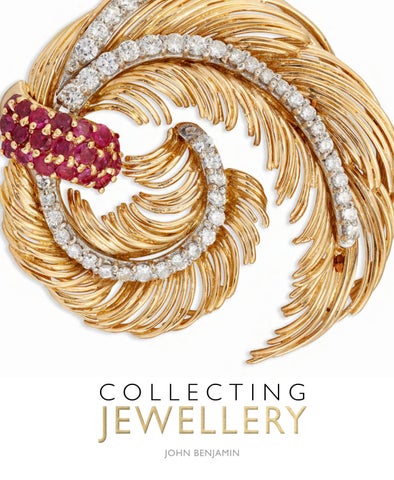
Kutchinsky gold, ruby and diamond coiled wirework feather brooch and matching earrings, London 1963. Kutchinsky excelled in this kind of delicate naturalistic jewellery in the 1960s. Rubies and diamonds were always a popular choice as well as other interesting colour gem combinations such as rubies or sapphires blended with clusters of turquoises.
reverberated in just about every aspect of fashion, music, art and architecture.
These days, the craftsmen active in Britain in the early to mid 1960s are rightly seen as pioneers of the post-war revolution in jewellery construction and design, and their work is highly sought by dealers and collectors. One of the most celebrated today is Andrew Grima, who, from his unique slate-fronted premises in Jermyn Street off Piccadilly, sold a remarkably bold and dynamic range of sculptural gold jewels mounted with colourful semiprecious stones, baroque-shaped pearls and rough gem
crystals. Using relatively inexpensive uncut and unpolished gems became a signature feature of several award-winning jewellers at this time. John Donald, for example, set large, eye-catching crystal and mineral specimens such as iron pyrites, rose quartz and idocrase in architectural and abstract gold frames while Charles de Temple, something of a maverick craftsman, specialised in ‘wrapping’ cultured pearls in chunky organic-looking gold mounts. All these designers shared one common feature: they were prepared to break the boundaries of what was considered ‘traditional’, creating daring and innovative jewels which, just
1960s 9-carat gold charm bracelet. It is difficult to overestimate just how popular charm bracelets were in the 1960s. Decidedly sentimental, jewellers caught on to the idea that new charms could be added to coincide with birthdays or, for example, a memorable holiday. Today they rarely sell for more than their value in gold.
Collecting Jewellery is the new, updated edition of former expert John Benjamin’s best-selling guide to collecting jewellery, from the medieval period right up to the Millennium.
This highly illustrated and accessible book includes a ‘Jewellery Compendium’ offering expert advice on quality, fakes and forgeries, and how to look after jewellery.
From natural to cultured diamonds, unique one-off pieces to popular prevailing fashions, Collecting Jewellery provides fundamental information to enable both the novice and the experienced collector, the student and the enthusiast to recognise and identify jewels, gemstones and designs through the centuries, while gaining the knowledge needed to create their own dynamic (and affordable) jewellery collection.