


The story of the Cobra art movement is a classic one: in an unguarded moment, a new generation of painters, poets and dramatists succeeded in drawing attention to their work. They gained a degree of approval, a certain number of admirers and had little choice but to support each other. At first, they were reviled by art critics and the public: ‘Is this art? How dare they call that art? It’s primitive. Like the drawings of a child or a lunatic. And they’re all Communists, you know!’
The movement’s theorists, Constant Nieuwenhuys, Christian Dotremont and Asger Jorn, were indeed influenced by the ideas of Karl Marx. Before the emergence of Cobra, the so-called Internationale van experimentele kunstenaars [International for Experimental Artists], Europe and its art lay in ruins. Each of the artists who raised the Cobra banner in the turbulent postwar years responded fiercely and viscerally to this desperate situation. Carl Jung said that an artist’s ‘handwriting’ was the most direct expression of the human psyche – one that reveals their unconscious stirrings. Many Cobra members were indeed devotees of Jung, yet most of all they loathed a Western culture founded on Reason. While they had all come through the Second World War, they had been deeply scarred by it and were under no illusions about what human beings were capable of. Art was straitjacketed by outdated rules and conventions. The artists were each looking, in their own way, for a new, untainted and indelible handwriting. The critics were right: Cobra paintings really were primitive – annoyingly childish, even. Was this deliberate? The very colours they used seemed second rate. And to make matters worse, they smeared their garish primary tones almost formlessly over the canvas. Many exhibition-goers were shocked, just as they no doubt would have been by the Action Painting that was emerging in America at roughly the same time as a mode of expression by the likes of Jackson Pollock.
The cross-border aspect of the Cobra movement was also largely unique for the time: Copenhagen, Brussels, Amsterdam = CoBrA. Freakish though their alliance might have seemed, in reality the bond between the artists was remarkably faithful to a time-honoured tradition, forged chiefly in Paris. The seven-headed movement also recalled the naga, the legendary part-human, part-snake often found accompanying and protecting the Buddha.
The fact that the artists did not wish to work aesthetically was a secondary consideration, while their lack of specialisation was in their nature: some were poets who painted, others were painters who wrote poetry. They also took photographs and sculpted, and used junk to create all kinds of assemblages. Some even painted the occasional mural together. As Lucebert put it in one of his poems:
In this time, what was always called beauty has scorched beauty’s face
5
PREFACE THE ART OF INTUITION
KARINE HUTS-VAN DEN HEUVEL
11 COBRA: INVITATION TO A DÉGUSTATION
PAUL HUVENNE
19
COBRA: NEVER WENT AWAY
PAUL HUVENNE
37
COBRA: THE NAME
PAUL HUVENNE
67
THE COBRA’S FANGS: THE COBRA NETWORK IN PRINT, 1945–55
JOHAN PAS
85
COBRA: A HOSPITABLE NETWORK
PAUL HUVENNE
115
RESTLESS MATTER
HILDE DE BRUIJN
135 COBRA: THE BIRD MOTIF
PAUL HUVENNE
157
GOOD MORNING COCK
LAURA STAMPS

Cobra is a resonant name. Dotremont came up with it the day after Jorn, Appel, Corneille, Constant, Noiret and himself had joined forces as experimental artists on 8 November 1948 at a Paris café. The six rejected the sterile theorising of the Surrealists at a conference they had just attended with great expectations. In retrospect, the name was little more than an impulsive, spontaneous idea, an acronym for ‘COpenhagen’, ‘BRussels’ and ‘Amsterdam’ referring to the nationalities of the signatories. A reminder too that Paris no longer held a monopoly on the avant-garde. The group now had a name, moreover, that captured the movement’s linguistic mentality: an intuitive, absurd play on letters, sounds and words that immediately evokes an image.
Cobra quickly proved to be an excellent brand. It was adopted as the title of the group’s magazine, for which the Cobra pictogram lent itself to all sorts of exciting variations that alluded to their shared projects.
The image of an actual cobra also gradually emerged as an icon from under the shadow of the resonant name. The snake swiftly took shape in a joint lithograph by Asger Jorn, Carl-Henning Pedersen and Egill Jacobsen for the cover of the first issue of Cobra magazine, and it was on the title page of the fourth issue that the motif first squirmed its way into the lettering of the word ‘Cobra’. This was clearly Dotremont’s work. Three little snakes form the ‘Co’, the ‘B’ and the ‘rA’, with the final element pinching the ‘r’ from the ‘B’ (for ‘Brussels’) to achieve a more balanced form. The typography was further adjusted in the title of issue number 6, where the snake now coils through the entire word.
For the cover of issue 6 (April 1950), Leo Van Roy came up with a cobra in the form of a tattoo on the back of a knife-throwing girl. This marked the completion of the magazine’s first annual run, to which the reader’s attention was expressly drawn on the back cover: ‘FIN DE L’AN UN DE COBRA’. The cover of Issue 7 features a semi-abstract
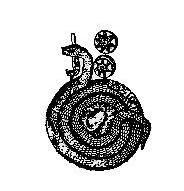
cobra’s head executed by Raoul Ubac in a slate relief. To find the familiar Cobra icon that became the group’s lasting emblem, however, we need to turn to page 10 of that same issue: a coiled cobra, neck outstretched, with prey in its mouth and accompanied by two little stars. The reptile pops up there completely unannounced, in between a few small articles on the archetypal significance of the spiral form in tribal art. The image is implicitly associated with other ancient spiral forms, but with no further explanation. Readers at the time are likely to have understood the nod to the Danish art movement Spiralen, which had been subsumed into Cobra. Jorn borrowed the icon from a book on Babylonian cosmology by Robert Eisler (The Royal Art of Astrology, London, 1946). It subsequently assumed a life of its own as a logo on all manner of publications, invitations, posters and leaflets. It also formed the full-page illustration on the back cover of the magazine’s tenth issue, in which it was clearly stated that Cobra was disbanding. Jorn wrote about the image in a book, published in 1957, where he links it to the serpent motif found on a fourth-century hunting horn in Gallehus, Denmark. It was thus used sporadically by the Danes as a Cobra logo. The zigzag snake that Appel came up with in 1950 as a publisher’s emblem for Hugo Claus was clearly inspired by the image.

Corneille
Untitled, 1948
Gouache on paper, burnt paper and textile, 36.5 × 45.5 cm

The Phoebus Foundation, Antwerp
———
>
Corneille
De slak [The Snail], 1953
Gouache and ink on paper, 290 × 410 mm
The Phoebus Foundation, Antwerp


Corneille
Le peintre et son modèle [The Painter and His Model], 1986

Acrylic on canvas, 69.8 × 50.5 cm
The Phoebus Foundation, Antwerp
———
Corneille Jeune fille à la fenêtre [Young Girl
Seated near the Window], 1947
Oil on panel, 74 × 47.5 cm
The Phoebus Foundation, Antwerp
Pierre Alechinsky
Soleil-fleur [Sun-Flower], 1971

Watercolour on remounted paper, 980 × 660 mm
The Phoebus Foundation, Antwerp
———
>
Pierre Alechinsky
Kummel [Caraway], 1973
Watercolour on paper, 980 × 656 mm
The Phoebus Foundation, Antwerp

Asger Jorn
Untitled, 1972

Oil on canvas, 50 × 40 cm
The Phoebus Foundation, Antwerp
———
>
Asger Jorn
Senza pietà
[Without Mercy], 1967
Oil on canvas, 100 × 81 cm
The Phoebus Foundation, Antwerp

Karel Appel

Kat [Cat], 1950
Gouache and pencil on paper, 500 × 695 mm
The

1947 February
Publication of Christian Dotremont’s manifesto
1934–1939
Ejler Bille and Vilhelm Bjerke Petersen found the Surrealist artists’ group Linien
1937
Linien: international group exhibition
1938–1942
Exhibition association
Corner-Høst
1941–1944
Publication of Helhesten magazine (12 issues), with contributions from CarlHenning Pedersen, Egill Jacobsen, Ejler Bille, Henry Heerup and Asger Jorn
1941–1945
La Main à Plume artists’ group and publication
1942–1949
Høst experimental artists’ association
1945–1948
La Jeune Peinture Belge artists’ association
1946
June−July
Jonge schilders exhibition at the Stedelijk Museum (Amsterdam, Netherlands), with work by Anton Rooskens, Karel Appel, Corneille and Eugène Brands
‘Le Surréalisme Révolutionnaire’ in the magazine Les Deux Sœurs
October
Conférence du Surréalisme Révolutionnaire
1947–1948
Christian Dotremont and others found the artists’ movement Le Surréalisme Révolutionnaire
Anton Rooskens and others found the avant-garde group
Vrij Beelden
1947–1949
Mogens Balle and others found the artists’ association Spiralen
1948
16 July
Foundation of the Experimentele Groep in Holland by Karel Appel, Eugène Brands, Constant, Jan Nieuwenhuys, Anton Rooskens, Theo Wolvecamp and Corneille Creation of Reflex magazine
8 October−7 November
Vrij Beelden exhibition at the Stedelijk Museum (Amsterdam, Netherlands)
8 November
The avant-garde movement Cobra is founded with the pamphlet La Cause était entendue by Christian Dotremont, Joseph Noiret, Asger Jorn, Karel Appel, Constant and Corneille
19 November−5 December
Høst group exhibition in Copenhagen with work by Corneille, Karel Appel, Constant and others
1949
Pierre Alechinsky and others found the Ateliers du Marais (Brussels, Belgium)
Cobra publication Le Tout Petit Cobra (four issues)
February
Creation of Le Petit Cobra magazine (four issues) in Brussels
March
Creation of Cobra magazine (ten issues of which two were never published), edited by Asger Jorn and Christian Dotremont. First issue published in Copenhagen (Denmark)
19−28 March
Exhibition La Fin et les moyens (exposition expérimentale internationale de tableaux, dessins, objets), Palais des Beaux-Arts, Galerie du Séminaire des Arts (Brussels, Belgium)
8 April−8 May
Exhibition Amsterdamse schilders van nu: Appel, Brands, Constant, Corneille, Rooskens, Stedelijk Museum (Amsterdam, Netherlands)
3 May−2 June
Exhibition Trois peintres du Groupe expérimental de Hollande Appel, Constant, Corneille (catalogue by ‘Éditions Cobra, Amsterdam’), Galerie Colette Allendy (Paris, France)
1949
21 May−2 June
Appel, Constant, Corneille, exhibition at Galerie Birch (Copenhagen, Denmark)
6−13 August
Exhibition L’Objet à travers les âges: Calonne, Dotremont, Bourgoignie, Havrenne, Noiret, Palais des Beaux-Arts, Galerie du Séminaire des Arts (Brussels, Belgium)
August−September
Bregnerød meetings (Denmark)
3−28 November
Première exposition internationale d’art expérimental, Cobra, (catalogue published in Cobra 4), Stedelijk Museum (Amsterdam, Netherlands)
1950
Cobra publication
L’Aventure dévorante with text by Joseph Noiret and drawings by Pol Bury Publication of the Bibliothèque de Cobra monograph series
17 February−2 March
Exhibition Apport 49: Alechinsky, Bury, Claus, Collignon, Hannoset, Van Roy, Welles, Galerie Apollo (Brussels, Belgium)
8−15 April
Exhibition Cobra 6: Claus, Corneille, Jorn, Österlin, Götz (with dedicated issue Cobra 6), Galerie Apollo (Brussels, Belgium)
9−31 May
Exhibition 6e Salon de Mai, Palais de New York (Paris, France)
26 May−8 June
Cobra exhibition, Galerie Tendances Contemporaines (La Louvière, Belgium)
1950–1954
Creatie artists’ group and publication, edited by Eugène Brands and Anton Rooskens
1950
6−30 October Les Mains Éblouies exhibition, Galerie Maeght (Paris, France)
October Bille, Jacobsen, Jorn, Pedersen, Gudnason exhibition, 17e Salon des Surindépendants (Paris, France)
Autumn Exhibition Tendances: Appel, Atlan, Constant, Corneille, Tajiri, Doucet, Galerie Colette Allendy (Paris, France)
21 October−1 November
Exhibition Les Développements de l’œil (À propos des photographies de Raoul Ubac, Roland d’Ursel et Serge Vandercam), Galerie SaintLaurent (Brussels, Belgium), on experimental photography in Cobra, organised by Christian Dotremont
1950–1951
30 December−14 January
Spiralen 1950 exhibition, Charlottenborg (Copenhagen, Denmark)
1951
9 February−1 March
Cobra exhibition, Librairie 73 (Paris, France)
14−28 April
Exhibition 5 Peintres de Cobra: Appel, Balle, Corneille, Jacobsen, Jorn, Galerie Pierre (Paris, France)
8−31 May
7e Salon de Mai exhibition, Palais de New York Paris, France)
6 October−6 November
Deuxième exposition internationale d’art expérimental, Cobra (catalogue published in Cobra 10), Palais des Beaux-Arts (Liège, Belgium)
November
Cobra disbands
1953–1957
Asger Jorn among the founders of the artists’ group Mouvement International pour un Bauhaus Imaginiste (MIBI)
1954–1955
Rencontres internationales de la céramique in Albisola (Italy), organised by Asger Jorn
1955
Pierre Alechinsky and Christian Dotremont release the film Calligraphie japonaise
1956
Asger Jorn organises the Congres Mouvement International pour un Bauhaus Imaginiste in Alba (Italy)
1957–1972
Internationale Situationniste (IS) artists’ group, founded by Constant and others
1962
Exhibition Cobra et après (et même avant)
Un panorama graphique, Palais des Beaux-Arts (Brussels, Belgium), organised by Christian Dotremont and Joseph Noiret
Joseph Noiret publishes ‘Description de Cobra’
1972
Publication of Cobra, including a revised version of ‘Description de Cobra’, by Bibliothèque Phantomas
1976
September
Opening of the CarlHenning Pedersen & Else Alfelts Museum (Herning, Denmark)
1995
8 November
Opening of the Cobra Museum voor Moderne Kunst (Amstelveen, Netherlands)