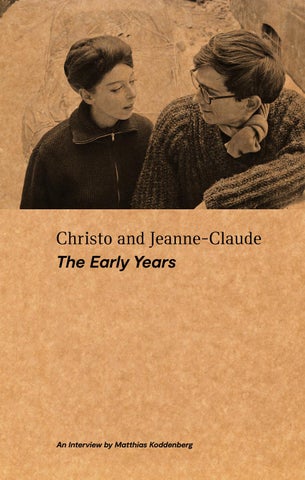
Christo and Jeanne-Claude The Early Years
An Interview by Matthias Koddenberg
But your family still lives in Bulgaria? Yes, my two brothers, Stefan and Anani. Anani comes to New York regularly to see me. We talk only in French. I’m only a quarter Bulgarian. I’m half Macedonian and a quarter Czech. My grandmother escaped with her two children from Salonika just before World War I. My grandfather was a Macedonian freedom fighter and was executed by the Turks during the Balkan Wars. When I was still an art student in Sofia, I desperately desired to go to Prague: the most “Western” of the Communist states. Finally, in the fall of 1956, I was allowed to visit some of my relatives who lived there. But things became very violent. With the Soviet tanks invading Budapest everybody thought that World War III was imminent. That’s why, in January 1957, I decided I would not return to Bulgaria. I bribed a railway employee and escaped to Vienna in a sealed freight car. I was not the only one. I was scared to death of being stopped at the border, but luckily, we made it. So you were a group of refugees… Yes. I was with a group of doctors. As I recall, we didn’t say a word. It was frightening. At the border, we heard the officers with their dogs, but they didn’t find us. When we arrived, we banged on the train door and somebody opened it from the outside. What happened then?
Gabrovo, 1949: Christo at age fourteen, on the far left, during a drawing lesson. Photo: Archive
When you were a refugee, the moment you arrived, you went your separate ways. Everybody took care of him- or herself. That’s how it worked. I handed over my Bulgarian passport and became a stateless political refugee. Because of the high number of refugees that were fleeing from the Communist block to Vienna, the United Nations became responsible for processing the situation and creating
8
9
But your family still lives in Bulgaria? Yes, my two brothers, Stefan and Anani. Anani comes to New York regularly to see me. We talk only in French. I’m only a quarter Bulgarian. I’m half Macedonian and a quarter Czech. My grandmother escaped with her two children from Salonika just before World War I. My grandfather was a Macedonian freedom fighter and was executed by the Turks during the Balkan Wars. When I was still an art student in Sofia, I desperately desired to go to Prague: the most “Western” of the Communist states. Finally, in the fall of 1956, I was allowed to visit some of my relatives who lived there. But things became very violent. With the Soviet tanks invading Budapest everybody thought that World War III was imminent. That’s why, in January 1957, I decided I would not return to Bulgaria. I bribed a railway employee and escaped to Vienna in a sealed freight car. I was not the only one. I was scared to death of being stopped at the border, but luckily, we made it. So you were a group of refugees… Yes. I was with a group of doctors. As I recall, we didn’t say a word. It was frightening. At the border, we heard the officers with their dogs, but they didn’t find us. When we arrived, we banged on the train door and somebody opened it from the outside. What happened then?
Gabrovo, 1949: Christo at age fourteen, on the far left, during a drawing lesson. Photo: Archive
When you were a refugee, the moment you arrived, you went your separate ways. Everybody took care of him- or herself. That’s how it worked. I handed over my Bulgarian passport and became a stateless political refugee. Because of the high number of refugees that were fleeing from the Communist block to Vienna, the United Nations became responsible for processing the situation and creating
8
9
refugee camps. You never knew where you would end up. But refugees who were registered as students in the country where they were trying to find asylum were not supposed to be sent to any of those camps. That’s why, since I still had my student card from the academy in Sofia, I registered as a student at the academy in Vienna, upon the suggestion of the wife of the friend of my father who hosted and helped me when I arrived. She was a lawyer. Why did you decide to go to Vienna in the first place? Well, I wasn’t the only one. There were thousands of refugees crossing the border. The same as today. Of course, my idea was to go to Paris. In Vienna, I only studied for one semester, from January to October 1957. So, you arrived in Vienna as a total stranger. Yes, I didn’t speak any language other than Bulgarian and Russian. When I arrived in Vienna, I only had a piece of paper with the address of an old friend of my father’s who studied in Vienna in the 1920s. Without even knowing whether he was still living there, I rang the bell, and when he opened the door, he miraculously understood immediately who I was and welcomed me into his home. How did you survive? I did all kinds of jobs, from washing cars and dishes to unloading crates from trucks at the market in the early morning; but at the same time I was doing portraits, which I signed “Javacheff.” All my first connections in Vienna arose through a Canadian United Nations officer, after I did a portrait of his wife. She introduced me to her hairdresser, Mr. Rochart, and I did portraits of all his clients. When I moved to Geneva, I met another
10
United Nations officer, Mr. Cabarrus, and I painted a portrait of his wife. His father or grandfather had an apartment in Paris, on rue Quentin-Bauchart, number 8. It’s a small street near the Champs-Élysées. When I went to Paris, I was able to rent a maid’s room there. Let’s stay in Vienna for a while. What kind of works did you do there? Any kind. I mostly did portraits, city landscapes, still lifes. It was in Vienna that I got to know Mr. Zagoroff, a university professor. I remember I painted two city landscapes for his office. His son, Mitko, later became the engineer of all our first projects till Surrounded Islands. Do you remember seeing any exhibitions or collections in Vienna? I remember going regularly to Galerie nächst St. Stephan. They had a lot of late 1930s art. It was a very small space with incredible exhibitions. I saw works by Jean Arp and Sophie Taeuber-Arp there. Did you do any sculptures in Vienna, or later in Geneva, before you went to Paris? Because at the academy in Sofia you said you were trained as a sculptor. Yes, in Sofia at the academy, I did everything. Drawing, painting, sculpting, scale models too. But not after I escaped, because I had nothing. I only started doing sculptures again in Paris, right after I arrived. But in Vienna, I did practice sculpture in Wotruba’s class.
11
refugee camps. You never knew where you would end up. But refugees who were registered as students in the country where they were trying to find asylum were not supposed to be sent to any of those camps. That’s why, since I still had my student card from the academy in Sofia, I registered as a student at the academy in Vienna, upon the suggestion of the wife of the friend of my father who hosted and helped me when I arrived. She was a lawyer. Why did you decide to go to Vienna in the first place? Well, I wasn’t the only one. There were thousands of refugees crossing the border. The same as today. Of course, my idea was to go to Paris. In Vienna, I only studied for one semester, from January to October 1957. So, you arrived in Vienna as a total stranger. Yes, I didn’t speak any language other than Bulgarian and Russian. When I arrived in Vienna, I only had a piece of paper with the address of an old friend of my father’s who studied in Vienna in the 1920s. Without even knowing whether he was still living there, I rang the bell, and when he opened the door, he miraculously understood immediately who I was and welcomed me into his home. How did you survive? I did all kinds of jobs, from washing cars and dishes to unloading crates from trucks at the market in the early morning; but at the same time I was doing portraits, which I signed “Javacheff.” All my first connections in Vienna arose through a Canadian United Nations officer, after I did a portrait of his wife. She introduced me to her hairdresser, Mr. Rochart, and I did portraits of all his clients. When I moved to Geneva, I met another
10
United Nations officer, Mr. Cabarrus, and I painted a portrait of his wife. His father or grandfather had an apartment in Paris, on rue Quentin-Bauchart, number 8. It’s a small street near the Champs-Élysées. When I went to Paris, I was able to rent a maid’s room there. Let’s stay in Vienna for a while. What kind of works did you do there? Any kind. I mostly did portraits, city landscapes, still lifes. It was in Vienna that I got to know Mr. Zagoroff, a university professor. I remember I painted two city landscapes for his office. His son, Mitko, later became the engineer of all our first projects till Surrounded Islands. Do you remember seeing any exhibitions or collections in Vienna? I remember going regularly to Galerie nächst St. Stephan. They had a lot of late 1930s art. It was a very small space with incredible exhibitions. I saw works by Jean Arp and Sophie Taeuber-Arp there. Did you do any sculptures in Vienna, or later in Geneva, before you went to Paris? Because at the academy in Sofia you said you were trained as a sculptor. Yes, in Sofia at the academy, I did everything. Drawing, painting, sculpting, scale models too. But not after I escaped, because I had nothing. I only started doing sculptures again in Paris, right after I arrived. But in Vienna, I did practice sculpture in Wotruba’s class.
11
You mean Fritz Wotruba? The famous Austrian sculptor? I remember I was in Mr. Andersen’s painting class. He was the professor who flunked Hitler twice when he was a student at the Academy of Fine Arts in Vienna. Andersen later became the dean of the academy. But, yes, I took courses with Fritz Wotruba as well. I have very vivid memories of his classes. So, what kind of works did you do there? Many different things, but all very abstract works, mostly made from plaster. But I literally left everything in the classroom when I left for Geneva. Since I took the train, I couldn’t take anything with me; but I really didn’t care. There is probably nothing left from that period. All I have are two small paintings, and only because a fellow student of mine kept them and gave them back to me many years later. The same thing happened in Bulgaria. I left so many things in the corner of the classroom at the academy. A pile of things. Now, people in Bulgaria claim that they have “a Christo” in their homes. The academy probably sold everything, or people just took the works. Anani still has some works from that period. You may remember that I went to see him in Sofia a few years ago. What does he have? Many drawings and paintings from your time in Bulgaria. But he also has some flower still lifes you did in Vienna or Geneva. Yes, probably, because I sent him something. Geneva, 1957: Christo with one of his oil-on-canvas portraits, which he signed with his family name, “Javacheff.” Photo: Archive
13
You mean Fritz Wotruba? The famous Austrian sculptor? I remember I was in Mr. Andersen’s painting class. He was the professor who flunked Hitler twice when he was a student at the Academy of Fine Arts in Vienna. Andersen later became the dean of the academy. But, yes, I took courses with Fritz Wotruba as well. I have very vivid memories of his classes. So, what kind of works did you do there? Many different things, but all very abstract works, mostly made from plaster. But I literally left everything in the classroom when I left for Geneva. Since I took the train, I couldn’t take anything with me; but I really didn’t care. There is probably nothing left from that period. All I have are two small paintings, and only because a fellow student of mine kept them and gave them back to me many years later. The same thing happened in Bulgaria. I left so many things in the corner of the classroom at the academy. A pile of things. Now, people in Bulgaria claim that they have “a Christo” in their homes. The academy probably sold everything, or people just took the works. Anani still has some works from that period. You may remember that I went to see him in Sofia a few years ago. What does he have? Many drawings and paintings from your time in Bulgaria. But he also has some flower still lifes you did in Vienna or Geneva. Yes, probably, because I sent him something. Geneva, 1957: Christo with one of his oil-on-canvas portraits, which he signed with his family name, “Javacheff.” Photo: Archive
13
So, why did you go to Geneva? I went to Geneva because I had a friend, Bulgarian born, who was studying medicine there. Now he’s a doctor in Alabama. His name is Alexandre Todorov, and we called him Sacho. We were already friends in Bulgaria. I probably met him a year before I left. It was not at the academy, but somewhere else, I don’t remember exactly. I hardly had any friends in Bulgaria. However, Sacho and I became very close. His parents were divorced and his father was already in the United States. He made his son study in Budapest, in another Communist country. He left at the same time I went to Prague, when the Hungarian Revolution started. From there he escaped to the West and went to Geneva to study medicine. And you joined him there? Yes, it was thanks to this connection that I finally made it to Geneva in October 1957. We shared a room in an old house, outside of Geneva, but at some point the landlord threw us out, because he found it very suspicious that two boys were sleeping in the same bed. Even Sacho’s father never understood why his son was hanging out in Geneva with a strange Bulgarian artist.
Geneva, 1957: Sacho, Chokoufé, her sister Mery, and Christo. Photo: Archive
I visited Sacho last week. He told me you were working like crazy. You had your easel in one corner of the room, and the whole floor was filled with drawings and paintings. I was working all the time and trying to go to as many museums as possible. I did portraits, still lifes, flowers, landscapes, boats on the lake, in the style of Picasso, Chagall, everything. Also, Cubist paintings, abstract compositions with newspaper collages. I drew and painted non-stop. I have never learned how to drive, but Sacho had a little
14
15
So, why did you go to Geneva? I went to Geneva because I had a friend, Bulgarian born, who was studying medicine there. Now he’s a doctor in Alabama. His name is Alexandre Todorov, and we called him Sacho. We were already friends in Bulgaria. I probably met him a year before I left. It was not at the academy, but somewhere else, I don’t remember exactly. I hardly had any friends in Bulgaria. However, Sacho and I became very close. His parents were divorced and his father was already in the United States. He made his son study in Budapest, in another Communist country. He left at the same time I went to Prague, when the Hungarian Revolution started. From there he escaped to the West and went to Geneva to study medicine. And you joined him there? Yes, it was thanks to this connection that I finally made it to Geneva in October 1957. We shared a room in an old house, outside of Geneva, but at some point the landlord threw us out, because he found it very suspicious that two boys were sleeping in the same bed. Even Sacho’s father never understood why his son was hanging out in Geneva with a strange Bulgarian artist.
Geneva, 1957: Sacho, Chokoufé, her sister Mery, and Christo. Photo: Archive
I visited Sacho last week. He told me you were working like crazy. You had your easel in one corner of the room, and the whole floor was filled with drawings and paintings. I was working all the time and trying to go to as many museums as possible. I did portraits, still lifes, flowers, landscapes, boats on the lake, in the style of Picasso, Chagall, everything. Also, Cubist paintings, abstract compositions with newspaper collages. I drew and painted non-stop. I have never learned how to drive, but Sacho had a little
14
15
Vespa and once I asked him to drive me to Basel to visit the Kunstmuseum. It was pouring rain. We were crazy, the road was so slippery. That was in November 1957. Sacho told me the exact same story. He said, “I was driving, and Christo was sitting in the back dreaming about the world.” For me, seeing those works was the biggest revelation. That collection is one of the most fabulous in modern art. It was simply marvelous. I really discovered the West in Austria and Switzerland. I was desperate to visit museums, because I never saw anything like that before in Bulgaria. Communist censorship was just horrible. Coming to the West, especially in the late 1950s, was insane! I also met with Chokoufé. Oh, Chokoufé! Yes, I met her through Sacho and we became very, very close in Geneva. She was also studying medicine. Very beautiful, with long black hair. She was an Iranian immigrant, from a wealthy Iranian family. I think they moved to Geneva when the Shah came to power. She showed me some letters you wrote her from Paris, very lovely, extremely touching letters. When I went to Paris, she stayed in Geneva, because she was studying there. But she came to visit me in Paris several times. She also told me you never really spoke about your art, never tried to explain it.
16
I do actually speak a lot about my art. I lecture very often now. But there’s nothing to explain, there are no hidden messages behind my art. Doing art is something extremely personal. I was educated as a Marxist and I use the capitalist system. I escaped Communism. I will not relinquish a millimeter of my freedom. I will never do art with messages. Messages can be political, religious, or commercial—but they are all propaganda. I’m an artist, I have the freedom to do things for no particular reason, with no particular purpose. You don’t have to explain why you want to cover a white canvas with paint, why you use blue, or yellow, instead of any other color. Chokoufé told me you even drew and painted on the walls and doors of her apartment. Like a maniac, she said. Did she tell you that? At that time I was really very, very poor. Sometimes, I didn’t even have enough money to buy new paint or paper. I constantly had to find money. That’s why I did so many portraits. Even when we arrived in New York. But when you’re young, you never think it’s the end of the world. You’re maybe irresponsible, but you don’t really care. She still has her portrait. Even Sacho has one. I believe it, because when I went to Paris, I left everything with Sacho. I think I did several portraits of her, in different styles. All were signed “Christo,” because they were not commissioned. Chokoufé recalled that each portrait took several sessions each at least three hours long! How did you communicate? Did you already speak French at that time?
17
Vespa and once I asked him to drive me to Basel to visit the Kunstmuseum. It was pouring rain. We were crazy, the road was so slippery. That was in November 1957. Sacho told me the exact same story. He said, “I was driving, and Christo was sitting in the back dreaming about the world.” For me, seeing those works was the biggest revelation. That collection is one of the most fabulous in modern art. It was simply marvelous. I really discovered the West in Austria and Switzerland. I was desperate to visit museums, because I never saw anything like that before in Bulgaria. Communist censorship was just horrible. Coming to the West, especially in the late 1950s, was insane! I also met with Chokoufé. Oh, Chokoufé! Yes, I met her through Sacho and we became very, very close in Geneva. She was also studying medicine. Very beautiful, with long black hair. She was an Iranian immigrant, from a wealthy Iranian family. I think they moved to Geneva when the Shah came to power. She showed me some letters you wrote her from Paris, very lovely, extremely touching letters. When I went to Paris, she stayed in Geneva, because she was studying there. But she came to visit me in Paris several times. She also told me you never really spoke about your art, never tried to explain it.
16
I do actually speak a lot about my art. I lecture very often now. But there’s nothing to explain, there are no hidden messages behind my art. Doing art is something extremely personal. I was educated as a Marxist and I use the capitalist system. I escaped Communism. I will not relinquish a millimeter of my freedom. I will never do art with messages. Messages can be political, religious, or commercial—but they are all propaganda. I’m an artist, I have the freedom to do things for no particular reason, with no particular purpose. You don’t have to explain why you want to cover a white canvas with paint, why you use blue, or yellow, instead of any other color. Chokoufé told me you even drew and painted on the walls and doors of her apartment. Like a maniac, she said. Did she tell you that? At that time I was really very, very poor. Sometimes, I didn’t even have enough money to buy new paint or paper. I constantly had to find money. That’s why I did so many portraits. Even when we arrived in New York. But when you’re young, you never think it’s the end of the world. You’re maybe irresponsible, but you don’t really care. She still has her portrait. Even Sacho has one. I believe it, because when I went to Paris, I left everything with Sacho. I think I did several portraits of her, in different styles. All were signed “Christo,” because they were not commissioned. Chokoufé recalled that each portrait took several sessions each at least three hours long! How did you communicate? Did you already speak French at that time?
17
You mean, right now?
But you also started doing portraits in Paris?
Yes. It’s the same watch I bought in Geneva in 1957. After you were sent back, how did you finally make it to Paris? That was thanks to a French diplomat, Mr. Bonavita. In the 1950s, Mr. Bonavita was the French consul in Sofia. I did portraits of his family when I was still at the academy there. I remember very well that Mr. Bonavita had a great collection of art books. He had those beautiful Skira books about all the classical modernist masters, which were forbidden in Bulgaria. That’s when I saw Western art for the very first time: reproductions in his books. It’s thanks to Mr. Bonavita that I finally managed to get a visa to France. And when you arrived in Paris, you were a total stranger again? Yes, I knew very few people there. But living in Paris in 1958, I went back to Geneva several times to make portraits. That’s how I survived. This is a very funny story: at that time, all the young French women who needed to get an abortion used to go to Geneva. I remember that Jeanne-Claude was once asked “Where is Christo?” and she replied, “He’s in Geneva.” Everyone then made jokes, because one would go there only to have or arrange an abortion. I remember that through Rochart, the hairdresser, I also met a Romanian family and I did portraits of their little boys. I think you sent me photos of those works when you discovered them in Geneva. You’re talking about the Höhn family? Yes, exactly.
20
Yes, because Rochart recommended me to two famous hairdressers in Paris. One was Jacques Dessange, and the other was René Bourgeois, who was JeanneClaude’s mother’s hairdresser. My life in Paris was like a French movie of the 1950s, absolutely crazy. I worked like a maniac. Doing all these portraits for the French aristocracy, going to all these castles, and painting all those ladies and their children, like the Bretton family. They commissioned me to make the portraits of all of their thirteen children. They had a property in Corsica with a little chapel adjacent to the house. Then they asked me to go there to paint the chapel. I painted different religious subjects: the Virgin above the altar and The Deposition on one of the lateral walls in a very cubistic style. It’s still there today, I actually went to visit it three years ago, after The Floating Piers project. You can still see the drops of paint on the floor! Tell me more about how you met Jeanne-Claude. We met in October 1958, when I was doing a portrait of her mother. Actually, I did the whole family. I also made portraits of her father, of her sister, Joyce, and of Jeanne-Claude herself, which I later wrapped. I even did a painting of their castle outside of Paris. JeanneClaude’s stepfather was Jacques de Guillebon, a famous four-star French general. He was the director of the École Polytechnique at the time. I remember we were once invited to a lunch where I met Mr. Robert Oppenheimer, who was hired by Jeanne-Claude’s father as a professor at the École Polytechnique. They even let me use a room in the attic of the École as a studio.
21
You mean, right now?
But you also started doing portraits in Paris?
Yes. It’s the same watch I bought in Geneva in 1957. After you were sent back, how did you finally make it to Paris? That was thanks to a French diplomat, Mr. Bonavita. In the 1950s, Mr. Bonavita was the French consul in Sofia. I did portraits of his family when I was still at the academy there. I remember very well that Mr. Bonavita had a great collection of art books. He had those beautiful Skira books about all the classical modernist masters, which were forbidden in Bulgaria. That’s when I saw Western art for the very first time: reproductions in his books. It’s thanks to Mr. Bonavita that I finally managed to get a visa to France. And when you arrived in Paris, you were a total stranger again? Yes, I knew very few people there. But living in Paris in 1958, I went back to Geneva several times to make portraits. That’s how I survived. This is a very funny story: at that time, all the young French women who needed to get an abortion used to go to Geneva. I remember that Jeanne-Claude was once asked “Where is Christo?” and she replied, “He’s in Geneva.” Everyone then made jokes, because one would go there only to have or arrange an abortion. I remember that through Rochart, the hairdresser, I also met a Romanian family and I did portraits of their little boys. I think you sent me photos of those works when you discovered them in Geneva. You’re talking about the Höhn family? Yes, exactly.
20
Yes, because Rochart recommended me to two famous hairdressers in Paris. One was Jacques Dessange, and the other was René Bourgeois, who was JeanneClaude’s mother’s hairdresser. My life in Paris was like a French movie of the 1950s, absolutely crazy. I worked like a maniac. Doing all these portraits for the French aristocracy, going to all these castles, and painting all those ladies and their children, like the Bretton family. They commissioned me to make the portraits of all of their thirteen children. They had a property in Corsica with a little chapel adjacent to the house. Then they asked me to go there to paint the chapel. I painted different religious subjects: the Virgin above the altar and The Deposition on one of the lateral walls in a very cubistic style. It’s still there today, I actually went to visit it three years ago, after The Floating Piers project. You can still see the drops of paint on the floor! Tell me more about how you met Jeanne-Claude. We met in October 1958, when I was doing a portrait of her mother. Actually, I did the whole family. I also made portraits of her father, of her sister, Joyce, and of Jeanne-Claude herself, which I later wrapped. I even did a painting of their castle outside of Paris. JeanneClaude’s stepfather was Jacques de Guillebon, a famous four-star French general. He was the director of the École Polytechnique at the time. I remember we were once invited to a lunch where I met Mr. Robert Oppenheimer, who was hired by Jeanne-Claude’s father as a professor at the École Polytechnique. They even let me use a room in the attic of the École as a studio.
21
Paris, 1959: Christo in his studio at the École Polytechnique. Photos: Jeanne-Claude
26
27
Paris, 1959: Christo in his studio at the École Polytechnique. Photos: Jeanne-Claude
26
27
82
Gentilly, 1962: Christo at the stockyard situated next to his studio. Photo: Enzo Sellerio
Gentilly, 1961: Christo’s Oil Barrel Column, a temporary installation. Photo: Raymond de Seynes
83
82
Gentilly, 1962: Christo at the stockyard situated next to his studio. Photo: Enzo Sellerio
Gentilly, 1961: Christo’s Oil Barrel Column, a temporary installation. Photo: Raymond de Seynes
83
What was so fascinating about the oil barrels? I found the cylindrical oil barrels already looked like sculptures themselves. Sometimes I stacked two barrels, sometimes several, to form a column. Occasionally some of the barrels were wrapped with black or brownish lacquered cloth. The lacquer stiffened the folds of the fabric to become permanent, almost like they were sculpted. To secure the fabric, I used steel wire. In the beginning, I used to clean and varnish the barrels. Later, I only removed the dust and preserved the pictorial quality of these used barrels. The spilled oil, the bleached out color, the rust, the bumps: I found them very enchanting, very beautiful, because they were “real.” So, you found those barrels in the streets? Or did you buy them? Near the studio in Gentilly there was a big barrel stockyard, where old barrels were recycled: cleaned and sold again. I bought some of the barrels there, and rented others. When Jeanne-Claude and I realized the temporary installation The Iron Curtain in 1962, we rented all the barrels. I did various oil barrel columns which no longer exist. They were photographed and then dispersed. The only thing in that style that still exists is a sculpture I realized at the house of Martin and Mia Visser in 1966-67. Then they donated it to the Kröller-Müller Museum in Otterlo, where it’s currently installed in its sculpture garden. So, at some point you stopped wrapping the barrels? Yes, around the time I had my first personal exhibition, at Galerie Haro Lauhus in Cologne in 1961. Another work with not wrapped barrels was a column of barrels I exhibited
86
in a group show at Galerie J in Paris in the fall of 1961, before the rue Visconti project. And then you did the project on rue Visconti in 1962. Yes. But the idea took shape in 1961. While I was in Cologne, they started building the Berlin Wall. I was afraid that World War III would break out and I would be caught and sent back to Bulgaria. Paris was also in turmoil because of the Algerian war: barricades in the streets, shootings… After I returned to Paris from Cologne, we submitted a proposal to make my own Iron Curtain, a barrel wall that would block rue Visconti. We wrote to the city and filed an application, but they never replied. Since our idea was technically never rejected, but simply ignored, JeanneClaude and I decided to do it anyway. It was built very fast, on the evening of June 27, when my personal exhibition at Galerie J—just around the corner—opened. It was only up for one night, from six in the evening to one in the morning. It stopped the traffic. People got very upset. Then the police arrived… Were you arrested? No. Somehow Jeanne-Claude convinced them not to arrest us. She explained to them that it was temporary anyway and that we would remove it the same night. I did many illegal things in those days: I escaped from the Communist block to the West. That was illegal. I tried to go to Paris illegally. Sometimes artists do illegal things. What did you show at the exhibition that opened the same night at Galerie J? It was very similar to the exhibition at Haro Lauhus. In Cologne I exhibited inside the gallery both wrapped
87
What was so fascinating about the oil barrels? I found the cylindrical oil barrels already looked like sculptures themselves. Sometimes I stacked two barrels, sometimes several, to form a column. Occasionally some of the barrels were wrapped with black or brownish lacquered cloth. The lacquer stiffened the folds of the fabric to become permanent, almost like they were sculpted. To secure the fabric, I used steel wire. In the beginning, I used to clean and varnish the barrels. Later, I only removed the dust and preserved the pictorial quality of these used barrels. The spilled oil, the bleached out color, the rust, the bumps: I found them very enchanting, very beautiful, because they were “real.” So, you found those barrels in the streets? Or did you buy them? Near the studio in Gentilly there was a big barrel stockyard, where old barrels were recycled: cleaned and sold again. I bought some of the barrels there, and rented others. When Jeanne-Claude and I realized the temporary installation The Iron Curtain in 1962, we rented all the barrels. I did various oil barrel columns which no longer exist. They were photographed and then dispersed. The only thing in that style that still exists is a sculpture I realized at the house of Martin and Mia Visser in 1966-67. Then they donated it to the Kröller-Müller Museum in Otterlo, where it’s currently installed in its sculpture garden. So, at some point you stopped wrapping the barrels? Yes, around the time I had my first personal exhibition, at Galerie Haro Lauhus in Cologne in 1961. Another work with not wrapped barrels was a column of barrels I exhibited
86
in a group show at Galerie J in Paris in the fall of 1961, before the rue Visconti project. And then you did the project on rue Visconti in 1962. Yes. But the idea took shape in 1961. While I was in Cologne, they started building the Berlin Wall. I was afraid that World War III would break out and I would be caught and sent back to Bulgaria. Paris was also in turmoil because of the Algerian war: barricades in the streets, shootings… After I returned to Paris from Cologne, we submitted a proposal to make my own Iron Curtain, a barrel wall that would block rue Visconti. We wrote to the city and filed an application, but they never replied. Since our idea was technically never rejected, but simply ignored, JeanneClaude and I decided to do it anyway. It was built very fast, on the evening of June 27, when my personal exhibition at Galerie J—just around the corner—opened. It was only up for one night, from six in the evening to one in the morning. It stopped the traffic. People got very upset. Then the police arrived… Were you arrested? No. Somehow Jeanne-Claude convinced them not to arrest us. She explained to them that it was temporary anyway and that we would remove it the same night. I did many illegal things in those days: I escaped from the Communist block to the West. That was illegal. I tried to go to Paris illegally. Sometimes artists do illegal things. What did you show at the exhibition that opened the same night at Galerie J? It was very similar to the exhibition at Haro Lauhus. In Cologne I exhibited inside the gallery both wrapped
87
“My life in Paris was like a French movie of the 1950s, absolutely crazy.” — Christo