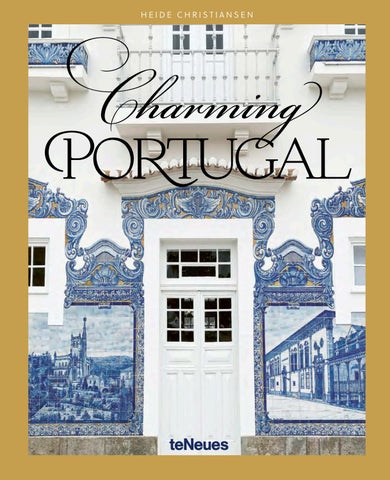
PoRtugal


Azulejos
AS PORTUGUESE AS VINHO VERDE AND FADO, AZULEJOS APPEAR ON FAÇADES AND DOORWAYS ACROSS THE COUNTRY
These intricately designed, vividly colored ceramic tiles form an artistic signature within Portugal’s cultural history. While the word may suggest the blue of the sea, it actually comes from the Arabic al-zuléija, meaning “polished stone.” King Manuel I of Portugal (1469–1521) encountered Moorish ceramic craftsmanship in Spain and brought the technique back to Portugal. Soon royal palaces were decorated with tiles, from traditional mosaics to precise geometric patterns. Before long, azulejos also took the form of large painted panels. The Grande Panorama de Lisboa, attributed to Gabriel del Barco, which is more than twenty-three meters long and dates from around 1700, is now displayed at the Museu Nacional do Azulejo. It presents the city in a sweeping, bird’s-eye view along the Tagus. The detail and clarity of this image made it an invaluable record of Lisbon before the earthquake of 1755 and a reference for rebuilding. Via churches and monasteries, tilework entered everyday architecture, especially once nineteenth-century industrial production made it more affordable. What had once marked status now also served a practical purpose, protecting walls from the weather. In the older quarters of Lisbon and Porto, geometric patterns and floral motifs still frame windows and doors or cover entire façades. Ceramic lovers should also look underground: Since the 1950s, Lisbon’s metro stations have featured large azulejo murals by leading artists.
LEFT: The ornate staircase of the Câmara Municipal in Braga, one of Portugal’s most striking examples of Baroque architecture.


ABOVE: At Campo de Santa Clara in the Graça district, near the Feira da Ladra—the “market of the thief lady.” Great finds at a flea market; plenty of color.
LEFT: At the foot of the Miradouro da Graça, narrow streets lead through one of Lisbon’s long-established workingclass neighborhoods. No shortage of wine bars here.


ABOVE: Azulejos on the façade of Casa do Ferreira das Tabuletas create the illusion of three-dimensional statues. Not carvings, the allegories were hand-painted onto the tiles by the artist Luís Ferreira.
LEFT: Azulejos on tramcars are no surprise in Lisbon.


The gardens surrounding
a
structured around shifting sightlines,
ABOVE:
Porto’s Art Deco Casa Serralves, now
museum, are
with fountains, tree-lined paths, and labyrinthine hedges.
LEFT: Porto’s city park, in the northern part of town, is the largest park in Portugal. Benches throughout the grounds provide shaded resting places beneath tall trees.


Centro & Alentejo
THE APPEAL OF PORTUGAL’S CENTRO AND ALENTEJO LIES IN THE INTERPLAY OF GENTLE HILLS, SHEER ROCK FACES, AND WIDE, QUIET EXPANSES
In remote corners, villages with long histories appear unexpectedly, their past still legible in stone and setting. Monsanto is one of them, and one of the twelve Aldeias Históricas. It is often described as deeply Portuguese and has served as a film location more than once. Small stone houses cluster tightly together, some appearing to grow out of the rock. Massive granite boulders form walls and roofs, as if giant children had once scattered their building blocks here and left them behind. From the ruins of Castelo de Monsanto high above the settlement, the view stretches as far as the Spanish border on clear days. In the Coimbra region, the mountain village of Piódão occupies steep terraces near the Serra do Açor. Its slate houses press close together, their dark surfaces broken by doors painted deep blue. As evening light settles in, the village grows still, briefly set apart from the present day. In Alentejo, Monsaraz stands on a hilltop beside its old castle, a place the Knights Templar likely chose for its wide views long before the Alqueva reservoir filled the valley below. Walking through uneven streets lined with whitewashed houses feels like stepping back into the Middle Ages—especially at sunset, when warm light spreads across the surrounding plains of olive groves and cork oaks. Aveiro, on the coast, offers a sharp contrast. Often called the “Venice of Portugal,” the town is defined by its canals, where brightly painted moliceiro boats pass Art Nouveau façades reflected in the water, and everyday movement along the canals gives it a light, easy rhythm.
LEFT: Red tile roofs, angular granite walls, and wide views over the neighboring valleys at Monsanto, one of the aldeias históricas, twelve towns recognized for preserving traditional architecture and practices.


ABOVE AND LEFT: The slate walls of Piódão seem dark and austere except for the moss and herbs pushing through narrow gaps in the stone. Brightly painted doors and windows are a source of variation.


Miradouros
THE NUMBER OF MIRADOUROS IN LISBON AND PORTO IS NO ACCIDENT. BOTH CITIES GREW ON STEEP HILLS SHAPED BY THE STRATEGIC IMPORTANCE OF THE TAGUS AND THE DOURO, AND BY ATLANTIC LIGHT THAT FAVORS LONG,
OPEN SIGHTLINES
As the cities rose, these high points took on the deliberate purpose of keeping views of river and harbor clear. The earliest miradouros were working look-out posts from which approaching ships could be seen well before they reached port and threats could be spotted from a distance. In Porto, one of the most striking viewpoints is the Miradouro da Rua das Aldas. Set high above the Ribeira quarter near the cathedral, it looks across the Douro to the Ponte Dom Luís I and the rooftops of Vila Nova de Gaia. On the opposite bank, evenings draw people to the Jardim do Morro. A small park near the Gaia cable car station offers a wide view and is a favorite spot to watch the sun set. Lisbon offers its own chain of miradouros overlooking the Tagus. The Miradouro das Portas do Sol projects outward like a balcony above Alfama, historically one of the best spots to watch ships leave the harbor. Just a short walk away, the pergola of the Miradouro de Santa Luzia, wrapped in bougainvillea, offers a quieter setting. For Portugal, a country shaped by the sea, the horizon once carried very real hopes of distant return. People gathered at these overlooks to scan the water, waiting for a ship that might bring someone home, a loved one. Over time, miradouros also became meeting places. Paths and terraces formed around them, as at the Miradouro de São Pedro de Alcântara, where a wide view can be had with a walk through the adjoining garden. When evening light settles on rooftops and glints off the river and sea, few places in Lisbon and Porto draw more people than these terraces above the city, whether for a date or simply to close out the day.
LEFT: Near the Miradouro da Rua das Aldas, a view across Porto to the Douro. In the foreground is the Igreja dos Grilos. Visitors to the Museum of Sacred Art can climb the church tower for an incredible view.


IMPRINT
CHARMING PORTUGAL
This book was conceived, edited, and designed by teNeues.
Edited by Heide Christiansen
Text/preface by Anja Klaffenbach, www.klarkonzept.de
Translation by John Foulks
Copyediting by Robin Limmeroth
Editorial Management by Stephanie Rebel, gestalten Verlag
Proofreading by Benine Mayer, gestalten Verlag
Design by Marcus Taeschner
Layout by Marcus Taeschner
Photo Editorial by Heide Christiansen
Production by Sandra Jansen-Dorn, gestalten Verlag
Picture editing by Jens Grundei
Map graphic by Thomas Vogelmann
Printed in the Czech Republic by Finidr
Published by gestalten, Berlin 2026
ISBN 978-3-96171-763-7
1st printing, 2026
The german edition is available under ISBN 978-3-96171-764-4
© teNeues, an Imprint of Die Gestalten Verlag GmbH & Co. KG, Berlin 2026
All rights reserved. No part of this publication may be reproduced or transmitted in any form or by any means, electronic or mechanical, including photocopy or any storage and retrieval system, without permission in writing from the publisher.
No part of this book may be used or reproduced in any manner for the purpose of training artificial intelligence technologies or systems. This work is reserved from text and data mining (Article 4(3) Directive (EU) 2019/790).
Respect copyrights, encourage creativity!
For more information and to order books, please visit www.teneues.com and www.gestalten.com
Die Gestalten Verlag GmbH & Co. KG
Mariannenstrasse 9–10 10999 Berlin, Germany hello@gestalten.com
Krefeld Office
Uerdinger Str. 265/Villa Pattberg 47800 Krefeld, Germany verlag@teneues.com
teNeues Press Department press@gestalten.com
Bibliographic information published by the Deutsche Nationalbibliothek. The Deutsche Nationalbibliothek lists this publication in the Deutsche Nationalbibliografie; detailed bibliographic data is available online at www.dnb.de