
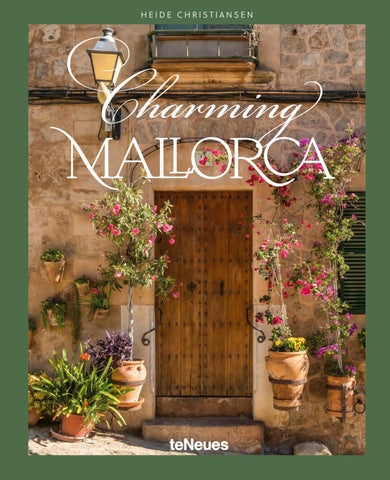
Charming Mallorca

Page 1


Mal oR

Palma

COSMOPOLITAN, COLORFUL, AND OPEN. FOR THOUSANDS OF YEARS, DIFFERENT CULTURES HAVE CONVERGED IN THE ISLAND’S CAPITAL

Palma does not require a carefully planned itinerary. Time is enough. Something appears on nearly every corner: ceramic details on Art Nouveau façades around the Plaça Major; historic town palaces built from Santanyí sandstone; Gothic churches; Arab baths; narrow, sometimes teeming old-town streets with nostalgic shops and contemporary bars. A slow drift works best here. A brief chat with a turrón vendor. Sobrasada from the butcher. Time spent in a haberdashery with intricate wooden paneling. In front of the cast-concrete walls of the Es Baluard museum, modern architectural shadows fall alongside the historic city ramparts. Palma has been shaped by successive cultures for centuries. Founded by the Romans in 123 BC, later settled by the Moors, their traces remain visible throughout the city. With Jaume I and the Aragonese, Christianity returned to the island in 1229. The cathedral rose soon after, and Palma developed into a maritime center. Perhaps this layered history explains the city’s distinctive rhythm. Nowhere is it more evident than above the harbor, in the former fishing district of Santa Catalina, today a bohemian neighborhood of artists, restaurants, and bars. The Mercat Santa Catalina brings together an international mix: local fishmongers beside sushi counters, fresh pasta next to traditional spice stalls, Spanish home cooks alongside Michelin-starred chefs provisioning charter yachts. Mallorca in a nutshell.

LEFT: Palma’s old town features numerous hidden gems, among them the narrow alleyway Carrer de la Mar, located near the cathedral.
ABOVE: Mallorcan delicacies at Colmado Santo Domingo: sobrasada, sea salt from Es Trenc, and regional specialties.
RIGHT: Probably the world’s most beautiful bakery: traditional Mallorcan pastries are hand-crafted with love at Fornet de la Soca on Plaça de Weyler 9.

The South

FISHING VILLAGES, FORMER PIRATE HIDEOUTS, AND SMALL TOWNS WITH LAYERED HISTORIES

When Mallorcans refer to the south, they usually mean everything from west to east that lies below the Bay of Palma. That includes the widely overlooked rural town of Llucmajor. Despite its size, it rarely appears on standard tourist itineraries. The surrounding countryside adds to its appeal. Almond and apricot groves, low hills, and open terrain lend themselves well to hiking and cycling. Llucmajor carries visible traces of the past. Local history here has shaped both the island and the people who live on it. The same applies to places such as Sant Elm, once a pirate refuge at the island’s southwestern tip, or the fishing village of Portocolom in the southeast. Its broad, sheltered bay offers reliable protection from swell, regardless of wind direction, which explains its popularity with sailors. Felanitx follows a similar pattern. The historic town can be explored entirely on foot and turns into a lively flea market and weekly market every Sunday. These are places that invite longer stays. The idea of settling in quietly takes hold. And then there is Santanyí, whose houses and narrow streets possess an appeal that is hard to resist. Historic buildings and traditional crafts have been handled with a deep sense of respect. Old trades continue in updated forms, without being stripped of their character. The south has many sides. Away from large resorts, it offers a sense of calm—to enjoy yourself, to gather your strength, and perhaps even to stay.

LEFT: The tall tower of the Church of Sant Miquel above Llucmajor, a visible landmark in a town often overlooked by visitors—all the more reason to go.

ABOVE AND LEFT: The park bench with perhaps the world’s most beautiful view stands in Sant Elm, a fishing village at the island’s southwestern tip. This remote village was once a pirate stronghold, surrounded by rocky hideaways and smugglers’ paths still accessible today. From here, the view of the uninhabited island of Sa Dragonera is spectacular.

Valldemossa

A SMALL TOWN IN A RUGGED LANDSCAPE LONG ASSOCIATED WITH INSPIRATION, NOT ONLY FOR ARTISTS

Valldemossa is tied to a particular love story. The composer Frédéric Chopin and the writer George Sand spent the winter of 1838–39 here living in an abandoned monastery. Chopin, weakened by asthma and tuberculosis, had hoped the mild Mediterranean climate would aid his recovery. The couple also wanted to enjoy their early relationship far from the scrutiny of Parisian society. That was the intention. The reality proved harsher. Cold weather, constant rain, and daily life in the drafty monastery took a physical toll on the composer. Relations with the local population were strained. The traveling party, which included Sand’s two children from her first marriage, met with reserve rather than warmth. An unmarried patchwork family raised suspicions. Sand herself stood out. She wore men’s clothing, smoked in public, and expressed feminist views that caused offense. Accommodation options were limited; they found nowhere to stay outside the monastery.

In her book A Winter in Majorca, Sand offered a sharply critical portrait of the Mallorcans, but her account also shows affection for the island, its landscape, and its natural abundance. For Chopin, the stay was physically exhausting but creatively productive. In cell number 4, he composed many of his best-known piano works, including the “Raindrop Prelude.” Those who travel through Valldemossa and its surroundings will be rewarded if they are attentive. The place tends to leave a lasting impression.

LEFT: The hamlet of Valldemossa in the Serra de Tramuntana, in its center the monastery where Frédéric Chopin and his lover George Sand spent a winter. They lived and worked out of cell 4, now part of a museum at the monastery.

ABOVE: The village of Capdepera not far from Artà, is likewise protected by a medieval fortress. The fort, with its round arches and crenellated walls, is among the largest and best-preserved castles on the island.

LEFT: Capdepera Lighthouse, a distinctive coastal landmark alone on a headland, is still in operation and a particularly rewarding destination.

Mallorca’s Bays

GREETINGS FROM THE TURQUOISE REALM OF KING NEPTUNE

There are, of course, long sandy beaches. Some are quiet, others more animated with promenades, beach clubs, parties, and watersports. Almost more compelling, however, are the many large and small coves scattered around the island. Even trying to access them can be a challenge. The payoff, however, is getting to snorkel among the rocks and maybe watch a busy octopus or gaze at a school of fish. It’s an experience you will surely want to repeat.

The water around the Balearic Islands is distinctive, significantly clearer than along the coast of the mainland, and the sight of its turquoise blue triggers an immediate sense of joy. King Neptune has endowed Mallorca and its neighbors with an endemic plant with unusual properties: Posidonia. Extensive underwater meadows of this seagrass surround the islands, filtering the water, binding carbon dioxide, producing oxygen, and sheltering numerous marine species. Also called Neptune grass, Posidonia is not a form of algae but a flowering plant, with roots and leaves that it sheds in autumn. Its importance to the marine ecosystem is considerable, and conservation efforts have ramped up in recent years. Measures include chasing away boaters who try to anchor over seagrass beds, which can tear up the plants. Encountering these seagrass leaves in the sea or on the shore is a quiet reminder of a natural wonder worth being grateful for.

LEFT: Here, the journey is truly part of the destination: You can drive to the Cala de Sa Calobra in the northwest of Mallorca on an adventurous winding road, reach it on foot by following a spectacular hiking trail, or take a boat from Sóller.

ABOVE AND RIGHT: Whitewashed houses and narrow streets in the generally quiet village of Es Mercadal, a farming community. Many residents work in agriculture. The grain mill, still in use, now houses the restaurant Es Molí d’es Racó.

IMPRINT

CHARMING MALLORCA

This book was conceived, edited, and designed by teNeues.

Edited by Heide Christiansen

Text and preface by Katja Klementz

Translation by John Foulks

Copyediting by Robin Limmeroth

Editorial Management by Stephanie Rebel, gestalten Verlag

Design by Marcus Taeschner

Layout by Marcus Taeschner

Photo Editorial by Heide Christiansen

Production by Sandra Jansen-Dorn, gestalten Verlag

Picture editing by Jens Grundei

Map graphic by Thomas Vogelmann

Proofreading by Benine Mayer

Printed in the Czech Republic by Finidr

Published by gestalten, Berlin 2026

ISBN 978-3-96171-752-1

1st printing, 2026

The german edition is available under ISBN 978-3-96171-754-5

© teNeues, an Imprint of

Die Gestalten Verlag GmbH & Co. KG, Berlin 2026

All rights reserved. No part of this publication may be reproduced or transmitted in any form or by any means, electronic or mechanical, including photocopy or any storage and retrieval system, without permission in writing from the publisher.

No part of this book may be used or reproduced in any manner for the purpose of training artificial intelligence technologies or systems. This work is reserved from text and data mining (Article 4(3) Directive (EU) 2019/790).

Respect copyrights, encourage creativity!

For more information and to order books, please visit www.teneues.com and www.gestalten.com

Die Gestalten Verlag GmbH & Co. KG Mariannenstrasse 9–10 10999 Berlin, Germany hello@gestalten.com

Krefeld Office

Uerdinger Str. 265/Villa Pattberg 47800 Krefeld, Germany verlag@teneues.com

teNeues Press Department press@gestalten.com

Bibliographic information published by the Deutsche Nationalbibliothek. The Deutsche Nationalbibliothek lists this publication in the Deutsche Nationalbibliografie; detailed bibliographic data is available online at www.dnb.de

Turn static files into dynamic content formats.
Create a flipbook