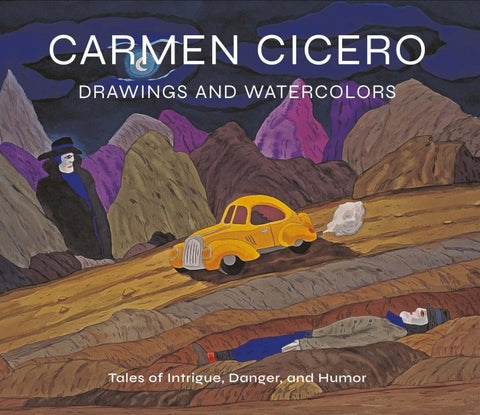
CARMEN CICERO: DRAWINGS AND WATERCOLORS
6
7
FOREWORD CARMEN CICERO: AN AMERICAN ORIGINAL Annette Blaugrund
ARTIST AND MUSICIAN CARMEN CICERO is a ninety-seven-
A studio’s proportions—its light, size, color, and general ambience—often
year-old wonder whose drawings and watercolors are celebrated here.
determine an artist’s work. Within his capacious new space on the Bow-
Born in New Jersey, he attended New Jersey State Teachers College (now
ery, about 2000 square feet, Cicero fashioned separate sections for each
Kean University) and later, in 1952, did graduate work at Hunter College,
of his artistic techniques—acrylic, watercolor, drawing, and collage—in
where he studied painting with the preeminent Abstract Expressionist
addition to living quarters. He had come a long way from his very first
Robert Motherwell. Cicero attained early success and recognition as both
studio, the former coal bin in the basement of his parent’s home, which he
an artist and a musician, all of which is detailed in the expansive illus-
painted white. After climbing the four steep flights of stairs to Cicero’s loft,
trated chronology by art historian Mary Ellen Abell. The insightful primary
visitors enter the living quarters, a warm, inviting, and intriguing environ-
text is written by the distinguished critic and author David Ebony, who
ment created by his boldly colored paintings hung Salon style, almost
analyzes the subjects and themes in Cicero’s works on paper.
floor to ceiling. The room is large enough to contain painting racks that store his prodigious output (FIG . 1).
In the 1960s, Cicero had a studio in a converted carriage house in Englewood, New Jersey. The Abstract Expressionist drawings and black-and-
Cicero’s other studio is in Truro, MA, near Provincetown on Cape Cod,
white paintings he produced there had pictorial elements that persist in
where he spends a good five months a year. He began summering in the
his work today. When that building burned to the ground in 1971, all of his
area in 1963, where he first rented and then in 1972 bought the former
art was destroyed, along with his worldly possessions, and most traumat-
South Truro Railroad Station. He added a studio to this property about ten
ically his French Buffet clarinet (FIG . 2).1 The artist subsequently moved to
years ago, since painting in the bedroom there was extremely confining.
Manhattan and found the large loft on the Bowery that he still occupies.
Joining his mentor Robert Motherwell, Cicero became a member of the
This tragedy stimulated a change from Abstract Expressionism to a com-
cooperative Long Point Gallery in Provincetown, which was founded in
plex, cartoonlike figurative style.
1977 and lasted until 1998. 2 Motherwell, who experimented with various automatist techniques while incorporating Surrealist ideas, may have predisposed Cicero to his own visionary themes. Another important relationship in Cicero’s life was with Mary Ellen Abell, the director of Long Point
1. Cicero’s studio on the Bowery in New York City.
Gallery from 1988 to 1994, whom Carmen married in 1995.
Farewell Abstract Expressionism, 1961, ink on paper, 22 1/2 × 28 1/2 inches. Whitney Museum of American Art; gift of the Ford Foundation Purchase Program.
11
TALES OF INTRIGUE, DANGER, AND HUMOR CARMEN CICERO’S DRAWINGS AND WATERCOLORS David Ebony
PART I: INTRIGUE
colors, as well as in his paintings, are full of dramatic proposals, complex social conundrums, and intriguing innuendo. Yet to complete the story,
The best of artists never has a concept A single block of marble does not contain Inside its husk, but to it may obtain Only if hand follows the intellect.
viewers are invited to find their own way to absorb, navigate, and reflect upon the quixotic ingredients he offers. The tale becomes the viewer’s as much as the artist’s. Cicero’s process is intuitive, not unlike Michelangelo’s. As the Renais-
—MICHELANGELO BUONARROTI, SONNET 149, C. 1540
sance master expressed in his Sonnet 149, the material (in his case marble) already contains the concept. The artist’s task—which often requires
Carmen Cicero is a born storyteller. As a musician, he can convey feelings
a herculean effort to overcome all sorts of willful premeditation—is to
and even various types of human interactions—from tense confrontations
simply let the hand follow the intellect in the realization of the work of art.
to romantic encounters—by means of a sequence of hot jazz riffs on his
Picasso was certainly attuned to this attitude and methodology. Model
saxophone or clarinet. One can hear these rhythmic tales on his 2007
and Sculptor with His Sculpture, for instance, an etching from Picasso’s
album, Play Me a Sad Song, which in my home is a frequent soundtrack to
1933 Vollard Suite (FIG . 4), shows an intently focused artist with out-
friendly gatherings or solitary moonlit evenings. In conversation, Cicero
stretched arms putting the final touches on his sculpture (an abstracted
spins lively and comically nuanced stories of people, places, and novel sit-
portrait bust), with his naked muse by his side.
uations that he has experienced and recalls in vivid detail. He expresses a
The British writer Colin McGinn has explored this vital pas de deux
wide range of human emotions and evokes complex social entanglements
of hand and mind during the creative process in his persuasive book Pre-
using an economy of words and gestures.
hension. “Our specifically human intelligence has evolved in concert with
Imparting these tales in his visual art as well as in person, Cicero is never judgmental or sanctimonious. As he noted in “The Human Con-
the hand,” he writes. “We express our intelligence in our hands (also in the voice—but language came from the hands originally).” 1
dition,” a statement he wrote in 2020, “Artists tell how it is; moralists tell
The hand as a creative tool (wielding a brush or a pen) is a prom-
how it ought to be.” The images he presents in his drawings and water-
inent feature in many of Cicero’s paintings, watercolors, and drawings of
CARMEN CICERO: DRAWINGS AND WATERCOLORS
22
23
CARMEN CICERO IN CONVERSATION with David Ebony
David Ebony
What was your first awareness of art—of fine art
painting and drawing? What was your introduction to art history? Carmen Cicero
When I got out of the army, under the G.I. Bill, I
Ebony
Do you think it’s important for artists to know art history
well, and if so, why? Cicero
Yes, I do. When people evaluate civilization, they talk about
could go to any school I chose. I didn’t know what the hell I was doing.
the arts and the sciences, and how significant these things are for any
I was mixed up. I thought I’d go to the nearest college to where I lived,
given situation in the course of the history of the world. An artist can then
which was [New Jersey] State Teachers College. Just as luck would have
get an idea of where he or she stands within that history, the history of art.
it, there were excellent teachers there. It was a small school, and I loved
They can also better define what art is.
small schools because you knew everybody, and it was very comfortable. I found out the difference between what I thought art was, and how
Ebony
really vast and profound art really is. I knew little or nothing about art
inspired you the most over the years, and why?
Could you name three artists who have influenced or
history. From the courses I took there, I learned a great deal about it. And there was another way I learned a lot about art and art history. I got a
Cicero
Guggenheim Fellowship grant for travel. When I made my itinerary, I just
when I first went to college. I thought that he was a charlatan. But when
got a pencil and circled all the places with great museums, from England
I first saw the works that Picasso did when he was a very young man, I
to Spain, and I loved every minute of that trip. I didn’t get tired of muse-
was stunned. I thought that if this man could do this kind of work, almost
ums. I saw great art, and my knowledge of history grew from that more
like Renaissance painting, then what he did later had to have some great
than anything else.
significance. That is how I first got involved with Picasso’s work. Another
Well, I have to say Pablo Picasso. I resented Picasso at first,
would be Robert Motherwell. I did some graduate work with Motherwell at Ebony
Was there a type of art or a period that you were most
Hunter College in New York, and it was right in the middle of the Abstract
interested in? Or were there certain artists that you sought out?
Expressionist period. I gravitated toward Abstract Expressionism right
Cicero No. At that time, I admired every artist whose works I saw in
away. I instantly understood what it was all about. The first painting I ever
the museums.
sold was an Abstract Expressionist work, to the Newark Museum of Art.
18. Carmen Cicero, 2024. Photo by David Ebony.
Ebony
What about artists further back in history?
CARMEN CICERO: DRAWINGS AND WATERCOLORS
Small Animal, 1954, ink on paper, 22 1/2 × 28 1/2 inches.
30
DRAWINGS
Untitled, 1955, ink and pencil on paper, 19 × 25 1/8 inches. Museum of Modern Art, New York; Blanchette Hooker Rockefeller Fund, 262.1956.
31
CARMEN CICERO: DRAWINGS AND WATERCOLORS
Those That Lived, 2011, ink and wash on paper, 11 × 14 inches.
62
DRAWINGS
The Ship of State, 2016, ink and wash on paper, 10 15/16 × 14 1/4 inches.
63
CARMEN CICERO: DRAWINGS AND WATERCOLORS
Duet, 1965, watercolor on paper, 15 3/4 × 12 5/8 inches.
116
117
WATERCOLORS
Untitled, 1965, watercolor on paper, 22 × 30 inches.
CARMEN CICERO: DRAWINGS AND WATERCOLORS
Rage, 1995, watercolor on paper, 45 × 65 inches framed. Cape Cod Museum of Art, Dennis, Massachusetts.
138
139
CARMEN CICERO: DRAWINGS AND WATERCOLORS
Lost, 2009, watercolor on paper, 12 3/16 × 16 1/16 inches.
158
WATERCOLORS
Driving in the Night, 2013, watercolor on paper, 12 1/4 × 16 1/4 inches.
159
CARMEN CICERO: DRAWINGS AND WATERCOLORS
The Count, 1991, watercolor on paper, 40 × 53 1/2 inches.
180
WATERCOLORS
Bad Men, 2013, watercolor on paper, 12 3/16 × 16 1/8 inches.
181
CARMEN CICERO: DRAWINGS AND WATERCOLORS
Red and Blue, 2009, watercolor on paper, 16 × 12 inches.
196
WATERCOLORS
Red Flower, 1997, watercolor on paper, 14 1/8 × 18 3/4 inches.
197