Canadian Museum for Human Rights
Director’s Tour Canadian Museum for Human Rights Director’s Tour
John F. Young is dedicated to the principle that all human beings are born free and equal in dignity and rights. In 2015, he was appointed President and CEO of the Canadian Museum for Human Rights. Prior to that he served in academia for more than twenty years as a political scientist and university administrator. His work in universities and with governmental and non-governmental organizations has included work throughout Canada and Russia, as well as Japan, Germany, and the United States.
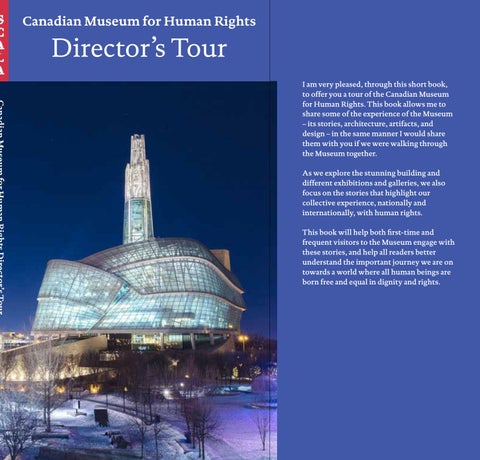
I am very pleased, through this short book, to offer you a tour of the Canadian Museum for Human Rights. This book allows me to share some of the experience of the Museum – its stories, architecture, artifacts, and design – in the same manner I would share them with you if we were walking through the Museum together. As we explore the stunning building and different exhibitions and galleries, we also focus on the stories that highlight our collective experience, nationally and internationally, with human rights. This book will help both first-time and frequent visitors to the Museum engage with these stories, and help all readers better understand the important journey we are on towards a world where all human beings are born free and equal in dignity and rights.
Preface 4 Welcome 6 What Are Human Rights? 20 Indigenous Perspectives 26 Canadian Journeys 33 Protecting Rights in Canada 46 Fourth Floor 51 Actions Count 68 Rights Today 71 Expressions 75 Inspiring Change 87 The Israel Asper Tower of Hope 89
Canadian Museum for Human Rights
3
Preface
I
am very pleased to have the opportunity, through this short book, to offer you a tour of the Canadian Museum for Human Rights. I want to share my favourite parts of the Museum – its stories, its architecture and its artifacts – just as if we were walking through each gallery together. While we are touring, I will also draw from the collective experience of many different visitors I have accompanied through the Museum, and I’ll reference some of the questions and comments they’ve raised. This book does not cover all the content found in the Canadian Museum for Human Rights, nor does it seek to replace the experience of actually visiting the Museum. Rather, I hope this Director’s Tour will entice you to visit or enhance your experience if you already have – no matter how many times you’ve come or how long you’ve stayed. I hope this book will also convey my enthusiasm for the work we do here. I am indebted to those who launched this audacious project, who persevered and brought a dream to reality – as well as to the inspiring people whose stories we tell.
4
Director’s Tour
I have occasionally heard potential visitors express reluctance to experience the Museum, believing that they must first “prepare themselves” for the content. While it’s true that the Museum’s stories include tragic examples of inhumanity, both past and present, what resonates most is the spirit of survivors and the courage of those who took a stand for their own rights and the rights of others. In this regard, I believe the overall Museum experience inspires us to better appreciate the rights we enjoy. It cultivates gratitude for the commitment and sacrifices of others. It strengthens our resolve to treat others with respect. It encourages us to passionately pursue our obligations to pass on to future generations vibrant communities that resonate with our individual and collective responsibilities for human rights. John F. Young, President and CEO.
Preface
5
Welcome
L
et’s start our tour of the Canadian Museum for Human Rights in Bonnie & John Buhler Hall – a large room on the ground level, just beyond the main entrance. On a typical day, you will find an architectural model of the Museum in the middle of this hall. This is where we usually invite visitors to pause while we deliver a few introductory comments. I welcome you by first acknowledging the ancestral land upon which the Museum rests, which is Treaty One territory and in the heartland of the Métis people. This land at the confluence of the Red and Assiniboine rivers is commonly called The Forks. It has served as a gathering place for Indigenous Peoples for countless generations. Prior to construction, we commissioned the largest block archaeological excavation ever conducted in Manitoba, which recovered more than 400,000 artifacts, some dating
The bronzed moccasin print in Bonnie & John Buhler Hall connects us to Indigenous ancestors who followed the waterways here for peace-making, trade and dialogue. Welcome wall in Bonnie & John Buhler Hall. 6
Director’s Tour
back a thousand years. Fragments of ceremonial pipes and of ceramic pottery reveal much about the importance of this location as a place where people lived, built alliances and gathered for trade and celebration. One of the more remarkable findings was a moccasin print that had been preserved in the earth for about 750 years. We cast this impression in bronze to showcase in Bonnie & John Buhler Hall, honouring those who walked here on these ancestral lands long before the Museum appeared. In this hall, you will also find a large animated welcome wall, projecting silhouettes of people writing “welcome” in 38 languages. These languages include French and English (Canada’s two official languages) and 12 Indigenous languages. Another prominent feature is a striking installation by Indigenous artist David Thomas. To create this piece, Thomas stretched a membrane across a two-anda-half-metre drum frame. He then placed earth from the site and sacred medicines such as sage, sweetgrass, tobacco and cedar upon the membrane, then “drummed” them into place – where they became the essence of a drum beat in visual form. I now want to tell you about the origins of the Canadian Museum for Human Rights, which opened its doors in September 2014. The vision was born many years earlier, the adventurous ambition of a courageous and charismatic individual. As a prominent businessman, media magnate, local politician, and devoted Canadian, Israel (Izzy) Asper Welcome
7
Canadian Journeys
T
he next gallery is the Museum’s largest and most visually impressive exhibit space, a place that explores Canada’s own steps and missteps on the path to greater human rights for all. Eighty stories are presented in various ways: through 18 exhibit alcoves on three sides of the gallery, through a 30-metre digital canvas and through image grids found higher on the walls, which connect to stories in digital insight stations on the floor. A theatre shows two films produced by the Museum: an overview of the evolution of human rights in Canada and an account of Indian Residential Schools and their damaging generational legacy. The 18 alcoves contain exhibits dedicated to important human rights themes and events in Canada. These include the internment of Japanese Canadians during the Second World War, women’s rights, the refugee experience in Canada, missing and murdered Indigenous women and girls, labour rights and the Winnipeg General Strike, voting rights, marriage rights, language rights, Indian Residential Schools, Chinese head tax and restricted immigration, disability rights, the rights of Peoples of the North, religious liberty, the Underground Railway and slavery, Métis rights, the War Measures Act, Viola Desmond and racial segregation in Canada, and migrant workers. Another alcove gives you the opportunity to share your own human rights story.
We then step into the middle of the gallery, onto an interactive experience called “Lights of Inclusion.” We are each suddenly surrounded by a bubble of coloured light that follows us as we move within the circle on the floor. When we move close to each other, the coloured lights interact and change colour, with ribbons of energy now 32
Director’s Tour
Canadian Journeys
33
A 30-meter-wide digital canvas in Canadian Journeys showcases faces of Canadian human rights champions and six silent films on human rights in Canada. Each alcove features a human rights theme or event in Canada.
34
Director’s Tour
The Banned From the Ballot exhibit alcove shares stories about the right to vote.
Canadian Journeys
35
flowing between them. As more people join the circle, they become even more interesting. This game teaches children of all ages that good things come from including others into our sphere of influence, regardless of difference. It is one of the many different ways the Canadian Museum for Human Rights uses technology to engage our visitors. Another example of interactive technology is found in the exhibit alcove about the refugee experience in Canada. Here, we turn a tactile globe to select a country of origin, then watch short videos of personal stories from people who have found a new home in Canada. This alcove is one of our most popular interactive exhibitions. One of my personal favorites is the account given by Kim Bui, who came to Canada as a refugee from Vietnam in the early 1980s. Among the hundreds of thousands of refugees, Kim’s story is a powerful reminder of the safe haven offered to refugees and the reciprocal benefits to both newcomers and country. Next to this alcove, the exhibit on missing and murdered Indigenous women and girls consists of an art installation by Indigenous artist Jaime Black called The REDress Project. Featuring empty red dresses hanging against a woodland background, this artwork demonstrates that The Lights of Inclusion experience in the Canadian Journeys gallery.
36
Director’s Tour
Canadian Journeys
37
sophisticated technology is not the only way for exhibits to be powerful and effective. The REDress Project is likely the most photographed exhibit in the Canadian Journeys gallery.
array of faces on the image grid which surrounds us on the upper walls of the gallery. They invite us to explore dozens more Canadian stories in the floor-level insight stations on themes including Indigenous peoples, veterans, people of
Another exhibit alcove, Taking the Cake, takes a celebratory tone. Here, we see a huge wedding cake made from tiered wedding photographs – crowd-sourced from same-sex couples across the country. In 2005, Canada became the fourth country in the world to legalize same-sex marriage. This exhibit points to the hard work of the community in speaking out for rights and inclusion.
The REDress Project in the Canadian Journeys gallery. The Who Gets In exhibit alcove features refugee experiences at Canada’s gates.
Looking up above us, we watch as the 30-metre-wide digital canvas plays six short, silent films about Canadian human rights themes and events: the expulsion of the Acadians, the rejection of South Asian immigrants aboard the ship Komagata Maru, challenges faced by conscientious objectors, wartime internment, freedom of assembly, and Indigenous land rights. We then turn our attention to the
38
Director’s Tour
Canadian Journeys
39
78
Director’s Tour
Expressions
79
to “see” photographs and fine art with their fingertips. The main exhibition featured photographs by artists from around the world with varying degrees of vision loss, who use different technologies and creative methods to express what they see. For the 150th anniversary of Canadian Confederation in 2017, the Museum created three original temporary and travelling exhibitions, and partnered on a fourth. The first, which opened in the Level 1 gallery at the end of 2016, was called 1867: Rebellion & Confederation, developed by the Canadian Museum of History in Gatineau, Quebec, and adapted by the Canadian Museum for Human Rights. This exhibition explored the stormy birth of Canada – three decades of armed revolt, brutal repression, negotiation and compromise between 1837 and 1867. More than 100 artifacts on display included weapons, period furniture and clothing, and famous original documents such as the Durham Report of 1839 and pages of the draft British North America Act. The Manitoba Museum contributed a 170-year-old Métis
80
Director’s Tour
saddle with quill and beadwork, and a sword given in 1839 to Métis leader Cuthbert Grant (the namesake of Winnipeg’s Grant Avenue). In early 2017, the Museum then opened Our Canada, My Story, an exhibition in the Level 6 Expressions gallery. Seven Canadians shared their uplifting, contemporary stories about human rights challenges in Canada. They included a Halifax man who arrived as a refugee from Somalia and became a Halifax firefighter and basketball coach; a Calgary dancer with cerebral palsy who had a leading role in a theatrical performance company; and a woman in Montréal who, with her same-sex partner, won the legal right to be equally recognized as the parents of their children. Visitors were invited to make a connection that challenged perceptions and celebrated diversity – sparking reflection about how we are different, how we are the same, and what links us all as Canadians. 7 This 16-foot-tall wall in the Mandela: Struggle for Freedom exhibition shows the oppressive laws under apartheid rule. Our Canada, My Story exhibition. Points of View exhibition.
Expressions
81
Next came Points of View, a crowd-sourced national photography exhibition that opened in the Level 1 gallery in the middle of 2017. The Museum had invited people across Canada to submit photos under four different human rights themes: Reconciliation; Inclusion and Diversity; Freedom of Expression; Human Rights and the Environment. Almost 1,000 submissions were received, from which 70 were chosen for the exhibitions and five received awards. The award-winning photographs were also replicated in three-dimensional tactile versions, enabling blind visitors to “see” the art through their fingertips.
wire and LED lights) changed colours when visitors stepped on a hashtag. A Victorian-era “magic lantern” projected images of early human rights struggles. Visitors could also tune in to war-time broadcasts on a period radio set, switch channels on 1970s vintage TV screens, or watch Instagram posts appear above shifting holograms. Indigenous oral traditions were also showcased as an enduring source of knowledge. The exhibition includes personal accounts of Indigenous Peoples’ efforts to resist assimilation, preserve a unique history and alter the path of the future.
The final exhibition for Canada 150 was called Rights of Passage and opened on December 10, 2017: International Human Rights Day. It invited visitors to peer through the lens of four different eras in Canadian history since 1867 to learn how people were thinking about human rights at the time. Projected wampum beads danced to the sound of voices, shifting into designs created by art students at Winnipeg’s Children of the Earth High School. A dress made from wearable technology (fibre optic fabric, laser
Two other exhibitions that have been presented in the Level 6 Expressions gallery have also left a lasting impression with me.
The Empowering Women: Artisan Cooperatives that Transform Communities exhibition.
82
Director’s Tour
Empowering Women: Artisan Cooperatives that Transform Communities came to us in 2016 from the Museum of International Folk Art in Santa Fe, New Mexico. It used colourful folk art objects, images and video to bring stories from 11 countries to life. It also told powerful stories – of a Moroccan artist who taught a village of women to read and to lead; about an embroiderer in India who took out
Expressions
83
her first business loan; or Rwandan sisters who began a weaving collective that expanded to include 4,000 women, both Tutsi and Hutu. But the part I liked best was created by staff from the Museum, who travelled to Guatemala to meet the women of an Indigenous Mayan weaving cooperative. A virtual reality experience called “Weaving a Better Future” was produced and can still be downloaded online. These 360-degree videos show the women working and living in their homes and marketplaces. Two of the Indigenous women featured in the video came to Winnipeg from Guatemala to participate in the exhibition opening and demonstrated their weaving for visitors. We still carry their textiles and woven products in our Boutique. The last exhibition I’d like to highlight is part of our ongoing efforts to play a role in the important process of reconciliation between Indigenous and non-Indigenous people in Canada. The Witness Blanket is an artistic installation that we exhibited on Level 6 starting in December 2015 – the day before the Truth and Reconciliation Commission (TRC) submitted its final report to the Government of Canada. Created by
84
Director’s Tour
West Coast Salish artist Carey Newman, The Witness Blanket was created from 800 pieces of residential school history. A battered shoe. Braids of hair. A hockey trophy. A wooden door. A black-and-white photograph. A piece of stained glass. They were all silent witnesses to the Indian residential schools era that lasted from the late Virtual reality app Weaving a Better Future allows users to experience a Guatemalan weaving cooperative. The Witness Blanket.
Expressions
85
Inspiring Change
W
The items were donated by residential school survivors and their families, or collected from band offices, friendship centres, churches and the sites of former residential schools.
1800s until 1996. Collected from 77 sites of former residential schools these objects were given a voice in a 12-metre-long artwork created as a national monument to the children. This powerful piece – set in a large cedar frame that resembles a quilted blanket – is an example of several exhibits and programs in the Museum that educate visitors about the legacy of residential schools in order to facilitate empathy, encourage mutual respect, and foster a desire for reconciliation. In its summary report, the TRC made specific reference to the Canadian Museum for Human Rights and other national museums as places to promote reconciliation through education. Newman, whose father is a residential school survivor, said he made The Witness Blanket for people who want to learn and are ready to work towards a better future together. He and his team spent over a year travelling 200,000 kilometres around the country to gather objects and stories. A documentary film about the project was screened in late 2018 at the Vancouver Film Festival and was nominated for Canadian documentary of the year.
86
Director’s Tour
e now reach the highest gallery in the Canadian Museum for Human Rights, which is on Level 7, called Inspiring Change. We are immediately drawn to a bright red, sequined prom dress standing in a glass case. This artifact is used to relay the contemporary story of Maréshia Rucker of Wilcox County, Georgia who with her friends organized her school’s first racially integrated prom – in 2013. This exhibit surprises most visitors because of how recently it occurred. This normally leads to a discussion about the persistence of the practice of racial segregation, despite decades-old laws against it. Other stories, of the Raging Grannies of Victoria who use humour to draw attention to human rights issues, or Egyptian graffiti art used as a form of resistance, draw additional attention to many ways that change can be inspired. Change might look like a prom dress, a piece of graffiti or a yarncovered tree (like those created by grandmothers of AIDS orphans in South Africa). Visitors can fill out cards in the Inspiring Change gallery with their ideas and hopes for a world that promotes human rights for everyone.
Inspiring Change
87
Canadian Museum for Human Rights
Director’s Tour Canadian Museum for Human Rights Director’s Tour
John F. Young is dedicated to the principle that all human beings are born free and equal in dignity and rights. In 2015, he was appointed President and CEO of the Canadian Museum for Human Rights. Prior to that he served in academia for more than twenty years as a political scientist and university administrator. His work in universities and with governmental and non-governmental organizations has included work throughout Canada and Russia, as well as Japan, Germany, and the United States.
I am very pleased, through this short book, to offer you a tour of the Canadian Museum for Human Rights. This book allows me to share some of the experience of the Museum – its stories, architecture, artifacts, and design – in the same manner I would share them with you if we were walking through the Museum together. As we explore the stunning building and different exhibitions and galleries, we also focus on the stories that highlight our collective experience, nationally and internationally, with human rights. This book will help both first-time and frequent visitors to the Museum engage with these stories, and help all readers better understand the important journey we are on towards a world where all human beings are born free and equal in dignity and rights.