BRUSSELS
ART DECO
PHOTOS | SOPHIE VOITURON

First walk
THE IXELLES PONDS AND AVENUE ROOSELVELT
LA LOGE TO VILLA EMPAIN
SPOTLIGHT Apartment buildings – La Cambre, a school of architecture – Adrien Blomme
Second walk
ART DECO ALONG THE CANAL
Third walk
THE CITY CENTRE
FROM PRÉVOYANCE SOCIALE TO SAINT-PIERRE UNIVERSITY HOSPITAL AND FROM THE CENTRE FOR FINE ARTS TO THE RVS BUILDING
SPOTLIGHT New hospital architecture – Victor Horta – The Nord-South connection
Fourth walk
THE COGHEN NEIGHBOURHOOD
ALTITUDE CENT TO THE HAERENS HOUSE
SPOTLIGHT Reinforced concrete – Square Coghen – Louis Herman De Koninck
Fifth walk
AROUND AVENUE MOLIÈRE
VAN BUUREN MUSEUM TO LA MAISON DE VERRE
SPOTLIGHT Antoine Pompe – Henry van de Velde
Sixth walk
WEST BRUSSELS ST JOHN THE BAPTIST AT THE BÉGUINAGE TO TOUR AND TAXIS
Spotlight Social housing – Victor Bourgeois – Garden cities – Tenants’ associations –Joseph Diongre AND MORE… Some reading and film titles to find out more about the architure of the interwar period
INTRODUCTION
At the end of the nineteenth century, architects in Brussels turned to Art Nouveau as a reaction against academic art. Victor Horta, with his organic style, and Paul Hankar, with his more geometric style, created a new architectural language, which soon became internationally famous, earning Brussels the title of European Art Nouveau Capital to this day.
Art Nouveau, meaning “new art”, was a fleeting moment in art history, lasting just over ten years and falling out of favour just before World War I. There were two dominant architectural styles during the interwar period in Brussels, which existed alongside one another, with multiple variations, i.e., Art Deco and Modernism.
Without aspiring to be exhaustive, this book aims to give an overview of Brussels architecture during the Twenties and Thirties, while examining some of the issues associated with these styles and the work of a few prominent architects in further detail.
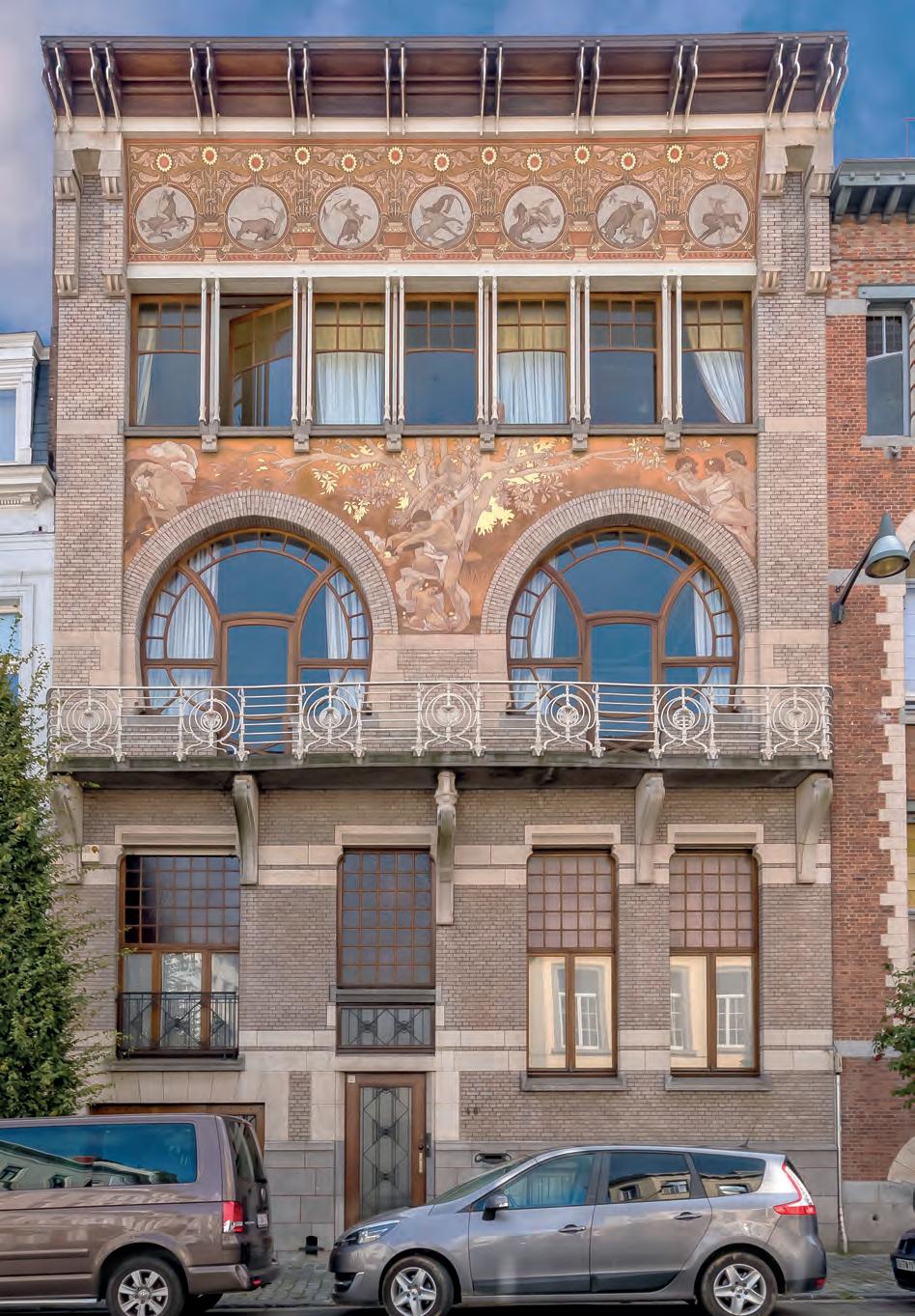
| Ciamberlani House, 48 rue Defacqz, Ixelles, arch. Paul Hankar, 1897
BELGIAN SOCIETY DURING THE INTERWAR PERIOD
By the end of World War I, which was a conflict with an unimaginable scope, the population was impatient for normal life to resume. Life would never be the same, however, and a new society emerged, which was defined for two decades by contradictory influences, including social progress, economic crises, prosperity for some and misery for others…
In 1919, universal suffrage for men, which was already a topic before the war, was finally enacted, changing the political landscape. While women had a lot more freedom compared with before the war, they could still only vote in municipal elections.
The Catholics lost the majority which they had held since 1884 as a result of this universal suffrage, forcing them to form coalitions with the liberals and the socialists. Belgium had eighteen governments in all during the years from 1918 until 1940, which were forced to deal with various crises associated with monetary instability, language issues, the need for social reform and so on.
The authorities promptly took measures to eliminate social equality and improve the living conditions of workers, limiting working time to 48 hours a week and 8 hours a day, enacting the right to strike and the freedom of association as well as 6 days of leave per year, compulsory insurance against unemployment, sickness and disability…
The way of working also changed, both in factories and in offices. No effort was spared to make operations more rational, better organised and more efficient,
resulting in increased mechanisation, assembly line production, bigger companies and the dehumanisation of workers and employees as well as giving rise to new relations with employers. Films like Fritz Lang’s Metropolis (1927) or Charlie Chaplin’s Modern Times (1936) paint a rather caricatural picture of these situations.
The government also had to focus on other greater issues, namely rebuilding a country that had been devastated by war and a lack of affordable housing.
In 1919, the Société nationale des habitations et logements à bon marché (The National Affordable Housing Society) was established to promote the construction of housing. The succession of monetary and economic crises was also a problem. The international crisis, which kicked off with the crash of the New York Stock Exchange in 1929, also affected Belgium, culminating in various social problems, such as rising unemployment, declining purchasing power, strikes… The authorities launched a series of largescale construction projects in an attempt to alleviate the problems, as construction sites employed a lot of workers. One such example is the resumption of the work on the North-South connection in Brussels. In the face of all these economic and social problems, as well as the international situation which clearly was a harbinger of a new imminent conflict, the population was easily tempted by extremist movements with a populist message.
DAILY LIFE DURING THE INTERWAR PERIOD
In spite of all these problems, the population’s daily life vastly improved during the interwar period. The standard of healthcare, education and housing was better. Once peace was re-established, the population indulged in the pleasures that were available to it. Monetary instability prompted people to live in the here and now, to consume and to live life to the full. These were the decades of jazz, tango, and popular music. Everyone could afford a cinema ticket and many new cinemas sprung up, especially in Brussels. America was regarded as a cultural reference and music hall was a huge success. The first jazz bands were formed and soon every music hall wanted to have its own jazz band. The performance of Josephine Baker and the Revue nègre in Brussels in 1925 was the highlight of the year. The population, which now had more free time, flocked to sports events. Boxing, cycling and football were the
most popular pastimes and sports halls and stadiums were built that were big enough to accommodate the masses on Sunday afternoons. Fashion, especially women’s fashion, soon adapted to the new lifestyles. Gone were the corsets and the long dresses in heavy fabrics. Modern women preferred to wear lighter clothes, which also contributed to their gradual emancipation. The garçonne , or flapper, with her short hair, cigarette holder, bowler hat or beret, was the epitome of the liberated woman of the Twenties. Thanks to technological progress, soon every woman could afford fashionable clothes and cosmetics.
Cars became faster, more comfortable and safer and were soon built on assembly lines. The railway network was expanded and steam engines made way for diesel and even electric locomotives. Ocean liners continued
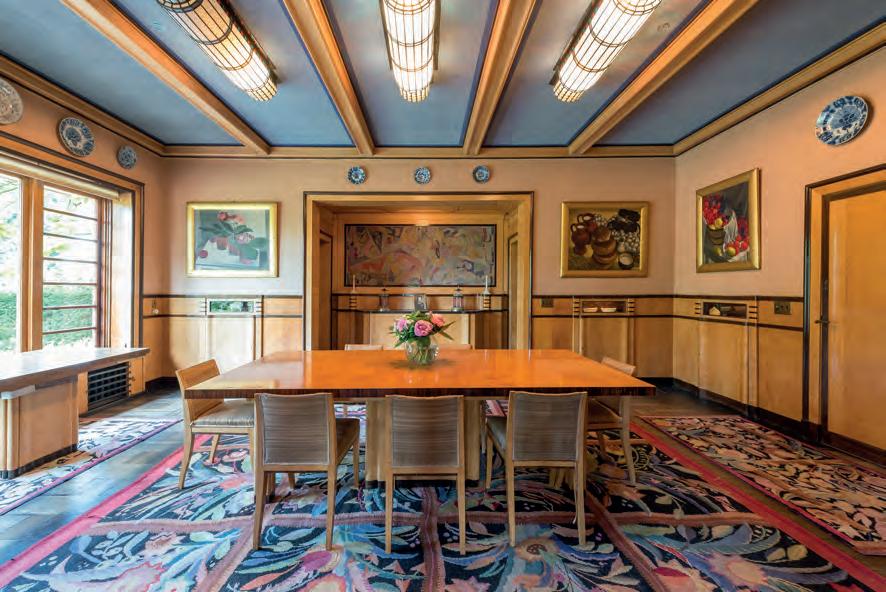
Dining room of the D. and A. van Buuren Museum, 41, av. Léo Errera, Uccle, 1924-1928
FIRST WALK THE IXELLES PONDS AND AVENUE ROOSEVELT
LA LOGE TO VILLA EMPAIN
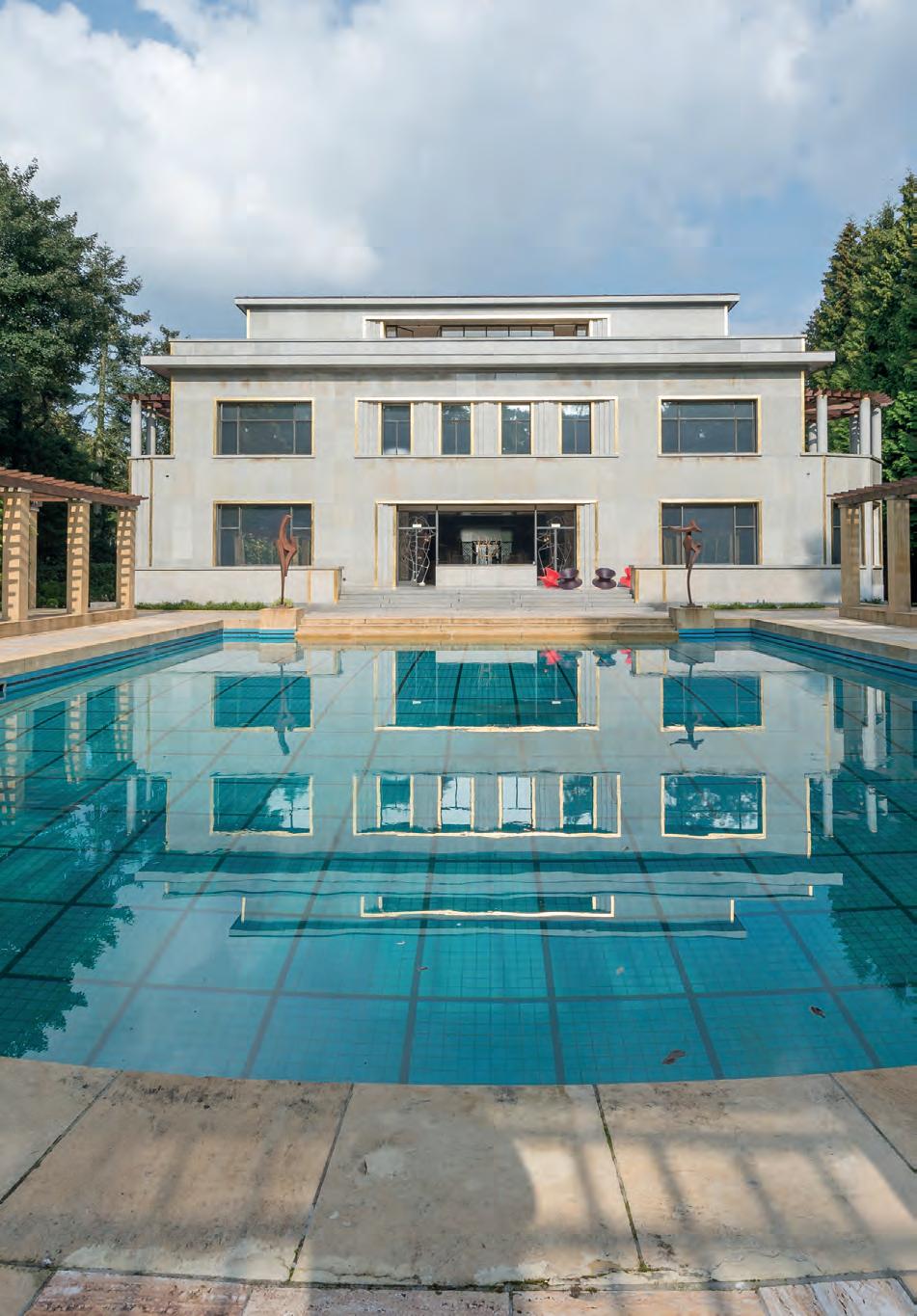
From the old location of the Masonic Lodge to Villa Empain, we will discover some architectural gems from the interwar period, including apartment buildings, town houses, cultural institutions, schools… This rather long walk can be taken in one go or split in two. The first part of the walk connects La Loge to Rond-Point de l’Etoile, by way of Flagey and the Ixelles Ponds. The second part continues along avenue Roosevelt, to Villa Empain, where the Boghossian Foundation is now located. This art centre aims to promote a dialogue between the cultures of the east and west.
| Rear view, Villa Empain / Fondation Boghossian, av. Roosevelt 67
01 FORMER MASONIC LODGE
86, rue de l’Ermitage, 1050 Ixelles
02 APARTMENT BUILDING
28, rue de l’Ermitage, 1050 Ixelles
03 FORMER RADIO BROADCASTING INSTITUTE
18, place Eugène Flagey, 1050 Ixelles
04 LA CASCADE
36, avenue Général De Gaulle, 1050 Ixelles
05 RÉSIDENCE BELLE-VUE
50, avenue Général de Gaulle, 1050 Ixelles
06 LE TONNEAU
51, avenue Général de Gaulle, 1050 Ixelles
07 GROUP OF DWELLINGS
1-27, square du Val de la Cambre, 1050 Ixelles
08 PALAIS DE LA CAMBRE
60-68, avenue Émile Duray, 4, avenue de la Folle
Chanson, 1050 Ixelles and Brussels
09 PALAIS DE LA FOLLE CHANSON
2, boulevard Général Jacques, 1050 Ixelles
10 RÉSIDENCE ERNESTINE
3, rond-point de l’Étoile, 1050 Ixelles
11 DOUBLE HÔTEL DE BODT
27-29, avenue Franklin Roosevelt, 1050 Brussels
12 PRIVATE HOME OF THE ARCHITECT AND APARTMENT BUILDING
52, avenue Franklin Roosevelt and 1, avenue Antoine Depage, 1050 Brussels
13 PRIVATE DWELLING
90, avenue Franklin Roosevelt, 1050 Brussels
14 VILLA EMPAIN / FONDATION BOGHOSSIAN
67, avenue Franklin Roosevelt and 32, avenue Victoria, 1050 Brussels
15 APARTMENT BUILDING
4, avenue des Scarabées, 1050 Brussels
16 VILLA
3, avenue du Brésil, 1050 Brussels
1/ FORMER MASONIC LODGE
86, RUE DE L’ERMITAGE, 1050 IXELLES
Architects: Fernand Bodson and Louis Van Hooveld
Built: 1934-1935
This building, which was built for the Belgian Federation of Human Rights, originally only had a ground floor, where the temple was located, which was covered by a roof with a slight pitch and a small upper floor that was set back.
In 1955, the building was raised to accommodate a second temple and offices. This transformation is invisible as the same brick was used. In 1984, Droit humain moved out and the building was used by the Archives d’Architecture moderne as an archive centre.
In 2001-2002, it became an architecture museum.
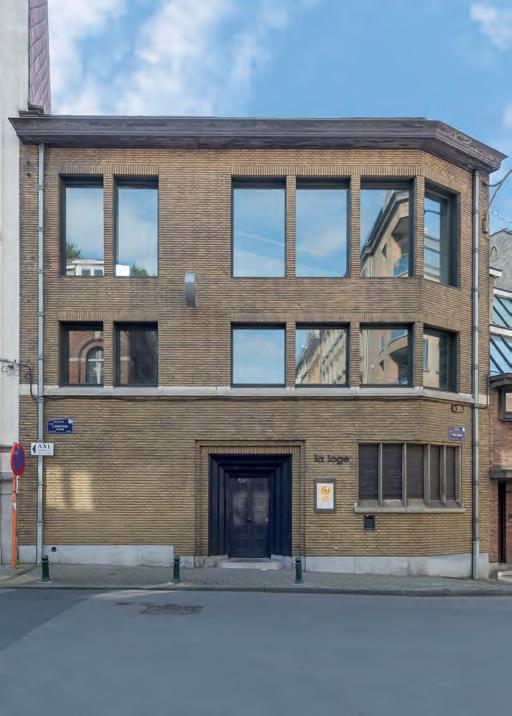
It currently is home to La Loge, a Brussels space dedicated to art and contemporary practices. The volumes and decoration of 1935 were preserved, including the large temple, a vast parallelepiped rectangle, that was painted white. From the outside, only the building’s striking volumetry and its dark wooden entrance draw attention to this unassuming building. The porch is set in the façade and was the starting point of a symbolic journey from the shadows to the light. One of the first Modernist architects, Fernand Bodson (1877–1966) refused any references to older styles. At the same time, he never built extremely pared-down buildings. A committed philanthropist, who also founded several journals, he was involved in the discussions on the rebuilding of Belgium after the Great War. He built social housing and developed prefabrication methods. At the end of the Twenties, he distanced himself from the Modernist movement, despairing over its radicalism. He ended up moving to the United States. This voluntary exile also explains why he is not very well-known.
| Former Masonic Lodge
Also by Fernand Bodson, next to the former masonic lodge, at 2-4 rue Paul Spaak, this Modernist building (1930) was used by two artists, as a studio, each with its own skylight. The façade is clad with terracotta tiles, which accentuate the building’s horizontal design. One of the two entrances leads to a courtyard, and an older house, where the Bodson family once lived. This building and the adjacent dwellings (6 and 8 were also designed by Bodson and date from 1927), which were built in the former location of an ice-house, and the first Decroly school attest to the huge talent of this architect.
CIVA, the international centre for city, architecture and landscape, is situated on the uneven side, in rue de l’Ermitage. On the even side, you will see a series of apartment buildings dating from the interwar period, after a group of more modern buildings that were built after World War II, where a V1 fell in 1944 (58 through 70). At No. 52, an Art Deco house (arch. Adolphe Puissant, 1923) with the original brick designs and stylised owls under the first-floor windows; at No. 50, an Art Deco apartment building with a distinctive entrance (arch. Jos Mouton, 1925) ; at No. 48, a modernist apartment building, built for the real estate developer Les Pavillons français (arch. Marcel Peeters, 1938) ; at No. 46, an apartment building which resembles an ocean liner, with an impressive volumetry (arch. Lucien De Vestel, 1936).
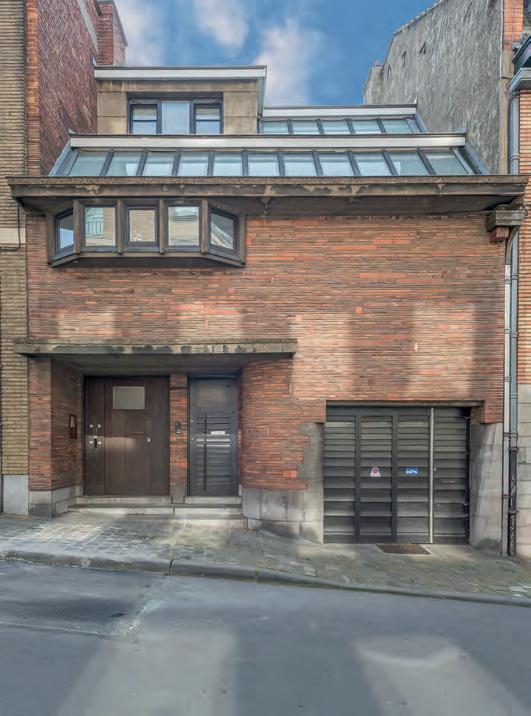
| Dwellings, 2-4, rue Paul Spaak, arch. F. Bodson
2/ APARTMENT BUILDING
28, RUE DE L’ERMITAGE, 1050 IXELLES
Architect: Louis Herman De Koninck
Built: 1935
The façade of this small modernist building, with five apartments, is made of a reinforced concrete wall, a technique which the architect developed and perfected. The span of the stairwell, which originally was much more refined and featured more subdivisions, has been altered. There was a small dwelling and an office for a liberal profession on the ground floor. On the upper floors, the luminous one-bedroom apartments had a balcony at the front and at the rear, with railings that were reminiscent of ocean liners. A staircase led from the balcony at the rear on the top floor to the rooftop terrace, with a canopy.
16, rue de l’Ermitage, a corner building (arch. Jos Mouton, 1925) stands out because of the vast terrace on the first floor, above the garages. Its concave façade, with white stone elements, brick combinations and protruding balconies must be seen from a distance. The entrance on the side has several stunning details, including the luminaire, the letterboxes, the boot scraper on a granito and stone floor…
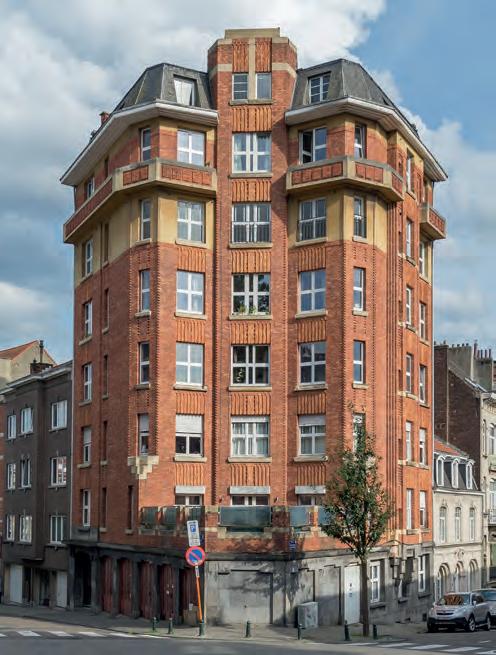
| Apartment building, 16, rue de l’Ermitage, arch. J. Mouton
3/ FORMER RADIO BROADCASTING INSTITUTE
18, PLACE EUGÈNE FLAGEY, 1050 IXELLES
Architect: Joseph Diongre
Built: 1935-1938
Listed: 28/4/1994
The National Radio Broadcasting Institute (Institut national de la Radiodiffusion (INR)) was founded in 1930. It required a large building, for ten recording studios and offices, and a hall for the public. In 1933, the project of an architect called Diongre was selected for its technical and aesthetic properties, after a competition. This massive building, which was built between 1935 and 1938, inspired by ocean liners, is clad with yellow bricks. The horizontal windows, which are so typical of modernist architecture, add to the building’s powerful horizontal appearance, which is offset by the verticality of the entrances (one for the public in place Sainte-Croix and the other for INR employees in place Flagey) and the corner turret for the TV antenna, which the architect sensed was the next step. The municipality of Ixelles required that the ground-floor be transformed into shops. The building fulfilled several technical requirements. The recording studios, which came in various sizes, were large enough for an audience and were situated in two acoustic towers with thick walls, which in a sense are the building’s vertebral columns, around which the administrative and technical offices were built. The building’s interior design and its furniture, its precious wood panelling and thick carpeting, were also created by Diongre. From the outset, this building became internationally famous for the quality of its studios, attracting world-class musicians. In 1953, the building also witnessed the advent of television. When the radio and TV broadcasting corporation left the premises in 1974, it was only sporadically used until it finally closed in 1995. Despite the fact that parts of it were listed, its future remained uncertain for quite some time due to the use of asbestos. In 1997, a working group of personalities from the private and arts sectors devised a plan to save the building
and give it a new use. On 30 June 1998, the limited company Maison de la Radio Flagey acquired the building and undertook its restoration. Flagey reopened in October 2002. The entrance in place Sainte-Croix once again leads to the former studios, which now host cultural events. The entrance in place Flagey leads to the offices that are occupied by private companies. The Belga Café, the Variétés restaurant and the ticket office are located in the former shops. On the side of place Flagey, the adjoining building (No. 19) was built in the Fifties, in the same style as the IRN, taking into account the strict urban planning rules that apply to any building in the square.
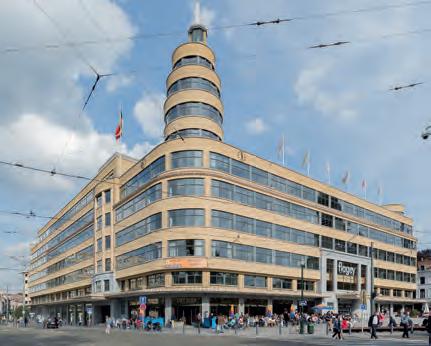
Former Radio Broadcasting Institute
4/ LA CASCADE
36, AVENUE GÉNÉRAL DE GAULLE, 1050 IXELLES
Architect: René Ajoux
Built: 1939
Avenue de la Cascade, after which this building is named, and which extends along the Ixelles ponds, was renamed avenue Général De Gaulle after World War II in the French president’s honour. Its ocean liner design and its cladding with white ceramics had led to this building sometimes being called the bathroom
of Ixelles . There is a wave-like feel to the design, in the combination of the façade’s volumes and the gate of the front garden, in the corner windows and the ceilings of the terraces. The rounded entrance is framed by two porthole-shaped windows.
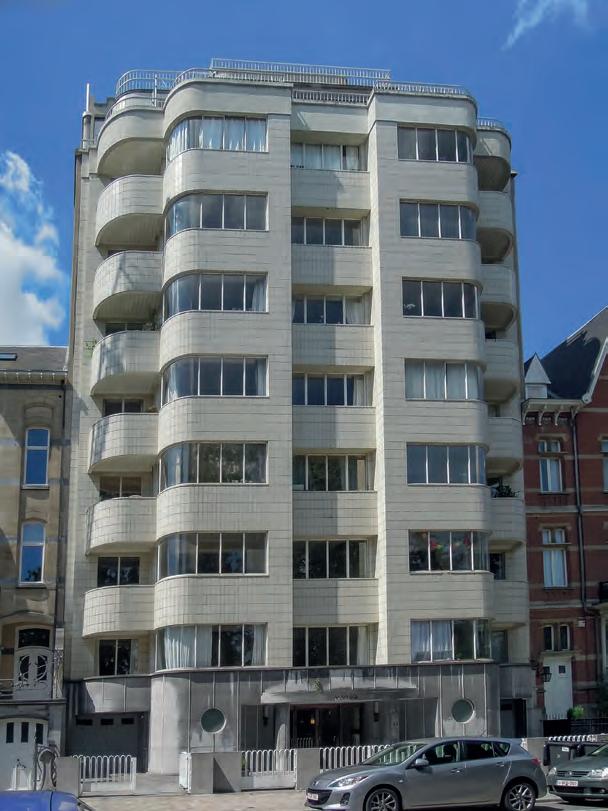
| La Cascade
APARTMENT BUILDINGS
After World War I, the construction of apartment buildings for the middle class boomed in Brussels, for practical and financial reasons and following the implementation of the Law of 8 July 1924, which made the principle of co-ownership legal. Until then, this type of dwelling was never a success with the affluent classes, who preferred a lifestyle based on private dwellings. The Société Belge Immobilière (SBI), which was founded in 1922, was the first company to take advantage of this change in legislation and promote this type of housing to the middle class. The apartments it built were originally inspired by the Beaux-Arts style, in an attempt to convince its hesitant clientele. From 1925, the buildings were more original, more modern. Other real estate companies also started to build apartment buildings, for rent or for sale. They include JeanFlorian Collin’s Études et Réalisations immobilières (ETRIMO) and Compagnie générale d’Entreprise immobilière (COGENI). These companies resorted to rational and modern building techniques, used reinforced concrete for the structure and foundations of these apartment buildings. These buildings offered all the comfort of the old town houses on several floors, but one single floor, with the added plus of mod cons, such as lifts, fitted kitchens, bathrooms, a concierge, garages, a garbage chute, central heating, a laundry room, wall cupboards, a telephone…
The apartments were subdivided into three autonomous zones, which corresponded to the division in several floors of the old town houses, which were separated from each other with hallways and corridors: the reception rooms,
the private rooms (bedrooms, bathrooms) and rooms for domestic purposes (kitchen, study, maid’s room). The reception rooms received special attention and were often vast and on the façade side. The shared spaces of these buildings were also very luxurious, revealing the occupants’ social status to visitors. The Residence Palace holds a special place in the history of apartment buildings in Brussels. The
CEO of Crédit général hypothécaire, Lucien Kaisin, tasked the Swiss-born architect Michel Polak (1885-1948) with the design of the huge Residence Palace (1922-1927), which combined all the assets of a luxury hotel and the city for millionaires. The building, in rue de la Loi, had 180 apartments, with 8 to 22 rooms, and a host of exceptional services: a theatre, restaurants that delivered food to your home with a dumbwaiter, a pool, a fencing hall and a gym, tennis courts, a garage, a shop, a bank, a post office… A cosmopolitan elite moved in, thereby giving its seal of approval to this new housing concept and convincing the middle class. The building, which was commandeered by the Germans in 1941, was acquired by the Belgian State in 1947, which converted it into an administrative building.
5/ RÉSIDENCE BELLE-VUE
50, AVENUE GÉNÉRAL DE GAULLE, 1050 IXELLES
Architect: Stanislas Jasinski
Built: 1933
Stanislas Jasinski (1901-1978) trained with several architects in Brussels and Paris, including Henry van de Velde. He was regularly asked to build apartments buildings for real estate companies, creating some of Brussels’ most beautiful apartment buildings, with a pure and elegant design. He also built houses, villas, designed interiors and helped build hospitals. On the outside, this corner building, which he designed for ETRIMO, and which is clad with white stone, has a rounded entrance, surmounted with a cylindrical projection running the length of the building. The span
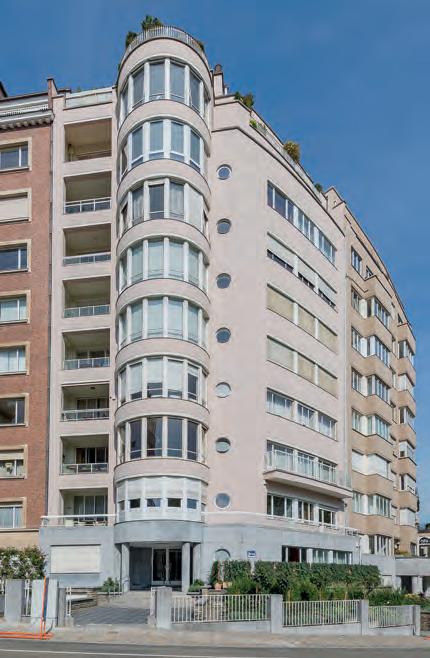
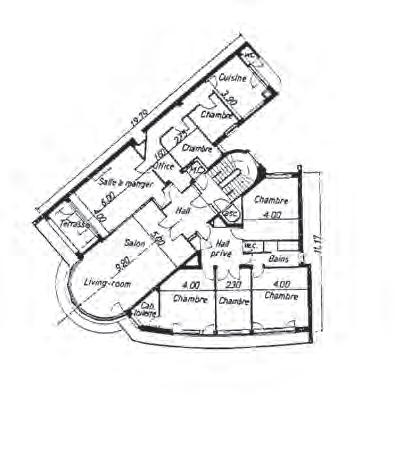
with porthole-shaped windows is reminiscent of an ocean liner. At the time, writers extolled the qualities of this building, its location, its layout and its beautiful finish.1 The building, which is proportionate to the open space in front of it, had a lovely view of the ponds. Authors were unhappy about the many apartment buildings with multiple floors that were being built in secondary, narrow streets. There was an apartment on every floor of this building, with a floor area of 200 m2, divided into three separate zones: the living and its rotunda in the centre, which was separated from the dining room with terrace by a wide glass window, with the study, the kitchen and two maid’s rooms at the rear. To the right of the entrance, a separate hall led to four bedrooms and two bathrooms for the apartment’s owners. So there was a clear division between the reception rooms, the private rooms of the owners and the realm of the domestic help. The structure of this building, made entirely out of reinforced concrete, meant that the architect did not have to stick to this fixed layout and was able to alter the spaces.
Floor plan of the 5th floor. Taken from La Technique des Travaux, No. 3, 1937, p. 117
Résidence Belle-Vue
6/ LE TONNEAU
51, AVENUE GÉNÉRAL DE GAULLE, 1050 IXELLES
Architect: Jean-Florian Collin, with Stanislas Jasinski
Built: 1939-1940
Listed: 19/4/2007
This apartment building, which clearly has some similarities with the design of an ocean liner and which is clad with pink cement, lives up to its name. Its ribbon windows are interrupted by a central, glazed span, capped with vertical spurs, which are so typical of Collin’s work. Jean-Florian Collin (1904-1985), a self-made man, architect, real estate developer and liberal politician, set up a business as an architect-builder in 1926. After declaring bankruptcy for the first time in 1932, he established ETRIMO (Études et Réalisations immobilières) in 1935, becoming a
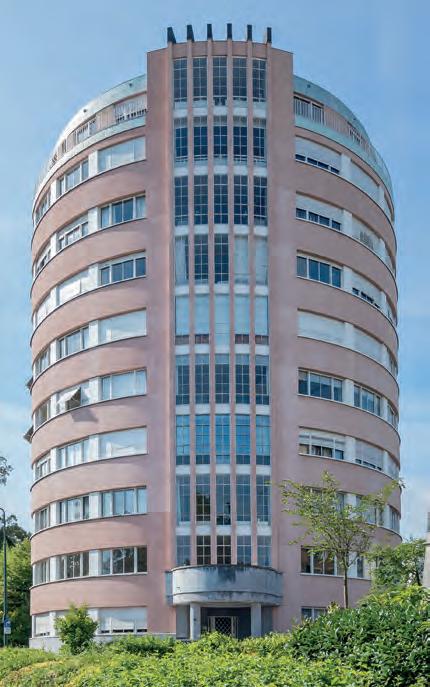
spearhead for modernist middle-class apartment buildings. After the war, ETRIMO specialised in the construction of medium-sized housing, which no longer had the same architectural quality or attention to urban integration, which was so typical of the buildings of the Thirties. Collin declared bankruptcy again in 1970.
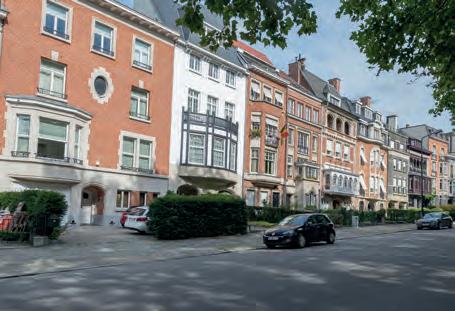
Let’s continue our walk to avenue Émile Duray. This avenue, which extends along La Cambre Abbay, was built for the World Expo of 1910 at Solbosch. The buildings along it all date from the interwar period and include several Art Decoinspired town houses: No. 4: 1928, Fernand Petit; No. 6: 1924, arch. Adrien Blomme; No. 12: 1925, arch. Michel Polak; No. 14: 1925, arch. Fernand Petit; No. 18 and No. 20, 1924, arch. Adrien Blomme.
Avenue Duray in Ixelles
| Le Tonneau
LA CAMBRE, AN ARCHITECTURAL SCHOOL
The site of the former La Cambre Abbey is now home to the renowned architecture and visuals arts school with the same name. In the early twentieth century, Belgium had various architectural programmes, with different approaches: artistic in the academies, technical/scientific in the engineering and artisanal schools of the Écoles Saint-Luc. In 1926, the La Cambre Decorative Arts School was founded. The first academic year started in 1927. Under the
impetus of its founder and first director, Henry van de Velde, La Cambre became synonymous with an extremely original approach to the arts, with students learning the different styles, in the same vein as the Bauhaus School in Germany. La Cambre added modern, contemporary architecture to its programme and attracted several modernist architects as lecturers including JeanJules Eggericx, Louis Herman De Koninck, Victor Bourgeois, Antoine Pompe...
7/ GROUP OF DWELLINGS
1-27, SQUARE DU VAL DE LA CAMBRE, 1050 IXELLES
Architect: Adrien Blomme
Built: 1925-1932
The Compagnie générale d’Entreprise immobilière (COGENI) tasked Adrien Blomme with the job of designing a plan for this close, with a main entrance along avenue Duray. Originally a private road, this subdivision shows how the wealthy classes wanted to isolate themselves from the city. At the same time, it was apparent, at the time, that these small urban islands had to be densely built up, for financial reasons but also because space was becoming an increasingly rare commodity. This subdivision is built around a square and extends, beyond the covered entrance with its pinnacle, to avenue de l’Hippodrome, with various winding roads. For the most part, it is made up of private homes, and one large apartment building. Adrien Blomme built or designed the plans for most of the houses, which were inspired by medieval and Baroque architecture. The square’s ambience is similar to that of a beguinage or a garden city.
At 52, avenue Émile Duray, a modernist house that was built by COGENI was recently restored (arch. Charles Bartels, 1928).
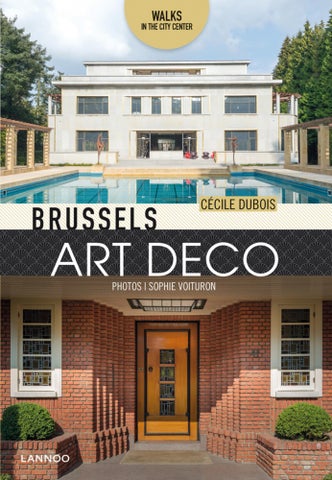
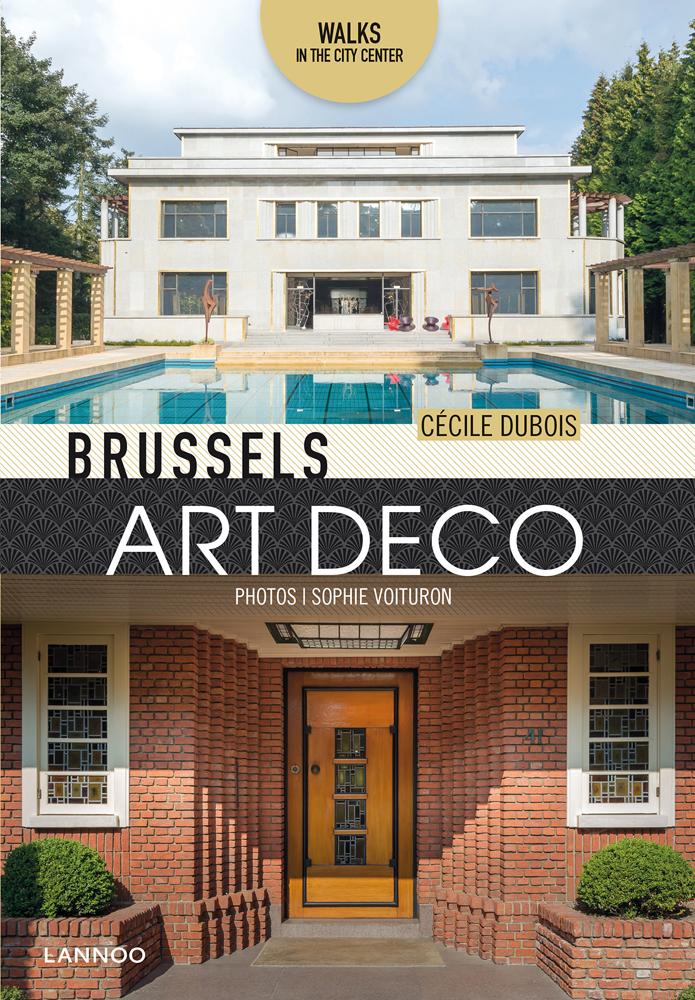
Cover caption:
Top: Villa Empain / Boghossian Foundation
Bottom: A. and D. van Buuren Museum
Text: Cécile Dubois
Translation from French: Sandy Logan
Proofreading: Karine Leroux
Photos: Sophie Voituron
Graphic design and maps: Aikaterini Chronopoulou www.aika-design.com
This book is published by Éditions Racine. Éditions Racine is part of the Lannoo Publishing Group. For more information: www.lannoo.be www.racine.be
Subscribe to our newsletter and receive regular updates about our latest publications and activities.
Any full or partial reproduction or adaptation of any extract of this book, by any process or on any medium, is expressly forbidden for all countries.
© Éditions Racine, 2018
Tour et Taxis, Entrepôt royal 86C, avenue du Port, BP 104A • B - 1000 Brussels
D. 2018, 6852. 25
Legal deposit: October 2018
ISBN 978-2-39025-058-6