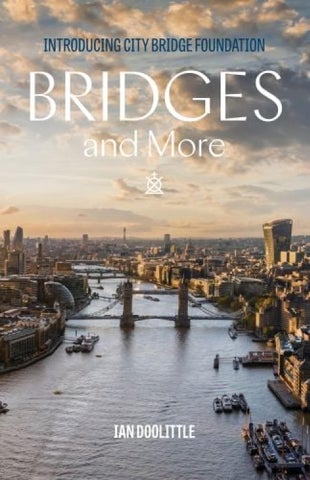
This edition © Kulturalis Ltd, 2026 Texts © Ian Geoffrey Doolittle and City Bridge Foundation, 2026 Illustrations © their respective owners, unless otherwise stated. Full credits and sources appear at the back of the book. The author has asserted his rights under the Copyright, Designs and Patents Act 1988 to be identified as the author of this work. First published in 2026 by Kulturalis Ltd 14 Old Queen Street London SW1H 9HP United Kingdom www.kulturalis.com In association with City Bridge Foundation City of London PO Box 270, Guildhall London EC2P 2EJ www.citybridgefoundation.org.uk ISBN 978-1-83636-039-1 Project manager and copy-editor: Ben Goulder Designer: James Alexander Proofreader: Caroline Ellerby Indexer: Nic Nicholas Reproduction by Opero, Verona Printed and bound in Turkey 10 9 8 7 6 5 4 3 2 1
All rights reserved. No part of this book may be reproduced, stored in a retrieval system, or transmitted in any form or by any means, electronic, mechanical, photocopying, recording, or otherwise, without the written permission of the author and publisher. Every effort has been made to trace and acknowledge the copyright holders of all illustrations. Full credits and sources are provided at the back of the book. Any errors or omissions are unintentional and should be notified to the publisher, who will arrange for corrections in any future editions. British Library Cataloguing in Publication Data A catalogue record for this book is available from the British Library. EU GPSR Authorised Representative: EASY ACCESS SYSTEM EUROPE OÜ Mustamäe tee 50, 10621 Tallinn, Estonia email: info@easproject.org
CONTENTS
Foreword 4 Preface 5 1 The Bridge House: a prologue 7 2 ‘God and the Bridge’: how it started 11 3 Kings (and some Queens): support, interference, and then disengagement 15 4 The trust that wasn’t: at least not for a few centuries 19 5 The City Corporation: the corporate trustee with a difference 29 6 London Bridge from Southwark to Arizona: the disappearing icon 41 7 More bridges: why, where and what? 49 8 Funding: property, tolls and credit 55 9 Southwark: an intriguing relationship 65 10 Parliament and politicians: coping with controversy 70 11 Tower Bridge: the new City Bridge icon 74 12 The City’s river and its bridges: a complicated relationship 78 13 ‘St Paul’s Bridge’: the bridge that never was 84 14 The new St Paul’s Bridge: for the millennium 87 15 ‘Ancillary purposes’: City Bridge Trust/Foundation 90 16 Discovering more: a remarkable archive 95 17 A current reading list 99 Acknowledgements 104 References 105 Illustrations 118 Index 119
FOREWORD Paul Martinelli, Chair, City Bridge Foundation
For more than nine centuries, City Bridge Foundation has played a quiet but steadfast role in shaping London. Today, we are best known as the charity that owns, maintains, and protects five of the Thames’ most iconic bridges at no cost to the taxpayer. Yet our purpose extends far beyond engineering. We help to bridge London in every sense: supporting essential infrastructure while, through our charitable funding, standing alongside the communities who live and work here. Over the past 30 years, we have awarded more than £850 million to organisations across the capital, supporting a fairer, more inclusive, and better-connected city for all. Our work also includes stewarding one of London’s most recognisable landmarks: Tower Bridge. As both a vital river crossing and a world‑class visitor attraction welcoming around a million paying visitors each year, Tower Bridge showcases the heritage, innovation, and global appeal of the capital, while generating income that helps sustain our charitable mission. To appreciate the scale and longevity of the Foundation’s impact, we can turn to the rich historical record preserved in The London Archives. City Bridge Foundation’s archive is one of the most significant medieval collections anywhere in the world. Its documents trace the story of bridge building, civic life, philanthropy, and governance across centuries, revealing not only how our bridges were engineered and cared for, but also how Londoners lived, traded, travelled, and imagined their city. The history of City Bridge Foundation offers a unique perspective on the development of the City of London and the wider capital. From medieval tolls and early infrastructure planning to moments of crisis, renewal, and reinvention, our archive provides a rare, unbroken line of sight from the London of the 1100s to the London of today. Throughout, one thread remains constant: the City of London Corporation’s careful and enduring stewardship of the charity. As trustee, the City Corporation administers and governs City Bridge Foundation with diligence and integrity, ensuring we remain focused on delivering public benefit for Londoners. I encourage anyone interested in London’s past – or its future – to visit the Archives and explore this extraordinary material. As we look to the next chapter of City Bridge Foundation’s work, the archive reminds us of the centuries of care, dedication, skill, and ambition that brought us here, and I am delighted that Ian’s book will help share this story with many more people.
4
BRIDGES AND MORE
PREFACE
The aim of this book is to introduce readers to the charity which looks after the City of London’s bridges – and also distributes its surpluses to good causes. City Bridge Foundation (CBF) deserves to be better known. It is not an ordinary charity. It uses its resources to maintain London, Blackfriars, Southwark, Tower and Millennium Bridges in perpetuity, but it also funds wider charitable activity throughout Greater London. This itself warrants attention but there is a very interesting ‘back story’ too. Until 2023 these activities were reflected in CBF’s two identities – Bridge House Estates (BHE) and the City Bridge Trust (CBT).* This book traces how BHE was established, how it built or acquired the City’s bridges, and how it was able to fund CBT for other qualifying purposes – and thus become today’s CBF. The history of CBF starts with the famous London Bridge completed (in stone) in the early 13th century, with its houses and 500-strong community (making it a so-called ‘living bridge’); and there ensued any number of vicissitudes (‘London Bridge is falling down’) before the Bridge found itself with both rivals and companions. The process by which the other bridges were constructed or acquired by BHE tells us a lot about London’s development and its transport challenges. There is also much to be said about the City Corporation, whose relationship with ‘its’ trust deserves to be better understood. And then there is the Thames itself – how the City and its ‘Bridge House’ trust coped with the difficulties of spanning a large and tidal river. But above all the story is about money – really interesting money, i.e. used for interesting purposes and ‘made’ in an interesting way. The funds that CBF uses and distributes today derive from the gifts of London’s citizens more than seven hundred years ago – some pounds or (often) shillings here, and a property or two there. When dying Londoners made bequests ‘To God and the * The complications warrant explanation. Bridge House Estates (BHE) came first, an unincorporated charity, with the City Corporation as its ‘corporate trustee’. In 1994 BHE was registered with the Charity Commission. It then established City Bridge Trust (CBT), as a grant-giving arm, with power to distribute ‘surplus’ money (i.e. not required to maintain the Bridges) for permitted purposes across Greater London. In 2023 BHE and CBT were re-branded as City Bridge Foundation (CBF). BHE remains the legal name. The distinction between ‘the Bridge House’ and ‘Bridge House Estates/BHE’ is not easy, particularly when referring to ‘estates’ (i.e. property). I have done my best.
PREFACE
5
Bridge’ they were making a civic as well as a personal and religious statement. CBF is almost literally their remarkable legacy. The City Bridge story has been told in many ways before, but not in an overall account as presented here. The subject-matter, with its many facets, is daunting. I have read as widely as I reasonably could, using for the most part printed sources. I have tried to produce a reliable and accessible account, while also posing questions and providing my own answers to help future historians. I am expecting and hoping for plenty of new insights and also corrections. CBF is keen to encourage further work on its rich archive: hence my approach to sources and citations.* A glance at the Contents page will show that my approach is thematic, though with the overall chronology recognised in the order of Chapters. This creates some overlap and repetition, but that is a price worth paying for drawing out issues and connections which would otherwise be lost. I was asked to write the book by CBF, but it is not an official history, still less an ‘approved’ one. (It certainly should not be treated as a ‘definitive’ account, legally or otherwise, of its complex subject-matter.) I am grateful for the support I have been given, but the text is my own – for good and for bad. I only hope that it gives readers as much pleasure as I derived from researching and writing it. Ian Doolittle October 2025
* Most of the references appear at the end of the book, numbered chapter by chapter. Where citations are given in the footnotes, they follow the same conventions. Full citations are given at the work’s first appearance (usually in the References but occasionally in the footnotes). Details of the most useful sources are set out in the suggested Reading List in Chapter 17. The text was largely completed in April 2024.
6
BRIDGES AND MORE
1 THE BRIDGE HOUSE: A PROLOGUE In 1350 the two elected Wardens of London Bridge handed over to their successors. Two inventories were drawn up, to effect a ‘clean’ transfer of responsibilities. One inventory listed the precious “books, vestments and other ornaments and goods” in the chapel on the Bridge itself;1 the other one simply itemised some “goods and chattels” found in or around a builder’s yard, south of the Bridge, in Southwark. But these were no ordinary “goods and chattels”, and this was no ordinary yard.2 The goods and chattels comprised, first, a formidable assortment of timber, including 400 great pieces of oak, wood for 14 shops, “fully wrought and framed for immediate building”, 120 pieces of elm for piles, and no fewer than 87,000 strips of wood (or laths) for various construction purposes. Then there was stone, notably 1,734 pieces or feet of Portland stone, some of it “hand-worked and squared”, 600 feet of cornerstone, 18 great stones from (possibly) Dorset, 2 boat-loads of ragstone, a boat-load of chalk, plus 12,000 tiles. The iron included vast numbers of nails: for planks (15,000 in all), doors (10,200), windows (5,100), roofs (23,000) and so on, including 400 large ones “for the drawbridge”. There were also “110 irons for piles”. Extras (not valued) included two boats and a barge, and “two engines with three rams, for ramming the piles of the said bridge”.3 The yard was part of a large site, to the east of London Bridge, near St Olave’s church, on the river side of Tooley Street. Contemporary descriptions of the yard and its surrounding buildings naturally focus on the latter, but there are enough details in the records to help us re-create the former: a porter at the gate;4 his fierce dogs or hounds which kept strangers out but occasionally chose the wrong victim;5 half a dozen cart-horses sharing the stable with the Wardens’ pair of riding ones;6 a shelter with a warm fire made available for tired and wet workmen after a night shift;7 river-water flooding the downstairs rooms;8 a crane for lifting heavy supplies from the adjacent wharf or dock;9 and a forge and grindstone for the iron-work.10 Great quantities of raw materials of the kind listed in the 1350 inventory arrived at the Bridge House gate by cart, or at the wharf by boat or barge:11 there was (for example) timber from Croydon,12 (a huge load of ) bricks from Deptford,13 chalk from Northfleet,14 and stone from Maidstone.15 All this was man-handled by labourers into and around the yard,16 and then it was worked on by a small army of craftsmen and labourers, mainly for use on the Bridge itself but also for the rent-generating properties in the City and elsewhere.17 The next stage was much movement of men
THE BRIDGE HOUSE: A PROLOGUE
7
An early use of the Bridge House mark (alongside the City’s arms) – on a Southwark property plan (1680)
and materials from, and back to, the yard. The yard was thus not really a builder’s yard at all; for a very long time it was the hub of a major maintenance, indeed construction, operation. The buildings included not just a storehouse and workshops, but also a hall, parlour, counting house and the rest (including a house for the chaplains) – plus, from the early 16th to the mid-17th centuries, City-run granaries to store wheat against shortages and also ovens to make bread for the poor.18 The main buildings were quite grand: their stone construction caught the eye of the celebrated John Stow, writing in the late 16th century;19 and there are references in the accounts to decorative features, draperies, carpets, clocks, and so on.20 The garden was clearly
8
BRIDGES AND MORE
maintained as much for pleasure (flowers) and indeed show (a fountain), as for more practical purposes, at least until the 18th century.21 There were even swans, treated by the Wardens with self-conscious privilege, under the supervision of the royal swanmaster, no less.22 Some of this formality reflected the fact that the Wardens shared the buildings with the City for its civic purposes (administering justice and maintaining the bread supply)23 – as well as the Wardens wanting to put on a ‘good show’ when City officials came to check on their work.24 There were plenty of reminders, in the forms of arms and other decorations, that this was a City of London institution.25 But there was self-confident pride too, demonstrated by the use of a ‘mark’ – a logo, if you will. The first indirect (published) reference – to a “marking iron” – may be that in the 1461–2 accounts,26 while the first direct one – to “the Bridge mark” – could be that in 1537–8.27 Initially the concern was merely to demonstrate ownership of stores and equipment: in 1461–2 it was timber,28 in 1509 stone,29 while in 1561 it was leather buckets.30 These marks (which seem to reflect the trust’s religious basis) were very basic, easily branded or carved ;31 but by the 16th century the mark was also being used for decorative purposes. When the Hall was re-fashioned, it acquired twelve green ensigns (or emblems) embroidered with the mark,32 as well as 30-odd panes of glass engraved with “the Bridge mark and the date of Our Lord”.33 The mark then ‘evolved’ and was presumably standardised, at least in formal settings; and it eventually adopted the more elaborate, stylised design attributed to William Leybourn (an important City surveyor in the later 17th century),34 and which is still used for CBF and (with variations) for Southwark-wide purposes today. It is thus easy to see why – when the bustling ‘builders’ yard’ activities developed apace into a major operation – the Wardens called their headquarters in Tooley Street “the Bridge House”,35 “the House of London Bridge”,36 or just “the House”.37 The Yard remained “the yard”. And the Bridge House name stuck.* It is in fact an odd name – and not merely because it disguises what went on outside the house and other buildings on the Tooley Street site. It is certainly worth clarifying here what 13th-century citizens really meant by ‘the Bridge House’. In 1272 property was left by will (to) “Domui Pontis London[iarum]”, making it clear that London or Londoners had a ‘Bridge House’.38 The author of Old London Bridge refers to the “dwelling house” attached to the chapel – though he is unsure whether the former was next to the latter (i.e. on the Bridge itself ) or close by, in Southwark.39 The evidence for the dwelling house is unclear; the apparent source for the comment does not help.40 It might simply be based on a misreading – or expands on the belief that the Tooley Street property was once a house belonging to either Peter of Colechurch himself or (more likely?) the old timber bridge.41 The comment certainly confuses. It is important to appreciate that, as we shall see, the Bridge ‘trust’ * In 1840 “the Bridge House and Yard in Tooley Street, with the garden and the wharves adjoining, were leased … for development”: Masters, ‘Records of BHE’, in To God and the Bridge, [3].
THE BRIDGE HOUSE: A PROLOGUE
9
A grant by Peter of Colechurch (the ‘founder’ of London Bridge), with the Bridge seal attached (c.1176–1202)
12
BRIDGES AND MORE
various kinds, and a number of saints’ relics – all worthy of an important church.16 The chapel remained a fundamental and quite expensive feature of the Bridge, right up to the Reformation (when it was stripped and converted into a house – and St Thomas himself was ‘dissolved’, by royal command)17* – attracting pilgrims and donors as well as regular worshippers;18 and the riverbed has yielded many items associated with the religious life of the Bridge.19 As we have seen, the Bridge chaplains and the ‘brothers’ (and also ‘sisters’) all lived together, in what could be called the Bridge House community, near the southern end of the Bridge in Southwark.20 Some husbands and wives joined them on the basis of ‘corrodies’ – i.e. in this case giving or promising property/money and getting board-and-lodging, so to speak, in return.21 As in more conventional religious houses, there was a good deal of self-help.22 We know the names of many of the chaplains and the so-called ‘religious’ – though only their Christian names, of course – because of their involvement in the administration of the Bridge.23 Chaplains clearly rolled up their sleeves, when not serving in chapel;24 more basic tasks were no doubt undertaken by the brothers, with some of them managing the estate elsewhere.25 But the brothers’ main role was to raise funds.26 The Bridge was often called the City’s bridge,27 and it was certainly more ‘iconic’ than either Guildhall or St Paul’s;28 but it was also and, in a way, really the citizens’ bridge. Londoners felt a deep commitment to their Bridge. There was pride, as well as piety. The Bridge absorbed a good deal of the wealth which might otherwise have been directed elsewhere: it is striking that, while parishes and guilds were significant attractions for medieval Londoners’ largesse, the City itself was not. In other words, the Bridge was as much a focus for civic responsibility as Guildhall. As Philip Jones explained: The citizens were encouraged to feel that it was their duty to support what was not only a commercial asset but almost a sacred structure. Its maintenance was an obligation of citizenship as well as an act of faith and charity.29
This was reflected in the way gifts were phrased. There was an early gift to “the church of the blessed Thomas [Becket] the martyr upon the bridge of London, and the brothers there serving God, and for the maintenance of the same bridge”.30 Hence the well-known description of or for such donations – ‘to God and the Bridge’.31 Some gifts were for the chapel and its priests; others were “for the maintenance of the [Bridge]”; still others were for specific works or purposes.32 But the distinctions were probably ‘lost’ over time, especially after the Reformation. In his speech at the laying of the memorial (or foundation) stone for the new Tower Bridge in 1886, the Recorder referred to the Bridge House estates as “partly bestowed by generous * Henry VIII saw Becket as a dangerous rebel – and Londoners were forced to pretend that their Thomas was really the Apostle of the same name.
‘GOD AND THE BRIDGE’: HOW IT STARTED
13
London Bridge in 1544 – detail from a panorama by A van den Wyngaerde
The Bridge was home to a large population – 550 or more at the end of the 17th century, when there are good records – and possibly, by extrapolation, significantly more in earlier times.10 It was a real community, at least until some lessees used the properties mainly as shops and acquired (other) homes elsewhere.11 The vigour of the Bridge’s economy helped it overcome the destruction caused by serious fires – in 1504, 1633 and then of course in 1666. The 1633 one was in fact the worst of the three.12 Many houses were destroyed and the (partial) rebuilding did not start until 1646, and then took four years to ‘complete’.13 Less than twenty years later, houses at the City end of the Bridge were destroyed in the Great Fire – and replaced
42
BRIDGES AND MORE
with ‘sheds’ – in fact, rather grand ones, which proved not to be quite as temporary as intended.14 It was said that the Bridge House had to spend £1,500 before tenants could start rebuilding.15 In 1683 the sheds were finally removed and the houses there rebuilt – by private or at least personal enterprise, with the Bridge House Lands Committee granting building leases (of ‘blocks’ ) more akin than hitherto to practice elsewhere in London.16 Despite detailed specifications, the quality of at least some of the work left much to be desired.17 Over the following years, most of the other houses were rebuilt too, though it was not at all easy dealing with the existing lessees – and there was plenty of to and fro with the builders and the new lessees.18 The result was however deemed to have improved the Bridge’s appearance.19 The fact that after yet another fire in 1725 most of the houses were rebuilt satisfactorily by the tenants (many of whom now had insurance) indicated a secure future for the Bridge houses;20 but there were in fact problems which, in little more than a generation, were to lead to the removal of London Bridge’s remarkable superstructure. The external factors were two-fold. One was aesthetic – a distaste for the houses as unsightly encumbrances. Influential critics such as James Ralph and Nicholas Hawksmoor were scathing.21 The other, possibly more important, factor was practical – the roadway across the Bridge was still only twenty feet wide,22 whereas the new, elegant and (for the City) very unwelcome Westminster Bridge (1739–50) would be thirty feet wide.23 Innovative traffic management (famously, keeping to the left hand side) was needed to deal with the heavy usage and alleviate the congestion. The ‘internal’ considerations were more complicated. If the roadway were to be widened, then extensive rebuilding or alterations were required. The Bridge House certainly had the opportunity to make radical changes. George Dance, the City’s clerk of works, had previously designed a uniform new-look for the houses on the Bridge, and the expiry of a large number of leases meant that the Bridge House Lands Committee could require prospective lessees to build new houses in accordance with Dance’s classical model.24 This approach was the same as adopted in 1683–96, i.e. the Bridge House was asking others to take the risk and bear the strain. The 1740s however were not a good time for property speculation, with a glut of property on the market and possibly insurance problems with houses on the Bridge. There were evidently no bids at all for the new leases. The pressure grew. Some of the houses were in urgent need of extensive repair or indeed replacement, and the Bridge House badly required the rental income. It was therefore decided that the Bridge House should itself contract to build at least some of the new houses, i.e. to assume the risk (as it had done in 1646–9). Mark Latham sees this as evidence of the Bridge House’s determination to retain the rents – and cost-saving plans to rebuild the Bridge itself foundered, it seems, because they were not obviously compatible with the plans for new houses.25 A treatise on bridges, ancient and modern, written in 1751 with a particular account of London Bridge’s new rival, commented tartly, though not inaccurately, that:
LONDON BRIDGE FROM SOUTHWARK TO ARIZONA: THE DISAPPEARING ICON
43
Tower Bridge under construction (1892)
they got quickly to work, with plans and costs.16 Three designs were proposed, two ‘swing’ and one ‘bascule’. The third was basically the same as the 1878 one, from which it was tactfully said by Horace Jones to have ‘evolved’.17 The cost was the same too, i.e. £750,000 – though it was now expected that BHE would bear it all – and could afford to do so.18 The difference this time was that Common Council adopted the recommendation and authorised promotion of the necessary bill in Parliament. The process there was lengthy and costly – the City later (in its submission to the Royal Commission dealing with the Corporation’s ‘amalgamation’) made much of its difficulties, listing a host of powerful complainants.19 In fact, the most vigorous opposition came from the wharfingers – indicating that the ‘riverside economy’, or at least the value of the riverside properties, had indeed been a key problem. The House of Lords introduced some compensation provisions, and the Corporation of London (Tower Bridge) Act was passed in August 1885.20 The Act’s formal aim was to enable the City to “construct a bridge over the river Thames near the Tower of London, with approaches thereto, and for other purposes”.21* It authorised the City to use the security of the Bridge House estates to raise the £750,000 and such further sums as * Tower Bridge is outside the City’s boundary: Masters, ‘The Records of the Bridge House estates’, in To God and the Bridge, [4]; but it is treated as inside for policing and criminal law purposes: Remembrancer’s opinion, 2016.
76
BRIDGES AND MORE
might be necessary:22 the final cost of the Bridge to BHE was in fact nearly £1.2m.23 JW Barry, the engineer, remarked that “Londoners will thus be presented, without the charge of one penny on the rates, with a free bridge.”24 It was a powerful message and one that did the City no harm at all at a sensitive time,* with the MBW (which had been wrong-footed over the Bridge25) collapsing amid controversy but replaced by the more powerful, and therefore more dangerous, London County Council. Tower Bridge should be best known for its engineering – which engaged leaders in the field in that golden age of enterprise and ingenuity, and to which Barry’s essay in the Corporation’s book introduces us, with the Victorian matter-of-fact confidence which under-pinned it all.26 But the engineering was out of sight, obvious to those who are impressed by its reliability but only really revealed to those who took (and take) the trouble to visit.** It was the appearance of the Bridge that really mattered. Hence Jones’s brick-and-stone medieval castle, complete with drawbridge, in studied contrast to Bazalgette’s iron alternative. Barry was clearly reminding readers of the latter when he referred to the concern on the part of “aesthetical people” that the Bridge might “ruin the picturesqueness of the Tower of London by hideous girder erections”.27 Jones’s design “evolved”, as we have seen, and Barry recognised that the steel behind the stone might offend the purist – but he was right to anticipate that people would forget that the Bridge towers have ‘skeletons’, just as they forget that human bodies do too.28 Tower Bridge certainly seems, eventually, to have satisfied those anxious “aesthetical people” and with the public as a whole it became a key landmark – taking on the role of ‘icon’ from the old London Bridge.29 And in 1982 it became a visitor attraction, with its pedestrian walkways inventively re-opened for highlevel excitement. All that it lost in this process of adoption was its definite article. When it was first proposed it was called, as was proper (for a proper noun), “the Tower Bridge”. Whether, despite this subtle re-designation, it retained the public’s association of it with the adjacent Tower, is not entirely clear. There is a post-script. In its formal Statement to a Royal Commission in 1958, the City referred to schemes for the “ultimate replacement” of Tower Bridge being “actively” pursued. There was obvious concern about Tower Bridge coping with the weight of modern traffic.30 There can be little doubt that the replacement of Tower Bridge would not now be mooted in such breezy fashion. In a media-driven but also nostalgic age, icons are cocooned by ‘public opinion’.
* The ‘gift’ was interestingly linked to another PR-conscious initiative, the City’s acquisition and protection of Epping Forest: H Godfrey, Tower Bridge (1988), 18. ** Masters, ‘The Records of the Bridge House estates’, in To God and the Bridge, [5]; 1974 Statement, 44.
TOWER BRIDGE: THE NEW CITY BRIDGE ICON
77
12 THE CITY’S RIVER AND ITS BRIDGES: A COMPLICATED RELATIONSHIP The City’s relationship with the Thames was complicated. As far as ‘land’ is concerned, the City boundaries are shown on the map on the following page. The north shore end-points were thus essentially Temple in the west and the Tower in the east; the south shore was not part of the City (even after the acquisition of the Borough in 1550), though the whole of London Bridge and the so-called Bridge-foot was. This is reasonably straightforward, but there were inevitably some complications. Conventional principles were not applicable, not least because the City’s rights derived from a melange of charters and customs. Instead of taking responsibility, like normal river-bank (‘riparian’) owners, for ‘its’ half of the Thames (as shown on one authoritative map),1 the City claimed to own the (entire) river-bed.2 And the Thames is of course tidal – prompting the City to assert that its rights over the foreshore extended to the low water mark.3 Needless to say, there were plenty of legal tussles with the Crown over all this. As well as these ‘land’ issues, the City had river powers which in fact reached out well beyond its own boundaries, with conservancy responsibilities stretching nearly forty miles from Staines upstream right out to the start of the Thames estuary. (It may or may not be significant that these powers were first secured, by charter, at the end of the 12th century, when the stone Bridge was being constructed.4) It is by no means clear how these various jurisdictional rights and obligations became established or how they inter-related. Only when rights were challenged, or obligations enforced, was there any interest in examining charters and custumals. The City’s principal, and intertwined, concerns were fisheries and navigation. This often meant removing weirs, confiscating nets, and so on.5 These powers thus had real significance for the City’s trade – which depended on a free-flowing Thames as well as the Bridge which spanned it. ‘Conservancy’ had a hard, practical edge (including navigation) quite distinct from its modern connotation. Little wonder therefore that the City fought hard, if not always successfully, to protect its jurisdictional rights.6 It was even prepared, in the 16th and 17th centuries, to get involved in a protracted, heavy-weight tussle over the powers of the Admiralty Court, backed by the Crown.7 It was of course the City’s control over the Port itself which mattered most – and which had direct relevance for the bridges. As we have seen, the City claimed the (northern) foreshore (and thus potentially could control the main wharves, quays,
78
BRIDGES AND MORE
City of London Millennium Bridge 2000 RIVE
R THAMES
Blackfriars Bridge 1769, 1869
London Bridge 1209?, 1831, 1972
Southwark Bridge 1819, 1921
Tower Bridge 1894
The five Bridges, with completion dates
and so on), both above and below London Bridge.8 It was thus able to impose a wide range of dues and tolls on traders and their goods, in support of citizens’ freedombased rights. But the City was not the only ‘regulator’ in the Port. The Crown collected all-important revenue through customs dues; the Tower (as a royal liberty) also imposed tariffs; and the Admiralty and Trinity House had or asserted rights as well. Most of the quays were private, but there were public quays or harbours at Queenhithe, Billingsgate and St Botolph’s. (Both Billingsgate and Queenhithe were markets as well.9) Queenhithe was initially the most important, but later Billingsgate’s larger facilities came into their own. St Botolph’s was somewhat different: it was open to the public but responsibility for it was often contracted
THE CITY’S RIVER AND ITS BRIDGES: A COMPLICATED RELATIONSHIP
79
And though they were expensive, ad hoc projects like Southwark re-housing would not absorb all the unspent surpluses. It was therefore no doubt with PR-conscious relief, as well as straightforward pleasure, that the Bridge House started to look systematically at ways to use its surpluses. Somewhat contrived expenditure of the kind which led to ‘Housing’ rather than ‘a Bridge’ was replaced with a transparent commitment to other causes. By this time BHE’s legal status was becoming clearer – and the City’s approach to its trusteeship was changing too. At the beginning of the 20th century the City was sufficiently confident about BHE’s special status to push back at the Charity Commission’s attempt at what was clearly perceived to be intrusion: the City effectively asserted, with what success is unclear, that the various statutory schemes of administration put BHE beyond the Commission’s reach.6 Shortly after the Second World War a tax settlement for BHE was secured by the Chamberlain and the City Solicitor.7 This initiative may have prompted new questions about the application of charity rules and regulations. When the Remembrancer informally consulted the Chief Charity Commissioner about a new charter in 1954, he emphasised that: we have over many centuries run this concern [i.e. BHE] ‘on our own’ and we are frankly very nervous that any official move may lead to the Charity Commission deciding to start asking questions about us, supervising us and generally, so to speak, ‘bossing us about’.8
The concerns were smoothly, but authoritatively, allayed.9 A few years later, prompted by new charities legislation, the City decided that it needed formally to clarify BHE’s status. When the Act was being drafted, the Remembrancer tried, but failed, to secure an exemption for BHE and other large charities.10 Then, in 1960, the City Solicitor took up the issue, exchanging legal views with the Home Office, which confirmed the uncertainty, but discouraged formal resolution of it.11 The Charity Commission provided reassuring confirmation of its benign view,12 but the City pressed harder – clearly conscious that, as the Home Office acknowledged, there was now legislative power to except BHE ‘by administrative order and without publicity’.13 A Charity Commission note on a Home Office meeting with the Remembrancer and the City Solicitor in early 1961 recorded that: Mr Heap [the City Solicitor] had been pressing him for an Order excepting the Bridge House Estates from the [Commissioners’] jurisdiction and the Charities Act 1960. He said that since the Act had become law people dealing with the Bridge House Estates had become more on their guard and the City Corporation would like such an Order so as to be able to satisfy purchasers, lessees and the like.14
92
BRIDGES AND MORE
AM Nortier (1865–1944?) – long-serving City Corporation clerk responsible for the Bridges: ‘he knew more about the Bridges of London than anyone breathing’
Later that year BHE was recognised as excepted from some provisions (accounts and property disposals) in the 1960 Act.15 In 1994 “Bridge House Estates” became a registered charity, with various orders and schemes thereafter.16 The Baring Foundation helped the Bridge House trust establish a grant-giving ‘arm’, City Bridge Trust.17 The clearly anticipated result was that, from April 1995, BHE could ‘use’ CBT – in accordance with a cy pres scheme – to apply what could be described as surplus income towards “the provision of transport … for elderly or disabled people in the Greater London area [and] for other charitable purposes for the general benefit of the inhabitants of Greater London …”18 There is obvious scope for such sanctioned ‘public benefit’ beyond the bridges – and indeed beyond the Square Mile. Supported by the Charity Commission’s schemes – for the Bridge and for the City’s other registered charities (including Epping Forest and other open spaces) – the City as trustee is now playing a much more defined role than it has in the past.
‘ANCILLARY PURPOSES’: CITY BRIDGE TRUST/FOUNDATION
93