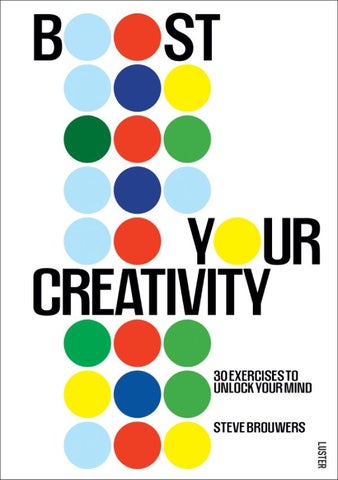
CREATIVITY ISNâT A LUXURY
Itâs not something for later in life, when things begin to calm down. Itâs how we connect. How we adapt. How we find meaning, even in chaos.
This book is here to help you remember that part of who you are â and to give it room to stretch. I didnât write this because I always feel creative. I wrote it because often I donât. Iâm a creative who suffers from imposter syndrome. Every new project comes with a quiet voice saying, âThis time, theyâll see youâve got nothing.â
Iâm a chronic overthinker, a master procrastinator, and Iâve spent far too much time hesitating.

So I made a choice: I got inked.
On my left arm (in Dutch): DONâT HESITATE, DO IT. On my right: FAIL BETTER, CREATE NOW.
Itâs my reminder to myself that action creates action. Like Robert Frost who said: âThe best way out is always through.â (A Servant to Servants)
So perhaps the only way out of doubt is through action? And more is more â and every messy start holds the seed of something real.
This book is for you â and for me. For anyone who wants to remember what theyâre capable of, and surprise themselves along the way.

LETâS BEGIN.
You canât use up
creativity.
The more you use, the more you have.
Maya AngelouâAmerican writer
START TRAINING
Creativity isnât magic. Itâs a muscle.
And like any muscle, the more you use it, the stronger it gets.
The problem? Most of us stop using it.
Somewhere between childhood curiosity and adult responsibility, weâre told to colour inside the lines, do things the 'right' way, and not be weird.
Our creativity muscle shrinks â not because weâre not creative, but because we stopped flexing it.
But hereâs the good news: muscle memory exists. And creativity comes back faster than you think.
Every time you write down a wild idea without editing it, doodle just for fun, or ask âWhat if?â instead of âWhat is?â, youâre training that muscle.
Every small act â no matter how silly, quick, or strange â counts as a rep.
Some reps will feel awkward.
Some days youâll draw a blank.
But keep going.
Youâre building something.
This book is your creative gym.
The more exercises you do, the easier it becomes to lift heavier ideas, jump into new projects, and stretch into wild new directions.
So donât wait for inspiration. Train for it.
Every day we walk past these tiny details without noticing, but they hold entire galaxies of meaning if we slow down and really look at them.
Georgia OâKeeffe, the American modernist painter, once said:
âNobody sees a flower â really â it is so small it takes time â we havenât time â and to see takes time like to have a friend takes time.â
Creativity asks us to take that time.
To zoom in.
To flip our perspective.
To notice what others miss. Look at things as if youâve never seen them before. Let them surprise you.
We donât see what we see, we see what we want to see. The Necker Cube is a simple wire-frame drawing of a cube but when you look at it, something strange happens.
Your brain flips between two different ways of seeing it. Is the front face here? Or there? You canât see both at the same time, but both are possible.
This is the same visual but with a different perception.
The Necker Cube shows how a small switch in perception can completely change what you experience.
The drawing stays the same. Itâs your mind that shifts.
Reality is perception, not a reflection of truth. Now look at the next image.
See the two sets of circles? Some look like convex bumps. Others like concave dimples.
But hereâs the trick â flip the book upside down.
This isnât magic.
Nothing has changed ⊠except your perspective.
Suddenly, the dimples become bumps, and the bumps become dimples.
Itâs your brain, doing what it always does: making assumptions. Your visual system is wired to expect light to come from above, like sunlight or ceiling lamps. So when it sees shading, it interprets this as depth based on this built-in model.
Flip the image, and the lighting no longer fits your brainâs usual logic â so it rewrites what it 'sees'.
Nothing is original. Steal from anywhere that resonates with inspiration or fuels your imagination.
Devour old films, new films, music, books, paintings, photographs, poems, dreams, random conversations, architecture, bridges, street signs, trees, clouds, bodies of water, light and shadows.
Select only things to steal from that speak directly to your soul.
If you do this, your work (and theft) will be authentic.
Jim JarmuschâAmerican film director
EVERYTHING IS A REMIX
Creativity doesnât exist in a vacuum. Every idea, every piece of art, every new invention is built on what came before it. This isnât just a limitation; itâs the nature of the creative process. Everything is a remix. When you embrace this truth, you free yourself from the pressure to be completely original. You realise that creativity isnât about starting from scratch â itâs about gathering inspiration, rethinking whatâs familiar, and combining elements in surprising ways.
You have to understand the culture, you have to go to the movies, go to museums every month, read books, listen to music, thatâs the DNA of creativity.
Consider the music industry. Some of the most iconic songs are reimaginings of earlier tracks, borrowing a melody, a beat, or a riff. In film, countless directors pay homage to their influences, incorporating themes, shots, and styles into their own unique visions. In technology, every breakthrough â smartphones, streaming services, social media platforms â stands on the shoulders of what came before it.
Evan 'Kidd' Bogart did not follow traditional songwriting rules when he wrote Rihannaâs SOS. At the time he really had no idea what he was doing. The second verse of the song is 80s song titles strung together as sentences because he thought it would be clever. Nobody would think of doing this.
SOS by RIHANNA
Take on me, (A-ha)
you know inside you feel it right
Take me on, (A-ha)
I could just die up in your arms tonight (Cutting Crew)
I melt with you, (Modern English)
you got me head over heels (over heels) (Tears for Fears)
Boy, you keep me hanging on, (Kim Wilde)
the way you make me feel (Michael Jackson)
Creativity takes courage.
Henri MatisseâFrench painter
COURAGE OVER CONFIDENCE
Courage is the quiet force that fuels creativity.
Itâs what moves you to try something new, even when doubt is whispering in your ear. Itâs what pushes you to share your work before it feels 'ready' or 'perfect'.
While confidence might tell you that youâve got it all figured out, courage steps in when you donât â when youâre uncertain, vulnerable, or on shaky ground.
In the creative process, courage matters more than confidence.
Confidence is often the result of repeated attempts, built over time through trial, error, and small victories. But courage? Courage is what gets you to take that very first step.
Itâs what propels you towards the blank page, the unfamiliar tool, or the daring idea. Itâs what allows you to create even when youâre unsure of the outcome.
When you choose courage, you give yourself permission to experiment. You open the door to possibilities you might have otherwise dismissed.
You let yourself fail, learn, and try again.
In that sense, courage isnât about being fearless â itâs about taking action despite the fear. Itâs about showing up, not because you know youâll succeed, but because youâre willing to grow.
Courage is also a powerful antidote to the perfectionism that often stifles creativity.
If you wait until you have the right amount of confidence, you may never start. But when you act with courage, you accept that imperfection is part of the process. You embrace the idea that the first draft, the rough sketch, the unfinished prototype are all necessary stepping stones to something extraordinary.
Ultimately, choosing courage over confidence reshapes the creative journey. It shifts the focus from needing to feel ready to simply being willing. It reminds you that the creative path is less about being certain of where youâre going, and more about having the bravery to take that next step.
Look for what notice,you but no one else sees.
Rick RubinâAmerican record producer
MORNING PAGES
Clear the noise, open the flow.
Before the day rushes in â before emails, headlines, and to-do lists â thereâs a quiet space.
Morning Pages are your way into that space.
This exercise is inspired by Julia Cameronâs The Artistâs Way. Itâs a creative path that encourages daily writing as a tool for unlocking creativity.
It doesnât have to be beautiful.
It doesnât have to make sense.
It doesnât even have to be interesting.
Youâre just clearing the clutter. Complaints. Weird dreams. Strange ideas. Big feelings.
H
W T PLAY
Write without editing, without judging, without stopping.
The goal isnât to create something perfect. The goal is to create space, so your real creativity has space to stretch.
Try it: grab a pen first thing in the morning when you wake up. Fill three pages, fast and loose.
Donât reread. Donât fix. Just let it flow.
Even on days when you feel stuck or silly, Morning Pages work quietly behind the scenes.
They clear the fog, reduce the noise, and help your truest ideas rise to the surface.
No rules. Just you, a page, and whatever shows up.
Y UR TIME T PLAY
START YOUR FIRST MORNING PAGE HERE USING THIS PROMPT
(If you like what you see, continue the exercise daily in another notebook, always taking care to fill three pages.)
Today I want to write because âŠ
Asking
ââWhat if?ââ is the seed to breathtaking ideas.
George LoisâAmerican art director
THE 'WHAT IF' CHALLENGE
Every groundbreaking idea begins with a question. Among the most powerful is: âWhat if?â This question doesnât seek immediate answers; instead, it opens doors to imagination, innovation, and transformation.
âWhat if?â challenges the status quo. It dares us to envision the world not as it is, but as it could be.
By asking âWhat if?â, we allow ourselves to explore possibilities without the constraints of practicality or fear.
Consider the moments when youâve felt stuck or uninspired. Introducing âWhat if?â into your thought process can reignite your creative spark:
What if I approached this problem from a completely different angle?
What if I combined two unrelated ideas?
What if I removed a fundamental element of my project?
By embracing the 'what if' mindset, you grant yourself permission to experiment, to fail, and to discover. Itâs in this space of exploration that truly breathtaking ideas are born.
Unlock bold possibilities with a single, simple question.
Objective: explore new creative horizons by asking 'what if' questions â without worrying about how practical or realistic they are.
AI is not a threat to creativity â itâs a partner.
It handles the boring parts so imaginationyour can do the wild parts.
Eric SchmidtâAmerican, former CEO Google
MEET YOUR CREATIVE SIDEKICK
AI is here to stay. Itâs not science fiction anymore â itâs part of our notebooks, our screens, and our creative lives. Some people fear it, others worship it, but hereâs the truth: AI is a tool. A powerful one. Like a pen, a piano, or a paintbrush, it can help you create â but it doesnât create for you.
Use it as a tool, not a crutch.
AI is a mirror, muse, or playful sidekick â something that can spark ideas, remix thoughts, or offer a fresh lens, while the soul of the work stays human.
The magic is in the collaboration between human intuition and machine suggestion.
But letâs be honest, even sidekicks come with baggage. AI models use a lot of energy, and their growing presence has an environmental cost. So as you explore its potential, use it intentionally, not endlessly. Like any powerful tool, itâs best used with care.
In this chapter, weâll treat AI as a partner. A weird, curious, and sometimes brilliant sidekick.
Youâre Batman, itâs Robin. Youâre the chef, itâs the spice rack. It wonât replace your voice â but it can help you find new ones.
Letâs plAIy.
AI can spark,suggest, remix â but only you dream.can
AI can help you brainstorm.
It can challenge your patterns. But it doesnât have your taste, your intuition, your point of view, or your weird sense of humour.
Thatâs your superpower.
Use AI. Stay human.
Thatâs where the magic happens.
Boost Your Creativtity
64 Exercises to Unlock Your Mind Through Play
Research and writing
Steve Brouwers
Text editing
Sandy Logan
Photography
Joost Joossen (P4â5â12â29â43â51â55â64â67â92â110â239)
Kaat Pype (P89)
Steve Brouwers (P37â48)
Graphic design
Stella Brouwers
Postproduction photography
Mieke Geenen â Pixelxpress
Artworks, courtesy of the artist
Vincent Bal â Shadowology (P116â117â236)
Mr Bingo â Donât forget to have fun (P67)
Ji Lee â Word as Image (P126-236)
D/2025/12.005/11
ISBN 9789460583889
NUR 640
© 2025 Luster Publishing, Antwerp info@lusterpublishing.com lusterpublishing.com @lusterbooks
Printed in Italy
Subscribe to our newsletter for new book alerts and a look behind the scenes:

All rights reserved. No part of this publication may be reproduced, stored in a retrieval system, or transmitted, in any form or by any means, without the prior written consent of the publisher. An exception is made for short excerpts, which may be cited for the sole purpose of reviews.