
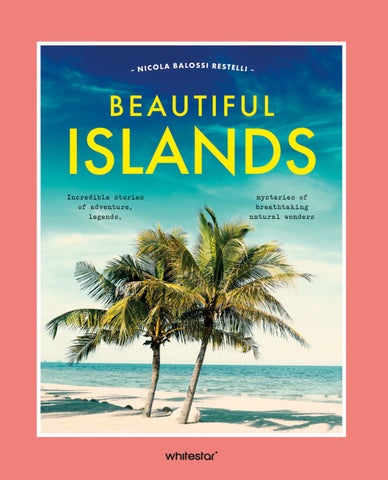
Beautiful Islands

Page 1


Chile

EASTER ISLAND

Geographical coordinates: 27°07’14’’ S; 109°21’05’’ W

Waters: Pacific Ocean

Population: 7,750 inhabitants

Surface area: 63.20 square miles (163.7 km2)

Principal settlement: Hanga Roa

CENTER OF THE WORLD

All it takes is to point to it on the globe to gain a sense of isolation: lying around 2,240 miles (3,600 kilometers) off the coast of Chile, lost in the Pacific Ocean, Easter Island hosts one of the most remote settlements on the planet. This patch of harsh rock, bordered by basalt cliffs, with few beaches, constantly battered by the trade winds, was born out of an eruptive process that began three million years ago on the oceanic ridge and forms a right-angled triangle, the corners of which are presided over by extinct volcanoes. These spectral craters are joined by a multitude of smaller cones and caves and tunnels, the remains of the volcanic activity of the past. All around, the seabed plunges rapidly to a depth of more than 6,500 feet (2,000 meters). It was on Easter Sunday 1722 that the Dutchman Jacob Roggeveen landed on the island, circumstances that were decisive in it being given a new name, destined

to coexist for centuries with the original Rapa Nui (the “Great Rock”) given by the local peoples. The island had in fact been inhabited for some time. This small but generous stretch of land favored the development of an evolved and flourishing society devoted to fishing and agriculture, a community of around 20,000 people, with their own written language, traditions, customs, and religion. It was the inhabitants of Rapa Nui who dedicated themselves to the construction of the Moai, anthropomorphic statues between 16 and 33 feet (5 and 10 meters) tall and weighing tens of tons. These enigmatic figures with their severe features were transported from the quarries to their final site via a complex system of trunks on which they were rolled for miles. They were almost all positioned around the coast, facing inland, and are so evocative that they have become the symbol of the island.

FERNANDO DE NORONHA

Geographical coordinates: 3°50’47” S; 32°24’49” W

Waters: Atlantic Ocean

Population: 3,167 inhabitants

Surface area: 10 square miles (26 km2)

Principal settlement: Vila dos Remédios

STONES IN THE OCEAN

The archipelago of Fernando de Noronha is located in the state of Pernambuco, where Brazil stretches out into the ocean, 215 miles (346 kilometers) from its northeastern coast, yet it could be anywhere, suspended between reality and imagination. A magma surge from an ancient wound in Earth’s crust has generated a handful of islands, barely visible from the sky, sculpted from the incandescent lava by the patience of the Atlantic Ocean. The principal formation is the island that lends its name to the entire archipelago, a labyrinth of curves, highlands, bays and cliffs plunging unhesitatingly into the abyss. The living volcanic rock is black, flayed by the wind, scarred like a face that has seen too many springs. The sparse but tenacious vegetation climbs the steep hillsides: cacti,

shrubs, a few patches of green that seem to defy the scorching sun dominating from above. Then, standing among the waves is the symbol of this place: the Morro do Pico, a stone tooth piercing the sky, 1,000 feet (304 meters) of basaltic solitude. A natural lighthouse, a silent eye that scans the horizon without ever looking away. Around it, 20 other smaller islands, rocks, formations that look like unfinished sketches. Only the main island is inhabited, the others belong to the wind, the birds and time. This is Fernando de Noronha: a presence that emerges from the sea without asking permission, a place that has more to do with geology than with geography, the result of an ancient compromise between fire and sea, where every stone tells an ancient story and every wave guards a secret.

Italy

CAPRI

Geographical coordinates: 40°33’03’’ N; 14°14’33’’ E

Waters: Tyrrhenian Sea

Population: 13,672 inhabitants

Surface area: 4 square miles (10.4 km2)

THE ISLAND OF THE SIRENS

There is a long history of sediment and stratified fossils leading to the birth of Capri, an icon of Italy throughout the world. Situated on the imaginary extension of the Gulf of Sorrento, it looks out over Naples and the other Neapolitan islands, but is unique, different even in its geology. While Ischia and Procida are of volcanic formation, Capri is of karstic origin. Up until ten thousand years ago—a remote time for us, but negligible for the earth—at the height of the last ice age, that imaginary line was still part of the mainland and Capri represented the tip of the Sorrentine peninsula, as the remains of mammals that lived in the Pleistocene period also confirm. Not only the great movements of the earth, including a slow and progressive subsidence that has taken certain Roman remains below sea level, not only the

ancient rocks spewed out by Vesuvius, but also the incessant work of the elements has contributed to the island’s current form, so severe, so poetic, so beloved: the wind and the waves have sculpted like tireless artists a landscape destined to steal the eyes and heart of anyone with eyes and a heart. The famous Faraglioni, but also the numerous caves, the steep cliffs alternating with coves, the slopes of the Solaro, Cocuzzo, Cappello and Tiberio hills that dominate the view and the uplands covered with agaves, prickly pears and broom: the whole of Capri is an up and down, a perennial tension of emotions, aspirations and inspirations that transcend time and in a certain sense even space, the same that over the years have bewitched those who have set foot here and breathed this air.

Ryūkyū, Japan

OKINAWA

Geographical coordinates: 26°28’46’’ N; 127°55’40’’ E

Waters: Philippine Sea, East China Sea

Population: 1,466,870 inhabitants

Surface area: 466.02 square miles (1,207 km2)

Capital: Naha

THE HAWAII OF THE RISING SUN

The Okinawa archipelago, more than 160 islands of which only 50 are inhabited, is the heart of the Ryūkyū, a fragmented island chain stretching over 620 miles (1,000 kilometers) between Kyūshū and Taiwan. Politically it belongs to Japan, but geographically, biologically and culturally it is actually a crossroads between East Asia and the Pacific. The main islands—Ishigaki, Miyako, Iriomote and Okinawa—are of volcanic and coral origin: gentle reliefs shaped by centuries of rain, alternating with low-lying formations with beaches of incredibly fine sand. While the southern islands of the archipelago, in particular Miyako and Yaeyama, are lower and flatter, punctuated by coral reefs emerging from crystal-clear lagoons and pristine beaches, Okinawa, about 60 miles (100 kilometers) long and never more than 18 (30 kilometers) wide, is a varied terri-

tory: jagged coastlines, limestone plateaus and an interior covered with dense subtropical vegetation. To the north lies the region of Yanbaru, home to one of Japan’s last virgin forests, with endemic species such as the Okinawan woodpecker. The climate is hot and humid for much of the year, with long summers and mild winters, but also sudden and violent typhoons. Everything oscillates between delicacy and resistance: the land, the sea, life itself that clings tenaciously to this hidden, kaleidoscopic archipelago. Natural beauty is only one element in its magic circle: it is a world full of precious insights that speak softly to the deepest parts of the human soul. Harmony between opposites, here, is an ideal within reach, courted gracefully in a refined and courageous cultural and spiritual quest, involving both the individual and the community.

Turn static files into dynamic content formats.
Create a flipbook
Beautiful Islands by ACC Art Books - Issuu