We do not know what or who prompted Jan Steen to take up a paintbrush. But shortly after he enrolled with the guild, he went to work in the Hague workshop of landscape painter Jan van Goyen – and promptly fell in love with Van Goyen’s daughter Margaretha (Grietje). Fortunately, they were both Catholic, and so were able to marry in 1649. Shortly after their wedding, Steen painted himself and Grietje in Couple Reading the Bible (fig. 5, cat. 3). He would habitually depict himself and his loved ones in his paintings throughout his life. Jan and Grietje had seven children who reached adulthood: Thaddeus, Eva, Constantinus, Havick, Johannes, Catharina and Cornelis. We know the faces of the Steen children – it is highly likely that their father used them as models in paintings like The Feast of St. Nicholas and Children Teaching a Cat to Dance (fig. 6 and 7, cat. 17 and 23).


AMUSING?
Merrymaking, laughing characters, men and women fondling each other: humour plays an essential role in Jan Steen’s work. Often, the laughing figures look at us as if they were asking ‘Do you see me?’, ‘Why not join us?’
Steen was well acquainted with the pictorial tradition of the visual joke. He knew the work of Pieter Bruegel from prints, and his kinship with Frans Hals has already been mentioned. Two of his paintings include a well-known work by Hals on the wall: Pekelharing (literally ‘pickled herring’), a drunken theatre character who was popular at the time as a general symbol of foolishness. Seventeenth-century jokes were almost always about sex or drunkenness, or both. As an innkeeper, Steen will have observed many goings-on from behind his bar. The bold allusions that seventeenth-century artists made in their paintings are not always understandable for a contemporary audience. Many came from poems, songs or plays that we do not know, with moral lessons that we cannot always grasp. Perhaps that is why we do not laugh so loudly at his paintings as his contemporaries did. But one thing has remained unchanged: laughter is infectious. Steen often still manages to make us smile.
BACK TO LEIDEN
1665 saw the outbreak of the Second Anglo-Dutch War, which dealt the art market another severe blow, and plunged Jan Steen back into financial difficulties. More ill fortune was to follow a few years later. His wife Grietje died in 1669, followed by his father Havick Steen a year later. Jan decided to return to his hometown, and took on the house from his father’s estate. He registered with the Guild of Saint Luke again where, as a respected artist, he held several high-ranking positions. But it seems, once more, that he was unable to make a living from his art. During the disastrous year of 1672 (the Netherlands was at war with France, and the decline in the art market continued) he was given permission to run an inn and opened a small tavern selling wine and beer at his house on Langebrug. To attract customers, his biographer Weyerman wrote ‘he hung out a wreath, and painted a figure on his sign representing Peace, holding an Olive Wreath.’ Despite his beautiful sign, business did not go well. According to the
26 — Jan Steen, Prince’s Day, c. 1670–1679
(detail from cat. 28)


3 Jan Steen
A Couple Warming Themselves and Reading the Bible
c. 1650
Panel, 30 x 24 cm
Museum De Lakenhal, Leiden
Acquisition from a private collection, 1954
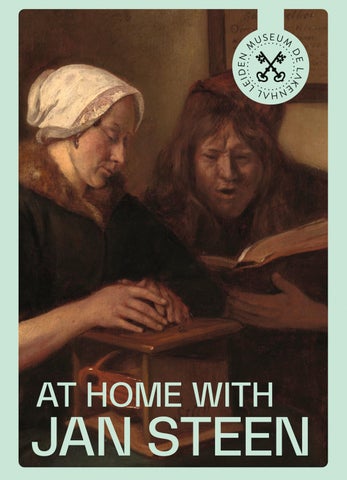
This small panel depicts a pious couple sitting close together, reading the Bible. The man’s open mouth suggests that he is reading aloud, as his wife sits with her eyes downcast, listening to the edifying words. Everything suggests that these people lead a modest, devout life. The woman’s clothes also make it clear that they are not impecunious. She is wearing a warm fur collar, and the end of her silver ear ornament protrudes from under her lace-trimmed bonnet. The cosy atmosphere is enhanced by the brazier on her lap, with glowing embers in an earthenware basin that give off a pleasant warmth. Braziers of this kind often feature in seventeenth-century paintings, usually placed on the floor to warm the feet. Sometimes, as here, the brazier is on a person’s lap – a nice choice for this intimate composition, drawing our attention to the woman’s subtly folded hands.
The religious message of moderation is emphasised by the sign on the wall behind the couple. The entire text, entitled ‘Solomon’s Prayer’, is legible. This refers to the Old Testament character King Solomon, who asks God for wisdom rather than wealth. At the end, he underlines the fact that wisdom comes from moderation: ‘Give me neither poverty nor riches. Give me just enough to satisfy my needs.’ Variations on this prayer also appear in other paintings by Steen, featuring families praying before a meal. People really did have such quotations hanging in their homes in the seventeenth century, as a daily reminder of the importance of following a devout and modest path through life.

5 Jan Steen
Young Draughtsman by Candlelight shortly after 1650
Panel, 24.8 x 20 cm
Museum De Lakenhal, Leiden Acquisition, 1897
On this very small panel, Jan Steen painted a young man drawing a plaster bust by flickering candlelight. The candle is positioned in such a way that only the flame is visible, above the bust, which produces a somewhat disconcerting effect. The warm glow highlights the boy’s concentrated expression and his fingers. The rest of the room is shrouded in darkness, Steen rendering the empty background with rapid brushwork, so that nothing distracts us from the young draughtsman. This was clearly inspired by the work of Gerrit Dou, who specialised in scenes lit by candlelight (fig. 5a).


13a — Lambertus Antonius Claessens and Ludwig Gottlieb Portman after Jan Steen A Young Man Offers a Girl a Cake, c. 1792–1808
Etching, 238 x 190 mm. Rijksmuseum, Amsterdam
particularly eye-catching, thanks to the masterful rendering of the fabrics. The chair with the lion’s head and the bouquet in the background are also meticulously executed. Such love scenes were particularly popular with the fijnschilders, who could flaunt all their skills when painting fabrics and lavish interiors. Steen also used his most refined brushwork to depict wealthy figures.


Steen started painting scenes of doctors’ visits in around 1660, during the time when he and his family lived in Haarlem. But his inspiration for this popular subject came more from the work of artists working in Leiden, particularly the finely executed paintings of Frans van Mieris (fig. 14a). The foolish doctor, the limp wrist, the bottle of urine and the inviting four-poster bed also featured in his repertoire.


24
Jan Steen
The Merry Threesome c. 1670–1672
Panel, 38 x 49.4 cm
Private collection, on long-term loan to Museum De Lakenhal
Jan Steen was a born storyteller who was not afraid to poke fun at himself. In this loosely rendered work, he presents himself in the role of the lusty chap, willingly allowing a beautiful young woman to rob him. The old woman in between them offers him a glass of wine, though it is not really necessary. Even without the influence of alcohol, this merry violin player would be easily seduced. Steen deployed his entire arsenal of gestures, emotions, costumes and symbolism to enhance the comedy of an already comic situation. For instance, the violinist wears an old-fashioned sixteenth-century suit, while the raised pipe – hardly subtle – refers to his state of arousal. The violin also serves as a sexual symbol. The seventeenth-century verb ‘vedelen’, meaning to fiddle, was also used to refer to sexual intercourse. The woman, on the other hand, appears at first glance to be the image of respectability. No low neckline or excessive embellishment, but a modest dress and, on her lap, a cushion she uses for her embroidery. As she talks to the man – gesturingwith one of her hands – she dexterously slips her other hand into his purse.
The foolish man who all too readily allows a beautiful woman to steal from him was a popular subject in seventeenthcentury genre painting. It fits seamlessly into Steen’s repertoire of humorous scenes with a much more serious underlying message. The work of his famous predecessor and fellow Leiden artist Lucas van Leyden will undoubtedly have been a big source of inspiration in this respect (fig. 24a).

Steen was approximately 45 years old when he painted this amusing scene. He had returned to his native Leiden for good in 1670. Steen was a widow at that point; he would remarry in 1673, when Maria van Egmond became his second wife (see cat. 25). It is tempting to think that his unmarried status at the time may have played a role in this warning against the foolishness that men can fall prey to when possessed by lust.


27 Jan Steen
The Spanish Bride c. 1670-1679
Canvas, 110.5 x 82 cm
Private collection Castendijk family, on long-term loan to Museum De Lakenhal, Leiden
The village wedding is a recurring theme in Steen’s work, ranging from wedding festivities at taverns to bridal processions arriving at the bridegroom’s house, as we see here. It was an ideal subject for Steen, which allowed him to really go to town, painting figures, costumes and an attractive staging, often against a background featuring imaginative architecture. One of his earliest masterpieces was a village wedding (cat. 7), and some twenty years later he reprised the subject in a truly spectacular piece. The painting, which belongs stylistically to Steen’s last period in Leiden, revisits all of the main ingredients in the early work, adding even more eccentric characters and a truly grandiose setting, in which a colourful Persian rug functions as the eye-catching centrepiece.
In a courtyard, a fairytale bride dressed in rustling satin and wearing a crown of flowers on her head, is graciously welcomed by her husband. He is dressed equally lavishly, in a pale yellow and white satin suit and a dramatically draped red cape. This central scene is a variation in mirror-image on the wedding scene Steen painted in 1653. This work, too, is notable for the extravagant attire worn by many figures. The bride’s chaperones are dressed in the style of the Southern Netherlands: a huik (a heavy hooded cape) with a pompom and impressive but old-fashioned ruffs. The bridegroom’s fabulous outfit, with its knickerbockers and lace collar, refers to sixteenth-century theatrical costumes that alluded to a clichéd image of a lover. In this respect, the pot-bellied man with the large ruff at the top of the stairs is notable. With his dark moustache and goatee beard, and his stylised eyebrows, he appears to have stepped straight out of a farce and into this painting. His appearance is reminiscent of the commedia dell’arte, an Italian style of theatre with stock characters, which was also known in the Dutch theatre. The same applies to the man with the halberd on the left, keeping the crowd in check. He is derived from the jester-like character Pulcinella, a humorous figure who often appears in Steen’s work.