
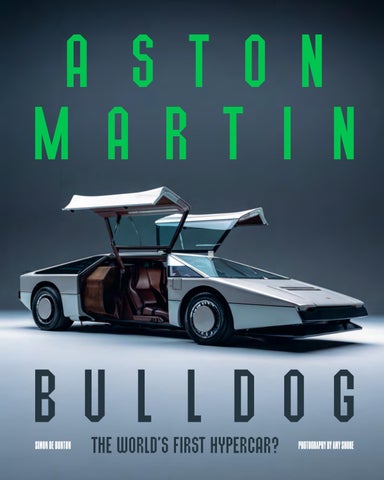
Aston Martin Bulldog

Page 1


SIMON DE BURTON PHOTOGRAPHY BY AMY SHORE

THEDESIGNER,WILLIAMTOWNS

“I discovered the wheel when I was two and have found it fascinating ever since.”

Middle Eastern oil sheiks, who (thanks to soaring fuel prices everywhere else) were about the only people who could really afford to buy and run them. In a 12-year production life that lasted until 1990, 645 examples were built, which probably saved Aston Martin Lagonda from going bust.

Towns created the Lagondas and Bulldog as a freelancer, working from his home studio (and using his kitchen AGA to bake clay models). He left a full-time position with Aston Martin in 1968 – little more than two years after joining the firm – to set up his own design consultancy, which he called Interstyl. But where had he come from before all that?

William Michael Cameron Towns was born in Kingston upon Thames on 23 June 1936 to Jean and Victor Towns. His father worked in the arcane world of theodolite manufacture for the South London scientific instruments firm Hilger & Watts. But for William and his sister Janet, life in the outer reaches of London was to be brief. The outbreak of war prompted Jean to move with them to the family holiday home in Eskdale, Cumbria, where she had grown-up. From there, William was packed off to Harecroft Hall preparatory school at Seascale, which (perhaps ironically, given the aim of the move was to avoid explosions) was just three miles from what was soon to become the site of the Royal Ordnance Factory and, later, Sellafield nuclear plant.

Based in a rambling house that started life in the 17th century as a small cottage, the school opened in 1926, having been specifically established, according to an early prospectus, for the ‘sons of country gentlemen and of other gentlefolk’. Indeed, the place seemed to major on gentility with the prospectus further stating that: ‘Any new boy who shows signs of being turbulent or destructive is immediately affected by the gentlemanly behaviour of those about him and soon learns to control himself and to be personally clean and tidy.’

Gentle by nature, Towns is said to have disliked the school intensely and had no interest in its promotion of sport and the outdoor life. Instead, he preferred to focus on what appeared to be a congenital obsession with automobiles that manifested itself when, as a toddler, he would robustly guard a tree stump that he cited as his first car. “I discovered the wheel when I was two and have found it fascinating ever since,” he said in later life.

Soon, the boy Towns began to make further calls on his vivid imagination. He produced copious quantities of sketches depicting vehicles of all types, many of which demonstrated precocious artistic talent and remarkable technical understanding. Some of these early drawings survive, including one of a charabanc, which a Harecroft Hall teacher had annotated with an encouraging “very good”. Also added to the sketch was an arrow pointing towards an apparently superfluous component, with a note saying: “You don’t need this...” Below it, a clearly affronted eight-year-old Towns demands an explanation with a single, boldly written word: “Why?”.

Having served his time at Harecroft – during which his parents went through a bitter and acrimonious divorce – Towns advanced to further educational drudgery at Denstone College, a boarding school near Uttoxeter, Staffordshire, before finally gaining his freedom. Soon

HAD HE BEEN WORKING FOR ONE OF TODAY’S high-profile marques, William Towns would undoubtedly have found himself among the firmament of ‘celebrity’ British car designers that includes names such as Gerry McGovern, Ian Callum and Aston Martin’s own Marek Reichman. But in the era during which Towns flourished, the British public had to make an effort if they wanted to learn much about who created the cars they might see on the roads every day, with only a few stand-out designs bringing their creators to prominence. Obvious examples are Sir Alec Issigonis, lauded for the genius of his Mini; Malcolm Sayer, whose Jaguar E-Type was extravagantly dubbed ‘the world’s most beautiful car’; and Colin Chapman, who brought in a whole new world of driving fun with his landmark Lotus Seven.

That said, Towns did attract a greater degree of notoriety during his lifetime than many of his peers, largely as a result of designs such as the Lagonda Series Two, the Bulldog and the Hustler being so very radical. He even managed to impress the famously no-nonsense television presenter Tony Bastable, who afforded him a 13-minute slot in a 1979 episode of Thames Television’s Wheels, in which Towns explained the design process behind Bulldog and five of his other creations. Dressed in a natty oatmealcoloured three-piece suit, sporting a pair of dark Foster Grant-style sunglasses and answering Bastable’s questions with careful ‘received pronunciation’, the cucumber-cool Towns almost seems capable of carrying off a second career as a character from The Avengers. The recording is definitely worth seeking out on YouTube.

Here, meanwhile, are some of the most notable designs other than Bulldog to have flowed from Towns’ truly ‘magic’ marker, including the Minissima and Microdot city cars that preceded ‘urban transport solutions’ such as the Mercedes-Benz Smart and today’s petrol-electric hybrids by decades.

RIGHT: Steve Hallam and Victor Gauntlett hand over Bulldog following its first sale, January 1982.

Andrew Turvey Engine Builder

CHAPTER4

THERESTORERS

“WHEN BULLDOG ARRIVED, IT HAD BEEN converted from mechanical fuel injection to Weber carburettors, and the turbos had been moved ‘outside’. It was fairly clear that the car had been modified simply with a view to getting it running, and when we dismantled the engine, it seemed as though it had been subjected to a great deal of heat and a great deal of revs.

“Non-original camshafts, with lobes the size of Wellington boots, had been fitted in what was probably a misguided attempt at improving performance. To accommodate them, the cylinder heads had been scalloped out by hand. The overall result of the ‘tuning’ being a crankshaft that was blued and bent, and piston skirts that were semi-seized.”

It was clear that the crankshaft couldn’t be saved, so a new one was machined from solid billet before being lightened, strengthened and balanced. It alone cost £10,000. The original block was good enough to be saved, but the worn and distorted journal housings meant that a 20-mm thick ‘girdle’ had to be made using waterjet cutting techniques to stiffen the bottom of the block.

“The original Aston Martin V8 was rated for only around 400 horsepower, but we were going for something nearer 1,000,” explains Turvey. “That meant the block was going to be put under huge strain. Because we had decided on a 7,000-rpm limit and 1–2 atmospheres of turbo boost, the power would constantly be trying to push the crankshaft out of the bottom. Hence the need for maximum strength.”

Bulldog’s original cylinder heads, meanwhile, were deemed unusable, so an entirely new pair was made, along with a complete set of new pistons.

“All the technology in the cylinder heads was new. That way we could be certain that none of the material had ever been compromised by overheating; that the valve seats were going to be 100 per cent reliable; and that we could design in plenty of anti-detonation measures.”

The engine also benefitted from a new set of billet conrods (made in-house at CMC), while new camshafts of almost standard profile were fitted to ensure the reliability of the valve train. Smaller valves than the originals were also fitted, as these were considered more compatible with the newly sourced Garrett AiResearch turbos, for which a set of bespoke exhaust manifolds had to be manufactured to fit the limited space beneath Bulldog’s engine cover.

“We actually built a dummy engine into the chassis while the parts for the real one were still being made, just so we could understand exactly where everything would fit and how much – or how little – space we had to play with,” recalled Turvey.

One major advantage the team had, however, was that engineering techniques have advanced dramatically since Bulldog was originally built more than 40 years ago.

“Back then, turbocharging of road cars was virtually unknown [one of the first significant production models was the Saab 99 Turbo, launched in 1978] but now people know exactly the specification needed to complement a particular

engine. These days, the turbo boost is controlled by the ECU [electronic control unit] so the power is deployed in a much more progressive manner. This is better for the life of the engine and gearbox and makes the car far easier and more pleasant to drive.”

The rebuilt and upgraded engine could not be run, says Turvey, until it was fully fitted into Bulldog’s chassis, at which point it was hooked up to a dynamometer and produced an instant and easy reading of 600 horsepower.

“Soon after, we took it to Yeovilton for the first high-speed run and saw close to 170 mph. After that, we brought it back to the workshop, performed a few minor modifications to the porting and valve springs and added some turbo boost. Immediately, the output went up to somewhere north of 750 horsepower. At that level, we can more or less ensure reliability,” says Turvey. “Beyond that, and we enter the realms of a science project.

“We worked out that the optimum temperature window for the engine to operate at is 80°C oil, 80°C water. So to get up to that as quickly as possible, we fitted an electric water pump, which not only circulates better, it releases an extra 10 horsepower because it doesn’t have to be driven by the engine.

“We saw a further power gain by using a smaller alternator and, instead of using the massive flywheel that was fitted to Bulldog’s engine when it arrived with us, we used a standard V8 one and upped the compression ratio from the original 7:1 to 9:1. That saves the bearings by reducing load, as does the fact that it just isn’t necessary to rev the engine to its 7,000-rpm red line. The torque from 1,000–1,500 revs is instantaneous, and although Bulldog has now been driven many miles and completed numerous high-speed runs, the engine has never had to be rebuilt.” Turvey sounds proud of that – and so he should be.

BELOW:

A Royal Navy Seafire performs a low-level fly plant in honour of the occasion.

The Aston Martin Bulldog is a car that should never have existed. A car that was built before its time and became lost in time. A car that never failed to leave those who encountered it mesmerised by its aesthetics and its jaw-dropping capability.

Turn static files into dynamic content formats.
Create a flipbook
Aston Martin Bulldog by ACC Art Books - Issuu