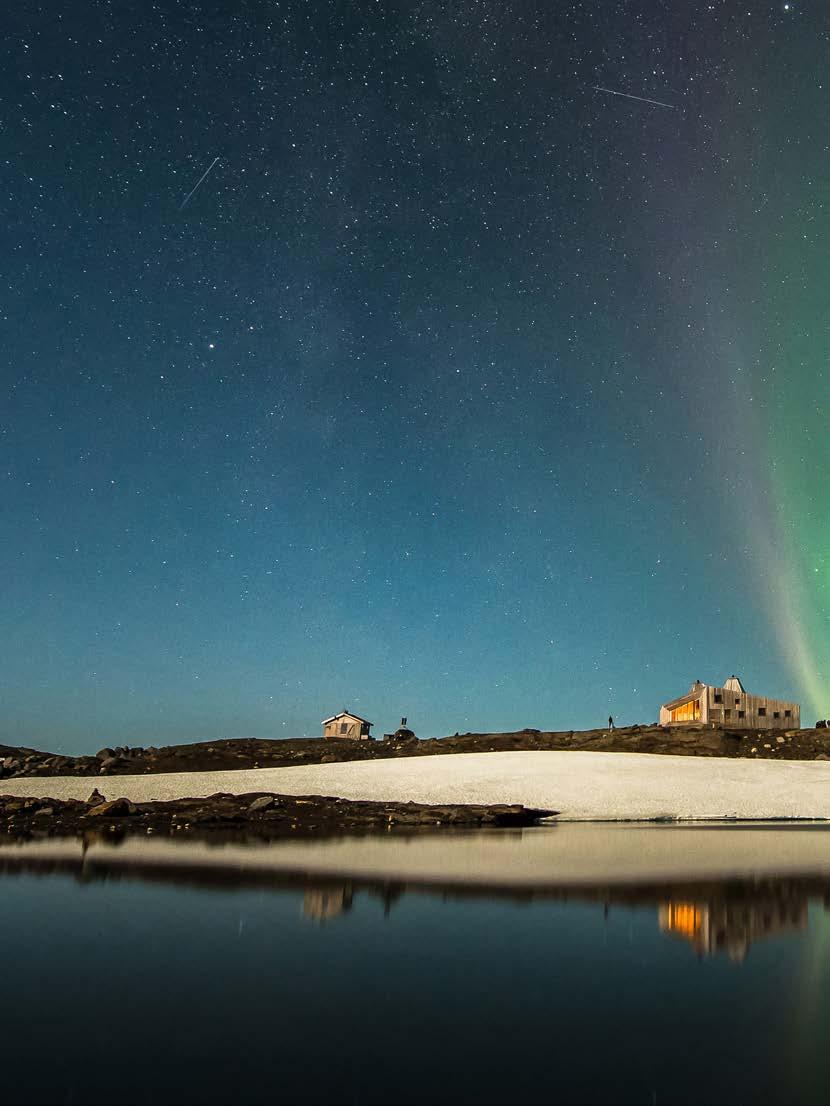
The shelter is the work of an architectural design studio led by Rok Oman and Špela Videčnik of OFIS Architects at the Harvard Graduate School of Design. The task was to come up with an innovative as well as practical shelter that would best respond to the extreme mountain conditions. To ensure that the structure could withstand radical temperature shifts (these can vary between plus and minus 30 degrees Celsius), snow loads, and strong winds, the architects chose a triple pane system of glazing, wood construction, and thermal wool insulation using about 97% mineral materials. “The production process for this particular stone wool is a technological replica of the inside of a volcano that spins and cools lava in a controlled environment, that makes the product naturally durable and stable over the lifetime of a building,” they explain. This choice is perfect for the constant condensation in the climate, as tiny pockets of air trapped within the physical structure of the stone wool create perfect insulation. It also reduces the need to keep the building warm in the winter, while providing a cool interior temperature during the summer.
The shape was on the one hand inspired by the vernacular architecture of Slovenia and the country’s rich heritage. On the other, it relates visually to the shape of the surrounding mountains (this design scheme is by students Frederick Kim, Katie MacDonald, and Erin Pellegrino). Designed for a high altitude, and for a plot with very limited accessibility, the shelter was prefabricated. All structural components, envisioned together with the team of AKT II responsible for the structural engineering, were easy to transport in parts via helicopter. The lightweight modules planned as a series of robust frames were then assembled on site. In the 12-square-metre shelter, made entirely of larch wood, there are three functional zones – an entrance with a storage area and a small space for preparing meals, a second module with a bedroom and space for socialising, and the last part with bunk beds. The shelter is strongly anchored to the rugged terrain, yet in a way that has a minimal impact on the ground and a non-invasive foundation, achieved through strategically placed pin connections. The visitors can also enjoy striking views of the rocky peaks of the Slovenian Kamnik Alps, particularly the impressive Skuta Mountain in the range of the Triglav Glacier (the highest mountain in Slovenia) and the valley, through full-wall glazing on each end of the building.
ACCESSIBILITY
While only one challenging and unmarked path leads to it through Žmavčarji Valley, the cabin is additionally difficult to find in the fog. The hiking and climbing season with the most suitable and stable weather conditions lasts from June to October. Hiking in the winter can be dangerous and demanding of special experience.
ARCHITECTURE
OFIS Architects / Harvard GSD / Akt II, 2013
LOCATION
Mountain Skuta, Kamnik Alps, Slovenia
ALTITUDE 2045 m
NUMBER OF BEDS 10
BIVACCO BRÉDY AOSTA VALLEY, ITALY
BCW Collective, founded by Chiara Tessarollo, Skye Sturm, and Facundo Arboit, specialises in architecture for extreme weather conditions and landscapes. The realisation of this hikers’ cabin was initiated by the Brédy family to commemorate Claudio Brédy, an alpinist and politician who lost his life in a hiking excursion five years earlier. The cabin was prefabricated in the valley and carried by a helicopter to the picturesque spot with a view of the two alpine Dzioule Lakes. Its silhouette has become a reference point recognisable from afar. However, while the building is distinctive, it can be easily removed. Its light yet durable structure is envisioned to reduce the footprint to a minimum, and the manner of anchoring it to the rock allows for the easy removal of the structure, practically without leaving a trace. The dramatic cantilever is symbolic: directed into the void, the shape is intended to evoke the absence of a person. But it also has a practical aspect – this way the volume can take maximum advantage of the solar gain to warm the interior, particularly in the winter time. From a bird’s-eye view the geometric volume looks like a stone, in part thanks to the dark grey hue of the zinc cladding, which not only resists the elements and absorbs heat, but also acts like a camouflage, immersing the curious shape into the rocky context.
Inside, hikers will find six beds, some of which, interestingly, are folding bunks that have been fabricated from climbing robe and fixed to the wall with carabiniers. Apart from the vestibule entrance, which offers storage space and protects the interiors from the elements, inside is a common open space with a striking culmination in the form of an extensive opening that frames the Grivola peak and Gran Paradiso. A sitting area at the window offers hikers a contemplative observation point, while the beds are located further back in the volume and sandwiched between more solid walls, which still feature some openings. The interior of the volume is based on wood-frame walls with efficient insulation. The architects envisioned basic furnishings to use the small space in a practical way. The envelope in light wood creates a striking contrast between the cosy inside and vast outside. Bivacco Brédy was realised in collaboration with YACademy, Cantieri d’Alta Quota, the Municipality of Avise, and the Architects’ Order of Valle d’Aosta.
ACCESSIBILITY
The new bivouac can be reached from Jovençan in the Vertosan Valley of the Valle d’Aosta region of Italy. In the snow-free months Bivacco Brédy is reachable by approximately three hours of hiking. Although the terrain is steep in places, there are no technical or exposed passages so it is accessible for most hikers. The hut is open and can be visited all year round, but in the winter, due to avalanche risk in the Vertosan Valley, it must be approached from a more technical route and is thus accessible only to experienced mountaineers.
ARCHITECTURE
BCW Collective, 2021 LOCATION
Vertosan Valley, Aosta Valley, Italy
ALTITUDE 2528 m NUMBER OF BEDS 6
BIVOUAC UNDER GRINTOVEC, A MOUNTAIN SHELTER KAMNIK ALPS, SLOVENIA
On a surface area of only 14 square metres, Miha Kajzelj designed a spacious vertical volume that is visible from afar yet visually attuned with the rocky setting. Its dark colour is an orientation point especially during the winter time, when it stands out against the snow. The structure has replaced the previous bivouac built back in the 1970s. Situated between the valley and Skuta Mountain, the cabin stands on a wide plateau. Its impact on the ground is minimal as the structure sits on a small concrete basement that is anchored to a rock and partly suspended in the air. “It is placed in a part of mountains where it is very difficult and dangerous to escape in the valley when caught by bad weather,” explains the studio. Completed in the valley, the structure with windows and all inside elements was brought to the spot via helicopter.
The main idea is to provide a temporary shelter for waiting out sudden meteorological changes, but higher levels of the cabin have been designed as bed units to accommodate two to three people for the night. The architect designed the interior as a monovolume – a vertical open space with three levels creating a void and connected with a ladder that allows access to upper floors. The ground floor has a dining and living space that can be transformed into a sleeping area for the night. Some of the most striking elements of this curiously shaped cabin are the
large openings arranged irregularly on all sides. Providing natural light and striking vistas, they also add lightness to the thus semitransparent structure. The idea was to create a shelter that would be open to the context so that while sitting inside, guests can really feel they are part of the natural surroundings. Additionally, as the architects remark, “the verticality of the windows creates the feeling that the sleeping levels are floating in the air above the mountain scenery.” The building is not heated, but the outer shell of the bivouac is made of isolated panels of aluminium, which are intended to keep in the heat produced by guests’ bodies – the vertical arrangement makes the upper levels warmer. Inside, wooden perforated panels have been used to help body moisture evaporate, to keep the space dry. This original perforation also has a practical use – hooks installed in the holes can be quite useful for hanging clothes. The cabin is open all year round.
ACCESSIBILITY
The bivouac is located on the official path to Skuta Mountain, between Kamniška Bistrica Valley and the peak. The trail is difficult and hence suitable only for experienced climbers.
ARCHITECTURE
Miha Kajzelj, 2009
LOCATION
Kamnik Alps, Slovenia
2080 m NUMBER OF BEDS 6–8
BIVAK II NA JEZERIH VRATA VALLEY, SLOVENIA
The first, original bivouac at this location, designed by Karel Korenini, was erected back in 1936. The idea was to create a small but functional shelter that would allow for the exploration of the higher parts of the mountain range. Built by the mountaineers in situ – with over a ton of wood and steel that they carried on their backs, the wooden cabin withstood extreme weather for 80 years. Today it is on display at the Slovenian Mountain Museum in Mojstrana. When envisioning the new version, Darko Bernik of AO drew from the original: “In a sensitive environment, where special laws apply, we have learned from our ancestors,” he said. The construction was upgraded and improved so that it would continue to be resistant to hurricane-force winds, extreme amounts of snow and low temperatures, but interestingly, there are no special solutions or modern materials used. The biggest challenges were the highly restrictive policies of Triglav National Park and a long list of criteria to be met by the bivouac, like resistance to winds of 200 km/h or the size of the volume remaining close to that of the original cabin.
It was also designed to be easily constructable and then maintained. The priority for the small interior was to find functional solutions that would made the best of the limited space, but the neatly lined wood nevertheless creates a cosy ambiance and is aesthetically pleasing. The aluminum in the outer shell makes the volume robust for the elements; however, the architects also used it for the visual effect of the harmony of its grey hue with the surrounding rocky peaks. The material is not only durable but also low weight, which was essential for the transportation stage (the cabin was brought to the high-altitude site by helicopter). Modern and safe, the bivouac offers a shared sleeping area, bench, folding table, and handy storage area, as well as USB ports supplied by a solar panel for charging mobile phones. The embracing, curved structure is open all year round and can welcome up to six visitors. Placed at the very edge of a slope, it enhances the remoteness of the location and allows guests to fully enjoy the impressive scenery.
ACCESSIBILITY
The cabin is located above the Vrata Valley with a view of the north face of Triglav Mountain and a demanding alpine trail leading to it. The path leading to the bivouac is very steep, unmarked and hardly seen with a very difficult and exposed trail for experienced mountaineers.
ARCHITECTURE
AO, 2016 LOCATION
Vrata Valley, Slovenia
GRAMPIANS PEAKS TRAIL VICTORIA, AUSTRALIA
McGregor Coxall and Noxon Giffen studios teamed up to envision a series of 11 unique hiker camp locations that would mark the 164-kilometre hiking tour along the Grampians Peaks Trail (GPT). The design team responded to the variety of the significantly stretched terrain with an impressive environmental consciousness. The trail is known for the beauty of its dense vegetation and natural wilderness. From the outset, the architecture was intended to be only an addition to the landscape and not the other way around. “GPT is bound by a series of breathtaking views and memorable experiences,” comment McGregor Coxall. “The walk will conserve, protect and celebrate the unique beauty of Gariwerd (Grampians), achieving the highest possible grade of environmental sensitivity through the protection of site-specific conditions such as biotope preservation, overland flow management and microclimate,” the studio adds. As Grampians National Park is part of the Gariwerd Aboriginal cultural landscape, the idea was also to bring the visitors closer to the land originally belonging to the Aboriginal cultures of the Jardwadjali and Djab Wurrung people.
These thoughtfully planned, off-grid camping sites required the architects to completely immerse themselves into the context and carefully analyse the sites. Preserving the biodiverse
landscape and highlighting the striking vistas has been achieved each time as a direct response to each location, its context, and geological conditions. Other factors included synchronising the cabins with site lines and taking into account the sun exposure and wind. Each site consists of a platform, communal area, shelter, and a toilet – organised in a simple yet comfortable way. The colours and textures initiate a harmonic dialogue with the natural context. “Four core types of cladding underpin robust site materiality, drawing on a mix of oxidised mild steel and sandstone, bushfire-charred timber, silvered timber form, and branches of organic cladding that seamlessly embed structures within topography,” notes the McGregor Coxall studio. To experience the complete Grampians Peaks Trail, hikers need two weeks. The route starts at Mount Zero in the north and heads south through diverse terrains, leading to the summit of Gar (Mount Difficult). It continues through Halls Gap, with hiking highlights like Redman Bluff, Mount William, Major Mitchell Plateau, Signal Peak, Mount Abrupt, and Mount Sturgeon, before finally reaching Dunkeld in the south. Another partner collaborating on this spectacular group of cabins, OPS Engineers, was responsible for the structural engineering.
ACCESSIBILITY
The complete trail is very difficult, with steep terrain, and is suitable for experienced longdistance hikers only, but the level of difficulty to each cabin varies and cabins can also be visited individually.
PROJECT TEAM
McGregor Coxall, Noxon
Giffen and OPS Engineers
LOCATION
Victoria, Australia
ALTITUDE
from 320 m (Barney Creek) to 1017 m (Redman Bluff)