
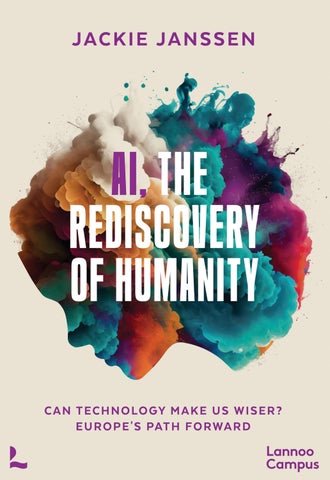
AI The Rediscovery of Humanity

Page 1


AI Companion

Hi there! I’m the LannooCampus Companion — your dedicated assistant for exploring AI: The Rediscovery of Humanity by Jackie Janssen. Whether you want to learn how AI can transform your work, how to stay ethical in an age of automation, or how to keep humanity at the centre of technological choices — I’m here to help. How can I assist you today?

That’s a question many people are asking. AI raises concerns about control, privacy, and work. In AI: The Rediscovery of Humanity, you won’t find doomsday scenarios, but a different perspective: what if we didn’t just let AI happen, but consciously shaped it? This book invites you to see AI as an ally — provided we design it around human values such as autonomy, empathy, and creativity.

By using technology as a supporter, not a replacement In AI: The Rediscovery of Humanity, you’ll read how AI can actually enhance creativity, autonomy, and empathy — by leaving space for reflection, cultural meaning, and personal growth. Not more machine, but more human — with the help of technology.

Should I be worried about AI?

How can AI strengthen human qualities?

MEET YOUR AI COMPANION

LET’S MAKE THE BOOK ABOUT YOU! Meet your AI companion

Imagine this: you’re not just reading this book — you’re actually having a conversation with it. It feels as if Jackie is sitting right beside you, ready to answer your questions and guide you with her knowledge and experience. On the left, you can see what such a conversation with the LannooCampus AI Companion might look like. The Companion tailors the insights from AI: The Rediscovery of Humanity to:

▪ you as a professional

▪ your team

▪ your company or organisation

▪ and your unique situation.

Through a convenient chat function, you’ll discover features that go far beyond the traditional learning experience — such as personalised advice, real-time updates, and practical tools to help you immediately apply the book’s insights.

Experience a new, interactive way of learning that grows with you — in three simple steps:

STEP 1:

Go to https://ai-therediscoveryofhumanity.com/ or scan the QR code and follow the instructions.

STEP 2:

To activate your AI Companion, you’ll need the following unique activation code:

STEP 3:

Open the chat — and start the conversation. From the moment you register, you’ll receive free access to your personal AI Companion.

INTRODUCTION

How I learned to love AI without losing my humanity

I remember the exact moment I realised that AI isn’t a story about technology — it’s a story about people. It was a Thursday evening, my laptop still warm after a long day of data analysis, when my daughter asked me, “Dad, why do you sometimes cry when you look at your screen?” I realised I had been struggling for months with something I couldn’t name. It wasn’t the code or the algorithms — it was the question: what does it mean to be human in an increasingly intelligent world? This book is my search for that answer.

A creative morning: A new perspective on living with AI

On a rainy afternoon, Sarah had an intriguing conversation with a sec ondary school teacher about one of his students. Lisa, usually one of the most engaged pupils in class, had been unusually quiet during a climate debate. Later it emerged that she was struggling with a deep inner con flict — her father worked in the fossil fuel industry, and she felt torn be tween her loyalty to her family and her growing concern about climate change. No AI system could have detected Lisa’s silent turmoil, Sarah realised, and that thought forever changed how she saw technology and humanity. Her interview the previous Monday with a young artist named Emma — caught in a struggle between technology and emotion — had taken her understanding one step further. It had cost her a sleepless night, her notebook filled with hastily scribbled lines, ideas, and

fragments of thought. With a steaming mug of coffee in her hand, she reread her looping handwriting: Emma, portrait — AI cannot capture a soul.

Oliver, her fluffy grey cat, brushed against her legs, gazing up with curious amber eyes. The sun cast a gentle glow across her cosy apartment. Sarah smiled, flipped open her laptop, took a deep breath, and opened a new document. Her fingers hovered above the keyboard, as if searching for the right words to capture the moment’s quiet magic. The blank screen reflected her determined expression. In the background, her AI writing tool imported and refined her handwritten notes. As the words appeared on the screen, she reread a passage: her protagonist, a young woman at a crossroads in her life, was wrestling with an inner conflict. In the corner of her screen, a subtle pop-up appeared — a suggestion from her AI writing assistant: consider deepening the dialogue by letting the protagonist voice more doubt. It could strengthen her inner struggle.

Sarah paused, her eyes gliding over the AI’s words. She read the suggestion again, considered its implications, and slowly nodded. It felt as if the AI wasn’t just organising her sentences but somehow reading her thoughts — sensing and enriching her creative process. She adjusted the passage, and with every keystroke the words seemed to resonate more deeply, to feel more authentic.

Then came another suggestion: replace 'morning' with 'daybreak'. Sarah froze, as if struck by lightning. She tasted the word, let it roll around in her mind. Daybreak… she whispered. It sounded so much more poetic, so much more vivid. Exactly what she had been searching for — without knowing it. A smile curled across her lips.

A moment later, the AI proposed a dramatic twist — a plot development to heighten the tension. Sarah thought it over, her fingers drumming softly on the table. Technically, it would no doubt strengthen the story, keep the reader on the edge of their seat. But her intuition, that vague and indefinable sense, told her otherwise. The power of this scene, a quiet inner voice whispered, lies in stillness — in subtle shifts of emotion. She decided to ignore the AI’s suggestion — a conscious choice to follow her own path. The AI might recognise patterns in what worked, in what appealed to the masses, but only she could sense what was right for this particular moment, for this unique scene in her story.

Strengthening human qualities

Sarah’s experience is just one example of how generative AI can enhance our creativity and reflection. All over the world, people are discovering how this technology can support their unique talents, goals, and dreams. This isn’t a vision of the future — it’s happening right now. Artificial intelligence is no longer a competitor to human ability but a collaborator. It embodies what I call HumanCentred AI: technology designed to strengthen, rather than replace, human qualities. It’s about using AI in ways that are both humane and meaningful. Like Sarah, we all experience how technology can help us expand our creativity and autonomy. Yet this also raises broader questions about the role of AI in our lives. How did this technology evolve so rapidly, and what does it mean for our future?

In recent years, we’ve mostly heard about the dangers of artificial intelligence — robots taking over jobs, algorithms violating our privacy, systems amplifying bias. In Europe, the AI Act was introduced to protect us and provide a framework for responsible development. These concerns are real, and we should not ignore them. But they tell only part of the story. There is another side — a side, and a chance, we are only beginning to explore. What if AI is not merely a force that changes our world, but one that can help us change ourselves? What if AI doesn’t make us less human, but more? True symbiosis means more than cooperation — it is a relationship in which both sides grow and strengthen each other. This book explores how that symbiotic relationship can help us become not only more efficient, but also wiser and more creative. It’s a story about how we can design and use AI in ways that do not threaten our humanity, but enrich it — a story about technology that seeks not to replace human capability, but to create space for authenticity, growth, creativity, and meaning.

That, too, is a European story — one that, in my view, is only partially captured by the AI Act. It means that this book is about far more than technology alone. The geopolitical reality of our time compels us to make deliberate social choices. Through a human-centred lens, Europe has the opportunity to claim a unique position in the global landscape of AI innovation. Europe now stands at a crossroads. The technologies we develop will determine how we live, work, and relate to one another. The choices we make in the coming years will shape the future of AI itself: will it become a force that displaces human capability, or an instrument that helps us realise our potential according to our own values and principles? This book offers a framework for that second path. It introduces the idea of AI as a technology designed with deep respect for European norms and

values. It also presents practical tools — such as the Humanity Check — that organisations can use to develop AI systems that foster human growth and wellbeing. In addition, it illustrates how these principles are already being applied across different sectors, from education to healthcare. So, what you’re holding is not a technical manual, but an invitation to rethink our relationship with technology — to look beyond the simplistic contrast between human and artificial intelligence, and to explore how technology can help us become not only more efficient, but also wiser, more creative, and more connected.

Europe often gets portrayed as the continent of rules. But the older I get, the more I suspect that rules are only the surface of something deeper: a civilisation’s answer to one silent question — what do we refuse to sacrifice, even when speed is available?

The AI Act matters, because it translates fundamental rights into a risk-based language that technology can be held accountable to. Yet if Europe’s AI story ends at compliance, we will have built a fence around a garden we never planted. And then, sometimes, history hides in unexpected places. In February 2026, the leaders of the European Union gathered informally in Alden Biesen — far from Brussels — to talk about Europe’s industry, taking time for a calmer, less “business as usual” conversation. The setting mattered, one of them said, because stepping out of the Brussels cocoon changes the tone at the table. I read that and thought: perhaps that is exactly what Europe needs to do with AI as well. Step out of the reflex of imitation. Slow down just enough to choose a direction.

And build an AI future in which autonomy is not a slogan, but a lived experience—personal, organisational, and continental.

In the chapters that follow, you’ll begin to discover what human-centred AI really means. You’ll start with the foundations of what makes us human and, from there, build a bridge to the future of human-AI collaboration. We’ll begin by examining the qualities that make us uniquely human — and why they are so valuable. There are fascinating examples of human creativity, emotional intelligence, and spirituality. Why can a poem written centuries ago still move us? How do we find meaning in situations that seem meaningless? Why can we feel comforted by the view of a still lake, or by a sunset after a difficult day? These questions open the door to a deeper understanding of our own capacities.

In the next part of this book, you’ll explore the limits of AI — not as constraints, but as opportunities for meaningful collaboration. Just as a microscope doesn’t make us less observant but helps us see more clearly, AI can enhance our human abilities. We’ll look at how the so-called limitations of AI can in fact create space for human growth and creativity. In the practical section of this book, you’ll find concrete tools and guidelines for developing human-centred AI. At the heart of this is the Humanity Check — an innovative framework that helps organisations design AI systems that promote human development and wellbeing. How do we ensure that AI systems are not only efficient, but also leave room for human autonomy and growth? To bring these principles to life, this book includes inspiring examples of organisations already putting this approach into practice — from a language app that doesn’t just teach vocabulary but also fosters cultural understanding, to healthcare systems that help doctors make better decisions without undermining their clinical judgement. These stories show what AI can look like in practice.

Finally, this book offers a vision of a future in which technology amplifies our humanity. What does a world look like where AI isn’t built to replace people, but to help them grow? What does it mean to have technology that not only increases our efficiency, but also nurtures our wisdom and creativity? How can we shape technology in a way that honours who we are — and who we can become? This book is my invitation to you to take part in what may well become the most important conversation of the next decade: how do we ensure that technological progress goes hand in hand with human progress? How do we create technology that doesn’t estrange us from ourselves, but instead helps us rediscover what it truly means to be human?

Curious for more? Scan the QR code and dive into the world behind the book — book a keynote, chat with AI, or discover how human you truly think AI is.

Jackie September 2025

WHAT MAKES US HUMAN?

What makes us human is not our perfection, but our unique imperfections. It is our doubt, our curiosity, and our creative spontaneity that set us apart from anything technology could ever become.

The

slow search for a uniquely human story

In 2025, Sarah — writer and AI developer at the forward-thinking com pany TechForward — finds herself at the intersection of a new era. She sees how technology and humanity meet, collide, embrace, and, in the best cases, strengthen each other. It is an age full of possibility, but also full of pitfalls. After a week of fresh insights, she now sits at her kitchen table, half a cup of coffee gone cold beside her, deeply absorbed in her work. Oliver the cat lies lazily stretched out in a stripe of sunlight on the floor. Next to her laptop rests the recorder from yesterday’s interview — Lisa’s teacher had given her plenty to reflect on, especially about the subtle signals AI would miss. Her novel is progressing, but this morning feels different. There’s something she can’t quite capture, a feeling that seems just out of reach. It reminds her of the heart of her argument:

what makes us human is not our perfection, but our unique imperfections. That thought — so powerful, so true — must become the red thread not only in her book, but in how we understand the world around us.

The protagonist of her story, a young woman named Mira, stands at a crossroads in her life, much like Lisa, who struggled with her loyalty to her father and her growing concern about climate change. Mira’s choices are charged with doubt, longing, and the question of what truly gives her life meaning. Sarah rereads the scene, frowns, and lets her fingers hover over the keyboard. Imperfection, she realises, is not the obstacle — it’s the driving force. A subtle notification appears in the corner of her screen: perhaps you could show what Mira feels by giving her a moment of silence — a scene in which she questions herself. Sarah nods slowly. A good idea, but it still doesn’t feel quite right. She leans back and gazes out the window. The sun is bright, but her mind is foggy. What is she really trying to say? What makes this story truly human? It’s that constant struggle — that productive friction — that defines us. She feels a quiet restlessness rise within her and closes her laptop.

She settles down with her pen and notebook. AI can make suggestions, offer structure, but it cannot tell her what’s going on in her mind. As Oliver purrs softly beside her, she lets her thoughts wander. This isn’t wasted time, she realises. It’s precisely in this moment of boredom that space opens up for new ideas to form. AI doesn’t experience boredom the way we do — it waits, it processes, or it stands idle. It lacks the existential dimension of boredom, that gnawing emptiness that can push us towards deep reflection and unexpected creativity. Our imperfect, sometimes 'aimless' moments are breeding grounds for the new. Sarah feels a spark of inspiration: what if Mira’s doubts don’t just stem from her situation, but from a deeper longing for meaning? She picks up her pen and starts writing, the words flowing straight from her thoughts. This is what it means to be human, she thinks — finding new ideas in the discomfort of nothingness.

When she returns to her reopened laptop, the AI offers a new suggestion: perhaps you could introduce an unexpected object that sparks Mira’s curiosity. Sarah smiles. That’s interesting. What could awaken her character’s sense of wonder? She thinks of how people are sometimes moved by the smallest things — a song, a painting, an unexpected scent. Flipping back through her notes, she spots a sketch of an old key. The key, she decides, will become a symbol in the story. Mira finds it and wonders what door it

might open — leading her to an unforeseen discovery. As Sarah types, she reflects on her character’s emotions. Mira feels fear, hope, and confusion. They’re not simple emotions — they’re layered, contradictory. It’s not only a question of which door the key opens, but what she hopes to find behind it. Here, the AI assistant falls silent. It can suggest structure, but it cannot feel what Sarah feels as she writes Mira’s struggles.

Sarah thinks about her own life — how her doubts have shaped her, how the pain of loss has made her wiser. That feeling, that depth, is what she now tries to capture in Mira’s story. Suddenly, the story takes an unexpected turn. As Sarah types, she realises that Mira doesn’t use the key to open a door, but to discover a letter. It wasn’t planned, but it feels right. This twist wasn’t conceived beforehand; it emerged spontaneously as she wrote. This, Sarah knows, is what makes her creativity unique. She improvises, trusts her intuition, and allows herself to be surprised by her own words. The AI suggests adding a conflict — a dramatic confrontation to heighten the tension: research suggests that readers are more engaged by stories with clear conflict. Sarah reads the suggestion, but her intuition tells her otherwise. She thinks of how some of the most meaningful moments in her own life were quiet and understated. Not every transformation needs a dramatic catalyst.

When the scene is finished, Sarah leans back and reads what she’s written. It feels as though she’s come closer to something essential. Mira has opened the letter and reads an old text about the search for meaning. The letter doesn’t offer answers — it raises more questions instead. Sarah smiles. That’s exactly what she wanted to capture. The search for meaning is never complete; it’s an ongoing process of reflection and growth. Her AI system remains silent as she absorbs the moment. It doesn’t understand what this means to her, because it cannot feel the deeper layers of that spiritual journey. After an hour of writing, Sarah pauses, struck by a quiet awareness of her own process. She reflects on how her decisions have been both intuitive and deliberate. She glances at her AI assistant. It has helped her with suggestions, but it doesn’t control her story. What gives her story meaning isn’t the structure or the words themselves, but the way she weaves her own experiences and emotions into them.

When Sarah closes her laptop, she looks over at Oliver, still peacefully asleep. “It’s not perfect,” she murmurs, “but that’s the point.” AI has helped her, but it’s her humanity — her doubts, her emotions, her spontaneity — that makes the story real. This is what technology will never fully

Turn static files into dynamic content formats.
Create a flipbook
AI The Rediscovery of Humanity by ACC Art Books - Issuu