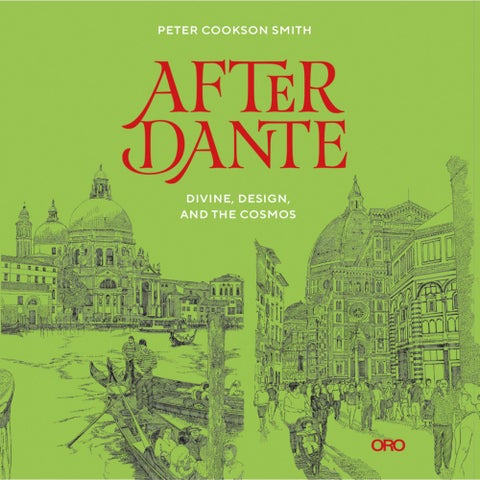
AFTER
Peter Cookson s mith
DANTE
Divine, Design, anD the Cosmos
ORO Editions — Novato, California
Trajan’s Market, situated on the Via dei Fori Imperiali was inaugurated in 113 Ce as part of Emperor Trajan’s Forum on the flank of the Quirinal Hill, and eventually completed by Emperor Hadrian. Shops and administrative offices were incorporated by excavating the ridge, connecting the Quirinal and Capitoline hills. The military tower above the market was constructed in 1200 CE. Between the Basilica Ulpia and the temple dedicated to Trajan were two libraries that housed Latin and Greek documents, with Trajan’s Column at their center.
Deconstructing
Epilogue
Acknowledgments
References
LA·DIVINA·COMEDIA: A·PERILOUS·VOYAGE INTO·THE·AFTERLIFE
O human race, born to fly upward, wherefore at a little wind dost thou so fall.
Dante a l I gh I er I , La Divina Comedia
a D I v I na Come DI a or D I v I ne Come Dy, the epic poem written by Dante Alighieri between 1308 and 1320, forms a poetic narrative that portrays an imaginative relationship between God, taken to be the benign creator of the Universe, and the souls who inhabit it who are conjured into existence through a celestial force and given spiritual purpose. The poem consists of a heroic journey of exploration but also self-examination that in part pursues the depth and elevated realms of humanity, but at the same time posits Dante as the detached protagonist open to his own beliefs, impulses, and prejudices. The intended purpose of the journey is the salvation of mankind, but can be read on many levels—spiritual certainty and attainment, a vanquishing of barriers, and a conquering of inner demons. Dante’s own vision and poetic accomplishment reinforces the sense of mission that purports to carry a message of reform from God to mankind, focussing on the threat of corruption and sin prior to the possible achievement of salvation. In its inspired and imaginative vision of human predestination in relation to the universe, it was made credible in the late medieval and early Renaissance period by the prevailing Christian belief system where philosophical thought was directed toward the human soul and its relation to God.
The medieval “Middle Ages” are generally taken as commencing with the fall of the Roman Empire in 476 ce and the beginning of the 14th century. Outside main centers of learning associated with ancient universities and monasteries, the medieval age suffered from war, famine, and disease. However, a new humanism began to take hold in cities in the first part of the 14th century, focused on education, guilds, and the arts. These were mutually stimulated through new types of political, trading, and religious bodies that celebrated the achievements of classical antiquity, just as it pursued new interfaces with the expanding international order that was spreading across Europe, forging a new modernity.
The main church interpretation of divine creation, derived from the Christian canon through the book of Genesis, was the formation of the Universe and its life forms representing a series of creative acts over six days. The Fourth Lateran Council presided over by Pope Innocent III in 1215, 50 years before the birth of Dante, blurred the issue somewhat by promulgating a canon law that God, through his omnipotent power, “created all things simultaneously at the beginning of time, and then made man from spirit and body.” Accordingly, heaven was created on the first day; the firmament comprising air, planets, and stars on the second; the waters on the third; and the celestial luminaries on the fourth. This remained as the most widely held opinion during the Middle Ages, and by the 13th century the only real impulse toward an understanding of the celestial void came from a theology based on an omnipresent God. The heavens themselves were assumed to consist of an ethereal and unknowable realm that changed only with
respect to an apparent circular motion. Aristotelian cosmology had, by the time of Dante, become part of Christian theology through the work of Albertus Magnus and Thomas Aquinas.
What Dante sets out in the Comedia is arguably a model for an “ideal” society, first through the identification of traits that must be excluded, second the means to counter them, and third the elements that are necessary for its political functioning. It is a call for the unification of society with all parties contributing to the common good through their individual abilities, but also an acceptance that communities must have officials to instill order and provide for the necessities of public life while renouncing any ambitions toward overall power. This well-intentioned but necessarily idealist aspiration is accompanied by a strong assertion that the church itself must be free of the workings of the state, and enable it to concentrate its intentions on ministering to the spiritual needs of citizens.
Dante’s writing portrays the late medieval period in Italy, but opens a door to the early Renaissance while examining issues of timeless concern. Love, suffering, struggle, and freedom are imperatives we encounter at a personal level, just as we put great stock in the pursuit of happiness and fulfillment. His use of allegory might well evoke analytical questions revolving around its precise level of interpretation, where there can exist several levels of reference and explanation, quite apart from the literal, even if his rich poetic resonance might detract somewhat from its comprehension.
The availability of classical Greek and Roman texts, that focused on philosophical thought rather than the religious piety of medieval mindsets, created a new emphasis on reason and inquiry related to the natural world. In as much as the Comedia reflects, at least in part, the strong medieval belief system set out in scriptures and systematically preached by theological scholars at the time, Dante’s profound and poetic communication of this, along with deep introspection as to the fallible state of human will, elevates the stature of the underlying message itself. As a moral focus, reinforced by the authority and conduct of figures such as the Roman poet Virgil, and Thomas Aquinas on his tortured road to salvation, Dante argues that a clear demarcation must exist between the need for a restored Holy Roman Empire and a return to the apostolic values of the Church. Each was seen as having a complementary role in pursuing both justice and ethical standards within society, which should logically extend to eternal satisfaction.
The elusive link between individuality and community hinges on the citizen’s ability to make independent choices, and can only be aligned with those who are free to choose. In this Dante acknowledges the philosophical scholarship of Aristotle who argued that the virtuous functioning of communities formed a necessary moral basis for individual re-awakening and salvation. At the same time Dante exhibits an indebtedness to Virgil’s Aeneid as an epic pilgrimage in pursuit of truth, no matter the trials and hazards associated with the journey. In this sense the underlying discipline of poetic language facilitates a fascinating rapport with the narrative, and its engagement with the horror of Hell, the frustration of Purgatory, and the exultation of Paradise.
The Comedia is caught up with the cultural and philosophical context of its time, but this has to allow for the prevailing political tension and the idealistic principles that underscore the poem, in particular the relationship between a God as the benign and prolific presence behind the universe, and his, or her, human creations. This line of thought contends that both the Church and the State have a complementary role in establishing a subtle and possibly an equivocal route to divine contentment, whatever the continual crisis along the path. Dante’s familiarity with the Aeneid clearly assists him not merely in adopting a new style of narrative verse, but in Virgil’s allusions to Christian belief - one that is consistent with appropriate modes of conduct and persistent moral motivation. The Comedia therefore
The Duomo di Sienna dating from the 13th century towers above the surrounding hillside structures’
stands as a means of conveying both passion and intellectual purpose, but also a conspirational web of double meaning, open to different interpretations and lines of conjecture.
The turbulent encounters in the Comedia take place in the year 1320, between Good Friday and the following Wednesday. Good Friday is spent exploring Hell with Virgil as a guide; the next day they ascend from Hell to observe the stars, and arrive at the shore of the Mountain of Purgatory on the morning of Easter Sunday. The Comedia ends with arrival in the Earthly Paradise. The “fall” of humanity is equated with what are perceived to be the “problems” in Italian society, with Hell, Purgatory, and the Heavenly Paradise represented by punishment, repentance, and bliss.
The implication of this allows for a certain directness of purpose toward Dante’s likely audience in terms of connectivity within the canto form of three-line verses. In the Comedia Dante is escorted through the first two realms by Virgil, and thereafter through the celestial barrier beyond the dank material world by Beatrice—a spiritualized ideal of sublime femininity, and a central figure in Dante’s poetic imagination, as a guide to the essence of a heavenly reality beyond sordid materiality. Beatrice is shown as a symbolic figure, at once both revelatory and enigmatic, but with an essential role of leading the poet to a divine order of understanding and salvation, from her unrivalled position as the eternal object of Dante’s devotion.
The awakening of Dante’s own linguistic authority gains from his descriptive power and imagination, but its overriding achievement is to position the work as a means of intellectual challenge rather than indulgence. Dante’s use of a vernacular Italian language from the region of Tuscany is calculated to set a powerful poetic standard and reach a wide audience—in effect the poet becomes the vessel of communication, representing a divine as well as a political mission, suggesting an eloquent and enduring meaning that is difficult to express in any other way. It is rooted in a rhapsodic spiritual transmission of belief, imagination, and emotion that embraces the entire universe. To Dante poetry was an instrument to probe and provoke, using it as a tool to grapple with his own frustrations and sense of justice. The intensity and significance of the subject is matched by what can be gleaned from the poetic medium itself. The Comedia incorporates several features that allow Dante to accomplish an innovative style of poetry, attuned to each canto. First, the term comedia alludes to the somewhat melodious dialect of Florence, possibly to express directly the overall message of humility, rather than the authoritative style associated with Latin—something that was unusual for scholars at that time. Secondly, cantos are used to express the narrative but with some flexibility as to continuity. This challenges the reader to connect the ends and beginnings of successive stanzas in order to decipher the intuitive relationships and contrasts. Thirdly, the adoption of the three-line stanza within the cantos allows the author to incorporate emphatic shifts in the narrative direction along with sudden changes of emphasis and imagery that embellish the underlying meaning and purpose of the poem.
In the portrayal of Virgil and his importance to the Comedia, Dante tactically positions his presence as an alter ego—someone who at the same time is an essential part of the poem in the form of an alternative self. This successfully opens up new lines of thought and provides responses that the protagonist himself might wish to state indirectly as a persuasive and even intimate mode of expression—a tactic later adopted by Galileo.
The appeal of Dante, and to a large extent his enduring fascination, is his metaphysical contribution to an enigmatic mix of thought, philosophy, literature, theology, and spirituality. He was born in
Florence in 1265 shortly after the death of Emperor Frederick II and nine years before the death of Thomas Aquinas. This late Middle Age period saw almost constant military struggle, and the defeat of the Florentine Guelphs by the Ghibellines, before a reinstatement of Guelph rule with the assistance of the French, allowing Florence to develop a tentative supremacy over Tuscany. Dante was by all accounts both impatient and presumptuous, possibly reflecting both his willingness to fight for Florence, and his later banishment from the city. His education was largely devoted to Latin, ancient literature, and later philosophical study, allowing him to relish what he termed the “art of grammar” that enabled him to study the classics outside monastic institutions and develop an excellence in prose writing.
It is generally acknowledged by scholars that the embryo for the Comedia was Dante’s earlier poem La Vita Nuova or a book of memory, completed in 1295. This explores the notions of transformation and change, inspired but also convoluted through his encounter with Beatrice, a real life personification of beauty, the daughter of a wealthy merchant, Folco Portinari. She was, however, in many ways a phantom, who exerted a distractive but powerful force on his life. Indirectly this “new life,” set in prose and verse, introduces aspects of reason, human nature, and the transience of life evinced by her early death, which Dante sorrowfully suggests as realizing a divine purpose.
Both Dante and Beatrice are presented in the Comedia as chosen messengers, so their views are taken as having divine sanction. The poem, occasionally in a rhetorical way, points the way to what is to come— in effect an entré to a more philosophical view of life, essential purpose, and death. More particularly, La Vita Nova seems to introduce a realization of Dante’s own capacity for ardor and vehemence as a means to adroitly allocate those in or out of divine favor. This includes the damned, who are condemned through moral abdication, and the redeemed, who are considered as being suitably open to ultimate salvation. In the process love is depicted as the source of a new beginning.
The fact that Dante proffers a caricature of himself into the narrative that is often less than positive, while subtly displaying his poetic skills, underscores a delicate collaboration with his audience, but at the same time challenges them. Over the years its many interpretations, with their audacious allusions to human nature and confident references to sacred events, mythology, and history, have permeated into Italian culture. The text also includes passing observations of familiar but incidental details that, in terms of imagery, echo an ancient way of life in the northern Italian city and countryside. While his work is now lauded by the Catholic Church, Dante’s poetry contains several layers of meaning and a degree of ambiguity making it open to scholarly interpretation, which perhaps explains the large number of English translations. But we must read into Dante much that is allegorical, only barely disguising repugnance toward the corrupt state of the church, the destructive rivalry among powerful political factions, and the role of the individual in society—all popular topics in the early 14th century.
The Comedia is constructed around the simple proposition that humans owe their existence to a creator, and that rather than the humdrum dust-to-dust scenario, eternal happiness will only be achieved when a being returns in sacrificial obedience to the heavenly court. The painstaking path to this comprehension is essentially a search for what is situated as an underlying truth about the concept of “eternity” and the painful hurdles that must be overcome in advancing toward it. That Dante wrote this masterwork during a state of exile from his home city of Florence, and under a lingering death sentence, gives the poem some poignancy. Crisis can bring fear and darkness, but also re-evaluation and resurrection, indicating a persistent pathway to enable the transition from evil to purification and wisdom. If human beings can be casually cast into the biblical version of everlasting fire due to a rather open-ended definition of sin, it was considered only prudent to proffer some ladder, which might permit escape through repentance.
A·RESTLESS·AND CREATIVE·SEED
Heaven wheels above you, displaying to you her eternal glories, and still your eyes are on the ground.
Dante a l I gh I er I
Section and exterior of Brunelleschi’s dome. Redrawn from C. von Stegmann and H. von Geymüller
The dome is crowned with a lantern designed by Brunelleschi’s colleague, Michelozzo, in 1461. A gilt copper ball that surmounts the lantern contains holy relics and supports a cross designed by Andrea del Verrocchio in 1469
MANNERISM, MONUMENTS· AND·MARKERS
Redrawn frontispiece from the original edition of I Quattro Libri dell’architetture (The Four Books of Architecture) by Andrea Palladio, Venice, 1570.
anner I sm I s assoc I ate D with the late Renaissance period. This partly reflected cultural and city-making advances, but ones that were gradually compromised by two main factors. The first was an increasing economic instability through competition over trading trajectories together with the loss of important territories that led to retrenchment; the second was the CounterReformation orchestrated by the Catholic Church in response to Protestantism that splintered the intellectual and belief structure of European populations. By the 16th century, the Church had begun to assume a commanding role over both the spiritual and secular realms, and the papacy adopted the use of expressive imagery and monumental constructions to symbolize its power. In 1503 Pope Julius II began to restore the authority of the Church, which began an era of imperial association with a range of notable architects who were directed to articulate the increasingly triumphant program of building.
By the 16th century, the Church had begun to assume a commanding role over both the spiritual and secular realms, and the papacy adopted the use of expressive imagery and monumental constructions to symbolize its power. In 1503 Pope Julius II began to restore the authority of the Church, which began an era of imperial association with a range of notable architects who were directed to articulate the increasingly triumphant program of building.
Pope Leo X was born Giovanni di Lorenzo de’ Medici, and became ruler of the Papal States from 1513 to his death in 1521. He encountered immense difficulty in implementing reforms agreed by the Fifth Council of the Lateran, but in 1516 a Concordat was signed between the Holy See under Leo and King Francis I of France. As an active representative of the Medici family, Leo was concerned to cement the relationship between Rome and Florence—the poetic association between the Tiber and the Arno. The Medici family itself rose to become Dukes of Florence with ceremonial trappings that consolidated their position as “first among equals.” The Medici connection with Florence, and the opportunity to underscore its dynastic pretensions in this republican city, was further expressed through an architectural initiative for the design of San Lorenzo, the family’s church in Florence and the burial chapel of the Medicis.
Leo was a strong patron of the arts, and he instigated the rebuilding of St. Peter’s Basilica in Rome. Bramante was chosen as the initial architect for the new church, which was intended as a universal symbol of humanism. However, its combination of ancient and modern elements within a Latincross plan rather than a centrally planned one that proclaimed the absoluteness of theological teaching came at a time when, in certain quarters, absoluteness had come into question. Leo’s death in 1521 and the election of another Medici, Clement VII as Pope in 1523, indirectly marked the end of the classical Renaissance, which coincided with a profound political and religious crisis associated with the Reformation and Counter-Reformation. The uncomfortable and often competitive relationship between Empire and Church that had so obsessed Dante some 200 years previously, came to a head in 1527. The emperor’s role was essentially to enforce established doctrine and prevent outbreaks of heresy. However, the coming years were distinguished by the eclipse of imperial greatness and an increasingly powerful papacy.
Bramante was chosen as the initial architect for the new church of St. Peter’s in Rome, intended as a universal symbol of humanism. However, its combination of ancient and modern elements within a Latin-cross plan rather than a centrally planned one that proclaimed the absoluteness of theological teaching came at a time when, in certain quarters, this was being questioned.
Progress of work on St. Peter’s was slow. After the death of Antonia de Sangallo in 1546 Michelangelo modified the plan, based on Bramante’s initial layout but with a monumentalized external expression. Michelangelo’s proposal for a flat curve and a tall lantern for St. Peter’s embracing an iconic image for “all of Christianity,” was modified by his architectural successor Giacomo della Porta. The planning layout, shaped by the need for large assemblies and the visual axis of spectators, eventually took the form of a gigantic stage set, suggesting a familiarity with the work of Serlio. This formed part of a wider urban design that stretched to Rome’s city gate, the Porta Pia, which formed the first part of later baroque city planning.
Pope Clement VII, alarmed at the Imperial power of the Holy Roman Emperor Charles V, formed an alliance with his great rival King Francis II of France, and a triumvirate of central Italian cities—Florence, Venice, and Milan. However, due to a lack of funds for the army of Charles V, more than 30,000 troops mutinied. A large force led by Charles de Bourbon comprising predominantly German, Spanish, and Italian troops attacked Rome on the 8th of May 1527. Despite a courageous “stand” by the Swiss Guard, 4,000 defenders were killed, and palaces, churches, and monasteries destroyed. After almost one month of fighting, Clement surrendered and paid a large ransom. As a result, the Emperor was able to exert almost complete control over the Catholic Church and much of Italy in the process, with strong repercussions for Italian independence and a prolonged pillaging of the gilded city by mutinous troops. This included the loss of the first globes of the terrestrial and celestial spheres, produced by Nicolaus Germanus, the German cartographer.