
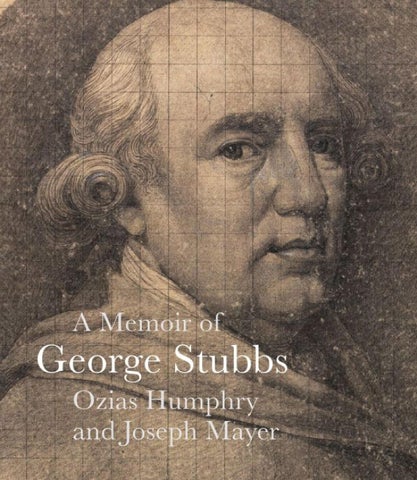
A Memoir of George Stubbs

Page 1


George Stubbs

A MEMOIR OF GEORGE STUBBS

B Y

O Z I A S H U M PH RY A N D

J O S E PH M AY E R

w i t h a n i n t ro d u c t i o n by

A N T H O N Y M O U L D P A L L A S

A Lion attacking a Horse, 1762

C O N T E N TS

In t ro d u c t i o n by A N T H O N Y M O U L D p. 7

A Memoir of George Stubbs, R.A.

O Z I A S H U M PH RY A N D

J O S E PH M AY E R

p. 25

A List of George Stubbs’ Pictures with Anecdotes

p. 69

List of illustrations

p. 94

INTRODUCTION

ANTHONY MOULD

George Stubbs had no Boswell. Indeed it was not until 1876, sixty years after Stubbs’ death, that any attempt to write his life was made. This was the essay published here, which was written by a fellow Liverpudlian, the art p

(1803–1886). Stubbs was by this time almost completely forgotten, so it is no surprise that Mayer’s essay was self-consciously a manifesto, advertising to a fairly indifferent Victorian audience the genius of a painter for whom the collector had a strong personal predilection.

But Mayer’s essay has a greater intrinsic interest than this suggests. It is in fact the closest we can get to a contemporary interview with Stubbs, for it is based on manuscript recollections left by Stubbs’ contemporary, Ozias Humphry. Humphry, a minor painter, was certainly no Boswell, but he was a would-be Vasari. In 1797, when Stubbs was 73, Humphry seems to have had one or more conversations with him about the painter’s life and career. Humphry never wrote up his notes properly, but

Opposite: Self-portrait on a white hunter, enamel on earthenware, 1782

they were transcribed and augmented by his relative, the manuscript collector William Upcott, who had himself been in touch with Stubbs’ family and had probably w r i t t t e n t h e b r i e f o b i t u a r y t h a t a p p e a r e d i n t h e Gentleman’s Magazine. All this rather scrappy but hugely informative material Mayer brought together into a more coherent whole, and he circulated the resulting essay privately in 1876, as part of a volume entitled Early Art in Liverpool, and again in 1879, in Memoirs of Thomas Dodd, William Upcott, and George Stubbs RA. As Mayer hoped, it was the beginning of a slow revival of interest in Stubbs. In 1898 Walter Gilbey published (also privately) his Life of George Stubbs RA; this went deeper but did not significantly alter Mayer’s view of the artist. In the 1920 ’ s Walter Shaw-Sparrow enlarged on the biographical material in his British Sporting Artists (1923), George Stubbs and Ben Marshall (1929), and A Book of Sporting Painters (1931). But it was left to the poet Geoffrey Grigson to bring a more critical sophistication to bear in Signature (1938) and The Harp of Æolus (1947). Grigson set the tone of subsequent analysis that went beyond that of just painting and pointed out that Stubbs’ tastes were those of ‘ an experimenter and observer ’ . Stubbs exhibitions in Liverpool in 1951 and at London’s Whitechapel Art Gallery in 1957 opened the door onto wider recognition and modern scholarship.

Within fifty years, Whistlejacket had become one of the most popular – if not the most popular – paintings in the National Gallery.

Nevertheless, there is still much unknown about Stubbs. The energetic perceptions of Basil Taylor brought greater focus to the scientific and veterinary aspects of the œuvre, but Taylor’s untimely death left much brilliant work unfinished. Stubbs himself remains largely silent but for the occasional letter or reported remark. There is no sitter’s book extant, and the catalogue of the posthumous sale of his effects in 1807 is mute evidence of how much has been lost: still lives, portraits, religious paintings such as a Descent from the Cross (Lot 70 on day 2), and many drawings in particular. Some of this material will no doubt emerge over time, and will enlarge our understanding of his working methods, but until it does the Humphry/ Upcott manuscripts and the edition of them by Mayer remain, whatever their shortcomings, the most comprehensive primary source we have.

George Stubbs was born in Dale Street in Liverpool (then ‘ a remote commercial town where little is heard of save Guinea-ships, slaves, blacks and merchandise’, in the

Overleaf: A cheetah with a stag and two Indian servants 1764-5. This may record an experimental hunt instigated by the Duke of Cumberland

words of one contemporary) on 25 August 1724. His father was ‘Honest John’ Stubbs, a prosperous currier, and Basil Taylor suggests that the young Stubbs’ social background was not dissimilar to that of the young John Constable. Little is known of his early life save that at the age of eight he began to make drawings from bones borrowed from a Dr Holt in Liverpool. (None of these drawings survives.) Stubbs was of course intended for the leather trade, but when he was 15 his father acceded to his artistic ambitions, and apprenticed him at a shilling a d a y t o t h e W a r r i n g t o n p o r t r a i t p a i n t e r H a m l e t Winstanley, who was then engaged in copying the Earl of Derby’s pictures at Knowsley. This arrangement lasted a few weeks only, and according to Humphry ended in acrimony. Stubbs determined that ‘henceforward he would look to nature for himself and consult and study her only’: the patterns of an independent mind were already crystallising. Until the age of almost 20 he continued to pursue his artistic and anatomical studies alone. Between 1743 and 1744 he left Liverpool, first for Wigan (then the larger town), where he worked as a portrait painter, and then for Leeds, where his chief patron was a Mr Wilson, possibly the painter Benjamin (himself much patronised at Wentworth Woodhouse), who found him employment again as a portrait painter amongst family and friends. There is tantalisingly little

known about this period, and as yet no portraits have appeared.

From Leeds Stubbs moved to York in about 1745. Here at the age of only 21 he was already making a serious study of human and animal anatomy and giving lectures to pupils at the infirmary whilst maintaining himself still by portrait painting. The lectures were apparently given privately, and Charles Atkinson, the town surgeon, procured for him his first body for dissection. Intriguingly in the first day of the 1807 studio sale appears ‘Lot 40, Sketch for the lay figure of Alice Atkinson who died at York aged 110, being the study for the large picture which Mr Stubbs painted for Dr Drake of York’.

Portraits from this period are now starting to surface, but more generally known are the illustrations made for Dr John Burton, man-midwife, the original for Dr Slop in Lawrence Sterne’s Tristram Shandy. It was Burton’s aim to counter the popular view of midwifery as undignified and unintellectual, and in 1751 he published his Complete System of Midwifery, which details the many ways a birth can go wrong. The graphic engravings were unsigned, and it was Mayer who first proved that they were by Stubbs. The anonymity is a mystery but human dissection was clearly a pastime that carried a social stigma. A much later letter from William Frankland to

Sir John Nelthorpe shooting on Barton Field, near Horkstow, 1776. His parents were loyal early patrons of Stubbs

Joseph Banks alludes to the ‘vile renown ’ in which Stubbs was held in York. Nevertheless he seems to have remained there (apart from a short visit to Hull) until about 1754, all the while continuing with his portrait painting, to which Frankland also refers. He also studied French and fencing, and had an enigmatic ‘ rencontre ’ with Mr Wynne, a dancing master, whose portrait he may well also have painted.

In 1754, perhaps supported by his portrait patrons the Nelthorpes and others in the Humberside region, Stubbs made the trip to Rome that was considered essential to an artist’s education. With what may have been characteristic contrariness, Humphry and Mayer report that he went to convince himself that ‘ nature was and always is the superior to Art, whether Greek or Roman; and having received this conviction he immediately resolved upon returning home’. This he promptly did, and we do not know if he even bothered to see any other Italian cities. Already by Christmas 1755 we find him back in Liverpool painting a portrait of James Stanley, and organising family affairs after the death of his mother.

Not long after he had returned to nearby Hull to complete portrait commissions promised prior to his departure to Italy, mainly for friends of the ever-reliable Nelthorpes. By the beginning of 1758, however, he was engaged in a much greater, career-changing enterprise;

the putrid business of dissecting equine corpses for The Anatomy of the Horse. Eighteen months he spent drawing in an isolated farmhouse at Horkstow, in a bleak Lincolnshire fen, entirely alone except for his companion Mary Spencer (a niece, according to Humphry, but more likely Stubbs’ common-law wife). The finished drawings he took to London to be engraved, only to discover that

Characteristically he set about the task himself, and six years later published his work in twenty four plates (or ‘Tables’) and an extensive text. The Anatomy superseded all previous works, and attracted international recognition that was to transform Stubbs’ career. Mayer quotes an entire letter sent by a professor at Groningen in high praise. The book’s success was due to Stubbs’ ability to design images that combine tremendous formal balance with a minute attention to detail. Stripping through layers of ‘muscles, fascias, ligaments, nerves, arteries, veins and glands’ down to the bone, the plates are still considered definitive in their accuracy, and it is not without good reason that Basil Taylor counted Stubbs next to Leonardo as ‘the greatest painter-scientist in the history of art ’ .

The move to London in 1759 marked a watershed in Stubbs’ career. By 1763 he had firmly established himself at 24 Somerset Street, Portman Square where he lived

Joseph Smyth, Lieutenant of Whittlebur y Forest, 1763-64

Smyth was for 52 years the agent for the Duke of Grafton, hereditar y warden of Whittlebur y Forest in Northamptonshire, who probably commissioned the painting

until his death in 1806. Making every effort to broaden and diversify his market, and cultivating the acquaintance of Whig aristocracy under a young king, George III, Stubbs now found himself at the age of 36 enjoying the enthusiastic patronage of the rising generation of the old Whig landowning families, Richard Grosvenor, Viscounts Torrington and Bolingbroke, the dukes of Grafton, Richmond, and Portland, John Spencer of Althorp (soon to be the first Earl) and the Marquess of Rockingham. Many of these he may have met through Domenico Angelo, a famous riding and fencing master. His new patrons were wealthy and youthful, and entering the great era of horse racing and foxhunting, the breeding of horses and dogs for the chase and the field, and the scientific breeding of farm animals; this was a time of agricultural experiment and expansion, the study of natural history, and new attitudes to country life, all encouraging a new and unparalleled demand for animal paintings. Stubbs’ response to this demand quietly transformed the character of English animal painting. As Mayer puts it, ‘ no temptation led him to invent a muscle nor did he put his creatures into an attitude. They are always as nature made, with their own shapes, gestures, and expressions – often ugly but always true. ’ But Stubbs did not confine this intellectual rigour and honesty to animals alone. The label ‘animal painter’ is manifestly

too restrictive when we look at the range of his subjects and interests and consider his matchless understanding of the human figure and the expression of character in portraiture.

The course of Stubbs’ subsequent career reveals the man as an uncompromising perfectionist, wrestling with the inevitable fluctuations of financial and artistic support. The range of subject matter continued to widen –portraits, family groups, exotic animals (monkeys, a zebra, a moose, a cheetah all appear), as well as horses and riders of all sorts. His work was exhibited freely at the Incorporated Society of Painters of which he was Treasurer, and at the Royal Academy. His technical inquisitivess and virtuosity found a new outlet in his e x p e r i m e n t s w i t h e n a m e l p a i n t i n g . I n 1 7 6 9 L o r d

Melbourne bought the first work in enamel for 100 guineas: a Lion devouring a Horse, 1 although this contradicts Humphry’s statement that the collaboration by Stubbs and Cosway in this medium began in the early years of the 1770 ’ s. By 1778 Wedgwood and Bentley were supplying large scale ceramic surfaces (2 ’6’’ high x 3 ’6” wide) and these were an increasing feature of

Overleaf: Sir Peniston and Lady Lamb, later Lord and Lady Melbourne, with her father, Sir Ralph Milbanke, and brother, John Milbanke (1769) 1. Tate Gallery

Isabella Saltonstall as Una, oil on enamel, 1782

Haymakers22 and Reapers33 in oval of 1794 and 1795. By this time painting commissions were beginning to dry up, and patrons such as Wildman, Vane Tempest, Lord Gormanston, the Duke of Newcastle and the Duke of Marlborough became erratic in their support. A grandiose project, the Turf Review, to paint a series of portraits of famous racehorses from the Godolphin Arabian to horses of his own day, instigated by an anonymous patron who may have been the Prince of Wales, sputtered out owing to a lack of funds. The lack of pictures after 1794 confirms the tradition that Stubbs lived his last years in financial difficulty and relied on the help of his friend Isabella Saltonstall who at the end had a lien on most of his unsold work. (All the enamels he is known to have made between 1791 and 1795 were still in his studio in 1806, as were the Turf Review pictures.) But the lack of regular painting commissions liberated his time for the ground breaking but alas incomplete Comparative Anatomy. This ‘Exposition of the Structure of the Human Body, with that of a Tiger and common Fowl’, for which 30 plates were planned, would have been a major scientific work.

2 & 3. Yale Center for British Art. See page 60

Mentally and physically very strong to the end (he 23

took a nine-mile walk the day before he died), and uncompromising in his views, Stubbs also seems to have suffered a certain social loneliness. Even his selfportraits, with their steady gaze, are notably taciturn. In them, and in his work, one senses not just a fairness of mind but also complexity and introspection. Yet these qualities never cloud the innate grip on reality, and a constantly exercised discrimination. Joseph Mayer put it thus: ‘He painted what he saw, and never showed an immortal soul in a poodle’s eye. ’ In his silence Stubbs emerges as a master recorder of his time: painter, natural historian, and dare one suggest it, at moments, psychologist of a very high order.

A Memoir of George Stubbs, R.A.

O Z I A S H U M PH RY A N D

J O S E PH M AY E R

The name of this eminent artist is familiar to few people at the present day. In some great mansions the housekeeper will pronounce it, and a visitor who catches that unknown monosyllable in the midst of her drawling roll, may glance with admiration at the big picture overhead, but will probably again forget. And in the old county inns of Yorkshire, where men love the weight-carrying horse their fathers bred, you may find Stubbs’ name on prints which the villagers still admire. By such works, indeed, he appears to be solely remembered amongst our critics. ‘Stubbs?’ they say ‘Oh, a man who painted racehorses!’ Yet it may be observed that whilst the great Sir Joshua asked but seventy guineas for a portrait ‘ as far as the knees,’ Stubbs’ commissions ran to 100 guineas each.*

Nay, it seems probable that Sir Joshua paid for his picture of the War Horse1 half as much again as he him-

* ‘I am just retur ned from Blenheim; consequently did not see your letter till yesterday, as they neglected sending it to me. My prices for a head is thirty-five guineas; as far as the knees, seventy; and for a whole-length one hundred and fifty. It requires in general three sittings, about an hour and a half each time; but, if the sitter chooses it, the face could be begun and finished in one day; it is divided 1. Lost

Opposite: Lord Grosvenor’s Arabian Stallion with a groom (c. 1765)

Turn static files into dynamic content formats.
Create a flipbook