
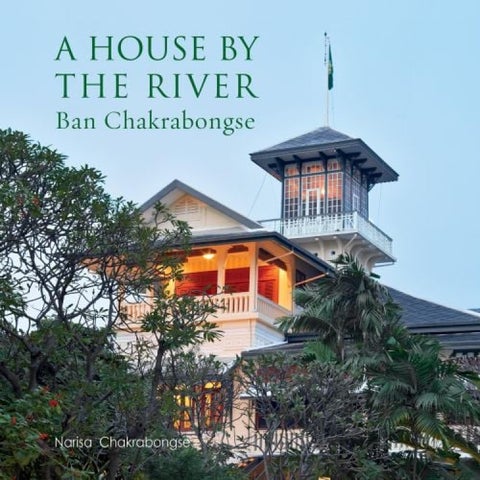
A House by the River

Page 1


With love to Gee, Hugo, Dominic, Hana, Natalie, Harper, Hunter, Oscar and Luca. You bring Chakrabongse House to life.

First published and distributed in 2026 by River Books Press Co., Ltd

396/1 Maharaj Road, Phraborommaharajawang, Bangkok 10200, Thailand

Tel: (66) 2 225-0139, (66) 2 225-9574

Email: order@riverbooksbk.com www.riverbooksbk.com

River books riverbooksbk @riverbooks

Copyright collective work © River Books, 2026

Copyright text © Narisa Chakrabongse

Copyright photographs © Narisa Chakrabongse

All rights reserved. No part of this book may be reproduced or transmitted in any form or by any means, electronic or including photocopy, recording or any other information storage and retrieval system, without prior permission in writing from the publisher.

Editor: Sarah Rooney

Production supervision: Ruetairat Nanta

Design: Narisa Chakrabongse and Ruetairat Nanta

Publisher: River Books Press Ltd., Bangkok, Thailand EU

Authorised Representative: Easy Access System Europe Oü, 16879218 - Mustamäe tee 50, 10621 Tallinn, Estonia, gpsr.requests@easproject.com

ISBN 978 616 451 112 5

Although I did not know my grandparents I have learned about their lives from their diaries and letters, which I have studied over the past 30 years.

Far right: Postcards from the first two decades of the

Above: Letters to my great Uncle Vanya and to Prince Chakrabongse from Katya.
Right: Diaries in Thai written by Prince Chakrabongse from 1911 onwards.
Bottom row: Diaries in Russian from Prince Chakrabongse’s time in Russia.
20th century.

Birth of Prince Chula, my father

Queen Saovabha was also angry and upset by the marriage but once Katya gave birth to my father on 28th March 1908, she relented and over the years became extremely fond of her daughter-in-law as evidenced in Katya’s letters to her brother, Vanya.

Letter to Vanya 1913

“The queen says I am the best hostess ever, that my food is delicious because I cook it myself, in other words that it is impossible to find a better wife.”

She doted on my father, her only grandchild, and there was often a tussle with his parents for him to spend the night with his grandmother at Phya Thai palace. It was she who named him and the note to this effect is below my father’s portrait. Although the king never met Katya, he often saw his grandson and gave him a small sword, which is on display in the dining room.

Chula in uniform with the sword given to him by King Chulalongkorn.
Note from Queen Saovabha naming my father, Pongchak. (His name was changed later by King Rama VI to Chula.
Note from Prince Chakrabongse to his mother, Queen Saovabha, informing her of his son’s birth.

A successful writer and journalist

The large desk covered with memorabilia is where my father sat and wrote when he was in Thailand.

After the revolution, apart from managing the White Mouse Racing team, my father realized he could pursue one of his great loves which was writing. He began his career as an author in the small London flat he shared with Bira in London and developed it extensively in Cornwall during the Second World War. He wrote both in English and Thai and was ambidextrous, meaning he would write the left page of his manuscript with his left hand and the right page with his right. Books recounting the racing successes of the White Mouse team sold well as did his memoir Brought up in England. My father had studied history at Cambridge and, as a result, he decided to write general histories in Thai. The titles included Cavour, Napoleon and later he translated Hugh Trevor-Roper’s The Last Days of Hitler. He also wrote a novel Sam Sao loosely based on Jane Austen.

One of his most successful books, however, was his Thai memoir Kert Wang Parus. The last book he wrote before his death was Lords of Life, which had both an English and Thai edition. He dedicated it to me and reading the dedication still makes me cry. I do not know if he knew he was ill when he wrote it.

Like father like daughter

I think my father’s love of books and writing must have been passed down to me. When I started publishing in Thailand, one of my first projects was to create a revised edition of Kert Wang Parus with many unpublished old photographs. This proved extremely popular and as of 2025 has been reprinted 18 times. One of the reasons for the book’s enduring appeal is the direct and simple way my father wrote about his early life and his relationship with Queen Saovabha, King Vajiravudh and King Prajadhipok.

In 2008 we celebrated my father’s centenary. The poster lists the books he wrote. Several are still in print.

My father at the launch of Kert Wang Parus (Born in Paruskavan Palace) volume 3.

The Pink Dining Room

A portrait of King Chulalongkorn dominates the room. On the table below is a bronze of Tsar Nicolas II on horseback. In the left corner is a portrait bust of King Vajiravudh, King Rama VI. On the table is part of a dinner service with Queen Saovabha’s insignia, as well as silver underplates with her initials.

A collection of copies in miniature of the Khon masks worn by dancers in the dance drama of the Ramakien which was performed at court in the late 19th and early 20th century.

Below: A collection of blue and white Chinese snuff bottles collected by my grandmother on her trip to China in 1911 and later in the 1920s when she lived in Shanghai. Below are some small Bencharong pots.

Bronze of Tsar Nicholas II on horseback in the uniform of the Russian Hussars. This was most likely a gift from the Tsar to Prince Chakrabongse. It is by Cornet Samonov, dated 1895.

Riverside Dining

We also opened a restaurant serving traditional Thai cuisine on a terrace by the Chao Phraya river with a magnificent view across the water to the Wichai Prasit Fort with Wat Arun to the north and Wat Kalaya to the south. The hotel appears in the Michelin guide as a place to eat by the river. The only downside is that I put on too much weight as the food is very delicious.

Above: The best-selling roast duck curry.
Right: The culinary team with Chef Worawut second from the right and F&B manager at far right.
Left: Downstairs in the Chinese Suite.
The Chao Phraya River
Chakrabongse House

This book, on the story of Chakrabongse House, is rich in family and historical detail. But as is usual with magnificent houses, a key part of the narrative remains hidden.

Yes the house is the design of the Italian architect, Mario Tamagno, built between 1908 and 1910. But the interiors and garden of the building between the two wars was relatively spartan and basic.

The current house that we love and admire today, is down to the expertise, style and curation of the current owner and descendant, Narisa Chakrabongse. She is the one who over the years has searched the shops and antique dealers of London, Paris and Bangkok and styled the interior with the elegant and eclectic mix of furniture, mirrors and art, both traditional and contemporary, that we now see and appreciate.

The beauty and magic is hers. It is her creation.

Her loving husband, Gee

Turn static files into dynamic content formats.
Create a flipbook
A House by the River by ACC Art Books - Issuu