A HISTORY OF AMERICAN TONALISM
1880–1920
CRUCIBLE OF AMERICAN MODERNISM

DAVID A. CLEVELAND
For my father, ROBERT G. CLEVELAND (1910–2008), whose youth on West Eleventh Street was touched by the faltering flame of the Tonalists, and who was besting his daughters—an electrical engineer and PhD economist—at computer Scrabble just days before his passing at ninety-eight. A great ride, Dad: the landscapes in these pages mirror the life of the spirit we will forever share with you. And for my wife, PATRICIA HAAS CLEVELAND , and partner in the fascinating journey of rediscovering these forgotten masters of American art.
jacket illustration
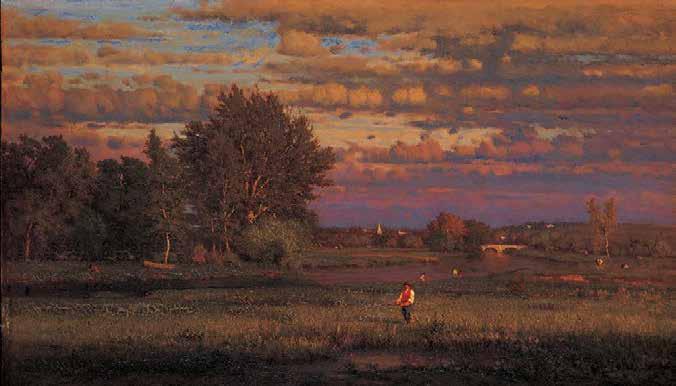
William Anderson Coffin, Sunset in October (detail), c. 1900. Oil on canvas, 14 × 20 in. Private collection. (See fig. 69, p. lxvi.)
endleaf (front and back)
Richard Mayhew, Misty Mystic (detail). Oil on canvas, 30 × 40 in. Courtesy ACA Galleries, New York. (See p. 570.)
frontispiece
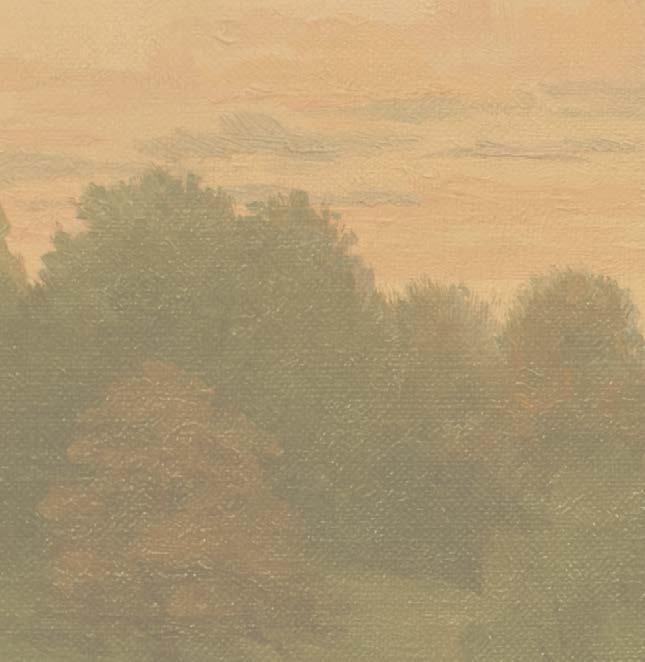
Ralph Blakelock, Red Landscape (detail), c. 1890. Oil on canvas, 12 × 18 in. Collection of Tina and Steven Price, New York.
Production: Patricia Haas Cleveland
Design: Christopher Kuntze
Editor: Stephanie Salomon; Amy K. Hughes (3rd ed.)
Indexer: Karla Knight
Printed and bound by Imago Publishing Limited in China
Pre-Press: Bright Arts, Hong Kong
Copyright © 2021, 2017, 2010 David A. Cleveland. All rights reserved under international copyright conventions. No part of this book may be reproduced or utilized in any form or by any means, electronic or mechanical, including photocopying, recording, or by any information retrieval system, without permission in writing from the publisher. Inquiries should be addressed to Abbeville Press, 655 Third Avenue, New York, NY 10017.
Third edition
10 9 8 7 6 5 4 3 2 1
isbn 978-0-7892-1411-9
A previous edition of this work was cataloged as follows.
library of congress cataloging-in-publication data
Cleveland, David Adams.
A history of American tonalism : 1880–1920 / by David A. Cleveland ; foreword by John Wilmerding. p. cm.
Includes index . 1. Tonalism—United States. 2. Art, American—19th century. 3. Art, American—20th century. I. Title. n 6510.t6c 58 2009
709.73–dc22 20 09038816
For bulk and premium sales and for text adoption procedures, write to Customer Service Manager, Abbeville Press, 655 Third Avenue, New York, NY 10017, or call 1-800-A rtbook
Visit Abbeville Press online at www.abbeville.com.
Contents
vii Foreword by John Wilmerding
x Acknowledgments
xiii introduction
A History of American Tonalism: The Tonalist Movement, Lost and Found
xxxi introduction to the third edition
1 chapter one
The New England Mind: William Morris Hunt, John La Farge, and the Barbizon Influence
35 chapter two
A Rising Tide: George Inness, Alexander Wyant, and Homer Dodge Martin the fading of the hudson river school
81 chapter three
The Old World versus the New: American Tonalists in Europe—Munich, Paris, and Brittany; The Art and Influence of Whistler
147 chapter four
The Tonalist Revolution and the Origins of American Modernism: The Return of the Expatriates and the Founding of the Art Students League and the Society of American Artists
225 chapter five
The Democratization of the Tonalist Landscape: Pastels, Watercolors, and Etchings, and Their Influence on the Tonalist Landscape and Aesthetic Tonalism
301 chapter six
The Rise of the Tonalist Establishment: The Major Exhibitions, 1889–1900 the paris exposition universelle of 1889; the chicago world ’ s fair , 1893; the lotos club ; the paris exposition universelle of 1900
353 chapter seven
The Transcendental Tradition and the Tonalist Landscape: Emerson, Thoreau, and Darwin— Elegiac Prophets for a Troubled Age
439 chapter eight
Tonalism and the Modernist Legacy
571 List of Artists: The Three Generations
573 Notes
597 Index

Foreword | john wilmerding
In opening this book, we first might be prompted to contemplate how the Tonalist movement, which bracketed the two decades on either side of 1900, represented the mood and state of America in that turn-of-the-century period; and second, why it is commanding attention again in our current millennial age. This cyclical recurrence of artistic taste and cultural sensibility almost exactly a century apart does not seem to be accidental. That we share a certain repetition of events and responses today with that earlier time has given us a heightened ability to appreciate and sympathize with the qualities of an artistic style intermittently marginalized, overlooked, or undervalued in the histories of American art.
The art that America produced up to the mid-nineteenth century was based on the natural wilderness that symbolized the New World, in which the divine hand of God was evident and the national story was one of heroic promise. With the nation’s identity settled by 1825 when the Erie Canal opened, American prosperity and self-confidence surged under the exuberant optimism of Jacksonian democracy, Manifest Destiny, and the shaping of a hemispheric empire.
All that changed in the second half of the century, and like much in American life, the tenor and course of American art were radically transformed. Several factors contributed to strong shifts in taste: politically and socially, the dramatic and profound trauma of the Civil War; intellectually and spiritually, the threatening upheaval implicit in the publication of Charles Darwin’s On the Origin of Species in 1859; and economically, the acceleration of industry and technology. With the appalling death toll and destruction wrought by the war, both in literal and psychic terms, America’s previous embrace of perpetual youth and regeneration now yielded to a dark sense of mortality and materiality. In turn, Darwin and his theories of evolution immediately challenged the notions of nature’s progress and perfection, and, even more, its divine underpinning, with his revelations about natural accident and indifference in the shaping of the human condition. Meanwhile the telegraph, newspapers, lithography, the daguerreotype, and balloon-frame construction all brought new possibilities to communication and life across the continent. At the same time, advances of the railroad, which had symbolically united the country with the golden spike at Promontory Point in Utah
in 1869, were soon associated with imagery of plumes of black smoke and scarring of the landscape.
Periodically, there were bank failures and market crashes— in the mid-1870s, the mid-1890s, and again in 1907. With the memory of Lincoln’s untimely death still sharp, additional presidential assassinations occurred in 1880 and 1901. By 1893 the western frontier was declared closed, the Native American population increasingly retreated, and waves of immigrants accelerated their entry into the country in the later decades of the century. With the failure of Reconstruction, sectional divisiveness and racism were again on the rise. On all levels Americans had reason to feel anxious and unsettled. In this context a younger generation of artists maturing in the late 1870s and 1880s naturally felt the need for new stylistic expressions more appropriate to this very different temperament of the times. In particular, it is within this framework that we see the emergence and shaping of the Tonalist movement during the latter part of the nineteenth century. This would be a moody and reflective art, dissimilar from the earlier bravado of the Hudson River School and the spiritual epiphanies of Luminism.
At least two major artistic currents dominated later nineteenth-century painting. One was the powerful new realism of Winslow Homer, Thomas Eakins, Eastman Johnson, and John F. Peto. This was unlike the work of earlier generations, which favored the meticulous rendering of landscape details, the glowing nuances of meteorology, and the implicit presence of the divine in nature. This later realism was down-to-earth, its coloring often dark, brushwork solid and broad, its mood moving toward the introspective and psychological. Human mortality, not immortality, and the material world were its primary subjects. There was an alternative strain that was also brushy and contemplative, but more restrained and delicate, which David Cleveland argues here is exemplified in Tonalist painting. In fact, in his ambitious and singular argument, Tonalism is an almost all-embracing alternative, extending to include both the symbolic and otherworldly nocturnes of Albert Pinkham Ryder and the more dissolved landscapes of the American Impressionists. This will be one of the provocative discussions this book is bound to initiate in art history circles.
Both of these broad developments embody much of the nation’s unsettled soul and sense of direction. The two great authors writing at the end of the nineteenth century, Henry James and Henry Adams, understood the profound disruptions at mid-century that implicitly led to their uneasy

one of the most vital and influential movements in American art right up to World War I and the decade beyond. Tonalism’s resilience and longevity was the result of not only its delicate somber beauty and evocation of values dear to the post–Civil War generation—the first to experience the full onslaught of modern war and industrial civilization—but also its radical and innovative nature and inherent capacity to encompass both traditional and modernist impulses. Tonalism’s modernity, its transcendentalist and Whistlerian embodiments, was seen by critics as epitomizing America’s progress in the arts, and expressing the individual and native brilliance of its finest exponents. It was a landscape art embraced by a tolerant and liberal Protestantism along with Emerson and Thoreau— and even Darwin. In the eyes of its patrons and creators, Tonalism was the first truly American art, combining European sophistication with a genuine American spirituality: the “real right thing.” Tonalism, very much a manifestation of a young melting-pot culture, drew upon a range of abstract formal values, both historical and contemporary, including the rediscovery of Velásquez’s envelope of atmosphere, especially the Spanish artist’s variegated low tones and pictorial synthesis; the broadly brushed soft-edged forms of the English painter John Constable and the abstraction of Turner; the realism of the French Barbizon school; and Whistler’s non-anecdotal, suggestive, and refined arrangements of subtle color and form—the essence of his harmonies. To this mix, American talents like George Inness, Albert Pinkham Ryder, and Ralph Albert Blakelock added an element of mystic romanticism— often described by modernist historians as “visionary.”
In retrospect, with the perspective of more than a century’s distance, the American Tonalists, after nearly seven decades of neglect, can reclaim their rightful place as the avant-garde of the 1880s and the modernist pioneers of 1900. In the best of Inness, Whistler, Ryder, Tryon, Murphy, Twachtman, and many others, the formal values of the modernist canon were first employed with conviction: abstract patterning, exquisite surface textures, gestural and expressive pigment use, and symbolic form embodying a vital spiritualizing energy. As an insurgent school or movement, the Tonalists broke with prevailing establishment orthodoxy, pioneered new, non-narrative forms of expression, and touted subjective individualism as the spearhead of artistic innovation: all hallmarks of turn-of-the-century modernism. Turn-of-the-century modernism evolved in the 1880s from a quietest Whistlerian abstraction, what might be called “Aesthetic Tonalism,” to a more expressive and simplified art of deep symbolic power by 1900, which can be viewed as “Expressive Tonalism.” (I have adopted these two terms throughout this book as useful general categories to describe and differentiate the look of Tonalist works, respectively, from the 1880s and 1890s and those from around 1900 and after.)
Increasingly shorn of overt literary or narrative context—and, for the most part, absent the human figure—Tonalism invoked the silence, solitude, and secret yearnings of the private imagination, and the sentiments touching on man’s sometimes perplexing relationships with both nature and society. The killing fields of the Civil War, a brutal capitalist economy, mass immigration, and Darwin’s unsettling notions changed everything. Tonalism’s cool serenity is deceptive; it was an art
for uncertain times. It is this uncertainty and ambiguity that places Tonalism at the fountainhead of American modernism. As will be seen, the radicals of the late 1870s like J. Frank Currier and John Twachtman, following in the footsteps of Whistler, La Farge, and Inness, changed the way Americans imagined their homeland, and themselves, until by 1900 a radical and distinctly American visionary art had taken hold. In turn, the artists in the Stieglitz circle—John Marin, Marsden Hartley, and Georgia O’Keeffe—were weaned on the Tonalist aesthetic as it evolved after 1900. Tonalist artists like Albert Pinkham Ryder, J. Francis Murphy, and Dwight Tryon directly influenced Milton Avery; and from Avery followed Mark Rothko, Adolph Gottlieb, and Barnett Newman, and postmodern Tonalists like Wolf Kahn. The Tonalist aesthetic may well be the most fundamentally ingrained impulse of the American imagination.
Perhaps the most astonishing thing about Tonalism has been its vanishing act. How could a movement that dominated American art for almost four decades become so lost to American art history and the art-going public for almost seventy years—from the 1930s to the turn of the twenty-first century? How could close to sixty of America’s best artists fall into near total obscurity? From the Depression to the Millennium, Tonalism barely figures in art history texts and exhibition catalogues. When it does—often vaguely and in passing or buried in footnotes—it is mostly dismissed as a retardataire post-Barbizon style, a backward-looking effusion of the Gilded Age, or a leftover of the dowdy taste of our Victorian forebears. Although artists like Inness, Whistler, Ryder,
Blakelock, Thomas Dewing, William Merritt Chase, and Tryon remained important to scholars and connoisseurs through the twentieth century, the majority of Tonalist artists, many with well-earned reputations in their day, were forgotten, their paintings relegated to the storerooms of museums, which had once avidly purchased the artists’ prize-winning efforts. Many Tonalist paintings were deaccessioned from art institutions after 1950, turning up in auctions for a fraction of the price at which they had originally sold. The neglect of the period, the mischaracterization of Tonalism and its vital modernity, much less the stellar achievements of its best artists, were the result of market forces, changing tastes, and the vagaries of scholarship, which resulted in a misreading of Tonalism’s crucial role in the history of American art. As will be argued, Tonalism encompasses all the complexities of its era and sounds the depths of the late-Victorian American psyche—depths of which contemporary critics and scholars, such as Ralcy Husted Bell, were only too well aware. Bell noted in 1916 that the Tonalists’ “dramatic landscapes arouse an emotional intensity fed by the tragic associations of human experience; and there are others which thrill, as it were, with the epic faith of man in his own splendid destiny. In the aspect of some may be found heroism, toil, and suffering almost to savage joy; and in still others there is something which arouses the supreme rapture as it corresponds to life’s aspirations just before their inevitable, periodic recoil—which in art is one phase of rhythm.”4
The inroads of European modernism from the 1913 Armory Show onward did much to challenge the reputations 0f artists


intimacy and charm may have partly flowed from the tradition of small sketches executed by Hudson River School artists, and certainly had precedent in the small-scale studies from nature painted by French Barbizon artists. The great avatar of American Tonalism and the New England Transcendentalist tradition, William Morris Hunt, on his return from studying with Millet in 1855, instilled in sophisticated Boston art circles a taste for painterly values and broadly massed forms on an intimate scale characteristic of Barbizon landscapes. Both by example and in his teaching, Hunt stressed proportion, values (areas of light and dark), simplicity of expression,
and parsimony of detail so as to give the composition visual impact. “Your work may be called monotonous; but one tone is better than many which do not harmonize,”10 as he noted in his enormously influential Talks on Art, a collection of Hunt’s exhortations to his students, which quickly become the Tonalist gospel after its publication in 1878. “We begin with the study of ‘values’ in order more readily to get the power of expressing the roundness and fullness of objects, the effect of light and shadow, and the mystery and distance of atmosphere.”11 It was Hunt’s most famous pupil, John La Farge, in his extraordinary small landscapes of the 1860s, who seemingly created the style
full-blown with relatively little foreign training and only Hunt’s example to guide him. La Farge’s precocious and scintillating panels of activated tone set along Narragansett Bay and the family’s Long Island retreat are less about place and more about mood and ephemeral light. Most of La Farge’s landscape gems, displaying both a sensuous charm and precocious sensitivity to cool color, were sold into Boston collections in the 1870s and set the mode for Tonalism as a peculiarly New England style. Scenes of rural New England were favored by collectors, along with the depiction of the passing of dusk into night, subjects sophisticated in execution yet deceptively naïve and romantic—the poetry of the everyday invoked by the artist to express feeling in paint and stir an emotion in the viewer.
Inness, too, maintained ties to Boston circles in the 1860s and 1870s where the post-Barbizon styles of American landscape found fertile ground, especially among those who had early appreciated the abstract and decorative qualities of Japanese art. In 1878, George Inness published his manifesto, which defined the quintessence of Tonalism for a generation. “A work of art does not appeal to the intellect. It does not appeal to the moral sense. Its aim is not to instruct, not to edify, but to awaken an emotion and the true beauty of the work consists in the beauty of the sentiment or emotion which it inspires ... the quality and the force of this emotion.”12
Unlike the panoramic and detailed views of specific places favored by the Hudson River School, Inness, in his late work of the 1880s and 1890s, along with his followers, painted landscapes that were more constrained in field and generalized, often just a glimpse of a copse, a portion of a field or meadow, the edge of a wood or a tiny clearing, or a patch of gentle hillside: here the bare remnants of an old road, there the tumbled fieldstone wall of a defunct farmyard, and on the near horizon a remaining stand of first growth white pine or an ancient oak. These are human landscapes, civilized landscapes, in Inness’s phrase—yet generally lacking figures (Inness, a firstgeneration Tonalist, never quite gave up on the figurative note in his landscapes), lest a narrative element interfere with the purity of solitude necessary for contemplation. This ostracizing of the figure is rooted in a Puritan iconoclasm found both in Emerson’s Transcendentalist ideas and Whistler’s modernist non-narrative abstraction. Or as Thoreau observed as he gazed over a meadow at a November sunset, “...we were only motes in its beams.” Abandoned farms, rural outskirts of villages, or near-at-home places cheek-by-jowl with nature were the preferred subjects, where the unspoiled landscape—far from the madding crowd of urban life—can be enjoyed firsthand. These are places of escape and wonder first elucidated in the writings of Thoreau and dreamed about by city dwellers.


the role of the artist in mastering nature. It was the artist, not nature, as Whistler liked to observe, who brought about the triumph of artistic perfection by redesigning the visual world for decorative and suggestive effect. “But the artist is born to pick, and chose, and group with science, these elements, that the result may be beautiful—as the musician gathers his notes, and forms his chords, until he bring forth from chaos glorious harmony.”13 Emerson and Thoreau in their own way were as assertive as Whistler in proclaiming man’s priority as the ultimate visualizer of nature. This transcendentalist subjectivity—in which man’s mysterious experience of nature counts for more than the objective reality observed—so central to the writings of Thoreau and Emerson, is fully embodied in the Tonalist landscape. Creator and creation have become one.
The misreading of Tonalism’s essentially avant-garde pedigree has much to do with the mistaken critique that it was derivative, a post-Barbizon style and thus old-fashioned. It would be almost impossible today to confuse a French Barbizon landscape with an American Tonalist landscape: perspective, style, and compositional modes are quite distinct. Whistler’s influence in the early 1880s, much less that of Japanese art and
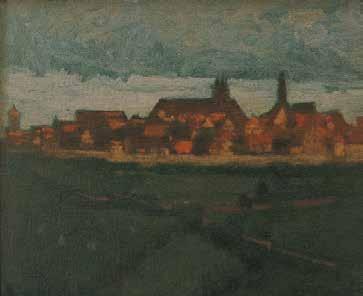
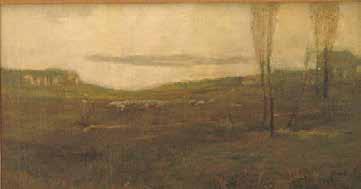
the Aesthetic movement, resulted in stylization of the Tonalist landscape, employing embedded patterns, flattened forms, cropped perspectives, and, for the most part, the elimination of figures or narrative detail. By the end of the 1880s, the Tonalist landscape by its best exponents had an unmistakably American look. This Whistlerian or decorative aspect of American Tonalism was duly noted by Bell, who wrote of the Tonalists’ “sensuous swing and play of broken colours, which are wedded to such delightful designs and pleasing patterns that they neither seem like designs nor yet suggest patterns. So agreeably are all the parts connected that they are seen only together; fused in a nice relation to the whole the deft methods of harmony, so cunningly wrought that the production is as free from the moans of labour, as the gently swaying boughs of a tree or the happy waters of a lazy brook.”14 The Americans tended to work in the studio from memory, adjusting their compositions along synthetic lines to gain subtle harmonies of design and a breathless equilibrium. The Barbizon School artists, also known as the men of 1830, with the exception of Corot, tended to use darker grounds (many of which have deteriorated) and thus lack the atmospheric vibration and refraction of adjacent
tones, and the mysterious blurred edges found in so many Tonalist works. Expressive Tonalism, from the 1890s on, is even more distinct, with an expressive gestural handling of paint and emphasis on nocturnes and symbolic content rarely found in Barbizon painting. The American expatriates assiduously ransacked the technical resources of their old-world bloodline but only occasionally—certainly not the great talents—copied out of whole cloth.
When the Americans did borrow, the influence tended to be short-lived and quickly merged with a broader stylistic synthesis back on American shores. The rediscovery of Velásquez by such expatriates as Whistler, Chase, and Currier is a perfect example. The vogue for Velásquez—often described as a Tonalist in period scholarship—directed the Americans to low-toned compositions in which slight variations of tone were meticulously noted to produce both a sense of real light and vibration: a palpable atmospheric envelope. This was a technique Whistler exploited to the full, especially in his figurative work. Of more recent vintage, the English painter John Constable was, according to Tonalist Birge Harrison, the first to record the pearly gray out-of-doors light in a faithful manner, exploiting the full gamut of grays, mauves, and lilacs in broadly painted masses. Constable’s example had a profound influence on French Barbizon painters who recognized the Englishman’s truth-to-nature observations, and the purity
and simplicity of his style freed from traditional formulas of academic representation. It was this style of handling, the sketchy, more generalized effects of paint application handed down from Constable to Barbizon artists Camille Corot, Charles-François Daugbigny, Narcisse Diaz, and Theodore Rousseau, which Americans like Inness, William Morris Hunt, and John La Farge developed in their early work, and then moved on. Perhaps even more important in the early development of Tonalism was the meteoric rise and fall of the French artist Jules Bastien-Lepage. Lepage’s naturalism had enormous influence on Americans working in France, especially Brittany—probably more than the academic art taught in the Parisian schools in the late 1870s. Lepage’s naturalist style, sometimes close to photographic realism, especially in the depth of cool crystalline atmosphere and high horizons of his compositions, found resonance with the Harrison brothers and J. Alden Weir, and was a strong presence in the early years of the Society of American Artists in the 1880s.
Another profound influence was the painterly style of the Munich School. Munich’s most important American acolytes, J. Frank Currier, Frank Duveneck, John Twachtman, Henry Muhrman, William Gedney Bunce, and William Merritt Chase, introduced the expressive brushstroke and a new freedom of form into the Tonalist movement at a crucial juncture in its development during the late 1870s and early


inventiveness that places him far ahead of most of his contemporaries in either America or Europe. Here, manipulating the surface with slashing, expressive strokes of color that literally abrade the paper ground, Currier creates a surface energy that approximates nature’s underlying forces while augmenting the inherent symbolic power of landscape forms: trees, rooflines, clouds, distant horizon, and the agitated atmosphere that encloses them. (Only Gustave Courbet, Whistler, and Degas, especially in his pastel and monotype landscapes of the 1890s, approached Currier’s radical and exuberant freedom of expression at this early date.) Alexander Wyant, at about the same time, in his extraordinarily precocious Gray Hills, 1879 (fig. 44), manages to capture the brooding stormy face of nature by using mostly abstract paint marks to create his dramatic landscape, mirroring the intuited energies pervading such a wilderness scene. Only a few linear marks, depicting silver birch trunks, can be detected anywhere in the composition. It is hard to think of another artist at this date, American or European, who could render a subject with such untrammeled freedom and subjective power. William Gedney Bunce is yet another Tonalist who used a slashing style of paint handling in the early 1880s as a method to indulge his love of gestural abstraction, with his later works gaining even greater power,
until his work neared almost complete dissolution of form. As noted above, Venezia (see fig. 15) is a dazzling example of Bunce’s exuberant use of color in an expansive sky, that is as much about the dynamic and luminous atmosphere of dusk as the artist’s intuited expression, as if Bunce sought a merging of hand and eye with the arrayed light sources refracted from sky to lagoon, an immensity of supersaturated air barely contained by the panel. J. Francis Murphy’s masterful April, 1909 (fig. 45), though subdued in subject, nevertheless pulses with energetic brushstrokes that rush in slathered horizontals across the canvas, broken only by depictions of ghostly tree forms. Such transitional seasons were a favorite of Murphy, who like so many of his colleagues, took delight in expressing nature’s changes in the sumptuous ebb and flow of rich pigment. Yellow Foliage, c. 1910 (fig. 46), by Ben Foster, although more constrained in its flurry of leafy yellow brushstrokes, seeks a similar approximation between the means of paint handling and the fall breeze playing across the receding tree line. By 1930, Charles Fromuth’s marine subject Wind and Sea (fig. 47) has moved toward near complete obliteration of form in the depiction of sea, sky, and Concarneau’s sardine boats plunging through the waves: all the forces of nature alloyed together in seamless interaction.

chapter one