
A Guide to Baroque Rome The Palaces

Page 1


a guide to baroque rome: the palaces

Title page: Design taken from the engraving in De Rossi’s Architettura Civile of the main door of Palazzo del Grillo

Copyright © 2015, 2017, 2020 by Anthony Langdon

The moral right of the author has been asserted All rights reserved

All photographs courtesy of Anthony Langdon, except pp. 136 and 227 courtesy of the publisher; p 239 courtesy of Emanuele (zak mc) and p 245 courtesy of Anthony Majanlahti under Creative Commons license

All other images courtesy of the publisher, except pp 61, 62 and 125 courtesy of the Warburg Institute; and pp. 68, 109, 129, 144, 203, 204-5, 209-10 and 225 courtesy of the British Museum

Special thanks to Lisa Adams

HB ISBN 978-1-84368-115-1

PB ISBN 978-1-84368-114-4

First published 2015 by Pallas Athene (Publishers) Ltd

Studio 11a, Archway Studios, 25-27 Bickerton Road, London n19 5jt

Reprinted 2016, 2017, 2020 www.pallasathene.co.uk

Pallasathenebooks

Pallas books

Pallasathenebooks

Pallasathene0

Printed in England

G U I D E T O

B A R O Q U E

R O M E : T H E

P A L A C E S

Anthony Langdon

Contents

Introduction 15

A few practical details

Visiting the palaces 21

Some essential places to see 22 Some possible itineraries 22

A note on the prints used to illustrate this book 27

THE PALACES

Casa degli Agostiniani Scalzi............................35

Palazzo Albani (Mattei, Massimi, Nerli, del Drago).......................................................36

Palazzo Albertoni (Spinola)...............................38

Palazzetto Alibrandi or Alivrandi (Cavalieri)..39

Palazzo Altemps.................................................39

Palazzo Altieri 41

Palazzetto Ansellini 47

Palazzo Antamoro (Strada) 47

Palazzo Astalli.....................................................48

Palazzo D’Aste (in via di Ripetta)...................49

Palazzo D’Aste (Rinuccini, Bonaparte, Misciattelli).....................................................49

Palazzo D’Aste (Pericoli, Sterbini)...................53

Palazzo Avila......................................................54

Palazzo del Banco di S Spirito (Spada, Bennicelli) 54

Palazzo Barberini ai Giubbonari or Casa Grande ai Giubbonari 55

Palazzo Barberini..................................................57

Palazzi Bernini....................................................74

Palazzo Boncompagni Corcos (Starinci)..........75

Palazzo Boncompagni Ludovisi (Cerasi).........76

Palazzo Borghese, Palazzo della Famiglia Borghese and Palazzetto Baschenis..............77

Palazzo Bossi.......................................................89

Palazzo Braschi 90

Palazzo Del Bufalo 90

Palazzo del Bufalo Ferraioli (Niccolini) 92

Palazzo della Cancelleria....................................93

Palazzo Capizucchi (Troili, Massimo, Gasparri).........................................................93

Palazzo Capponi (Orsini, Stampa, Pediconi).........................................................95

Palazzo Capponi (‘della Palma’).......................96

Palazzo Cardelli 97

Palazzo de Carolis (Simonetti, Banco di Roma) 98

Palazzo Carpegna (Baldinotti) 100

Palazzo Carpegna (Accademia di S Luca)........100

Opposite: The door of Palazzo Nari in Campo Marzio by the architect G. A. De Rossi. The engraving comes from D D De Rossi’s Architettura Civile

Palazzo Cavallerini Lazzaroni...........................101

Palazzo Celani.....................................................102

Palazzo Celsi.......................................................102

Palazzo Cenci-Bolognetti (Petroni)..................104

Palazzo Centini (Toni, ‘dei Pupazzi’) 105

Palazzo Cerri (Gaucci) 106

Casa dei Chierici Minori 106

Palazzo Chigi (Aldobrandini) 108

Palazzo Chigi (Odescalchi)................................111

Palazzo Cimarra.................................................113

Palazzo del Cinque.............................................114

Palazzo Colonna..................................................115

Palazzo della Consulta.......................................119

Houses at Piazza delle Coppelle, 64 and 66.....122

Palazzo Corsini (Riario)....................................123

Palazzo Costaguti (Patrizi) 124

Palazzo Crescenzi (Bonelli, De Dominicis) 130

Palazzo Donarelli (Ricci)...................................133

Palazzo Doria-Pamphili.....................................134

Palazzo del Drago (Gentili)....................................139

Casa del Falco (Casa di Biagio Puccini).................140

Palazzo Falconieri...............................................140

Palazzo Farnese...................................................143

Palazzo Ferrini (Cini).........................................146

Palazzo Galloppi (Santovetti, Volpi di Misurato) 147

Palazzo Gambirasi...............................................148

Palazzo Ghetti.....................................................152

Palazzo Giangiacomo.........................................152 and House at via Monserrato, 102

Casa Giannini......................................................153

Palazzo Giustiniani.............................................153

Palazzo Gomez (Lepri, Gallo di Roccagiovanine, Silj).................................................................155

Palazzo Grazioli (Gottifredi) 156

Palazzo del Grillo (de Robilant) 157

Palazzo Guelfi Camajani (Montauto, Rovarella, Polidori, Pericoli)......................160

Palazzo Lancellotti.............................................160

Palazzo Lante (Medici, Lante Della Rovere, Grazioli, Aldobrandini)..............................162

Palazzo Lateranense ..........................................163

Palazzo Lazzaroni (Grimaldi)...........................164

Palazzetto Lupardi (‘Casa dei Ritratti’)............165

Palazzo Maccarani Odescalchi..........................166

Palazzo Maccarani Savorgnan di Brazzà 166

Palazzo Macchi di Cellere (Capranica) 166

Palazzo Madama 168

Casa di Carlo Maderno 170

Palazzo Maffei (Peretti, Sannesi, Ludovisi, d’Este, Acciaioli, Marescotti, del Vicariato) ................................................170

Palazzo Magnani.................................................171

Palazzo Malta (del Sovrano Ordine Militare Gerosolomitano di Malta etc).....................171

Palazzo Mancini (Salviati)..................................172

Palazzo Mandosi (Castelli-Mignanelli) 173

Palazzo Manfroni 174

Palazzo Marescotti 174

Palazzo Maruscelli (Lepri).................................174

Palazzo Massimo di Rignano (Colonna)..........175

Palazzo Mastrozzi (Graziosi)............................177

Palazzo Mattei di Giove.....................................179

Palazzo Mellini (Cesi, Salviati, Michiel)...........181

Casa dei Merolli (Partini)...................................183

Palazzo del Monte di Pietà................................183

Palazzo di Montecitorio.....................................186

Palazzo Montoro (Chigi Montoro, Patrizi, Naro, Lepri) 189

Palazzo Muti Bussi 190

Palazzo Muti Papazzurri (Savorelli, Balestra)........................................................ 193

Palazzo Muti Papazzurri (in Piazza della, Pilotta)..........................................................196

Palazzo Nari (in Piazza S Maria in Campo Marzo) .........................................................199

Palazzo Nari (in via Monterone) ......................199

Palazzo Nuñez (Torlonia) 199

Palazzo Ottoboni Boncompagni 201

Palazzo Pallavicini Rospigliosi (Bentivoglio, Mazzarino, Pallavicini)................................201

Palazzo Pamphili................................................205

Palazzo Panizza..................................................210

Palazzo Patrizi (Aldobrandini)..........................212

Palazzo Patrizi (Clementi).................................212

Palazzo Pecci Blunt (Fani, Ruspoli)..................212

Palazzo Peretti (Fiano, Ottoboni, Boncompagni Ludovisi, Almagià) ......................................213

Palazzo Perucchi (Campello) 214

Palazzo del Pio Sodalizio dei Piceni (della Naziona Picena, Casa di Sisto V) 214

Palazzo Pighini (Fusconi, del Gallo di Roccagiovine)...............................................214

Palazzo Pio di Savoia da Carpi (Orsini, Righetti)........................................................217

Palazzo Pizzirani (Cesarini, Leoni)..................219

Palazzo Pizzirani (in Via di Torrre Argentina) ....................................................220

Palazzo Poli.........................................................220

Palazzetto di Flaminio Ponzio 221

Palazzo Pulieri (Ginetti) 221

Palazzo del Quirinale.........................................221

Palazzo Raggi......................................................229

Palazzo Rocci (Pallavicini).................................229

Palazzo Rondinini or Rondanini (Sanseverino)................................................229

Palazzo De Rossi................................................231

Palazzo Ruggeri..................................................232

Palazzo Ruspoli 233

Palazzo S Calisto................................................234

Palazzo Santacroce ............................................235

Apartment buildings in Piazza di S Ignazio...................................................238

Apartment building in Piazza S Lorenzo in Lucina 240

Palazzo Sciarra (Colonna di Sciarra, Carbognano) 240

Palazzo Serlupi Crescenzi..................................242

Palazzo Sinibaldi (dei Cavalieri dell’Ordine Teutonico)....................................................243

Palazzo Spada......................................................243

Palazzo di Spagna...............................................247

Palazzo della Stamperia (Cornaro)....................248

Palazzetto Sterbini (Boncompagni)..................249

Palazzo Strozzi (Olgiati, Besso) 249

Palazzetto ‘dei Telamoni’ 250

Palazzo Testa Piccolomini.................................250

Palazzo Valentini (Bonelli, Alessandrino, Spinelli, Imperiali, della Provincia)............250

Palazzo Varese or Varesi (Degli Atti)...............252

Palazzo Verospi..................................................253

Unnamed building at via degli Zingari, 55...........254 Palazzo Zuccari 255

General Bibliography 259

Select Bibliographies and Notes 263

Glossary 283

Index of artists 285

Index of streets 291

Introduction

As someone from outside the academic community, I am diffident about producing a guide of this sort. When I was in Rome for several months in 2003, however, I was so struck by the lack of an up-to-date general guide to the Baroque palaces that I felt it would not be too presumptuous to try my hand at writing one. After many more visits to Rome, this book is the result.

Before going any further I must say a word about Anthony Blunt’s Guide to Baroque Rome, which is the default guide for most people, and a much-loved one at that. Nobody could admire Blunt more than I do, but an enormous amount of work has been done on the palaces since his day. Furthermore – as he himself acknowledged* – his treatment of the palaces was perfunctory in comparison with what he had to say about the churches.

For both these reasons, I believe that there is plenty of space for a new effort that does not try to supplant Blunt, but just to provide a practical guide that is genuinely up-todate and comprehensive. Blunt’s Guide will always have its own value. My aim has simply been to produce a really accurate summary of the building history of the palaces, drawing on recent material published in English and Italian, and providing for each building a bibliography that has been brought up to date. I have also tried to indicate the main features of each building as clearly as I can, and to convey the feeling of actually looking at it on the spot.

Those who are already well informed may, I hope, at least find it convenient to have a handy summary of what is now known about the authorship and history of the lesserknown buildings. I ask their forbearance for my efforts to summarise quite drastically the extensive literature on the more famous palaces and their builders.

Although I have managed to see the interior of many of the buildings described here, there are also many where I have only been able to see what is visible from the street. In these circumstances there is every chance that one will give too much emphasis to the façade of a building, even if its builders made a conscious decision that it should be conventional and discreet. I have tried to be on my guard about this, but may not always have succeeded.

*Blunt Guide, p. ix

Opposite: The door of Palazzo Lancellotti, designed by Domenichino. Engraving from De Rossi’s Architettura Civile. The door was also illustrated by Visentini, see p. 161

The scope of this guide; the barocchetto; restored buildings; colleges etc

Although I use the word ‘Baroque’ occasionally in a shorthand way to indicate places, such as Palazzo Barberini and the gardens of Palazzo Borghese, that are always considered to be notably ‘Baroque’, I have tried to steer well clear of argument about the existence of a Baroque style or what its characteristics might be. I have simply aimed to include notes on most buildings still standing in Rome that have any claim to be called palaces and that incorporate significant parts dating from 1600 to 1750. There are, however, some that are so dull and about which so little is known that I have left them out. I have included a few buildings from before 1600 by architects such as Giacomo Della Porta and Maderno. Beyond the other end of the period I have included a few buildings up to the late 1760s and I follow Blunt in including Palazzo Braschi as an obvious terminal point.

I have also included a handful of buildings that are clearly not palaces, and I need to explain why.

Although some famous noble family palaces (such as those of the Corsini, DoriaPamphili, Colonna and Rondinini) were built or modified in Rome during the eighteenth century, the emphasis moved steadily towards the construction of buildings designed for multi-occupation. One thing that manifestly had a lot to do with this was the rise in demand from a professional middle class that was growing in importance, partly because of the need to service the bureaucratic requirements of a modern state. But it would be quite wrong to think in simple terms of the nobles living in palaces and the bourgeois in apartment blocks. Many of the purpose-designed new buildings included a range of levels from the humble to the very grand and luxurious. Very often, as at Palazzo Del Cinque, an aristocratic owner occupied only part of his building and, as at Palazzo Pighini, this was not necessarily the most desirable and expensive part. Furthermore, the chapters of churches and other religious communities such as confraternities went into the burgeoning property market and built apartments for rent, sometimes as free-standing independent buildings, sometimes as extensions of their convents.

This blurring of boundaries, with multi-occupation becoming the dominant mode of accommodation, was necessarily reflected in the architecture of the buildings themselves. Overall, there was a strong pull towards a common architectural vernacular, whatever the circumstances of commissioning by lay or ecclesiastical patrons. There were, however, intriguing cross-currents, with palaces (eg Palazzo Boncompagni Ludovisi) adopting the prime characteristics of apartment buildings, and apartment buildings (eg the one at via degli Zingari, 55) imitating the traditional tone and style of palaces.

As regards architectural structure, the main feature of the new buildings was the equality of emphasis given to several storeys, and the expansion of the proportion of the w a l l t h a t w a s g i v e n o v e r t o w i n d o w s . S m a l l i r o n b a l c o n i e s ( r i n g h i e r e ) w e r e o f t e n employed, both as a facility for the occupants and to provide visual variety in the large flat surfaces that were created. Although some of these buildings were astonishingly

functional and austere,* very many of them featured stucco decoration that exploited the qualities of the medium, and this was the defining element of the style that has been given the label ‘barocchetto’. Good quality, elegant decoration of windows and doors was routine, and in some cases the most wayward, post-Borrominian shapes were developed for those elements. Another common feature was the ‘stacking’ together of windows to create uninterrupted vertical bands of stucco framing that articulated the wall surface.

Walking around Rome in connection with this book sharpened my awareness of the extent to which these barocchetto apartment buildings contribute to the urban landscape, what constantly surprising variations on a theme they provide, and how far their characteristics were already beginning to be apparent in many palaces of the later seventeenth century. This was the thread along which domestic architecture developed in Rome during the later Baroque period, and it has hardly been exposed to English readers.

There are so many of these non-palatial barocchetto domestic buildings in Rome that a full list of them would be out of the question for the present book. On the other hand, their typology became so thoroughly co-mingled with that of palaces that ignoring them would lead to a very incomplete idea of the way in which the palace tradition ended. I have therefore chosen just the following six buildings to serve as examples of a far greater number.

The best-known of the six is the group of buildings by Raguzzini in Piazza S Ignazio, which are one of the most famous pieces of 18th century town planning in the city. It seemed to me that this very celebrity distracted attention from the development’s purpose as rental property designed to raise money, and that it was worth emphasising this aspect. The building in Piazza S Lorenzo in Lucina is included because it incorporates so many characteristic features that it can serve as the best single example of the class. The Casa del Falco is simply too bizarre to ignore. The Casa degli Agostiniani Scalzi and the Casa dei Chierici Minori are included for their sheer architectural merit. The building at via degli Zingari, 55, has never attracted any scholarly attention so far as I know, but it seems to me to be an interesting example of an apartment building that deliberately mimics the reserved, conservative style of the traditional palace.

A decision was also needed on how many to include of the palaces that have been radically rebuilt, commonly as part of the urban development that took place after Rome became the capital of the united Italy in 1871. I have deliberately been rather lax about this and have included, for example, an entry on the palace of the Cavalieri di Malta because of its exalted history, and very brief notes on several of the rebuilt palaces of the Corso, simply to save readers the time that I myself spent there identifying what was what.

Last, there are many notable colleges and other non-ecclesiastical institutional buildings in Rome but I have had to draw the line somewhere. I have therefore not included t

* See, for example, the convent/apartment building of SS Quirico e Giulitta (now the Hotel Forum) by Valvassori, or the apartments built by Ferdinando Fuga for the chapter of S Giacomo degli Spagnoli at via dei Giubbonari, 29-32.

Fuccioli in the suggestive barocchetto street of via S Agata dei Goti. I have, however, found room for the Monte di Pietà, which I could try to justify because it started life as a family palace, but which I have really included just because the sculpture and polished marble of its chapel is so magnificently enjoyable.

Sources

Substantial books in Italian have now appeared on nearly all the most important palaces. The bulk of them have been devoted to buildings that are owned either by the state or by banks, and have been sponsored by their owners. Those done for banks are a distinct genre of lavish productions for private publication, and, although they are essential reading, they vary greatly in quality and the older ones naturally betray their age in many ways.

In the last two or three decades art history in Italy has increasingly turned towards archival work and there has also been a new interest in urbanism. There has been a steady search for new archival sources, and unprecedented attention has been given to the records of public bodies such as the Maestri di Strade. There have thus been several research monographs on previously neglected Roman palaces (such as Patrizia Cavazzini’s work on the Palazzo Lancellotti and Alessandra Anselmi’s book on the Palazzo di Spagna) and a steady stream of conference papers and articles about buildings, architects and planning projects. The work by Elisabeth Kieven and Giovanna Curcio on 18th century architecture and urban planning has been particularly important, as has the ‘Studi sul Settecento romano ’ series under the organisation and editorship of Elisa Debenedetti.

The Guide Rionali series, covering every kind of building in Rome, has been produced over a long period and it is therefore inevitable that some material in the earlier volumes has been overtaken by later work. The bibliographies for the main buildings described are extremely useful, however, and the series has tended to become much more detailed as it has progressed.

Ferruccio Lombardi’s Roma; Palazzi, Palazzetti, Case; Progetto per un Inventario, 12001850 is a working tool that deserves a special mention. It lists about 750 buildings with photographs and short comments that are always worth taking seriously. The photographs are an excellent record – and a poignant one for those who mourn the old ochre city that has been so ruthlessly scraped, scrubbed and homogenised under recent political leaders.

There are many Italian and English books offering descriptions and pictures of selected Roman palaces, and one or two that purport to be comprehensive. None of them appears to be very precise about its sources, but Giorgio Carpaneto’s I Palazzi di Roma in the Newton Compton series is worth a mention as a cheap and useful volume to have to hand.

I have not ignored the Strenne dei Romanisti series, now wonderfully available online at http://www.strennadeiromanisti.it. It must be acknowledged that these publications

do not include much straight material on building histories etc., but they are a very pleasurable source of miscellaneous contextual material.

The most notable texts published in English since Blunt’s time are, I think, Joseph Connors’s Alliance and Enmity in Roman Baroque Urbanism; Patricia Waddy’s Seventeenth-Century Roman Palaces: Use and the Art of the Plan; John Beldon Scott’s Images of Nepotism: The Painted Ceilings of Palazzo Barberini; and Richard Krautheimer’s The Rome of Alexander VII, 1655-1667.

A few practical notes

Visiting the palaces

Most churches are open in principle, even if it does not always feel that way in Rome as one waits in hope at some strange hour. Indeed the whole point of a church is that it should be open. The presumption in the case of palaces is the exact opposite. Even if a detailed account of a palace has been published, that does not mean that any of the interior will be visitable.

The only palaces generally open to the public are those that are now museums. Visits are negotiable to some of the others, especially for people who have contacts with learned institutions. The banks that occupy many important palaces are usually quite cooperative, and many of them join in organising occasional open days, which tend to attract large crowds. Some other institutions occupying old buildings are extraordinarily unhelpful. Visits are also becoming increasingly difficult to buildings in private hands as more and more of them are split up into separate apartments. Furthermore, one effect of the devastating increase of tourism in Rome seems to be that concierges of private palaces are less relaxed about allowing people even to glance at the courtyards and entrance passages of the buildings that they guard, though there are many exceptions to this and it is always worth a try.

Visiting palaces that are not open to the public

Some of the institutions that occupy famous palaces are genuinely proud of them, and some banks have printed scholarly accounts that they give to enquirers without charge. Even these enthusiastic occupiers, however, are unlikely to show rooms that are normally closed to the public without a prior appointment, for which some kind of introduction is highly desirable, if not essential.

At any one time, however, it is quite possible that some palaces will have a special opening, and every year there are organised occasions when several buildings are opened to the public. The useful events guide, Roma c’è, is no longer published, so the only way to find out about such things is to look at the culture sections of the weekend newspapers.

There are a number of websites that advertise special guided tours of palaces.

Opposite: There are four windows of this unusual design on the garden front of Palazzo Barberini. This engraving is from De Rossi’s Architettura Civile, where they are attributed to Borromini, but Anthony Blunt preferred an attribution to Pietro da Cortona (see p 64)

TO BAROQUE ROME: THE PALACES

Some special arrangements

The Galleria Colonna is open on Saturdays from 9 am to 1.15 pm. It is closed in August. For arranging visits to the Appartamento Principessa Isabelle at the Palazzo Colonna use the email address info@galleriacolonna.it or telephone 06 6784350.

For visiting the Palazzo Farnese use the website www.inventerrome.com and make your booking well in advance.

The Casino dell’Aurora at the Palazzo Pallavicini Rospigliosi is open on the first day of every month except January from 10 am to noon and from 3 pm to 5 pm.

As of 2015, arrangements for visiting the Palazzo del Quirinale (and, indeed the gardens) have been greatly expanded, so that visits are normally possible on every day except Mondays and Thursdays. Go to the website www.quirinale.it for the details. Bookings must be made at least 5 days in advance.

The essential things to see

While any selection is subjective, a visitor with an interest in the subject should certainly make a point of seeing the following palaces:

Palazzo Barberini: The most important of all palaces in the Baroque period, and now a national art gallery with long opening hours. Including the paintings, there is so much to see here that one should ideally allow several hours.

Palazzo Borghese: The interior is not accessible but it is possible to get a good idea of the hanging garden and Rainaldi’s viewing gallery at the west (river) end, and one can usually glimpse the cortile behind the main entrance at the east end.

Palazzo Doria-Pamphili: Both Valvassori’s astonishing façade on the Corso and Ameli’s later one on via del Plebiscito are important Roman landmarks; visiting the Galleria also enables one to see the main cortile and the entrance vestibule on Piazza del Collegio Romano.

Palazzo Spada: It would be a shame to leave Rome without having seen Borromini’s perspectival arcade, and the fascinating Galleria Spada has long opening hours.

Palazzo di Montecitorio: Together with the obelisk and piazza before it, Bernini’s huge palace makes a stupendous theatrical statement.

If one ’ s schedule can accommodate the weekend visiting arrangements (see above) the Galleria Colonna and the Quirinale should definitely be seen as well.

Some possible itineraries

Most of the important palaces of the period are grouped in the central area bounded to the north by Piazza Colonna, to the west by the Cancelleria, to the east by the Quattro Fontane and to the south by the Tiber. The following itineraries are no more than suggestions for linking several of the palaces in continuous walks, and there is certainly no need to follow them slavishly.

1 From Piazza Navona to the Palazzo Corsini

This walk takes you across the Tiber to the one important Baroque palace on the right bank.

Start in Piazza Navona, looking at the ensemble of the Palazzo Pamphili and S Agnese. Leave Piazza Navona by Corsia Agonale on the east side and walk through to Corso del Rinascimento. Stop and look at Maruscelli’s façade of Palazzo Madama, turn right and walk down to S Andrea della Valle at the bottom of the street. Turn right on Corso Vittorio Emanuele, take via del Biscione (second left) and walk down to Piazza del Biscione to look at Arcucci’s Palazzo Pio di Savoia da Carpi which has so much in common with Palazzo Madama.

Carry on, cross Campo de’ Fiori and go down via Ballauri, with Specchi’s first façade of Palazzo Pighini filling the block on your left. When you get to Piazza Farnese, stop and look at the Pighini’s main façade, also by Specchi, which faces Palazzo Farnese across the square. (The workmanlike Palazzo Mandosi is on the left side of the square and Palazzo Sinibaldi is down via Mascherone on the left side of Palazzo Farnese.)

Here you have a choice. You could go down via Monserrato in the far corner of the square, stop in Piazza di S Caterina della Ruota to look at the stuccoes on Palazzo Mastrozzi, go down via in Caterina to via Giulia, where you will see Palazzo Falconieri facing you on your left, continue down the right side of the palace, and then walk back along Lungotevere dei Tebaldi, taking a good look at Borromini’s work at the back of Palazzo Falconieri on the way. Or you could leave Piazza Farnese by via Capo di Ferro, between the Sinibaldi and Mandosi palaces, spend some time at Palazzo Spada, walk down to SS Trinità dei Pellegrini and turn right on via Pettinari. (Incidentally, SS Trinità seems to be open more than it used to be: if it is open when you pass, you should certainly go in to see the Guido Reni altarpiece.) Either way, you will end up at the pedestrianised Ponte Sisto.

Cross Ponte Sisto, with Borromini’s belvedere on Palazzo Falconieri appearing as a prominent landmark as you look north, if it is not obscured by the leaves of the plane trees in the summer. Walk up to via della Scala by via Benedetta , or any other of the Trastevere lanes that appeals to you. Turn right on via della Scala and walk through to Fuga’s Palazzo Corsini on the left hand side. It is well worth going to the Galleria Nazionale d’Arte Antica in the palace, but at the very least you should go up the stairs to see

Fuga’s double-height vestibule. When you have finished at the palace you can have a pleasant walk in the Botanical Garden at the back.

2. From Piazza Navona to Piazza Venezia

Start from Piazza Navona as before, look at the façade of Palazzo Madama and then walk down the left side of the palace to Piazza di S Luigi dei Francesi, where you will see Palazzo Patrizi straight ahead and Palazzo Giustiniani to its right. Turn right down via della Dogana Vecchia and first left down Salita de’ Crescenzi to Piazza della Rotonda. Just before you get to the piazza you will see all the original exterior work that remains of Palazzo Crescenzi on your right.

Leave Piazza della Rotonda by via degli Orfani and walk up to Piazza Capranica, where Casa Giannini fills the left end of the square. Then by way of via in Aquiro and via della Guglia go up to Piazza di Montecitorio. As you enter the square, Palazzo del Cinque (with its many points of similarity with Casa Giannini) is on your right, Palazzo Macchi di Cellere on your left and, of course, Bernini’s great Montecitorio palace dominates the square in front of you.

Walk across the front of the Montecitorio palace into Piazza Colonna - leaving one great 17th century urban theatre for another. Palazzo Chigi (Aldobrandini) fills the north side of the square, with its altana challenging that of the Montecitorio palace alongside. Opposite is Palazzo del Bufalo Ferraioli.

Go down the Corso towards Piazza Venezia. The main palaces that you will pass on the left are Palazzo Sciarra, Palazzo Mellini, the 19th century faux-Tuscan back of Palazzo Chigi (Odescalchi) and Palazzo Mancini. On the right you will pass Palazzo de Carolis, the Valvassori façade of Palazzo Doria-Pamphili and Palazzo D’Aste.

3. From the Quirinale to the Campidoglio

Start from the splendidly theatrical Piazza del Quirinale, where you will want to look at both the Quirinale and Consulta palaces. Before you leave the square, you may want to go down via XXIV Maggio for a few paces to look at the gate into the Colonna gardens on the right. Leave the piazza by via della Dataria which will take you down to via dei Lucchesi; on the corner of these two streets is Palazzo Testa Piccolomini.

Carry on down via dei Lucchesi, passing Palazzo Lazzaroni on the right, turn right in Piazza Pilotta, and walk down via del Vaccaro, along the left flank of Palazzo Muti Papazzurri. This will bring you out at the façade of the adjoining Palazzo Muti Papazzurri (Balestra) at the head of Piazza dei SS Apostoli. As you look down the piazza, Palazzo Colonna is beyond SS Apostoli on your left, Palazzo Chigi (Odescalchi) is on your right and Palazzo Valentini is at the far end of the piazza on the other side of via Nazionale. Walk down the piazza, turn right on via Nazionale, and carry straight on across the bottom of the Corso into via del Plebiscito, where four great palaces fill the right-hand side without a break. They are De Rossi’s Palazzo D’Aste, the Ameli façade of Palazzo

Doria-Pamphili, Arcucci’s Palazzo Grazioli and De Rossi’s Palazzo Altieri on Piazza del Gesù. This is where the papal procession, coming from the Vatican in front of you, would have swung right (i.e. to your left) towards the Campidoglio, passing down via d’Aracoeli to the left of Fuga’s façade of Palazzo Cenci-Bolognetti. Follow the processional route past Palazzo Muti Bussi on the left and finishing with Palazzo Massimo di Rignano on the corner with via del Teatro di Marcello.

Material on the internet

Following are three useful websites that might not be found in a casual trawl for information on the palaces.

‘Falda publications’ in the Princeton University Digital Library at pudl.princeton. edu/collections.php has images of all the plates in Falda’s topographical books.

‘Rome in the Footsteps of an XVIIIth Century Traveller’ at www.romeartlover.it displays the whole of Vasi’s Magnificenze together with the relevent parts of Nolli’s 1748 map and various other supporting material, including many comparative pictures of the present-day city.

‘Imago Urbis: Giuseppe Vasi’s Grand Tour of Rome’ at vasi.uoregon.edu also displays Vasi’s plates together with the Nolli map, and has a highly developed interactive system for linking details of the plates with other material.

The best websites for individual palaces are probably those for Palazzo Barberini (http://galleriabarberini.beniculturali.it) and the Quirinale (http://www.quirinale.it) but all the official websites for historic State buildings are well worth looking at.

A note on the prints used to illustrate this book

Most of the illustrations in this book come from some famous sets of prints that were made in Rome between the 1660s and the 1770s. This note gives a very highly summarised account of the various series and the background to their production.

Probably no city has been the subject of so much painted and graphic depiction as Rome has been, and this is a fascinating and complex subject in its own right. While pictures and prints of the city certainly functioned like modern tourist publications, providing an alluring vision before the journey and a valued souvenir afterwards, there were other agendas too. Rulers have always wanted their capitals to look impressive as an implied statement of their political power, but in the case of Rome this theme had overwhelming importance because of the city’s status as the seat of a church that claimed a universal authority going back in direct succession to the time of the ancient empire whose ruins still dominated the city.

Any project to illustrate the city inevitably had to operate against this political background, and interact with it. Furthermore, the images that were selected and disseminated through the art trade both reflected the current ideas of urbanism and in turn helped to shape the way in which those ideas developed. Whilst these issues go far beyond the scope of the present book, it is worth bearing in mind that the prints were made in a specific and changing historical context. It should also be remembered that the great prints discussed in this note did not suddenly emerge out of nowhere. Very accurate drawings of the city were being made in the 16th century, and there were several sets of – usually rather crude – prints by a variety of artists earlier in the 17th century. Nevertheless, the high-quality prints that emerged in the 1660s were a distinctly new development.

During the Middle Ages Rome had shrunk to a few small inhabited areas within the ancient walls, but from 1420, when Martin V brought the papacy back to the city after the Council of Constance, there was a more or less ongoing project to beautify and develop it, to match the splendour of the classical Roman remains, and to project the city as the centre of the civilized world. The high-point of the endeavour came after the Catholic Reformation, with the transformation of the city in the Baroque period – and particularly in the pontificate of the Barberini pope Urban VIII (reigned 1623-44) and even more markedly in that of the Chigi pope Alexander VII (reigned 1655-67). As has often been

Opposite: Mattia De Rossi’s entrance (now destroyed) to the Palazzo Muti Papazzurri in Piazza della Pilotta This engraving is from D D De Rossi’s Architettura Civile Alessandro Specchi’s print of the palace is reproduced on p 197

pointed out, these amazing achievements of art, architecture and town planning were effected during a time when the papacy ’ s funding and its international political influence were rapidly declining. In his earlier career, Alexander VII, who spent so lavishly and imaginatively on the city’s fabric, had been the papacy ’ s representative at the negotiations leading to the Peace of Westphalia, where the Holy See’s claims to be a major international player had been unceremoniously brushed aside for good.

During the age of the Grand Tour in the 18th century the papacy ’ s external influence had sunk very low indeed, but some fine buildings and urban projects were still appearing and the papal administrations remained anxious to ensure that Rome retained its réclame as the supreme cultural and artistic centre. The perception that the architectural splendours of the city (including the palaces) had not died with the ancient Romans but had continued with Michelangelo and then with the 17th century masters was, in fact, as central to the papal city’s opinion of itself as the constant flow of visitors was economically advantageous. All this was supported by the universally accepted belief throughout Europe that Rome was the one place that a painter, sculptor or architect had to visit before his studies could be said to be complete.

There were several printing presses and print shops in 17th century Rome but by far the most important was the printing/publishing/printselling business run from premises in via della Pace by the De Rossi family, which played a central role in establishing the image of the Baroque city. Many members of the family were involved in the trade, at several locations, but the main business was established in via della Pace around the beginning of the century by Giuseppe De Rossi, who set himself up as a printer and soon established a solid practice, publishing sets of topographical prints among other things. Giuseppe died in 1639 and the business was taken over by Giovanni Giacomo De Rossi, who was probably the son of Giovanni Battista De Rossi, who ran a printshop in Piazza Navona. Giovanni Giacomo was an imaginative and cultured businessman who enormously raised the status of the printshop in the via della Pace so that it became an essential component of Rome’s intellectual life, and an institution with an international reputation. Although Giovanni Giacomo is now best remembered for the series of topographical prints that concern us here, he published a wide range of other material and handled the work of some of the most esteemed graphic artists of the time, such as Castiglione and Testa. On Giovanni Giacomo’s death in 1691 the business passed to his adopted son Domenico De Rossi, also an ambitious publisher, who died in 1729. The final owner of the business was Domenico’s son Lorenzo Filippo De Rossi, who soon began negotiating with English collectors for the sale of the business, including its huge and very valuable collection of original etched and engraved metal plates. This notion was vetoed by Cardinal Neri Corsini as soon as he heard about it, and after protracted negotiations the entire business, plates included, was bought by Pope Clement XII (Corsini) to form the Calcografia Camerale, of which the present Istituto Nazionale per la Grafica is the direct descendant.

The crucial point in the development of topographical prints of Rome came with

Giovanni Giacomo De Rossi’s decision to make himself the de facto official visual chronicler of the wholesale changes being made to the city by Alexander VII. Of all the popes, Alexander was probably the most imaginative, cultured and energetic in the matter of urban development. He was responsible not just for some important and highly visible individual projects – the colonnaded piazza of St Peter’s being obviously the most significant – but also for setting in train an enormous programme of widening and straightening streets, and clearing piazzas, so as to open up vistas and spaces and to present the city as a series of theatrical compositions. The word ‘teatro’ in fact came to be used not just in connection with individual projects, such as the development in front of S Maria della Pace (just outside Giovanni Giacomo’s shop), but also for Alexander’s urban development programme as a whole.

Giovanni Giacomo De Rossi began attracting Alexander’s favour with a proposal to produce a set of portrait prints commemorating the existing College of Cardinals. He timed this proposal, which Alexander immediately accepted, to coincide with Alexander’s first set of new nominations in 1657, and once he had established his credentials with the pope he moved on to propose what became the celebrated Nuovo Teatro delle fabbriche, et edificii, in prospettiva di Roma moderna, sotto il felice pontificato di N S Papa Alessandro VII, which appeared in two volumes in 1665, with a fulsome dedication to the pope ’ s brother, adulating Alexander’s programme to restore Rome to its former grandeur. A third volume, dealing only with churches, appeared in 1669 with a dedication to Alexander’s successor Clement IX.

All the etchings in these first three volumes of the Nuovo Teatro were by Giovanni Battista Falda (1643-78), from Valduggia in Piedmont, whom Giovanni Giacomo De Rossi spotted as a talented teenager in Bernini’s workshop. De Rossi must have quickly realized that Falda had just the skills for the project that he had in mind, and he took his education in hand, introduced him to the best artists in Rome and made sure that he was trained in all the disciplines necessary for accurate topographical printmaking. It is, indeed, the verisimilitude of his images of the piazzas, streets and prospects of Rome that makes Falda’s work so extremely valuable. As can be seen from the several examples used in this book, Falda did not try to impose much drama or atmospheric feeling on the scenes he depicted, and his work generally gives a rather touching sense of self-effacing, transp a r e n t s i m

ambitious artistic effects, many of the views selected by Falda became in effect the default images of the area in question, and were simply paraphrased by later artists. Another noteworthy aspect of the Nuovo Teatro is that many buildings are shown half-finished. This adds to the sense of verisimilitude and also provides a great deal of valuable information about the city’s building history.

Falda died of cancer at the age of only 34 but in his short life he did a very great deal of work for De Rossi, including sets of etchings of the fountains of Rome (four volumes published from the mid-1670s to 1694, the third and fourth volumes with plates by Giovanni Francesco Venturini) and the gardens of Rome (published posthumously in 1680).

In 1676 he also made one of the most famous maps of Rome, on 12 printed sheets and using an unusual axonometric projection system, that was successively revised until well into the next century.

In 1699 Domenico De Rossi published a fourth volume of the Nuovo Teatro with etchings by the important Roman architect Alessandro Specchi (1668-1729). This volume was limited to palaces, and Specchi tends to present the buildings from a close view-point so that they bulk large and fill the picture space in a way that is different from Falda’s more panoramic compositions. Specchi also comes across as a more forceful artistic character than Falda: the contrasts of light and shade are greater, the potentialities of the etching tones are exploited more fully, and the Roman people who inhabit the prints are rather more various and vigorous than Falda’s endearing puppets. The concern with accuracy is not diminished but Specchi’s prints make a greater demand to be considered as artworks in their own right.

The next great series of printed images of Rome was undoubtedly Delle Magnificenze di Roma antica e moderna by Giuseppe Vasi (1710-82) which came out in ten volumes between 1747 and 1761. Vasi came from Corleone in Sicily and established himself as a veduta specialist in Rome by around 1736, under the protection of the royal house of the Kingdom of Naples. He produced a famous panorama of Rome from the Janiculum (1765) and an up-dated version of Falda’s map (1781) but it is the Magnificenze for which he is mainly remembered, and many of these images are used in this book.

With Vasi we are manifestly in the age of the Grand Tour. The Magnificenze consists of ten books of etchings, each book being devoted to a particular theme – Gates and Walls, Piazzas, Basilicas, Palaces, etc – so as to build up a total picture of the urban experience. As in the prints by Falda and Specchi, the main items in each view are numbered and named, but Vasi goes far beyond that by also providing quite a lengthy written commentary for each plate. In 1763 he also brought out a guidebook that aimed to enable the reader to find all the magnificenze of Rome in eight extremely strenuous one-day itineraries. This concern with the tourist visitor is reflected in the æsthetics of the plates themselves.These maintain quite a high level of accuracy (together with much juggling of perspective to enable buildings to be privileged by views that could not exist in reality) but Vasi aims to go beyond recording the precise appearance of the buildings and to evoke the experience of actually being in Rome and being part of the urban theatre. The Magnificenze thus span a great range of mood, from a sombre view up the Tiber on a stormy day to quiet streets on sun-drenched afternoons with few people about – and Vasi is skilful in handling the fall of light to achieve these effects. His subject matter also ranges from the great sights of Rome to unpretentious little corners that can never have had much reputation, and the people who populate his prints include every type from the pope taking the air in his garden to beggars outside churches, fast-food sellers, and women praying in the street before images of the Virgin. It all amounts to a remarkably vivid and convincing impression of the 18th century city.

The evocation of mood was taken to a completely new level by the Venetian printmaker

and architect Giovanni Battista Piranesi (1720-1778) who briefly studied with Vasi in the early 1740s and who went on to become one of the most famous artists in Europe. Apart from his celebrated etched views of Rome (Varie vedute di Roma and Vedute di Roma) he produced a great deal of learned antiquarian work and a series of imaginary, fantastic prison scenes (Carceri) that became icons of the Romantic period. Although he did produce a number of conventional images of the modern city, he was mainly interested in the dramatically expressive possibilities of the decaying ancient ruins, and this book does not rely on him for illustrations.

In addition to the topographical work described above, there was a complementary way of describing Rome in the form of architectural prints. Many cultured gentlemen throughout Europe would have had these imposing books in their libraries, but these were specialist productions for the architectural profession, with illustrations that were carefully drawn to scale. While the very existence of such luxury books was an advertisement of the artistic pre-eminence of Rome, they were also professional tools that enabled architects anywhere to copy the plans and motifs of Roman architecture.

The two most famous publications of this kind were both published by the De Rossi firm, and this book contains many illustrations from each of them. All these architectural plates are, incidentally, engravings, as opposed to the topographical depictions described above, which are all etchings.

The first of these books was Palazzi di Roma de’ più celebri architetti, which was published by Giovanni Giacomo De Rossi in 1655 and consists of elevations, together with a few plans, of Roman palaces from the time of Bramante onwards. The illustrations were drawn by the architect Pietro Ferrerio (active 1634 – died 1653), though we do not know the names of the engravers who made the plates. A few years later (both volumes are undated) De Rossi brought out a second volume under a slightly different title and with plates in the same form by Falda. The selection of palaces in the second volume is more weighted towards the Baroque period.

The second important book of architectural engravings was brought out in three volumes by Domenico De Rossi in 1702, 1711 and 1721. The generic title is Studio d'architettura civile though each title then goes on to describe the contents at length. The first volume, dedicated to Clement XI, is devoted to windows, doors and gates, porticos and porches, chimney pieces and stairs; the second shows chapels, tombs, and other items; the third illustrates the façades and plans of several Roman churches, and concludes with sections on the Farnese palace at Caprarola and the Royal Palace at Naples. The engravings were done by a team of artists including Specchi and the overall quality of this prestige publication is superb.

Last, a word about Paul-Marie Letarouilly (1795-1855), a French architect who spent many years in Rome after 1820 preparing the engravings that were published in 4 volumes between 1840 and 1855 under the title Édifices de Rome moderne: ou recueil des palais, maisons, églises, couvents, et autres monuments publics et particuliers les plus remarquables de la ville de Rome. He also published a separate volume on St Peter's and

the Vatican. Letarouilly seems to have been a rather obsessive character who lived in penury during his time in Rome, dedicated to making carefully measured drawings of the major buildings as a resource for future students. In addition to the plans and elevations that make up most of the book there are several line drawings, delightfully peopled by men and women dressed as in the age of Stendhal.

One of the caryatid features that run around the cortile at Palazzo Lateranense They provide an interesting comparison with the masks at Palazzo della Stamperia (see p. 249)

T H E P A L A C E S

Casa degli Agostiniani Scalzi

Via dei Crociferi, 23

A building of extraordinary invention and energy. It was picked out by Paolo Portoghesi forty years ago as being ‘ among the most interesting works of the Roman Settecento’,1 b u t i t h a d t o w a i t a n o t h e r t h r e e d e c a d e s until its history was established and its architect identified. Portoghesi associated both it and the Convent of the Mercedari Scalzi of S M a r i a i n M o n t e r o n e w i t h t h e n a m e o f D o m e n i c o G r e g o r i n i , b u t B o n a c c o r s o showed that the architect of both buildings was the much less well-known Francesco B i a n c h i . S M a r i a i n M o n t e r o n e i s n o t a l l that far away and is well worth visiting for comparison.

The building in via dei Crociferi was done between 1738 and 1740 for the Agostiniani Scalzi of the church of Gesù e Maria on the Corso. It was a purely commercial venture, offering two ‘appartamenti nobili’ and two ‘mezzanini signorili’ as well as shops and service rooms at street level and accommodation for servants and others in the lowest mezzanine and also in the low rooms under the roof. Although the project soon turned out to be a commercial failure, Bianchi had g o n e t o g r e a t t r o u b l e w i t h t h e i n t e r n a l arrangements, crafting a service staircase that would keep the servants completely out of the

w a y o f t h e g r e a t p e

‘cortile ignobile’ as well as a grander one that qualified to be called ‘nobile’.2

T h e o v e r a l l a r c

simple one of three storeys, each equipped with a mezzanine, plus a cornice containing the oval windows of the rooms crammed u n d e r t h e r o

A

r u s t i c a t i o n i

multi-faceted corners and string-courses, is handled with ultra-careful finesse, but it is the quality, exuberance and sheer strangeness of the doors and window surrounds that make the building so exceptional These stucco creations are just five years later than Valvassori’s Doria-Pamphili façade and, like t h a t m a s t e r p i e

h

c h o e s o f Borromini together with more bizarre forms for which it is virtually impossible to find a precedent. The central bay of the top mezzan i

idiosyncratic quality in the weird undulating feature that combines three pediments over the central window of the first floor. But nothing else here can match the hyperp l a s t i c i t y o f t h e e n t r a n

, w h e r e t h

architectural components are merged into each other as though they were formed by oozing lava. The entrance alone makes the building highly memorable.

Opposite: Francesco Bianchi’s extraordinary entrance to the apartment building in via dei Crociferi that was owned by the Agostiniani Scalzi

Palazzo Albani (Mattei, Massimo, Nerli, del Drago)

Via delle Quattro Fontane, 20

T h e c r o s s - r o a d s w h e r e t h e p a l a c e s t a n d s was one of the important nodal points in Sixtus V’s town-planning scheme, since it is where his new Strada Felice (via delle Quattro Fontane) crosses the Strada Pia (via XX settembre) leading to the Porta Pia. Sixtus decided to mark the spot with four fountains in 1588 and the palace was built at that time for Muzio Mattei. The striking thing about t h e e x t e r i o r h a s a l w a y s b e e n t h e w a y i n which the landmark corner is emphasised by

t h e p l a c i n g o f t h e b e l v e d e r e s o t h a t i t provides the upper two storeys of the tall feature that rises above the fountain: Lieven C r u y l ’ s 1 6 6 5 d r a w i n g s h o w s t h e g e n e r a l arrangement of the fountain and belvedere very much as it is today.1 In the mid 18th century the belvedere was Winckelmann’s home.

M u z i o M a t t e i ’ s p a l a c e , w h i c h w a s completed before Tempesta’s map of 1593, was almost certainly designed by Sixtus’s regular architect Domenico Fontana, who h a d p l a n n e d t h e S t r a d a F e l i c e , 2 t h o u g h

M a s c a r i n o a l s o m a d e d r a w i n g s f o r i t . I t

c o n s i s t e d o f a b l o c k o f n i n e b a y s o n t h e Strada Felice and five on the Strada Pia, with a five-bay loggia and a garden at the back.

From 1664 the palace belonged to Cardin a l C a m i l l o M a s s i m o , t h e h i g h p r i e s t o f classicism and artistic adviser to the family of the Altieri pope, Clement X 3 After his d e a t h i n 1 6 7 7 i t w a s b o u g h t b y C a r d i n a l

F r a n c e s c o N e r l i ( d . 1 7 0 7 ) a n d w a s l a t e r

a c q u i r e d b y C a r d i n a l A l e s s a n d r o A l b a n i ,

t o g e t h e r w i t h t h e t w o o t h e r n e p h e w s o f Clement XI. It was here that Albani estab-

l i s h e d h i s f i r s t g r e a t c o l l e c t i o n o f a n c i e n t sculpture (which was bought by Clement XII in 1733 to form the nucleus of the Capi-

toline Museum’s sculpture collection) and the collection of drawings by 16th and 17th century artists (now in the Royal Library at W i n d s o r C a s t l e ) . T h e c e l e b r a t e d A l b a n i library was under the direction of Wincke l m a n n , a n d i t w a s a t t h i s p e r i o d t h a t h e had his quarters in the belvedere, writing enthusiastically about his airy and elevated lodging, which he decorated with casts taken from the classical sculpture in the cardinal’s collection.4

Cardinal Albani greatly extended Muzio Mattei’s L- shaped building. In the nucleus around the cross-roads he built a grand new s t a i r c a s e , c o n v e r t e d t h e f

into a gallery, and built two new wings to form a court with four uniform sides where the rather heavy form of the windows is set o

main front on Strada Felice by building over an area where there had been a garden and external stairs, and incorporating a palace which had belonged to the Bonelli.5

Following Titi’s attribution of 1763, the architect of Albani’s alterations is usually said to be Alessandro Specchi, and this view has often been baldly stated as a matter of c e r t a i n t y . H o w e v e r , m o s t o f t h e e a r l y sources6 say that the architect responsible was Filippo Barigioni. The point cannot be settled without the discovery of new documentation, but Delfini Filippi notes that of the two architects (who were both pupils of Carlo Fontana) it was Barigioni who was the closer to the Albani at the time. 7

The three rooms on the piano nobile in the angle of the building below the belvedere are the Sala di Apollo, the Stanza dei Putti and t h e S a l a d i E f e s t o T h e y e a c h c o n t a i n a central ceiling painting amidst much decorative detail and it has been suggested that the central panels themselves are survivals of t h e w o r k t h a t C h e r u b i n o a n d G i o v a n n i

Alberti carried out for Muzio Mattei.8 The subjects are A naked youth seated on clouds, A trio ofærial winged putti and The forge of H e p h æ s t u s . T h e d e c o r a t i v e w o r k i n t h e Stanza dei Putti is in the style of P. P.Bonzi ( m i d 1 6 2 0 s ) w h i l e t h a t o f t h e o t h e r t w o rooms is 18th century.

Two nearby rooms have ceiling paintings by Giovanni Odazzi which, according to Pascoli, were done for Cardinal Annibale Albani around 1722.9 The subjects are, in the first, Peace and Justice and, in the second, Charity, Prudence, Faith and Hope.

The major decorative ensemble done for C a r d i n a l A l e s s a n d r o A l b a n i i n t h e e a r l y 1720s, however, was the five-bay vault of the gallery, which was frescoed by Pannini on the theme of the Phases of the Day and the F o u r S e a s o n s , w i t h t h e G o d s o f O l y m p

composition strongly emphasizes the archit e c t u r a l f o r m s o f t h e

h

r old-fashioned manner and the overall effect is heavier and more conventional than, for example, that of Pannini’s deliciously airy gallery in the Villa Patrizi at Frascati. No doubt, even in the 1720s the fantasy that was enjoyed in the setting of a villa was not t h

surroundings of a major palace.

In the mid 19th century the palace was bought by Maria Cristina, widow of Ferdinand VII of Spain and protagonist in the Carlist Wars. From her the palace passed to h e r

Drago, whose descendants still own it. The piano nobile is now occupied by the British Council.

Vasi’s print of the Quattro Fontane, looking towards S Maria Maggiore in the distance with Palazzo Albani on the left and S Carlo alle Quattro Fontane on the right On the extreme right is Palazzo Galloppi; the corner of the old Palazzo Barberini gardens is on the extreme left

Palazzo Albertoni (Spinola)

Piazza Campitelli, 2

According to Baglione the palace was begun by Giacomo Della Porta in the early 1600s, a n d c o m p l e t e d a f t e r D e l l a P o r t a ’ s d e a t h (1602) by Girolamo Rainaldi, who added the door incorporating the Albertoni lion

a n d t h e b a l c o n y a b o v e . T h e r e a r e m o r e heraldic symbols (lions and trestles) in the frieze. The bridge linking the palace to buildi n g s o n P i a z z a M a r g a n a w a s b u i l t i n 1616-18.1

Della Porta’s façade is a symmetrical, arist o c r a t i c d e s i g n , w i t h s i m p l e a r c h i t r a v e s s u p p o r t e d b y v o l u t e b r a c k e t s a b o v e t h e windows on the ground floor and the piano nobile, and with more brackets supporting

benches at ground level. The two tiers of w i n d o w s b e l o w t h e c o r n i c e h a v e s t u c c o frames. Everything above the cornice was a d d e d i n t h e 1 9 t h c e n t u r y a n d o l d p r i n t s show how much better balanced the façade was without that imposition.

The palace was the headquarters of the Albertoni clan and it was clearly intended to present them as the dominant power in the developing area around what is now Piazza C a m p i t e l l i . T h e A l b e r t o n i i n t e r

i e d e x t e n s i v e l y w i t h t h e R o m a n n o b i l i t y b u t the crucial event in their rise was in 1669 when Gaspare degli Albertoni married the h e i r e s s L a u r a C a t e r i n a A l t i e r i , t o o k h e r family name and was adopted by the bride’s uncle Cardinal Emilio Altieri. In the following year the cardinal unexpectedly became

Falda’s engraving of Palazzo Albertoni, without the disfiguring attic that was added in the 19th century

Pope Clement X and Gaspare and his relat i v e s w e r e c a t a p u l t e d t o t h e p i n n a c l e o f Roman society. When Carlo Rainaldi’s great church of S Maria in Campitelli was built in 1 6 7 3 - 7 5 t h e f i r s t c h

s owned by the Albertoni, but the rights to it w e r e s o o n t a k e n o v e r b y t h e a s c e n d a n t Altieri, whose fine funerary monuments it now contains, together with a marble altarp i e c e c e l e b r a t i n g t h e B l e s s e d L u d o v i c a Albertoni.

Palazzetto Alibrandi or Alivrandi (Cavalieri)

Piazza del Monte di Pietà, 22

A plain but dignified 18th century building of three storeys with a balconied entrance and a ground floor mezzanine, plus an additional storey added in the 1930 restoration commemorated in the new lintel that was then placed above the door. There is little to indicate the exact date, but one could hazard a guess of around 1730. Vasi’s print of the Monte di Pietà (reproduced p. 147) shows this building with an enclosed glazed structure across the front at street level, which must have masked the entrance.

From the outside there is no hint of the e x t r a o r d i n a r y i n t e r i o r a r r a n g e m e n t , w i t h open balustraded stairs and landings running around the cortile in a rectilinear two-level

P e a b o d y T

London Clearly the building was purposebuilt for multiple occupation, with the two upper floors privileged quite equally. The Alibrandi themselves, who were a Roman merchant family, presumably also had an a p a r t m e n t i n t h e b u i l d i n g , s i n c e i t w a s described as Palazzo Alibrandi in Nolli’s map of 1748. It passed to the Cavalieri at the beginning of the 19th century.

Palazzo Altemps

Via S Apollinare, 8

The palace was originally built for Girol a m o R i a r i o i n 1 4 8 0 a n d p a s s e d t o t h e Soderini in 1511. In 1568 it was bought by Cardinal Marcus Sitticus Altemps (Hohenems), nephew of Pius IV

Between 1577 and 1589 Altemps had the palace splendidly refashioned by Martino Longhi the Elder, assisted by other architects including Giacomo Della Porta, Flaminio P o n z i o a n d T o m m a s o S c h i r a t t i . T h e f i n e cortile, with its loggias at each end and high quality stucco decoration throughout, dates from this period, but all this work is firmly in the High Renaissance tradition of Roman palaces, and does not really look forward to the Baroque. A notable feature is the massive a l t a n a s u r m o u n t e d b y t h e r

n g g o a t emblem of the Altemps which emphatically blocks the view down via della Maschera d’Oro.

T h e p a l

Nazionale Romano, where the celebrated a n t i q u e L u d o v i s i M a r b l

d i s p l a y

d . Many of the rooms retain decoration from Altemps’s time (together with some earlier fragments) but, again, little of this has much bearing on the Baroque. The one exception is the north loggia, which was one of the last parts to be commissioned by Altemps before his death in 1595. It was painted betweeen

1 5 9 2 a n d 1 5 9 4 b y A n t o n i o V i v i a n i , w h o created an elaborate feigned pergola, populated by birds and putti, that is well on the w a y t o t h e

G u i d o R e n i

B o r g h e s e i n h i s p a l a c e o n t h e Q u i r i n a l e twenty years later.

The next significant addition to the palace w a s b y A l t e m p s ’ s g r a n d s o n , G i o v a n n i Angelo Altemps, who had the chapel of St A n i c e t u s c o n s t r u c t e d b y O n o r i o L o n g h i

and Girolamo Rainaldi from 1603 to 1617. The occasion for this was the gift to him by Clement VIII (who had been his tutor) of some human remains that had been discovered in the catacomb of S Calisto and which were claimed to be those of Anicetus, a 2nd century pope and martyr. Giovanni Angelo

u s e d t h e c h a p e l a s p a r t o f a c a m p a i g n t o develop a cult in favour of his father (Marcus Sitticus’s illegitimate son Roberto, Duke of G a l l e s e ) w h o i n 1 5 8 6 h a d b e e n b e h e a d e d for adultery despite Marcus Sitticus’s pleas for clemency to Sixtus V, who had various reasons for resenting the advancement that Roberto had been given. (This background is summarised in Scoppola and Vordemann and analysed more fully in Scoppola, 1992.)

T h e c h a p e l i s l a v i s h l y d e c o r a t e d , w i t h

much coloured marble, and its iconology is extremely odd. The paintings on the side walls, by Antonio Circignani (Pomarancio), e m p h a s i s e a s c e n e i n w h i c h a w o m a n i s sponging up the blood that flows from the saint’s headless trunk (There was no historical authority for the idea that Anicetus had been executed by decapitation, but the whole point of the chapel was the assimilation of t h e d e c a p i t a t e d R o b e r t o w i t h t h e s a i n t l y Anicetus, so that each absorbed the charact e r i s t i c s o f t h e o t h e r . ) I n t h e c o n f e s s i o behind the altar and not accessible for a visitor there are murals in oil-paint of the l i f e o f S t A n i c e t u s , a t t r i b u t e d t o O t t a v i o Leoni. Pomarancio’s frescoes on the vault depict processions of putti, with those on o n e s i d e c a r r y i n g m a r t y r s ’ p a l m s a n d

Vasi’s print of Piazza di S Apollinare. Two wings of Palazzo Altemps, with its towering altana, fill the corner opposite the church

crowns, while those on the other side bear weapons and instruments of torture. The atmosphere of the place is distinctly hysterical.

In the exhibition room known as the Sala della Duchessa is G. F. Romanelli’s frieze of T h

m p h

ments in the Notizie on the delicacy of this

s w e e t l

d shortly before Romanelli left Italy for his second visit to France 1

When the State obtained the palace in the early 1980s the part to the east of the cortile was acquired by Confcooper, the federation of Italian co-operatives, who sold it to other commercial occupiers in 2006.

Palazzo Altieri

Piazza del Gesù, 49

The old Roman family of Altieri had long been the great landowners on the south side of this site and had, indeed, owned the land on which the Gesù was built In 1650 Cardin

G

rebuilding of the part of the family property

ù originally known as Piazza degli Altieri

w a

sional route between the Vatican and the Lateran, and a palace at this point offered a splendid opportunity for displays of family

Vasi’s print of Palazzo Altieri with the Gesù on the right. Vasi widens via del Plebiscito so as to give an imaginary view of the entire palace. He also conceals the fact that De Rossi’s original palace (three bays by ten on the corner nearest the viewer) is much lower than his later enormous extensions On the distant skyline the Quirinale is to the left and Palazzo Pallavicini Rospigliosi to the right

P u g l i s i , C . R . , 1 9 9 9 . F r a n c e s c o A l b a n i , N e w Haven

Robertson, C , 2008 The Invention of Annibale Carracci, Milan

Roethlisberger, M., 1961. Claude Lorrain: The Paintings, London

Roethlisberger, M., 1959. ‘Les Fresques de Claude Lorrain’, Paragone, 10 (109), p 41

Röttgen, H., 2002. Il Cavalier Giuseppe Cesari d’Arpino: un grande pittore nello splendore della fama e nell’incostanza della fortuna, Rome

Roettgen, S , 2007 Italian frescoes, the Baroque era, 1600-1800, New York and London

Roisecco, Gregorio, 1739. Descrizione Di Roma Moderna etc. Various later editions. Rome

Romano, P., 1940. Strade e piazze di Roma: (Piazza del Popolo), Rome

Rossi, Filippo, F., 1654. Ritratto Di Roma Antica

Nel Quale Sono Figurati I Principali Tempij, Theatri Aggiuntovi Di Nuovo Le Vite & Effigie De’primi Re Di Essa, E Le Grandezze dell’Imperio Romano, Etc Various later editions. Rome

Rossini, P., 1732. Il Mercurio Errante Delle Grandezze Di Roma, Tanto Antiche, che Moderne Various later editions Rome

Russell, S , 1997 ‘Frescoes by Herman van Swanevelt in Palazzo Pamphilj in Piazza Navona’, Burlington Magazine, 139, pp. 171-177

Salerno, L., 1988. I Dipinti del Guercino, Rome

Salerno, L., 1977. Pittori di Paesaggio del Seicento a Roma, Rome

Salerno, L., et al., 1961. Via del Corso, Rome

Salerno, L., et al., 1973. Via Giulia: una Utopia urbanistica del 500, Rome

Schiavo, A., 1956. La Fontana di Trevi e le altre opere fi Nicola Salvi, Rome

Schleier, E., 1968. ‘Affreschi di François Perrier a Roma’ Paragone, 19 (217/237), pp 42-54

Scott, J. Beldon, 1991. Images of Nepotism: The Painted Ceilings of Palazzo Barberini, Princeton

Scott, J Beldon, 1997 ‘Strumento di potere: Pietro da Cortona tra Barberini e Pamphilj’, in Lo Bianco 1997, pp. 87-98

Spagnesi, G., 1964. Giovanni Antonio De Rossi, Architetto Romano, Rome

Spear, R. E., 1982. Domenichino, New Haven

Tessin, N., 1914. Nicodemus Tessin d.y:s studieresor etc, Stockholm

Titi, F., 1763. Descrizione delle pitture, sculture e architetture esposte al pubblico in Roma etc, Rome

Toesca, I., 1960. ‘G. B. Crescenzi, Crescenzio

Onofri (e anche Dughet, Claude e G. B. Muti)’, Paragone, (125) 11, pp. 51-59

Torselli, G , 1965 Palazzi di Roma, Milan

Totti, P., 1638. Ritratto Di Roma Moderna, Rome

Vasi, G., Delle Magnificenze Di Roma Antica E Moderna Ten books published 1747-1761, Rome

Vecchi, M., 1971. Ambasciate estere a Roma, Milan

Venuti, R., 1766. Accurata e Succinta Descrizione Topografica e Istorica di Roma Moderna, Rome

Visentini, A., 1771. Osservazioni Che Servono Di Continuazione Al Trattato Di Teofilo Gallaccini, Venice. (Facsimile reprint, 1970, Farnborough)

W a d d y , P . , 1 9 9 0 . S e v e n t e e n t h - C e n t u r y R o m a n Palaces: Use and the Art of the Plan, New York

Wasserman, J., 1966. Ottaviano Mascarino and his Drawings in the Accademia Nazionale di San Luca, Rome

Wittkower, R., 1973. Art and Architecture in Italy, 1600 to 1750, third revised edition, Harmondsworth

Zocca, M., 1927. Architettura Minore in Italia, Turin bibliographies and references

Schleier, E , ed , 2001 Giovanni Lanfranco: un pittore barocco tra Parma, Roma e Napoli, Milan

Wittkower, R , 1955 Gian Lorenzo Bernini: The Sculptor of the Roman Baroque, London

S E L E C T B I B L I O G R A P H I E S

A N D N O T E S

Casa degli Agostiniani

Scalzi

Portoghesi 1966, pp. 422-423, pls. 375377; Bonaccorso, G., 1994a, ‘La figura

e l ’ o p e r a d i F r a n c e s c o B i a n c h i : precisazioni su una famiglia di capomastri e architetti di origine lombarda’ in Debenedetti 1994, pp. 65-89; id., 1 9 9 4 b , ‘ L a c a s a d e g l i A g o s t i n i a n i

S c a l z i d i G e s ù e M a r i a i n v i a d e i Crociferi’ in Debenedetti 1994, pp. 131-141; GR II, 6, p. 43

1 Portoghesi 1966, caption to pls 375-377

2. Bonaccorso 1994b, p. 134

Palazzo Albani (Mattei, Massimo, Nerli, del Drago)

Baglione, p. 82; Ferrerio, II, pls. 11-13; Vasi, pl 36a; Rossi 1697, p 686; id , 1707, p 717; id 1725, p 160; Roisecco 1 7 3 9 , p . 1 3 4 ; R o s s i n i 1 7 5 0 , p . 8 2 ; Martinelli 1969, p. 246; id., 1750, p. 173; Ferri 1725, p. 146; Titi, p. 300; Letarouilly, pl 169; Wasserman 1966, p 139; Clark, A, 1975, ‘State of studies: Roman eighteenth century art’, Eighteenth century studies, IX, pp. 102-107; Delfini Filippi, G , 1985, ‘Il palazzo alle “Quattro Fontane”’ in D e b e n e d e t t i 1 9 8 5 , p p . 7 7 - 1 1 6 ; Connors & Rice, p. 173; Beaven, pp. 237-322; GR XVIII, 2, p 25; Blunt Guide, p 158

1. The Cruyl drawing is published in Blunt Guide, p. 235 and in Connors & Rice, p 173 The most prominent alteration since Cruyl’s day is the addition of a balcony immediately above the fountain.

2 Baglione ascribes the palace to Giacomo Della Porta but Martinelli explicitly contradicts this and says that ‘la verita è che è del Cav Domenico Fontana’

(Martinelli 1969, p 246) Blunt states that Bellori also ascribes the building to Fontana in a manuscript note (Blunt Guide, p 158)

3. For a full account of Massimo’s display of his collections, see Beaven, pp 237-322

4 Winckelmann, J J , 1961, Lettere italiane, Milan, p 151 See letters of 21 June, 1759 and 21 February, 1761.

5 Blunt notes that the small plan in Letarouilly does not correspond with that in Ferrerio, but represents the part that Albani built over the garden in Strada Felice (Blunt Guide, p 158)

6. Ferri (1725), Roisecco (1739), Rossini in the Mercurio Errante of 1750, and the editor of the 1750 edition of Martinelli See Delfini Filippi 1985 for various extracts.

7. Delfini Filippi 1985, p. 101

8 See the summary in GR XVIII, 2, p 49 There is a preparatory drawing for the putti composition at the National Gallery of Scotland

9 Pascoli, II, p 392

10. See Clark 1975

Palazzo Albertoni (Spinola)

Baglione, p. 82; Ferrerio, II, pl. 39; Martinelli 1969, p 247; Magni, II, pl 3 5 ; C o n n o r s 1 9 8 9 a , p p 2 5 4 - 2 5 9 ; Lombardi 1992, p. 426; GR X, 1, p. 40; Blunt Guide, p. 158

1 Connors 1989a, p 253 See pp 245-259 of this essay for a general account of the development of the Piazza Campitelli in the 17th century

Palazzetto Alibrandi or Alivrandi (Cavalieri)

Vasi, pl. 180; Lombardi 1992, p. 318; GR VII, 1, p. 18

Palazzo Altemps

Baglione, p 68; Ferrerio, II, pl 18; Vasi, pl. 164; Baldinucci, vol. 5, p. 543; Letarouilly, pl. 169; Scoppola, F., 1992: ‘Influssi della “Giustizia” Sistina sulla Produzione Artistica Successiva’ in Fagiolo, M. & Madonna, M.L., eds. Sisto V, Rome, I, pp. 773-823; Scoppola, F & Vordemann, S D , 1997 Palazzo Altemps, Rome; Barroero, L 1997, ‘Giovanni Francesco Romanelli’ in Lo Bianco, pp. 181-186; GR V, 1, p. 26; Blunt Guide, p 160 1 Baldinucci V, p 543 Romanelli was paid for the fresco in 1654 (Barroero 1997, pp. 184-185).

Palazzo Altieri

Ferrerio, II, pl 38; Falda 1665, IV, pls 28, 29; De Rossi, I, pls 119-23; Vasi, pl. 79; Visentini, p. 33; Magni, II, pls. 56, 57; Coudenhove-Erthal, pp. 31-33; Schiavo, A , 1962, The Altieri Palace, Rome; Haskell, pp 118, 161163; Spagnesi 1964, pp. 66-72, 151-158; Marqués, M. M., 1976: ‘Some Drawings by Carlo Maratta and Niccolò B e r r e t t o n i f o r t h e A l t i e r i P a l a c e ’ , M a s t e r D r a w i n g s , X I V , p p . 5 1 - 5 5 ; Montagu, J., 1978, ‘Bellori, Maratti and the Palazzo Altieri’, Journal of t h e W a r b u r g a n d C o u r t a u l d I n s t itutes, (41), 334-340; Connors 1989a, p p . 2 2 9 - 3 0 ; B o r s i , F . e t a l . , 1 9 9 1 , Palazzo Altieri, Rome; Di Castro, D. et al , 1999, Roma, Palazzo Altieri: le stanze al piano nobile dei cardinali Giovanni Battista e Paluzzo Altieri, Milan; Metzger Habel, p. 138; Beaven, pp 344-349; GR IX, 1, p 56; Blunt

Statue parlanti: The ‘talking statues’ of Rome to which satirical and scurrilous verses were attached They were the Pasquino, the Babuino, the Facchino, the Abate Luigi, the Marforio and the Madama Lucrezia.

Tondo: Round. An artwork of circular format.

Veduta: A topographical image, usually depicting some well-known tourist scene

Vigna: A vineyard; a small country or suburban estate

Albani, Francesco (1578-1660)

Palazzo Doria-Pamphili

Palazzo Mattei di Giove

Palazzo del Quirinale

Palazzo Verospi

Alberti, Cherubino (1553-1618)

Palazzo Albani

Palazzo Lateranense

Palazzo Pallavicini Rospigliosi

Palazzo Ruggeri

Alberti, Giovanni (1558-after 1601)

Palazzo Albani

Palazzo Lateranense

Palazzo Ruggeri

Aldrovandini, Pompeo (1677-1735 or 1739)

Palazzo Doria-Pamphili

Allegrini, Flaminio (1587-1663)

Palazzo Chigi (Aldobrandini)

Palazzo Costaguti

Allegrini, Francesco (1604-1673)

Palazzo Costaguti

Palazzo Pamphili

Ameli, Paolo Antonio (1698-1752)

Palazzo Boncompagni Ludovisi

Palazzo Doria-Pamphili

Ammannati, Bartolomeo (1511-1592)

Palazzo Ruspoli

Angeletti, Pietro (c. 1737-1798)

Palazzo Doria-Pamphili

Arcucci, Camillo (1618-1667)

Palazzo Grazioli

Palazzo Pio di Savoia da Carpi

Palazzo Spada

Baccio Bigio, Nanni di (Giovanni di Bartolomeo Lippi) (c. 15131568)

Palazzo Lante

Palazzo Ruspoli

Badalocchio, Sisto (1585-after 1617)

Palazzo Farnese

Palazzo Mattei di Giove

Palazzo Verospi

Baglione, Giovanni (c 1573-1644)

Palazzo Lateranense

Palazzo Pallavicini Rospigliosi

Baldi, Lazzaro (c 1624-1703)

Palazzo del Quirinale

I N D E X

O F A R T I S T S

Barberi, Giuseppe (1746-1809)

Palazzo Altieri

Barigioni, Filippo (c. 1680-1753)

Palazzo Albani

Palazzo Testa Piccolomini

Baronino Bartolomeo (1511-1554)

Palazzo Spada

Bartoli, Pietro Santi (1635-1700)

Palazzo Borghese

Bassetti, Marcantonio (1586-1630)

Palazzo del Quirinale

Battisti, Antonio de (active 1620s)

Palazzo della Famiglia Borghese

Palazzo Costaguti

Benaglia, Paolo (active 1720s, d. 1739)

Palazzo della Consulta

Benefial, Marco (1684-1764)

Palazzo di Spagna

Bernini, Gianlorenzo (1598-1680)

Palazzo Altieri

Palazzo Antamoro

Palazzo Barberini

Palazzo Chigi (Odescalchi)

Palazzo Colonna

Palazzo di Montecitorio

Palazzo del Quirinale

Palazzo di Spagna

Bernini, Pietro (1562-1629)

Palazzo del Quirinale

Palazzetto ‘dei Telamoni’

Berrettoni, Nicolò (1637-1682)

Palazzo Altieri

Berthelot, Guillaume (c 1580-1648)

Palazzo del Quirinale

Bianchi, Francesco (1682-1742)

Casa degli Agostiniani Scalzi

Bizzacheri, Carlo Francesco (16551721)

Palazzo del Monte di Pietà

Bonazzini, Giovanni Maria (active around 1610)

Palazzo Barberini ai Giubbonari

Bonzi, Pietro Paolo (c. 1576-1636)

Palazzo Albani

Palazzo Giustiniani

Palazzo Mattei di Giove

Borromini, Francesco (1599-1667)

Palazzo Barberini

Palazzo del Bufalo

Palazzo Carpegna (Accademia di S Luca)

Palazzo Falconieri

Palazzo Giustiniani

Palazzo Lateranense

Palazzo Pamphili

Palazzo del Banco di S Spirito

Palazzo Spada

Palazzo di Spagna

Boselli, Orfeo (1600-1667)

Palazzo Cardelli

Bosman, André (active around 1675)

Palazzo Borghese

Brandi, Giacinto (1621-1691)

Palazzo Pamphili

Breccioli, Bartolomeo (documented 1593, died c. 1637)

Palazzo del Monte di Pietà

Palazzo Nari (in via Monterone)

Palazzo Ruspoli

Bril, Paul (1554-1626)

Palazzo Lateranense

Palazzo Pallavicini Rospigliosi

Brozzi, Paolo (active 1670s)

Palazzo Altieri

Buonarotti, Michelangelo (the Younger) (1568-1646)

Palazzo Barberini

Buonvicini, Nicola (active 1780s)

Palazzo Altieri

Busiri Vici, Andrea (1818-1911)

Palazzo Colonna

Palazzo Doria-Pamphili

Palazzo Pamphili

Palazzo del Quirinale

Calandrucci, Giacinto (1646-1707)

Palazzo Lante

Palazzo Muti Papazzurri

Palazzo Nuñez

Camassei, Andrea (1602-1649)

Palazzo Barberini

Camassei, Giacinto (active late 1670s, d. after 1683)

Palazzo Barberini

Palazzo Pamphili

Vanvitelli, Luigi (1700-1773)

Palazzo Chigi (Odescalchi)

Palazzo Sciarra

Vasanzio, Giovanni (Jan Van Santen) (1550-1621)

Palazzo Borghese

Palazzo Pallavicini Rospigliosi

Vasari, Giorgio (1511-1574)

Palazzo della Cancelleria

Venturi, Sergio (active 1620s and 1630s)

Palazzo della Famiglia Borghese

Vespignani, Virginio (1808–1882)

Palazzo Maruscelli

Palazzetto Sterbini

Vignola, Jacopo Barozzi da (15071573)

Palazzo Borghese

Palazzo Capizucchi

Viviani, Antonio (1560-1620)

Palazzo Altemps

Palazzo Barberini

Palazzo Lateranense

Volterra, Francesco da (Francesco Capriani) (active 1565, d 1594)

Palazzo Cardelli

Palazzo Lancellotti

Wernle, Giacomo (1650 – 1722)

Palazzo Spada

Zuccari, Federico (1540/41-1609)

Palazzo Zuccari

Zuccari, Taddeo (1529-66)

Palazzo Farnese

Zucchi, Jacopo (1542-1596)

Palazzo Ruspoli

Accademia di S Luca, Piazza dell’ Palazzo Carpegna (Accademia di S Luca)

Aracoeli, via d’ 1, Palazzo Massimo di Rignano

2, Palazzo Muti Bussi

3, Palazzo Pecci Blunt Arcione, via 70, Palazzo del Drago Babuino, via del 41, Palazzetto Sterbini

49-52, Palazzo Boncompagni Ludovisi

Banchi Nuovi, via dei

3, Casa di Carlo Maderno Barbieri, via dei 6, Palazzo Cavallerini

Lazzaroni

Benedetto Cairoli, Piazza

3, Palazzo Santacroce Bocca di Leone, via 79, Palazzo Nuñez Borghese, Piazza

Palazzo della Famiglia Borghese Bufalo, via del 8, Palazzo del Bufalo Campitelli, Piazza

2, Palazzo Albertoni

3, Palazzo Capizucchi 6, Palazzetto di Flaminio Ponzio

Campo Marzio, via 46, Palazzo Magnani 69, Palazzo Marescotti Cancelleria, Piazza della 1, Palazzo della Cancelleria Capo le Case, via 3, Palazzo Centini Capranica, Piazza 95, Casa Giannini Capodiferro, via 13, Palazzo Spada Caprettari, Piazza dei 70, Palazzo Lante Cardelli, Piazza 4, Palazzo Cardelli Carlo Goldoni, Largo 55, Palazzo Ruspoli

I N D E X

O F S T R E E T S

Colonna, Piazza

355, Palazzo del Bufalo Ferraioli

370, Palazzo Chigi (Aldobrandini)

Colonna Antonina, via 52, Palazzo del Cinque

Condotti, via dei 11, Palazzo Maruscelli

55-57, Palazzetto Anselini

68, Palazzo Malta

Consolato, via del 6, Palazzo De Rossi

Corso, via del 146-154, Palazzo Manfroni 173, Palazzo Raggi 239, Palazzo Sciarra 271, Palazzo Mancini

304, Palazzo Doria-Pamphili 307, Palazzo de Carolis 337, Palazzo Guelfi Camajani 374, Palazzo Verospi 480-488, Palazzo Pulieri 519, Palazzo Rondinini

Croce, via della 71, Palazzetto ‘dei Telamoni’ 78A, Palazzo Gomez

Crociferi, via dei 23, Casa degli Agostiniani Scalzi

Dataria, via della 22, Palazzo Testa Piccolomini

Dogana Vecchia, via della 29, Palazzo Giustiniani

Falco, via del 18, Casa del Falco

Farnese, Piazza 44, Palazzo Pighini 51, Palazzo Mandosi 67, Palazzo Farnese

Fontanella di Borghese, Largo 19, Palazzo Borghese

Funari, via dei 12, Palazzo Patrizi

Gesù, Piazza del 16, Palazzo Cenci-Bolognetti 49, Palazzo Altieri

Giubbonari, via dei 41, Palazzo Barberini ai Giubbonari

Giulia, via 1, Palazzo Falconieri

14-21, Palazzo Varese 97, Palazzo Donarelli

Governo Vecchio, via del 3, Palazzo Boncompagni Corcos 104, Palazzetto Lupardi

Grillo, Piazza del 5, Palazzo del Grillo

Lancellotti, via 18, Palazzo Lancellotti

Larga, via 12, Palazzo Cerri

Lavatore, via del 38, Casa dei Chierici Minori

Librari, Largo dei 89, Palazzo Ghetti

Lucchesi, Largo dei 26, Palazzo Lazzaroni

Lungara, via della 10, Palazzo Corsini

Madama, Piazza 11, Palazzo Madama

Maggio, via XXIV 43, Palazzo Pallavicini Rospigliosi

Margana, Piazza 19, Palazzo Maccarani

Odescalchi

Mascherone, via del 57, Palazzo Sinibaldi

Mattei, Piazza 10, Palazzo Costaguti

Mercede, via della 11 and 12A, Palazzi Bernini

Michelangelo Gaetani, via 32, Palazzo Mattei di Giove

Monserrato, via 25, Palazzo Rocci 105, Palazzo Giangiacomo 149, Palazzo D’Aste 154, Palazzo Bossi

Montecitorio, Piazza di 33, Palazzo di Montecitorio 115, Palazzo Macchi di Cellere

Monte di Pietà, Piazza del 22, Palazzetto Alibrandi 32, Palazzo del Monte di Pietà

Turn static files into dynamic content formats.
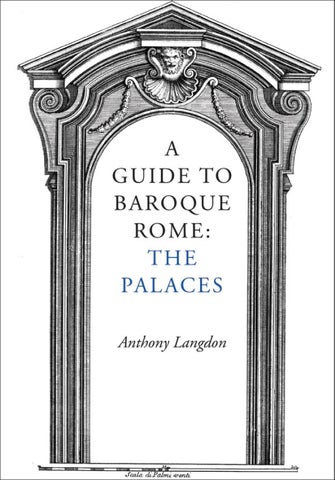
Create a flipbook