2
THE SARTORIALIST
3
CONTENTS
PROLOGUE
7
THE BACCHA NA LI A N 14 JEA N-CLAUDE BI V ER HA NI FAR SI 5 4
50
THE SARTOR I A LIST 58 A LEX A NDER K R AFT
86
THE HOROLOGIST 90 NICK BOULLE
114
THE THR ILL-SEEK ER 118 M AR K CHO
14 4
TAJ PHULL
18 4
THE AUTOPHILE 14 8 THE CULTUR A LIST 188 K AR L-EDW IN GUER R E
222
THE A DONIS 226
A MEER H NAR A N
252
THE CUR ATOR 256 BLA K E JOHNSON 276 TOM CHA MBER LIN 280 EPILOGUE 28 3
6
THE SARTORIALIST
< Fresh oysters dressed in a vibrant green herb oil, at The Clunie Dining Room, The Fife Arms
PROLOGUE
‘A gentleman,’ as one unattributed adage has it, ‘uses his butter knife even when he’s dining alone.’ And who would not applaud personal conduct being impervious to who is watching? This patrician advice feels overmannered and elitist, though, as we enter the second quarter of the 21st century. As for the saying ‘a gentleman is one who puts more into the world than he takes out’ (often mistakenly attributed to George Bernard Shaw), it is admirable in its altruism, but is perhaps too saintly and self-effacing to function as any practical definition of modern masculinity. Oscar Wilde’s droll input into the discussion (‘A gentleman never hurts anyone’s feelings unintentionally’) is a welcome rallying cry to self-awareness, but supercilious and spiky; while ‘Manners Makyth Man’, Winchester College’s motto, is virtually a toast to vacuous performance over solid principles. Rudyard Kipling’s much-vaunted poem If fares somewhat better – its calls for stoicism, humility and resilience have certainly stood the test of time – but it’s still marinated in Victorian-era emotional repression, and riddled with now obsolete references to imperial duty and the stiff-upper-lip worship of endurance at all costs. And here we have the problem with defining what a gentleman is today: it’s a constantly evolving concept, shedding nuances of its meaning as they slip into desuetude and
retaining all that remains relevant to modern protocol. Even the word’s very etymology – ‘gentle’ meaning noble-born, as opposed to kind – has a fusty stench about it, now that Britain’s class structure has become markedly less rigid. While the chivalry once at its core is still alive, even that has had to adapt to the modern world: were Sir Walter Raleigh to encounter a muddy puddle today while walking with the reigning monarch, instead of sweeping off his cloak and laying it over the water so the Queen might pass unsoiled, he’d probably pause, glance about for a more sensible route, and make a note to complain to Westminster council about the potholes. So what does constitute a gentleman today? This book is an attempt to answer that question by examining – and curating the very finest among – his natural habitats in the modern era: from those steeped in tradition (the bespoke tailor, the barber, the cigar lounge) to those with a more contemporary edge (the high-tech listening bar, the cryotherapy room, the heli-skiing lodge). Along the way we’ll encounter some that tick both boxes: from whisky lounges designed with avant-garde flair to remote retreats that dispense with all the dusty bric-a-brac of oldworld ceremony. What unites many of these places – from the bespoke fitting room to the arthouse cinema, from the whisky bar 7
to the wellness sanctuary – is not exclusivity, but refuge. The modern world offers constant connection yet very little stillness; endless convenience yet few rituals. Gentlemen’s retreats endure because they provide environments in which time slows, standards remain intact, and one can take a rare opportunity to zoom out and see life’s bigger tapestry instead of frantically trying make the next strand of thread fit the bigger picture. These are havens in a world in which contemplation and deliberateness have become precious currency. Elsewhere in the book, we find instincts of an entirely different nature satisfied: the hunger for speed, risk, competition and adrenaline, which has been hard-wired into the human psyche by evolution. The baritone roar of a vintage car, the crack of gunfire on a rural shooting range, the sensory thrill of danger indulged at racetracks and heli-skiing lodges and in wilderness expeditions: these spaces cater to the enduring desire to feel sharpened, challenged and vividly alive. In these spaces too, beneath all the velocity and spectacle, many of the same principles are at work: discipline, mastery, camaraderie, self-command and the pursuit of excellence. A few notes for the reader to bear in mind as he or she peruses A Gentleman’s Retreat. Firstly, the phrase ‘spoiled for choice’ does virtually no justice to quite how painstaking the process of omission has been. Keeping the book manageable has been a case of relentless editing and selection. In a spirit of disciplined economy, whole areas of potential inclusion – yacht interiors, casinos, fashion shows, car and watch expos – have been ignored entirely. Within the sectors that have been included, innumerable spaces and establishments have found themselves left, reluctantly, on the cutting-room floor. Having chopped so relentlessly, I’ve had to prune what remains. Meanwhile, given the associations still attached to the word ‘gentleman’, many will be surprised to learn two things about the author. Firstly, I am not of a privileged background. Educated in a state school in the London8
PROLOGUE
Essex overlap, and once saddled with a mockney accent that has since been hammered and smelted into something vaguely more refined by a career in luxury media, I would not have passed for a gentleman when Jane Austen was penning her caustically class-conscious works, let alone in the Middle Ages, when the term was adapted from the Old French, gentilhomme. Secondly? It may surprise many readers that I consider myself proudly progressive. While many in my circle think that James Bond has been emasculated by tweaks to his character imposed by changing societal values, for me Daniel Craig’s 007 is more, rather than less, of a gentleman than Sean Connery’s, by virtue of the fact that he keeps his hands to himself. While I still meet men in my line of work – astoundingly – who sniff at the idea of women being cigar sommeliers and master distillers, I see it as an overdue deepening of the talent pool. While some blench at the idea of Savile Row becoming a more unisex thoroughfare – Richard Anderson has joined Huntsman in doing women’s bespoke, while Banshee of Savile Row and Knatchbull are devoted to it – I believe this to be a long-overdue dismantling of arbitrary boundaries around who gets to enjoy the fruits of the bespoke craft. As such, the title of this book is not meant to embrace only men while excluding women (or even, dare I write it, those who consider themselves neither). However, I would surmise that it will be mostly male fingers and thumbs that will end up turning the pages of what is, unapologetically, a study of the spaces in which modern masculinity expresses itself through thrills, ritual, craftsmanship, fellowship and taste. I hope that all who peruse it, though, find edification and an impetus to marvel at the wonders of human ingenuity, and come to the conclusion that there’s far more to the phrase ‘Wonders of the World’ than ancient monuments.
Gentlemen’s retreats endure because they provide environments in which time slows, standards remain intact, and one can take a rare opportunity to zoom out.
> House 21 at Home House, an award-winning private members’ club located at 20 Portman Square in Marylebone
9
11 6
THE SARTORIALIST
4.
117
CHAPTER FOUR
THE THR ILL-SEEK ER In the winter of 1885, in St. Moritz – a hotspot then at the embryonic stage of its emergence as a premier playground for the elite – a group of visiting British army officers found themselves hungry for a regular dalliance with danger.
And so, with the help of Johannes Badrutt, owner of the Kulm Hotel, they carved out a quarter-of-a-mile track down the icy slopes between St. Moritz and Celerina for the specific purpose of head-first tobogganing. Almost a century and a half later, the Cresta Run – the world’s most dangerous skeleton toboggan track – is, in defiance of the health and safety culture that prevails in the developed world, more popular than ever.
marker post. To date, the Cresta Run has broken so many bones that the art deco clubhouse at the top of the run has a patchwork of injury X-rays compiled on the wall to form a complete human skeleton. Meanwhile the Kulm Hotel’s Sunny Bar, the oldest sports bar in the Alps and the rallying point of the Cresta Runners, is lined with vintage photographs and trophies.
It’s impossible to overstate what a formidable experience hurtling down this ribbon of packed and polished ice is. Their eyes poised inches above the ice, splinters of ice pelting their cheeks, riders – controlling direction, braking and speed using toe cleats – descend to a deafening soundtrack of steel on ice as the course’s treacherous corkscrew twists fall 514 feet (157m) over its threequarters-of-a-mile stretch.
And this is typical of the jaunty camaraderie that pervades the whole Cresta Run ethos and culture. Falling out at the notorious Shuttlecock Corner (an almost 180degree, six-foot-high turn designed to flip an out-ofcontrol sled from the track) confers instant membership to ‘The Shuttlecock Club’ and the right to wear its striped tie, for example. One can only guess at the amount of money – and the club’s other currency of note, Champagne – that has changed hands based on wagers over timings.
Reports tend to cite five fatalities, the last of them in 2017, on a run the British broadcaster, politician and chef Clement Freud called ‘the most reliable laxative imaginable’. Regular injuries are obviously a given, some more serious than others. In 2008, having survived a six-month tour of Iraq unscathed, a British army captain parted company with his foot when it connected with a wooden
> The Cresta Run remains one of the most historically significant and demanding venues in world sport
11 8
T H E T H R I L L- S E E K E R
119
14 4
PORTR AIT
Mark Cho
An entrepreneur, style icon, horology enthusiast and cultural curator, Mark Cho is a major force when it comes to stripping the mystique and stuffiness from classic male elegance. ‘We just want people to have nice clothes and go about their day in a manner that feels comfortable to them,’ he says of the retail ethos at The Armoury, which he co-founded in Hong Kong in 2010 with Alan See as an antidote to disposable luxury and the ephemeral whims of fashion. Born and raised in London, Cho developed an interest in tailored clothing as a teenager after his school permitted older pupils to swap their uniforms for suits. A life immersing himself in the finer nuances of classic menswear had begun. ‘I found all the rules around how to wear a suit, all the history around its development and all the technical aspects of how they are made just fascinating,’ he later recalled.
A graduate of the Ivy League Brown University in the US, Cho, also a former co-owner of the British haberdasher Drake’s, expanded his empire by converting the fifth floor of the Pedder Building in Hong Kong’s Central with pop-ups, a cigar lounge and a new flagship store in 2023. He is now – as well as a long-standing horological enthusiast – one of the defining voices in contemporary menswear, admired for combining Savile Row discipline with softer Italian sensibilities and Japanese craftsmanship. Yet Cho’s philosophy remains notably unshowy. He has consistently argued that elegance is less about wealth or trend-chasing than self-knowledge. ‘People need to be who they want to be,’ he has said. ‘If life is going to be a competition, then you can always compete with your imagination instead of your wallet.’ Impeccably mannered, and brimming with understated poise and charisma in person, Cho is the living embodiment of refinement over the ostentatious bravado so prevalent in menswear circles.
145
CHAPTER FIVE
THE AUTOPHILE In March 1930, after a few too many Champagne cocktails in what is now Bar°58 at the Carlton Cannes, Woolf Barnato – the free-spirited heir to a South African diamond-mining fortune, and de facto leader of the Le Mans-conquering motoring club the Bentley Boys – made what has become one of the most iconic wagers in automotive history.
He bet his companions £100 that he could set off from Cannes in his Bentley 6½ Litre Speed Six and reach his favoured club in St James’s, London, before French luxury express train Le Train Bleu reached Calais from the same starting point. The following afternoon, after a quick nerve-settler at the same bar, he set out. His journey involved heavy rain and fog, a flat tyre and a rough ferry ride – but he reached Mayfair four minutes before the train reached Calais. An obsession with propelling oneself from A to B using pedals and powertrains has been at the heart of gentlemanly culture ever since the invention of the combustion engine, and foppish, carefree tomfoolery has tended to be part of the ride. The history books are replete with colourful protagonists offering testimony to this. Figures such as Count Louis Zborowski, a Kent-raised American and heir to a large fortune, who competed at Brooklands and Indianapolis, setting speed records with casual abandon, before dying during the 1924 Italian Grand Prix at Monza aged 29. Zborowski’s cultural legacy is a huge one, thanks to his once speeding past a schoolboy named Ian Fleming in a 23-litre, Maybach-engined beast named Chitty Chitty Bang Bang. 14 8
THE AUTOPHILE
Another is Scotch whisky heir Rob Walker – a man who, having learned to fly at Cambridge, was turfed out of the university air squadron for taking on the Cottenham horse-racing course at zero feet in a Tiger Moth biplane on full throttle. A true gentleman racer, Walker, competing at Le Mans in 1939 in a Delahaye coupé previously raced by Thailand’s Prince Bira, would wear blue pinstriped suits for his evening stretch before opting for Prince of Wales check for the 12-hour-long marathon the following day.
> Coolnvintage, a Lisbon-based workshop founded by Ricardo Pessoa that specialises in restoring vintage Land Rovers
14 9
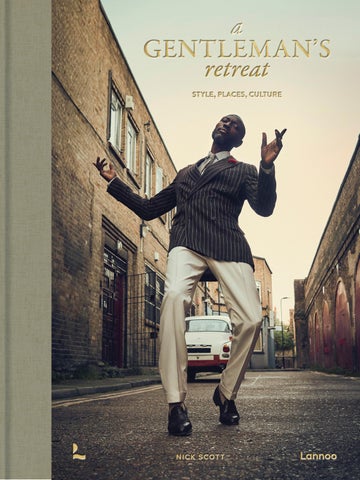
TEXT Nick Scott COPY EDITING Léa Teuscher BOOK DESIGN Bart Luijten COVER PHOTOGRAPH Kim Lang
Sign up for our newsletter with news about new and forthcoming publications on art, interior design, travel, photography and fashion as well as exclusive offers and events. If you have any questions or comments about the material in this book, please do not hesitate to contact our editorial team: art@lannoo.com © Lannoo Publishers, Belgium, 2026 THEMA: WJ D/2026/45/536 ISBN: 978-90-599-6453-2 WWW.LANNOOPUBLISHERS.COM
All rights reserved. No part of this book may be reproduced or transmitted in any form or by any means, electronic, mechanical or otherwise, without the prior written permission of the copyright owners and publishers. All rights are reserved, including those for text and data mining, AI training and similar technologies. Every effort has been made to trace copyright holders. If, however, you feel that you have inadvertently been overlooked, please contact the publishers.