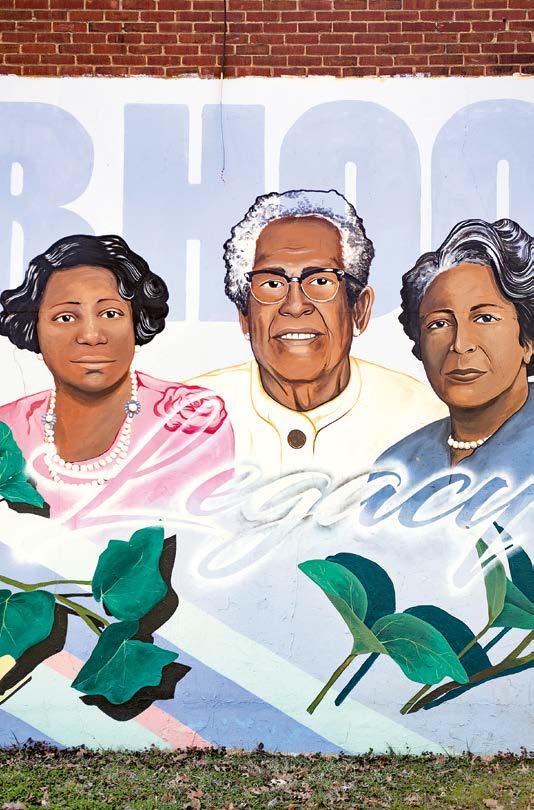
AKA Sisterhood Mural
Kamala Harris, Madam Vice President
The date was January 20th, 2021, and Americans were preparing for the inauguration of the first woman to be elected as vice president. Ladies across the country laced up their Converse shoes and donned beautiful pearl necklaces in celebration of Kamala Harris. “Chucks” sneakers are a playful fashion preference for Madam Vice President, but the pearls are a symbolic jewelry of her sorority.
Alpha Kappa Alpha (AKA) was founded in 1908 at DC’s Howard University, a prestigious historically Black college, where Harris graduated from in 1986. The everlasting connection between all Howard alumni is quite remarkable, but the members of AKA form a bond stronger than friendship; they are a sisterhood. When Kamala Harris was sworn into office, she too was wearing her pearl necklace and representing not only the people of the United States, but also her nearly 300,000 sisters from Alpha Kappa Alpha (see ch. 89).
The Sisterhood mural is located on the back wall of the Xi Omega Chapter building and was painted by artists Rose Jaffe and Kate DeCiccio. It features several of the sorority’s founders, who are often referred to as “Twenty Pearls.” Their portraiture shows them wearing their necklaces and surrounded by bold words – “Service,” “Education,” “Justice,” and “Legacy.” Any trained eye will notice the more intricate representation of the sorority; the pink tea rose, their official flower, and the official AKA symbol and magazine name, Ivy Leaf. Notable members of Alpha Kappa Alpha include singer Marian Anderson, tennis star Althea Gibson, and astronaut Mae Jemison.
Another notable member is Maya Angelou (see ch. 64), whose presence was on stage with Kamala Harris on January 20th when Amanda Gorman delivered her poem, “The Hill We Climb.” As the youngest poet to ever perform at an inauguration, Gorman wore a caged bird ring, gifted to her by Oprah Winfrey in honor of Maya Angelou’s memoir, I Know Why The Caged Bird Sings.
Address 4411 14th Street NW, Washington, DC 20011, www.muralsdcproject.com/mural/ sisterhood | Getting there Metro to Columbia Heights (Yellow and Green Line); bus D50 to 14th & Webster Streets NW | Hours Unrestricted | Tip Artists Jaffe and DeCiccio also collaborated on a mural titled Cup Of Communitynear the restaurant Soup Up, owned by Donna Henry (709 Kennedy Street NW, www.petworthnews.org/blog/soupup-kennedy).
Beau Thai
Aschara Vigsittaboot’s mom inspires a curry
When Aschara Vigsittaboot moved to the United States in 2001, she started out as a server and grew into an entrepreneur. She met a customer named Ralph Brabham, who would become her future business partner alongside Drew Porterfield, and together, the trifecta built an empire known as Beau Thai.
It’s not hard to imagine what Vigsittaboot’s experience was like leaving southern Thailand as an exchange student with AFS Intercultural Programs because a photo of her initial departure hangs inside the restaurant to depict her story. Fast forward several years, and the original Beau Thai has been rebranded BKK Cookshop – the Bangkok airport code.
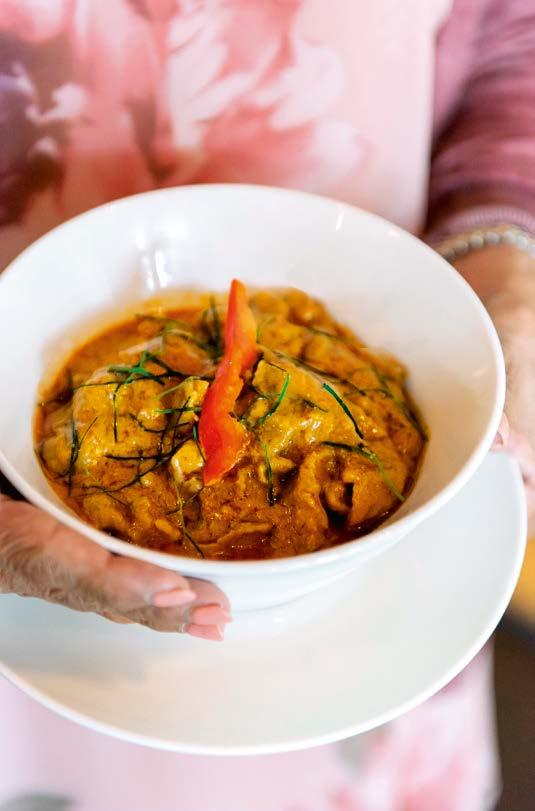
Walking into the Shaw and Mount Pleasant establishments is like time-traveling to the past and getting a glimpse of Southeast Asia. The wall art pays homage to Aschara’s family, with a special focus on her mother, Udom, who attended culinary school and taught her daughter everything she knows about cooking. Aschara recalled analyzing a plate of curry in the US and saying, “No, it’s wrong.” So she recreated the traditional Thai dish herself, perfected it from scratch, put it on the menu, and named it “Udom’s Curry’’ in honor of her mother. The classic photos hanging at Beau Thai are matched with an edgy and modern vibe influenced by Brabham and Porterfield, a married couple, who infuse their North Carolina roots into the beverage list and brunch menu.
Vigsittaboot enjoys the four seasons of weather in Washington, DC, and she remembers seeing snow for the first time here. She not only opened a business here but became a respected member of the community. Beau Thai makes considerable donations in support of local organizations, like My Sister’s Place and New Endeavors by Women. She also teaches cooking classes for locals to further her mission of “Making everybody in the community healthy in the way that they eat.”
Address 3162 Mount Pleasant Street NW, Washington, DC 20010, +1 (202) 450-5317, www.beauthaidc.com, beauthaidc@gmail.com | Getting there Metro to Columbia Heights (Yellow and Green Line); bus C87, D72 to Mount Pleasant & Lamont Streets NW | Hours See website | Tip For more than 20 years, Dos Gringos’ owner Alex Kramer has served tasty, affordable, non-processed food inspired by her New York roots and Salvadorian staff. Bring a book to read (maybe this one), as laptops are not allowed (3116 Mount Pleasant Street NW, www.dosgringosdc.com).
Belmont-Paul National Monument
Where women first fought
“We ratified the 19th Amendment. But the suffragists didn’t stop there,” said President Barack Obama at the ceremony designating the Belmont-Paul Women’s Equality National Monument (2016).
Long adored as a place of local history, the former headquarters of the National Woman’s Party (NWP) became a national monument during this ceremony. Here inside one of the oldest homes on Capitol Hill, you can explore the story of the hard-fought battle for equal rights for women in the rooms where it happened. Originally completed in 1800, the building was sold to Alice Paul and the NWP in 1929.
The NWP, founded by Paul in 1916 to shift the fight for women’s suffrage to a constitutional amendment, had been the more militant wing of the suffrage movement, staging protests outside the White House and hunger strikes inside their jail cells. After the ratification of the 19th Amendment, Paul went back to school, earned three law degrees, and refocused the fight for equality through the law. In 1923, she drafted the Equal Rights Amendment and supported the legislation for the next 50 years. In 1943, in honor of her tireless work on the issue, the amendment was renamed in her honor. Spearheaded by Paul, the NWP continued its work for gender inclusion at the United Nations and equality in legislation such as the Civil Rights Act of 1964.
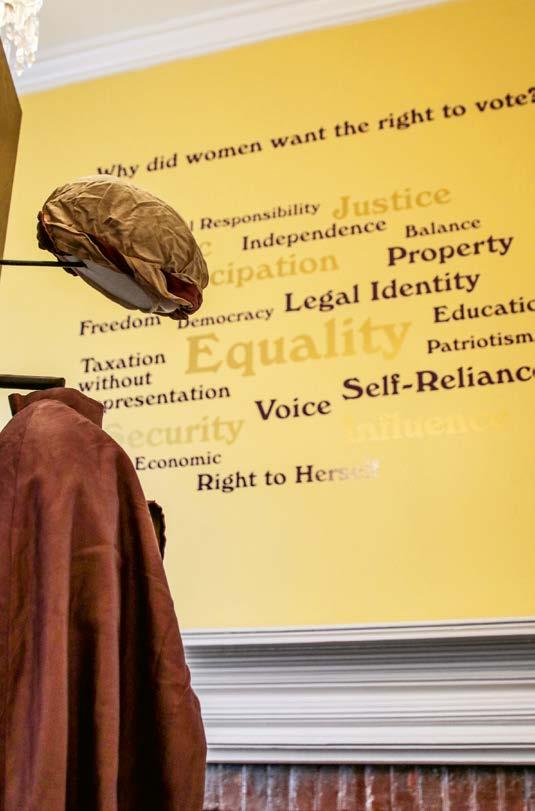
On display here is the NWP’s robust collection of portraits and sculptures featuring pivotal female figures and leaders. But most importantly, look for the tools used by the female activists of this movement, including banners carried by the Silent Sentinels who protested outside the White House, as well as sashes, capes, and typewriters – all wielded with the single goal of women’s equality at the ballot box and beyond.
Address 144 Constitution Avenue NE, Washington, DC 20002, +1 (202) 543-2240, www.nps.gov/bepa, bepa_info@nps.gov | Getting there Metro to Union Station (Red Line); bus C43, C51, D24 to Massachusetts Avenue & 2nd Street NE | Hours Fri – Sun 10am – 5pm | Tip Alice Paul tracked progress of the ratification of the Equal Rights Amendment on a charm bracelet, now displayed at the National Museum of American History – she added a charm for each state as it ratified, although she died in 1977, just three states short (1300 Constitution Avenue NW, www.americanhistory.si.edu).
Flora Molton Call Box
A street corner tribute for a street corner icon
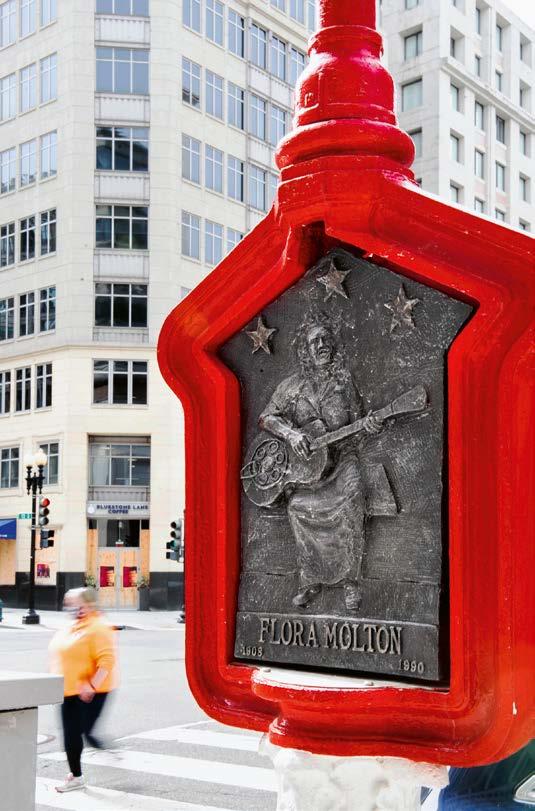
If you walk the city’s streets, you are likely to come across a call box. These metal structures dotting the street corners were once part of a vast alarm system used to signal for police or fire services for almost a century before going out of use and falling into disrepair. In 2019, the city undertook a project to convert eight call boxes into eight memorials to significant DC women. Local artist Charles Bergen retrofitted each box with a cast iron sculpture of a notable woman, along with paintings, symbols, sculptures, and quotes to tell her story. Noted historian Mara Cherkasky helped select the subjects, choosing women from a variety of backgrounds and eras.
Flora Molton is not a name that many Washingtonians will know, but her voice used to ring out loud and clear through the busy rush hour streets of downtown DC. A partially blind native of Louisa County, Virginia, Flora grew up surrounded by music. She learned to play the slide guitar with a knife, a technique she picked up from local musicians, and accompanied herself with a tambourine at her feet. She made her way to DC and began busking on street corners in the 1940s, earning a loyal audience of passersby.
Flora played what she called “spiritual and truth” music, using her background as a preacher to infuse her bluesy country sound with gospel praise. She would set up a plastic bucket at the corner of 11th and F Streets NW, earning enough to survive for over 20 years, until she started to be awarded with grants, prizes, and prominence – legend has it that she once held a private performance for the Rolling Stones.
Her success came late in life, with her first scheduled gig inside a coffee shop at the age of 55 and her first album recorded at 79. Flora Molton would continue to sing until six months before her death in 1990. Today she is buried at the National Harmony Memorial Park in Hyattsville, Maryland.
Address G Street NW and 13th Street NW, Washington, DC 20004, https://historicsites. dcpreservation.org/items/show/1034 | Getting there Metro to Metro Center (Blue, Orange, Red, and Silver Line); bus D10 to 13th & G Streets NW | Hours Unrestricted | Tip If you walk G Street to 14th Street, you’ll spot another call box, this one honoring Mary Church Terrell, an educator in DC, founder of several civil rights organizations, suffragist, activist, and more (14th and G Streets NW, https://historicsites.dcpreservation.org/tours/show/14).
Human Rights Porch
Social justice at Washington National Cathedral
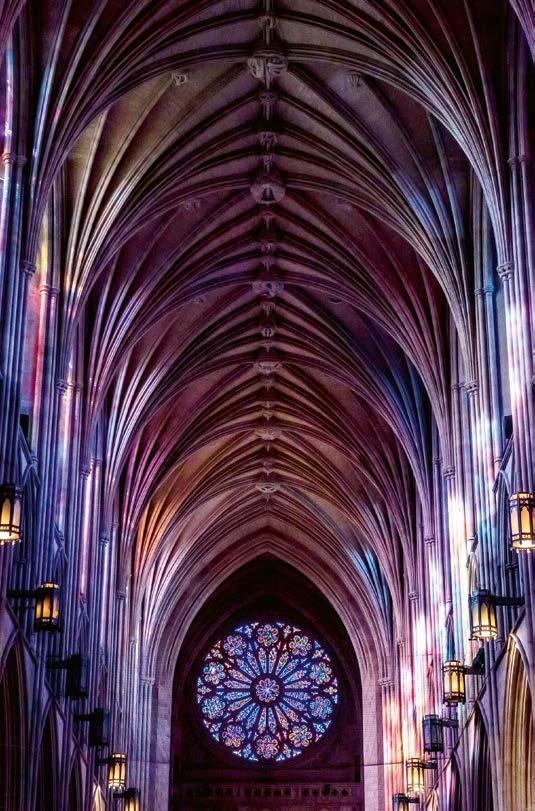
Founded as a great church with national purpose, the Washington National Cathedral is the sixth largest gothic-style cathedral in the world. It is committed to both religious worship and social justice, and its Human Rights Porch features three stone carvings of women who have served the country as spiritual and cultural leaders.
Born Anna Eleanor Roosevelt, she was first lady to the President and first delegate to the United Nations. She served as committee chairperson in drafting the Universal Declaration of Human Rights. Her stone carving was dedicated on the document’s 50th anniversary in 1998. Much like the cathedral’s purpose and Eleanor Roosevelt’s vision, the Declaration clearly states the desire for “faith in fundamental human rights.”
The First Lady met with the mother of the civil rights movement, Rosa Louise McCauley Parks, the year after she was arrested for refusing to give up her seat on a segregated bus in Montgomery, Alabama (see ch. 82). Roosevelt wrote in her My Day column (see ch. 24) about the quiet and gentle nature of Rosa Parks while admiring her strong stance against injustice.
The stone carving of Parks serves as a testament to progress and perseverance – that a seamstress from Alabama can blaze a path all the way to the United States Capitol Building, where she became the first woman in history to lay in honor.
Rosa Parks is the companion carving to Mother Teresa of Calcutta, each looking at the other from opposite sides of the archway. Washington National Cathedral dedicated both of these memorials in 2012. Just four years later, Pope Francis officially canonized Mother Teresa as a Roman Catholic saint, a woman who was awarded the Nobel Peace prize for her humanitarian work around the world. In 1997, the US Mint issued a bronze coin replica of her Congressional Gold Medal that reads, Service to the poorest of the poor.
Address 3101 Wisconsin Avenue NW, Washington, DC 20016, +1 (202) 537-6200, www.cathedral.org, info@cathedral.org | Getting there Metro to Cleveland Park (Red Line), then take bus C51 to Woodley Road & Wisconsin Avenue NW, or walk 20 minutes | Hours See website for hours and services | Tip Enjoy brunch at Open City, the coffeehouse and café housed in the Old Baptistry building on the Cathedral’s grounds. The menu offers a broad range of savory meals, sweet pastries, coffees and teas often sourced from local businesses (3101 Wisconsin Avenue NW, www.cathedral.org/visit-us-2/cathedral-cafe).
Letena Restaurant
Yamrot Ezineh serves authentic Ethiopian cuisine
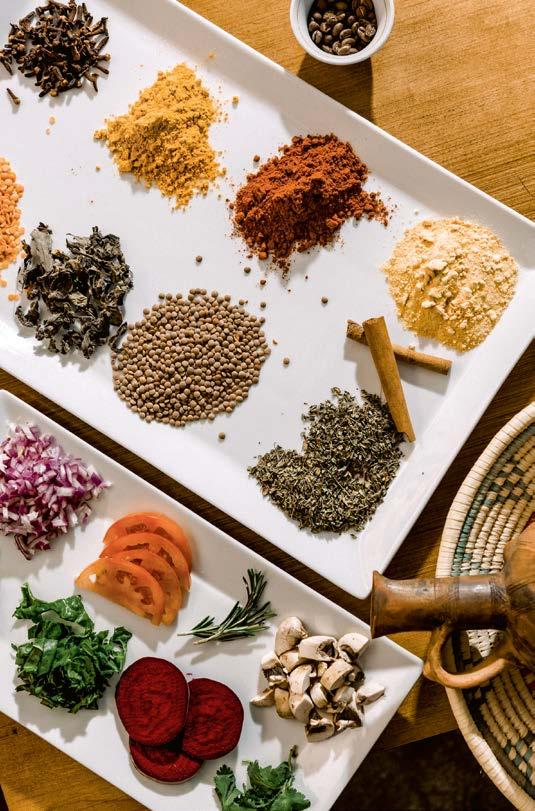
The largest population of Ethiopians outside of Africa is concentrated right here in the greater DC region. Proximity to the country’s embassy has earned Washington, DC the reputation as Ethiopia’s “second capital.” Over several decades of immigration, local neighborhoods have been infused with the culture, and one must-not-miss experience is dining at Letena. Meaning “for health” in Amharic, this Columbia Heights neighborhood restaurant offers authentic Ethiopian food and beverages.
The story of owner Yamrot Ezineh highlights the long-lasting relationship between sister capital cities Washington, DC and Addis Ababa, where she was born. Her approach to food offers a broad range of natural and healthy options. The menu includes both vegetableforward and hearty meat dishes, like traditional gulash, wot, and tibs. Ezineh emphasizes that these ingredients are readily available because of the strong network in the city. “Everything starts from scratch,” she says. This is certainly true for her food, as she returned to Ethiopia to study and research recipes before opening in 2016. But it also speaks to her personal journey.
Ezineh bravely restarted her life’s path from scratch several times. She was educated for a career in pharmaceuticals, worked as a chemical engineer, and committed to raising her kids as a homemaker before launching Letena. She credits much of her desire for entrepreneurship to her mother, a banker and self-employed businesswoman, who set a positive example rooted in strength and independence.
Yamrot’s family influence is in the foundation of her establishment. After leaving Ethiopia, she spent time in London learning from her relatives who owned a restaurant there. Eventually she met her husband, who is from the DC area, and moved here in 2007. Experiencing the nation’s capital must include Ethiopian culture, and Letena is at the top of the list.
Address 3100 14th Street NW, Washington, DC 20010, +1 (202) 733-4830, www.letenadc.com, dine@letenadc.com | Getting there Metro to Columbia Heights (Green and Yellow Line); bus D50, D5X to 14th & Monroe Streets NW | Hours See website | Tip All members of the DC community can join the DC Sister Cities Steering Committee to foster international relationships (os.dc.gov/service/dc-sister-cities).
The Star-Spangled Banner
Mary Pickersgill’s handiwork is American history
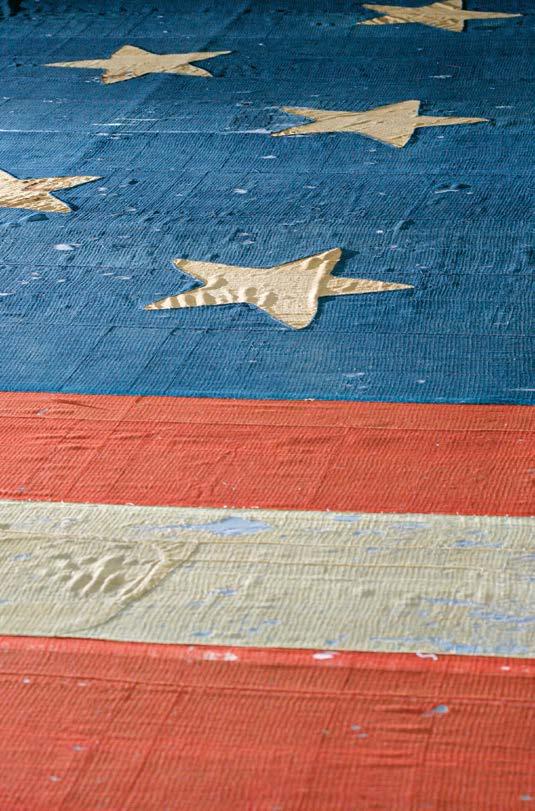
The National Museum of American History is one of the most popular destinations in DC. Visitors from around the world go there to see our national treasures, including our most important flag, the Star-Spangled Banner, which inspired Francis Scott Key to pen the poem that would become our national anthem.
Before the lawyer and poet set pen to paper, a woman named Mary Pickersgill worked diligently to complete two flags for Fort McHenry in Maryland. Mary’s mother ran a flag shop and taught her daughter the art of making flags. Mary would marry in 1795 at the age of 19, bear four children, only one of whom would live to adulthood, and find herself a widow by age 29. She was living in Baltimore with her mother and daughter when she received a commission that would change American history.
While the US was fighting Great Britain in the War of 1812, Major George Armistead felt that Fort McHenry was well-prepared for battle but lacked an impressive flag. Armistead led the group that arrived at Mary Pickersgill’s shop in 1813 to commission a flag. It was too large for one person to make, so Mary recruited help from her own household and neighbors. She was able to complete the task in six weeks, although she had to move to a local brewery to finish the project, as the flag was too big to fit in her own shop. The finished flag contained 400 yards of fabric, weighed 50 pounds, and included 15 stars and 15 stripes, one for each of the 15 states in the Union. The final flag was delivered to Fort McHenry in August 1813, just before the Battle of Baltimore.
Pickersgill was paid over $400 dollars ($6,700 in today’s currency) for her efforts, and her business would boom. She became successful enough to advocate for social issues, such as housing, jobs, and financial assistance for disadvantaged women. She died in 1857 and is buried in Loudon Park Cemetery in Baltimore.
Address 1300 Constitution Avenue NW, Washington, DC 20560, +1 (202) 633-1000, www.americanhistory.si.edu, info@si.edu | Getting there Metro to Smithsonian (Blue, Orange, and Silver Line); bus D50, A29, F19 to 14th Street & Constitution Avenue NW | Hours Daily 10am – 5pm | Tip Virginia Blanca Arrisueno supports and promotes independent artisans and makers at Steadfast Supply, a retail store and community incubator she founded in 2016 (301 Tingey Street SE, www.steadfastsupplydc.com).
Walsh-McLean Mansion
A doomed marriage and a cursed diamond
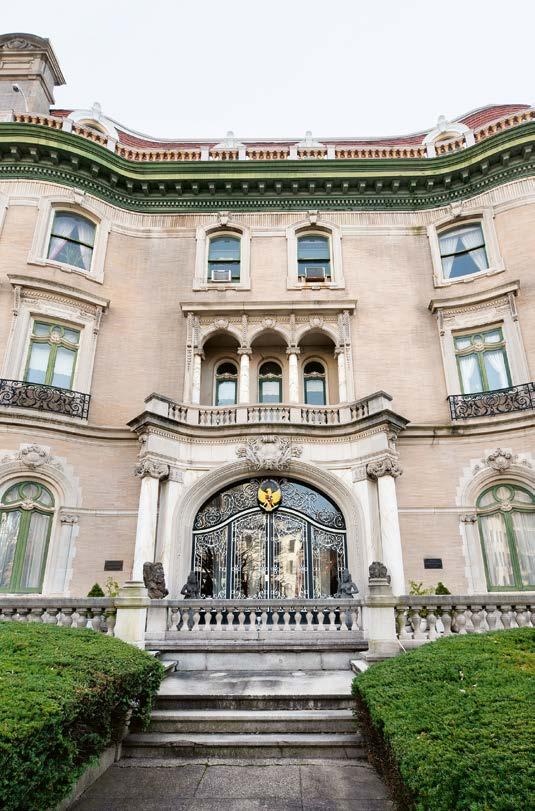
When Evalyn Walsh was 12 years old, her father discovered an actual gold mine, and she became one of the wealthiest teenagers in the country. At 17 years old, she received an incredible gift from her dad: a brand-new mansion on Massachusetts Avenue, then known as Millionaire’s Row. The mansion was said to cost $835,000 to construct and another $2 million to furnish and decorate – an unimaginable sum in 1903. It had 60 rooms, a theater, a ballroom, a grand staircase, and a three-deck promenade in the center foyer. It was in this extraordinary setting where Evalyn met Ned.
Edward “Ned” Beale McLean was a scion of a wealthy publishing company, who already had a reputation for copious gambling and drinking. A whirlwind romance led to their elopement in 1908, followed by a lavish honeymoon adventure through Europe and the Middle East. As they traveled, they bought cars, clothing, art, and jewelry, including the 92.5 carat diamond, the Star of the East.
In 1911, they purchased the piece of jewelry that would be linked to their lives forever – the Hope Diamond. The couple purchased the 45.52 carat blue diamond for $180,000 – almost $5 million today. Evalyn adored flaunting the diamond, wearing it constantly, even when just lounging around her mansion. The McLeans threw lavish parties, often spending thousands of dollars in a single night.
But things turned south for the pair. A messy divorce followed, and Ned was deemed legally insane in 1933. Evalyn would spend the second half of her life dealing with her unfaithful husband, the loss of multiple children, and the draining of her financial resources. When she died in 1947, her estate was deeply in debt, partially due to her unfailing generosity with her money. She is entombed today at Rock Creek Cemetery. The mansion retains its splendor.
Washington Spirit
Professional soccer scores in the nation’s capital
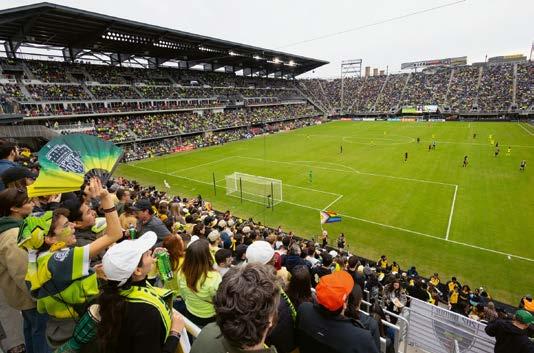
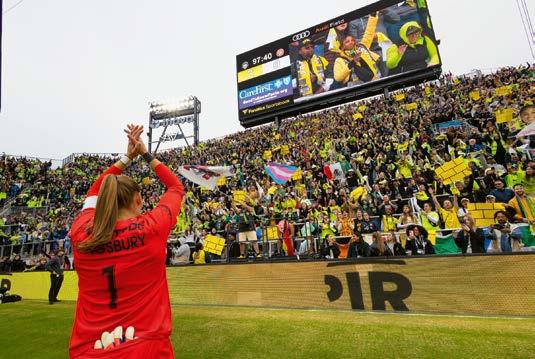
A Washington Spirit game is the heartbeat of DC with non-stop drums coming from the Spirit Squadron and fan section. Among the diverse crowd of intergenerational Americans are pride flags flying high and chants for DC to “rise up.”
Soccer in the district has come a long way since the Washington Freedom started playing at RFK stadium in 2001, shortly after the iconic 1999 FIFA Women’s World Cup Final. The NWSL gave new life to the sport in 2012 when the Spirit played during the inaugural season. The following decade would be pivotal for the growth of women’s soccer. The 2019 National Team won the World Cup and paraded down Broadway in NYC with visibility for their ongoing fight for equal pay. Using the momentum from their victory, they negotiated a historic Collective Bargaining Agreement which was signed right here in Washington, DC at Audi Field on September 6, 2022.
Under the leadership of Washington Spirit owner Michelle Kang, there is no doubt where her vision for the sport is: the potential for a better future. In 2024, she made a $30 million dollar pledge to invest in U.S. Soccer to support female players, coaches, and referees. Supporting her efforts are notable Spirit investors such as Chelsea Clinton, Jenna Bush Hager, Dominique Dawes, and Briana Scurry. Most recently, Magic Johnson announced his investment, followed by a local visit to meet young soccer players at Ida B. Wells elementary school.
Where did the rise of women’s sports come from? Well, what’s a story about the nation’s capital without a policy reference? Today, we have Title IX of the Education Amendments Act of 1972 and its author Patsy Mink to thank. This was a federal law that prohibited sex discrimination under any federally funded education program, essentially mandating equal access to sports in schools. Since then, generations of girls have hit the ground running.
Address 100 Potomac Avenue SW, Washington, DC 20024, +1 (202) 587-5000, www.washingtonspirit.com, fans@washspirit.com | Getting there Metro to Waterfront (Green Line); bus 74 to 2nd & R Streets SW | Hours See website for schedule | Tip If you’re looking to get into the athletic spirit yourself, join a social sports league with DC Fray. The group plans recreational league play, events, and more, all centered around the ethos to make fun possible (www.dcfray.com).
Zitkala-Ša, aka Red Bird
Women’s Suffrage Mural: Zitkala-Ša, a Native voice
Thaté Iyóhiwi was a loving mother who wanted to provide her daughter with the best educationpossible. But opportunity did not come without sacrifice on the Yankton Indian Reservation in South Dakota. For her daughter Zitkala-Ša, or Red Bird, to broaden her perspective beyond the West, she would have to leave her native culture behind and accompany the missionaries to the East.
Thaté’s “mother’s intuition” was to resist the idea of being separated from her daughter, but she rationalized her final approval. “The palefaces, who owe us a large debt for stolen lands, have begun to pay a tardy injustice in offering some education to our children. But I know my daughter must suffer keenly in this experiment.” It was 1884, and the missionaries promised Zitkala-Ša an abundance of fresh fruit and an experience riding on a modern train, which she called an “iron horse.” She and seven other children set out for “The Land of Red Apples,” arriving at the Quaker school in Wabash, Indiana, where she would drop her native identity as Red Bird and take the name Gertrude Simmons.
Over time, she became keenly aware of the intense emphasis on assimilation the program forced onto Native children. In her book American Indian Stories, Simmons would write, “I slowly comprehended that the large army of white teachers in Indian schools had a larger missionary creed than I had suspected. It was one which included self-preservation quite as much as Indian education.” She claimed to have lost her connection to nature and vowed to spend her energies “working for the Indian race.”
Zitkala-Ša became one of the most accomplished advocates for the representation of Native Americans and women. The cover of her original 1921 book matches the pattern behind MISS CHELOVE’s portrait mural. Visitors can also pay respects at Arlington National Cemetery where she is buried with her husband.
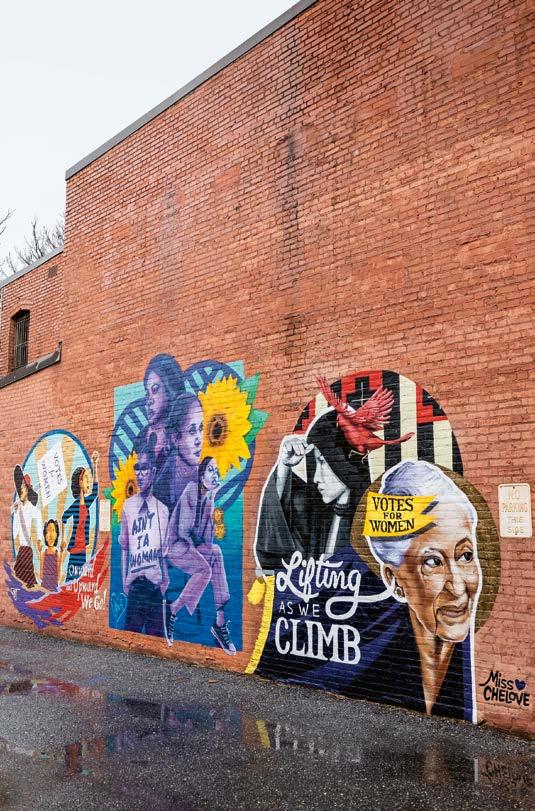
Address 2027 Martin Luther King Avenue SE, Washington, DC 20020, www.chelove.com | Getting there Metro to Anacostia (Green); bus C11, C15, C23, C31, C41, C51 to Martin Luther King Avenue & U Street SE | Hours Unrestricted | Tip Frederick Douglass established Cedar Hill, his home in Anacostia, in 1877 and used it as a base of operations for his work, including his fight for women’s suffrage (1411 W Street SE, www.nps.gov/frdo/index.htm).
Kaitlin Calogera embarked on a journey of entrepreneurship when she launched A Tour Of Her Own, the first tourism company in Washington, DC to focus exclusively on women’s history. As a licensed tour guide, she recognized a lack of women’s stories being represented in public spaces so she mobilized her community to reframe the traditional narrative through special events and historical tours. With a degree in History and a background coaching women’s athletics, Kaitlin believes in the power of tourism to promote gender equality and education beyond the classroom.
Rebecca Grawl is a professional DC tour guide with nearly two decades of experience in public history, museum education, and tourism. She is particularly proud to be a founding team member of A Tour of Her Own, the first tour company in DC to focus exclusively on women’s history. She is a proud graduate of Randolph-Macon Woman’s College and member of the National Society Daughters of the American Revolution. Rebecca has been featured on Mysteries at the Museum on the Travel Channel, Tour Guide Tell All podcast, and in local press outlets such as WAMU, Washingtonian, Washington City Paper, DC News Now, and more.
Cynthia Schiavetto Staliunas is an internationally awarded artist who reveals the strength and beauty within her subjects. A licensed drone pilot, her versatile work spans empowering fine art to dynamic commercial and real estate projects for global clients. Her unique perspective captures both the intimate essence of a person and the grand character of a place.