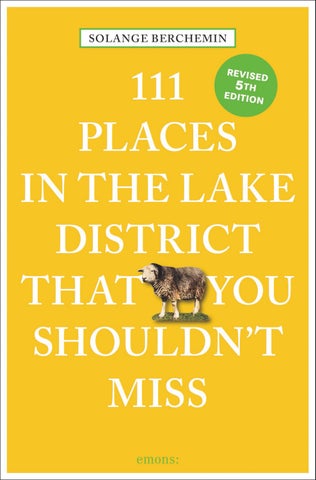
111 Places in the Lake District 2026

Page 1


Arnside

Fish, chips and sunsets

Once a quiet fishing village, Arnside, situated on the Cumbria-Lancashire border, found its place as the gateway to the Lake District, though it still remains an unspoiled holiday destination. Transport developments played a large role in its growth. In the 19th century, the construction of a 500-metre-long railway viaduct across the River Kent contributed to the good fortune of the local economy and without any doubt changed the scenery. But it is the pleasure boats sailing from Morecambe and Fleetwood that contributed most to the tourist boom. Ships dropped affluent passengers ashore, for them to enjoy the famous Promenade walks and sample the local delicacies: salmon and potted shrimps. Two centuries later, the Promenade pubs, cafés and shops are still a pull for people on vacation who come to admire the spectacular sunsets and enjoy the famous Arnside fish and chips.

Sunsets across Morecambe Bay are certainly a technicolour spectacle. Some even say that they are the best displays in the world, and are free of the usual crowds which often spoil such sights. Drivers, blinking in the evening sun, tend to zoom along the A 6 road to reach the south lakes quickly, leaving Arnside and Silverdale, its twin village, behind, taking no notice of their Outstanding Natural Beauty status.

The sunset experience is not complete without a visit to the Arnside Chip Shop and the Big Chip Café located at the north end of the Promenade. Run by David Miller and his sons, the shop with its bow-window and backwards clock deserves its reputation. Best seasonal potatoes, of course, and meaty fish in light crispy batter straight from the fryer make for an excellent meal or takeaway. It’s not only word-of-mouth spreading the message, it’s technology too. This is one of the few fish and chip shops in the country equipped with a live webcam feed.

Address The Arnside Chip Shop and the Big Chip Café, 1 The Promenade, Arnside, LA5 0HF, +44 (0)1524 761874, www.arnsidechipshop.co.uk, arnsidechipshop@gmail.com |

Getting there By car via M 6 exit at J 35; from A 6 it is between Milnthorpe and Carnforth. Arnside station is a stop on the Lancaster to Carlisle and the Barrow-in-Furness to Preston lines. Stagecoach bus 551, 552 from Kendal and 555 from Lancaster via Carnforth, or 99 from The Promenade to Kendal and Kirkby Lonsdale. | Hours Tue – Thu 11.30am – 1.45pm & 4.30 – 7:30pm, Fri 11.30am – 2pm & 4.30 – 8pm, Sat 11.30am – 8pm, Sun noon – 7.30pm or earlier in the winter | Tip A bore is a rare and impressive tidal phenomenon, and can come down the River Kent as fast as a galloping horse, with high waves. A siren is sounded twice before a bore. Canoeists come from miles around to take advantage of the incoming water.

Stott Park Bobbin Mill

‘Happy hour’ it’s not

South of Lake Windermere, you’ll find a 19th-century time capsule. In the 1830s, when tourism was in its infancy, the region relied on industries that took advantage of the environment. Stream water provided power, and coppiced woodland offered the raw material for the local mills, an important part of the national economy. Stott Park Bobbin Mill was founded in 1835, one of 40 such mills in the area serving the growing textile industry and the infamous cotton mills of Manchester, which required millions of bobbins.

Turning wood into bobbins was a dangerous, fast-paced, profithungry business. Some bobbins were rather large while others, known as ‘caps’, were very small. Caps were required for the delicate work of the silk ‘throwsters’, or spinners. To bore them, workers had to be very skilled and extremely vigilant, otherwise they could easily lose their fingers. Horrific accidents involving loss of limbs in fast-moving leather belts were not uncommon. Luckily, no deaths were recorded at this mill. Boys as young as 8 years old were employed until 1878, when a law regulating child labour was passed and the minimum age was raised to 11.

A 45-minute guided tour of the mill is a unique opportunity to understand the manufacturing process and the working conditions of Lakeland dwellers during the Industrial Revolution. The mill buildings have been faithfully restored and the machines repaired. Demonstrations make the process all the more vivid to understand what happened from the moment the coppiced wood was stripped of its bark to the final process.

Gluing and staining were done by one worker during the last hour of the working week. This was referred to as ‘happy hour’ on account of the chemical inhaled. When the mill closed in 1971, its production had diversified one last time: it had been able to take advantage of the yo-yo craze.

Address Colton Hill, Ulverston, LA12 8AX, +44 (0)1539 531087, www.englishheritage.org.uk/visit/places/stott-park-bobbin-mill | Getting there By car, located 1.5 miles north of Newby Bridge, off A 590; by train, Grange-over-Sands station is 8 miles away; by boat, Windermere Lake Cruises from Ambleside or Bowness to Lakeside, then a threequarter-mile walk; bus 538 (Thu only) passes the site, or take X 32 to Newby Bridge (summer only) | Hours Sept – Nov, Wed – Sun 10am – 5pm; visit the website for other times during the yearIf you are interested in more of the area’s industrial past, contact Cumbria Industrial History Society (www. cumbria-industries.org.uk). | Tip If you are interested in more of the area’s industrial past, contact Cumbria Industrial History Society (www. cumbria-industries.org.uk).

Sticky Toffee Pudding

Keeping up with the Johnses

A sticky toffee pudding is like a giant muffin made with dates then covered in rich, soft toffee sauce and served while still warm. There have been many sticky toffee puddings since its invention in the Seventies, and many chefs and cooks have tried to emulate the most renowned – Cartmel Sticky Toffee Pudding – but no one has yet succeeded to make one as deliciously moreish as that of Jean and Howard Johns.

The couple first made their version of this pudding for a restaurant they ran near Grange-over-Sands. Naturally, when they moved to Cartmel’s shop-cum-post office (a beautiful example of its kind) their pudding was added to their takeaway menu. At first, they didn’t make more than a few dozen for locals and tourists during high season. Though Cartmel is a lovely village, it’s also very small and not really on the tourist circuit. Jean (pictured opposite) explains, ‘Our pudding became very popular, very quickly and people asked where else they could get it. As a result, we packaged up some samples, this was the source of our success. We didn’t invent sticky toffee pudding, we found a way to package it.’ She’s being modest. Everyone who has tried this delicious handmade confection will tell you that the pudding is the star, not the box it comes in.

As demand grew, the couple built a larger kitchen in their back garden, down the road from the village shop. There were regular orders from Booths, the local supermarket chain, but nothing compared to the orders following Waitrose’s request to stock them. The company now employs over 30 people in order to produce over a million puddings a year, and celebrities such as Madonna have been known to order them. The little village of Cartmel ranks 44th in The New York Times list of the world’s top travel destinations, just behind the Seychelles. Does it have sticky toffee pudding to thank? You decide.

Address Cartmel Village Shop, Parkgate House, 1 The Square, Cartmel, LA11 6QB, www.cartmelvillageshop.co.uk, nicepeople@cartmelvillageshop.co.uk | Getting there About a mile from A 590, there is a large pay-and-display car park on the edge of the racecourse. Getting to Cartmel by public transport is not easy but the 530 Stagecoach to Kendal stops in the village. Check the timetable, especially during the winter months. | Hours Mon – Sat 9am – 5pm, Sun 10am – 4.30pm | Tip The Lake District has an extensive number of local puddings. Look out for Lakeland lemon cake, Westmorland parkin, Ennerdale cake, Windermere spice biscuits and the funnily named Cumberland ‘nickies’ to name but a few.

Thornby Moor Dairy

A course of cheese, or a cheese-making course

Situated in Hadrian’s Wall country in the Solway Plain, with the Lake District’s northern fells in the background, this dairy has built a solid reputation for its production of flavoursome Cumbrian cheeses. Allerdale, Stumpies and Blue Whinnow are made at Thornby Moor using traditional skills and artisanal methods. In 1979, Carolyn Fairbairn set up a cheese dairy in the basement of the family home, using raw milk from her own herd of goats. Entirely self-taught in the craft, Allerdale was her first creation. It was produced using the time-tested trial-and-error method. Later, she experimented with cow’s milk from a neighbouring farm and produced a new range. From there, the business was a step away from producing a mi-chèvre cheese – a blend of cow and goat milk. There are over 700 cheeses in the UK, but very few are produced near the Lake District.

Leonie, Carolyn’s daughter, is now adding her own creativity to the family business. Her Oak Smoked Cumberland Farmhouse is a direct product of the region. The Solway Plain is good pasture land, and in the past was known for its production of butter. The inspiration behind oak-smoked cheeses is rooted in the reign of Henry VIII, when the shipbuilding industry was going strong. A large quantity of wood was required to feed the war-machine, and many oaks were planted in the north of England. Centuries later, the descendants of these trees provide the oak shavings needed to smoke the dairy’s craft cheeses. The oak-smoked cheeses are easily recognisable by the burnt-orange rind.

The award-winning Thornby Moor Dairy offers the opportunity to get acquainted with the cheesemaking process. Visitors to the shop are welcome to have a look at the process during weekdays and to talk to a member of the Fairbairn family. For others who would prefer a hands-on experience, the dairy organises day courses on request.

Address Crofton Hall, Thursby, Carlisle, CA5 6QB, +44 (0)1697 345555, www.thornbymoordairy.co.uk, leonie@thornbymoordairy.co.uk | Getting there Take A 595 from Carlisle. The dairy is the first right turn after Thursby. | Hours Mon – Fri 9am – 5.30pm, Sat 10am – 5pm | Tip Does your cheese need an accompaniment? The Hawkshead Relish Company is an artisan company which is known for its quality preserves, offering Lakeland relishes and chutneys using indigenous crops such as Lyth Valley damsons (www.hawksheadrelish.com).

Grasmere Gingerbread Shop

The Gingerbread Woman

The Lake District has long been a foodies’ paradise. Whether due to the quality of its produce or the locals’ culinary ingenuity, regional products are known nationwide and appreciated abroad. Take gingerbread. Many places have a claim on spiced biscuits, but none has played such an important role for their own community as Sarah Nelson’s gingerbread creation. At first glance it’s a classic story of perseverance. Sarah Nelson was born Sarah Kemp in Bowness-onWindermere, to a poor family, in 1815. Though she had little prospect of social mobility, she worked hard and soon obtained a position as a cook in a big house. She married, and the couple had three children. But, tragedy struck not once, not twice but three times. She was left childless, bereft, with a husband who was drowning his sorrows. Fortunately, by then Sarah had already created her soft, spicy and buttery gingerbread cake-cum-biscuit, which was acquiring a reputation outside the Lake District thanks to Victorian tourists.

The invention of Grasmere Gingerbread and its subsequent fame could not have been possible without the port of Whitehaven on the west coast. In the 18th and 19th centuries, Whitehaven was one of the main landing posts for sugar and spices from India and the West Indies, rivalling London and Bristol. By opening the world up to Cumbria, the goods imported gave the area its unique style of food. This in turn contributed to the development of the area’s cultural identity, which led to the Lake District being awarded World Heritage status in 2017.

Sarah Nelson died at the age of 88, but her legacy lives on. Today the business is run by third-generation owners. The sweet smell wafting from the small, whitewashed, green-accented cottage attracts visitors from around the world. Be prepared to queue, but it’s worth it.

Address Church Cottage, Grasmere, LA22 9SW, +44 (0)1539 435428, www.grasmeregingerbread.co.uk, mailorder@grasmeregingerbread.co.uk | Getting there The shop is adjacent to the medieval church of St Oswald; pay-and-display car park on nearby Redbank Road | Hours Mon – Sat 9.15am – 5pm, Sun 12.30 – 5pm | Tip There are many varieties of cakes in the area. Keep an eye out for Westmorland Pepper Cake, a fruitcake spiced with ginger, cloves and ground pepper. It fell out of favour and almost disappeared until in 2014 the Slow Food Movement instigated its revival.

Kendal Climbing Wall

All-weather climbs

The word ‘mountaineering’ was first recorded in an 1802 letter written by the poet Samuel Taylor Coleridge to his friend William Wordsworth. In the letter Coleridge describes a tour of some of the remote parts of the Lake District along with his groundbreaking ascent of Scafell: ‘I spent the greater part of the next day Mountaineering.’ It took another 50 years for mountaineering to emerge as a sport. Abroad, British mountaineers were the first to reach the summit of Mount Everest. At home, with its over 200 fells, the Lake District consolidated its firm position as a favourite with climbers of all abilities.

Climbing requires skills as well as practice, so it isn’t a complete surprise to find that the highest climbing wall in England is in Kendal, the town that nurtured Wainwright, the famous fellwalker. Lakeland Climbing Centre has a unique, 25-metre vertical climbing wall. The centre also offers Europe’s first indoor via ferrata, and a CrazyClimb (a clip and climb activity) also known as a fun-climb. There is a whole floor that is dedicated to bouldering, where acclimatization starts. The Lakeland Climbing Centre project started in 1995 with the conversion of a disused milk drying plant on the northern edge of Kendal. A year later, Doug Scott, noted for the first ascent of the south-west face of Mount Everest, opened the centre. The centre welcomes locals and visitors, and attendance averages 200 people a day.

A few things have changed since the 19th century. Women are not considered spoilsports any more, and climbing is an inclusive sport with no divide between the sexes. The same applies to abilities. At Lakeland Climbing Centre, amateurs and famous climbers such as Leo Houlding, known for his multiple BBC shows, train together. The climbing walls also make for a visual feast, the various colours and textures resembling an abstract painting.

Address Lake District Business Park, Kendal, LA9 6NH, +44 (0)1539 721766, www.kendalwall.co.uk, info@kendalwall.co.uk | Getting there From the town centre, follow signs for A 6 and Penrith. The centre is 1 mile or so after the train station, just before the Morrisons supermarket. | Hours Mon – Fri 10am – 10pm, Sat & Sun 10am – 6pm | Tip There are two other indoor climbing walls in Lakeland: Ambleside Adventure (www.amblesideadventure.co.uk) and Keswick Climbing Wall (www.keswickclimbingwall.co.uk).

Little Salkeld Watermill

Not run-of-the-mill

‘Once upon a time there was a miller who lived with his wife in great contentment… ‘ The Grimms Brothers’ words spring to mind when setting eyes on this charming watermill with its baby-pink walls and blue windows and doors, set in a peaceful atmosphere overlooking Sunnygill Beck next to the lovely village of Little Salkeld in the charming Eden Valley. Though some of the village’s records go as far back as 1292, the watermill doesn’t appear until the 18th century, when the Scottish army eventually left the area and the local population looked more serenely towards a peaceful future. At first, it was a small local affair. Farmers arrived with their sacks of grain to be milled. They lined up their horses and carts on the dirt road still in existence in front of the mill. Since that time, the mill has prospered only to have reversals of fortune, mirroring the ups and downs of the area. In the 1940s, when it was producing oatmeal, it ground to a halt. In 1974, the watermill was purchased and the historic wheels started grinding again.

It’s one of the few mills in the UK that specialises in homegrown organic and biodynamic (BD) grains. The milling process is explained during tours where visitors can hear the miller’s stories and the mill’s history along with tales of the past and present village life. Bread-making courses are offered to budding and / or fully fledged bakers. There is a mill shop where visitors can buy the mill’s flours, from their Harvest Flour created to be used in bread machines to a Special Blend ‘invented’ for vegans and vegetarians, and many more speciality flours.

Next door, there is an award-winning tearoom with two rooms serving delicious wholefood, vegetarian dishes and very nice scones. The tearoom is a welcome stop at the end of the walking circuit taking in Maughanby Circle (see ch. 67) and Lacy’s Caves (see ch. 65).

Address Little Salkeld, CA10 1NN, +44 (0)1768 881523, www.organicmill.co.uk | Getting there The mill is on the C2C Cycle Route. By car or bicycle, from M 6 exit at J 40, follow A 66 East, take A 686 to Alston. After 6 miles turn left at Langwathby and follow for 1.5 miles. | Hours Mon, Tue, Thu – Sun 10.30am – 4pm | Tip There are only a handful of corn mills dotted around the Lake District. Heron Mill in Beetham is an 18th-century watermill, open Wed – Sun 11am – 4pm throughout the year (www.heronmill.org).

RSPB St Bees Head Reserve

The red cliffs of St Bees are truly spectacular. Their colour, geologically known as St Bees New Red Sandstone, has given many Cumbrian buildings their unique dark red appearance from time immemorial. The hundred-metre drop from the cliffs can be scary, but a path safely cordons the walkers. From here, there are truly stunning views. On a clear day, the panorama stretches across the Irish Sea taking in the Isle of Man. The nature reserve situated on the headland is maintained by the Royal Society for the Protection of Birds. This is the only cliff-nesting seabird colony in the north-west of England. The cliff face is not always visible from the path but the RSPB has provided viewing platforms for bird-watching. Don’t forget your binoculars. Though there are birds all year round, from the end of March until July the cliffs come alive with over 5,000 pairs of seabirds nesting on ledges. Some are difficult to differentiate; to the untrained eye they look very much alike. It’s the case for the herring gulls and the kittiwakes, which are set apart by their calls. Some species spend most of their lives at sea, like the black-and-white razorbills, landing only to breed. According to the experts, the RSPB St Bees Head Reserve hosts the most important colony of black guillemots in the north-west of England. On the cliff-top path you might spot puffins, gannets, cormorants and large black ravens. If you were very lucky, you might even witness a peregrine falcon or sparrowhawk gliding silently. Don’t be too disappointed if the conditions are not quite right for such sightings; a walk along the towering cliffs to the lighthouse at the north headland and back has other charms. The flora is interesting, and the sea lavender and sea pinks may not be very easy to spot but at least they are stationary, which gives you a better chance. A day at St Bees’ sandy beach is always a pleasure.

Address Beach Road, St Bees, CA27 0EN, +44 (0)1697 351330, www.rspb.org.uk/reservesand-events/reserves-a-z/st-bees-head, stbees.head@rspb.org.uk | Getting there From St Bees village, take Beach Road, park in the shore-front car park. Access to the reserve is via the path over the metal footbridge at the north end of the promenade. St Bees station is 1 mile from the reserve; the Beach Road starts directly outside the station. | Access Yearround; best sightings during early mornings in spring | Tip St Bees beach is the start of Alfred Wainwright’s 192-mile Coast to Coast walk. The beginning of the walk is marked by the ‘Wainwright Wall’ which retraces the route. The walk ends at the North Sea’s Robin Hood’s Bay.

RB Woodall

Cumberland sausages don’t fear the Wurst

Something delicious has been happening for nearly 200 years in the hamlet of Waberthwaite, at the western edge of Lakeland – something that has not passed unnoticed, and was once spotted by the Duke of Edinburgh. HRH Prince Philip tasted Woodall’s products at a Cumbrian trade fair. He was so smitten by their Cumberland sausages that the royal household bestowed them the highest seal of approval: a royal warrant. Following the death of HM Queen Elizabeth II, the royal warrant expired, but RB Woodall’s brand is still receiving the highest accolade from people, who travel from far and wide to buy these local specialities.

Like many ventures in these parts of the country, it all started back in the 1800s, with an impoverished widow in need of extra income. When her husband died, Mrs Hannah Woodall began curing meat using local pigs, salt, sugar and saltpetre. The business still operates on the same principles, and is now run by the seventh, eighth and ninth generations of the Woodall family.

Some speculate that Cumberland sausage originated with German miners who came to Cumbria in the 1500s to work. Since most pork bangers on the market are made with 60% meat, it may come as a surprise that RB Woodall’s Cumberland sausages contain 98% pork shoulder and belly. Of course, everything is down to the spicing – pepper, mace and nutmeg play their part, but the other ingredients are a trade secret. The Woodalls are tight lipped about the exact mixture. They are only prepared to reveal that the secret is kept by one member of the family at any time. There is one thing we know for certain: a Cumberland sausage is a continuous coil. At RB Woodall, coils in the main weigh 500g each. Cumberland sausages can be as long as the natural skin allows. RB Woodall goods are sold on the premises, delivered locally or by mail order, and can’t be found in supermarkets.

Address Lane End, Waberthwaite, near Millom, LA19 5YJ, +44 (0)1229 717237 or +44 (0)1229 717386, info@rbwoodall.co.uk | Getting there Waberthwaite is 2 miles southeast of Ravenglass. From the A 595 enter the hamlet of Waberthwaite, turn down past the school, and the shop is on the right. | Hours Mon – Fri 8.30am – 12.45pm & 1.15 – 5pm, Sat 8.30am–noon; closed Sunday and Bank holidays | Tip Cumberland food, unlike any other regional food in England, is spicy. This is because in the 18th century, all sorts of tropical spices landed in Whitehaven.

Lakeland – the Store

A Lake District success story

Lakeland, the home-shopping pioneers, has a special place in the heart of the nation. It has been going strong for over half a century without fighting unnecessary wars with its competitors. From the beginning, this family firm focused on its customers’ needs, a principle reflected in their Windermere flagship store. The modernist glass building with its easy-to-navigate shop, natural light and fresh candy colours, offers a delightful shopping experience. On the openplan ground floor, there is a state-of-the-art kitchen where visitors can watch demonstrations and try out the newest gadgets. The aisles are spacious and products easy to find. A visit wouldn’t be complete without trying out Steven and Maj Doherty’s dishes in the first-floor café. Steven was the first British chef to head a three-Michelin-Star establishment.

Lakeland’s motto could be the founder’s guiding principle: ‘We take care of our customers and the business takes care of itself.’ The story began with the humble plastic bags that Alan Rayner used to wrap chickens in on market days. When home freezing became the next new thing, the company offered freezing and storing equipment. By then their mail order was very popular. The next step was a watershed in the firm’s history, as Sam Rayner explains in their golden anniversary celebration book: ‘In a moment of inspiration, we got a glimpse of what must seem blindingly obvious to anyone now: people who froze food also cook it.’ Soon the demand for cooking equipment outweighed everything else.

The operations are now a far cry from the days when the Rayner brothers used to wheel parcels to the local post office on a trolley for pocket money but, in the words of Wendy Miranda, Lakeland’s Customer Ambassador, ‘Some things have never altered such as the warm family feeling and the brothers’ genuine care for their staff and customers.’

Address Alexandra Buildings, Windermere, LA23 1BQ, +44 (0)1539 488100, www.lakeland.co.uk | Getting there Next to Windermere railway and coach station. By car, approach Windermere on A 591 and follow the signs for the railway station; free parking on site. | Hours Mon – Fri 8am – 7pm, Sat 9am – 6pm, Sun 11am – 5pm | Tip Next to Lakeland is another retailing success story in the north of England: Booths. The chain focuses on regional produce with specialist fish, meat and deli departments.

Acknowledgements

It’s impossible to write a book like this alone, and I could not have done it without the following people: Simon for his invaluable support, Claire for her warmth and marmalade, Alison who worked tirelessly editing this book, every single person who showed me around, gifted me their time. You are too many for me to name each one, but you know who you are. Thank you so much.

Solange Berchemin was 18 when she travelled solo to the other side of the world, four years later, her partner took her to visit the Lake District. It was love at first sight. She has always enjoyed words and has a passion for people’s stories. If there is a story somewhere she will find it. Ten years ago, after an atypical career path which led her to pick cotton in Greece and manage the largest languages department in London (not at the same time), she turned to writing. Columnist for the Greenwich Visitor, her articles have appeared in national and international publications such as The Toronto Star, BBC Good Food, The Sunday Times. She writes a blog and is the author of five books but when it gets too much she returns to the Lakes to collect more stories. To read her complete biography go to www.solangeberchemin.com.

The information in this book was accurate at the time of publication, but it can change at any time. Please confirm the details for the places you’re planning to visit before you head out on your adventures.

Turn static files into dynamic content formats.
Create a flipbook
Issuu converts static files into: digital portfolios, online yearbooks, online catalogs, digital photo albums and more. Sign up and create your flipbook.