Biggest Pair of Pants
Not for the faint of waist
The charming village of Homer is basically a Hallmark movie. This place has tree-lined streets, homes with manicured lawns and gardens, a village green surrounded by old brick churches, and a quaint, picturesque downtown. Homer provided inspiration for “Homeville,” the setting in the novel David Harum: A Story of American Life by Edward Noyes Westcott, a portrait of small-town life in America at the turn of the 20th century.
The Homer Men and Boys Store has been a cornerstone of the village since Roland “Frog” Fragnoli, an Italian immigrant, opened its doors in 1951. Specializing in durable, no-nonsense, workwear-inspired clothing, the store carries everyday essentials – no cocktail dresses or designer handbags here. Frog’s motto was always, “If we don’t have it, you don’t need it.” The store is now in the hands of Frog’s daughter, Leslee Fragnoli Garrison, who upholds her father’s legacy and remains committed to his values.
There’s something timeless about this store. It’s a hometown mainstay with the welcoming spirit of a place that tourists love to stumble upon. Folks still talk about the day comedian Bill Murray walked in to buy a “Homer” imprinted shirt for his son, whose name just happens to be Homer.
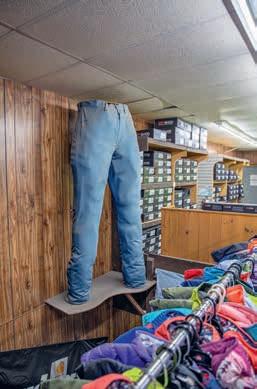
The store carries its own line of Homer-branded jeans, piled high on shelves, but the jeans everyone talks about are one extraordinary pair on the second floor. It seems that back in the mid-1980s, the Wrangler company held a “Guess the Stitches Contest,” featuring an 8-foot-tall pair of its signature denim jeans, measuring from the floor to the ceiling, with a 64-inch waist, pockets, belt loops, and a Wrangler leather patch. Customers were invited to guess how many stitches it took to make the jeans, and the three closest guesses won a free pair of normal-size Wranglers. The “biggest pair of jeans” on display has been a tourist attraction ever since.
Address 11 South Main Street, Homer, NY 13077, +1 (607) 749-3314, www.homermenandboys.com | Getting there From Cortland, follow Route 11 for 3 miles (becomes South Main Street in Homer) | Hours Mon – Wed 8:30am – 6pm, Thu & Fri 8:30am – 7pm, Sat 8:30am – 5pm | Tip It’s a short walk to the birthplace of William Osborn Stoddard, who became Assistant Private Secretary to Abraham Lincoln. Stoddard personally wrote the first draft of the Emancipation Proclamation from the president’s notes (5 Albany Street, Homer, NY 13077).
The Boating Museum
Whatever floats your boat
In the language of the native Iroquois, Keuka means “Canoe Landing,” so it’s not surprising to find the long and storied history of Finger Lakes boating being told right here in the Keuka Lake village of Hammondsport. Native Americans used canoes and other small craft for fishing and transportation before white settlers began building commercial vessels to transport goods to markets around the lakes and beyond.
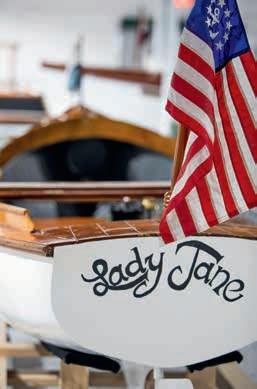
With the demise of the one-time giant Taylor Wine Company, in 1996, the former production complex became available to a group of dedicated antique boat aficionados who worked with New York State’s Department of Education to establish the Finger Lakes Boating Museum. Two floors of the main building are dedicated to exhibit spaces that display a growing collection, including canoes, rowboats, powerboats, sailboats, cruising boats, trout boats, outboard runabouts, hydroplanes, and luxury pleasure boats – more boats than you can shake an oar at – all built either by regional manufacturers or those with local ties.
One of the museum’s on-loan treasures is the Elizabeth Ellen, a 26-foot special launch, built of cypress wood in 1910 by the Faye and Bowen Engine Company in Geneva. Lavishly restored in 2003 with leather-upholstered benches, wicker chairs, and an oriental carpet, it’s on prominent display with a picnic basket inside, imagining its many past outings across the lake.
The Steamboat Room contains two dozen miniature, to-scale steamboats that became a vital part of transportation on the four major lakes for both passengers and cargo from the 1830s until the 1920s. There’s a Motorboat Room, a Rowboat Hall, a Canoe Room, and an active Restoration Shop where volunteers regularly work on a variety of boats. A classroom offers lectures, workshops, and boatsafety programs, and a video theater shows a 13-minute film about the history of boating in the region.
Address 8231 Pleasant Valley Road, Hammondsport, NY 14840, +1 (607) 569-2222, www.flbm.org | Getting there Drive south on Route 54, turn onto South Valley Road, then right onto Pleasant Valley Road | Hours Daily 10am – 5pm | Tip After learning everything you ever wanted to know about boats, book a 90-minute water excursion on Keuka Lake on the Pat II, a 39-foot tour boat, originally built in 1924, and restored at the Finger Lakes Boating Museum (7 Water Street, Hammondsport, NY 14840, pat2boat@flbm.org).
Dutch Schultz Hideout
Prohibition era’s notorious gangster
New York State Senator and president of the Groton Mechanics’ Bank, Benn Conger was on a train to Albany in 1909 when he encountered a fellow passenger with a portable typewriter. Captivated by the ingenuity and potential of the groundbreaking device, Conger bought the patents and manufacturing rights from the inventor and moved the Standard Typewriter Company from New York City to Groton. One of the new company’s first customers was Theodore Roosevelt, who took Model #2 with him on a big game hunting trip to Africa.
With the success of a company now called the Corona Typewriting Company, and with his financial windfall, Conger purchased an 18-acre property in the village, and in 1921, completed building a 10-bedroom Colonial Revival mansion. Sadly, he lived in the home only a few months before his death in early 1922.
Conger’s mansion was later rented to one of the Prohibition era’s most notorious gangsters, Arthur Flegenheimer, better known as Dutch Schultz, a bootlegger who controlled a significant portion of illicit liquor distribution in New York City. Seeking a safe haven outside the city, the “Beer Baron” moved his base of operations to rural Groton where he could manage his criminal enterprises while evading law enforcement efforts to apprehend him. Schultz made millions from his operations, but on the night of October 23, 1935, he was gunned down in Newark’s Palace Chop House tavern along with three of his associates.
Over the following years, the estate has weathered several changes in ownership, first as a private residence, then beginning in 1978, as a bed and breakfast. Following multiple innkeepers over the years, the Benn Conger Inn is currently in the hands of the Brennan family, who welcome guests for overnight accommodations, as well as sightseers captivated by the inn’s rich history and its intriguing connection to the infamous Dutch Schultz.
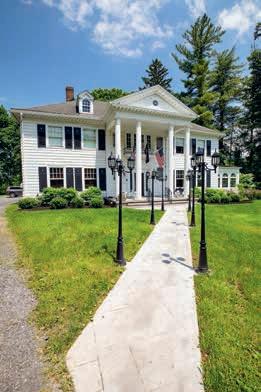
Address 206 West Cortland Street, Groton, NY 13073, +1 (607) 898-5817, www.thebenncongerinn.com | Getting there From Route 13 between Ithaca and Cortland, take Route 38 past Freeville and into Groton, then left onto Cortland Street | Hours By appointment only | Tip The former residence of Joseph “Joe the Barber” Barbara in the sleepy hamlet of Apalachin (one hour away) was the site of a historic organized crime summit in 1957. The estate is now Hidden Farm, a horse boarding and lesson facility (625 McFall Street, Apalachin, NY 13732).
Empire Haven Nudist Park
Naked and unafraid
The Germans call it freikörperkultur, which translates as “free body culture.” It’s a lifestyle that includes communal, open-air nudity as part of enjoying nature. In America, the naturism movement and naturist gatherings began in the 1930s and grew steadily during the 1940s and ’50s.
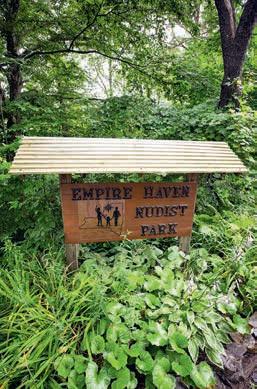
In 1959, George and Mary Robinson purchased 100 acres of rural land, a mix of cow pastures, apple orchards and strawberry fields, and opened Empire Haven, the first nudist park in New York. Located just outside the hamlet of Moravia, the secluded park is now operated by the third generation of the Robinson family. It remains one of the few naturist enclaves in all of the state.
The setting is a gated community, deep in the countryside, with overnight accommodations that range from rental trailers and cabins to a variety of RV sites, many with electric and water hook-ups. For a more nature-immersed experience, adventurers can opt to pitch their own tents in designated areas. Visitors leave their pretenses at the door, along with their clothes. From late spring to early fall, they sunbathe in the open air to acquire borderless tans, swim without bathing suits, play tennis and volleyball without the benefit of uniforms. They relax in the hot tub or sauna, pitch horseshoes, play shuffleboard, or pickleball, and hike along a nature trail. And there’s a snack bar for food in the nude. Nudity is optional everywhere except in the pool area, sauna, and hot tub.
The tranquil and scenic surroundings foster a welcoming, inclusive atmosphere for individuals and families of all backgrounds and ages, encouraging a connection to nature, a sense of community, and a shared, liberating experience. Empire Haven adheres to the philosophy of freikörperkultur, with an emphasis on body positivity and personal comfort. Unwind and undress. Shed your garments, and don’t forget the sunscreen.
Address 5947 Sun Lane, Moravia, NY 13118, +1 (315) 497-0135, www.empirehaven.net |
Getting there From the village of Moravia, follow Skinner Hill Road to Lick Street, then turn right onto Sun Lane | Hours Daily May 15 – Sept 15 Shoulder Season Sun – Sat 9am – 3pm, Memorial Day – Labor Day Sun – Thu 9am – 3pm, Fri & Sat 9am – 5pm | Tip Potter’s Falls, a 25-foot waterfall in Six Mile Gorge, is an unofficial naturist sanctuary in Ithaca. The deep pool below the falls is a popular skinny-dipping hole, and there are rock ledges for nude sunbathing (Giles Street, Ithaca, NY 14850).
Hammerstone School
Women teaching women to build stuff
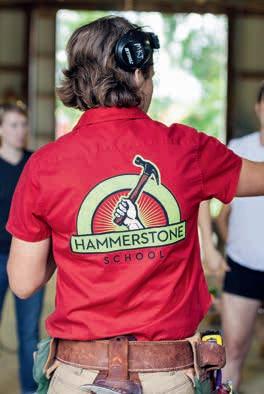
Nestled in an old barn amidst the rolling hills of Trumansburg, Hammerstone is one of the country’s only all-female carpentry schools. Surrounded by apple orchards and clucking chickens, hands-on workshops are taught by women for women, fostering a supportive space for prospects to enter the male-dominated trades.
A feminist fairytale, the Hammerstone School was the brainchild of Maria Klemperer-Johnson. Although she started along the path to a PhD in geology at Cornell, a passion for carpentry drove her to leave studies behind and pursue a career in woodcraft. After collaborating on a project with Liz Coakley, the two craftswomen launched Hammerstone.
Since its beginning in 2013, the school has expanded its staff and curriculum. All the way from Adirondack chairs to tiny houses, aspiring female carpenters learn to construct almost anything at the picturesque workshop. Whether embarking on home renovations or dipping a toe in the carpentry pool, the school serves as a resource for women who are determined to build. The popular two-day basic carpentry class warms up beginners with the fundamental tools of the trade, measuring and marking, using hand- and circular-saws, assembly with screws and nails, and understanding wood as a material. Since courses are offered at sliding-scale tuition rates, the school fulfills a mission of increasing accessibility for all who wish to enter the trades.
While joining the construction world once felt like a towering feat for gender minorities, Hammerstone makes it possible for students to overcome the challenges of the profession. Courses for non-binary learners are offered, while collaboration with Open Doors English and the Youth Farm Project has increased Hammerstone’s reach. The scenic campus disguises an innovative feminist workshop. Within its rustic walls, creative projects are reshaping the landscape of gender equality.
Address 3285 Jacksonville Road, Trumansburg, NY 14886, +1 (607) 280-8513, www.hammerstoneschool.com | Getting there Follow Trumansburg Road north out of Ithaca, turn left on Perry City Road, then left again onto Jacksonville Road | Hours By appointment only | Tip A second location of the Hammerstone School in Ithaca’s West End provides students with accessibility to transit, and the heated space allows teachers to expand programs throughout the entire year (720 West Green Street, Ithaca, NY 14850).
Largest Pancake Griddle
Pass the buckets of maple syrup
Its name contrived from the first letters of “Pennsylvania” and “Yankee,” in 1797, Penn Yan’s water-powered, community gristmill was acquired by an Englishman named Clarence Birkett who created a private merchant mill, purchasing grain from many growers and selling the flour in neighboring villages in the region. After Birkett’s buckwheat flour took first prize at the Paris Exposition of 1887, his products were sought after by grocers across the country. Today, Birkett Mills is one of the largest producers of buckwheat products in the world – buckwheat pancake mixes, cream of buckwheat, and roasted buckwheat (kasha).
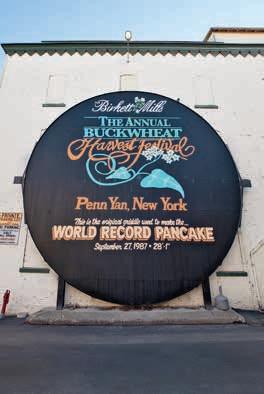
In 1996, Birkett Mills held a first-of-its-kind event called the Buckwheat Festival, with events that included making an underwhelming 10-foot-diameter buckwheat pancake. The following year would be more ambitious, and organizers announced they intended to set a world record. They constructed a 28-foot diameter, 10-ton metal pan to cook the largest pancake the world had ever seen.
On Sunday, September 27, 1987, the giant griddle was placed over a bed of hot stones, while batter ingredients were added one by one into the rotating drum of a cement mixer. After 15 gallons of cooking oil was spread on the griddle, the batter was poured down the chute and spread onto the griddle with rakes as it started cooking. The pancake was lifted into the air and flipped by a 75-ton crane, then topped with a 68-pound pat of butter and 15 gallons of maple syrup. The culinary behemoth was cut into 7,200 portions, and attendees each paid one dollar for a taste of history.
The Guinness Book of World Records certified the making of the World’s Largest Pancake (exceeded seven years later in Manchester, England). The iconic griddle is now a popular roadside attraction, displayed outside the Birkett Mills complex, an absolute must for shutterbugs.
Address 1 East Main Street, Penn Yan, NY 14527, +1 (315) 536-3311, www.thebirkettmills.com | Getting there Follow Route 54 N or Route 54A N to East Main Street in Penn Yan | Hours Mon – Fri 8am – noon & 1 – 4:30pm | Tip After selfies at Birkett Mills, walk a block down Main Street to the Wagner Restaurant, the perfect stop for a heaping plate of, you guessed it, buckwheat pancakes (124 East Elm Street, Penn Yan, NY 14527, www.facebook.com/thewagnerrestaurant).
Motor Racing Center
No speed limit here
Watkins Glen will forever have a place in racing history. It was here, on October 2, 1948, that the first road race was held after World War II. The six-and-a-half-mile circuit ran through the village streets, starting and ending in front of the local courthouse. For 20 years, the world’s best drivers and fastest cars descended on this small Finger Lakes village, and three times beat Monte Carlo and other glamorous Formula One venues to be named the best-organized Grand Prix event of the season. Sports Illustrated described the charm of the Watkins Glen Grand Prix as “courage and cornpone, sophistication with straw in its teeth.”
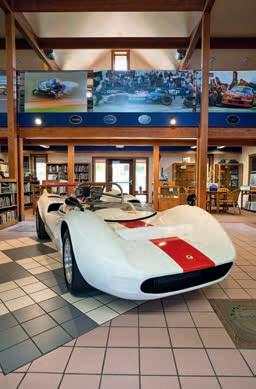
So it’s only natural that the Glen would become home to the International Motor Racing Research Center. Think of it as a museum inside a library. Opened in June 1999 and sharing a building with the public library, the IMRRC has more than 700 individual collections, representing the heritage of amateur and professional motor racing. You’ll find more than 3,800 rare and reference books, over 2,800 cataloged race programs, 4,500 cataloged films, nearly 800 periodical titles, and photographs in the tens of thousands.
Archives include the personal papers of drivers, journalists, and authors, as well as the records and newsletters of clubs and motor racing teams, historical photographs, films, oral histories, and memorabilia. The amount of information available here can seem overwhelming but it’s well organized and easy to access.
The center welcomes both serious researchers and casual fans, and the first thing you’ll see is one of the race cars on loan – it could be anything from an IndyCar to a dragster, a different car nearly every month. Knowledgeable research and archives staff members are on hand to share their passion with all who visit, and you’ll be invited to watch a 25-minute video on racing history in Watkins Glen.
Address 610 South Decatur Street, Watkins Glen, NY 14891, +1 (607) 535-9044, www.racingarchives.org | Getting there From South Franklin Street in downtown Watkins Glen, take Grandview Avenue to South Decatur Street | Hours Mon – Fri 9am – 5pm, some Sat 10am – 4pm during race weekends (check website for details) | Tip A local tour of the Drivers Walk of Fame is a walk through racing history, honoring drivers who competed in those early street races, from 1948 to 1952. The majority of markers are located along the east and west sidewalks of Franklin Street in downtown Watkins Glen.
Shequaga Falls
From the Finger Lakes to the Louvre
Have you ever watched Aurora Teagarden Mysteries on the Hallmark Channel? The story is set in the fictional town of Lawrenceton, Washington, but the opening scene features a shot of one of the Finger Lakes’ most iconic waterfalls.
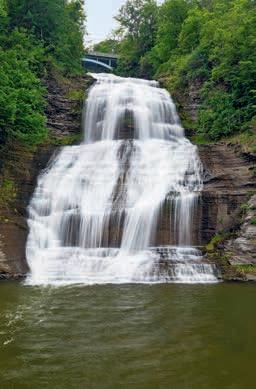
Known as “Tumbling Waters” to the Native Americans, Shequaga Falls is a towering cascade that transforms the serene surroundings of what is now the village of Montour Falls. It starts to tumble from the arch bridge above and fans out, plunging down 156 feet of pale gray limestone and reaching a shallow basin below. The creek then continues on its way to Seneca Lake. Among the hundreds of dramatic waterfalls throughout the region, what makes this one truly notable and worth visiting is a remarkable story that originated during the late 18th century.
In 1796, Prince Louis Philippe, heir to the French throne, arrived in Philadelphia, and after attending the inauguration of John Adams, he visited Mount Vernon, home of newly retired President George Washington. When Louis expressed an interest in exploring the vast landscapes and wilderness of the young country, Washington showed him a map, marking a route that would guide him along the early American frontier.
As a royal, Louis had been tutored in painting and drawing from childhood, and it was his intention to make drawings of the places he visited. His adventure took him through the backwoods of Pennsylvania before following into the untamed Finger Lakes region, and among the many natural wonders he encountered, he was so inspired by the site of Shequaga Falls, Louis felt compelled to capture it on canvas. His sketch and later painting would survive the 1848 Revolution to eventually be housed in the Louvre Museum in Paris.
Your visit here will take you to the “Glorious T,” named for the T-shaped intersection of Genesee and Main Streets, and crowned by the cascading falls.
Ward O’Hara’s Museum
Small town version of the Smithsonian
It all began with Ward O’Hara, gentleman farmer, John Deere farm implement dealer, newspaper columnist, and inveterate collector of farming equipment and farmhouse memorabilia. When the personal collection outgrew his home in Aurelius, he persuaded the Cayuga County Legislature to transform the old pavilion at Emerson Park in Auburn into an agricultural museum, showcasing the evolution of farming practices, machinery, and rural life. Opened to the public as the County Museum in 1975, it was renamed the Ward W. O’Hara Agricultural Museum in 1997.
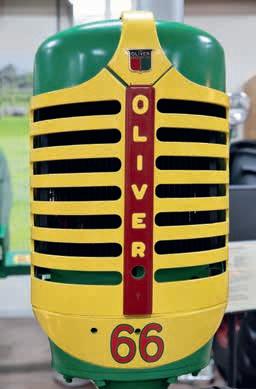
At the entrance there’s a photo of Mr. O’Hara in an Irish flat cap and a display of every John Deere tractor in miniature. Follow along to view hand tools such as plows, scythes, and sickles used by early farmers. A large portion of the museum is dedicated to the display of historical farm machinery, including horse-drawn plows, threshers, tilling equipment, harvesting equipment, and a room filled with tractors of every shape and size. There are themed areas focusing on everyday rural life artifacts, farming household items, old photographs of Main Streets, and full-scale replicas, including a farm kitchen, schoolhouse classroom, blacksmith and woodworking shop, and mortise and tenon barn.
A country store mercantile exhibit has a post office mail sorter and a vintage Toledo counter scale and is stocked with everything from coffee mill and old coffee cans to top hats, straw hats, and bonnets. You’ll also see countless objects of rural American life, including antique pianos, radios, gramophones, Victrolas, sleds, sleighs, buggies, and a milk delivery truck. There’s an enchanting dollhouse display and a circusthemed room overflowing with a stunning collection in miniature.
Allow at least an hour or so to browse through the museum, and don’t miss Ward O’Hara’s own 1927 Ford Model T touring convertible on display.
Address 6880 East Lake Road (Route 38A), Auburn, NY 13021, +1 (315) 252-7644, www.wardwoharaagriculturalmuseum.org | Getting there From Route 20, turn onto Owasco Road / East Lake Road (across from Emerson Park) | Hours Mon – Fri 9am – 5pm, Sat & Sun 11am – 3pm | Tip CNY Living History Center is made up of three different museums –military and local history, the Brockway truck museum, and the Tractors of Yesteryear museum (4386 Route 11, Cortland, NY 13045, www.cnylivinghistory.org).
World’s Fastest Carousel
Round and round we go!
Dr. Edwin Eldridge could not have imagined that the land he donated to the city of Elmira would evolve from a public park, growing with the community’s dreams, eventually transforming into a legendary amusement park filled with thrilling rides and attractions – most notably, a historic carousel that has entertained visitors for most of a century.
Over the years, the city cleared land for a walking trail around the lake, built a picnic pavilion, restaurant, race track, small-gauge train ride through the park, several other rides, and an outdoor stage for live shows. By the 1920s, the “Golden Age” of carousels in America had arrived, and every city wanted one. In 1924, the city of Elmira placed an ad in The New York Times seeking a carousel for Eldridge Park, and Robert A. Long answered the ad.
Long had acquired the original Charles Looff carousel built for Atlantic City’s Million Dollar Pier in 1906 after the pier replaced it with a newer version. He went on to install and manage that carousel at the park, converting 20 of the 54 carousel animals into jumpers. However, by 1988, the ride had deteriorated and the wooden animals were sold at auction.
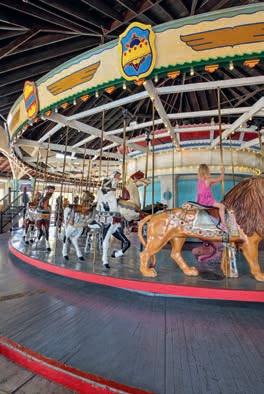
In 2002, the Carousel Preservation Society was formed to revive one of the city’s missing treasures. In an extensive renovation by members of the community, artists hand-carved and hand-painted replicas of the original animals based on vintage photographs. On May 26, 2006, the Eldridge Park carousel once again began rotating, this time with 53 newly carved horses, plus a lion, tiger, and goat. It’s one of only two dozen carousels in America that still features a “ring feeder,” allowing riders to attempt to “grab the brass ring” as they go round and round. The prize is a free repeat ride.
Are you ready to take a spin? As the fastest carousel in the world, it can reach speeds of approximately 18 miles per hour.
Address 96 Eldridge Park Road, Elmira, NY 14901, +1 (607) 732-8440, www.eldridgepark.org | Getting there Follow Clemens Center Parkway (Route 14) north from downtown Elmira to Eldridge Park Road | Hours Park open dawn to dusk year-round; amusement park open Jun – Sep Thu & Fri 5 – 9pm, Sat noon – 9pm, Sun noon – 8pm | Tip
A visit here is the chance to see a life-sized statue that honors the memory of American Girl, installed in 1876, a year after the beloved mare died during a harness race at Eldridge Driving Park. Races ended in 1880, and the track was last used when Buffalo Bill brought his Wild West Show to Elmira in 1883.

Michael Turback is a former restaurateur and saloonkeeper. After studies at Cornell University, he created one of Upstate New York’s first destination restaurants, pioneering farmto-table, vineyard-to-glass, and craft cocktail movements. The Los Angeles Times called Turback’s of Ithaca “the first Finger Lakes restaurant to really devote itself to New York’s culinary and enological bounty.” Michael has journeyed through every corner of the region, and this book, part of a wide-ranging body of work, best reflects his lifelong passion for travel, discovery, and storytelling. www.michaelturback.com

Brian Wilder is a seasoned freelance photographer specializing in advertising, editorial, and corporate work. His visual style and sharp storytelling have earned him the trust of major clients, including AT&T, IKEA, This Old House, Timberland, Titleist, and Volkswagen. He has served as in-house photographer for both Kodak and Fisher-Price and has taught Advertising Photography at the Rochester Institute of Technology. Notable assignments have taken him behind the scenes at the Academy Awards, the People’s Choice Awards, as well as on tour with the PGA. www.bwilder.com
The information in this book was accurate at the time of publication, but it can change at any time. Please confirm the details for the places you’re planning to visit before you head out on your adventures.