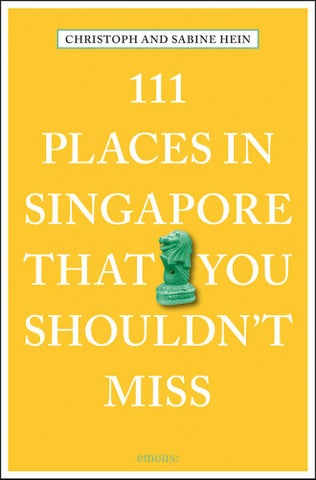
Foreword Yes, we know all of the prejudices. Singapore, the test tube of the tropics. Asia light. A city for beginners, softies and anyone who is afraid of real life and real travel in the Asian jungle. A laboratory city, air-conditioned, guided and directed, boring and what’s more, a ‘fine city’, a city of penalties, where chewing gum is banned. Enough of all that. Singapore is a metropolis that can be proud of what it has to offer. A cosmopolitan city that has plenty to teach us and is prepared to be learnt from. Not everything here actually meets our expectations, but there are many things worth thinking about. The city was and is a melting pot. A place for immigrants and millionaires, settled by seafaring nomads, built by Chinese coolies and Indian prisoners, governed by the British and persecuted by the Japanese in World War II. This hotbed of vice became a world city. The Nobel-prizewinner-in-waiting Einstein looked for money here, the Chinese revolutionary Sun Yat Sen looked for followers and the young photographer Helmut Newton for romance. The city with its population of almost 6 million is a unique melange of newcomers, transients and the descendants of earlier immigrants. They have all brought their cultures with them. Where else in the world do churches, mosques and Hindu temples exist so peacefully side by side? Where else can you find a Chinese takeaway with Michelin stars? Where else is there a cemetery for Japanese prostitutes? And huge dunes behind barbed wire in the middle of the city? Singapore is one of the greenest cities in the world. It is currently reinventing itself with fantastic museums and structures by the best architects in the world. At the same time it has – unlike Hong Kong – learned to respect the old. No longer merely a red dot on the map, Singapore has long since become a leading Asian player. Its secrets are hidden, but not lost. Come with us on a journey to uncover them!
111 Places 1_ ABM Salesroom
Dream cars in a car tower | 10
2_ The Armenian Church
Masterpiece with national flower | 12
3_ Artillery Shell Casing
Singapore’s head gardener | 14
4_ Baba House
The heritage of the Peranakan | 16
5_ The Berlin Wall
The wall is staying put! | 18
6_ The Billiard Table
Wildlife in the jungle city | 20
7_ Black-and-White Houses
Fine living for colonial masters | 22
8_ The Black Elephant
The king’s love of Singapore | 24
9_ Bukit Brown Cemetery
Almost lost to the jungle | 26
10_ Businesswoman’s Mosque
The leaning tower of Singapore | 28
11_ The Cathay Building
Lost facade, lost life | 30
12_ The Changi Mural Copies The forgotten painter | 32
13_ Chan Hou Meng’s Takeaway
A soya chicken reaches for the stars | 34
14_ Chesed-El Synagogue
A home away from home | 36
15_ The Children Sculptures The literary quartet | 38
16_ The Chinese Cultural Centre Dream in three pieces | 40
17_ The Chinese Store Lift to China | 42
18_ The Civilian War Memorial Four towers for eternity | 44
19_ The Club of Songbirds
The tropical bird singing contest | 46
20_ The Coffee Alphabet
First spell, then enjoy | 48
21_ Corner House
Simian treetop scavengers | 50
22_ The David Elias Building
Love under the Star of David | 52
23_ The Duo High Rises Arabian nights | 54
24_ The Durian Stall
A smelly green monster with prickly skin | 56
25_ Einstein Memorial Plaque
First supplicant, then Nobel prizewinner | 58
26_ Eng Aun Tong Factory
The leaping tiger cures the pain | 60
27_ The ERP Gantry
Pay when it beeps | 62
28_ The Former Ford Factory
Two days under the wrong name | 64
29_ The Gandhi Memorial
The final journey of the father of India | 66
30_ The Gate of Hope
Singapore’s baby hatch | 68
31_ The Gate to Knowledge
Three arches, one thought | 70
32_ Glass Dragons
Night work for floral splendour | 72
33_ The Golden Roof
An awning for the National Gallery | 74
34_ The Good Shepherd
A time capsule under the bell tower | 76
35_ Goodwood Park Hotel
The abrupt end of German comfort | 78
36_ The Green Roofs of Tangs
The doors stay closed at Christmas | 80
37_ Harmony in Diversity
Purely a matter of faith | 82
38_ Harry’s Bar
Of speculators and sipping | 84
Address 70 Eu Tong Sen Street, Singapore 059805 (Chinatown) | Getting there MRT to NE 4 / DT 19 Chinatown | Hours Sun – Fri 11am – 9pm, Sat 11am – 10pm | Tip The Spring Court at 52 – 56 Upper Cross Street is the oldest family-run restaurant in Singapore. Chinese dishes have been cooked here to family recipes since 1929.
18__ The Civilian War Memorial Four towers for eternity
It is known as the ‘Chopstick Memorial’. But harmless as the name sounds, the four concrete pillars that tower 68 metres high and are indeed reminiscent of Chinese chopsticks at first sight, form a war memorial of a different kind. With it, Singapore commemorates the civilian victims of the Japanese occupation during World War II. The comparison with chopsticks isn’t at all indecent in Singapore: the two towers of the Takashimaya shopping complex have likewise been compared with them, as have the three towers of the new casino complex, Marina Bay Sands. The pillars of the memorial stand for four ethnicities: Chinese, Malaysian, Indian and other ethnicities, who suffered under the Japanese occupation between 1942 and 1945. The atrocities went as low as displaying the heads of shot civilians in public. It has been estimated that the occupiers killed around 50,000 civilians. In mid-February 1962, five mass graves were discovered in Siglap, later a further 40 were uncovered. For many years Singapore’s Chinese Chamber of Commerce was responsible for maintaining the memory of the victims and for following their stories. After the war, the ashes of those whose remains were picked up in the Changi Prison and in places of execution such as Siglap were laid to rest in a burial chamber under the memorial. The government provided the space for the park in the heart of Singapore and also assumed half of the building costs. The other half was contributed by the Chamber of Commerce. During the inauguration of the memorial in 1963, the now legendary Lee Kuan Yew, prime minister at the time, said: ‘As painful as the past was, we must live and plan for the future, without being hindered by it. We cannot forget, cannot completely forgive, but we can soothe the wounds that eat away at so many hearts.’ 44
Address War Memorial Park, Beach Road, opposite Raffles City, Singapore 068912 (Colonial District) | Getting there MRT to CC 2 Esplanade | Hours Always accessible | Tip Indulge yourself: the Golden Peony restaurant in Conrad Centennial Hotel one street on offers superior Chinese cuisine.
19__ The Club of Songbirds The tropical bird singing contest
One of the most popular pets of the 1960s, the budgerigar, with its mirror and spray of millet, has all but disappeared from our living rooms. But at the Kebun Baru Bird Singing Club, they and many other varieties of songbird are all the rage. Hundreds of elaborately carved birdcages hang up high on poles in a large field between HDB blocks, so that the precious songbirds inside get plenty of air and light. And what a range of feathered friends there is! There’s the shama, which can be very expensive indeed, its value depending on the quality of its song or the frequency of its feather movements while singing. The jambul with its black hood and red patch and white circle under its eyes. The mata puteh, small and very cute, also with a white ring under its eyes. All of them sing beautifully, but the most beautiful song of all is the merbok’s. It can be recognised by the blue of its beak, head and cheeks and the black-and-white-striped ruff. They can cost up to 100,000 Singapore dollars. The birds are brought here by their owners to train their singing from around six in the morning. The greater the number of birds, the more animated they become. The club is at its busiest at the weekend between 10 and 11am, before it gets too hot around noon. There are also big singing competitions, during which over 1,000 poles are occupied. The air is filled with warbling, chirping and tweeting as the judges go from pole to pole, equipped with pen and clipboard, to assess the timbre, length and endurance of the singing. On the days without competition, a meditative tranquility that belongs to the birds and their song alone envelops the field. Even if you find the cages disturbing and would prefer to see birds in their natural habitat, you can’t help but be moved by the symphony of their soft sounds in the wind. And by the dedication of the owners to their pets. 46
62__ Mount Serapong Cannons that don’t shoot
A mountain is, well, a mountain. But not in Singapore. Here, a hill on the island of Sentosa has been elevated to the title of ‘Mount Serapong’. The island doesn’t have many other areas of high ground left after all. But beyond any fraudulent labelling, this hidden corner of the fun island offers adventure. At first, you can only see the satellite installations that Singapore built on Sentosa’s then outermost tip in 1971. Rather more interesting for those who aren’t into telecommunications is the hill itself. Here, behind numerous ‘Do not enter’ signs, you will find the remains of Fort Serapong. From 1879, the British had erected a fortress here to protect the harbour on the other side of the water. It formed a quartet together with the maritime fortresses Fort Siloso, Fort Connaught and Imbiah Battery. Alongside casemates and artillery stands, a connecting tunnel and lookout booths, the British also constructed a chapel for the spiritual well-being of their soldiers up here. There are still living quarters right on the side of the road, built in 1936, that have never been renovated. Locals know the place because of the huge military development carried out under the name Cement Hill. The British gave the essential water reservoir a camouflaged cover: a cement dome that was supposed to look like the summit of a hill. It also served as a lookout. The two heavy cannons were always primed and ready, but never actually fired a single shot in wartime, because the Japanese invaded Singapore by land in 1942. Before they fled, the British blew up the cannons. Two days later the Japanese bombed the hill fortress. What is left behind today are decaying concrete barracks, the rotating platforms for the cannons, rusting steel railings and retaining rings. This is what makes the place so fascinating for photographers and hobby historians alike. 132
Address Woolwich Road, Singapore 098687 (Sentosa) | Getting there MRT to CC 29 / NE 1 HarbourFront, then Sentosa Express to Beach Station, then bus B to Sentosa Pavilion at Eton House, walk towards Serapong Hill Road | Tip Tired of war? Take some time out, be pampered and eat delicious snacks under palm trees at the peaceful So Spa (30 Allanbrooke Road).
Address Along Mount Vernon Road, Singapore 539247 (Paya Lebar) | Getting there MRT to NE 11 Woodleigh, then bus 100 towards Mount Vernon Sanctuary, or CC 12 Bartley | Hours Only viewable from outside | Tip Mount Vernon Sanctuary, a cremation cemetery on a park-like site, will only be a peaceful place for a few more years – until it becomes a new residential area.
64__ Mustafa Centre The world’s shop counter
It is crowded here. Sticky. Chaotic. But there’s nowhere else in Singapore like it. The department store is an institution. And if shopping is an accepted therapy, then this place can even help during the night: Mustafa is open 24 hours a day. You can get everything here and almost everything is very cheap. Watches and jewellery, cosmetics and DVDs, blenders, suitcases, saris, spices, shoes and swimming costumes. But also massage benches, suits for children and motivational posters for your office wall. If China is the factory of the world, then Mustafa Centre is its shop counter. Spread over almost 37,000 square metres of shopping space across four floors, it also offers a restaurant, a travel agent and a bureau de change. It was built to offer the migrant workers in Little India a piece of home, and a one-stop shopping opportunity. When you shop here you can also take out insurance, apply for a visa, book a flight home, or pick up some jewellery for your wife. Just like the Chinese department store Tangs (see ch. 36) in the city centre, Mustafa too has a long tradition: Mustafa Ahmad, together with his son Mustaq – who still manages the shop today – and uncle Samsuddin, opened their first clothes shop in Campbell Lane in 1971. The family migrated from India in the 1950s and began with nothing at all: the father sold food from a barrow, and brought his son over later when his mother died. Mustaq only went to school for four years. But he developed a feeling for business. The Mustafa Centre opened in 1995. The concept worked: Mustaq is one of Singapore’s super-rich with a fortune of more than 250 million U.S. dollars. Electronic devices are particularly popular at Mustafa Centre, but for tourists it’s the food hall that really matters: nowhere else in Singapore is there such a great selection of South Asian spices and gastronomical souvenirs. 136
The authors
Dr Christoph Hein has lived in Singapore, where he works as a correspondent for a newspaper, for 20 years. He loves wandering through the city with his wife Sabine, deciphering its many secrets bit by bit. This is a laborious task – but one they are dedicated to, if they don’t happen to be travelling the rest of Asia with their daughter or enjoying the cold rain of their native Germany. Sabine Hein-Seppeler has lived in Singapore with her husband Christoph for 20 years. The travel book author and newspaper correspondent have long since taken the ‘little red dot’, as Singapore refers to its own place on the map, with the friendliness of its people and the diversity of their cultures, into their hearts. They love wandering through the city, deciphering its many secrets bit by bit. This is a laborious task – but one they are dedicated to, if they don’t happen to be travelling the rest of Asia with their daughter or enjoying the cold rain of their native Germany.