
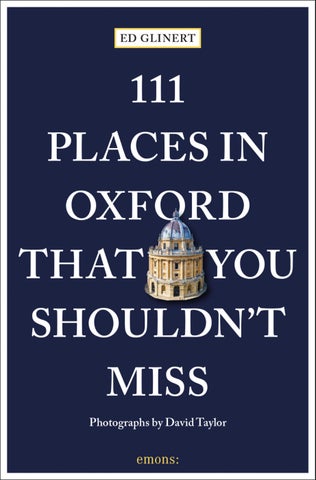
111 Places in Oxford

Page 1


Another Time II

Don’t look now

He stands guard over Broad Street in the heart of Oxford University. He might be making sure than any neophyte Boris Johnsons or Rees-Moggies behave themselves. He is Another Time II, a statue of a nude man standing on the roof of Blackwell’s Art and Poster shop at the corner with Turl Street, frightening passers-by who happen to look up.

Another Time II stands seven feet in his metallic shoes and weighs half a tonne. He is the work of master sculptor Antony Gormley, of Angel of the North fame, who has explained that the figure was inspired by his own physique. No one knows how Another Time II got up there in 2009, well, apart from the 20 workmen who hoisted him, and the crowd that watched the bursar of nearby Exeter College try to align him with Martyrs’ Cross in the middle of the road. As Gormley has explained, ‘The casual passer-by will ask, “What is that naked iron bloke doing up there?”, for which I hope there will never be a single satisfactory answer… It is separated from shelter of the architecture that might otherwise contain it’.

Exeter College was thrilled when an anonymous benefactor provided the funds to secure the figure. A spokesman explained that ‘it is important for the visibility of the sculpture to be positioned close to the parapet of the building’. However, the statue did not arrive without controversy.Ten days before the unveiling, councillors announced that he didn’t have planning permission. Fortunately, the Mayoress allowed the event to go ahead.

But beware. Another Time II is one of a series. Already similar pieces elsewhere have sparked anxious calls to the police fearing someone was about to throw themselves off a building. When rain and water dripped off one of Gormley’s London figures onto a passer-by, she contacted the police to report that someone standing on a building had urinated on her. Check your roofs, folks.

Address 27 Broad Street OX1 3BS | Getting there Bus 6 or 13; Broad Street is a 10-minute walk east from Oxford Station | Hours Accessible 24 hours | Tip Underneath yer man is Blackwell’s well-stocked art and poster shop.

Beating the Bounds

The wall that protects the city from invaders

In case any visiting armies or aliens wish to attack Oxford, the old walls on Queen’s Lane will sort of protect the city from invaders. And just so that nobody forgets, every three years the Lord Mayor of Oxford joins forces with the college’s governing body to stroll through town, repelling marauders, by ‘beating the bounds’– inspecting the walls and marking the boundary stones to make sure they’re doing their job. No stone is left unturned as participants walk up ladders and climb scaffolding while the vicar beats the stones with willow wands shouting: ‘Mark, mark, mark!’

The event has taken place on Ascension Day, the 40th day after Easter, since 1428. Occasionally the bound beaters come across a problem. When they recently headed for the fashion shop Zara to beat the stone in a store area known as the ‘Beat the Bounds room’, they discovered that the shop was now TK Maxx,and were obstructed by two burly security guards. Following some hasty negotiations, the Revd Anthony Buckley persuaded the guards to let them in round the back, after which they hit the stone and left, the staff astounded.

The last stop for Beating the Bounds is at Lincoln College, where at lunchtime the connecting door with Brasenose College is opened to allow in members of the latter.This tradition dates back to a legend that a Brasenose man was pursued by a town mob and murdered at the gates of Lincoln. It became the custom for Lincoln to taint the beer with ground ivy to discourage Brasenose students from partaking of too much hospitality.

By the walls is New College, best known as Alma Mater to the Revd William Spooner, the bizarre late 19th-century cleric. Spooner was notorious for mixing up syllables, the classic being: ‘You have hissed all my mystery lectures and were caught fighting a liar in the quad. You have tasted two whole worms and will leave by the next town drain’.

Address Queen’s Lane OX1 4AR | Getting there Bus 3, 3A, 8 or 10; a 20-minute walk from Oxford Station | Hours Accessible 24 hours | Tip Check out the nearby deconsecrated church of St Peter-in-the-East and the statue of the popular 13th-century preacher St Edmund in the churchyard.

Bill Clinton’s Address

Where he didn’t inhale – but someone did Bill Clinton was president of America from 1993 till 2001. It was a time when US leaders could string a couple of sentences together. He arrived in Oxford as a Rhodes Scholar in 1968 with opposition to the Vietnam War, one of the main things on the minds of all Americans, and soon moved into this charming Jericho terraced house.

Contemporaries continue to gush about their Clintonian experiences. Katherine Gieve, who became a solicitor in London, later recalled how ‘Bill was thinking about people. He made a relationship between abstract ideas and the meaning of people’s experiences’. Oh dear. The novelist Sara Maitland recalled how ‘Bill and his housemate, Frank Aller, took me to a pub in Walton Street in the summer term of 1969 and talked to me about the Vietnam War.When Frank began to describe the napalming of civilians I began to cry. Bill said that feeling bad wasn’t good enough.That was the first time I encountered the idea that liberal sensitivities weren’t enough and you had to do something about such things’. Tragically Aller, also a Rhodes Scholar, committed suicide in 1971, for reasons that may have been related to dodging the draft.

Yet thanks to populist tabloid sensationalist journalism, the only thing anyone wants to hear about regarding the Pres’Oxford sojourn is whether or not he inhaled. And to add grist to the mill, after Clinton left to become governor of Arkansas within 10 years, and later American president for eight years, a mid-1970s resident was Howard Marks, Britain’s most prolific drug dealer!

Nor did it work out too well for Clinton. In 1998 he was impeached by the US House of Representatives on charges of perjury and obstruction of justice, although the Senate exonerated him. However, the charges meant that the Clinton name was besmirched and wife Hilary failed to make the White House. At least America eventually got Donald Trump.

Address 46 Leckford Road OX2 6HY | Getting there Bus 6 or 14 | Hours Viewable from the outside only | Tip Head the short trip east to newby St Antony’s College, forever known as the spy’s college thanks to John le Carré’s Tinker Tailor Soldier Spy novel.

Headington Shark

Don’t go near the roof!

It’s one of the most bizarre animalian sculptures in the country. Jaws devotees come from all over the world to New High Street, Headington, a couple of miles east of Oxford city centre, to check whether it’s really true that the tail of a 26-foot fibreglass shark is sticking out of the roof of a normal house.

The shark first jumped out of the water (possibly the Thames, possibly somewhere off Australia) in August 1986. Bill Heine, an Oxford journalist, came up with the idea while sitting on the doorstep of the house chatting with designer John Buckley over a glass of wine. Buckley designed it and Anton Castiau, a local carpenter, built it. Originally it was given the name Untitled 1986, which hardly did the beast justice.

Inspiration also came as a statement against American warplanes flying from the nearby Upper Heyford air base to bomb Libya in retaliation for terrorist attacks on American troops. With the shark, Heine was making a statement not only against that round of bombing, but against atomic weapons in general. It was appropriately unveiled on the 41st anniversary of the dropping of the A Bomb on Nagasaki in 1986. According to Heine, ‘The shark was to express someone feeling totally impotent and ripping a hole in their roof out of a sense of impotence and anger and desperation. It is saying something about CND, nuclear power, Chernobyl and Nagasaki.’

Oxford Council wasn’t keen and threatened to have it taken down for flouting planning rules.They felt the shark wasn’t in keeping with the elegance and sophistication of one of the world’s most prestigious cities, and ordered it back in the ocean. However, in 2022 they did an about swim and decided to grant the beast heritage status for its ‘special contribution’ to the community. In 2016, Heine’s son Magnus bought the house to preserve the shark and has since run it as an Airbnb guesthouse.

Address 2 New High Street, Headington OX3 7AQ | Getting there Bus 8; the shark is just off the A 420 | Hours Accessible 24 hours | Tip Visit the less dangerous C. S. Lewis home, the Kilns, a mile east, where he wrote all his Narnia books.

Penrose Paving

Do the math

A tiling pattern in the pavement outside Oxford’s Andrew Wiles building is named after Roger Penrose, the famous mathematician who devised the design in the 1970s. The paving is created from two different diamond-shaped granite tiles, each embellished with circular stainless steel arcs. The shape is of kites and darts, and the pattern is aperiodic. In other words, it is not possible to create the tiling by taking a section and repeating it over and over again. The paving was unveiled in 2013 and now has a geometric cousin in a street in Helsinki.

For those of a higher level mathematical bent, the pattern has an ‘inflation property which proves the non-periodicity of any such tiling. If some region could be repeated over and over again to yield the whole tiling, this same region would have to be a period parallelogram for the inflated darts and kites too’. For those not of a mathematical bent, it’s a nice bit of crazy paving.

Roger Penrose, born 1931, is Britain’s leading mathematician and an expert in cosmology. He has long bucked establishment points of view, contradicting his elders with new facts such as claiming that the universe didn’t start with the Big Bang. Penrose shared the 1988 Wolf Prize for Physics with Stephen Hawking, and the 2020 Nobel Prize in Physics after discovering that black holes can predict Einstein’s general theory of relativity. The committee explained how ‘the discoveries of this year’s laureates have broken new ground in the study of compact and supermassive objects’. In his thousand-page tome

The Road to Reality, his masterpiece, Penrose gives an overview of the whole of physics as it stands today.

But if you do bump into him knocking back a swift half in the nearby Jude the Obscure pub, never mind e=mc2, just get him to explain how 1+2+3+4 all the way up to infinity equals negative 1 divided by 12. Yes, really!

Address Andrew Wiles Building, 43 Woodstock Road OX2 6GG | Getting there

Bus 6 or S 6; a 20-minute walk from Oxford Station | Hours Accessible 24 hours | Tip Marvel in awe at the Classical temple that is the nearby Radcliffe Observatory. It was designed in 1794 by James Wyatt of the famous family of architects, who based the tower on Athens’Tower of Winds.

Turn static files into dynamic content formats.
Create a flipbook
111 Places in Oxford by ACC Art Books - Issuu