7__ Beigel Bake
Legendary 24-7 Jewish café
The queues stretch out into the road at what is the most famous and sought after take-away in London, let alone the East End. The service is lightning quick, the prices absurdly cheap, and the shop is open all day, all night, all year. Beigel Bake opened in 1974 when the area still had a Jewish community. The food is in the traditional north European Jewish style, dominated by beigels stuffed with smoked salmon and cream cheese, or what is now almost impossible to find in the capital: authentic salt beef, the portions so vast they fall out of the sandwich. The shop produces some 7,000 beigels a day. There are no tables or chairs for customers, just a long counter along one tiled wall, inviting a quick turnaround. The art of making the beigel is a closely guarded secret, although it can be revealed that the dough is boiled before finally being baked. And watch the beigel maker explain to gullible children how the hole is the most important part. Despite the culinary euphoria, the establishment was involved in a terrible tragedy recently. In August 2017 two members of the owners’ family, Leah Cohen, and her daughter, Hannah, were found stabbed to death in the family home in Golders Green. Astonishingly, the culprit was Leah’s son, Joshua Cohen, 27, who had discovered he had been cut out of the family’s baking fortune only weeks earlier. He was arrested in nearby Golders Hill Park the following day and charged with two counts of murder. Joshua’s late father, Asher, was one of the founders of the shop. When probate was granted on his estate, it named only Cohen’s two older brothers, Nathan, 30, and Daniel, 34, as directors of the company. The judge ruled Joshua unfit to stand trial as he was suffering from paranoid schizophrenia ‘characterised by thought disorder and paranoid delusions.’ He has since been incarcerated at Broadmoor high-security hospital. 22
Address 159 Brick Lane, Spitalfields E1 6SB | Getting there Overground to Shoreditch High Street | Hours Open 24 hours | Tip Brick Lane is as equally well known for its myriad curry houses that stretch the entire length of the street, outside which hopeful staff implore passers-by to try theirs and theirs only.
8__ Ben Truman Chimney When this brewery ruled the ale world
Towering over Brick Lane is the lofty Ben Truman chimney, a reminder of the days when this complex housed the biggest brewery in the world. Although no beer has been brewed here this century, the sprawling buildings have been wonderfully preserved and are now home to myriad stalls, workshops, studios, media company offices, furniture showrooms and food outlets. A Thomas Bucknall built the Black Eagle brewhouse here in 1666, the year of the Great Fire of London. Joseph Truman acquired the brewery in 1679. His son, Benjamin, became so powerful he was able to loan money to the Crown to finance the country’s wars. Thomas Gainsborough even painted his portrait in one of his largest canvasses. Ben Truman brewed a drink that came to be known as porter, thanks to its popularity with the porters of London. The air was filled with the smell of hops and yeast, and workers were welcomed each morning with their own pewter jug that would be filled with two pints of ale. Porter became the first beer to be mass produced, but its popularity was later supplanted by pale ale. Ben Truman’s ales went on to receive the royal blessing, despite an unfortunate incident when the Duchess of Brunswick, a granddaughter of George II, was born in 1737. A barrel ordered by the royal household was found to be of such poor quality revellers threw the beer in each other’s faces and the barrels into the fire. Fortunately for the brewery, the Prince ordered another barrel for the following night ‘with which the populace was pleased and satisfied.’ In the 19th century, Truman’s became Truman, Hanbury and Buxton, and their motifs can still be seen on pub walls throughout the East End. Ben Truman’s brand failed to meet the challenges of the push for ‘real ale’ in the 1970s. The brewery closed in the 1980s, but the brand was revived in 2010 and is now brewed just outside the East End in Hackney Wick. 24
Address 91 Brick Lane, Spitalfields E1 6QR | Getting there Overground to Shoreditch High Street | Hours Accessible 24 hours | Tip Brick Lane now has no pubs, something unthinkable a few generations ago. Yet many of the pub buildings remain, having been converted into curry houses and coffee houses. The nearest pub, just off Brick Lane at 3 Heneage Street, is The Pride of Spitalfields, a throwback to the days of proper pubs.
9__ Bethnal Green Tube Station Disaster Memorial Stairway to heaven replaces stairway to death
The biggest civilian loss of life during World War II occurred at Bethnal Green tube station on 3 March, 1943. The station was not then in use, as it was the first stop on a new extension of the Central Line east of Liverpool Street, but it had been turned into a major air-raid shelter, with more than 5,000 bunk beds and room for 5,000 more people in makeshift set-ups. Unfortunately, entrance was through only one narrow opening, which led to a staircase lit by a single 25-watt bulb, the steps wet from rain. By the beginning of 1943 the worst raids seemed to be over, and only some 250 people were using the Bethnal Green shelter most nights. However, early in March there was a raid on Berlin and the War Office was expecting reprisals. The night before the disaster some 850 people used the shelter. At 8pm on the night of 3 March an air-raid warning sounded and hundreds made for the station. Then came a thunderous sound from the park. People in their panic mused what it could be. Bombs didn’t have that type of sound. Perhaps it was land mines? It was a new type of anti-aircraft salvo, and it led to a stampede at the top of the station, while at the bottom of the steps a girl stumbled. Someone fell on top of her, and someone else on top of them. People at the top pushed, exacerbating the crush at the bottom. One hundred and seventy-eight people died, 62 of them children, mostly suffocating. A further 62 were seriously injured. The government suppressed news of the disaster. Neither the place nor the number of casualties was mentioned in the press. Nazi radio boasted of panic in London from German bombs, the news conveyed to them by fifth columnists in the British Union of Fascists who, ironically, were based in Bethnal Green. 26
Address Top of the south-east entrance to Bethnal Green tube station, west end of Roman Road, Bethnal Green E2 0ET | Getting there Underground to Bethnal Green (Central line); bus 8, 106, 254, 309 or 388 | Hours Accessible 24 hours | Tip At the same junction stands the Salmon and Ball pub, a regular meeting place for the British Union of Fascists in the 1930s. Their HQ, a cowshed just off the Bethnal Green Road, was demolished only as recently as 2016.
10__ Billingsgate Market The carp and sole of the fish world
After centuries of being set by the Tower and the Thames, Billingsgate now occupies this huge site, developed with the very latest technology, at the north end of the Isle of Dogs. A building that was erected in 1982, the market complex covers an area of 13 acres. The ground floor consists of a large trading hall with 98 stands and 30 shops, 2 cafés, cold rooms, a 1,500-tonne freezer, an ice-making plant, and 14 lock-up shops used mainly by catering suppliers and assorted merchants. Each trading day offers buyers the largest selection of fish in the United Kingdom, thanks to daily arrivals from the coast by road from ports as far afield as Aberdeen and Cornwall. With around 40 merchants trading in close proximity, competition is fierce. There’s even a training school at Billingsgate supported by the City of London Corporation and the Worshipful Company of Fishmongers aimed at encouraging young people to enjoy seafood as part of a healthy diet, established at a time when obesity levels began to soar and fish consumption was on the decline. Billingsgate was established formally by an Act of Parliament in 1699. By the mid-19th century it consisted only of shed buildings by Billingsgate Dock, with a range of wooden houses and little shelter until successive extensions and improvements. Boats delivered fish to a small inlet of the Thames and business took place on the quayside. The City of London Corporation still runs the market and pays an annual ground rent, stipulated in an agreement between the latter and Tower Hamlets Council, of ‘the gift of one fish.’ Past workers here include the Kray twins. Reggie worked as a salesman while Ronnie’s job was collecting empty fish boxes. The traders still use the infamously coarse curses that once made the word ‘Billingsgate’ a byword for crude and vulgar language, as used historically by ‘fishwives’. 28
Address Trafalgar Way, Poplar E14 5ST | Getting there Underground to Canary Wharf ( Jubilee line); Overground to Canary Wharf Crossrail | Hours Tue – Sat 5 – 8.30am, closed Tuesdays following a Bank Holiday Monday | Tip If you can’t manage Billingsgate’s extraordinarily early hours, there’s always Ernie’s Snack Bar, a small white van, dispensing food and drink to the office and construction workers, tucked away behind offices off Marsh Wall. Ernie Bennett who began the venture was Canary Wharf ’s first retailer when Olympia & York started the Canary Wharf development.
63__ Olympic Bell
Immense silent bell created for the 2012 Olympics
The world’s largest harmonically-tuned bell sits in Queen Elizabeth Park next to the Olympic London stadium, now home of West Ham United. The bell was created for the 2012 London Olympic Games. It is made of bronze, stands over 2 metres high, with a diameter of 3.3 metres, and weighs more than 22 tons. The bell is the second heaviest in Europe, after St Petersglocke in Cologne Cathedral. It is inscribed Be not afeard. The isle is full of noises from Caliban’s speech in Shakespeare’s The Tempest. The (now sadly shut) Whitechapel Bell Foundry was supposed to construct the bell, but when their workings were found to have insufficient capacity it was sub-contracted to Royal Eijsbouts in Holland. Understandably there was some controversy about using a non-British firm. The programme for the Olympic opening ceremony on Friday 27 July noted how ‘bells ring out the changes of our days. They call us to wake, to pray, to work, to arms, to feast and, in times of crisis, to come together. Anyone born within hearing of the Bells of St Maryle-Bow in Cheapside [in the City, not in the East End] has the right to call themselves “Cockney”.’ The bell was rung at the start of the opening ceremony by Bradley Wiggins who had just won the Tour de France. Wiggins’ action was symbolic; the hammer moved mechanically. Or as one journalist noted: ‘He may be a superhuman athlete but even Bradley Wiggins isn’t capable of setting the Olympic Bell’s monumental half-ton clapper in motion by hand!’ The bell was also rung just before Paul McCartney sang ‘Hey Jude’, the ex-Beatle blaming his faltering start on the bell’s unexpectedly loud sound. Sadly, it now seems that because the bell is so loud it will probably never be rung again. Wags have suggested that if it is to be rung only sparingly, it should do so for significant local events, such as when West Ham win the Premiership. 134
Address Queen Elizabeth Olympic Park, Stratford E20 2ST | Getting there Underground (Central and Jubilee lines), DLR and Overground to Stratford | Hours Accessible 24 hours | Tip The Bow Bells pub a mile south does not refer to the bells within whose sound a cockney is born. Those bells are in the City of London, not the East End.
Address Poplar E14 0JW | Getting there East India DLR | Hours Accessible 24 hours | Tip Fascinating exploration is to be had just to the west searching for remnants of the mostly filled-in East India Docks with a suitable OS map.
65__ Peasants’ Revolt Reminder Where the king met the people
The White Hart pub, one of the few left locally, is built on the site of where the 14-year-old king, Richard II, rode out to Mile End in 1381 to negotiate with the leaders of the Peasants’ Revolt. The infamous revolt had started east of London on 30 May, 1381 when the king tried to levy a tax – a poll tax – on all the population to make up for the cost of his unsuccessful war against France. But the peasants were not just protesting against the government. There was general discontent following the Black Death epidemic of 1348. It had led to a shortage of workers. Wages rose but Parliament set a maximum wage. The radical priest, John Ball, enthused people, demanding that all men should be free and equal, and that wealth should be distributed more fairly. In a famous sermon he asked: ‘When Adam delved and Eve span, who was then the gentleman?’ As the peasants, led by Wat Tyler, streamed into London, the king took to the Tower for safety. This didn’t stop the rebels entering the building, killing the Lord Chancellor and the Lord High Treasurer. On 14 June, Richard met the rebels at Mile End and agreed to most of their demands. The next day the king met Tyler and the rebels at Smithfield in the City. Violence broke out, and Ralph de Standish, a servant of the king, killed Tyler as Sir John Newton, another servant, called him ‘the greatest thief and robber in all Kent.’ To defuse the situation, Richard promised to abolish serfdom. The peasants dispersed, but government men toured the villages hanging men who had taken part in the Revolt. Although the Revolt failed, its demands, for freedom, equality and money to the poor, were later accepted. Richard II used as his symbol the white hart, a very rare beast, often associated in pageantry with Jesus Christ. The name of the beast fitted as a pun on his name Richard: rich heart/white hart. 138
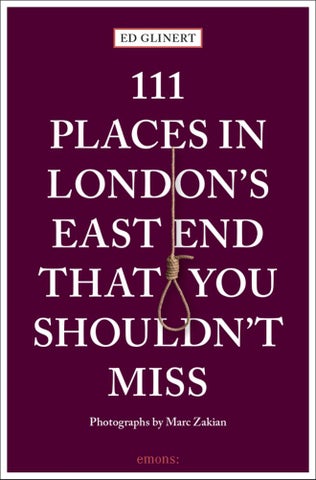
Ed Glinert was born in Dalston, two miles from the East End. He studied Maths and Classical Hebrew at Manchester University, but not at the same time. He worked for Private Eye magazine for more than 10 years, and has written a number of books for major publishers including The London Compendium and East End Chronicles for Penguin. He is one of Britain’s most prolific tour guides, working in London, Manchester and Liverpool, and gives talks on cruise ships. He knows who was responsible for the Jack the Ripper murders.
Marc Zakian is a photographer and writer. His images have appeared in newspapers and magazines across the world, including The Guardian, The Daily Telegraph, The Times, Condé Nast Traveller and DK Guides. He is also the editor of The Guide magazine. Marc has lived in Dalston, in east London, for nearly 30 years, photographing its transformation from down-at-heel cityscape to hipster hot spot.