Brixton Market
An explosion of colours and flavours
Brixton has had its ups and downs. In the late 19th century it was a prosperous district. It then became a working-class area, and after the Second World War had an Afro-Caribbean population. The first Jamaicans came straight from their ship to temporary accommodation in a bomb shelter in 1948, and the nearest job exchange was in Brixton, which today is a mixed quarter with immigrants from different continents, including Africa and South America. At times Brixton has had a reputation for drug-related crime. These issues have not disappeared, but in recent years the district has shown its strengths, including a creative cultural scene and vibrant markets.
Parading Rastafarian dreadlocks, headscarves and African or Asian robes, the traders and their customers are visibly part of a multicultural quarter. The products are equally diverse: yams, plantains and manioc, dried fish from West Africa, religious items from Haiti, Chinese herbs, huge cooking pots, metal bins filled with brooms and mops. On Brixton Road lies the art deco entrance to Reliance Arcade, a narrow passageway filled from end to end with tiny hairdressers’ salons, where women have their hair elaborately plaited and styled. At the end of this arcade you cross Electric Lane to reach Market Row, and beyond this is the brightly painted Brixton Village market hall. Here salsa music booms out from a Columbian butcher’s stand, while other stalls rock to the sounds of reggae and soul.
Gentrification has begun: shops selling designer items and vintage fashion have moved in, and trendy world-cuisine eateries have opened, offering sourdough pizza and gourmet burgers, but also down-to-earth meals of Jamaican curry and Chinese dumplings. The adjacent Electric Avenue, too, is a colourful market street, where Rasta-look clothes in bright colours bearing the face of Bob Marley are on sale.


Address Electric Avenue, SW9 8JX, www.brixtonvillage.com | Getting there Overground or Victoria Line to Brixton | Hours Mon 8am – 6pm, Tue – Sun 8am – midnight | Tip On the other side of the railway arches, via Pope’s Road, is Pop Brixton – a cool containerbuilt village for creative start-ups, market stalls, street food, cocktails and live music (Sun noon – 11pm, Thu – Sat until midnight, www.popbrixton.org).

Edgware Road
‘Little Beirut’ in London
London, where a third of the population was born abroad, is probably more multicultural than any city in the world apart from New York. The faces, clothing and languages spoken make it obvious that dozens of different ethnic groups live here. Some concentrate in a particular area – east Africans in North Kensington, for example, Turks in Dalston. European and English-speaking immigrants also have their favourite quarters. Five per cent of the residents in Chelsea are US citizens, and a Cypriot community has congregated in Camberwell. Lovers of Portuguese food head for South Lambeth Road, and those who like Arab cooking are spoiled for choice on Edgware Road.
At its southern end near Marble Arch, expensive Lebanese restaurants put on live music and belly-dancing. Further out, north of Edgware Road Tube station, a simpler style takes over. Syrians and Iraqis run grocery stores and eateries with plain furnishings that serve delicious meals for a low price. Newsagents sell Arabic newspapers, fashion outlets cater for ladies who prefer to reveal little, and numerous TV screens show the latest football match from Egypt or the news from Al Jazeera channel. When the weather is fine, cafés put shisha pipes out on the pavement.
Arabs trading with the Ottoman Empire settled in this area 100 years ago. In the 1950s, many Egyptians arrived, and since then every crisis in the Middle East has brought more immigrants. Lebanese and Palestinians fled from war, Algerians from violent civil unrest, Syrians and Iraqis from recent horrors in their region. While rich Arabs in search of sound investments and desirable residences have bought property in Knightsbridge – although the Egyptian Mohamed al-Fayed no longer owns Harrods – and Mayfair, to enjoy some Arab atmosphere, avoid these haunts of the super-rich and walk across Hyde Park to Edgware Road.


Address Edgware Road, W2 2HZ: walk north-west from Marble Arch | Getting there Tube to Edgware Road (Circle, District Line) | Tip 100 m west of Edgware Road, close to the A 40 flyover, lies Paddington Basin. From here you can walk along the canal to the houseboats at Little Venice.
God’s Own Junkyard
Rolling Scones and an assault on the eyeballs
Walthamstow lies far out in the north-east of Greater London, but the trip takes only 20 minutes from the West End by Tube, and is rewarded by an astonishing spectacle, an explosion of colour. The home of God’s Own Junkyard is a modest factory hall on an industrial estate. Inside the hall, every corner is crammed full of bright neon signs. Winking and flashing advertisements for restaurants, nightclubs, bars and motels adorn every wall, and are reflected in disco mirror-balls. They promise all kinds of services, from sushi to ‘beer, girls and porn’. This is not a museum, but a showroom for collectors, and thousands more examples of neon art await purchasers in storerooms. A 20-strong team of restorers puts the sparkle back into old neon signs and also makes new ones – a craft that few people master in the age of LED lighting, as it requires a great deal of skill to bend the glass tubes.
Dick Bracey founded the company in the 1950s. His son, Chris, became a true artist in neon, producing eye-catching and creative signs in the 1960s. Many were commissioned for the sex and striptease clubs of Soho in its seedy days, and a few were made for Hollywood films, including Blade Runner, and Stanley Kubrick’s Eyes Wide Shut. Chris Bracey’s works became collectors’ items, finding purchasers said to include Lady Gaga and Elton John.
The fitting acoustic background to these garish wares is rock music. It entertains customers at the tables of the Rolling Scones Café, which have been squeezed in between the neon exhibits. In these surroundings, a desire for something stronger than afternoon tea is understandable, so cocktails are served, and in neighbouring units on the estate two craft beer breweries and a gin distillery have set up shop. All are open at weekends, approximately at the same times as the Junkyard, turning this gritty corner of Walthamstow into an extremely trendy scene.


Address Unit 12, Ravenswood Industrial Estate, Shernhall Street, E17 9HQ, www.godsownjunkyard.co.uk | Getting there Tube to Walthamstow Central (Victoria Line), turn right at the exit, cross Hoe Street, straight ahead along St Mary Road and Church Path, right into Orford Road, left into Summit Road, and to the metal gate at the end; it’s about a 12-minute walk | Hours Fri & Sat 11am – 10pm, Sun 11am – 6pm | Tip The walk to the Junkyard passes the old village centre of Walthamstow with its church, a 15th-century half-timbered house, and the Vestry House Museum, where the first British-made petroldriven car, from 1894, is displayed.
The K2 Telephone Kiosk
The prototype of a famous design
Behind the wrought-iron gates of the Royal Academy of Arts stands the very first example of the red telephone box called K2. This oneoff item was made of wood for a competition in 1924, as the earlier model, K1, had been rejected.
The designer of K2 was Giles Gilbert Scott (1880 – 1960), a scion of a well-known dynasty of architects. At the age of 22, he was awarded the commission to build the Anglican Cathedral in Liverpool, and has a strong presence on the Thames with his two unmistakable power stations at Bankside (now the Tate Modern) and Battersea. For the miniature architecture of the phone box, Scott turned to the formal repertoire of classical building. His careful design gave it a shallow dome and fluted window frames. For the colour, he proposed silver, but the General Post Office opted for red and installed 1,700 steel-built K2 phone kiosks, one of which stands opposite the prototype. The 200 surviving K2s are all protected monuments.
With its height of 2.74 metres and a weight of 1250 kilos, K2 was too expensive, but alternatives made of concrete (K3), with a built-in stamp vending machine (K4) and of plywood (K5) failed to catch on. In 1935, Scott produced a simplified version: K6, 30 centimetres shorter and 500 kilos lighter than K2, with a teak door; 60,000 of them were manufactured. K6 is plainer and has eight rows of windows on each side, with the middle window in each row wider (K2 has six rows of three windows, all the same size). K6 became a design classic, so popular that its successor, K8, did not appear until 1968. Around 11,000 K6 boxes still stand in Britain, and a considerable number can be seen abroad; 2,260 of them are listed heritage structures. They are not all identical. Look out for the crown in the pediment: since 1953 it has been a depiction of St Edward’s Crown, the one used for coronations, rather than a stylised ‘Tudor’ crown.


Address Burlington House, Piccadilly, W1J 0BD | Getting there Tube to Piccadilly Circus (Bakerloo, Piccadilly Line) | Tip The Royal Academy of Arts founded in 1768 has its own art collection and puts on outstanding changing exhibitions. Its cafés are good places to take a break.
Limehouse Basin
Post-industrial London
Canals played an important part in the early stages of the Industrial Revolution. The construction of Limehouse Cut began in 1766, enabling traffic from the River Lea, which flows into the Thames from the north, to reach the quays in the City of London more directly. The Regent’s Canal, a long arc around the north side of central London, opened in 1816, transporting goods that had come along the Grand Union Canal from the Midlands to the harbour basin in Limehouse. This linked the entire network of English canals and navigable rivers to the London docks on the Thames, and thus to the world’s biggest port and its global trade.
Today, boats can still pass along Limehouse Cut and the Regent’s Canal to the old dock that is now called Limehouse Basin, but freight transport on these routes came to an end in 1969. The quays and warehouses fell into decay until the redevelopment of the whole huge area of London’s Docklands began. New housing was built from 1993 onwards, and a declining area with a bad reputation gradually became fashionable. Limehouse Basin now provides moorings for expensive motorboats, ocean-going yachts, a few historic sailing barges and a number of narrowboats – the gaily painted traditional vessels of the canals.
Expensive flats, cafés and shops now occupy sites where coal from the north-east of England or wood from Finland and Norway was once unloaded. In the north-eastern corner of the basin stands a relic of the days of goods transport: the brick accumulator tower, built in 1869 to power hydraulic cranes, swing bridges and lock gates. The celebrity chef Gordon Ramsey operates a restaurant next to the lock gate, offering diners a view of the Thames from the terrace – a scene of modern urban life, though not entirely without natural features, as cormorants, herons and even kingfishers join Ramsey’s customers here to enjoy some fish.

Address Narrow Street, E14 8DP | Getting there Overground and DLR to Limehouse | Tip At Bread Street Kitchen you can find out whether Gordon Ramsey’s restaurant lives up to his own reputation – without breaking the bank (44 Narrow Street, +44 (0)207 592 7950, www.gordonramsayrestaurants.com).
Orbit
An observation tower on the Olympic site
The 2012 Olympic Games were planned on the principle that the biggest party ever held in London should not be followed by a hangover. Instead of leaving decaying, unused stadiums, which were the legacy of mega-events in Athens, Beijing and South Africa, the intention was to transform industrial wasteland into a large park on the banks of the River Lea, business and entertainment districts and pleasant residential areas. The sports venues were partly dismantled after the Olympics, leaving a downsized aquatics centre, the velodrome and the main stadium, which became the new home of West Ham United FC. Up to 6,800 homes in five new districts are to be built by 2030 – and in the middle of all this stands an eyecatching visitor attraction, a sculpture 115 metres high that doubles as a viewing tower.
The tower, produced through a collaboration of the engineer Cecil Balmond and the artist Anish Kapoor, is officially called ArcelorMittal Orbit. The billionaire Lakshmi Mittal made a large contribution, including steel that his company produced with 60 per cent recycled content in accordance with the Olympic project’s declared aim of sustainability. The structure looks like a white-knuckle looping ride, made of red tubular steel wrapped around a central support. Two viewing platforms at the top present a 30-kilometre panorama across the whole of London for up to 5,000 visitors daily. They can descend via 455 steps circling around the main pillar with a view of the sculptural forms, or take a 40-second, adrenalin-kick orbit on a 178-metre-long slide – or sedately use the lift.
Critics have variously damned this ‘snake that swallowed a broomstick’ and ‘vainglorious sub-industrial steel gigantism’, or praised its organic shape as ‘a network of bulging red arteries’ and ‘a generous drunken party animal’. The popularity of Orbit as a viewpoint suggests that the party has successfully been held without a hangover.


Address South Plaza, Queen Elizabeth Olympic Park, E20, www.zipworld.co.uk/ adventures/arcelormittal-orbit-360 | Getting there DLR or Tube to Stratford (Central, Jubilee Line) | Hours See website for the latest information and to book tickets | Tip Visitors can hire a pedalo or a kayak in the Queen Elizabeth Park or take a boat tour: www.queenelizabetholympicpark.co.uk.
Peckham Levels
A car park, garish and creative
What do you do with a huge multi-storey car park when it becomes surplus to requirements? Imaginative repurposing or demolition? The former option was chosen in Peckham, a district notable – even by the standards of London – for its ethnic diversity: around half of the area’s residents have African or Caribbean heritage. Immigrants from Eastern Europe, China, Vietnam and South Asia are also well represented, alongside their white British counterparts.
Some parts of Peckham have become hip and affluent. The first sign that things were happening in the area was the opening in 2000 of the library, a post-modern structure that earned its architect, Will Alsop, the Stirling Prize – the most prestigious British award in this field. In 2009, Frank’s Cafe opened on the roof of the redundant car park, attracting a young crowd during the summer months. Trendy cocktails at sunset with a stunning view of Alsop’s library and the skyline of the City of London were and remain to this day irresistible attractions.
The car-parking storeys beneath the cafe were transformed into the Peckham Levels, a project to promote local creative enterprises. Levels 1 to 4 are home to more than 80 small businesses, start-ups of all stripes, ranging from jewellery and fashion designers and architects to a ceramics studio open to all potters who need a kiln and a wide range of health, mental health and beauty services. The dimensions of the former parking spaces determine the layout of the co-working offices and studios that now occupy them.
Garishly painted stairwells lead up to the public levels 5 and 6, where mirrored glass and murals create a highly colourful environment. On level 5, the bar, coffee shop and restaurant named Multi Story serves morning coffee, lunches, evening meals and cocktails, with pool tables and cultural events thrown in. At weekends and late into the evening, dance classes, exhibitions, markets and live music breathe life into the old concrete construction.


Address 95A Rye Lane, SE15 4ST, www.peckhamlevels.org | Getting there Train to Peckham Rye (16 minutes from London Bridge), left into Rye Lane and across the road; the entrance is to the right of the Peckhamplex cinema | Hours Wed – Fri 9am – midnight, Sat noon – midnight, Sun noon – 10pm | Tip Meals from Senegal and the Caribbean, food from South America and Africa, and clothes from all over the world are sold at Rye Lane Market (ryelanemarket.com, daily 10am – 6pm).
The Ropewalk
Street food from the railway arches
Bermondsey, once an industrial district, has not shaken off its working-class character, but it is changing. Although the wide railway viaduct that has sliced through the area since 1839 is anything but pretty, its miles of brick arches are useful – for storage space or car repair shops, and in recent years for producing, cooking and serving interesting food. An alley next to the tracks has become trendy for street food at weekends. Some of the stalls are run by chefs and producers who once supplied the better-known Borough Market but were looking for a smaller, higher-class event. The official name is Maltby Street Market, but the stalls are in The Ropewalk, a strip of land where ropes were once made. Around 25 stands line one side of the alley, and further eateries occupy the deep railway arches on the other side.
The organisers’ stated aim is to offer quality and variety. The aromas of Ethiopia, Lebanon and Morocco waft on the air. Venezuelan arepas are made from white corn flour with various fillings. Europe is represented by Greek mezes and Sicilian arancini. British treats are also on offer, for example excellent beefsteaks and oysters from Maldon. Given that porridge and Scotch eggs were taken upmarket for foodies long ago, fans of those staples of down-to-earth home or pub catering need not go hungry. And no one who sticks to a vegan, gluten-free or lactose-free diet will feel discriminated against. There are also indulgences such as hot waffles and calorie-rich brownies.
As for beverages, healthy options such as vegetable juice are sold alongside alcoholic drinks that are as hip as the Londoners who come here: craft beer and cider are made in microbreweries in the brick arches, the Little Bird gin distillery serves its creative cocktails, and the flavours of Spain are on offer at the Bodega Tozino, which serves jamón to accompany its wines.


Address Ropewalk, between Maltby Street and Millstream Road, SE1 3PA, www.maltbystreetmarket.co.uk | Getting there From London Bridge Station walk parallel to the viaduct along St Thomas Street, then follow Crucifix Lane and Druid Street to Tanner Street, and pass under the bridge to Maltby Street | Hours Sat 10am – 5pm, Sun 11am – 4pm | Tip Little more than a five-minute walk away is a gallery renowned for contemporary art: the White Cube Gallery at 144 Bermondsey Street (from Maltby Street via Tanner Street, www.whitecube.com).
Shoreditch Street Art
Legal or illegal, subversive or sponsored
The transformation of Shoreditch from run-down to hip began in the 1980s, when artists set up studios in vacant commercial properties. Cool bars and nightclubs followed in their wake, and start-ups from the IT sector clustered around Old Street. As rents rose in the new millennium, many artists moved further east, and in recent years sleek new buildings have appeared. For the time being, Shoreditch remains a zone of transition between the City and points east, a place of galleries, unconventional designer shops and creative street art.
To the east of Shoreditch High Street, artists from all over the world have made their mark on walls and doors. On some streets, almost every available space has been pasted, painted freehand, sprayed using templates or adorned with little sculptures. Internationally known street artists have worked here: Banksy inevitably, Space Invader and Roa, who paints outsized animals – in Shoreditch a bird four storeys high. Some operate with the permission of the house owners, others illegally. Some studied at art school, others emerged self-taught from the graffiti scene. Some are sponsored by galleries that use attention-grabbing street art as publicity for their exhibitions, others oppose the art business on principle. One sprayer receives a lucrative commission, another is summoned for a court appearance.
Street art is a wildly creative cosmos of humorous, political or poetic work that is constantly renewed. Some works are quickly ruined by tags and low-grade graffiti, then painted over within a few weeks. The painting on the right, juxtaposing a British ultranationalist with a Muslim preacher of hate, has already disappeared. Work by respected artists may stay untouched for a long time, or even be repaired by supporters if it is defaced. And if all of Shoreditch becomes chic, never mind: street art thrives in many parts of London.


Address Between Shoreditch High Street and Brick Lane, E1 | Getting there Tube to Liverpool Street (Central, Circle, Hammersmith & City, Metropolitan Line) | Tip Not hip, but never out of fashion: excellent traditional fish and chips at Poppies (6 – 8 Hanbury Street, Sun – Wed 11am – 10pm, Thu – Sat 11am – 11pm).

The White Building
Art and pizza by the canal
On the east bank of the canal, in Queen Elizabeth Park, site of the 2012 Olympic Games, everything has been carefully planned: paths, playgrounds, works of art, lawns and flower beds, sports facilities. Although this has been well done, it is a liberating feeling to cross the old bridge to the less orderly, more creative district of Hackney Wick, where the grass grows as it pleases from cracks in the paving and art is not necessarily the result of a public commission, but appears overnight on the walls.
Where White Post Lane crosses the canal, Clarnico, a maker of mint creams and chocolate, built a roasting plant for cocoa beans in 1897. Later a printworks moved in. In the new millennium it became The White Building, a ‘creative lab’ with event spaces, studios and residencies for artists who explored the themes of technology and sustainability. The Crate Brewery installed its tap room and pizzeria on the ground floor, furnishing the space with recycled materials. The bar is made from railway sleepers, the benches from pallets. Scaffolding planks were used to make tables, bed springs for the lamp fittings. Here in hipster Hackney the brewery produces, needless to say, a range of craft beers, from IPA to stout. They are just right for washing down pizza in trendy flavours such as sage and truffle, or Kashmiri with Indian spices. Guests can dine on the terrace or drink cocktails on a canal boat while they watch passing paddleboarders and look across the water to sprayed art on the wall of another surviving part of the Clarnico factory.
For really thirsty drinkers, around the corner is the Howling Hops Tank Bar, where the beer is tapped direct from a row of tanks. And the theme of green lifestyle continues a short distance north along the canal path at an ‘experiment in sustainable and ethical business’ named Grow, an arts venue that supports local musicians and other performers, with a bar and restaurant serving fusion cuisine.


Address Unit 7, Queens Yard, Hackney Wick, E9 5EN; Crate Brewery, +44 (0)754 769 5841, www.cratebrewery.com | Getting there Overground to Hackney Wick, then five minutes’ walk via White Post Lane | Hours Crate Brewery Sun – Thu noon – 11pm, Fri – Sat until 1am | Tip On the other side of the canal, Moo Canoes hires out boats painted in the colours of Frisian cows. www.moocanoes.com

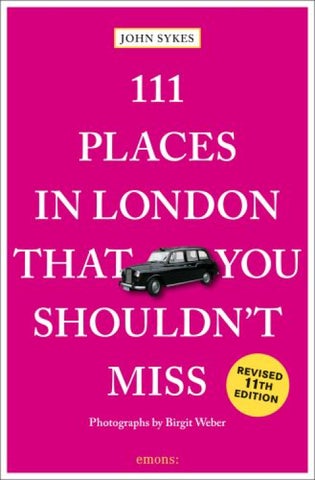
John Sykes was born in Southport, Lancashire, studied in Oxford and Manchester and lived in London before moving to Germany and making his home in Cologne. He has written and translated books about London and is the author of several travel guides about the British Isles.

Birgit Weber studied in Aachen and lives in Cologne. She works on various book projects, mainly about London. She has been travelling to the UK for over 30 years and is regularly in London. The city fascinates her every time, because there is always something new to discover.
The information in this book was accurate at the time of publication, but it can change at any time. Please confirm the details for the places you’re planning to visit before you head out on your adventures.