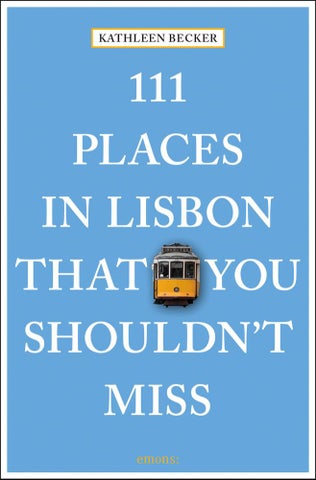
Foreword The Portuguese capital is no longer a secret for insiders: its picturesque location on the wide river Tejo (Tagus), the famous light of Lisboa, old and new rubbing shoulders, azulejo tiles on all sides, friendly restaurants and a lively café culture. After decades of neglect, the city centre of Lisbon is now flourishing again. Restoration is going on everywhere, and the city’s traditional, slightly fatalistic melancholy with a background of fado music is being overlaid by a mood of creative renewal, innovative projects for tourism and cool street art. Add to this the colourfully diverse street scene: in recent years Brazilians and Africans, part of the heritage of colonial times, have been joined by shopkeepers from South East Asia, Ukrainian construction workers, French property investors and holidaymakers from cruise ships. With an urban structure that has developed organically, hidden treasures behind peeling façades and a tendency to surreal contrasts, Lisbon is also the ideal city for the 111 Places concept. It has places off the beaten tourist track, out of sight of selfie sticks and away from the activities of brazen pickpockets. Places where you meet the locals. Concealed historic sites that narrate 2,500 years of city history. Religious places: Lisboetas may no longer be assiduous church-goers, but their places of worship are sources of fascinating tales and histories. Unknown miradouros command ‘golden views’, and Lisbon’s green spaces are enchanting, as half a millennium of colonisation and exploration gave Portugal surprising botanical diversity. The curious places in the city range from tiny shops and hidden sites of working-class culture to obscure locations connected with medical history, unexpected spots for art, adrenalin-soaked sporting venues and unusual ‘conveniences’ for people with an urgent need. As the Portuguese say: Bora! Let’s go!
111 Places 1_ The 40 Water Jets
In Portugal’s oldest botanical garden | 10
2_ The Amoreiras Towers
Postmodern shopping | 12
3_ The Animatograph
From cinema history pioneer to striptease joint | 14
4_ Armazém Xangó
A store for white magic and bright colours | 16
5_ Bairro Padre Cruz
Street art on social housing | 18
6_ Beau Séjour Palace
A place to study the spirit of Lisbon | 20
7_ Belenenses Stadium
The home of football in Belém | 22
8_ The British Cemetery RIP in Lisbon | 24
9_ Bugio Lighthouse
Where the Atlantic begins | 26
10_ Bullfight Arena
Tauromachy and more | 28
11_ Café Gelo
Secret café society | 30
12_ Camões Car Park
Pomp, prostitution, parking | 32
13_ The Capuchin Chapel
Raise your arms to the Lord | 34
14_ The Carnide Quarter
Cult of the Virgin Mary and a restaurant with ties | 36
15_ Casa da Achada
A lively cultural hotspot | 38
16_ Casa do Alentejo
Unadulterated regional culture | 40
17_ The Central Mosque Islam in the city | 42
18_ Centre for the Unknown
The temple of oncology | 44
19_ The City Museum Garden
Lisbon’s magical zoo maze | 46
20_ The Climbing Centre
No fear of heights on Lisbon’s climbing wall | 48
21_ Conceição Velha Church Manueline HQ | 50
22_ Corredor Verde
Along the green corridor to the green lung | 52
23_ Culturgest
Monumental foundation of a state bank | 54
24_ The Dance Canteen
A taste of the Cape Verde islands | 56
25_ Dictatorial Architecture
Greetings from Albert Speer | 58
26_ The Doll Hospital Toy Story | 60
27_ The Dominican Church
A pogrom and a blaze | 62
28_ Ervanária Rosil
A herbal tea for every ailment | 64
29_ Excavations
The 2,500-year history of the castle | 66
30_ Fashionable Marvila
Creativity flourishes beside the industrial river | 68
31_ The Feira do Relógio
Bargain, bargain, baaaargain! | 70
32_ The Galeto Bar
Retro charm | 72
33_ Game Boards
Finger football at the castle | 74
34_ Ginginha Rubi
Cherry liqueur for the locals | 76
35_ Goodbye Man
Waving against loneliness | 78
36_ Grandma’s Workshop
Crochet work and activities for third agers | 80
37_ The Gulbenkian Garden A green oasis of art | 82
38_ The Hindu Temple Canteen
A trip to India – for ten euros | 84
27__ The Dominican Church A pogrom and a blaze
The brightly coloured, flowing robes on Largo de São Domingos belong to immigrants from Guinea-Bissau, who swap news here about the former Portuguese colony. This African connection continues in Lisbon’s largest hall church: one of the priests at São Domingos comes from Mozambique, and the candle vendor is from Cape Verde. The Inquisition was in the hands of the Dominican Order, who set out from this church to burn heretics. And a generation before the Inquisition arrived, in 1506, the most terrible pogrom in Lisbon’s history began on this square. Some members of the church congregation were ‘New Christians’, Jews who had been forcibly converted in the late 15th century. In medieval Portugal only certain types of work were open to Jews, for example financial trading. Some Lisboners were therefore in debt to Jewish citizens. 1506 was a year of plague and drought, and believers hoped for a miracle. When, during Easter Mass, a ray of sunlight fell on the monstrance on the altar and made it shine brightly, some believed that the miracle had taken place. A New Christian pronounced his own death sentence by daring to point out that the brightness came from the sun on the metal: he was battered to death. The spark of hatred quickly caused a conflagration. In the following days, 3,000 Jews were murdered – men, women and children. Given the history of this church, it is amazing that real candles are still sold here. In August 1959 the church was almost completely burned out. The decision was taken for a memento mori restoration, leaving the fire damage and installing just a new roof and chapel walls. The church did not open again until 1994. With their grotesque stumps of arms, the stone figures of saints on the high altar, designed by the naturalised Baroque architect Johann Friedrich Ludwig, born in Germany, are a dramatic reminder of earthly transience. 62
Address Largo de São Domingos, 1150-320 Lisbon | Getting there Metro to Rossio (Green Line) or to Restauradores (Blue Line) | Hours Daily 7.30am – 7pm, no sightseeing or photography during Mass | Tip On the square in front of the church, between the olive tree and various monuments, women from Guinea-Bissau sell delicious roast cashews and peanuts. The purple cola nuts, which allegedly increase sexual potency, are inedibly bitter.
28__ Ervanária Rosil A herbal tea for every ailment
Bladder trouble? A highly specific blend of genuine cherry stalks and hairy barbas de milho, ‘corn beards’, is the thing – especially with the syrup to match. Likeable gentlemen in white coats pass the dried herbs taken from drawers and glass cases across the long counter. Ervanária Rosil was founded in 1950, as shown on the old-fashioned packages of the tea mixtures, and its name, an acronym of the company founder, Rodrigues e Silva, can be found in some of the products: Omegasil, Aloesil, Libidosil. It is one of the typical wood-panelled shops in the Baixa district that will, one hopes, serve the people of Lisbon for a long time to come. Many of them are listed and valued as ‘historic shops’ (www.lojascomhistoria.pt). Even if this is not very noticeable, given the Portuguese culture of drinking coffee, a chãzinho (a little cup of tea) in the afternoon definitely has its followers, especially among the ladies. And anyone who is in Lisbon and gets saudades (longing) for some kind of herbal tea from home, whether aniseed, fennel and caraway, or anything else you care to mention, can have it blended here. Or how about chã milagroso, a miracle tea that is said to have even cured yellow fever in the past. But this is not a den of quackery, or of what the Portuguese call banha de cobra: snake oil. They sell only honest phytotherapy, healing through plants. There is a pleasant, plant-like aroma in the air, which many Lisboners inextricably associate with memories of childhood illnesses, when they were brought here holding the hand of a parent and emerged again with a herbal tea and a little bottle of pine syrup. Fortunately the jar of leeches is no longer there! It has been replaced by two lovely jars once used for sweets and now filled with leaves and petals. But you don’t necessarily have to be ill to do some shopping here: oregano for a typically Portuguese salad or an attractive, aromatic tea from globe amaranth flowers always comes in useful. 64
Address Rua de Santa Cruz do Castelo, 1100-129 Lisbon | Getting there Tram 12E to Castelo de S. Jorge | Hours Daily Nov – Feb 9am – 6pm, Mar – Oct 9am – 9pm, free guided tours in the majority language (Portuguese, English, Spanish): daily 10.30am, 11.30am, 12.30pm, 2pm, 3pm, 4pm, 5pm, 6.30pm, 7.30pm | Tip The castle café is one of the few places in Lisbon where you can get a decent iced coffee!
77__ The People’s Bakery Charitable, subversive, integrative
Visitors to Lisbon are often astonished at the good quality of Portuguese bread, for example broa maize bread or bread from Alentejo. Indeed, pão is greatly prized in Portugal. One of the big success stories of recent years in Lisbon is the chain called Padaria Portuguesa. A legend tells of the ‘baker of Aljubarrota’, who baked a dozen Castilians in her oven during a battle for the country’s independence. When the Padaria do Povo was founded in 1904 on the initiative of the monarchs, Dom Carlos I and Dona Amélia, to produce the cheapest bread in Lisbon, this staple food was in short supply. The price of bread had already been an issue during the French Revolution, as Dona Amélia, who came from France as Amélia of Orléans, was well aware. Four years later Dom Carlos was the victim of an assassination, and the monarchy was shaken. In 1910 Portugal became a republic, and Dona Amélia died in 1951 in France – home of the baguette. Soon the Padaria do Povo cooperative expanded into other fields. From 1919 it housed the people’s university, and the bakery was a meeting place for opponents of the dictator Salazar, and later for African students in the anticolonial movement. Bread was baked here for the last time in the 1970s. In 2013 a group of friends from the district, which is home to many writers and actors, joined forces to open the People’s Bakery as a hub for everyone from the neighbourhood. Behind the tall, yellow-tiled façade, young and old, workers and residents from both alternative and established circles meet in the restaurant on the first floor and for varied cultural activities: film screenings, a chess club, a choir, live music and tango milongas. In summer the yard is a pleasant place to sit beneath vines, and on Sundays representatives of the ‘third age’, as they say in Portugal, dance by the two bread ovens on the ground floor. 162
Address Rua Luís Derouet 20, 1250-153 Lisbon, www.apadariadopovo.weebly.com | Getting there Bus 774 to Saraiva de Carvalho; tram 28E to Estrela | Hours Daily noon – 1am, Fri & Sat until 2am, Sun until midnight | Tip Less than five minutes away, at Rua Francisco Metrass 28D, a modern municipal library with an arts centre was set up in 2017 in the historic Cinema Europa with its striking façade decorated with reliefs.
78__ The People’s Kitchen Live together, cook together
To make one thing clear from the start: the Cozinha Popular da Mouraria is not a commercial restaurant in the conventional sense but a gastro-social neighbourhood project in the old Moorish quarter, where residents from more than 50 countries meet and cook together. The layout is simple, with a motley mix of furnishings and a vertical herb wall among them, and the meals are run on a self-service basis. The founder of the People’s Kitchen is the food photographer Adriana Freire. When the financial crisis hit Portugal, Adriana, who had lived in the Mouraria for 20 years, decided to set up a community kitchen rather than producing cookery books alone at home. A municipal investment programme for underdeveloped districts provided the funds. Today Adriana Freire brings the whole world to Lisbon’s most multicultural quarter. Newcomers to the city from Italy, Venezuela, Columbia and the Cape Verde Islands take over the open kitchen to present their culinary culture. To begin with, says Adriana, the neighbours were sceptical. They were afraid it would be a soup kitchen for the poor, a sopa dos pobres. Indeed, the prices are attractive – around ten euros for a menu including house wine, cooked with love. And no one who is in the middle of a personal crisis is sent away hungry. But the social effects work the other way round: Lisboners who would never have thought of coming to the Mouraria in the past now discover chicken muamba from Angola or attend a vegan workshop. The president of Portugal paid a visit, and ate lunch cooked by five Syrian refugees. A cookery school is planned. The latest idea is the Muita Fruta project (www.muitafruta.org) to map the fruit trees in the area so that the ‘many fruits’ can be made available to people who are unable to get much fresh fruit, and to encourage local residents to look after fruit trees and plant new ones. 164
Address Rua das Olarias 5, 1100-012 Lisbon | Getting there Metro to Martim Moniz (Green Line), then 10 minutes’ walk uphill | Hours Lunch: Wed, Thu, Fri 1 – 3pm; evening meal (groups of ten or more) only by arrangement (+351 92 652 0568 or via Facebook) | Tip The profits from the people’s kiosk (daily 10am – 10pm) in the dogfriendly Jardim da Cerca da Graça between the Mouraria and Graça are for the benefit of the People’s Kitchen.
79__ Photo Alley
The neighbourhood gallery
A narrow cobbled alley in the Old Town, Beco das Farinhas, holds a surprise in store: large-format black-and-white photographic portraits adorn the walls of the houses. They are depictions of elderly locals who go to and fro here every day, shown with their shopping bags, playing dominos, drinking red wine or chatting – the famous Portuguese convivio. You might even meet one of them in the alley. One is a widow, a pensioner with a strongly expressive face, another is the friendly drugstore lady who works next to São Cristóvão church (see ch. 96), who also keeps an eye on tourists’ baggage – because, on closer inspection, you see that many of the small flats in this alley have been converted to holiday accommodation. Today the Mouraria quarter is booming. In 2007, when the British photographer Camilla Watson made it her home, it had a somewhat mixed reputation. The name of her photographic installation is Homenagem, Tribute. You see no toothpaste-advertisement smiles, but solemn, often reserved looks, Portuguese faces full of character, deeply wrinkled, with profundity in their smiles – real people. Many tourists photograph the photos and some buy a portrait tile or a set of atmospheric postcards in the ceramicist shop at no. 16b on the little square at the end of the alley. Camilla’s honest undistorted approach to people puts her subjects at their ease - a vontade, as the Portuguese say, and she also taught local children to take pictures of their environment with cheap pinhole cameras – a project that she repeated with the children in the Mouraria. Since the appearance of her Tribute, Camilla Watson has become something like a court photographer in the Old Town, with photo trails in the Alfama district and a fado trail in a different part of the Mouraria. But it all started here, in this modest alleyway. 166
79__ Photo Alley
The neighbourhood gallery
A narrow cobbled alley in the Old Town, Beco das Farinhas, holds a surprise in store: large-format black-and-white photographic portraits adorn the walls of the houses. They are depictions of elderly locals who go to and fro here every day, shown with their shopping bags, playing dominos, drinking red wine or chatting – the famous Portuguese convivio. You might even meet one of them in the alley. One is a widow, a pensioner with a strongly expressive face, another is the friendly drugstore lady who works next to São Cristóvão church (see ch. 96), who also keeps an eye on tourists’ baggage – because, on closer inspection, you see that many of the small flats in this alley have been converted to holiday accommodation. Today the Mouraria quarter is booming. In 2007, when the British photographer Camilla Watson made it her home, it had a somewhat mixed reputation. The name of her photographic installation is Homenagem, Tribute. You see no toothpaste-advertisement smiles, but solemn, often reserved looks, Portuguese faces full of character, deeply wrinkled, with profundity in their smiles – real people. Many tourists photograph the photos and some buy a portrait tile or a set of atmospheric postcards in the ceramicist shop at no. 16b on the little square at the end of the alley. Camilla’s honest undistorted approach to people puts her subjects at their ease - a vontade, as the Portuguese say, and she also taught local children to take pictures of their environment with cheap pinhole cameras – a project that she repeated with the children in the Mouraria. Since the appearance of her Tribute, Camilla Watson has become something like a court photographer in the Old Town, with photo trails in the Alfama district and a fado trail in a different part of the Mouraria. But it all started here, in this modest alleyway. 166
80__ The Photographic Archive The city’s memory
Lisbon is not only one of the most photogenic cities in Europe, but also a city of photographers and photography. The light here is famous: Lisbon is blessed with 2,800 hours of sunlight annually, and its hills form a natural amphitheatre in which the pale limestone paving and the Tagus reflect the light from ever-new angles. Then there are the contrasts, often surreal, between old and new. And thanks to Portugal’s neutral status in the Second World War, few of its historic buildings have been destroyed. A stone’s throw from Martim Moniz Square, between Chinese wholesalers, the post office, a supermarket and a police station, stands the Arquivo Fotográfico Municipal, at the heart of the urban bustle and in the middle of a district (the Mouraria) that symbolises as no other the transformation of the Old Town. The quiet, bright exhibition spaces in the archive are dedicated to displaying the work of Portuguese and international photographers. The archive regards itself as the memory of the city in photography and film, but also plays an active role. The project Recolha de Memorias is a service that digitalises amateur films about Lisbon free of charge and thus makes them available to a wider public. The reading room on the upper floor has books on photography and city history, as well as an archive of about 600,000 photographs. The earliest were taken between 1898 and 1908. The Portuguese photographer Daniel Blaufuks, winner of the Kodak Prize in 1990, has a fascinating biography. Born in Lisbon in 1963, he is the grandson of Polish and German Ashkenazi Jews who emigrated to Portugal in the 1920s and 1930s. From 1976 to 1983 Blaufuks lived in Germany. He is particularly interested in the overlap of private and public memory. This provided the inspiration for his films, about both Jewish refugees in Lisbon in the Second World War and Portuguese architecture. 168
Address Rua da Palma 246, 1100-394 Lisbon, arquivomunicipal.cm-lisboa.pt | Getting there Tram 12E, 28E; bus 34, 40, 708 to Rua da Palma | Hours Mon – Sat 10am – 7pm; reading room: 9am – 4.30pm | Tip On a photo walk through the city (www.lisbonphoto.com) you can improve your skills and learn about the best angles for a shot.
Photo credits Pedro Monteiro: ch. 13 (The Capuchin Chapel), ch. 20 (The Climbing Centre), ch. 24 (The Dance Canteen), ch. 27 (The Dominican Church), ch. 28 (Ervanaria Rosil), ch. 31 (The Feira do Relogio), ch. 41 (The Holy Seat), ch. 48 (The Library of St Lazarus), ch. 60 (The Old Main Post Office), ch. 64 (The Other Tower), ch. 70 (Parque Mayer), ch. 110 (The Well of Wine), ch. 111 (The Worker’s Quarter); José Bruno Parrinha: ch. 6 (Beau Séjour Palace), ch. 32 (The Galeto Bar); António Moura für Reclusa: ch. 85 (The Reclusa Shop); Marco Pires: ‘Show Room’ exhibition: Los Carpinteros, Carpintarias de São Lázaro:ch. 47 (The Lazarus Carpenters); Filipa Pequito Valente: ch. 9 (The Bugio Lighthouse); Pedro Rodrigues: ch. 36 (Grandma’s Workshop); Ricardo Carrajola, Gasoline Project: ch. 104 (The Urban Wave); Teatro Thalia, Gonçalo Byrne Arquitectos and Barbas Lopes Arquitectos © Daniel Malhão (DMF): ch. 99 (Teatro Tália); Mariana Castro, Instituto Superior de Agronomia: ch. 108 (The Vineyard)
The author Kathleen Becker, born in Marburg, Germany in 1970 to German-Irish parents, gained a degree in English and Romance languages, and has been based in Lisbon since 2006, after spending over a decade in the UK. She has published literary guides and guidebooks and worked freelance for radio and magazines, and as a translator. Kathleen leads walking and cultural tours in Lisbon, the Alentejo and Ireland, and in the former Portuguese colony of São Tomé & Príncipe, to which she has written the Bradt Guide.