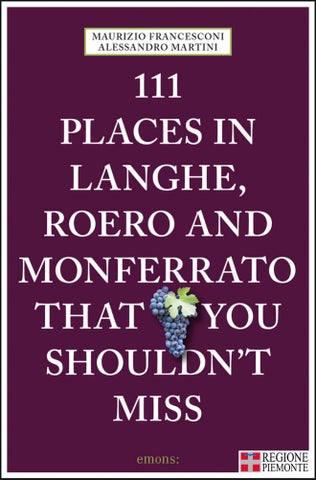
Foreword In 2014, two neighbouring but very different areas were recognised by UNESCO as a single World Heritage Site, the Vineyard Landscape of Piedmont: Langhe-Roero and Monferrato. This whole region is now increasingly popular among international tourists, drawn here by the top-quality food and wine, the artistic treasures, ancient and modern, the fascinating landscapes, both natural and man made, and the thriving and constantly evolving local traditions. Half-forgotten wines that have been transformed into international bestsellers; native foods impossible to find elsewhere; art and architecture from the medieval and Baroque eras as well as the 20th and 21st centuries; historic gardens, royal and noble private residences, still lived in but open to visitors; wineries designed by architects; saints who are innovative entrepreneurs; great writers and partisans; local businesses that are movers and shakers in their own fields; giant benches and collections of tennis rackets – southern Piedmont has all these and much more. The list of places to visit and stories to discover is almost endless: from donkey trekking to llamas that are perfectly acclimatised to the Monferrato habitat; from Roman remains to the legendary white truffle; from open-air museums to foundations of contemporary art; from museums of magic to prehistoric whales; from Scrooge McDuck’s treasure chest to DOCG snail farms and former cement factories, now acknowledged masterpieces of industrial archaeology. We have selected what we consider to be the 111 very best places – with great effort, we confess, because there are so many others that deserve to be included. We hope that they will arouse curiosity about and interest in this incredibly diverse region. It’s already one of the international Meccas of food and wine tourism, but it has so much more to offer.
111 Places 1_ The Ceretto Artworks | Langhe/Alba Ambassadors for wine and art | 10
2_ Famiglia Paolina | Langhe/Alba Entrepreneurial saints | 12
3_ Giacomo Morra | Langhe/Alba
World ambassador for Alba’s white truffle | 14
4_ Pinot Gallizio | Langhe/Alba
Situationism and industrial art | 16
5_ The Sphaeristerium | Langhe/Alba The ancient sport of fistball | 18
6_ Underground Alba | Langhe/Alba
Two thousand years of underground history | 20
7_ Architecture for Wine 1 | Langhe/Barolo Pop art winery and rural wisdom | 22
8_ The Corkscrew Museum | Langhe/Barolo Every way to open a bottle | 24
9_ WiMu Wine Museum | Langhe/Barolo
An analysis of Barolo and its inventors | 26
10_ Architecture for Wine 2 | Langhe/Barolo and Castiglione Falletto Amabile Drocco and Boroli | 28
11_ Frescoes in San Fiorenzo | Langhe/Bastia Mondovì
Demons and courtly life in the Biblia pauperum | 30
12_ Shrine of San Bernardo | Langhe/Bastia Mondovì A homage to the partisan epic of the Langhe | 32
13_ Artists’ Shop Signs | Langhe/Bossolasco In the town of roses | 34
14_ The Underground Cathedrals | Langhe/Canelli Sparkling wine in the tufa | 36
15_ The Fat Ox Fair | Langhe/Carrù Boiled meat for breakfast | 38
16_ Altalanga Organic Farm | Langhe/Cerretto Langhe The best hazelnuts in the world | 40
17_ The Adriani Museum | Langhe/Cherasco Wisdom – what’s that? | 42
18_ The Garden of the Somascan Fathers | Langhe/Cherasco Peace and well-being amidst the greenery | 44
59_ The Pietra da Cantoni Ecomuseum | Monferrato/Cella Monte Queen of building stones | 126
60_ Gualino’s Castle | Monferrato/Cereseto Monferrato International art and culture | 128
61_ The Chapel in the Vineyards | Monferrato/Coazzolo
David Tremlett, environmental and landscape artist | 130
62_ The Town that Lived Twice | Monferrato/Coniolo Coniolo Rotto: past and present in the mines | 132
63_ The Enigma of San Secondo | Monferrato/Cortazzone Asti’s unmissable Romanesque church | 134
64_ The Asti Geosite Park | Monferrato/Cortiglione d’Asti The hills of the sea | 136
65_ Villa Pattono | Monferrato/Costigliole d’Asti From noble residence to hotel | 138
66_ A Monument to Everyone | Monferrato/Frassineto Po 5633.9 kilos of public art in Frassineto Po | 140
67_ The Po Landscape Interpretation Centre | Monferrato/Frassineto Po A view of the river | 142
68_ Claudia Formica | Monferrato/Incisa Scapaccino A female artist under the fascist regime | 144
69_ Moleto | Monferrato/Moleto
Secluded, enchanted – a place best kept secret | 146
70_ The Scagliola Antependia | Monferrato/Moncalvo
Faux marble and great art in Sant’Antonio Abate | 148
71_ The Hunchback Thistle | Monferrato/Nizza Moferrato Not good looking, but definitely good | 150
72_ Pinin Pero | Monferrato/Nizza Monferrato
Where even sugar sachets become works of art | 152
73_ Villa Gabrieli Park | Monferrato/Ovada From Argentina to Ovada | 154
74_ The Cement Factories of Ozzano | Monferrato/Ozzano Monferrato Industrial archaeology in the Casale area | 156
75_ Luigi Tenco | Monferrato/Ricaldone
The discreet tomb of a great Italian musician | 158
76_ The Holy Mountain of Crea | Monferrato/Serralunga di Crea The New Jerusalem, from Calvary to Paradise | 160
77_ The Madonna of Squaneto | Monferrato/Spigno Monferrato A spectacular marble of the great Genoese school | 162
78_ The Castle of Vesime | Monferrato/Vesime Straight out of a fairy tale | 164
79_ Gardella and Borsalino | Monferrato Vicinity/Alessandria Architect to the world-famous hatter | 166
80_ Marengo Museum | Monferrato Vicinity/Alessandria Napoleon and the battle | 168
81_ Walter Massa | Monferrato Vicinity/Monleale Champion of the Timorasso grape | 170
82_ Basilica della Maddalena | Monferrato Vicinity/Novi Ligure A miniature holy mountain | 172
83_ The Champions’ Museum | Monferrato Vicinity/Novi Ligure Girardengo and Coppi | 174
84_ La Raia Foundation | Monferrato Vicinity/Novi Ligure A fruitful meeting of art and landscape | 176
85_ The Mask Museum | Monferrato Vicinity/Rocca Grimalda Wooden clogs and trainers | 178
86_ The World of Pellizza | Monferrato Vicinity/Volpedo The divisionist master of light | 180
87_ Pinacoteca dei Cappuccini | Monferrato Vicinity/Voltaggio Great Genoese art | 182
88_ The Racket Museum | Roero/Baldissero d’Alba
Tennis from 1875 to the Grand Slam champions | 184
89_ Augusta Bagiennorum | Roero/Bene Vagienna
An unexpected amphitheatre among the fields | 186
90_ Academy of the Nameless | Roero/Bra
The name of their protectress was sufficient | 188
91_ Bra Sausages | Roero/Bra
In a word: mmmmmmm | 190
92_ Converso Café | Roero/Bra
A taste of the hospitality of Bra and Roero | 192
93_ La Zizzola | Roero/Bra
The strange house of the Braidesi | 194
94_ Santa Chiara | Roero/Bra
A shining example of Piedmontese Baroque | 196
95_ The Wine Bank | Roero/Bra-Pollenzo Heritage of inestimable value | 198
96_ The Biotope | Roero/Canale
Toads, ponds and princes | 200
97_ The Duchesse of Canale | Roero/Canale
Refined taste and Art Nouveau design | 202
98_ Roast Ham | Roero/Canale A Roero speciality | 204
Address Via Statale 108/b, 14033 Castell’Alfero | Getting there On the E 70 Torino – Piacenza – Brescia, take the exit for Asti Est, then continue towards Castell’Alfero | Hours For information: www.bottigamba.com | Tip The Ristorante del Casot (Serra Perno 76, +39 0141 204118, www.ristorantedelcasot.it) offers excellent local cuisine in a family-friendly environment. If, however, you feel like getting back into the car, we recommend the Durando farm in Portacomaro, less than a 10-minute drive away (Viale A. Degiani 33, +39 327 7867161, www.fratellidurando.it). They have a shop selling locally-produced wines, nuts, eggs and other delicacies.
M O N F E R R AT O / C AVAT O R E
58__ Walking with Llamas Ute, Inge and their animals
Anna was the first llama to set foot on the panoramic hills overlooking Acqui Terme. She got here in 2013, and now rightly has pre-eminent status in the llama hierarchy. Artù is her son; he has beautiful penetrating eyes. She is very protective of him: if any female llama of lower rank bothers him, Anna will put her back in her place by spitting. Luv, another female with soft brown hair, also spits as soon as you touch her back. The blonde Lucrezia and her daughter Lola, a small llama with blue and brown eyes, on the other hand, are very shy. Lia, recognisable by her spotted coat, is the most patient of the group, even with small children and the disabled. The llamas live together with the alpacas, known as ‘the scientists’: Leonardo, Einstein and Galileo. Lamas and alpacas are both species of South American camelids. They argue amongst themselves, and establish complex relationships, roles and hierarchies. In the evening they all play together, led by the highest in rank. This binds the group together in a sort of ‘team building’ effort. The fifteen llamas and three alpacas of Animal Walk graze in the meadows outside Cavatore, a scenic stone-built village of a few beautiful houses built around a tower and a church. The business is run by Ute and Inge, two energetic German women who are perfectly integrated into the local community. They welcome children and adults for trekking and themed walks alongside the animals, aimed at finding harmony, peace and balance. Ute, from Frankfurt, arrived here ‘by chance’ in the early 2000s; 10 years later Inge, from Bavaria, joined her. They try to renew the broken link between man and nature. The Animal Walk mainly hosts participants from cities, including children who are often coming into close contact with animals for the first time, learning that each has its own character and unique emotions. 124
Address Animal Walk, Valle Ferri 21, 15010 Cavatore | Getting there On the E 70 Torino – Piacenza – Brescia, take the exit for Felizzano or Alessandria Sud towards Acqui Terme; from Bagni, continue along the SP 210 to Cavatore | Hours Times and activities vary according to the season; for information: +39 338 3729076, www.animalwalk.eu | Tip Next to Animal Walk is the Scuderia Valle Ferri, stables which organise activities with horses (www.scuderiavalleferri.com), and also Lidia Oggioni’s very nice farm L’Orto dei Nonni (+39 0144 323165). Don’t miss the restaurant Da Fausto (Località Valle Prati 1), a favourite with foreigners, many of whom actually live here. The complex includes the Borgo del Gallo hotel (www.relaisborgodelgallo. com).
M O N F E R R AT O / C E L L A M O N T E
59__ The Pietra da Cantoni Ecomuseum Queen of building stones
The term pietra da cantoni literally means ‘angled stone’, and immediately brings to mind houses and sharp edges. But what is it? The short answer is that it is one of the finest construction stones that Italy has to offer, along with the stone found in Lecce, in the Puglia region. The stone’s history begins about 22 million years ago, when the Monferrato region looked somewhat different from how it appears nowadays. It’s an important feature of the local culture because it has always been used for buildings and for the famous infernot – underground rooms that were used to store wine. Worked in large square blocks (cantòn), it closely resembles tufa, but is in fact a type of sedimentary rock called marlstone. The history of this stone, which has had such a profound influence on the Monferrato landscape, is the subject of the Pietra da Cantoni Ecomuseum, which displays a variety of works of art made by local artists using the stone in question. But to get back to the infernot: these are small underground rooms (additional to standard cellars) carved out of the ‘angled stone’, totally devoid of light and natural ventilation and generally located under houses, courtyards or even streets. It’s quite clear that in Monferrato there’s a good chance that you could be walking on top of an infernot without knowing it. Cool – but also rather creepy. They come out of a rural tradition and from the technical skills of those who had to make a virtue of necessity: we have to thank these veritable sculptor-architects, whose names we will never know, for handing these architectural marvels down to us. We strongly recommend a visit to an infernot: they are special places with the capacity to transport the visitor back hundreds or even thousands of years. 126
M O N F E R R AT O / C E R E S E T O M O N F E R R AT O
60__ Gualino’s Castle International art and culture
Riccardo Gualino was a daring financier and successful entrepreneur in Italy and throughout the world, involved in everything from lumber to artificial fibres, from confectionery products to cement. He founded the textile and chemical firm SNIA Viscosa, was vicepresident of Fiat and was even Luchino Visconti’s producer. He was also a great patron and friend of some of the most innovative Italian artists, musicians and architects. In the 1910s and 1920s he displayed his status as an entrepreneur and great collector, exhibiting his collections of art, from Botticelli to Modigliani to oriental sculpture. His famous residences included a Turinese villa with a private theatre, the great villa on the Busiri Vici hill, also with a theatre and private museum (never completed), and above all the Palazzo per Uffici, designed in 1928 by Gino Levi-Montalcini, a true icon of Italian Rationalist architecture. However, at the time of their marriage in 1907, Riccardo and Cesarina Gurgo Salice had more traditional tastes, commissioning a magnificent neo-medieval castle that, with its almost 160 rooms, dominates the village of Cereseto. It was designed by the Casalese architect Vittorio Tornielli and inaugurated in 1912 with a party in 15th-century fancy dress. Gualino had forewarned his bride, ‘I’ll tell you right away, I want a nice castle … one of those medieval ones with battlemented walls and turrets, overhanging eaves … and rooms lit by stained glass, with high coffered ceilings.’ And that’s exactly what he got. Today the castle is closed but, after a long series of corporate difficulties and a few financial scandals, its restoration as a cultural centre is now under way. From the outside it really is impressive and, if you stand underneath it, you are likely to come across some elderly local eager to tell you about the life and times of Gualino and his lady. 128
The authors
Alessandro Martini (born 1972 in Turin) is an architectural historian and journalist. He teaches History of Architecture at the Polytechnic University of Turin and, since 2000, has edited the News and Museums sections of Il Giornale dell’Arte. In 2011 he was one of the creators of MuseoTorino, an online museum of the city. He is a regular contributor to The Art Newspaper, La Lettura, Abitare, Living and Corriere Torino. Maurizio Francesconi (born 1974 in Turin) is a fashion historian and journalist. He teaches the History and Semiotics of Fashion at the IED design institute in Turin. He regularly writes about art and culture for La Lettura and Corriere Torino as well as contributing to Living, Abitare, Sportweek and other publications. He is also the Paris Fashion Week correspondent for Collezioni.