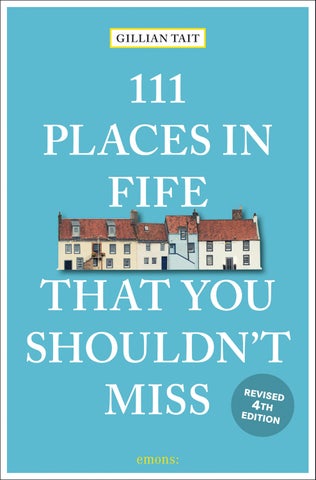
111 Places in Fife

Page 1


The Wee Miner Boy

Brightening up a grimy heritage

Cowdenbeath was built on coal. When the rich seams of the region were discovered in 1844, the settlement consisted of little more than a few farms and a coaching inn (where Queen Victoria had stopped off two years earlier, on her first trip to Scotland). Within a few decades it had become the centre of Britain’s largest mining enterprise, the Fife Coal Company, and a veritable boom town: by 1914 its population had grown to 25,000, earning it the nickname ‘The Chicago of Fife’. But in the 1930s the industry began an inexorable decline, and by the 1960s most of the deep pits that had been at the heart of the local economy were gone, and with them the proud cultural heritage and traditions of the miners.

Until recently, Cowdenbeath’s most obvious reminder of this lost way of life was the mining subsidence for which the town was long notorious – apparent even in the High Street, where the once level roadway now has a pronounced dip. But since 2017 this same street has boasted a much more welcome memorial, in the form of a huge gable-end painting commissioned by the Community Council as part of a town centre improvement scheme. Officially called the Mining Heritage Mural, it’s more familiarly known to artist Kerry Wilson as the Wee Miner Boy – despite being the biggest painting in Fife.

It was Kerry’s first work on such a scale, though she had a variety of previous experience as a street artist, with a portfolio including the witty Maci-Selfie, which transformed a Glenrothes underpass into a giant mobile phone, and an acclaimed project to decorate the shutters of Cowdenbeath shops, carried out with the help of pupils from Beath High School. The mural is a positive image for a new generation now at more than one remove from the tough and grimy past of their community. It’s a far cry from the harsh reality of lives spent ‘howkin’ awa neath a mountain o’ stane’ (in the words of pitman-poet Joe Corrie), but a warm tribute to them nonetheless.

Address Brunton Square, 353 High Street, Cowdenbeath, KY 4 9 QJ | Getting there Train to Cowdenbeath; bus X27, X54 or X59A to Broad Street (the Fountain) | Tip The nearby town of Lochgelly has a striking statue of a miner ‘cracked and fractured like a coal seam’, in the words of its sculptor, David Annand. Unveiled in 2008 as part of the town centre redevelopment, the sculpture is in the town square at the end of Main Street, near the former Miners’ Institute.

The Mercat Cross

A unicorn to believe in

It remains to be proven whether the roots of Inverkeithing date back as far as the Roman general Agricola’s anti-Caledonian campaign of ad 84, but what is certain is that by the mid-12th century the community was sufficiently established to be granted a royal charter as a burgh. At the heart of all burghs was the mercat (market) cross, a status symbol indicating an official place for trading goods, as well as a focal point for townsfolk to witness proclamations, celebrate holidays and join in the popular entertainment of tormenting miscreants. Inverkeithing’s is one of the finest in Scotland, and in 2025 the long-neglected monument was restored and moved to a prominent new site. A replacement for an earlier wooden column, it was erected around 1400 courtesy of Robert III’s queen consort Annabella Drummond, who often resided in the town. (Annabella had been de facto ruler of the country since a riding accident had left the king a depressive invalid, who declared that he wanted only to die and be dumped in a dung-heap.) In 1688, year of the ‘Glorious Revolution’, the crucifix that had previously formed the cross’s finial was symbolically replaced with a carving of a perky unicorn – the heraldic animal of Scotland – squatting on a faceted sundial. Our infantilising 21st-century culture has reduced this proud, untamed creature of myth to a pastel-shaded, long-lashed, simpering soft toy. But the unicorn was then a fierce and noble beast, strong, swift, pure and the natural enemy of the lion – symbol of England.

The elaborate sundial may seem a counterintuitive feature in a country where clear skies can never be guaranteed for long. In fact it’s one of a great number made in Scotland in the 17th century, part of a craze for ever more sophisticated sculpted dials that go far beyond basic solar timepieces, probably linked with the beginnings of freemasonry. This fashion persisted for centuries; there’s a showy neoGothic example dated 1878 at Crawford Priory, near Springfield.

Address Market Square, Inverkeithing, KY11 1NN | Getting there Train to Inverkeithing or bus 7, 87, 88, X57 or X58 to High Street | Tip Inside St Peter’s Kirk on Church Street is another gift from Queen Annabella – a font dating from c1398, carved with four rather hefty angels grasping coats of arms. It was buried for centuries and so is unusually well preserved. On your way there, look up at the 18th-century tolbooth in Townhall Street to see a charming carved and painted representation of St Peter and a sailing ship on the burgh’s coat of arms.

The Vintage Bus Museum

Transports of delight

There’s something about the sight, sound and even the smell of an old bus that inspires instant affection and a rush of nostalgia in just about everyone. You don’t have to be an ‘anorak’ with an obsessive interest in the minutiae of specifications, routes, liveries and timetables to appreciate these sturdy egalitarian vehicles that once shuttled you to school and back, escorted you on your first date, or took you on your own magical mystery tours.

Founded in 1985, the Scottish Vintage Bus Museum has the largest collection of its type in Europe, with a fleet of nearly 200 passenger carriers housed on a 45-acre site at Lathalmond. (It’s a nice coincidence that this is just down the road from the village immortalised by John Watt in ‘The Kelty Clippie’ – surely the world’s only folk song about a bus conductress.) Most of the buses date from the 1920s to the 1980s, magisterial double-deckers and snub-nosed coaches, many with potent names redolent of ancient myths – Titan, Valkyrie, Atlantean, Olympian – or champions of the animal kingdom – Lion, Tiger, Cheetah, Leopard. Unmissable guest stars include a formidable 1930 steam roller, a cute 1963 bubble car and a resplendent Edinburgh horse tram dating from 1885, meticulously restored after decades languishing as a summerhouse in a Borders garden. The buses are almost all privately owned, lovingly renovated and maintained by members of the museum trust.

Opening hours are mostly restricted to Sunday afternoons; your ticket includes a bus tour of the extensive site, with enthusiastic volunteers to guide you round the exhibition hall, workshops and stores. There is also a specialist bookshop. On open days, trips outside the museum are on offer, and highly recommended: the experience of lurching along the byways of West Fife in a Leyland Victory Mark 2 double-decker, made by Alexander’s of Falkirk for the China Motor Bus Company of Hong Kong, is quite unforgettably surreal.

Address M 90 Commerce Park, Lathalmond, Dunfermline, KY 12 0 SJ, +44 (0)1383 623380, www.svbm.org.uk | Getting there Free shuttle bus from Dunfermline Bus Station, stance 14, Sun 12.30pm (returns 3.30pm); car: M90 to Junction 4, then west on B914 & B915 | Hours Apr – 1st week of Oct, Sun 12.30 – 5pm, plus some midweek dates – check website | Tip The Lathalmond Railway Museum is based in a locomotive shed nearby, formerly a Royal Naval Store Depot with an internal rail network. You can travel behind a narrow-gauge steam engine, take a ride on a diesel-hauled brake van, view their model railway and see other projects in progress (Apr – early Oct, Sun 12.30 – 4pm; www.shed47.org).

Fife Ice Arena

Get your skates on

Kirkcaldy Ice Rink caused a sensation when it opened its doors on 1 October, 1938. There were traffic jams for miles around as an eager public and invited dignitaries flocked to the state-of-the-art stadium to enjoy a day-long spectacle, including a curling tournament and figure skating displays, and culminating in the debut of the town’s fledgling ice hockey team, the Fife Flyers. Like many others in the UK, the Kirkcaldy squad was born out of a massive craze for the game triggered by the momentous gold medal win of the British ice hockey team at the 1936 Winter Olympics.

It was predicted that in Scotland the sport could grow to rival football in popularity, until the outbreak of war put paid to plans for constructing a score of new rinks. The Flyers are the sole survivors of that boom time. The longest-established professional team in the UK, they’re still based at the same venue, now renamed Fife Ice Arena, and currently play in the Elite Ice Hockey League, followed by their exuberant and vocal fans. Generations of Fifers have become knowledgeable and critical spectators of the fast-paced, physical sport. Skating on blades just half a millimetre thick, players can reach speeds of 20 miles per hour, and the atmosphere is electric as they dodge and race across the ice pad in pursuit of the all-important puck.

As the oldest operational rink in Scotland, offering skating sessions, curling classes and more besides, the building is itself a remarkable survival. Designed by local architects Williamson and Hubbard to house 4,000 spectators, its final cost was a tidy £40,000. The arena, whose unsupported roof span of 145 feet was the widest in the country at the time of its construction, has seen some necessary modernisation, but the glamorously streamlined entrance bay in classic Art Deco style remains virtually unaltered. Other features of the original highend decor included Parker Knoll furniture and fabrics designed by Dame Laura Knight, all sadly long gone.

Address Rosslyn Street, Kirkcaldy, KY 1 3 HS, +44 (0)1592 595100 | Getting there See Fife Ice Arena Facebook page for times of public sessions, and fifeflyers.co.uk for hockey fixtures | Tip Kirkcaldy’s other major sporting venue is Stark’s Park football stadium, home of Raith Rovers F.C. Local authors Ian Rankin and Val McDermid are among the celebrity fans of the team immortalised in the 1960s by the unwitting gaffe uttered by BBC commentator Sam Leitch after one of their victories, ‘…and they’ll be dancing in the streets of Raith tonight!’

The Dutch Village

Fairy tales can come true

It doesn’t look remotely Dutch (there’s not a windmill in sight), nor does it actually resemble a village – but never mind its prosaic misnomer. The whimsical cluster of towers and turrets on the islet in Craigtoun Country Park has a magical quality that seems straight out of a fairy tale, particularly when glimpsed through the thicket on the bank of its shimmering lake, as a bevy of swans glides around the walls and under the hump-back bridge. Completed a century ago, in an eclectic style best described as Franco-German, the village was the work of architect Paul Waterhouse, part of his remodelling of what was then the Mount Melville estate, for brewing magnate James Younger. The buildings were designed as a fanciful summerhouse and boathouse; the small artificial lake is one of two created to meet insurance company demands for a ready source of water, in case of fire at Younger’s vast new mansion. Other features of Waterhouse’s scheme that can still be enjoyed today include an Italian Garden and a magnificent avenue of cypresses.

The transformation of the estate into picturesque parkland had in fact begun in the 18th century, when it was the property of the remarkable General Robert Melville, a distinguished soldier who was also an antiquary and a pioneering botanist. Some 230 trees were purchased in 1790 for orchards and other plantings, and landscaping continued under the estate’s 19th-century owners, with the creation of woodland belts and attractive vistas.

In 1947, a 47-acre portion of the grounds was sold to Fife Council, who turned it into Scotland’s first public country park, under its original name of Craigtoun. Attractions such as a miniature railway and a putting green were added as well as a ‘fairy glen’, and with rowing boats and pedalos available for hire on the lake, the Dutch Village (which once housed a café) became a favourite spot for generations of locals and holidaymakers.

Address Craigtoun Country Park, KY 16 8 NX, +44 (0)1334 472013, www.friendsofcraigtoun.org.uk | Getting there Bus 64 to Craigtoun Park Lodge, then walk up the drive to the car park and main entrance. The Dutch Village is to the right, in the south-east of the park. | Hours Park: unrestricted; village viewable from the outside only | Tip The park has a variety of all-year free-use activities for children, as well as seasonal ticketed attractions including the miniature railway, crazy golf, etc. (Apr – Oct; see website for opening times).

Bowbridge Alpacas

Close encounters of the camelid kind

They could hardly be further from the Peruvian altiplano, but the alpacas grazing peacefully in the rolling countryside of north-east Fife seem quite at home here. The South American camelids, domesticated from the wild vicuña around 7,000 years ago, first appeared on British farms in the 1990s (although their much-prized wool had a significant prior history in the UK, as the source of the wealth of Victorian cloth magnate Titus Salt). Though often mistaken for their cousin the llama, alpacas are only half their size, and this, together with their docile nature and exceptionally soft coats, is undoubtedly part of their appeal. When they turn their graceful necks to meet your gaze with their gorgeous, long-lashed almond eyes, you just won’t be able to stop smiling.

For a hands-on encounter, with the privilege of bonding with one of these intelligent, biddable creatures, book a visit to Bowbridge Farm, where Simon Johnson will guide you through an immersive experience with the herd. This includes hand feeding (quite safe, as they have no top front teeth) and an introduction to training techniques, and culminates in leading your chosen alpaca on a trek round the farm, part of it through an obstacle course. You’ll learn a lot about their behaviour, such as their fastidious habit of using a communal ‘field toilet’, and as a final treat have a go at needle-felting a little of their luxuriant wool. High quality knitting yarn is also on sale.

The Johnsons began their family venture in 2015, after daughter Sarah had gained experience working on alpaca farms in Europe. Her father Paul had already undertaken a handling course where he became aware of the stress-relieving value of alpaca encounters, and these have always been part of the farm’s remit. A group of Bowbridge’s finest are regularly booked for therapeutic visits to local care homes, schools and the like, and they’ve even starred as camels in nativity plays, to the delight of audience and participants.

Address Bowbridge Farm, Peat Inn, KY 15 5 LL, +44 (0)7484 778040, www.bowbridgealpacas.com | Getting there On B 941, 0.6 mile south-east of Peat Inn | Hours 1- & 2-hour Alpaca Experiences Wed & Fri 2.30pm, Sat 10.30am, 2.30pm; booking essential | Tip The hamlet of Peat Inn is famed for its eponymous restaurant with rooms, a multi-award-winning establishment which, in the 1980s, earned the first ever Scottish Michelin star. The 2020 Good Food Guide judged it the second best in Scotland (Peat Inn, KY 15 5 LH, +44 (0)1334 840206, www.thepeatinn.co.uk).

The R & A World Golf Museum

Open secrets right by the Old Course

It’s the holy grail of golf – or an authorised replica of it, at any rate. The Claret Jug is, rightfully, the culminating exhibit of the R & A World Golf Museum, a low-key, bunker-like building in St Andrews, situated within striking distance of the Royal & Ancient clubhouse and the first tee of the Old Course. There couldn’t be a more appropriate site for a museum devoted to the history of the game: it’s been played here since at least the 15th century, and as early as 1691 the town was referred to as the ‘metropolis of golfing’. The coveted silver trophy, presented annually to the winner of the Open Championship, is no doubt the museum’s star exhibit for true aficionados, but even the uninitiated, or those with only a casual interest in the sport, will find a surprising variety of other highlights among the eclectic displays. With a total of over 17,000 items, this is Europe’s largest collection of golfing memorabilia.

The story of the world’s most popular ball and stick game, from its medieval beginnings up to the present day, is told in a circuit of themed galleries. Topics include pioneering women players and golfing fashion, as well as an exhaustive typology of equipment, from the oldest set of clubs in the world to the latest in high-tech gee-whizzery.

Intriguing items catch the eye at every turn, such as the Silver Club, a trophy covered in a mass of glittering balls like an over-the-top Christmas ornament, and the two-tone trousers worn by Gary Player at the 1960 Open, as a protest against apartheid. There’s a striking recreation of the workshop of a famous Victorian ball maker, from the days when a top hat-full of feathers was laboriously stuffed into each little leather casing, and a practice room where you can try out various types of ball and old-style putters, plus a host of activities for younger visitors that are both fun and informative.

Address Bruce Embankment, St Andrews, KY 16 9 AB, +44 (0)1334 460046, www.worldgolfmuseum.com | Getting there Bus to St Andrews Bus Station | Hours Daily, Apr – Oct 9am – 6pm, Nov – Mar 10am – 4pm (last entry 45 minutes before closing time) | Tip On the shore 2 minutes’ walk away is St Andrews Aquarium, home to a wide variety of wonderful aquatic creatures including penguins, crocodiles, octopuses, seals, sharks and piranhas as well as, rather unexpectedly, meerkats and marmosets (daily 10am – 5pm).

Eden Mill Distillery

The doctrine of original gin

Not so long ago, gin was widely dismissed as a one-note drink, jokingly vilified as ‘mother’s ruin’ and the province of a stuffy older generation. Its resurrection as a modish, nuanced premium spirit began in London in 2009, after a long campaign for the repeal of the 1751 Act that had outlawed small-scale distilleries. Scotland soon took up the torch, and it now produces at least 70% of the UK’s gin, in more than 90 locations from the Highlands to the Borders, challenging the primacy of whisky as our national dram.

Fife’s Eden Mill was established in 2014 within the former Guardbridge paper mill, on the extensive estuary of the River Eden. This earthly paradise for drinkers already had a history of alcohol production when co-founder Paul Miller set up his original microbrewery here in 2012. From 1810 to 1860 the site had been the home of the legendary Haig Brothers’ grain whisky distillery, and this motivated the Eden team’s expansion from wood-matured beers into spirits. They began with whisky, reviving interest in the skill of blending before launching their own estimable single malt in 2018. But it was their venture into small-batch gin production that really caught the contemporary zeitgeist. Besides the core ingredient of juniper berries, Eden Mill’s unique portfolio is subtly blended with flavourings such as hops (a natural choice for brewers) and select botanicals, most notably wild sea buckthorn, whose vivid orange vitamin-rich berries are sustainably foraged along the nearby coast. Such was the success of these carefully crafted liquors that it wasn’t long before the company began a major expansion project, which finally came to fruition in 2025 with the opening of a new distillery on the existing site, powered entirely by renewable energy and capable of producing one million litres of spirit per annum. A range of guided tours is available, culminating in the top-floor bar, which enjoys glorious views across the estuary.

Address Eden Campus, Guardbridge, KY16 0US, +44 (0)7759 525238, www.edenmill.com | Getting there Bus 42A, 42A, 59, 65, 65A, 99, X24, X59 or X59A to Guardbridge | Hours See website for details of tours | Tip Just a short walk from the distillery, Eden Estuary Nature Reserve is an excellent site for bird-watching, with a comfortable and well maintained hide and visitor centre (off Main Street; for access code phone +44 (0)7985 707593).

The Unknown Bairn

Unnamed, but not unmourned

More than half a century ago, the quiet community of Tayport was shaken by a strange and distressing mystery that haunts the town to this day. It was a Sunday afternoon in May 1971, and local postman Ian Robertson was taking his five-year-old son Neil for a walk along the beach when he spotted what looked like a large doll lying where it had been washed up by the tide. It turned out to be a harrowing discovery: the body of a boy aged about three, which had clearly been in the water for some time.

A pathologist confirmed that he had died of natural causes, and it was assumed that police enquiries would soon lead to his identification. But no child matching his description had been reported missing, and despite a nationwide appeal for information and massive media coverage, no one ever came forward to solve the mystery of who he was or where he was from. Speculation that he had been on a vessel lost at sea came to nothing; in fact it transpired that his death, though not suspicious, was probably not due to drowning. Years later, detectives involved in the investigation revealed that the most likely explanation was that his parents were tinkers or travellers, living on the margins of society, too poor to pay for a funeral when their infant son died of natural causes, and subsequently too intimidated to come forward with all the publicity surrounding the case.

The child forever remembered as the unknown bairn was buried in Tayport cemetery, near the shores where he was found, with a headstone paid for by donations from all over the country. Flowers and toys are still left there by the local community. The Robertsons were deeply affected by their role in the poignant story, tending the grave and leading the mourning each year on the anniversary of his discovery. Sadly, Ian and Neil have both now passed away; they are laid to rest just a few feet away from the nameless child that Ian always thought of as part of the family.

Address Tayport Cemetery, Newport Road, Tayport, DD 6 9 AU, +44 (0)1334 659336 |

Getting there Bus 41, 42, 42A or 77 to Tayport Cemetery; the grave is near the north-east corner | Hours Unrestricted | Tip The Harbour Café in Tayport is a welcoming community-run venture on the waterfront, with views across the Tay to Broughty Ferry Castle (10 Broad Street, DD 6 9 AJ, daily till 4pm). In the heart of the town on Whitenhill, look out for the leaning clock tower of the Auld Kirk, now an exhibition and concert venue.

The Pilgrim Way

Take the road less travelled

In the Middle Ages, pilgrimage was a physical journey towards a spiritual goal: to fulfil a vow, seek a miraculous cure, expiate wrongdoing or just ensure salvation. The earliest Christian pilgrims visited the land where Jesus and his followers had lived; in later centuries, however, as the physical evidence of saints’ existence became scattered throughout Christendom, the pious began to travel in large numbers to the shrines of Europe that held the most venerated remains.

As the home of the bones of Christ’s first disciple, St Andrews was in the top three destinations for spiritual tourism (after Rome and Compostela), and for 400 years before the Reformation brought a violent end to relic-worship, pilgrims poured into Fife from far and near. Their journeys might have involved fun and adventure, but they were also slow, arduous and often dangerous, and a vast infrastructure of roads, ferries, bridges, chapels, hospitals and inns was established to help travellers on their way.

One well-trodden route has been recreated as the Fife Pilgrim Way, a 64-mile trail starting from either Culross or North Queensferry. Waymarkers with a logo based on a 15th-century pilgrim’s badge guide you through its eight stages. You can take in atmospheric landmarks such as Inverkeithing Hospitium, the healing well of St Finglassin and the superb Norman tower of St Drostan’s, Markinch; there are many stretches where you’re alone with the beauties of nature, and the route has also been designed to incorporate terrain related to Fife’s mining heritage. Towards the end you proceed up the Waterless Road to Ceres before crossing the Bishop’s Bridge, where the final section begins. Scottish pilgrims were famed throughout Europe for walking with their shoes tied round their necks; that is not recommended today, although the paths are well made, mostly level, and considerably easier to negotiate than the uneven and often boggy tracks that medieval travellers had to contend with.

Address From Culross or North Queensferry to St Andrews; the photo shows Bishop’s Bridge, Ceres. See www.fifecoastandcountrysidetrust.co.uk for full details and maps; route data can be downloaded to your phone. | Getting there Train to North Queensferry; bus to Culross; good public transport links along the way | Tip The other main route to St Andrews was by boat from North Berwick to Earlsferry (now merged with Elie). The remains of a hostel, where pilgrims stayed before continuing overland, can be seen on Chapel Green. In the year 1413 alone, the ferry service was used by 15,000 people.

Gillian Tait was born in Edinburgh, and grew up in other parts of Scotland. She studied art history and painting conservation at the universities of Edinburgh and London respectively, and worked for many years in the museum sector in Scotland, England and the USA. In more recent years she has occupied her time as a writer, editor and photographer, while indulging her passions for travel, singing and performing in opera, operetta and musical theatre, and improving her Italian. Her first book in this series as author and photographer was 111 Places in Edinburgh That You Shouldn’t Miss, and her latest is 111 Places in the Lothians and Falkirk That You Shouldn’t Miss. She also contributed to 111 Places in Glasgow That You Shouldn’t Miss as photographer and editor. She has lived in the heart of Edinburgh’s Old Town for nearly 40 years.

The information in this book was accurate at the time of publication, but it may change at any time. Please confirm the details for the places you’re planning to visit before you head out on your adventures.

Turn static files into dynamic content formats.
Create a flipbook
Issuu converts static files into: digital portfolios, online yearbooks, online catalogs, digital photo albums and more. Sign up and create your flipbook.