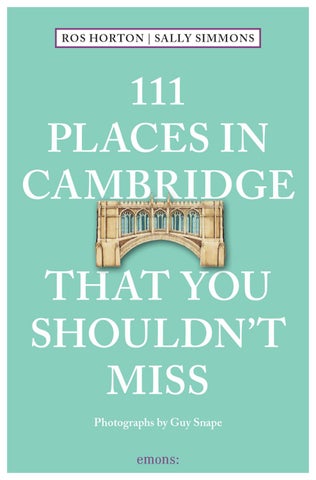
Foreword Cambridge is not a big city, even taking its urban sprawl into account, and the historic town centre is very small, with an area of only 0.5 square miles. It’s tempting to try to ‘do’ Cambridge in an afternoon, and indeed many people do – King’s College Chapel, a punt up the river, a pint in a pub, a quick nip into the shops and away again. This means that for most of the year Cambridge is packed, with coachloads of visitors, pavements full of shoppers and streets full of bikes. When the University students are up (and there are nearly 20,000 of them) the town never seems still or empty. Cambridge has changed enormously in the 40 years that we have lived and worked here, a period in which the extraordinary growth of new high-tech companies has had the biggest impact on the town since the founding of the University 800 years ago. Employment and wealth have transformed the city; property prices are among the highest in the country, there is a lot of regrettable new building and the traffic is dreadful. And yet in essence Cambridge is unchanged. It has always been a place where odd and peculiar people and things can be accommodated comfortably, and although the pull of history is strong, it has never held back innovation and experimentation. We imagine that, like us, you will probably realise that the best way of getting around the city is by bike and the easiest way of exploring is on foot, especially in the centre, where even finding a place to park your bike can be a problem. And we hope you have as much fun exploring Cambridge as we have had photographing and writing about the places in this book.
111 Places 1_ Abbey House
Cambridge’s most stately home | 10
2_ The ADC Theatre
A springboard to stardom | 12
3_ Afternoon Tease
The gentle art of cake-making | 14
4_ All Saints’ Church
A masterpiece of Victorian Gothic Revival | 16
5_ The American Cemetery
‘In proud memory of their valor’ | 18
6_ Anna Maria Vassa Memorial
‘But one, a hapless orphan, slumbers here’ | 20
7_ Arjuna Wholefoods
Doing you good, naturally | 22
8_ Art at Addenbrooke’s
More pictures than patients | 24
9_ Arts Picturehouse
The phoenix rises, again | 26
10_ Ascension Parish Burial Ground Genius beneath our feet | 28
11_ The Beechwoods
A walk on the wild side | 30
12_ The Bells of Great St Mary’s
Ring the changes with Cambridge Surprise Major | 32
13_ Betty Wu Lee Garden
How pineapples helped to create a garden | 34
14_ Bin Brook
The other Cambridge river | 36
15_ The Brick Tree
A single garden for all the world’s habitats | 38
16_ Caius Court
Unhealthy Cambridge | 40
17_ The Cambridge Blue
Top tipples, best beers and winning wines | 42
18_ Cambridge Buddhist Centre
A strange thread linking bawdy comedy to Buddhism | 44
19_ Cambridge Cheese Co.
Hello! Is it Brie you’re looking for? | 46
20_ Cambridge Escape Rooms
Game on for those little grey cells | 48
21_ Cambridge Junction
Up the Junction, where art meets life | 50
22_ Cambridge Satchel Company Bags of success | 52
23_ Castle Mound
Next stop – the North Pole | 54
24_ Centre for Computing History
From mainframes to microprocessors | 56
25_ Charles Darwin Sculpture Garden
The gentleman naturalist before he was famous | 58
26_ Cherry Hinton Chalk Pits
The white cliffs of Cambridge | 60
27_ Church of the Holy Sepulchre Christianity in the round | 62
28_ Churchill College
Art for education’s sake | 64
29_ Clip ’n Climb
How high can you go? | 66
30_ The Clough Gates
Holding out for academic recognition for women | 68
31_ The Corpus Clock
Time is not on your side | 70
32_ Cromwell’s Head
Protecting the Protector | 72
33_ David Parr House
A small artistic miracle | 74
34_ Disaster at the Fitz
Why you should always do up your shoelaces | 76
35_ The Eagle
Beer and the secret of life | 78
36_ Emma’s Duck Pond Getting the bird | 80
37_ Fenner’s
Cricket, lovely cricket (and tennis) | 82
38_ Fitzbillies
Possibly the stickiest buns in the world | 84
2__ The ADC Theatre A springboard to stardom
In 1855 the new Cambridge University Amateur Dramatic Club made its home in the old coaching inn off Jesus Lane that is now known simply as the ADC. The University disapproved; performances were often halted by the Proctors, and the number of productions was strictly limited. Today, things are very different. The theatre is now a department of the University, which runs it on behalf of the club. From the start, the club attracted high-profile undergraduates, among them the future King Edward VII. Finances were strained, the theatre was unheated, war and fire interrupted the club’s activities, but from 1935 plays were staged almost continuously. The club’s earliest productions were light comedies, but a serious interest in drama soon began to emerge among its members. The Marlowe Society was the first company to stage little-known works by Christopher Marlowe (after whom it was named) and neglected Jacobean playwrights. Later, the revues produced by the Cambridge Footlights kick-started the satire boom of the 1960s, making household names of those who took part. Two decades later, another generation of students, including Stephen Fry, Hugh Laurie, Rowan Atkinson and Emma Thompson, similarly revolutionised British comedy. The roll call of actors, directors, writers and comedians who cut their teeth at the ADC includes some of the best-known names in entertainment and public life, from theatrical knights (Ian McKellen, Derek Jacobi, Peter Hall, Trevor Nunn, Julian Fellowes) to Oscar winners, TV and radio stars, novelists and politicians. In 2011 the ADC took over the Corpus Playroom in St Edmund’s Passage, a smaller space. Between them, the venues stage two weekly main shows, late shows and one-off productions. Whatever you choose to go and see, make sure you hang on to your programme. The names inside could become award winners in the not-too-distant future. 12
Address Park Street, CB5 8AS, +44 (0)1223 300085, www.adctheatre.com | Getting there Any Citi bus (1 – 8) to town centre; Park Street car park | Hours See website for details of productions | Tip Ignore its underwhelming situation next to the Park Street car park – The Maypole pub is a delightful free house with a wide selection of real ales and beers from local breweries. Run by the same Italian family for 35 years, it has a cosy interior and a large covered outside space. Unsurprisingly, its pizzas are very popular.
3__ Afternoon Tease The gentle art of cake-making
Afternoon Tease owner Jo Kruczynska was born to bake. Abandoning her sensible career as an editorial illustrator, Jo went travelling; while in Australia she was very taken with the laid-back café culture, and determined to try something like it back home. Working in London, Jo saved for seven years to help fund her dream of opening a café. Until she was ready to make her big move, she supplied existing outlets with her home baking, while a very entertaining blog got her name known. When premises came up in King Street, with all the business planning already sorted out, she was ready to go. Family and friends helped with decorating and fitting out the café, and three months after she got the keys, Jo managed to open. This small café – think shabby chic meets diner – has gained a following for the warmth of its welcome and the food it has to offer. The décor is plain white walls with duck egg blue tables and chairs, a chequerboard floor and dainty mismatched china. There’s seating for just 24, so people often have to share tables, but this never seems to be a problem for the customers. A huge neon sign hangs in the window. ‘It’s a big part of the budget,’ admits Jo, ‘but worth every penny.’ Jo’s food philosophy is straightforward: ‘We do simple things really well, using the best ingredients.’ The lunch menu is small and seasonal, with as much food sourced locally as possible. Dovecote Bakery supplies all the bread, meat comes from the Mill Road Butcher, and the eggs from Rattlesden Farm Foods have to be the freshest possible to produce a perfectly shaped poached egg. They take their coffee seriously too. Cakes are baked every single day, and these are proper ones – like Chocolate Guinness Cake and Earl Grey Cake. Jo has no truck with fancy cupcakes (too dry, she says). Thursdays are popular with many customers, who come in for the excellent cheese scones. 14
Address 13 King Street, CB1 1LH, www.afternoontease.co.uk | Getting there Citi 1, 2, 3, 5, 6 or 8 to Hobson Street | Hours Tue – Fri 8am – 6pm, Sat 9am – 5pm, Sun 10am – 5pm | Tip King Street is home to a diverse range of small independent shops, selling everything from bridal gowns and art supplies to musical instruments. The Post Office, at number 11, also stocks a wide range of speciality teas and coffees.
4__ All Saints’ Church
A masterpiece of Victorian Gothic Revival
Once considered one of the finest Victorian churches ever built, by 1973 All Saints’ future hung in the balance. In that year, the vicar retired and the parish was merged with that of the Round Church. For years the church stood empty, grass growing high outside and damage caused by neglect spreading inside; by 1979 it was threatened with demolition. A campaign to save it was mounted by local and national conservation groups, not without controversy: some people felt that the money needed for restoration should go to help the living, not empty churches. But saved it was, and since 1981 it has been cared for by the Churches Conservation Trust, which has put into place a programme of restoration. Its exterior is grey and rather uninviting and, despite its great size, many people manage to pass by it without even noticing that it is there. Inside, it’s neither the altar nor even the paintings that will draw your attention, magnificent though they certainly are; it’s the walls. George Bodley, one of the finest church architects of his generation, drafted in leading Victorian artists to work on the interior, and they were joined by craftsmen from Frederick Leach’s City Road workshop, including David Parr (see ch. 33). When the church was built in 1870, William Morris was commissioned to produce the design for the east end of the church. Here you can see the huge, intricate stencilled patterns against a deep, rich background. Elsewhere, Leach and his son painted much of the rest, which is a riot of pomegranates and flowers. The stained glass windows, so dull from the outside, shine like jewels from within the church. The East Window, which shows figures from the Old Testament, is a Pre-Raphaelite masterpiece displaying the work of William Morris, Edward Burne-Jones and Ford Maddox Brown. Long closed but now open to all, All Saints’ is most definitely worth a visit. 16
Address Jesus Lane, CB1 1LQ, +44 (0)20 7213 0660, www.westcott.cam.ac.uk/ all-saints-church | Getting there Citi 1, 1A, 2, 3 or 8 | Hours Tue – Thu 11am – 4pm, Sat 10am – 4pm | Tip Next door to All Saints’ is the theological college Westcott House, established in 1881 for the training of Anglican ministers. The peaceful and attractive grounds are open to the public.
30__ The Clough Gates
Holding out for academic recognition for women
The right for Cambridge University’s women students to be awarded degrees was the subject of a long-drawn-out struggle. The time the process took, and several incidents along the way, do not show the University and its members in the best of lights. Anne Jemima Clough, who is commemorated in the magnificent bronze gates at Newnham College, was a self-educated schoolteacher. In 1871, Henry Sidgwick, a professor who promoted the higher education of women, invited her to take charge of a house in town he had rented for a handful of young women who attended his lectures. Four years later, this establishment settled at Newnham Hall, now known as Old Hall, and Newnham College was founded. At first, Newnham students took courses below degree level, unlike students at Girton, the first women’s college, who took the same courses as the men. This caused friction between the two colleges. However, in 1881 women were allowed to sit the same exams as men, and in 1890 a Newnham student outperformed all students in the maths tripos. Recognition of women’s success was given grudgingly, in the form of certificates rather than degrees, and in 1897, when a petition for women’s right to degrees was rejected, male undergraduates celebrating in the market square caused damage running to thousands of pounds. When Oxford admitted women to degrees in 1920, things looked hopeful for Cambridge women, but in 1921 the University again rejected their claim. This time, triumphant male students used a coal trolley as a battering ram and attempted to break down the Clough Gates, destroying the lower half. They were faced down by Anne Clough’s niece, Thena, a Newnham graduate, who had become Principal of the college the previous year. The University paid for repairs after a fundraising campaign. Cambridge eventually awarded women degrees in 1948 – the last university in the UK to do so. 68
Address Newnham College, Sidgwick Avenue, CB3 9DF, +44 (0)1223 335700, www.newn.cam.ac.uk | Getting there Bus 199 to Grange Road | Hours College grounds normally open to the public; contact Porters’ Lodge to check | Tip In Newnham Walk look up to see the Unequal-Hours Sundial, a memorial to Margaret Stanier who was a Fellow of Newnham College and avid designer of sundials. She was also an enthusiastic bell-ringer, which is acknowledged by the small bell supporting the sundial’s gnomon.
90__ Reality Checkpoint Where gown and town part company
How can an apparently ordinary lamp post have been designated a Grade II listed building and become such an icon for Cambridge residents? Bang in the middle of the two paths that bisect the green space known as Parker’s Piece stands a large cast-iron lamp post, believed to be the oldest electrical lamp post in the city, on which the words ‘Reality Checkpoint’ were scratched over 40 years ago. The lamp post, which was installed around 1860 as a gas light and later converted to electricity, sits on a large square plinth and is painted a tasteful verdigris shade, decorated with scrolled wrought-iron, writhing dolphins and red and white stylised flowers. American GIs celebrating the end of the war with Japan are reported to have torn down the lamp post above the dolphins, but in 1947 it was repaired and the single lamp replaced by four, which is how it remains today, casting its watery light over the centre of the park. For the majority of Cambridge students, Parker’s Piece is at the outer limits of their perception of Cambridge – any further out towards Mill Road starts to become dangerously uncharted territory. So the lamp post has been claimed to be the place where the student part of the city ends and the real world begins. Reality Checkpoint acquired its arresting name in the 1970s when, the story goes, students from Cambridge Art School (now part of Anglia Ruskin University) painted on the words under the guidance of one of their tutors. For a brief moment in 1998, the lamp post carried a plaque bearing its name, but as it was only attached with superglue it wasn’t long before this vanished. Since then the lettering has been repainted many times, and painted out just as often by the council. The lamp post has recently been lovingly restored, showing off its many special features. It remains to be seen how long it’s allowed to remain in this pristine state. 188
Address Parker’s Piece, CB1 1PN | Getting there Any bus to Drummer Street Bus Station; Queen Anne Terrace car park | Tip Parker’s Piece is where the defining rules of football were drawn up in 1848. These became the origin of the Football Association’s modern Rules of Association Football in 1863.
The authors Ros Horton was brought up and studied in London but moved to Cambridge to pursue a career in publishing. After many years in educational marketing at Cambridge University Press she left to work freelance, and reinvented herself as an editor. Getting together with her former colleague and friend of over 30 years, Sally Simmons, they formed Cambridge Editorial and have worked together ever since. She likes to indulge her passion for singing in an a cappella choir, and playing ukulele in Major Swing, a six-piece gypsy jazz band.
Sally Simmons was a student at Cambridge University and began her career in publishing at the University Press, where Ros Horton was her first boss. Marriage took her to France for several years, where she started her family and became a committed Francophile. She now divides her time between Cambridge and Fontainebleau. Luckily, her work with Cambridge Editorial is portable, as is the latest target of her late-onset mission to rehome small, elderly dogs.
The photographer Guy Snape was born in North Staffordshire and studied at Birmingham, Kingston and Cambridge universities. In a varied career, he has been a schoolteacher in the UK and Greece, and a software consultant. As well as his photographic work, he is currently training as a psychotherapist, while teaching ukulele and guitar and occasionally giving lectures on the art and science of bread-making. He lives in Cambridge with his wife, two teenage children and their cat and dog.