Monthly Newsletter
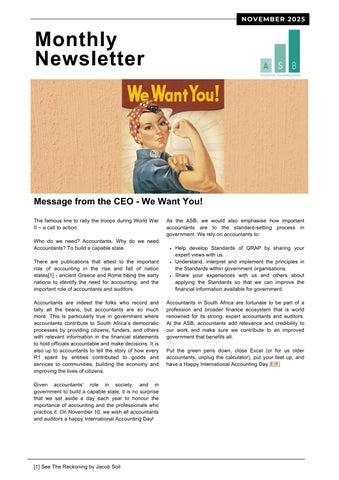
There are publications that attest to the important role of accounting in the rise and fall of nation states[1] - ancient Greece and Rome being the early nations to identify the need for accounting, and the important role of accountants and auditors
Accountants are indeed the folks who record and tally all the beans, but accountants are so much more This is particularly true in government where accountants contribute to South Africa’s democratic processes by providing citizens, funders, and others with relevant information in the financial statements to hold officials accountable and make decisions It is also up to accountants to tell the story of how every R1 spent by entities contributed to goods and services to communities, building the economy and improving the lives of citizens
Given accountants’ role in society, and in government to build a capable state, it is no surprise that we set aside a day each year to honour the importance of accounting and the professionals who practice it. On November 10, we wish all accountants and auditors a happy International Accounting Day!
Understand, interpret and implement the principles in the Standards within government organisations Share your experiences with us and others about applying the Standards so that we can improve the financial information available for government
Accountants in South Africa are fortunate to be part of a profession and broader finance ecosystem that is world renowned for its strong, expert accountants and auditors At the ASB, accountants add relevance and credibility to our work and make sure we contribute to an improved government that benefits all
Put the green pens down, close Excel (or for us older accountants, unplug the calculator), put your feet up, and have a Happy International Accounting Day ����
[1] See The Reckoning by Jacob Soll
requires that, for an arrangement to be a principalagent arrangement, there must be a binding arrangement between the parties A binding arrangement, which can be evidenced through a contact, legislation or similar means, or through the operation of law, needs to be in place as it establishes the rights and obligations of the parties to the arrangement.
Entities often struggle to identify whether a principalagent arrangement exists, especially when binding arrangements are unclear or not in writing. To assist entities with identifying whether a binding arrangement exists, ED 215 on Proposed Amendments to GRAP 109 combines the relevant
the parties’ rights and obligations An entity should therefore consider all the mechanisms to determine if the arrangement is a principal-agent arrangement; judgement should be applied to determine if a binding arrangement exists; and when there are modifications to the binding arrangement, an entity assesses if the nature of the arrangement has changed.
Do you agree with these proposed amendments? You can share your views on ED 215 by submitting written comments to info@asb.co.za, or by participating in roundtable consultations The “ASB Engage” post on Friday includes information on scheduled engagements or contact Amanda Botha at amandab@asb co za for more
Proposed amendments to the GRAP 109 disclosure requirements
ED 215 on Proposed Amendments to GRAP 109 on Accounting by Principals and Agents proposes amendments and additional disclosures for entities involved in a principal-agent arrangement These include:
a new disclosure objective to guide preparers in providing information that meets users’ needs, rather than providing a checklist of required disclosures This objective replaces the previous GRAP 109 guidance on materiality and the aggregation of information for disclosure purposes a new requirement to disclose significant judgements made in concluding that an arrangement meets the definition of a principalagent arrangement; and
a cross-reference to the encouraged disclosure on the nature and amount of restricted cash balances in GRAP 2 on Cash Flow Statements
Have your say on these proposals
The Board wants to hear from you! Share your views on the disclosure proposals in ED 215 by submitting written comments to info@asb co za, or by participating in roundtable consultations You can contact Amanda Botha at amandab@asb co za for more information on scheduled engagements
The comment deadline for ED 215 is 13 February 2026
When is an arrangement a principal-agent arrangement? [part 1]
ED 215 on Proposed Amendments to GRAP 109 on Accounting by Principals and Agents proposes several amendments to assist entities in assessing whether the definition of a principal-agent arrangement is met This article highlights some of these proposals
(a) Assess the nature of an arrangement before applying GRAP 109
ED 215 clarifies that an entity first needs to assess whether an arrangement is a principal-agent arrangement before accounting for the arrangement using GRAP 109 If the definition of a principal-agent arrangement is not met, other GRAP Standards are applied to account for the arrangement
(b) A single binding arrangement may create multiple rights and obligations
This proposal clarifies that a single binding arrangement between parties can establish rights and obligations for the parties involved for different activities .
The parties to the arrangement need to assess the rights and obligations for each activity and related transactions, or group of similar transactions that share similar characteristics
This is because not all the activities and their related transactions may meet the definition of a principal-agent arrangement
(c) Direction given by the principal ED 215 clarifies that a principal does not need to actively direct an agent to undertake transactions on its behalf and similarly, the agent does not need to receive active direction from a principal, for a principal-agent arrangement to exist
The direction is established through the rights and obligations as set out in the binding arrangement. A binding arrangement is evidenced through a contract, legislation or similar means, through the operation of law, or a combination of these These mechanisms should be read together, as applicable.
Want to share your views?
You can share your views on these proposals in ED 215 by either submitting written comments to info@asb co za, or by participating in one of the roundtable discussions scheduled by the Secretariat
You can contact Amanda Botha at amandab@asb co za for more information on scheduled engagements
The comment deadline for ED 215 is 13 February 2026
Also, have a look out for a future article that highlights other proposals in ED 215 that clarify whether the definition of a principal-agent arrangement is met