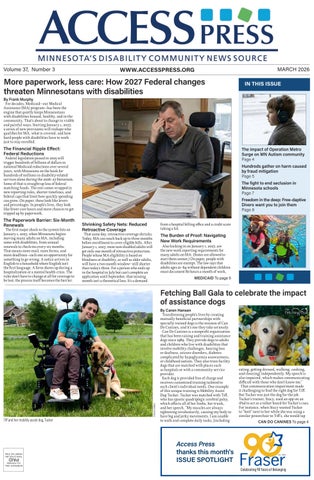
March 2026 Edition - Access Press

Page 1


For decades, Medicaid—our Medical Assistance (MA) program—has been the engine that quietly keeps Minnesotans with disabilities housed, healthy, and in the community. That’s about to change in visible and painful ways. Starting January 1, 2027, a series of new provisions will reshape who qualifies for MA, what is covered, and how hard people with disabilities have to work just to stay enrolled.

The Financial Ripple Effect: Federal Reductions

Federal legislation passed in 2025 will trigger hundreds of billions of dollars in national Medicaid reductions over several years, with Minnesota on the hook for hundreds of millions in disability-related services alone during the 2026–27 biennium. Some of that is straight-up loss of federal matching funds. The rest comes wrapped in new reporting rules, shorter timelines, and federal caps that limit how quickly spending can grow. On paper, these look like levers and percentages. In people’s lives, they look like fewer care hours and more chances to get tripped up by paperwork.

The Paperwork Barrier: Six-Month Renewals

The first major shock to the system hits on January 1, 2027, when Minnesota begins moving many adults on MA, including some with disabilities, from annual renewals to check-ins every six months. That means more mail, more forms, and more deadlines—each one an opportunity for something to go wrong. A notice arrives in English to a household where English isn’t the first language. A form shows up during a hospitalization or a mental health crisis. The rules don’t have to change at all for coverage to

Shrinking Safety Nets: Reduced Retroactive Coverage

That same day, retroactive coverage shrinks. Today, MA can reach back up to three months before enrollment to cover eligible bills. After January 1, 2027, most non-disabled adults will get only one month of retroactive protection. People whose MA eligibility is based on blindness or disability, as well as older adults, will have a two month window—still shorter than today’s three. For a person who ends up in the hospital in July but can’t complete an application until September, that missing

The impact of Operation Metro Surge on MN Autism community Page 4

Hundreds gather on harm caused by fraud mitigation

Page 5

The fight to end seclusion in Minnesota schools

Page 7

Freedom in the deep: Free-daptive Divers want you to join them Page 8

from a hospital billing office and a credit score taking a hit.

The Burden of Proof: Navigating New Work Requirements

Also kicking in on January 1, 2027, are the new work reporting requirements for many adults on MA. (States are allowed to start them sooner.) On paper, people with disabilities are exempt. The law says that adults ages 21–64 without dependent children must document 80 hours a month of work,

Fetching Ball Gala to celebrate the impact of assistance dogs

Transforming people's lives by creating mutually beneficial partnerships with specially trained dogs is the mission of Can Do Canines, and it’s one they take seriously. Can Do Canines is a nonprofit organization that has been raising and training assistance dogs since 1989. They provide dogs to adults and children who live with disabilities that involve mobility challenges, hearing loss or deafness, seizure disorders, diabetes complicated by hypoglycemia unawareness, or childhood autism. They also train facility dogs that are matched with places such as hospitals or with a community service provider.

Each dog is provided free of charge and receives customized training tailored to each client’s individual needs. One example of this unique training is Mobility Assist Dog Tucker. Tucker was matched with Tiff, who has spastic quadriplegic cerebral palsy, which affects all of her limbs, her trunk, and her speech. “My muscles are always tightening involuntarily, causing my body to have big and jerky movements. I am unable to walk and complete daily tasks, [including

eating, getting dressed, walking, cooking, and cleaning] independently. My speech is also impaired, which makes communicating difficult with those who don’t know me.” That communication impairment made it challenging to find the right dog for Tiff. But Tucker was just the dog for the job. Tucker’s trainer, Stacy, used an app on an iPad to act as a talker board for Tucker’s cues. For instance, when Stacy wanted Tucker to “heel” next to her while she was using a similar powerchair to Tiff’s, she would tap

Tiff and her mobility assist dog, Tucker
MEDICAID

OPINION

The power and the duty of advocacy

A message from Heidi

In 1986, I began my work in advocacy. It had probably started before then, but that was the first time I realized I was being an advocate. I was 16 years old. My friend, who worked as a Certified Nursing Assistant (CNA), told me about the job. To a 16-year-old girl, it sounded like "good money." I got the job at the nursing home, and I can still remember the distinct feeling that I did not know what I had gotten myself into.

It was scary and exhilarating all at once. Here I was, a very young person responsible for the care of people who needed a lot of support. It was exhilarating because I knew I could make a difference in their lives. As it turns out, I did make a difference, but they made an even bigger difference in mine.

A Foundation in Care

For the next eight years, through high school and college, I worked as a CNA in nursing homes and as a home health care aide, providing care to people with disabilities in their own homes. Even though it is 30 years later, the people I cared for are still very much alive in my mind.

My favorite days were when we had time to sit down and talk. They would hold my hands in theirs, soft or rugged, and tell me about their histories or their families. I cared for them as they aged, as they grew sick, and sometimes, I was with them when they passed away. I learned early on that it is an honor to be with someone when they die. They knew I cared, and that mattered to me, to them and their families.

That early experience shaped my lifelong commitment to improving the lives of

From Direct Service to Public Policy

I attended college close to home so I could continue working in care settings. At the time, I wasn’t sure where my future lay, but an inspiring political science professor gave me the "political bug." I realized that to make systemic change, I needed to understand the system.

After earning my degree in Political Science, I landed a job as a Legislative Assistant at the Minnesota State Senate.

Around that same time, Irma, my friend of eight years (who lived at the nursing home), passed away. It felt like the right time to transition into a new way of helping. I spent the next 20 years in various roles

HISTORY NOTE

within the Minnesota State Senate, the House of Representatives, the Department of Health, and the Governor’s Office as a policy advisor focusing on health care and human services. I developed expertise in Medicaid, Medicare, disability rights, and longterm care, later advancing these priorities through public policy roles at AARP and Care Providers of Minnesota.

I met amazing advocates during this time, people who made real change happen by advocating for themselves and their loved ones. Leadership and Lived Experience

Eventually, I moved from policy back to provider leadership, serving as Executive Director of a nonprofit that provided services and housing for 160 people with developmental disabilities and 250 employees. Leading that team allowed me to manage the business side of a nonprofit while staying deeply connected to the human side. I sat with the people we served in their homes, learning about their friends, their fears, their happiness, their lives.

However, I don’t want to romanticize these experiences. Over the years, I saw mistreatment. I saw regulations that didn’t make sense and seemed to get in the way of good work. I saw people facing loneliness at the end of their lives, and I saw the chronic issue of staffing shortages that existed when I was a CNA in 1986, and continues today.

I also have personal skin in the game. I have worked with and advocated for my own daughter to get an IEP at her school, a world we had to learn to navigate from scratch. I hear from friends about their struggles with TEFRA fees, mental health concerns, accessibility issues, and the daunting task of

Eighty years later: Remembering the 1946 push for mental

The end of fighting in World War II didn’t mean an end to the disabling health conditions veterans faced. While physical disabilities were noticeable, many veterans struggled with the hidden disabilities of mental illnesses.

Stepped-up efforts to address mental health issues faced by veterans began 80 years ago. Men who were conscientious objectors or COs were given the option of being part of the Civilian Public Service (CPS) Program.

CPS operated between 1941-47 and employed almost 12,000 men in unpaid “work of national importance.” The men were from what were described as “peace churches” including Brethren, Mennonites and Quakers.

Working in what were described as “mental hospitals” was an option. Other jobs were in soil conservation, firefighting, agriculture and forestry.

CPS workers weren’t paid by the government and relied on their families and home churches for support.

Conditions in the hospitals shocked many of the CPS workers, leading to what became a national reform movement.

The National World War II Museum website tells us:

Although not always as physically demanding, the work performed by COs in psychiatric hospitals was some of the most difficult. Care for those with mental illness in the 1940s was oftentimes inhumane, as many of the men learned.

Orderlies were known to strike patients, something which those who believed in

transitioning into adult services. The Responsibility to Speak Up

Despite the challenges, I know the power of advocacy. I have seen the advancements made over the last few decades. I see hundreds of thousands of people identifying where things can be better.

I read a quote years ago by Lily Tomlin that sticks with me: “I always wondered why somebody didn’t do something about that, and then I realized I was somebody.”

We all have to do something. Sometimes you advocate for yourself, sometimes for a loved one, and sometimes for the community at large. Every voice matters. If you do not speak up, nobody can hear you.

As I step into the role of Executive Director at Access Press, I am honored to carry forward its mission of amplifying the voices of Minnesotans with disabilities. For me, that means creating space for real conversations, sharing stories about what is happening in our community, and ensuring this paper continues to be a place where people feel heard, connected, and supported.

My advice to our readers is this: Speak up. Get involved. Talk to your legislators, your city council, your case managers, and anyone who can help make change. Write letters, go to a lobby day, join an advocacy group, go to your local legislator's town halls, meet with them in their office at the Capitol, your voice does make a difference.

I believe we are all responsible for using our voices for greater good. We must try, and keep trying. You will make a difference. You are somebody.

health reform

nonviolence struggled to cope with. They instead learned to use restraint, not violence, to curb violent episodes, which began to be noticed by the patients, if not the orderlies.

Appalled by the treatment of such vulnerable men, some COs snuck in cameras to document the treatment and conditions in the hospitals. A selection of these photographs was published in a May 1946 edition of Life magazine, causing a national uproar and a cry for change. Instead of waiting for others to make changes, COs from a hospital in Philadelphia started an association to train and professionalize work at psychiatric

In 1946 the workers launched the National Mental Health Foundation, as a way to expose abusive conditions at the institutions. Their work led to early efforts toward deinstitutionalization.

A leader in the movement toward more human treatment was Harold E. Barton.

Harold Barton was one of four CPS workers who created the Mental Hygiene Program of CPS, largely responsible for exposing the abuses that occurred in many of the hospitals in which CPS workers were stationed. The Oregon native was a mining engineer when he was drafted.

Barton recalled his experience at the

Philadelphia State Hospital:

“We were presented with the latest insights into the nature, the care, the treatment of mental illness. Our instruction was on a high and idealistic level. The contrast between the ideal and the practical day-to-day ward situation was so striking as to be upsetting to say the least.”

The expose also forced lawmakers to act. The National Mental Health Act was signed into law by President Harry S. Truman on July 3, 1946. This landmark law pushed forward the need for helping those who live with mental health challenges, through treatment, training and research. It also authorized the creation in 1949 of the National Institute of Mental Health.

Learn more at: https://stcpsarchive.z9.web. core.windows.net/cpsarchive/workers/418.html https://archives.tricolib.brynmawr.edu/ agents/corporate_entities/14018 https://www.nationalww2museum.org/

The History Note is a monthly column produced in cooperation with the Minnesota Governor’s Council on Developmental Disabilities.

Past History Notes and other disability history may be found at https://mn.gov/mnddc

EDITORIAL: Editorial submissions and news releases on topics of interest to persons with disabilities, or persons serving those with disabilities, are welcomed. We reserve the right to edit all submissions. Editorial material and advertising do not necessarily reflect the view of the editor/ publisher of Access Press.

DEADLINE: 15th of each month.

CIRCULATION/DISTRIBUTION: Distributed the 1st of each month through more than 200 locations statewide. Approximately 1,400 copies are mailed to individuals, including political, business, institutional and civic leaders.

SUBSCRIPTION: Free and accessible to anyone in MInnesota, visit www.accesspress.org/subscribe ABOUT ACCESS PRESS: A monthly newspaper published for persons with disabilities by Access Press, Ltd.

POSTMASTER: Send address changes to Access Press, PO Box 40006, Industrial Station, St. Paul, MN 551048006

INQUIRIES AND ADDRESS CHANGES should be directed to: Access Press, PO Box 40006, Industrial Station, St. Paul, MN 55104-8006; 651-644-2133; email: access@accesspress.org Website: accesspress.org

Heidi Holste
President Harry S. Truman signing National Mental Health Act July 3, 1946.

How Fraser Helps the Youngest Children Build Strong Beginnings ISSUE SPOTLIGHT

provider of early childhood mental health services.

One of Fraser’s strengths is the range of services available across early childhood. From infancy through age seven, children can receive coordinated care that evolves with their development. Clinicians work closely with families to monitor progress, adjust goals, and recommend next steps, ensuring that children continue to receive the right level of support at the right time. This continuum of care helps families avoid gaps in services and creates a sense of stability during critical developmental years. Fraser provides 63% of Minnesota’s early childhood mental health services to children 0-5, making us a critical part of the state’s mental health safety net.

with a focus on partnering with caregivers emotional health. Fraser offers a variety of evidence-based and evidenceinformed services to match every young child’s unique needs.

Fraser Early Beginnings is an evidenced informed, interactive, play-based therapy designed for children from birth to 48 months who have autism spectrum disorder or social and communication concerns. The program focuses on strengthening parent-child relationships while building communication, play, and social engagement skills.

Fraser Attachment Biobehavioral Catch-up (ABC) and Fraser Child Parent Psychotherapy (CPP) are evidenced based interventions for young children and their families who have experienced

trauma and stress. ABC is a homebased, parent-coaching intervention that supports the development of parenting behaviors which foster socialemotional health in children. CPP is a family-centered treatment focused on caregiver/child relationships to help children and families heal and grow after stressful experiences and improve the child’s emotional, behavioral, social and cognitive functioning.

Fraser Parent-Child Interaction Therapy (PCIT) is an evidence-based intervention for children experiencing challenging behaviors. PCIT uses parent coachingbased to improve the quality of parent-child relationships and manage challenging behaviors.

Research consistently shows that early intervention can lead to dramatically positive outcomes, especially when parents are engaged partners in the process.

Fraser clinicians also help families identify next steps based on each child’s individual progress, ensuring support continues in ways that meet evolving needs.

Fraser offers intensive early childhood mental health services including day treatment and Applied Behavior Analysis (ABA). Additionally, young children can also access rehab services through Together We.

Early, effective mental health intervention can help children get back on track and improve developmental outcomes, support the parent/child relationships and decrease stress in family. Just as importantly, it helps children experience success, connection, and joy in their everyday lives.

Getting Started

Fraser is here to help. Get started with services by scheduling an initial assessment with an experienced early childhood mental health clinician. Call our intake line at 612-767-7222 to schedule your Initial Assessment today.

This approach allows advertisers to craft compelling copy, showcase visuals, and share their story with readers effectively. This is an excellent opportunity to shine a spotlight on a dedicated month that centers around a particular disability or theme. Highlights feature a promotion on page 1 and an article on page 3.

FROM OUR COMMUNITY

The impact of Operation Metro Surge on Minnesota’s autism community

Immigration and Customs Enforcement (ICE) Operation Metro Surge has had far-reaching effects across Minnesota communities. The federal government has stated that the surge was prompted by fraud allegations in Minnesota—an issue that has already had a disproportionate impact on people with disabilities. In the wake of increased ICE activity, disruptions in school attendance and access to healthcare have been widely documented. Reports of ICE vehicles following school buses and special education transport vehicles have heightened fear among families and raised serious concerns about the vulnerability of children with disabilities.

As professionals and partners serving Minnesota’s autism community, we are deeply concerned about the impact of these operations on autistic children, adults, and their families. Many autistic individuals experience heightened anxiety, particularly when routines are disrupted or environments become unpredictable. For autistic people who have higher support needs, consistent services are essential to maintain and build critical skills.

Interruptions in care can have immediate and long-term consequences. For many autistic children, missing even a few weeks of therapy or school can mean losing hardwon communication, daily living, and emotional regulation skills.

To better understand these impacts, clinician-researchers at the University of Minnesota partnered with the Autism Society of Minnesota to survey autism service providers statewide. The goal was to inform policymakers and community leaders about the scope and severity of service disruptions associated with Operation Metro Surge.

The survey was distributed through statewide professional and community networks, including early intervention, education, healthcare, and advocacy organizations. Sixty-three providers responded as of February 12, 2026.

Key findings include:

• 87% of providers reported that their clients had been impacted by ICE activities in Minnesota.

• More than 70% described the level of disruption to their organization as moderate to severe.

CAN DO CANINES

From page 1

the cue “heel” from the matrix of more than a dozen words on the screen. This would generate the cue in Tiff’s own voice, so Tucker could begin to recognize her sounds.

• Over 80% reported that clients missed services by staying home, experienced increased anxiety or fear related to ICE activity or had family members or friends who felt targeted based on immigration status, appearance, or accent.

• 52% reported that clients witnessed ICE activities in person.

• 40% reported that a client’s family member or close contact was detained by ICE.

• 7% reported that a client was detained. Service providers themselves have also been affected.

• Two-thirds reported lost staff time due to ICE-related disruptions.

• 10% reported that a staff member had been detained.

• More than 80% of organizations created new ICE-specific policies, including updated privacy protocols, family resource supports, and building security procedures to protect therapy, healthcare, and classroom environments.

These findings make clear that Operation Metro Surge has significantly disrupted

“Help” (for “get help”), “down,” and “get it” were just a few of the other prompts Stacy could select.

With Tucker now in her home and life, Tiff shares, “Tucker remains by my side through the day, retrieving items that I need and drop, such as my cell phone (most

autism services in Minnesota. Providers are observing fear-driven interruptions among a population that depends on stability and predictability. Our experience during COVID-19 demonstrated that service disruptions and traumatic events can have lasting effects on autistic individuals, including missed developmental gains, regression in critical skills, long-term mental health impacts, and difficulty re-engaging with community life after crises subside.

Autism service providers continue to operate on extremely narrow financial margins. The pandemic created severe staffing shortages and reduced service capacity across the state. We anticipate that ICE-related disruptions—combined with payment pauses and administrative burdens associated with fraud investigations—will further strain an already fragile system.

Minnesota must act to mitigate these impacts and protect continuity of care. State and local leaders have both the authority and responsibility to act now.

We join the broader disability community

importantly), shoes, and kitchen towels. Additionally, I can always count on Tucker to “get help” when needed … [He] also offers me independence by tugging open and shutting drawers, tugging laundry baskets, opening doors, and helping me get undressed. Lastly, Tucker not only helps me be an independent person, but he also empowers me to be a mom to my 5-year-old son.”

Another dog, Gaelen, was trained with a combination of skills for Valerie, who needed help with both mobility and seizure challenges. Valerie shares, “I can do so many things with more ease and more peace of mind. I think that peace of mind aspect is what a lot of people could use when they have a disability. In some ways, they can’t trust their own bodies; I can’t trust mine to do what I would like it to, but having a helper do what I want to do is such an amazing gift.”

Can Do Canines has certified over 900

• Continuity of care safeguards, including clear transfer-of-care and care navigation plans when families experience service interruptions due to enforcement actions.

• Development and dissemination resources—created in partnership with autism professionals and individuals with lived experience—to promote resilience and recovery both during and after the surge.

• Investment in workforce development,

behavioral health providers specializing in neurodevelopmental disabilities. Minnesota already faces a severe provider shortage, and families cannot continue to wait months—or years—for essential services, particularly

Autistic Minnesotans deserve stability, dignity, and uninterrupted access to the services that allow them to learn, grow, and thrive. Public policy decisions and enforcement practices must consider and address the disproportionate impact on individuals with disabilities and the systems

Amy Esler, PhD, LP; Ellie Wilson, Executive Director, Autism Society of Minnesota; Jennifer Hall-Lande, PhD, LP ; Kathryn Ashley; Paige Berland, MA, LPCC, LBA, Minnesota Behavioral Specialists ; Catherine (Casey) Burrows, PhD, LP; Maren Christenson Hofer, Multicultural Autism Action Network; Jen Diederich, MA, BCaBA, MAC-Midwest; Marie Erickson; Abigail Ernst; Charles Jaschek, MD, Masonic Institute for the Developing Brain; Eric V. Larsson, PhD, LP, LBA, BCBA-D, Lovaas Institute; Chimei Lee; Elizabeth Lood, MS, BCBA, LBA, The Lazarus Project; KayeAnn Mason LICSW QSP; Melyssa McDonough; Emily Monn; Mikenna Mork, BCBA, LBA; Katherine E Murray, MD, MPH, Developmental Behavioral Pediatrics; Jane Nofer, PhD, LP, Great Lakes Neurobehavioral Center; Alissabeth Olejniczak, MA, BCBA, LBA, Caravel Autism Health; Robin Rumsey, PhD, LP; Jessica Simacek, PhD; Kyle Sterrett, PhD, LP; Sethe R. Zachman, Fraser, LLC. and University of Minnesota Special Education

teams and will celebrate these inspiring partnerships at its annual Fetching Ball Gala, scheduled for Saturday, April 11, at 6 p.m., at Radisson Blu Mall of America. Participants will enjoy dinner, inspiring stories, games, and silent and live auctions. KARE 11 Anchor Lauren Leamanczyk will serve as Master of Ceremonies.

Tickets must be purchased by April 1. All proceeds help Can Do Canines continue to provide free, specially trained assistance dogs to people with disabilities.

Event Producer Melissa Herman says, “The Fetching Ball Gala has always been a very special event for Can Do Canines. You will enjoy stories that will pull on your heartstrings, fabulous auction items, delicious food, and of course, dogs.”

To learn more about Can Do Canines, the Fetching Ball Gala, or an upcoming open house, visit candocanines.org.

Responsive PCA Choice Services

Independent Living Services

ADA Information & Referral

Information

COVID Community Coordination

Covid Community Coordination

Long COVID Information & Referral

Transitional and Housing Services

PCA College Service Corps

Transitional and Housing Services

Contact us today!

Contact us today!

Contact

www.mcil-mn.org

651-646-8342 www.mcil-mn.org

651-646-8342

530 North Robert Street Saint Paul, MN 55101

your most independent life, follow your path!

ICE presence in Minnesota has caused families to fear leaving home.
Valerie and Gaelen at last year’s Fetching Ball Gala.

Hundreds gather for town hall on harm caused by Minnesota fraud mitigation

More than 700 Minnesotans gathered virtually on February 4 for a statewide discussion to address harm caused by recent Minnesota Medicaid fraud mitigation efforts. The event titled, “Let's Talk About Disability Services in Minnesota,” was hosted by the Minnesota Council on Disability (MCD).

The purpose of the meeting was to let members of the public and legislators know how new anti-fraud measures were affecting real people. Throughout the meeting testimony revealed that delayed payments caused agency closures, caregiver layoffs, and Minnesotans with disabilities left without essential care.

“This is not a theoretical harm,” said MCD Executive Director David Dively, at the opening of the event. He noted that there has already been a death associated with these sudden lapses in service.

A poll conducted during the meeting underscored the community’s panic: 80 percent of attendees reported feeling either “concerned,” “overwhelmed,” or “afraid.” Comments and microphones were turned off for community members. The only way to interact was to send emails to the moderator.

The Human Cost of Bureaucracy

The event became emotional when Minnesotans with disabilities began testifying about the real-world impact of policy decisions.

A wheelchair user who relies on a team of 12 caregivers to live independently, testified that she received notice on New

MEDICAID

From page 1

job training, or volunteering unless they meet exemptions for disability, pregnancy, or American Indian/Alaska Native status. The key word there is “document.”

Real life is not a neat chart. Many people with disabilities work part-time, seasonally, or in jobs where hours fluctuate with health, transportation, or caregiving needs. Others are early in the process of getting a disability determination, or their conditions aren’t easily captured by a single diagnosis code. By January 1, 2027, these Minnesotans will be asked to prove, and re prove, that they are exempt—or that they meet the new work standard. Every month. Every year. Miss a request for information, fail to upload a form, or misunderstand a deadline, and coverage can be suspended even when the person is doing everything the policy supposedly wants: working as they are able, contributing, and trying to stay healthy.

Squeezing Community Supports:

Caps on Waiver Funding

Beyond that date lies another shift, less visible but just as consequential: federal caps on how quickly Medicaid spending can grow, scheduled to bite hardest in the 2027–28 biennium. In Minnesota, the pressure won’t fall evenly. It will land most heavily on homeand community-based services—the disability waivers that pay for personal care attendants, supported housing, day programs, and other supports that make community living possible. These are exactly the services that uphold Minnesota’s obligations under the Americans with Disabilities Act and the landmark Olmstead decision. When they are squeezed, the entire promise of “the most integrated setting” is at risk.

We’ve seen how this plays out when budgets tighten. Waiver rates don’t keep up with inflation, so providers can’t pay competitive wages and staff leave. Counties quietly cap caseloads or slow down assessments. Families hear that “everyone is being asked to do more with less.” For the person receiving services, it looks like fewer PCA hours, a denied

been suspended. She described the terror of facing institutionalization—a move that would disrupt her career, her family life, and the independence she has worked hard to achieve.

“We should not need to justify our right to exist,” she told the attendees, demanding that Minnesotans with disabilities stop being treated as “disposable pawns” in a

request for adaptive equipment, or pressure to consider a more congregate, cheaper option. Once those community supports erode, they don’t snap back when the economy improves; rebuilding takes years.

Taking

Action: Preparation and Advocacy

So what does January 1, 2027, mean in practical terms if you are a Minnesotan with a disability, or love someone who is?

First, it is a call to get your own house in order, as unfair as that may feel. If you rely on MA, know your renewal month and mark it on a calendar. Make sure your address and phone number are up to date with your county or tribal human services office and your health plan. Gather and organize key documents now—disability determinations, assessment letters, pay stubs, benefit notices— so you are not scrambling when the first six month renewal hits.

Second, this date is a call to collective action. Disability organizations, Centers for Independent Living, provider agencies, and advocacy groups have a narrow window to shape when and how Minnesota implements these federal mandates. The federal law sets parameters, but states choose how clear their notices are, how generous their timelines are, and how easy they make it to claim exemptions or appeal mistakes. That happens when Minnesotans with disabilities, families, and allies insist on being in the room, reviewing draft forms, testifying at hearings, and defining consequences if these changes roll out without strong safeguards. Third, we need to challenge the inevitability narrative. You’re going to hear a lot over the next two years about “doing our part,” “bringing Medicaid growth under control,” and “aligning with federal expectations.” There is some truth in this. But it’s also true that Minnesota has choices about where the pain lands. We can choose to protect disability waivers and MA EPD from the worst of the cuts. We can choose to simplify, rather than multiply, renewal and documentation requirements for people with stable disabilities. We can choose to

disruption in services affected her life. "I cannot eat, I cannot shower, I cannot change my clothes," she said, describing the reality of service interruptions. She also highlighted the exhausting redundancy of the system, noting she must constantly “re-justify” her need for a wheelchair and communication device every five years, despite her disability being permanent.

invest a little more in county staff, care navigators, and legal aid so that eligible people aren’t dropped simply because they couldn’t decipher a confusing letter. Finally, we need to remember that these policies are not laws of nature. The provisions taking effect on January 1, 2027, were passed by elected officials. They can be adjusted, delayed, or mitigated—by those same officials or their successors—if they hear enough from the people who will live with the consequences. That means the time to speak up is before the first termination notice hits someone’s mailbox, not after.

State Response and the "Squeaky

State officials and legislators attended the

Lieutenant Governor Peggy Flanagan joined the call to let everyone know she is aware of issues and working on solutions. While maintaining that fraud prevention is necessary, Flanagan admitted that state actions alone haven't been enough to protect vulnerable citizens and promised that the administration is appealing federal decisions

DHS Director, Heidi Hamilton also spoke, acknowledging communication missteps by the department, citing unprecedented pressure from federal oversight as a driving force behind the aggressive audits.

Sen. Jim Abeler (35, R) was critical of the current process, particularly the “credible allegation of fraud” standard that freezes funding for honest providers without due process. “You are not a statistic,” Abeler told

The event concluded with a unified call to action from organizers and legislators alike.

“Be squeaky,” Representative Kim Hicks (25A, D) said. She urged the community to contact their legislators, county commissioners, and case managers to ensure that the human rights of Minnesotans with disabilities are not lost in a spreadsheet.

As the 2026 legislative session approaches, the message from the town hall was clear: The disability community must not be silent while their lives and independence are on the line.

Conclusion

Minnesota can’t ignore every federal cut. But we can decide whether we implement them in a way that honors the time, dignity, and aspirations of people with disabilities, or in a way that threatens their independence. For the nearly 200,000 Minnesotans who depend on MA to get out of bed, go to work, and stay in their homes, those are not abstract choices. They are the difference between merely surviving the next round of reforms and having a real shot at thriving. Your advocacy can make a real difference.

MCD Executive Director, David Dively

Common diabetes drug shown to prevent Long COVID

Many people with Type 2 diabetes take a drug called metformin. It is used to lower blood sugar levels. But in the fight against Long COVID, can Metformin be effective?

The University of Minnesota’s Center for Infectious Disease Research and Policy (CIDRAP) has published research about Metformin and how it can be used to prevent Long COVID. CIDRAP is a global leader in addressing public health preparedness and emerging infectious disease response.

Metformin would not be used as a treatment for the many symptoms of Long COVID. Instead it would be a potential preventative measure. The latest review found that metformin reduced the risk of development of Long COVID, when taken by persons with acute COVID-19 infection during or shortly after their illness. CIDRAP published the findings as did the publication Clinical Infectious Diseases.

University of Minnesota Medical School researchers Carolyn T. Bramante, MD, MPH, and David R. Boulware, MD, MPH wrote the review. It was commissioned to weigh in on a study by London-based Ubonphan Chaichana, MSc, and colleagues and to situate the findings within a widening body of evidence that suggests Metformin use during COVID infection can substantially reduce the risk of developing long COVID.

The Chaichana study looked at overweight or obese people and found a strong protective association between Metformin use and reduced risk of Long COVID.

Metformin is sometimes used by people with disabilities, including intellectual and developmental disabilities. It mainly is used to manage side effects of other medications, such as weight gain.

It is emphasized in the review and studies

starting Metformin during or shortly after an acute COVID-19 infection lowers the risk of clinician-diagnosed long COVID by roughly 40 percent to 60 percent.

“That’s an important point,” Bramante told CIDRAP News. “None of the four studies that we wrote the editorial on were studying Long COVID treatment. They address preventing Long COVID.”

One challenge the researchers faced is that of how Long COVID was measured and defined early in the pandemic.

“The issue is that Long COVID is a new disease, and the whole biomedical research community has grappled with how to define it,” said Bramante. “So for the first clinical trial, we asked participants, ‘Has a clinician diagnosed you?’”

Relying on clinician diagnosis rather than symptom surveys allowed the results to be replicated in electronic health reviews (EHR) and larger trials conducted later. “The big news now is that this has been replicated in these additional studies.”

“This effect—that starting metformin during acute infection is safe and reduces the risk of developing long COVID by about half—has been replicated in multiple studies,” said Bramante. “And these results are relevant to most people getting infected today.”

The review also addresses why the findings have been slow to translate into clinical practice. Metformin is a decades-old generic diabetes drug. It is not an intuitive antiviral, Bramante notes, and its potential role in addressing viral infections has largely flown under the radar.

“This idea of using a chronic diabetes med to treat viral infections is a foreign idea and seems nonsensical,” she said.

But metformin is also low-cost drug with a high safety profile. It’s compatible with other antiviral therapies, such as Paxlovid, said Bramante. That makes a strong case for considering the drug as part of outpatient management aimed at preventing long COVID.

How to Get Involved

Your thoughts and experiences are essential to shaping the future of Long COVID support in Minnesota.

• Take the Survey: Visit https://mcil-mn.org/mcillong-covid-community-survey/ or scan the QR code.

• Contact: If you have questions about the survey, your rights as a participant, or how your answers will be used, please contact Kelly Krantz, Director of Independent Living at MCIL, at kellyk@mcil-mn.org.

The keys to the kingdom: Why your birthday is a terrible password

The Recommendations: Choose Based Upon the Devices You Have

There are many advanced, and paid solutions out there, but we are focusing on the easiest, and mostly free options. Your choice depends on the "platforms" you use—meaning the type of phone and computer you own:

Your 3-Step Action Plan Don't try to change 500 passwords today. You’ll hate me, and you’ll quit. Follow this simple triage:

1: Identify the "Big Fish" Focus on your financial accounts (banks), your primary email, and your healthcare portals. Go change those proactively.

he’s the one who first ignited my interest in technology by showing me his computers and inviting me to help him use them for his accessibility needs. Today, I spend my days at Google and my nights on the board here at Access Press. I live with one foot in the hyper-speed world of Silicon Valley and the other in the pragmatic, real-world advocacy of the disability community. I used AI to help me draft these thoughts (because life is short), but the perspective is all mine. Today, we’re talking about Password Managers.

I know. It sounds about as exciting as reading an insurance policy. But here is the cold, hard truth: If you use your birthday, your parent’s name, or "Password123" for every account, you are one data breach away from a very bad year. The goal isn't just a "strong" password; it’s a different password for every site. If a hacker cracks one, they shouldn't get the keys to your entire life. A password manager does the

are using a Mac with an Android phone, you are intentionally making your life difficult. Pick a side! Apple does an excellent job of integrating all of its devices and if you have spent the money on a Mac take advantage of that.

"remembering" so you don’t have to.

For the disability community, a password manager is an accessibility tool. If you have limited dexterity or struggle with memory, having a tool that auto-fills your info is a gamechanger.

Decoding the Alphabet Soup: 2FA, MFA, and Passkeys

Before we get to the "how," let’s clear up the jargon. These tools are the digital version of "double locking" your front door.

• 2FA / MFA (Two-Factor / Multi-Factor Authentication): This requires a second "factor"—usually a code sent to your phone or an app—to log in. Even if someone steals your

password, they can't get in without that code.

• Passkeys: This is the new gold standard. Instead of typing a password, you use your device’s security (like a fingerprint, face ID, or phone PIN) to log in. It’s faster, more secure, and impossible to "forget."

Pro Tip: For the best security, use 2FA/ MFA and or Passkeys whenever they are available along with having a unique password in your password manager. Whenever a website offers both 2FA/MFA and Passkeys, turn them both on. Using a Passkey as your primary login and having 2FA/ MFA is like having a deadbolt and a security camera.

2: The "As You Go" Method Don't stress about the rest yet. Every time you log into a site and realize you're using an old, weak password, change it right then and there. Your password manager will offer to save it for you.

3: Always Turn on MFA/2FA If a site offers it, use it. It is the single best way to keep hackers out of your business.

What’s On Your Mind?

But we want to hear from you. Does this all sound like gibberish? Is there a specific tech barrier preventing you from living your best life?

Send your tech questions to us at editor@ accesspress.org. We’ll pick a few questions and tackle those in an upcoming column.

Tim Benjamin is an Access Press Board member and a Google employee.

952-472-1458

6371 Bartlett Blvd Mound, MN 55364

Bartlett Blvd Mound, MN 55364

ProAdvisor 2022 | 2005-2021

ProAdvisor 2022 | 2005-2021

• Located on 180 acres along beautiful Lake Independence, Vinland Center provides drug and alcohol treatment for men with brain injuries, cognitive impairment, and/or multiple disabilities.

• There are many causes of brain injury, and each brain injury is unique.

• Our staff members are highly trained to work with people living with disabilities caused by brain injuries.

763.479.3555 • VinlandCenter.org

Locking doors on scared children: The fight to end seclusion in Minnesota schools

When parents envision a special room for a child in distress, they likely picture beanbag chairs, soft lighting, and toys. They couldn’t imagine a 5-by-6-foot concrete cell with a heavy metal door, magnetic locks, and no windows. Yet according to attorneys at the Minnesota Disability Law Center (MDLC), this is the reality of "seclusion rooms" in many Minnesota schools. These are stark rooms where a child can be involuntarily confined for hours.

In an interview with Access Press, MDLC staff detailed the findings in their new report, Children in Confinement, and the urgent legislative battle to protect the state’s most vulnerable students.

Stark, Empty, and Awful

There is lots of confusion between seclusion rooms and sensory rooms in schools. "Seclusion rooms are stark and empty and awful looking," Jessica Heiser, supervising attorney for MDLC’s Education Team, explains. "Sensory rooms are colorful and fun and have toys. You’re there with another adult who is co-regulating with you."

In contrast, seclusion rooms are often built with cinderblock walls and concrete floors for "ease of cleaning," implying an expectation that children will be so distressed they may soil themselves or vomit. The doors are heavy, often metal, and lock from the outside.

History of Hidden Trauma

For many families, the first time they learn their school has a seclusion room is after their child has been injured in one. Heiser recounted the story of a third-grade student with a learning disability who had no prior history of behavioral incidents. When a new, inexperienced principal took over, the child’s behavior was met not with support, but with confinement.

The boy was locked in a small room for hours, denied food and water. In his distress, he ran into the walls trying to escape, sustaining a brain injury and three hematomas. His mother only discovered the situation when she was called to pick him up and found him locked inside.

“The child is already traumatized, the family and school relationship has completely broken down, and the damage has been done,” Heiser said.

The Doomsday Myth

Despite these horrors, the practice persists, driven by what MDLC attorneys call "doomsday

arguments." Opponents of the ban suggest that without seclusion, schools will be forced to rely on police intervention or dangerous physical holds to manage unsafe behavior.

“We went to other states that have banned seclusion—there are 11 now—and asked, 'Have you seen law enforcement involvement increase?' And nobody said yes,” Heiser said.

“There is no data across the country that backs it up the argument that seclusion decreases violence.”

In fact, MDLC argues the opposite is true: seclusion escalates behavior rather than resolving it.

The Legislative Battleground

Minnesota is currently at a crossroads. A 2023 law successfully banned seclusion for students up to third grade, but a provision to end the practice for all students by 2026 failed to pass. Now, advocates are fighting a defensive battle.

Jessica Webster, a legislative staff attorney with Legal Aid, highlighted a current push led by Senator Judy Seeberger to roll back the existing K-3 ban, driven by personal experiences where she felt seclusion was necessary for safety.

“It’s really a one-legislator strong fight,” Webster said. “She did not have the votes in the House... but she was able to get votes in the Senate to move us in this direction.”

This rollback effort comes despite the fact that, privately, nearly every school administrator MDLC has spoken to admits they want to stop using seclusion.

“We have not heard a single school say they want to keep seclusion forever,” Heiser said. “They just say, 'We need more tools and training to stop using it.'”

A Call for Transparency

As the legislative session continues, MDLC is urging parents and community members to demand transparency. The report found that the state’s list of registered seclusion rooms is inaccurate, meaning many parents have no idea if their child’s school maintains a locked cell.

“People get confused between a seclusion room and a calming space,” Webster said. “Minnesotans need to understand the vast differences between those two things so that we can end the practice of solitary confinement.”

The full report, "Children in Confinement," is available at https://mylegalaid.org/news-stories/ mid-mn-legal-aid-releases-report-on-childconfinement-in-minnesota-schools/

My experience with autism is a story shaped by the myth of endless resilience.

I was diagnosed at thirty-two, after a lifetime of subconscious survival strategies I didn’t know I was using, and suddenly, I could no longer hold my life together. The mask of the agreeable, shrinking, and cute girl crumbled.

During the pandemic, I was working in a hospital, and the job revealed the limits of my nervous system in brutal ways. My body started screaming with chronic pain a couple of months in, and pushing through the symptoms only intensified them. After a year, I was left with a body that anchored me to my bed with overwhelming pain, and fatigue that found no relief in rest. My mind was so closed off to possibility that I could not even think of applying to another workplace without my breath freezing in my chest.

Disability doesn’t announce itself as a category. It arrives as a circumstance as common as life and death.

What I didn’t know then is that my autism and these debilitating ailments were not separate. Under chronic stress, autism emerged through countless secondary conditions: depression, anxiety, suicidal ideation, chronic pain, and fatigue. My nervous system communicated this way to say it was being pushed beyond its limits. After quitting the hospital, research became my full-time job. I discovered that nervous system regulation is not a luxury; it is the source of quality of life.

My healing didn’t begin until two years later, during the collapse of my marriage and following social solitude. I was left in an extraordinary situation where, for the first time in my life, I was released from the demands of performance. I had no dysfunctional relationships to contort for and no job that erased my needs. Starting that winter, my days and nights fell into a rhythm that only I could hear.

I danced in my apartment with music

blasting in my headphones. My arms cradled me as I swayed back and forth, humming. Sometimes I shook so violently my teeth chattered as I released years of stored trauma from my body. When Spring came, I woke up one day without pain, without fatigue, and with a clear mind. I started to walk nearly every day, and nature gently met me halfway. Mundane miracles appeared in the form of wild animal encounters and weather patterns that seemed to bend around me. In the profound peace I found in those months, I could hear myself again about how I wished to participate in the world.

Support didn’t make me dependent. It allowed me to function and revealed me.

The way I experience autism as a highmasking woman is a feeling of suspension in a liminal space between childhood and adulthood. I’m able to remember both at once, the way a dream lingers upon waking. I feel everything completely, all the time. And I

What do

wouldn’t change it if I had the chance to.

The past few years have transformed me in ways I could have never predicted, and I’m convinced that it wouldn’t be possible without my unique flavor of autism. One way it reaches forward is through human connection. Speaking with people and sharing my life is a beautiful gift, even if it is in line at the grocery store.

My autism is never going to vanish in my lifetime, but the way it expresses itself shifts constantly in response to my environment. When my basic needs are met without condition, my nervous system calms. In that safety, it becomes safe enough to expand, to engage with my community, to uplift others through kind words, through acts of service, through insights that only my mind can convey through my writing. Autism is not a calamity that crashed into my life. It didn’t change anything.

Revelation of myself did.

Mindy Pine
Adult man who is 5 feet 11 inches tall sits in a registered seclusion room with cinder block walls and unfinished concrete floor in Cedar School – Eagan, MN
This calming sensory room with brightly colored cushions, balls, mats, and toys is different than a seclusion room.
– Coon Rapids, MN

Freedom in the deep: Free-daptive Divers

1991,

was a 15-year-old with Olympic dreams. A dedicated cyclist, he was competing in a road race near Duluth when his life changed in a split second. Rounding a curve at 40 mph, he collided with a support vehicle, suffering a spinal cord injury that left him paralyzed and a C4-C5-C6 quadriplegic.

“Doctors told me that I would never feed myself again,” Aaron said.

But Aaron, driven by the competitive spirit that made him an Olympic hopeful, refused to accept that prognosis. He not only regained enough movement to feed himself but went on to achieve what was unimaginable in those early days. He earned a college degree, became a motivational speaker, and traveled the world as a member of the U.S. Paralympic Archery team, winning silver and bronze medals in international competitions.

Yet, despite these triumphs on land, it was a different surface where he found the most freedom.

Taking the Plunge

Aaron’s journey into the underwater world began with a simple question from his father. His dad, an avid diver, asked an instructor if his son could ever join him. The instructor, a man named Bill King, didn’t hesitate. He simply said, "Guess what? I've got a problem"—meaning he was going to find a solution.

That solution led Aaron to a pool, where he took his first breath underwater. For a man who spends his days fighting gravity in a wheelchair, the sensation underwater was unforgettable.

“It was the first time I felt completely weightless,” Aaron recalled. “I could move in three dimensions. It was absolute freedom that I hadn't felt since my injury.”

He was hooked. Aaron went on to get certified in 2006 while living in England, becoming an HSA (Handicapped Scuba Association) certified diver. He discovered that underwater, the wheelchair is left behind on the dock. The ocean doesn’t care about your disability; it only cares about your buoyancy.

The Mission of Free-daptive Divers

Today, Aaron serves as the President of Free-daptive Divers, a Minnesota-based non-profit dedicated to bringing that same sense of liberation to others with disabilities. Founded in 2016 by a group of passionate divers including Rick Kline and Tom Cornell, the organization operates on a simple but powerful premise: Scuba diving is for everyone.

“We want to help people with barriers navigate and be introduced into the world of scuba diving,” Aaron said.

Free-daptive Divers focuses on ability, not disability. They utilize the buddy system inherent in diving to create safe, accessible experiences.

Scuba and More

Free-daptive Divers offers a variety of programs designed to take people with disabilities from curiosity to certification.

• Try Scuba Events: These introductory sessions are held in the controlled environment of an indoor pool. They allow individuals to experience the weightlessness of diving in a safe, warm, and supportive setting.

• Scholarships: Cost can be a significant barrier to adaptive sports. Free-daptive works to offset these costs, offering scholarships that cover training and certification for aspiring divers.

• Destination Trips: The ultimate goal is to get divers into the open water. The group

organizes accessible dive trips, including an upcoming excursion to Curacao. These trips are meticulously planned to ensure accessible accommodations and boats, allowing divers to experience world-class reefs without worries.

• Community Building: Beyond the diving itself, the organization fosters a community of "dive buddies"—friends and family members who train alongside adaptive divers, strengthening bonds and sharing the adventure.

For Aaron Cross, diving is more than a sport; it’s an equalizer. It’s a place where the physical limitations of life on land dissolve into the blue. Through Free-daptive Divers, he is ensuring that others get the chance to leave their chairs on the dock and experience the freedom of the deep.

To learn more about upcoming events, scholarships, or how to support the organization, visit www.free-daptive.org.

Aaron Cross loves introducing new people to diving.
By Joey Carlson
In
Aaron Cross
New divers often report a sense of freedom during Try Scuba events.
Last year Free-daptive Divers enjoyed a destination diving trip to Curacao.

IN MEMORIAM

Remembering Deb Holtz, lifelong disability rights advocate

Debra "Deb" Holtz, a dedicated attorney, educator, and fierce advocate for the Minnesota disability community, passed away on February 4, 2026. She was 69. Holtz’s career was defined by an unwavering commitment to fairness and the protection of vulnerable populations. Her professional journey began in the classroom as a special education teacher, following her graduation from Augustana University in Sioux Falls. Seeking to deepen her impact, she earned a master’s degree in special education in Colorado.

However, it was her desire to address systemic barriers that led her to the legal field. Holtz earned her law degree from William Mitchell College of Law in St. Paul, specifically to help people with special needs

understand and exercise their legal rights.

Throughout her career in Minnesota, Holtz worked to ensure equity for those often overlooked by the system. Her advocacy work included time with The ARC Minnesota, where she championed individuals with developmental disabilities. She also worked within higher education, providing support services for students with disabilities at Hamline University.

Holtz later served as an ombudsman with the Minnesota Board on Aging. In this role, she acted as a watchdog and advocate, championing the rights and dignity of individuals in long-term care facilities. Even after her formal retirement, she continued her service work as an end-of-life doula, guiding families with compassion and honesty.

Colleagues and friends describe Holtz as

a connector who maintained relationships for decades. She was known for her sharp intellect, optimism, and a distinctively "wacky—sometimes dark—sense of humor."

In her personal life, Holtz was a trailblazer. She intentionally built her family as a single adoptive mother, welcoming her daughters Indra and Radhika from India. She is survived by her daughters; her grandchildren, Jada, Lyric, Isaac, Korell, and Kayden; and her brothers, Joel, Timothy, Michael, and Jon. She was preceded in death by her parents, Bob and Lois Holtz.

Service Information

A celebration of life will be held at 10:00 a.m. on Thursday, May 14, 2026, at the Como Lakeside Pavilion (1360 Lexington Parkway North, St. Paul), with a luncheon to follow.

Deborah Gillis and Bob Rausch are selling this wheelchair accessible home.

For Deborah Gillis and Bob Rausch, their house in Robbinsdale, Minnesota, is more than just a place to live. It is a home renovated and still overflowing with love for Bob’s daughter, Kristina.

Kristina had muscular dystrophy (MD) and used a wheelchair, but she didn’t let that stop her. She was always a huge part of family life, loved adaptive sports, and enjoyed creative activities like jewelry making and gardening. Bob, who Deborah calls "Bob the Builder,"

wanted to make sure his daughter could live as independently as possible. So, he worked hard to make the house accessible in every way that mattered. He even used a large machine to dig out the backyard, turning the lower level into a walkout basement.

The bottom floor of the house became Kristina’s special place. Bob made sure everything was perfect for her. He made sure the bathroom had a roll-in shower and a raised toilet with grab bars. He also made the sink perfect so she could roll her chair right under it.

Another feature they added was a stairlift that brought Kristina right up to the main floor of the house with everybody else.

These changes gave Kristina freedom, peace, and joy.

Kristina passed away a few years ago, but the independence Bob built into the walls is still there. Now, Deborah and Bob are ready to sell the home, but they are looking for a special buyer. They would prefer to sell it to a wheelchair user, so someone else could enjoy the freedom that Kristina enjoyed much of her life.

“It

House Details Price: $550,000. Location: 4201 40th Ave N, Robbinsdale, MN. Contact: Deborah Gillis, 612-432-1289

Features Easy Access: The lower level is a walkout with no steps. Bathroom: Roll-in shower and raised toilet. Kitchen: Sink designed for a wheelchair user. Moving around: Electric stair lift and wide doorways.

Deb Holtz
Kristina

Minnesota chooses medical associations over CDC in new vaccine guidelines

Minnesotans seeking guidance for vaccines from the Minnesota Department of Health (MDH) will find that guidance to be in line with professional medical associations and not the latest recommendations from the federal Centers for Disease Control and Prevention (CDC).

The change in guidance was made earlier this year after a federal-level decision to change the childhood immunization schedule and reduce the number of childhood vaccines that had been typically recommended.

The MDH decision is one of two in Minnesota that bucks the latest federal logic on vaccines.

The University of Minnesota has announced a partnership with the American Medical Association (AMA) to give people credible advice about immunizations.

The AMA is the nation’s largest medical association. The work with the U of M will assemble leading doctors and researchers to review the latest evidence about seasonal vaccines against influenza, COVID-19 and RSV, and offer public guidance.

“This change at the federal level does not reflect the best available science. Medical association immunization schedules are evidence-based, reflect current clinical practice and are developed through established professional review processes,” said Minnesota Commissioner of Health Dr. Brooke Cunningham in a news release.

“Aligning our recommendations with professional medical associations helps provide clarity and stability for families and providers by using a proven set of recommendations that doctors, and other clinicians, already know and trust".

The unilateral move by the federal government to change the childhood immunization schedule did not follow previous processes that include intensive scientific review by an advisory committee.

In order to provide Minnesotans with clear, science-based information about

immunization, MDH updated its website and other immunization guidance to follow the immunization schedules put out by professional medical associations. The CDC long recommended the COVID-19 vaccine for everyone 6 months and older to protect against severe illness. Now the recommendation is that parents and guardians should seek medical advice before moving ahead with some vaccines, including those for COVID-19. The American Academy of Pediatrics (AAP) continues to recommend the vaccine for all children, regardless of prior infection. Families with children who are immunocompromised should especially take

steps to prevent COVID-19.

One frustration early in the pandemic was that vaccines were limited, and some children and teens with disabilities had to wait for vaccines. Groups including Down Syndrome of Minnesota (DSAM) worked with parents whose children had to isolate due to not having access to vaccines right away.

MDH’s immunization recommendations will now align with professional medical associations:

• The American Academy of Pediatrics (AAP) immunization schedule when vaccinating children and adolescents from birth through 18 years of age.

Federal SAVE Act threatens voting access for Minnesotans

How did you vote in 2024? Not who did you vote for: how did you vote? Did you vote by absentee ballot? If so, did you vote early with your absentee ballot at a special in-person polling place? Did you bring an absentee ballot to a drop-off location? Did you use agent delivery because you live in a nursing home or assisted living facility or for medical reasons could not go in person to vote? Or did you vote at your polling place on Election Tuesday? And if you voted in person on election day, did you bring an assistant or ask for assistance?

That’s a lot of options. And as a Minnesota voter, you get to choose any one of them. Having all those options is especially important for anybody whose life contains a lot of contingencies, and people with disabilities know how contingency can

interfere with the best of plans for any specific day.

Weather, for instance. It wasn’t bad on Nov 5, 2024. No rain or snow; highs in the 40s. But what if there had been snow or freezing rain? What if an unplanned medical situation occurred? Or a support professional couldn’t come to work? Or…fill in the blank. You know how easily a day, no matter how important, can go awry. Having all those choices for how to vote can be a little daunting, maybe, but it does mean you can plan to make sure your vote is counted.

SAVE America Bills

There are three bills making their way through the U.S. Congress and being referred to collectively as the “SAVE Act Bills.” They are: 1. Safeguard American Voter Eligibility

(SAVE) Act, H.R.22 (passed by the House in 2025)

2. SAVE America Act, H.R. 7296 (passed by the House Feb 11 2026)

3. Making American Elections Great Again Act, H.R. 4798 (introduced Jul 2025)

All of them are focused on ensuring that only citizens vote in federal elections. All will roll back available voting options— especially voting by mail or absentee ballot. Many disability organizations are publishing alerts and asking that disabled citizens contact their U.S. senators and urge them to reject the SAVE Act and any related bills that come before them.

What will be SAVEd?

The SAVE America Act, like the SAVE Act that came before it, requires proof of

To page 11

• The American Academy of Family Physicians (AAFP) immunization schedule when vaccinating adults 19 years of age and older.

• The American College of Obstetricians and Gynecologists (ACOG) maternal immunization guidance for recommended vaccines during pregnancy.

Minnesota has previously shifted away from the federal CDC schedule for COVID-19 and hepatitis B vaccines. This action extends that approach across all vaccines. Aligning immunization recommendations with those of professional medical associations will help save lives, prevent infectious diseases, and ensure a simpler, more consistent approach for providers, parents and the public, according to MDH.

“The Minnesota Medical Association is very concerned about how the CDC's changes will add unnecessary confusion and uncertainty around vaccines," said Minnesota Medical Association President Lisa Mattson, MD. "We urge Minnesota parents and families to talk directly with their physicians about the critical role that childhood vaccines play in preventing serious disease and death. By vaccinating your child, you are not only protecting your child’s health, but also the health of their classmates, friends and community".

At this time, vaccines recommended by professional medical associations continue to be covered by private insurance and available through the Minnesota Vaccines for Children (MnVFC) program.

Aligning immunization recommendations with the professional medical associations means MDH will continue to recommend that children routinely receive vaccines to protect them from 17 infectious diseases that can often be severe, even leading to hospitalization and death.

More information on recommended immunizations for all ages can be found at https://www.health.state.mn.us/people/ immunize/index.html.

VOTING

Uniquely educated: Why school choice is critical for special education students

The headlines seem endless: “Public schools are failing,” “Charter schools skim resources,” “Achievement gaps persist.”

But amidst this noise, we must ask: what about the children actually being served by these schools?

While no school can meet every need for every child all the time, it is imperative that parents have options—especially when a child has special educational needs. For these families, the debate isn't about politics; it is about finding an environment where their child can thrive. Unfortunately, the polarization between traditional public schools and public charter schools often obscures the real reason parents choose one over the other: the unique, individual needs of their children.

Parents and guardians are the most consistent advocates in a child’s life. In Minnesota, parents theoretically have choices, yet there is widespread misinformation regarding the landscape of traditional versus charter education.

Traditional public schools are highly qualified to offer mandated special education services. While they do not receive all the funding promised at the inception of IDEA (Individuals with Disabilities Education Act), public schools strive to provide these services effectively and efficiently. With many districts offering open enrollment, parents may opt to send their children to schools within the district that are outside their home attendance boundaries, or even to schools in neighboring districts.

Conversely, many parents opt for the smaller environment of a public charter school, whether brick-and-mortar or online. Like their traditional counterparts, public charter schools are mandated to provide special education services, often doing so with even less funding than traditional public schools receive. So, if all public schools are mandated by law to meet the unique needs of students with disabilities, why do parents of children with special needs care so much about school choice? Often, they cite those very special needs as the deciding factor.

A parent review for F.I.T. Academy, a free public charter school that opened in 2017 in Apple Valley, states, “The smaller school size makes it really easy for the staff to get to know you and your child.” Such sentiments are common when parents compare smaller public charter schools to larger traditional ones. F.I.T. Academy’s Superintendent Claud Allaire notes that charter schools actually “serve more students with disabilities, more students from poverty, and more who… have struggled academically in a traditional school.” Yet, there is often resentment within the educational community toward parents

page 10

citizenship both to register and to vote in U.S. federal elections. Several major polls conducted in the last few years indicate that a majority of Americans in both major parties approve of required voter ID. But note: It is already against the law in every state for a non-citizen to vote in federal elections, punishable by fines and up to a year in prison. So is voting by noncitizens really a problem? The Bipartisan Policy Center (“Four Things to Know About Noncitizen Voting”) presents two recent studies, one by the conservative Heritage Foundation and one by the more liberal Brennan Center for Justice found the same thing: in the years since 1999, there have been fewer than 100 instances of non-citizen voting in presidential elections. That’s 100 votes total out of more than 400 million votes. What do you think? An urgent national problem?

What will change?

The SAVE America Act requires proof of citizenship at the time of voter registration and, for the first time in the history of federal elections, requires voters to present a photo ID when voting in person. It prohibits voting by mail or absentee ballot in general but requires states to make accommodations for illness and disability. Many votingrights organizations have expressed concern that the SAVE Act bills will weaken the rights of people with disabilities to vote by absentee ballot, and while the SAVE Act allows generally for absentee ballots for the disabled, it adds the requirement that when

who choose charters, despite their valid reasons for doing so.

My son was in 3rd grade when we first felt like we were hitting roadblocks with the special education program at his traditional elementary school. Drew, turning 30 this year, has always been a creative young man. But, sometimes the ideas that flow so freely through his brain just can’t get out as quickly as he would like. This struggle became apparent when at 9 years of age he was trying to write stories for class assignments. We purchased an assistive keyboard device for him to use at school, but before he was

applying for an absentee ballot, a voter must provide a copy of an eligible ID. It’s unclear how that would work. Would you have to show your ID in person? Send it through the mail? Share a photocopy?

How would the changes be implemented?

While many Americans want to see voter ID requirements put in place, the infrastructure to do that—for registration and in polling places—would require massive changes and expensive investments in staff and systems. Many state officials, who are the ones with responsibility to conduct and ensure the integrity of elections, are sounding an alarm in response to the SAVE America Act.

Nonprofit VOTE points out that the SAVE acts make no provision for proof of citizenship to be submitted online, which “would render the online voter registration systems currently running in 42 states useless, forcing election officials to revert to more far more costly and labor-intensive in-person registration.” Votebeat quotes several officials who have “compared a proof-of-citizenship requirement to the Transportation Security Administration’s slow rollout of REAL ID requirements.”

As for REAL ID, since it doesn’t provide any evidence of citizenship, it would not be a permissible document to use in voter registration if the SAVE legislation passes. “This is bad for voters, but this will be a nightmare for election administrators,”

Minnesota Secretary of State Steve Simon, a Democrat, told Votebeat.

The Brennan Center for Justice has been

allowed to use it in class the staff felt that he needed to learn proper keyboarding. This not only put an extra burden on the staff, but working with the device became a chore for Drew and not a useful tool to aid in his creativity. Additionally, the mainstream class size was so large that he was often placed at the back of the classroom despite his IEP stating a front row seat was best for him.

After many meetings, and with a then new charter school opening in the area, we made the decision to move our son to the smaller charter school. For him, the smaller mainstream class size and the truly individualized instruction at the charter school helped him to succeed. And with a smaller administration, the special education teacher had the authority to purchase a set of similar assistive devices to help Drew and the entire classroom with their writing. This made all the difference for our son who went on to complete vocational training in animation and web design post high school.

Both traditional and charter public schools receive a per-pupil stipend from the state. It is not difficult to imagine that with tight budgets, unfunded mandates, and everchanging standards, these funds are highly coveted. While both models are funded with public tax dollars, many perceive charter schools as entities that “skim” funding from traditional schools. Meanwhile, charter schools cite unequal funding streams—such

warning for years about state legislation that is reducing access to voting for people of color and people with disabilities. Publishing several recent articles on the SAVE Act, the Center states bluntly, “The SAVE Act would be the most restrictive voting legislation ever passed by Congress.” Their article, “The SAVE Act and the Election Power Grab” echoes the statements of many disability rights groups, saying Congress should use its “power to pass national standards to protect the freedom to vote, not restrict it.”

Whatever your feelings about these changes in election law and procedures, now

as the inability to access local property tax dollars through levies—as a source of their own financial strain. In the middle of this tug-of-war, the children are just trying to go to school.

For the sake of all children, but especially those with unique educational needs, we must stop viewing schooling as "one size fits all" and stop seeing the "other" model as the enemy. In a September 23rd, 2024 Star Tribune Counterpoint article, Brad White discusses the struggles faced by both sectors and concludes that it is “time for us to come together and rebuild a system that supports all schools, regardless of type,” and that “Minnesota’s schools, our students, and our shared future deserve nothing less.”

The path forward requires a shift in perspective. If we truly care about the education of ALL students, we must move from a mindset of competition to one of collaboration. We must recognize that traditional and charter schools play different, equally vital roles in the ecosystem of special education. The goal isn't for one system to win; the goal is to ensure that the diverse needs of our young people are fully met. Catherine Hunter serves on the Access Press board. She is a former public-school teacher and the parent of children with special needs who have benefitted from both traditional public schools and public charter schools.

is the time to speak up. Now is the time to contact your members of Congress and let them know what your opinion is: the Senate may vote on the SAVE America Act any day now. Will the SAVE Act bills make you feel more secure about elections, or will they introduce barriers that will hinder your participation in elections?

However you are able to vote in elections this year, the end result should be that you feel great about it—even before the results come in. It’s a fine thing to take part in this democracy. For people with disabilities, it’s a necessity.

VOTING
Catherine Hunter

Affordable Senior Apartments

For

Immediate

For

Affordable Senior Apartments

Housing

Immediate

Turn static files into dynamic content formats.

Create a flipbook