Volume 37, Number 1
WWW.ACCESSPRESS.ORG
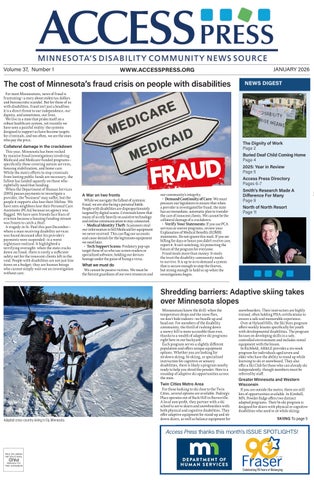
The cost of Minnesota’s fraud crisis on people with disabilities For most Minnesotans, news of fraud is frustrating—a story about stolen tax dollars and bureaucratic scandal. But for those of us with disabilities, fraud isn’t just a headline; it is a direct threat to our independence, our dignity, and sometimes, our lives. We live in a state that prides itself on a robust healthcare system, yet recently we have seen a painful reality: the systems designed to support us have become targets for criminals, and too often, we are the ones who pay the price.
Collateral damage in the crackdown This year, Minnesota has been rocked by massive fraud investigations involving Medicaid and Medicare-funded programs— specifically those covering autism services, housing stabilization, and home care. While the state’s efforts to stop criminals from looting public funds are necessary, the fallout has landed squarely on those who rightfully need that funding. When the Department of Human Services (DHS) pauses payments to investigate a provider, the "business" may suffer, but the people it supports also lose their lifeline. We have seen neighbors lose their Personal Care Assistants (PCAs) because an agency was flagged. We have seen friends face fears of eviction because a housing funding stream was frozen to catch a thief. A tragedy in St. Paul this past December— where a man receiving disability services was found deceased after his provider’s payments were suspended—is a worst nightmare realized. It highlighted a terrifying oversight: when the state cracks down on fraud, there is rarely a sufficient safety net for the innocent clients left in the void. People with disabilities are not just line items on a budget; they are human beings who cannot simply wait out an investigation without care.
A War on two fronts While we navigate the fallout of systemic fraud, we are also facing a personal battle. People with disabilities are disproportionately targeted by digital scams. Criminals know that many of us rely heavily on assistive technology and online communication to stay connected. • Medical Identity Theft: Scammers steal our information to bill Medicaid for equipment we never received. This can flag our accounts and cause denials for the legitimate equipment we need later. • Tech Support Scams: Predatory pop-ups target those of us who use screen readers or specialized software, holding our devices hostage under the guise of fixing a virus. What we must do We cannot be passive victims. We must be the fiercest guardians of our own resources and
our community’s integrity. • Demand Continuity of Care: We must pressure our legislators to ensure that when a provider is investigated for fraud, the state has an immediate, automatic plan to transfer the care of innocent clients. We cannot be the collateral damage of a crackdown. • Verify Your Statements: If you use PCA services or waiver programs, review your Explanation of Medical Benefits (EOMB) statements. Do not ignore this mail. If you see billing for days or hours you didn't receive care, report it. It isn’t snitching, it’s protecting the future of the program for everyone. Fraud steals more than money. It steals the trust the disability community needs to survive. It is up to us to demand a system that is secure enough to stop the thieves, but strong enough to hold us up when the investigations begin.
JANUARY 2026 NEWS DIGEST
The Dignity of Work Page 2 Buried Deaf Child Coming Home Page 4 2025: Year in Review Page 5 Access Press Directory Pages 6-7 Smith's Research Made A Difference For Many Page 9 North of North Resort Page 11
Shredding barriers: Adaptive skiing takes over Minnesota slopes Minnesotans know the drill: when the temperature drops and the snow flies, we don’t hide indoors—we bundle up and head out. For members of the disability community, the thrill of rushing down a snowy hill is more accessible than ever, thanks to a wealth of adaptive ski programs right here in our backyard. Each program serves a slightly different population and offers unique equipment options. Whether you are looking for sit-down skiing, bi-skiing, or specialized instruction for cognitive or sensory disabilities, there is likely a program nearby ready to help you shred the powder. Here is a roundup of adaptive ski opportunities across the state.
Adapted cross-country skiing in Ely, Minnesota.
Twin Cities Metro Area For those looking to ski close to the Twin Cities, several options are available. Padraig’s Place operates out of Buck Hill in Burnsville. A local non-profit, they partner with a ski school to serve skiers and snowboarders with both physical and cognitive disabilities. They offer adaptive equipment for stand-up and sitdown skiers, as well as balance equipment for
snowboarders. Their instructors are highly trained, often holding PSIA certifications to ensure a safe and memorable experience. Over at Hyland Hills, the Ski Stars program offers weekly lessons specifically for youth with developmental disabilities. The program focuses on developing skills in a safe, controlled environment and includes rental equipment with the lesson. In Richfield, AR&LE provides a six-week program for individuals aged seven and older who have the ability to stand up while learning to ski or snowboard. They also offer a Ski Club for those who can already ski independently, though members must be referred by staff. Greater Minnesota and Western Wisconsin If you are outside the metro, there are still lots of opportunities available. In Kimball, MN, Powder Ridge offers two distinct adapted programs. Their bi-ski program is designed for skiers with physical or cognitive disabilities who need to sit while skiing; SKIING To page 5
Access Press thanks this month's ISSUE SPOTLIGHTS!
TWIN CITIES, MN PERMIT NO. 4766
PAID
NONPROFIT ORG. U.S. POSTAGE