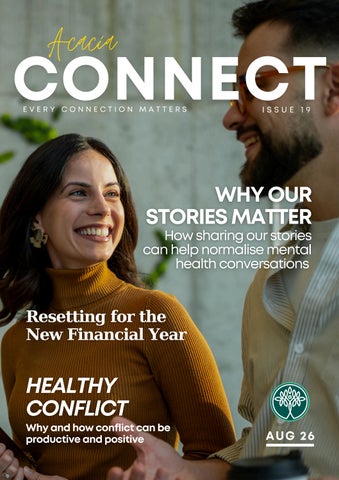
Acacia
CONNECT EVERY CONNECTION MATTERS
ISSUE 19
WHY OUR STORIES MATTER How sharing our stories can help normalise mental health conversations
Resetting for the New Financial Year
HEALTHY CONFLICT Why and how conflict can be productive and positive
AUG 26
CONTENTS DOWNLOAD MAGAZINE AS PDF
03 HEALTHY CONFLICT When conflict is handled constructively, disagreement can provide opportunities for teams to communicate openly, strengthen trust, and develop better ways of working together.
13 RESETTING FOR THE NEW FINANCIAL YEAR A reset can provide an opportunity to restore energy, reconnect with purpose, and consider how to make the year ahead more positive and meaningful.
R U OK? DAY WEBINARS
17 OCCUPATIONAL VIOLENCE AND AGGRESSION (OVA) Understanding stress responses and knowing what to do before, during, and after an incident can help individuals respond safely and recover more effectively.
21 SEXUAL ORIENTATION, GENDER IDENTITY, AND GENDER EXPRESSION
THE POWER OF MUSIC
WHY OUR STORIES MATTER
Music is much more than entertainment. It is a form of expression that can connect people across cultures and generations.
Sharing stories can reduce stigma and encourage more open conversations about mental health and seeking support.
29 HOW TO DEAL WITH DISTRACTIONS Research has found that people working on computers switch their attention, on average, every 47 seconds, highlighting just how challenging it has become to maintain focus in today’s digital world.
AUG 2026 | ISSUE 19
Recognising the distinctions between these can help avoid assumptions and support respectful, affirming interactions.
FROM THE CEO REBECCA WEISS CHIEF EXECUTIVE OFFICER
As we approach September and October, we enter an important time of the year for mental health and wellbeing. R U OK? Day, World Mental Health Day, and National Safe Work Month bring greater attention to mental health, psychological safety, and the importance of looking out for one another. While these initiatives provide an important focus, the conversations they encourage need to extend well beyond a single day or month. This edition of Acacia Connect explores many of the things that can help create environments where people feel safe to be themselves, speak openly, and seek support when they need it. We look at how sharing our stories can help reduce stigma around accessing EAP support, and why healthy conflict can strengthen relationships when approached with respect and openness. We also explore some of the challenges people are navigating in their everyday lives and workplaces, from distractions and occupational violence to understanding sexual orientation, gender identity, and gender expression. Alongside these topics, we consider the power of music and the opportunity a new financial year provides to reset and refocus. For me, one of the strongest messages in this edition is that meaningful connection often begins with creating space for honesty. We do not need to have all the answers. Sometimes listening without judgement, being willing to have a difficult conversation, or appropriately sharing our own experiences can help someone else feel more comfortable doing the same. As greater attention turns to mental health in the months ahead, I encourage you to use this opportunity to start conversations, check in with those around you, and continue building workplaces where people feel safe, respected, and supported. At Acacia, we will continue to be here to support those conversations and ensure that when someone is ready to reach out, there is a human connection waiting for them. 02
Healthy CONFLICT Why and how conflict can be productive and positive Most people dislike conflict. It can feel uncomfortable and, when not handled well, can lead to arguments and relationship tension. However, when handled constructively, disagreement can provide opportunities for teams to communicate openly, strengthen trust, and develop better ways of working together. In a workplace, there are many different personalities, values, cultures, experiences, and understandings of the world. It can be easy to assume that these differences are the primary reason unhealthy conflict occurs. However, workplace conflict can also arise from factors that may be addressed or improved, including poor communication, differences in learning or processing styles, unclear expectations, and perceptions of unfairness. Healthy workplace conflict can spark innovation, improve decision-making, and challenge existing norms. Constructive debate can also help clarify individual roles, project expectations, and responsibilities. Recognising the difference between healthy and unhealthy conflict is therefore important for maintaining a positive working environment.
03
Healthy conflict is collaborative. It follows a “you and me versus the problem” approach, where individuals work together to seek solutions. Unhealthy conflict occurs when disagreement becomes focused on the individuals involved rather than the issue itself. Healthy conflict also maintains mutual respect. Team members listen, acknowledge others’ perspectives, and engage constructively. In contrast, unhealthy conflict can foster defensiveness, blame, and hostility. Healthy conflict is solution-focused, with individuals critiquing ideas rather than people and keeping their attention on resolving the problem. Unhealthy conflict can become driven by heightened emotions, with disagreement or criticism becoming personal. Most importantly, healthy conflict creates a more inclusive environment where different perspectives can be heard. Unhealthy conflict may suppress contributions and leave team members feeling disengaged or reluctant to speak up. For example, imagine a project meeting where two team members have different opinions about the best approach to a new client proposal.
Instead of avoiding the disagreement, the manager encourages both individuals to share their perspectives, ask questions, and discuss the advantages and disadvantages of each approach openly. As a result, the team may be able to combine the strengths of both ideas and develop a more creative and effective solution. This kind of constructive conflict can help team members feel valued and involved in the process. Positive workplace conflict involves listening openly, expressing different points of view thoughtfully, and challenging assumptions in ways that help everyone learn or move forward. Instead of creating tension or division, constructive disagreement can question assumptions, surface new ideas, and strengthen decision-making. When constructive disagreement is avoided, teams may default to agreement even when concerns exist or better ideas are available. Healthy conflict can instead foster a culture where speaking up is accepted and encouraged. Rather than suppressing concerns, teams can address them early and work towards resolution.
04
Creating Healthier Conflict For workplace conflict to remain constructive, there are several important factors to consider.
Focus on the issue, not the individual Conversations should focus on behaviours, processes, ideas, and project outcomes rather than personal criticism.
Create space for different perspectives Team members should feel psychologically safe to express their views, ask questions, and respectfully disagree.
Listen to understand During a heated discussion, it can be easy for individuals to focus on preparing their response rather than genuinely listening. Taking time to understand another person’s perspective can help identify misunderstandings and areas of common ground.
05
Check for understanding Clarifying what another person means rather than making assumptions can prevent unnecessary escalation and help resolve underlying misunderstandings.
Know when to pause If emotions become heightened, taking a short break can allow those involved to regain composure and return to the conversation more constructively.
Address concerns early When workers feel comfortable raising concerns about conflict at an early stage, there is a greater opportunity to prevent disagreements from becoming more difficult to resolve. Work design can also influence conflict. Isolated individuals or groups, unhealthy competition, unclear communication channels, and limited opportunities for collaboration can all make constructive communication more difficult. Identifying and addressing these factors can support healthier team dynamics.
Healthy conflict is not about winning or losing. It is about engaging in respectful communication, exchanging ideas, and challenging assumptions in ways that foster understanding and progress. When handled constructively, conflict can strengthen relationships, encourage innovation, and help teams develop greater trust. Leaving conflict unaddressed, however, can allow frustration and resentment to build. When employees do not feel comfortable speaking up: Issues may remain unresolved Frustration can build quietly Communication may become less direct Engagement can begin to decline Healthy conflict creates a different dynamic. It gives employees opportunities to communicate concerns, challenge ideas, and contribute more fully to discussions. This is closely connected to psychological safety, which refers to an environment where people feel able to speak up, ask questions, acknowledge mistakes, or raise concerns without fear of embarrassment or punishment.
When psychological safety is supported, constructive disagreement can become an opportunity for learning and improvement rather than something teams feel they need to avoid. Ultimately, healthy workplaces are not necessarily those without conflict. Differences in perspective are a natural part of working with others. What matters is how those differences are approached. When teams have the skills and confidence to navigate disagreement respectfully, conflict can become an opportunity to strengthen communication, relationships, and the way people work together.
Need support navigating workplace conflict? If workplace conflict is becoming difficult to navigate, support is available. Employees can access confidential EAP counselling to talk through workplace concerns and seek guidance on how to approach difficult situations. Leaders can also access Acacia’s Manager Support service for guidance in managing workplace conflict and supporting their teams.
06
Why our Stories
Matter How sharing our stories can help normalise mental health conversations
When leaders and employees openly share their lived experiences of mental health challenges, periods of psychological distress, or recovery from mental illness, they send a powerful message to those around them:
Many organisations continue to invest significantly in workplace wellbeing through Employee Assistance Programs, Peer Support Programs, psychosocial risk management strategies, and other wellbeing initiatives. Yet despite these positive developments, many employees still hesitate to open up and seek support at work or outside of work.
"It's okay to not be okay, and it's okay to ask for help."
Why? For many people, it's not a lack of available support, but the fear of what others might think. In our experience, one of the most effective ways to reduce this stigma is also one of the simplest: storytelling.
07
We are all on the Mental Health Continuum Protecting
Supporting
employees’ mental health
those with mental ill health
THRIVING
SURVIVING
STRUGGLING
IN CRISIS
Normal functioning
Common & reversible distress
Significant functional impairment
Clinical disorder or severe & persistent functional impairment
Promoting positive mental health
Mental health is not something that only affects ‘other people.’ We all move along the mental health continuum throughout our lives. There are times when we feel energised, optimistic, and resilient. At other times, life presents challenges that can affect our wellbeing such as relationship breakdowns, caring responsibilities, financial pressures, grief, illness, workplace stress, or major life transitions.
Being human means our mental health changes over time. When organisations acknowledge this reality, they begin to normalise mental health conversations. Seeking support becomes viewed as a healthy response to life's challenges rather than a sign of weakness.
Why stories matter Facts educate. Stories connect. A leader standing in front of their team saying, “A few years ago I experienced anxiety and counselling really helped me,” can have a greater impact than any awareness poster or wellbeing campaign. Stories create permission. They challenge outdated stereotypes about what mental illness looks like. They demonstrate that successful, capable, and high-performing people can experience mental health challenges and continue to thrive.
08
Research and workplace experience consistently show that when senior leaders speak openly about their own experiences, employees are more likely to feel psychologically safe discussing their own wellbeing and accessing available supports. This philosophy underpins initiatives such as PwC Australia's Green Light to Talk program, which encourages leaders to share their personal stories as a way of reducing stigma, increasing awareness of support services, and creating a culture where conversations about mental health become part of everyday working life. PwC Australia gives workers Green Light to Talk about mental health | The National Tribune
Sporting heroes have shown us the way Some of the world’s most respected sporting figures have helped shift the conversation around mental health simply by telling their stories. AFL great Wayne Schwass has spoken openly for many years about living with depression and has become one of Australia's strongest advocates for mental health awareness. Olympic swimming champion Ian Thorpe has also shared his experiences with depression, reminding Australians that even those who achieve extraordinary success are not immune to mental health challenges. Internationally, tennis champion Naomi Osaka has spoken openly about her experiences with anxiety and depression and the importance of prioritising mental wellbeing.
09
US gymnast Simone Biles brought global attention to mental health when she stepped away from events at the Tokyo Olympics, later speaking about seeking help and the role therapy has played in supporting her wellbeing. Their willingness to speak publicly helps challenge the outdated belief that strength and success mean staying silent. Their stories are also an important reminder that mental health challenges can affect anyone, regardless of success, status, or performance.
The important role leaders play Leaders do not need to become counsellors. Nor do they need to disclose deeply personal experiences if they are uncomfortable doing so. However, leaders who choose to appropriately share aspects of their own wellbeing journey can have a positive influence on workplace culture. It might be speaking about a period of burnout. It might be acknowledging that they have benefited from counselling. It might simply be saying, "I've had challenging times too." When this is done authentically and appropriately, it demonstrates that vulnerability and leadership are not mutually exclusive. In fact, they often strengthen one another. Most importantly, it helps employees recognise that accessing support, such as via an EAP, is not something to hide. It's a practical and proactive step towards maintaining wellbeing.
A conversation about men One group that deserves particular attention is men. In Australia, approximately three-quarters of people who die by suicide are men, while in New Zealand the rate of suspected selfinflicted death is more than twice as high for males as females. These figures highlight the importance of continuing to create environments where men feel comfortable seeking support. Many men have grown up with messages that encourage them to ‘push through’, solve problems independently or avoid appearing vulnerable. While resilience is valuable, silence can come at a significant cost. The encouraging news is that conversations don't need to begin with, "How's your mental health?" For many men, connection often starts alongside an activity rather than face-to-face across a table. Some practical ways men can help normalise mental health conversations include: Checking in with a friend or colleague during a walk, round of golf, or while exercising together. Sharing their own experiences before asking someone else about theirs. Moving beyond “I'm sure you'll be fine” and asking “How are you really doing?” Encouraging mates to use available supports, including an EAP, when life becomes overwhelming. Staying connected even when someone says they're "fine."
Sometimes the most important conversation isn't about fixing someone's problems. It's simply letting them know they don't have to face them alone.
Every Story Matters Not everyone will choose to tell their story publicly, and that's okay. But every organisation benefits when people feel safe enough to speak honestly about mental health. Every conversation chips away at stigma. Every leader who shares their experience creates permission for someone else. Choosing to access an EAP can be a practical and proactive step towards looking after your mental health and wellbeing. Changing workplace culture rarely happens through one major initiative. More often, it happens one conversation, one story, and one act of courage at a time. And perhaps that's the most powerful story of all.
References: Suicide Prevention Australia, (2024), Stats & Facts
10
Mental Health DATES & EVENTS SEPTEMBER
OCTOBER
NOVEMBER
ALL SEPTEMBER Childhood Cancer Awareness Month
ALL October Mental Health Month
ALL NOVEMBER Movember
ALL October ADHD Awareness Month
NOVEMBER 13 - 19 Trans Awareness Week
ALL OCTOBER Breast Cancer Awareness Month
NOVEMBER 13 World Kindness Day
SEPTEMBER 7 - 11 Women's Health Week SEPTEMBER 10 World Suicide Prevention Day SEPTEMBER 10 R U OK? Day SEPTEMBER 21 World Alzheimer's Day SEPTEMBER 21 - 27 Dementia Action Week
ALL OCTOBER National Safe Work Month OCTOBER 1 - 7 BPD Awareness Week OCTOBER 2 International Day of NonViolence OCTOBER 4 - 11 World Mental Health Week OCTOBER 10 World Mental Health Day OCTOBER 10 World Homeless Day OCTOBER 15 Pregnancy and Infant Loss Remembrance Day OCTOBER 11 - 17 National Carers Week
11
NOVEMBER 19 International Men’s Day NOVEMBER 20 Transgender Day of Remembrance NOVEMBER 21 International Survivors of Suicide Loss Day (Survivor Day) NOVEMBER 22 - 28 Perinatal Mental Health Week NOVEMBER 25 International Day for the Elimination of Violence Against Women
BECAUSE EVERY CONNECTION MATTERS Simple, meaningful conversations prevent small worries from becoming big challenges. Don’t wait for a milestone. Make every day a day for connection. One chat can change a life.
FREE EMPLOYEE9WEBINARS: September THE ART OFLeaders ASKINGWorkshop Building an R U OK? Culture Learn the practical signs that a friend, colleague, or loved one might be struggling. These 30-minute sessions give you the skills and the confidence to initiate meaningful R U OK? conversations whenever they are needed. When: Thursday, 10 September 2026 Times: 12:30 pm AEST | 3:00 pm AEST Secure your free spot here:
12:30 pm AEST
3:00 pm AEST
Need support now? We are here for you 24/7. Call anytime
Contact us by SMS
1300 364 273 (AU) 0800 000 657 (NZ)
0480 087 020 Live chat or book an appointment
acaciaconnection.com 12
Resetting for the New Financial Year A new financial year can provide a valuable opportunity for a reset, particularly after the pressure of year-end KPIs, tax obligations, reporting requirements, or the need to finalise tasks and close out the previous year. If the end of the financial year has marked the end of an intense period of work, followed almost immediately by a new beginning, it may be worth taking some time to pause before simply moving on to the next set of priorities. A reset can provide an opportunity to restore energy, reconnect with purpose, and consider how to make the year ahead more positive and meaningful.
What just happened? If you have recently worked through end of financial year pressures, you may have experienced a period of deadlines, additional responsibilities, competing priorities, and reminders about the approaching end of the financial year. During busy periods, it is common to rely on momentum to keep going. Then, once deadlines have passed and the pressure begins to ease, fatigue can become more noticeable. Before moving immediately into the next cycle of work, it can be useful to reflect on what the previous financial year required of you and how you are feeling now.
What can you do? What is a reset, and why might you need one? Work can come in bursts, and many expectations may culminate at the end of the financial year. A reset is an intentional opportunity to pause, reflect, and begin again with renewed motivation and direction. Rather than immediately setting new goals or adding more to your workload, resetting involves taking deliberate steps to consider what you need and how you want to approach the year ahead. It is an opportunity to be more strategic about your priorities, energy, and time.
13
The first step is to consider what the previous financial year was like for you. This will be different for everyone, so take some time to reflect on your energy levels, motivation, stress, workload, and overall wellbeing. Feeling tired after an intense period of work is understandable. Once the immediate pressure has subsided, you may become more aware of fatigue that was less noticeable while you were focused on meeting deadlines. The following strategies can help you reset and approach the year ahead with greater intention.
1. Reconnect with your goals, purpose, and direction Now can be a useful time to pause and reflect. It is easy to become absorbed in the immediate needs of an organisation, particularly when working towards KPIs and deadlines, but personal goals and a sense of purpose matter too. Consider what worked well during the previous year, what did not, and what can be learnt from those experiences. The beginning of a new financial year may also provide an opportunity to reconsider aspects of your role, your workplace relationships, and how you would like to contribute in the year ahead.
3. Check in with your wellbeing When organisational priorities become demanding, personal wellbeing can sometimes move further down the list. Consider whether the beginning of the financial year provides an opportunity to refocus on self-care, physical activity, nutrition, social connection, or other areas of wellbeing that may have received less attention during busy periods. If you are experiencing ongoing stress, burnout, or simply do not feel like yourself, whether for work or personal reasons, support is available through Acacia EAP.
4. Review your sleep and energy
2. Plan a meaningful break Regular lunch breaks, switching off after work, and taking opportunities to celebrate achievements are important. Longer periods of rest can also provide an opportunity to decompress and step away from everyday work demands. If possible, consider planning annual leave or something enjoyable to look forward to. Rest does not need to be earned through exhaustion. Building recovery into the year can help create a more sustainable approach to work.
If you are feeling particularly tired or lacking energy, it may be worth considering whether you are getting sufficient, good-quality sleep. Review your bedtime routine, sleep environment, interruptions, and wake time. Small adjustments to sleep habits can sometimes make a meaningful difference. If sleep difficulties persist or significantly affect daily life, consider seeking appropriate professional support.
14
Small changes to bring into your workday Regularly review what you can stop doing. Some tasks or processes may have once been useful but no longer add meaningful value. Periodically reviewing them can help create capacity for higher priorities. Develop a “done” list. In contrast to a traditional to-do list, a done list records what has already been accomplished. This can provide a useful reminder of progress, particularly during periods when it feels as though the workload never ends. Create some blank space in your calendar. Where possible, periodically leave some unscheduled time for unexpected work, thinking, planning, or connecting with colleagues. Not every part of the workday needs to be allocated in advance.
15
Your career and working life are a marathon, not a sprint. If your role involves an intense race towards the end of the financial year, the pace may have shifted, but there will always be another deadline or busy period ahead. A reset does not need to involve dramatic change. Small, deliberate steps taken regularly can have a more sustainable impact than attempting to change everything at once. The beginning of a new financial year can simply provide a useful point to pause, reflect on what has been, and decide what is worth carrying forward. A new financial year can also be a good time to review your financial wellbeing. If money, budgeting, or financial goals are contributing to stress, Acacia’s Financial Coaching service can provide practical, confidential support to help you better understand your finances and plan for the year ahead.
Upcoming
Pay Per Seat Events Expert-led Wellbeing Workshops Secure your spot now Access our specialist training sessions on a flexible per-participant basis, providing your team with the practical skills and mental health literacy needed to navigate psychosocial hazards and foster a resilient workplace culture. Seats are strictly limited.
Sept
16
Oct
29 Oct
30 Nov WBS Homepage Visit our Wellbeing Solutions Homepage for more details on our workshops and tailored Wellbeing Programs.
25
Dual Lens for Peak Performance: Psychological Safety and Psychosocial Hazards
Neurodiversity for Leaders Working well with a Neurodiverse Team: A Practical Guide for Leaders
Neurodiversity for Employees Working Well Together: Understanding Neurodiversity in Your Team
Build Your Team’s Conflict Muscle: Conflict Coaching
Reserve Your Seats 16
Occupational Violence and Aggression (OVA) Frontline staff facing abuse from clients or customers
17
Working on the frontline often means supporting people during stressful or emotional situations. While most interactions are positive and respectful, some may involve occupational violence and aggression (OVA).
What is occupational violence and aggression?
Experiencing OVA can affect both physical and psychological wellbeing. Understanding stress responses and knowing what to do before, during, and after an incident can help individuals respond safely and recover more effectively.
It can range from shouting, swearing, and verbal abuse through to discrimination, harassment, threats, stalking, physical violence, and sexual assault.
Occupational violence and aggression (OVA) includes behaviours directed towards staff that make them feel threatened, intimidated, or unsafe.
OVA may come from clients, customers, or members of the public, and can affect both those directly involved and anyone who witnesses an incident. Common reactions include feeling distressed, anxious, or emotionally drained. Repeated exposure, even to incidents that may appear less severe, can gradually increase stress, reduce confidence, and contribute to burnout. In Australia, Safe Work Australia estimates that only around
46% of workplace violence incidents are formally reported, meaning many incidents go unreported because workers may see them as simply “part of the job”. Violence, aggression, and abuse should never be accepted as normal workplace behaviour.
Before an incident Preparing for challenging situations can help individuals respond more effectively. Know workplace procedures, including who to contact and what support is available. Learn the early warning signs of escalating behaviour, such as raised voices, hostile language, invading personal space, or increasing frustration. Recognise personal stress responses. Early signs may include a racing heart, tense muscles, rapid breathing, or difficulty concentrating. Support overall wellbeing through regular sleep, exercise, healthy eating, social connection, and activities that promote relaxation.
18
During an incident The priority is personal safety and the safety of others. If it is safe to do so: Pause and assess the situation. Speak slowly, clearly, and calmly. Explain actions and use respectful communication. Use “I” statements. For example, “I do not feel safe, so I need you to step back.” Maintain personal space and avoid arguing or raising your voice. Leave the situation if necessary. Seek assistance from colleagues, supervisors, or security. Use a duress alarm if one is available. Contact emergency services if there is an immediate threat to safety. Stress reactions such as rapid breathing, muscle tension, and a racing heart are normal responses to a perceived threat. Recognising these reactions early can create valuable time to respond more thoughtfully by slowing breathing, remaining as calm as possible, and thinking more clearly. Remember, verbal abuse, intimidation, and threatening behaviour are all forms of OVA. No one should be expected to tolerate behaviour that makes them feel unsafe.
After an incident Once everyone is safe: Seek medical attention if required. Tell a manager or supervisor. Record what happened. Follow workplace reporting procedures.
19
The emotional impact of an incident may not be immediate. Hours or days later, an individual may experience intrusive thoughts, anxiety, difficulty sleeping, feeling on edge, low mood, or repeatedly replaying the incident. These can be common responses following a stressful experience. Where possible, allowing time to recover before returning to usual duties can be helpful. A short walk, slow breathing, a drink of water, or talking with a trusted colleague may help the mind and body settle.
Maintaining healthy routines outside work and staying connected with family and friends can also support recovery. It is important to notice changes such as becoming more anxious before work, feeling increasingly exhausted, becoming less patient, or finding it difficult to switch off. Recognising these changes early can allow support to be accessed before stress becomes overwhelming.
Report the incident and seek support Reporting incidents helps organisations identify risks, improve workplace safety, and provide better support to staff. Workplace reporting procedures should be followed, even when an incident appears minor. If distress continues, consider seeking support from a manager, trusted colleague, family member, friend or existing mental health professional. Acacia EAP also provides confidential counselling and support following distressing workplace incidents.
Remember No one deserves to be threatened, abused, or intimidated at work. Occupational violence and aggression should never be considered simply “part of the job”. Recovery is not about simply “getting over it”. It involves recognising the impact of the experience, allowing appropriate time to recover, and accessing support when needed so individuals can continue to work safely and confidently.
20
Understanding SEXUAL ORIENTATION, GENDER IDENTITY, AND GENDER EXPRESSION Sexual orientation, gender identity, and gender expression are important aspects of human diversity. While these terms are often discussed together, they describe different aspects of a person’s identity and experience. Understanding that these concepts are separate is important, as one should not be assumed based on another. Each person’s experience is individual, and the language they use to describe themselves may also differ.
Understanding the differences between these concepts can help reduce assumptions and support more respectful and inclusive interactions. The Gender Unicorn provides a simple visual representation of how sexual orientation, gender identity, gender expression, and sex characteristics are distinct from one another.
Trans Student Educational Resources, 2015. “The Gender Unicorn.” www.transstudent.org/gender.
21
Sexual Orientation Sexual orientation describes a person’s pattern of emotional, romantic, and/or sexual attraction to other people. Some people find that a particular label describes their experience well, while others may choose not to use a label at all.
Questioning: A term that may be used by someone who is exploring or considering their sexual orientation or gender identity. Asexual: A person who experiences little or no sexual attraction to others.
The LGBTQIA+ acronym encompasses a diverse range of identities and experiences, including lesbian, gay, bisexual, transgender, queer or questioning, and intersex people, as well as many other identities, including asexual people. It is important to recognise that the acronym includes concepts relating to sexual orientation, gender identity, and sex characteristics rather than describing sexual orientation alone.
Queer: An umbrella term used by some people within LGBTQIA+ communities to describe sexual orientation or gender identity. The term has historically been used in a derogatory way but has since been reclaimed by many people. Not everyone is comfortable using this term, so individual preferences should always be respected.
Sexual orientation exists across a broad spectrum. Some terms include:
Heterosexual: A person who is attracted to people of a different gender.
Lesbian: A woman who is attracted to other women. Gay: Commonly refers to a man who is attracted to other men, although the term may also be used more broadly by people attracted to the same gender. Bisexual: A person who experiences attraction to more than one gender. Pansexual: A person who may experience attraction to people regardless of their gender.
For some individuals, sexual orientation remains relatively stable throughout life. For others, their understanding of their sexual orientation may evolve over time as they gain greater insight into themselves or as their experiences change. Neither experience is inherently more valid than the other. Intersex is distinct from sexual orientation. It is an umbrella term relating to innate variations in sex characteristics, which may include chromosomes, hormones, reproductive anatomy, or other physical characteristics.
22
Gender Identity Gender identity refers to a person’s deeply held internal sense of their own gender. Not everyone experiences gender in the same way. A person may identify as a woman, a man, both, neither, somewhere along a gender spectrum, or another gender altogether. Some examples include cisgender, which refers to a person whose gender identity aligns with the sex they were assigned at birth, and transgender, a broad term used to describe people whose gender identity differs from the gender associated with the sex they were assigned at birth. Nonbinary is another broad term encompassing gender identities that do not fit exclusively within the categories of woman or man. This may include identities such as gender fluid, agender, and bigender, among others. Only an individual can determine and describe their gender identity. Sharing one’s own pronouns or respectfully asking which pronouns a person uses can help avoid assumptions. Examples may include she and her, they and them, he and him, or other pronouns.
23
Gender Expression Gender expression refers to how a person presents or expresses their gender to others. This may include clothing, hairstyle, voice, body language, mannerisms, interests, or other aspects of how someone presents themselves to the world. Gender expression also exists across a broad continuum and may be influenced by personal preference, culture, community, safety, and social expectations. It may be feminine, masculine, androgynous, or vary across different contexts. Importantly, a person’s gender expression does not necessarily indicate their gender identity or sexual orientation. Assumptions about someone’s identity should therefore not be made based on their appearance, clothing, mannerisms, or other forms of expression. Ultimately, the most respectful approach is to use the language people choose for themselves and value each person’s individual experience, while creating space for ongoing learning, exploration, growth, and authenticity. For anyone wanting to explore their identity, relationships, or other personal concerns, confidential support is available through Acacia EAP. References: Western Australia Department of Health, (2026), Sexual Orientation. Advocates for Trans Equality, (2026), Understanding Transgender People: The Basics. TSER, (2015), The Gender Unicorn. Australian Institute of Family Studies, (2026), LGBTIQA+ Glossary of Common Terms.
24
Book your EAP session online using Appointment Hub Find an EAP Professional for you and filter by age, experience, or gender. Book your EAP Counselling, Financial Coaching, Nutritional support, or Legal Referral sessions. Appointments are available as soon as tomorrow.
BOOK NOW 25
Reschedule or rebook at any time.
The Power of
Music
How music can support wellbeing, connection, and emotional regulation throughout our lives
Music and connection
Music and our emotions
Music has a remarkable ability to bring people together. Across cultures and communities, it forms part of celebrations, traditions, sporting events, religious and cultural practices, and everyday social experiences.
Music can have a strong relationship with emotion. A particular song can energise us, help us relax, evoke sadness or joy, or bring back memories of a particular person, place, or period of our lives.
Sport provides a powerful example. A stadium filled with thousands of people singing or chanting together can create an immediate sense of shared identity and belonging. People who may have little else in common can find themselves connected through a team, a song, and a shared moment. Similar connections can happen at concerts, celebrations, community events or simply when people discover they share a favourite artist or style of music. Music can also help connect people across generations and cultures. Songs, rhythms and musical traditions can carry stories, experiences and cultural identity, while shared musical interests can create opportunities for conversation and connection.
This connection can make music a useful part of everyday wellbeing. Some people use upbeat music to increase energy or motivation, while quieter music may help them slow down and unwind. Music can also provide a way to experience or express emotions that may be difficult to put into words. Music can contribute to experiences of flow, where a person becomes deeply absorbed in an activity with heightened focus and engagement. Whether listening, singing, playing an instrument, or moving to music, engaging with music can provide opportunities to shift attention, express emotion and connect with the present moment.
26
Music across our lives Our relationship with music can begin remarkably early. Babies respond to sounds and rhythms, while nursery rhymes, lullabies and songs can become part of early learning, language and connection with caregivers. As people grow, music can become increasingly connected with identity and belonging. During adolescence in particular, musical preferences can become closely associated with friendships, experiences, values and emerging identity. Songs heard during important periods of life can remain strongly connected with those memories many years later.
27
That relationship can continue throughout adulthood and into later life. Familiar music can evoke memories and create opportunities for connection, including for some people living with dementia. A familiar song may encourage singing, movement or interaction and provide meaningful moments of connection with family and others. Music therapy takes the therapeutic use of music further. Delivered by appropriately trained professionals, it may incorporate listening, singing, playing instruments, movement and discussion to support a range of emotional, cognitive, communication and physical needs.
Making music part of your wellbeing There is no single type of music that supports everyone in the same way. What feels calming to one person may be energising to another, and our response to music can change depending on our mood, experiences and environment. Consider how music already features in your life. What helps you unwind? What gives you energy? What brings back positive memories? What makes you want to move? And what music helps you feel connected to other people?
Using music intentionally might be as simple as creating a playlist for the commute home, listening to something calming after a demanding day, sharing music with friends or family, attending a live performance, singing, dancing or returning to an instrument you once enjoyed. Music is much more than entertainment. Throughout our lives, it can provide opportunities for connection, expression, reflection and enjoyment. It can become one of the many ways we support our everyday wellbeing.
28
How to deal with
DISTRA CTIONS
29
Have you ever sat down to complete an important task, only to find yourself scrolling through social media, replying to a message, browsing online shopping websites, reading the news, or suddenly remembering something else you need to do? If so, you are certainly not alone.
While it can be frustrating to lose focus, it does not necessarily mean you lack motivation or self-discipline. Psychology tells us that attention is a limited mental resource that can become stretched when too many demands compete for it at once.
Distractions are a normal part of being human. In today’s fast-paced world, our attention is constantly competing with social media, digital notifications, conversations, deadlines, responsibilities, and even our own thoughts. Research has found that people working on computers switch their attention, on average, every 47 seconds, highlighting just how challenging it has become to maintain focus in today’s digital world.
Concentration is a skill that can be strengthened. By understanding how attention works and making small changes to daily habits, it can become easier to regain focus and reduce the impact of distractions.
??
1. Recognise the source of the distraction The first step is identifying what is pulling your attention away from the task at hand. Some distractions come from the environment, such as digital notifications, noisy workplaces, or interruptions from others. Others come from within, including worries, racing thoughts, fatigue, stress, or thoughts about unfinished tasks. Before becoming frustrated, it can be helpful to pause and ask yourself, “What has just taken my attention away? Is this something happening around me or within me? Is there something I need to address now, or can it wait until later?” Simply becoming aware of distractions can reduce their power and make it easier to refocus.
The mind can also keep returning to unfinished tasks. Writing these tasks down in a notebook or on a simple to-do list can help free up mental space, allowing your attention to return to the task in front of you. Breaking larger tasks into smaller, manageable steps can also make them feel less overwhelming and easier to begin.
3. Focus on one thing at a time Many people believe they are good at multitasking. However, research consistently shows that what feels like multitasking is often rapid switching between tasks, requiring the brain to repeatedly refocus. This constant switching can reduce productivity, increase errors, and leave you feeling mentally exhausted. Research also suggests that after an interruption, it can take an average of 23 minutes to fully return to the original task. Even brief distractions can therefore have a much greater impact on productivity than you might realise.
2. Reduce mental clutter Our brains can hold only a limited amount of information in working memory at any one time. When you try to keep track of multiple tasks simultaneously, concentration can become more difficult and mistakes more likely.
Whenever possible, choose one priority and give it your full attention before moving on to the next task. Even short periods of uninterrupted focus can be far more productive than trying to do several things at once.
30
4. Design an environment that supports focus Your surroundings can influence behaviour more than you might realise. Small changes to the environment can make concentrating much easier. Consider turning off non-essential notifications, closing unnecessary browser tabs, keeping only the materials needed for the current task within reach, and, where possible, working in a quieter space or using headphones to reduce background distractions. If appropriate, letting colleagues know when you need uninterrupted time can also help protect your focus. Creating an environment with fewer competing distractions allows the brain to devote more attention to what matters most.
Even taking five minutes to stand up, stretch, walk around, or simply look away from a screen can help restore mental energy before returning to work. Rather than viewing breaks as unproductive, it can be helpful to see them as an investment in maintaining concentration and performance.
6. Learn to gently redirect your attention Sometimes the biggest distraction is your own thinking. Worries about the future, replaying past conversations, or mentally planning what comes next can easily pull attention away from the present moment. When this happens, try to notice where your mind has gone without criticising yourself. You might simply acknowledge, “I’ve noticed my attention has wandered,” before gently bringing your focus back to the task in front of you. Each time you redirect your attention, you are practising your ability to concentrate. The goal is not to eliminate distracting thoughts altogether, but to become better at noticing them and choosing where your attention goes next.
5. Give your brain permission to take breaks Concentration is not designed to last indefinitely. Just as muscles become tired after physical exercise, the brain also benefits from regular opportunities to recover. Working in focused periods followed by short breaks can help support sustained attention throughout the day. 31
7. Be kind to yourself It is easy to become frustrated after losing focus. However, self-criticism can increase stress, making it even harder to concentrate. Instead, remember that everyone experiences distraction. Progress comes from consistently bringing your attention back, not from expecting perfect focus throughout the day. Developing concentration is much like developing physical fitness. It improves through regular practice, patience, and realistic expectations.
8. When to seek additional support Occasional distraction is a normal part of everyday life. However, if difficulties with concentration become persistent or begin affecting your work performance, relationships, or overall wellbeing, it may be helpful to seek professional support. Stress, anxiety, burnout, poor sleep, and other physical or mental health concerns can all contribute to difficulties with attention. Accessing support with a trained professional through Acacia EAP can help identify the underlying causes and develop strategies that are tailored to your individual needs. Improving concentration does not require perfection. Often, small, consistent changes in the way you manage your attention can make a meaningful difference to both productivity and overall wellbeing.
References: American Psychological Association, (2023), Why our attention spans are shrinking. Mark, G., Gonzalez, V. M., & Harris, J. (2005), No Task Left Behind? Examining the Nature of Fragmented Work. Mark, G., Gudith, D., & Klocke, U. (2008), The Cost of Interrupted Work: More Speed and Stress.
Book your appointment Scan the QR code or click here to visit our Appointment Hub platform and book in for support with an EAP Professional
32
Acacia
CONNECT CONTRIBUTORS
CONTACT US
Elena Holzworth Content & Communications Coordinator
Susanna Mullner EAP Professional (Psychologist)
Rebecca Weiss Chief Executive Officer & Registered Psychologist
David Lopis EAP Professional (Psychologist)
Contact us by SMS
Gerard Beven Director of Wellbeing Solutions
Hayley Jones EAP Professional (Psychologist)
Live chat or book an appointment
Call anytime
1300 364 273 (AU) 0800 000 657 (NZ) 0480 087 020 acaciaconnection.com
Tanya Maharaj EAP Professional (Psychologist) Nicole Gale EAP Professional (Social Worker) Copyright © Acacia Connection Pty Ltd, all rights reserved.
Download magazine as a PDF