DAILY NEWS IN ENGLISH
Japanʼs Tepco fights for return to nuclear power after Fukushima Decades ago, nuclear power was supposed to be the perfect solution for Japanʼs thirst for energy and for its rural economies. And in the sleepy town of Kashiwazaki, in the prefecture next to Fukushima, the solution was supposed to bethe KashiwazakiKariwa nuclear power plant,run by the power company Tepco — the company responsible for the 2011 Fukushima accident. When in full operation, the Kashiwazaki-Kariwa power plant is the biggest in the world, capable of servicing 16 million households. But all of its seven reactors have been idle since the nuclear accident at Fukushima Daiichi. This is Tepcoʼs only remaining nuclear power plant apart from the tsunamistricken plants in Fukushima, in the neighboring prefecture. Tepco has been repeatedlycriticized for its negligenceand has been ordered topay compensation to the residents.The cleanup of the Fukushima power plant has beencausing major headaches,while the reasons for the accident have yet to be clarified even eight years later.
German Leftʼs Wagenknecht to stand down Wagenknecht said Monday she would not seek re-election in September as co-leader of the Leftʼs 69-member opposition parliamentary group, a post she has shared inside the Bundestag debating chamber with Dietmar Bartsch since 2015. Writing to the partyʼs executive, Wagenknecht attributed her recent two-month absence, including non-attendance at the Leftʼs recent Bonn convention, primarily to "stress and overload," adding that she had recovered and was feeling "fine." "I will, of course, remain politically active and will continue to commit myself to my convictions and social goals," said Wagenknecht, a highprofile figure often seen on talk shows, who originally comes from Germanyʼs eastern state of Thuringia.
60/2019 • 12 MARCH, 2019
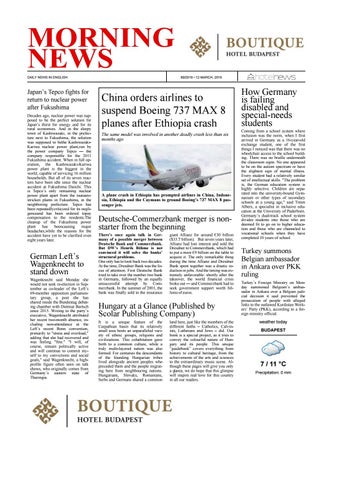
China orders airlines to suspend Boeing 737 MAX 8 planes after Ethiopia crash The same model was involved in another deadly crash less than six months ago
A plane crash in Ethiopia has prompted airlines in China, Indonesia, Ethiopia and the Caymans to ground Boeingʼs 737 MAX 8 passenger jets.
Deutsche-Commerzbank merger is nonstarter from the beginning Thereʼs once again talk in Germany of a possible merger between Deutsche Bank and Commerzbank. But DWʼs Henrik Böhme is not convinced it will solve the banksʼ structural problems. One only has to look back two decades. At the time, Dresdner Bank was the focus of attention. First Deutsche Bank tried to take over the number two bank in Germany, followed by an equally unsuccessful attempt by Commerzbank. In the summer of 2001, the bank was finally sold to the insurance
giant Allianz for around €30 billion ($33.7 billion). But seven years later, Allianz had lost interest and sold the Dresdner to Commerzbank, which had to put a mere €9 billion on the table to acquire it. The only remarkable thing during the time Allianz and Dresdner Bank spent together was a drastic reduction in jobs. And the timing was extremely unfavorable: shortly after the takeover, the world financial crisis broke out — and Commerzbank had to seek government support worth billions of euros.
Hungary at a Glance (Published by Scolar Publishing Company) It is a unique feature of the Carpathian basin that its relatively small area hosts an unparalleled variety of ethnic groups, religions and civilizations. This cohabitation gave birth to a common culture, while a truly multi-layered nation was also formed. For centuries the descendants of the founding Hungarian tribes lived alongside ancient peoples who preceded them and the people migrating here from neighbouring nations. Hungarians, Slovaks, Romanians, Serbs and Germans shared a common
land here, just like the members of the different faiths – Catholics, Calvinists, Lutherans and Jews – did. Our book is a special project, as it tries to convey the colourful nature of Hungary and its people. This unique “guidebook” covers everything from history to cultural heritage, from the achievements of the arts and sciences to the extraordinary music scene. Although these pages will give you only a glance, we do hope that this glimpse will inspire real love for this country in all our readers.
How Germany is failing disabled and special-needs students Coming from a school system where inclusion was the norm, when I first arrived in Germany as a 16-year-old exchange student, one of the first things I noticed was that there was no wheelchair access to the school building. There was no braille underneath the classroom signs. No one appeared to be on the autism spectrum or have the slightest sign of mental illness. Every student had a relatively similar set of intellectual skills. "The problem is, the German education system is highly selective. Children are separated into the university-bound Gymnasium or other types of secondary schools at a young age," said Timm Albers, a specialist in inclusive education at the University of Paderborn. Germanyʼs dual-track school system divides students into those who are deemed fit to go on to higher education and those who are channeled to vocational schools when they have completed 10 years of school.
Turkey summons Belgian ambassador in Ankara over PKK ruling Turkeyʼs Foreign Ministry on Monday summoned Belgiumʼs ambassador in Ankara over a Belgian judicial decision it said prevented the prosecution of people with alleged links to the outlawed Kurdistan Workersʼ Party (PKK), according to a foreign ministry official.
weather today BUDAPEST
7 / 11 °C Precipitation: 0 mm
60/2019 • 12 March, 2019
Reform Germanyʼs welfare state, urges communal association A simplification of Germanyʼs welfare state is wanted by its Association of Towns and Municipalities (BStGB). Only then, it says, will communities be able to cope with demographic aging and future economic strains. Germanyʼs11,054 communal authoritieswere overburdened with complicated welfare delivery and needed "de-bureaucratization" to stay within budget in the future, asserted association chief executive Gerd Landsberg on Tuesday. "Every problem is met with the promise that there is more money and naturally more personnel," he said, adding that, longterm, Germanyʼs highly legislated welfare state would not function, given finite taxation revenues, populations withmore elderly, and regions facing loss of industry and jobs.
Two Germans win second gold medals at Nordic World Ski Championships Germanyʼs Markus Eisenbichler on Sunday helped destroy the opposition to win gold in the large hill skijumping team event — his second world title at this yearʼs FIS Nordic World Ski Championships in Seefeld, Austria. Eisenbichler and his compatriots Karl Geiger, Richard Freitag, and Stephan Leyhe led from start to finish on Innsbruckʼs Bergisel hill, winning 987.5 points overall, a massive 56.5 points — or 31 meters (101 feet) — ahead of hosts Austria, who took silver, and Japan (bronze).
Justin Trudeau admits to mistakes in corruption trial crisis but not breaking any rules Prime Minister Justin Trudeau has denied interfering in Canadaʼs judicial system, though conceded he should have done things differently in handling accusations he intervened to shield a firm of bribery charges. Embattled Canadian Prime Minister Justin Trudeau admitted to making mistakes in his handling of a controversy that threatens to sink his government ahead of October elections, but he stopped short of apologizing. Trudeau said on Thursday that his government had done nothing illegal afteraccusations of hindering the prosecution of giant Canadian engineering firm SNC-Lavalin. "There are many lessons to be learned and many things we would have liked to have done dif-
ferently," he said, but he insisted there was no breakdown in Canadian justice. Trudeau tried to shore up the biggest crisis of to face his government which has already seen theresignationof two high profile Cabinet members and a close aide. ʼNo pressureʼ Trudeauʼs former adviser Gerry Butts defended the prime minister yesterday in the House of Commons, telling the justice committee that "nothing happened here beyond the normal operations of government."
What our teeth reveal about us They can find out all sorts of useful medical information about you from your teeth — even predict future diseases. Are you always brushing your teeth? One look inside your mouth and your dentist will know. The worse the condition of the teeth, the lower on average the social status of the patient. At the same time, teeth are like afingerprint:forensics can use a dental impression to identify the perpetrator or the victim at a crime scene. Weʼve known this ever since Inspector Columbo, played by Peter Falk, fished chewing gum out of a trash can in the well-known television series and solved a case. Hereʼs where it
gets exciting: Researchers now claim to be able to draw information from a childʼs teeth about whether they are likely to develop mental illness. In older people, on the other hand, teeth may reveal whether they have been exposed to heavy metals and whether there is a high risk of Alzheimerʼs disease. "In the field of mental health, is it possible that we have been ignoring this potential marker that literally falls out of peopleʼs mouths or is extracted and then thrown away and ends up in landfills?" asked Erin Dunn of the Massachusetts General Hospital in Boston, US. The epidemiologist for psychiatric diseases thinks that teeth, especially milk teeth, should be given much more attention.
Budapestʼs historic Lotz Hall café reopened as Café Párisi After two years of undesired silence a new café has opened its gates in Budapest’s neo-renaissance styled jewellery box, the former Paris Deparment Store (Párisi Nagy Áruház). Situated in the heart of the city on Andrássy avenue, Café Párisi is the perfect location for those who wish to enjoy the luxury of early 20th century Budapest. The newly reopened location is already one of Budapest’s hidden gems: set in the Paris Department Store’s mezzanine level just below the iconic frescos created by renowned Hungarian painter Károly Lotz. Párisi Café has everything you could ask for from traditional Hungarian cakes like the Eszterházy or the Gerbaud slide to alternative milk-based cafés. Open everyday from 9:00 - 21:00
H-1056 Budapest, Só u. 6. Telephone: +36 1 577 0700 Fax: +36 1 577 0710 bhzinfo@zeinahotels.com www.boutiquehotelbudapest.com
Published by: Mega Media Kft. 1075 Budapest, Madách I. út 13-14. +36 1 398 0344 www.hotelujsag.hu
Mann+Hummel: Hidden champion fights fine particles It only takes the weather to be unfavorable,and megacities across the world sink into wafts of mist. According to the World Health Organization (WHO), some 7 million people die every year partly as a result of inhaling polluted air over longer periods. Increasing traffic has no doubt contributed to creating "thick air." Many nations are in the middle of campaigns to reverse the trend by pushing e-mobility, arguing that electric vehicles donʼt have exhaust pipes as sources of poisonous nitrogen oxides and particulate matter. But a closer look reveals that fine particulates cannot be reduced drastically through electric cars. "Irrespective of a carʼs transmission system, it will always produce a lot of particulate matter," says Jan-Eric Raschke, who heads the fine particulates/filtration division at the German company Mann+Hummel. He explains thatroughly 90 percent of all particulate emissions in cars stem from tire wear and the braking system.
Germanyʼs migrants: wooed and discriminated "We are Hamburg. Are you in?" Thatʼs the slogan Hamburg is using to advertise municipal jobs to migrants. From police officers to teachers, doctors, bookkeepers and prison workers — the city is hoping to hire more employees with an migrant background. And itʼs not just Hamburg making this push. All throughout Germany, the business and public sectors alike are focusing on the countryʼs newest residents. Rising education levels Thatʼs because the average education level of migrants in Germany is on the rise. In 2011, one-quarter of young migrants between the ages of 18 and 25 had completed their "Abitur," or high school certificate exam. By 2015, that figure had climbed to 33 percent. During that same period, the percentage of youth without a migrant background who completed high school rose from 32 to 39 percent.