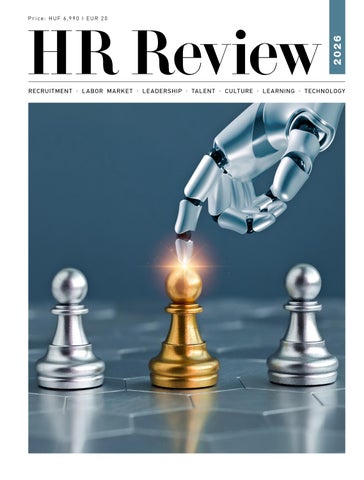
2026
P r i c e : H U F 6 ,9 9 0 Ι E U R 2 0
REC RUI T MEN T › L A B OR M A RK E T › LE A DER SHIP › TA LEN T › C ULT URE › LE A RNING › T EC HNOLOGY
4
HR Review
MANAGING A WORKFORCE BUILT FOR TOMORROW’S ECONOMY The labor market is undergoing a fundamental transformation. In Hungary, this shift is being shaped partly by regulatory changes affecting the employment of foreign workers, but the forces behind it are much broader. Technology, demographic pressures, changing employee expectations and new approaches to organizational efficiency are all redefining how companies attract, manage and retain talent. For employers, this means that workforce planning can no longer be treated as a routine administrative function. Decisions about recruitment, skills, employee development and organizational structure have become closely connected to competitiveness, resilience and long-term business strategy. Companies must respond not only to immediate shortages or hiring needs, but also to a labor market in which the roles, tools and capabilities required can change rapidly. Technology is perhaps the clearest example of this transformation. New jobs are emerging that would have been difficult to imagine only a decade ago. The position of prompt engineer is an obvious example: a role created by the rapid adoption of generative artificial intelligence and the need to communicate effectively with increasingly sophisticated systems. Similar developments are taking place
across data analysis, cybersecurity, automation, sustainability, digital product development and other areas where new technologies are creating demand for combinations of skills that previously did not exist. At the same time, many established jobs are being reshaped rather than simply replaced. Employees are increasingly expected to work alongside AI-based tools, interpret data, adapt to automated processes and develop digital capabilities beyond those traditionally associated with their positions. Technical expertise remains important, but companies are also placing greater emphasis on adaptability, problem-solving, communication and the ability to learn continuously. This creates a major challenge for both employers and employees. Businesses must determine which skills they will require in the coming
years, while workers must consider how their existing experience can remain relevant. Education and training can no longer end when a person enters the labor market. Upskilling, reskilling and careerlong learning are becoming central elements of modern employment. STREAMLINING AND OPTIMIZING THE RECRUITMENT PROCESS Technology is also changing recruitment itself. HR departments and recruitment firms are adopting more advanced tools to identify, screen and process candidates. Artificial intelligence can support candidate searches, analyze large databases, coordinate interviews and reduce the administrative burden associated with high-volume recruitment. These systems can make hiring faster and more targeted, particularly when companies are managing large numbers of applications or searching for specialist skills. Jobseekers, however, are also adapting. It is no secret that candidates increasingly use digital tools to optimize résumés, cover letters and online profiles. Some seek to improve how their applications
HR Review
SKILLS, AI AND DEMOGRAPHICS REDEFINE HUNGARY’S HUMAN COMPETITIVENESS Hungary’s labor market may appear stable on the surface. Unemployment remains low and the economy, although unevenly, continues to function. Beneath that surface, however, a slower and more persistent erosion has been underway for years.
The domestic labor market is shrinking by around 50,000 people annually, meaning Hungary could face a shortfall of roughly a quarter of a million workers within four to five years. At the same time, the country ranks near bottom in the European Union for participation in adult education, even as artificial intelligence and robotics are fundamentally changing which forms of work and knowledge will remain valuable. These were among the central challenges addressed by speakers at the Verseny. Képesség. Business Summit, held at Budapest’s Museum of Ethnography. The event focused on how Hungary can remain competitive in the dimension likely to matter most in the future: the quality of human capabilities. Organized by Prohuman Group,
the Hungarian Chamber of Commerce and Industry and the Joint Venture Association, the summit drew nearly 250 participants and brought together experts who rarely share the same stage. Speakers included researchers from Harvard and Oxford, government decisionmakers, training executives from multinational companies and owners of Hungarian manufacturing businesses. COMPETITIVENESS DEPENDS ON HUMAN SKILLS Hungary has outgrown the economic model based primarily on assembly operations, but further development is being constrained above all by the lack of workers
Image by New Africa / Shutterstock.com
6
14
HR Review | PRESENTED CONTENT
THE HUMAN SIDE OF COMPETITIVENESS Hungary’s labor reserve is real, but activating it requires companies to connect skills, work design, employment models and technology. Viktor Göndöcs, CEO of Prohuman Zrt., explains why workforce questions belong on the CEO, CFO and COO agenda — and why execution matters as much as advice.
Viktor Göndöcs, CEO of Prohuman Zrt.
VIKTOR GÖNDÖCS has been CEO of Prohuman Zrt. since January 2026, having joined the company as deputy CEO for strategy the previous year. An economist by training, he has more than 17 years of professional experience, including over a decade at multinational companies and leadership roles. His professional focus is the human side of competitiveness: connecting workforce strategy, skills, employment models and delivery capability to measurable business performance, while contributing to the long-term development of employment and the Hungarian economy. His experience spans temporary staffing and recruitment, student and other atypical employment models, the labor market integration of third-country nationals, HR analytics, outsourcing and workforce operations.
Labor market tightness has eased in recent years, yet companies across Hungary still report that they cannot fill positions. Where is the disconnect? Viktor Göndöcs: Availability is not the same as productive capacity. Hungary does have a labor reserve, but it does not necessarily have the right skills, in the right location, under the working arrangements employers currently offer. The real question is whether a company can secure the right number of people, with the right capabilities, at the right time and cost, in a sustainable way. When any one of those conditions is missing, a labor reserve can coexist with unfilled positions and lost output.
22
HR Review
KPMG HUNGARY PUTS SKILLS, LEADERSHIP AND BELONGING AT THE HEART OF HR STRATEGY With more than 1,100 employees and an average age of 33, KPMG Hungary is reshaping its HR strategy around continuous development, stronger onboarding, modern leadership and a more personalized employee experience. Anikó Hinterstein, HR director at KPMG Hungary, discusses how the company is responding to changing workforce expectations, growing international diversity and the rapid impact of AI on jobs and skills.
KPMG Hungary employs more than 1,100 people, with an average age of just 33. How does having such a young workforce shape your HR strategy and the way the organization approaches employee expectations? Anikó Hinterstein: Having such a young workforce has a significant impact on how we think about talent, leadership and employee experience. Today’s professionals expect much more than a job title and a competitive salary. They are looking for continuous development, meaningful work, flexibility, and a strong sense of belonging. As a result, our HR strategy places a strong emphasis on career growth, learning opportunities and building a leadership culture where people feel supported, trusted and encouraged to develop. We invest heavily in professional development because our people want to see a clear path forward and understand how they can grow within the organization. We particularly value curiosity, adaptability and a willingness to learn. In a fastchanging business environment, the ability to continuously develop new skills has become increasingly important, regardless of career stage.
HR Review
GEN Z’S DIGITAL SKILLS WIN RECOGNITION, BUT OLDER COLLEAGUES QUESTION THEIR APPROACH TO WORK Employees from different age groups often see their own generation in much the same way as their colleagues do, but significant differences emerge on certain issues. The greatest number of misunderstandings and differences of opinion concern Generation Z.
Nevertheless, the youngest employees are not the group reporting the most disagreements at work. Instead, employees in their 30s and 40s experience workplace conflicts most frequently, according to a representative survey by Hungarian recruitment platform Profession.hu. Workplace communities generally include members of several generations, meaning that differences arising from age and experience naturally form part of everyday working life. Such conflicts, however, often begin not with personal disagreements but with contrasting views of what constitutes effective
communication, an appropriate pace of work or an acceptable degree of workplace flexibility. These generational differences appear to cause the most tension in day-today cooperation among members of Generation Y, defined by the survey as employees currently aged between 30 and 45. Half of respondents in this group said they experienced workplace conflicts. By comparison, the proportion remained below 40% among both the youngest employees and members of Generation X. For those aged between 30 and 45, workplace conflicts most commonly arise from differences in working pace,
Photo by as-artmedia / Shutterstock.com
28
34
HR Review
INTERNAL MOBILITY, INCLUSIVE CULTURE AND CREDIBLE EMPLOYER BRANDS SHAPE THE FUTURE OF BUSINESS SERVICES As automation, artificial intelligence and changing employee expectations reshape the business services sector, companies are placing greater emphasis on internal mobility, continuous learning, hybrid collaboration and authentic workplace culture. Leaders from Citi and BT say organizations that can redeploy existing talent, create credible career opportunities and build genuinely inclusive teams will be better positioned to fill specialist roles and remain competitive.
This Sector Outlook discussion features Kriszta Pusztai, country human resources officer for Citi in Hungary, and Péter Sütő, country people and culture lead for Hungary at BT. They examine how internal mobility can reduce reliance on external recruitment, what makes an employer brand credible and which HR practices help internationally diverse teams integrate successfully. What role can internal mobility and reskilling play in filling specialist positions and reducing dependence on external recruitment? Kriszta Pusztai: Across the business services sector, internal mobility has become one of the most effective ways to address growing demand for specialist talent. As AI, automation and digital transformation continue to reshape business services, the challenge is no longer simply attracting talent but continuously reinventing skills. In this environment, organizations that can rapidly reskill and redeploy existing talent gain a significant competitive advantage over those relying primarily on external hiring. As Citi continues its next phase of accelerated growth following the successful execution of its transformation strategy, Hungary is playing an increasingly strategic role within our global franchise. We are taking on more complex work and responsibilities, creating demand for new skills and capabilities.
HR Review
BREAKING OLD HABITS KEY TO SUCCESSFUL HR DIGITALIZATION AND AI INTEGRATION
How far has digitalization progressed in HR departments, and which processes remain the most resistant to technological change? Attila Török: The digitalization of HR processes has become a prerequisite for agile organizational management. By reducing heavy administrative burdens, technological evolution fundamentally reshapes the employee experience and datadriven management decision-making, enabling HR to transform from an
Image by K2L Family Stock / Shutterstock.com
Digital self-service platforms and artificial intelligence are reducing administrative workloads, accelerating recruitment and strengthening datadriven decision-making, but successful HR digitalization also requires companies to eliminate entrenched processes and integrate HR, payroll and financial systems, says Attila Török, commercial director at Orgware. operational executor into a valuecreating strategic business partner. The key to HR digitalization lies in employee self-service and manager self-service platforms. Among other benefits, these solutions generate significant savings in labor and costs. This is precisely why we sought to develop and implement the OrgwareConnect web-based selfservice system. Some examples of key digitalized processes include:
TIME AND PROJECT MANAGEMENT Leave tracking: Real-time management of leave balances, requests and approvals, supported by overlap calendars. Working-time workflows: Calendar-based overviews of shifts and schedules, including working hours and overtime requests, as well as digital approval and monthly closing processes.
39
HR Review
AI RESHAPES HUNGARY’S LABOR MARKET AS GENDER GAP IN USAGE WIDENS Artificial intelligence is becoming an increasingly visible force in Hungary’s labor market, with nearly one in five workers saying they know someone who has lost their job because of AI or robotics, according to a large-scale survey conducted in 2026. The research also identified a significant divide between men and women in how they use AI, with male respondents more than twice as likely to describe themselves as advanced or expert users and reporting substantially greater productivity gains from the technology.
The survey, which followed a similar study conducted in 2025, found that 17.1% of respondents knew someone who had lost their job because of AI or robots in recent years. The finding suggests that the effects of automation are no longer perceived as a distant possibility but are increasingly being experienced within workers’ own professional and social circles. At the same time, the research indicates that the main impact of AI is not limited to job losses, as the content of existing roles and the skills expected from employees are also changing rapidly.
Image by Hyejin Kang / Shutterstock.com
42
46
HR Review
CAUTIOUS OPTIMISM DEFINES HUNGARY’S CORPORATE HR OUTLOOK Hungarian companies entered 2026 with greater caution than in previous years, but the overall mood remains broadly optimistic. According to a survey published by Randstad this year, a substantial share of businesses still expects revenue growth, while most of those not anticipating expansion believe turnover will at least remain stable. At the same time, companies are preparing for continued wage pressure, rising operating costs, weaker demand in some markets and a more selective approach to hiring. The findings point to a corporate environment that has become accustomed to uncertainty. Rather than expecting a rapid rebound, businesses are planning around moderate growth, restrained salary increases and greater control over headcount. Recruitment remains active in selected areas, particularly IT, business services, engineering and energy, but demand is moving away from lower-value-added
and more easily standardized roles toward specialist positions requiring technical, digital and analytical capabilities. The survey also highlights a wider shift in HR priorities. Competitive pay remains the leading factor in employer attractiveness, but companies are investing more heavily in training, health and wellbeing, coaching and mentoring. Home office arrangements appear to
have stabilized, while confidence in artificial intelligence is growing rapidly. An increasing number of businesses are no longer asking whether AI has a role in the workplace, but where it can be introduced and how employees should be prepared to use it. Randstad’s research was based on responses from 434 companies. More than half of respondents were
Expected Business Evolution in 2026 vs 2025 HU, RO, CZ. Hungary (434)
Romania (207)
Czech Republic (210)
Revenue increase
Revenue stable
Revenue decrease
I don’t know
2025
2026
Source: Randstad
HR Review
TOP 100 HR SOLUTION PROVIDERS TOTAL NET REVENUE IN 2025 (HUF MLN)
LISTED IN ALPHABETICAL ORDER
OWNERSHIP (%) HUNGARIAN NON-HUNGARIAN
Adecco Kft. www.adecco.hu
11,532
(–) The Adecco Group AG (100)
László Fekécs
1138 Budapest, Esztergomi út 31–39. (30) 412-8752 adecco@adecco.hu
Agora Oktatási Intézet Kft. www.agoraintezet.hu
368
Individuals (100) (–)
Eszter Krisztina Kaiser, Tamás Pintér
1024 Budapest, Keleti Károly utca 8. (20) 595-3233 info@agoraintezet.hu
Amrop Kohlmann & Young Kft. www.amrop.hu
244
Katalin Indra Hollainé (A) Richard Kohlmann (A)
Katalin Indra Hollainé, Richard Kohlmann
1022 Budapest, Eszter utca 6/B (1) 391-0950 office@amrop.hu
Arthur Hunt Kft. www.arthur-hunt.hu
345
Individuals (30) A2H SARL (70)
Krisztina Krokos Dávidné, Gábor Áldott, Máté Seres
1052 Budapest, Vármegye utca 3–5. (1) 361-3612 arthurhunt@arthurhunt.hu
Assessment Syístems Hungary Kft. hrmegoldasok.hu
279
(–) Assessment Systems CEE Holding a.s. (100)
Gábor Füzér
1095 Budapest, Lechner Ödön fasor 3. (1) 492-0362 info@asystems.hu
Bányai & Partners Consulting Kft. www.banyaiconsulting.hu
543
Tibor Bányai (50), Szabolcs Bányai (50) (–)
Tibor Bányai
1052 Budapest, Arany János utca 34. (1) 950-6081 info@banyaiconsulting.hu
BDO Magyarország www.bdo.hu/hu-hu/ bdomagyarorszag
10,000 (2024)
(100) (–)
Zoltán Gerendy, Ilona Orbók
1103 Budapest, Kőér utca 2/A (1) 235-3010 office@bdo.hu
Beck and Partners Kft. www.bap.hu
846
Zsolt Beck (100) (–)
Zsolt Beck
1119 Budapest, Bártfai utca 15-17. – info@bap.hu
Bettermore Consulting Kft. www.bettermore.hu
621
Gábor Krivánik (100) (–)
Gábor Krivánik
1054 Budapest, Szabadság tér 7. (20) 578-2756 hello@bettermore.hu
Blue Colibri Internatioal Kft. hu.bluecolibriapp.com
690
Individuals (A) O3 Partners N.V. (A)
Tamás Barathi, Viktória Takács-Fulai
1022 Budapest, Bimbó út 7. (70) 935-5045 –
Bluebird International Zrt. bluebird.hu
3,694
Balázs Réfi (100) (–)
Veronika Réfi
1134 Budapest, Váci út 23-27. (70) 657-0713 info@bluebird.hu
Brandfizz Employer Branding Kft. brandfizz.hu
546
Individuals (100) (–)
Ádám Horváth, Anita Zvezdovics
1111 Budapest, Szent Gellért tér 3. (20) 772-9312 hello@brandfizz.hu
Carbyne Kft. www.carbyne.hu
217
Individuals (100) (–)
Péter Sitte
1124 Budapest, Apor Vilmos tér 18. (20) 401-4766 info@carbyne.hu
Chefparade Kft. www.chefparade.hu
553
László Kócsa (100) (–)
László Kócsa
1094 Budapest, Páva utca 13. (20) 959-6425 rendezveny@chefparade.hu
CX-Ray Kft. www.cx-ray.com
112
(100) (–)
Edit Karády
1095 Budapest, Gát utca 21. (20) 214-4777 hello@cx-ray.com
COMPANY WEBSITE
TOP LOCAL EXECUTIVE
ADDRESS PHONE EMAIL
53