VOL. 34. NUMBER 17 | SEPTEMBER 18 – OCTOBER 1, 2026
HUF 2,490 | EUR 7 | USD 8 | GBP 6
YOUR INDISPENSABLE EVERYDAY COMPANION FOR BUDAPEST BUSINESS NEWS AND VIEWS SINCE 1992 | WWW.BUDAPESTBUSINESSJOURNAL.COM
SPECIAL REPORT INSIDE THIS ISSUE
Green Business
Accreditation Systems Face More Complex Demands Developers and asset owners in the region see a growing need for higherlevel third-party sustainability accreditation such as BREEAM, LEED, and, increasingly, the WELL system, which focuses on interiors. 12
Net-zero Transition Becoming a Core Banking Issue Banks have a central role to play in financing Hungary’s transition to a lower-carbon economy, not by withdrawing from carbon-intensive sectors but by supporting credible transformation across the real economy. 15
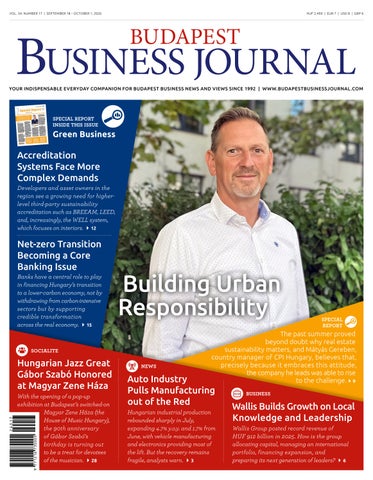
Building Urban Responsibility
SOCIALITE
Hungarian Jazz Great Gábor Szabó Honored at Magyar Zene Háza With the opening of a pop-up exhibition at Budapest’s switched-on Magyar Zene Háza (the House of Music Hungary), the 90th anniversary of Gábor Szabó’s birthday is turning out to be a treat for devotees of the musician. 28
NEWS
SPECIAL REPORT
The past summer proved beyond doubt why real estate sustainability matters, and Mátyás Gereben, country manager of CPI Hungary, believes that, precisely because it embraces this attitude, the company he leads was able to rise to the challenge.9
Auto Industry Pulls Manufacturing out of the Red
Hungarian industrial production rebounded sharply in July, expanding 4.7% y.o.y. and 1.7% from June, with vehicle manufacturing and electronics providing most of the lift. But the recovery remains fragile, analysts warn. 3
BUSINESS
Wallis Builds Growth on Local Knowledge and Leadership Wallis Group posted record revenue of HUF 912 billion in 2025. How is the group allocating capital, managing an international portfolio, financing expansion, and preparing its next generation of leaders? 6
2|1
News
www.bbj.hu Budapest Business Journal | September 18 – October 1, 2026
IMPRESSUM EDITOR-IN-CHIEF: Robin Marshall EDITORIAL CONTRIBUTORS: Luca Albert, Anikó
Angyal, Balázs Barabás, Éva Bodor, Zsófia Czifra, Kester Eddy, Bence Gaál, Gergely Herpai, David Holzer, Gary J. Morrell, Nicholas Pongratz. LISTS: BBJ Research (research@bbj.hu) NEWS AND PRESS RELEASES:
Should be submitted in English to news@bbj.hu LAYOUT: Zsolt Pataki PUBLISHER: Business Publishing Services Kft. CEO: Tamás Botka ADVERTISING: AMS Services Kft. CEO: Balázs Román SALES: sales@bbj.hu
CIRCULATION AND SUBSCRIPTIONS: circulation@bbj.hu
Address: Madách Trade Center 1075 Budapest, Madách Imre út 13-14, Building B, 7th floor. Telephone +36 (1) 398-0344, Fax +36 (1) 398-0345, www.bbj.hu
What We Stand For: The Budapest Business Journal aspires to be the most trusted newspaper in Hungary. We believe that managers should work on behalf of their shareholders. We believe that among the most important contributions a government can make to society is improving the business and investment climate so that its citizens may realize their full potential. The Budapest Business Journal, HU ISSN 1216-7304, is published bi-weekly on Friday, registration No. 0109069462. It is distributed by HungaroPress. Reproduction or use without permission of editorial or graphic content in any manner is prohibited. ©2017 BUSINESS MEDIA SERVICES LLC with all rights reserved.
BBJ-PARTNERS
VISIT US ONLINE: WWW.BBJ.HU
THE EDITOR SAYS
A SOMBER DAY IN NEED OF MARKING A significant date passed last week, and while far cleverer people than I have spoken eloquently about it, I feel it should be acknowledged here. It is hard to grasp that 9/11 was 25 years ago, although it does underline the theme from the editorial in our last issue about how quickly time passes. It is also sobering to think that those born after 2001 have a totally different relationship with those tragic terrorist attacks. I was chatting about this very thing with someone at our BBJ Back to Business mixer on Sep. 15. She had mentioned “9/11” to some colleagues and was surprised at the lack of an immediate response. “Then I looked at them, and realized they were all born after it.” I guess it is similar to my understanding of the London Blitz of World War II. I know about it from the history books and from my mother’s stories. Born in 1930, it was a lived experience for her as a pre-teen. I was the production editor in a different Budapest newsroom on that day. We got word of “an accident” at the first tower, switched on the company TV set and watched, slack-jawed, as events unfurled. I cannot remember what stories we were working on, but I do recall that we were not on deadline; it was obvious no meaningful work could be done that day. We let those who had relatives in the States go home if they wanted to try to make contact in a world so unbelievably ancient that social media didn’t exist, email was far from ubiquitous,
and the internet was still in its relative infancy. Most of the team chose to stay gathered around the television. Back in 2001, my cousin was a serving officer in the U.S. Army. Following some time in Europe, he had been rotated back to the United States. Although he had not been assigned to the Pentagon, it was not impossible that he might have been visiting. Only in the afternoon did I hear from his wife that he was well, if shocked and angry. Too many others had longer, sadder waits. For my generation, there was a world before 9/11 that had been our normal. Post 9/11, nothing for us has ever been quite the same. Deliberately flying a plane into a skyscraper was too abhorrent to entertain as a serious likelihood. Yet Al-Qaeda conceived, planned, and carried out just such an attack. The attacks also came to define an era in which terrorism, and the threat of terrorism, became an inescapable part of public life. In the years that followed, other extremist groups, including Islamic State, would commit their own atrocities in the name of their so-called Caliphate. Time passes. Direct links with the past fade and eventually die away. And yet, as we say at every Remembrance Service, or Veterans Day, or International Holocaust Remembrance Day, “Never forget.” Robin Marshall Editor-in-chief
• Independence. The BBJ’s journalism is dedicated to reporting fact, not politics, and isn’t reliant on advertising from the government of the day, whoever that might be.
THEN & NOW
• Community Building. Whether it is the Budapest Business Journal itself, the Expat CEO award, the Expat CEO gala, the Top Expat CEOs in Hungary publication, or the new Expat CEO Boardroom meeting, we are serious about doing our part to bind this community together.
For more information visit budapestbusinessjournal.com
Photo by Tamás Vasvári / MTI
• Value Creation. We have a nearly 30-year history of supporting the development of diversity and sustainability in Hungary’s economy. The fact that we have been a trusted business voice for so long, indeed we were the first English-language publication when we launched back on November 9, 1992, itself has value. • Crisis Management. We have all lived through a once-in-a-century pandemic. But we also face an existential threat through climate change and operate in a period where disruptive technologies offer threats and opportunities. Now, more than ever, factual business reporting is vital to good decision-making.
Photo by Márton Ernő Kovács / Fortepan
Why Support the BBJ?
In the 1949 black-and-white photo from the Fortepan public archive, Olympic champion Olga Gyarmati is pictured at the Vasas Sports Center at 11–13 Pasaréti út in Budapest’s District II. In the color image from state news agency MTI, taken on Sep. 11, 2026, Luca Kozák competes in the women’s 100-meter hurdles semifinal at the World Athletics Final at the Gyula Zsivótzky National Athletics Center in Budapest.
1
www.bbj.hu Budapest Business Journal | September 18 – October 1, 2026
News
• macroscope
Auto Industry Pulls Hungarian Manufacturing out of the red, Battery Output Remains Weak
Hungarian industrial production rebounded sharply in July, expanding 4.7% year-on-year and 1.7% from June, with vehicle manufacturing and electronics providing most of the lift. But the recovery remains fragile: battery production fell more than 15%, while uncertainty over German demand and August’s power-supply disruption at the Paks nuclear plant could weigh on the months ahead.
Industrial Production in Hungary, 2002–2026 (January–July) Production Volume Index (compared to the same period of the previous year)
Source: KSH / National Archives / MTI
However, Erste’s Nyeste highlighted a later monthly decline in German industrial production as a warning sign for Hungary’s export-oriented manufacturers. The German recovery matters because German companies operating in Hungary employ around 250,000 people and account for more than 7% of Hungarian GDP, according to the bank’s analysis. For Hungary, therefore, stronger German demand could provide an important external boost, while renewed weakness would represent a significant downside risk.
Domestic Energy Risk
Another immediate risk comes from Hungary’s domestic energy supply. The exceptionally severe drought and low water levels on the Danube have affected operations at Paks nuclear power plant, prompting concerns over electricity supply during a period when industrial power demand normally increases. Analysts expect the impact to be visible in the August industrial figures. Gránit Alapkezelő chief economist Gábor Regős said the partial shutdown of Paks, together with voluntary production restrictions, could take several percentage points off monthly industrial output. The impact will depend partly on how companies adjusted their operations. Nyeste noted that if energy-saving measures coincided with the usual summer shutdowns and maintenance periods, some of the effect might not be fully visible in the annual statistics. Energy-market risks have also increased externally. Virovácz pointed to oil prices approaching USD 100 per barrel, gas prices
around
EUR 75,
ZSÓFIA CZIFRA
Hungary’s industrial sector started the third quarter on a stronger footing, according to fresh data from the Central Statistical Office (KSH). The improvement was driven primarily by two sectors. Vehicle manufacturing expanded by 18% y.o.y., while computer, electronic and optical product manufacturing increased by 19.7%. Their strong performance more than offset declines across most other manufacturing segments. The figures suggest that new production capacity is beginning to make a visible contribution to Hungary’s industrial performance. Analysts have pointed in particular to the ramp-up of BMW’s new Debrecen plant as a likely factor behind the automotive industry’s strong July showing. Orsolya Nyeste, analyst at Erste Bank, said the automotive sector appeared to be the main driver of the July increase. In her assessment, output from newly commissioned capacity was likely strong enough to outweigh weaker performance elsewhere in the sector. The development is significant for an economy where manufacturing remains closely tied to external demand, particularly from Germany and the broader European automotive industry.
The recovery, however, is far from broad-based. Electrical equipment manufacturing, which includes battery production, contracted by
6% y.o.y.
in July, with battery manufacturing itself plunging 15.2%. That divergence highlights a key feature of Hungary’s industrial strategy in recent years. Large investments in electric vehicle and battery manufacturing have created substantial new capacity, but demand conditions in European automotive markets remain uncertain. Food, beverage and tobacco manufacturing also declined, falling 2.3% from July 2025. Both domestic and export sales weakened. Meat processing, which accounts for around 22% of the sector, fell 1.2%. The export figures were considerably stronger overall. Industrial export volumes increased 6.3% y.o.y. Vehicle manufacturing, which accounts for around one-third of manufacturing exports, increased its exports by 15.7%, while exports of computers, electronic and optical products jumped 36%.
New Orders Encouraging
One of the more encouraging elements of the July data was the sharp increase in new orders, up 17.8% y.o.y. Domestic orders increased 4.5%, while export orders
rose 20%. At the end of July, the total order book was 46% larger than a year earlier. The unusually strong order-book data provide some support for expectations that Hungarian industry could finally emerge from its three-year recession. ING Bank chief economist Péter Virovácz nevertheless described the recent performance as a continuation of the sector’s familiar “saw-tooth” pattern in which a weak month follows a strong one. After June’s decline, a better July had been expected, but he warned that August could again bring a significant deterioration. Virovácz expects the pattern to continue, with a possible recovery in September. Despite the volatility, he estimates that industrial production could grow by
around
3-4%
on average this year, allowing industry to make a positive contribution to GDP growth after three years of contraction. The outlook for Hungarian manufacturing is closely linked to conditions in Germany, its most important industrial and trading partner. Signals from the German economy were mixed. According to the analysis cited by MBH Bank, German industrial production rose 1.3% m.o.m. in July and 1.5% y.o.y., supported mainly by machinery and automotive manufacturing.
and disruptions linked to the Strait of Hormuz as downside risks for European industry. Despite the risks, analysts see reasons for cautious optimism. MBH Bank expects industrial production to expand in 2026 after three years of recession, supported by the gradual commissioning of new capacity. The Debrecen BMW plant, the expansion of MercedesBenz production in Kecskemét, and the developing supplier network around BYD’s planned electric vehicle plant in Szeged could all contribute to growth. BYD currently has business relationships with 192 companies operating in Hungary, including 24 that are already actual suppliers, according to the analysis. However, the start of production in Szeged may be delayed until the final quarter of 2026, according to reports. Battery plants could also contribute more substantially once their production reaches full capacity. A further potential boost could come from the release of around EUR 16 billion in EU funding. MBH expects the funds to create upside potential for industrial investment, although their actual disbursement and economic impact are likely to take time and could become more significant from 2027. Gránit’s Regős said the July data suggested that industry may have moved beyond its trough, but stressed that the recovery remained fragile.
4|1
News
www.bbj.hu Budapest Business Journal | September 18 – October 1, 2026
Photo by Zsolt Czeglédi / MTI
Ukraine’s Draft Minority Education Ukraine Law Could Unlock EU Cluster Progress Crisis Roundup Hungary again withheld approval for Ukraine’s next European Union accession clusters, now for a fourth time, pending Ukrainian legislation implementing June’s minority rights deal, days after Kyiv’s parliament condemned Soviet deportations of Transcarpathian Hungarians, and Budapest expelled 10 Russian diplomats. NICHOLAS PONGRATZ
On Sep. 3, two days after Budapest’s third refusal at the Council of the EU’s Working Party on Enlargement (COELA), Deputy Prime Minister and Minister of Foreign Affairs Anita Orbán set out the government’s terms at the Cultural Diplomacy Conference. She said Hungary would not back fast-track accession under any circumstances and would hold a referendum once Kyiv concludes its negotiations. “What we expect is the implementation of the minority agreement negotiated in June,” Orbán said, referring to the political deal in which Kyiv committed to guaranteeing the educational, cultural, linguistic and administrative rights of Transcarpathia’s Hungarian minority, adding that the Verkhovna Rada, Ukraine’s parliament, must adopt the corresponding laws on education by December 2026 and on political participation in 2027. The Rada adopted a declaration the same day recognizing the Soviet deportation of Transcarpathian Hungarians to labor camps between 1944 and 1946 as a crime of the communist totalitarian regime. Fedir Shandor, Ukraine’s ambassador to Hungary, initiated the measure, which also calls for memorials, archival research and inclusion of the deportations in school curricula. Hungary’s Ministry of Foreign Affairs responded on Sep. 4, saying, “Hungary respectfully thanks and welcomes Ukraine’s step, and is ready to cooperate both in uncovering the past and in honoring the memory of the victims.” Orbán reported progress on Sep. 7, writing that she had consulted Hungary’s consul general in Uzhhorod three times in
48 hours
after Ukraine’s education ministry began drafting the required legislation. She
Ihor Tyerehov, Mayor of Kharkiv, Ukraine (right), and Mayor of Debrecen László Papp exchange signed copies of the sister city agreement between their cities at the Old City Hall in Debrecen on Sep. 16, 2026. noted that Kyiv had continued funding small minority-language schools from Sep. 1 under Resolution 929. “It is now time for implementation, and both sides are working on it,” she wrote. On September 8, COELA again failed to approve the screening results for clusters 2 and 3, according to EU sources cited by Ukrainska Pravda. The Kyiv Post, citing the same sources, reported that Budapest had not disclosed which legislative steps it expects. The impasse also holds up Moldova, as Ireland, which currently holds the rotating Presidency of the Council of the European Union, and other member states have declined Hungary’s offer to advance Chisinau separately. “We are practically negotiating with our Hungarian partners with the EU every day to avoid artificial delays in the negotiation process,” Ukrainian foreign ministry spokesperson Heorhii Tykhyi told European Pravda at a briefing earlier that day. He blamed Viktor Orbán’s former government for 17 months of obstruction. “But even having lost power, Orbán’s team continues to disrupt the normalization of Hungary’s relations with Ukraine,” he said.
Merit-based Accession
Prime Minister Péter Magyar addressed the refusal on Sep. 10 following a Visegrád Four summit in Bratislava also attended by Ireland’s Taoiseach Micheál Martin. He said the June agreement was political, and that Ukraine had
not yet taken the concrete measures it committed to, adding that his Tisza Party backed opening clusters 1 and 6 but would support further chapters only under merit-based accession. “It is not fair that everyone is now demanding that we open the clusters for Ukraine, while no progress has been made in the negotiations in the first and sixth clusters either,” Magyar said. On Sep. 11, Telex reported that Ukraine’s draft law departs from the text agreed at expert level. According to the outlet, the draft leaves minority-school status to the discretion of individual institutions rather than granting it automatically wherever minority classes exist, and does not require either the director or a deputy director of such schools to speak Hungarian. Anita Orbán told a joint press conference in Budapest on
September
14
with German Foreign Minister Johann Wadephul that the government’s position on enlargement remained unchanged. She added that expert talks on the legislative package would continue this week, with adoption by the Rada as the next step. Meanwhile, Hungary ordered 10 Russian diplomats to leave the country on Sep. 8, weeks after the government’s instructions for the UN General Assembly named Russia a threat to Hungary. Orbán
said the staff had engaged in activities unacceptable for diplomats under the Vienna Convention, a week after Russian investigative outlet Agentstvo reported that at least 15 of the embassy’s 47 employees had ties to Russian intelligence.
“Hungary respectfully thanks and welcomes Ukraine’s step, and is ready to cooperate both in uncovering the past and in honoring the memory of the victims.” “This decision [...] does not imply breaking off diplomatic relations with Russia. Hungary intends to continue the necessary dialogue,” she said in a statement. Moscow called the move an “extremely unfriendly step.” Foreign ministry spokesperson Maria Zakharova promised a “harsh and painful” response to what she described as the “Russophobic lobby in Budapest,” without specifying measures, while Russian Ambassador Evgeny Stanislavov rejected Orbán’s characterization. EU spokesperson Christian Wigand called Hungary’s first expulsion of Russian diplomats since the full-scale invasion a legitimate decision.
1
www.bbj.hu Budapest Business Journal | September 18 – October 1, 2026
Investors Becoming More Selective as Markets Rebound
News | 5
Real Estate Matters A biweekly look at real estate issues in Hungar y and the region that base has not yet broadened much beyond domestic capital,” he comments.
Commercial real estate investment across the CEE-6 markets reached EUR 5.8 billion for the first half of 2026 compared with EUR 5.4 bln in H1 2025, representing a 7% year-on-year increase in volume, according to Colliers figures.
Budapest Upturn
of 2026, Czech capital accounted for EUR 1.98 bln of investment activity, while Hungarian capital represented EUR 700 million, according to Colliers. “Domestic buyers should keep the lead, though likely a touch below the 75% plus share they held in the first half of 2026, up from under 60% a year earlier,” the consultancy adds. “The rebound looks structural rather than seasonal. First-half 2026 turnover topped EUR 460 mln, up 57% year-onyear, spread across a dozen deals in every core sector rather than resting on one large transaction,” says Borbély. “Whether it counts as fully sustainable still depends on who is buying, and
Many analysts expect an upturn in investment market activity in Hungary this year. “We started to see an improvement in terms of liquidity in the second half of 2025,” comments Benjamin Perez-Ellischewitz, principal at Avison Young Hungary. “The trend was confirmed in the first semester of 2026 with some EUR 560 mln transacted, and the expectation to pass the EUR 1 bln volume of transactions by year-end. That would be the first time since 2021,” Perez-Ellischewitz adds. Borbély, of CBRE, says his firm expects full-year turnover of EUR 900 mln to EUR 1 bln, up from EUR 610 mln in 2025 and more than double the EUR 314 mln in 2024. “That assumes roughly EUR 450 mln of assets currently under offer close in the second half, drawn from a broader EUR 2 bln deployment pipeline still being worked through,” he adds. Retail led in Hungary in the first half of the year at about EUR 200 mln, ahead of offices at roughly EUR 150 mln across seven deals, including Capital Square and Millennium Towers I. Industrial came in at about EUR 105 mln, anchored by a Budapest-North logistics deal, according to CBRE. Retail and hotel assets are scarcest, held back by longstanding development restrictions, while industrial supply is comparatively abundant; living and student housing remain almost entirely absent from the market.
Appeninn Asset Management Holding Buys 11 Retail Properties in Poland
market as the owner of the Wiśniowy Business Park in Warsaw and the Goodyear logistics center in Tarnów. Indotek Polska will assume responsibility for the asset management of the acquired portfolio.
GARY J. MORRELL
This marks a significant improvement on recent years and confirms that investor confidence is returning to the region. However, it is not yet seen as a broad-based recovery. “Capital is flowing selectively towards assets offering resilient income, strong ESG performance and long-term relevance in a changing economic environment,” says Colliers. The consultancy forecasts a full-year investment total of EUR 12.5 bln-13 bln. “Half of the investment volumes in the region is undertaken by domestic capital and a further quarter by CEE investors, so we are not so reliant
Hungary’s Appeninn Asset Management Holding has finalized the purchase of 11 modern retail properties (seven retail parks and four shopping centers) located in towns and cities across Poland from Dekada S.A. The transaction value exceeded EUR 100 million. The total GLA is approximately 53,000 sqm, with the properties completed between 2011 and 2024. “From the very start, we have focused on creating modern retail centers, mainly in city centers, that meet the needs of local communities. We developed each project with long-term value in mind, for tenants, local residents and investors alike,” says Aleksander Walczak, CEO of Dekada.
The Capital Square building, acquired by Wing, was one of seven office deals in Hungary in H1 2026, worth a combined EUR 150 mln. on Western European, American or Asian capital as we once were,” says Gábor Borbély, head of CEE business development and research at CBRE. “However, Chinese capital is still important for Hungary, and the Nordic countries are extending into CEE, starting with Poland and filtering further to the south. In all markets, there is more domestic capital active, as international capital is not moving around,” Borbély adds. Czech capital dominated CEE real estate in 2025, deploying a record EUR 5.4 bln and capturing 44% of all CEE investment activity according to Colliers. In the first half
‘Immediate Scale’
“The acquisition of the Dekada portfolio gives Appeninn immediate scale in the Polish retail property market and adds a substantial retail component to our existing office and logistics investments in the country,” says Györgyi Szűcs, CEO of Appeninn Plc. “The portfolio’s geographic reach, high occupancy and established tenant mix reflect the quality of the assets Dekada has developed over more than a decade and align closely with our strategy of investing in income-producing properties across Central and Eastern Europe. We thank The Dekada Sieradz retail park in Poland, part of the 11-unit the Dekada team for their professional Dekada retail portfolio acquired by Appeninn Asset Management. and constructive cooperation throughout this complex transaction,” he adds. Indotek Group, Appeninn’s largest shareholder, acted as transaction Retail parks are set to play a defining for households and a defensive, incomeadvisor to the buyer, alongside role in shaping the CEE consumer generating asset class for investors. Cushman & Wakefield, the law firm and investment landscape, according The purchasers of the portfolio are Greenberg Traurig Poland, and Sentient. to analysts. As domestic demand companies belonging to Appeninn strengthens and EU integration Holding Plc., one of Hungary’s largest Dekada S.A. was advised by CBRE advances, the format’s adaptability publicly listed investment groups. The and the law firm Dentons. Consultancy TPA Poland advised both parties. positions it as both a community hub group is already present on the Polish
2
www.bbj.hu Budapest Business Journal | September 18 – October 1, 2026
Business
Wallis Builds Next Growth Phase on Local Knowledge and Leadership Wallis Group posted record revenue of HUF 912 billion in 2025, with more than 60% generated in foreign markets. Gyula Mező, CEO of Wallis Asset Management, tells the Budapest Business Journal how the group is allocating capital, managing an increasingly international portfolio, financing expansion, and preparing its next generation of leaders. GERGELY HERPAI
BBJ: Beyond the headline figures, what were the most important drivers of 2025’s growth, and how does that reflect Wallis Group’s long-term investment approach? Gyula Mező: Record revenue was driven primarily by growth in international markets, with the combined revenue of our portfolio companies increasing by nearly 30% last year. All of our subsidiaries contributed to the strong result, but I would highlight four in particular. AutoWallis continued to expand in line with its announced growth strategy, increasing both the number of vehicles sold and its revenue. At Wing, residential unit sales rose, and the company also completed several exits in Poland. Akko Invest, our publicly listed integrated real estate services company, also achieved record results. Praktiker increased both revenue and market share, with new store openings providing additional support for that growth. BBJ: Group-level EBITDA was close to HUF 97 billion in 2025, compared with HUF 103 bln a year earlier. How do you interpret that result alongside the record revenue, and what does it say about the earnings capacity of the portfolio? GM: In a challenging economic environment, where there has now been no meaningful growth for three consecutive years, we kept EBITDA broadly stable in 2025. I consider that a strong result, particularly because, unlike in previous years, we did not complete any major company sale or other significant transaction during the year. BBJ: Talking of group-level corporate transactions, what types of investment opportunities is Wallis actively seeking, and what criteria must a potential acquisition or partnership meet before it can become part of the portfolio? GM: We continue to look primarily for investment opportunities involving companies at a mature stage of
development, where we can work together with a management team that also holds an ownership position to generate shared value growth. We also need to share the same fundamental values, including integrity, professionalism, and hard work. BBJ: Wallis now has businesses in real estate, automotive and mobility services, retail, and specialty flooring production. How does the group set strategic priorities and allocate capital across such different sectors? GM: The current constraint on our capital allocation is not the amount of capital available to us, but the capacity that can be effectively deployed in each market. Our real estate companies primarily operate through development projects, where we can clearly identify the limits imposed by market demand and our own execution capacity, and then determine the corresponding capital requirements. At Wing, the current focus is on residential development in all three countries, and capital is mainly being allocated to such projects within the individual companies. AutoWallis has sufficient capital to implement its strategy and growth plans for several years. This is partly due to the capital increase we completed in 2024 and partly to the substantial earnings generated by its core operations. At Praktiker, we have opened three new stores in recent years, and we plan additional locations. We view each of these as an investment expected to generate an appropriate return. BBJ: AutoWallis operates in 17 countries, while Wing has substantial exposure in Hungary, Poland, and Germany. How do you balance local decision-making with common group-level governance, capital allocation, and risk management across this international portfolio? GM: Our portfolio companies have local management teams in Hungary, Poland, and Germany that are responsible for operations. At the top of the decisionmaking chain, however, Wallis Group
funding intended to support international investment. Both Wing and AutoWallis have used such facilities in recent years. BBJ: Where do you see Wallis’s strongest competitive advantages, and what are the main challenges of building an international portfolio from Budapest? GM: Our greatest advantage is the local knowledge we have accumulated. We have been present in several countries across the region for many years, and we work closely with the management teams of our portfolio companies. Building that network of relationships is not simple and is one of the main challenges involved. We work well with the leadership of the two international real estate companies within Wing Group, Poland’s Echo Investment and Germany’s Bauwert. Bauwert is more than 40 years old and has benefited from strong management continuity since its founding, while Echo’s chief executive has held the position for approximately 10 years. Both management teams are deeply embedded in their respective markets. At AutoWallis, central direction is provided from Budapest, with the group working closely with local management teams in the other countries where it operates.
BBJ: Your Horizont Program connects experienced professionals and key middle managers across your companies. Gyula Mező, CEO of Wallis Why is leadership development and Asset Management. knowledge-sharing important to your long-term growth strategy, and how do you measure its value? executives also sit on the companies’ GM: We believe deeply in human values boards, meaning that final decisions on as fundamental principles. Successful investments, including investments Western companies show that training and abroad, and divestments are ultimately development strengthen both individuals made in Hungary. Our objective remains and organizations. We expect participants to build an international investment in the Horizont Program to take on group. In that context, we are still in leadership positions within the group over the investment phase in some of the the long term. In our experience, colleagues countries mentioned, including Germany. who are supported and developed We seek to mitigate risk through internally can become exceptionally diversification by both geography and effective and successful leaders. business activity. In real estate, we Another objective is to strengthen are present across every major market relationships between our companies. segment, allowing us to allocate capital We want to place greater emphasis among them in response to changing on personal connections alongside the market conditions. We also cover predominantly formal relationships several segments of the automotive that already exist across the group. market, with operations in services as well as vehicle distribution and retail. BBJ: What milestones will determine whether Wallis has succeeded in its BBJ: European financing conditions next phase of development beyond have shifted considerably in recent revenue and EBITDA growth? years. How has Wallis adapted its In which areas do you expect the financing mix, and what lessons has the group to change most significantly? group drawn about raising capital in GM: Our core values will not change. We the current environment? will remain adaptive and make decisions GM: We rely primarily on our own equity, quickly when we identify new opportunities although we also make use of external that can generate long-term value, and we financing. Wallis Group consistently will work hard to realize that value. One seeks to ensure that, alongside traditional area where we plan to place even greater bank financing, our companies can also emphasis is developing and training our raise capital from public markets. Because colleagues, because they will secure the our businesses have a stable financial group’s long-term success. We will measure background, they have continued to that success by how much participants obtain funding through these channels in these programs develop, how much in recent years, and their bond auctions value they add to our companies, and how have been oversubscribed on several many of them become senior executives occasions. In addition to institutional within the group over the next five years. bonds, Wing has also successfully I would also like our senior executives issued retail bonds. Another component to be recognized as leading professionals of our financing mix is state-backed in their respective industries.
www.bbj.hu Budapest Business Journal | September 18 – October 1, 2026
PROMOTION
2
Business | 7
The People of DSB: Growing Through Encounters What makes a school special? Its buildings, facilities, and academic program certainly matter. But ultimately, a school is shaped by its people, by the children who bring their curiosity and talents, the teachers who encourage them, the families who contribute to school Natali Hajsz went from a second prize at the Hungarian Science and life, and the many Innovation Olympiad to fourth place at the Taiwan International people students Science Fair and a silver medal at meet along the way. I-FEST in Tunisia. Dóra and Mátyás This idea is particularly meaningful at the German School of Budapest as the 2026/27 school year marks the beginning of a new chapter. Martina Fuchs has taken over as head of school, bringing new perspectives and impulses while building on DSB’s strong foundations. The school’s former head, Carolin Schmidt, expressed this idea in her farewell message: a school needs resources, but it lives through the people who shape it; through their curiosity, energy, respect, and patience for one another.
Heart, Hand, and Mind
Martina Fuchs describes her understanding of education with a simple principle: heart, hand, and mind belong together. Academic achievement remains an important part of DSB. But education is about much more than grades. It means helping young people discover their strengths, develop independence, and take responsibility. Art, music, and sport therefore matter just as much for personal development as languages, mathematics, and the sciences. This attitude is also reflected in DSB’s approach to talent development. Students are encouraged to explore their interests, go beyond the classroom, and test their abilities. The results are impressive. DSB students have achieved outstanding success at Jugend forscht, the Hungarian Science and Innovation Olympiad (OTIO), the Mathematics Olympiad, and international physics competitions. In 2026 alone, 16 DSB students presented 12 projects at Jugend forscht, with three first-place winners qualifying for the state finals.
Szederkényi received a second prize for STEAMflow, while Adél FürchtBeck and Petra Schmidinger received a special award. Bertalan Biró achieved second place in the state round of the German Mathematics Olympiad, while Lőrinc Biró qualified for its national final for the second time. Stella Sipeki and Ármin Nagy joined the Hungarian national physics team, with Stella captaining the team to bronze at the IYPT in Zurich. But behind every result are people: students who persevere, teachers who recognize potential, teammates who support one another, and experts who open doors.
Learning Through Encounters
At DSB, education deliberately reaches beyond the classroom. Meeting people with different experiences and perspectives can sometimes teach as much as a lesson itself. One extraordinary example was the opportunity for Year 11 students to meet former German Chancellor Angela Merkel at the presentation
wants to create more opportunities for sporting development. Sport strengthens not only physical abilities but perseverance, fairness, teamwork and resilience. New ideas also include a school garden, animal-assisted education or a school dog, stronger student participation, and more shared experiences. The aim is to make school not only a place where knowledge is acquired, but a place where people enjoy spending time, taking responsibility, and creating something together.
DSB is a Community
Ultimately, all these elements come together in one idea: DSB is a community. This is visible in everyday of her autobiography, “Freiheit,” at relationships, but also in traditions, the Goethe-Institut Budapest. Students projects, celebrations and alumni could engage directly with her on returning years after graduation. The responsible leadership, the future yearbook describes former students of Europe, civic engagement, and traveling from different countries for her personal experiences in office. reunions and immediately rediscovering DSB students also encounter that familiar sense of belonging. people from science and innovation. Martina Fuchs expresses her vision At the Hungarian Science and with a powerful image: she wants to Innovation Olympiad, Hungarian “tear down walls rather than build them.” astronaut Tibor Kapu presented That is also what education at DSB prizes. Through programs such as can mean: bringing people together. Girls’ Day, Researchers’ Night, and Students and teachers, German and Brain Awareness Week, students Hungarian perspectives, science enter laboratories, meet researchers and creativity, individual talent and and companies, and experience community, but also young people science as something created by and those who can inspire them. real people rather than something Because in the end, education happens confined to textbooks. through people. And it is the people Alumni are another important part of DSB, and the people they encounter, of this culture of encounter. Former who make the school what it is. DSB students regularly return to share their experiences of university, professional life, important decisions Would you like to experience and even unexpected detours. Their the DSB community in person? stories demonstrate that there is no Prospective families are warmly single “right” path after graduation. invited to our Open Day on Sep. 25 from 10 a.m. It is a great More Space for Sport opportunity to get to know the and New Ideas school, meet members of our From this school year onwards, sport community, and gain a first-hand will receive significantly greater impression of everyday life at DSB. emphasis. As a PE teacher with a background in athletics, Martina Fuchs
8|2
Business
www.bbj.hu Budapest Business Journal | September 18 – October 1, 2026
Company Alpiq Opens EUR 64 mln Hybrid Power Plant in Budapest
Energy group Alpiq inaugurated a EUR 64 million hybrid power plant combining gas engines and battery storage in Budapest on Sep. 14, state news wire MTI reports. The investment includes 50 MW of high-efficiency gas engine capacity and a 5 MW/10 MWh battery storage system, which can respond to demand initially without keeping the engines running continuously. The plant’s additional flexibility is expected to support the integration of around 150 MW of additional solar capacity into Hungary’s electricity grid. The facility complements Alpiq’s existing 403 MW combined-cycle gas-fired power plant and 35 MW power-to-heat facility at its Csepel site. The Budapest complex can meet around 6% of Hungary’s electricity needs and supply district heating to approximately 20,000 households in the southern part of the capital.
CATL Debrecen Sets up Packaging and Assembly Unit
CATL Debrecen has established a separate unit for warehousing, packaging, assembly and manufacturing equipment repair, the Chinese-owned battery maker
News
said on Sep. 3. The unit, dubbed GreenPower Energy Debrecen, will start operating at a 44,000 sqm facility next to the CATL Debrecen plant in the east of Hungary at the end of October, after it acquires the necessary permits. The functional separation of CATL’s activities in Hungary will help optimize internal operations, CATL Debrecen said. GreenPower Energy Debrecen will make more than 90 hires by year-end.
Oddo BHF Sees Further Upside for Richter Shares
Oddo BHF has raised its price target for Gedeon Richter Plc. shares, projecting an 11% gain over the next 12 months while maintaining a hold recommendation, online economic daily Világgazdaság (Global Economy) reports. The financial services group joins several analysts expecting the Hungarian pharmaceutical company’s shares to reach a new record high. Richter peaked at HUF 13,570 on Aug. 25, while its market capitalization has risen 27% since the start of the year, trailing the BUX index’s 33% advance. Concorde has the highest price target at HUF 15,080, followed by MBH Bank at HUF 14,911 and Jefferies at HUF 14,742. Wood & Company has the lowest target at HUF 9,435, implying a substantial decline.
Among the 11 institutions covering Richter, four recommend buying and seven advise holding, with none issuing a sell recommendation.
Lidl Magyarország Opens HUF 60 bln Logistics Base
Lidl Magyarország has opened a new logistics base in Kiskunfélegyháza (116 km southeast of Budapest by road) at a cost of nearly HUF 60 billion, the local unit of the German-owned discount chain said. The base, which has around 9,000 sqm of rooftop solar panels, has created over 400 jobs, raising Lidl Magyarország’s headcount to 10,500. The more than 83,000 sqm base will supply 70 of Lidl’s 220 stores in Hungary.
Wizz Air to Resume 4 Middle East Routes From Budapest
Wizz Air will resume direct flights from Budapest to Dubai, Abu Dhabi, Jeddah and Amman from Oct. 25, the airline announced. Tickets are already available through its website and mobile app. The decision follows revisions to the European Union Aviation Safety Agency’s conflictzone recommendations and the airline’s own operational and safety assessments. Wizz Air said it would continue monitoring developments and coordinating with the relevant authorities, with flights remaining subject to ongoing safety reviews. Across its network, the airline plans to gradually restore 12 routes to
Jordan, the United Arab Emirates and Saudi Arabia during the winter season, operating 49 flights a week. The services will offer 470,000 seats from nine European cities. Alongside the Budapest routes, connections to the UAE will resume from Bulgaria, Cyprus, Poland, and Romania in October, while flights between Italy and Saudi Arabia restart in September.
WKW to Close Győr Plant, Putting Around 500 Jobs at Risk
WKW Hungária will close its plant in Győr (120 km west of Budapest by road) by the end of the year, potentially leaving around 500 employees without jobs, news outlet Index has reported. The German parent company decided to dissolve the Hungarian business without a legal successor amid restructuring and declining orders. The plant produces decorative trim for premium car brands including Audi, Mercedes, Jaguar, and Porsche. According to an employee account cited by regional news portal Kisalföld, workers were told the company would cease operations on Dec. 31 and that staff would receive standard severance payments plus retention bonuses equivalent to one or two months’ pay. Mayor of Győr Bence Pintér said he was working with the Vasas trade union to explore assistance for affected employees. Union vice president Zoltán László said the business had struggled for some time and attempts to sell it had apparently failed. The union and municipality plan to assess vacancies at nearby companies and help workers find alternative employment.
Photo by Csaba Krizsán / MTI
Audi Confirms Long-term Role for Győr Plant
Audi Hungaria Zrt.’s new MEBeco electric powertrains on the production line on the day series production began in Győr, in the Audi G10 hall, on June 18, 2026.
Audi CEO Gernot Döllner reaffirmed that the future of the Győr plant (122 km west of Budapest by road) is secure, even as the Volkswagen Group launches a global efficiency program that will cut about 50,000 jobs worldwide, news and current affairs publication HVG reports. His statement follows internal scenarios in which Győr was briefly considered among five European sites potentially facing shutdown, alongside Emden, Hannover, Zwickau and Neckarsulm. The group’s finalized plan highlights excess European capacity of more than 500,000 cars annually and forecasts a reduced global sales volume of roughly nine million vehicles, down two million from earlier expectations. Győr’s strategic importance is underscored by its 2025 output of 1.59 million powertrains, including 265,000 electric units, and more than 200,000 vehicles. It currently has 11,430 employees and has seen EUR 13.2 billion in cumulative investments since 1993. Döllner emphasized that Győr remains one of the Volkswagen Group’s largest component hubs and is a key player in its electric transition, including the new MEBeco drivetrain production launched in June.
3
www.bbj.hu Budapest Business Journal | September 18 – October 1, 2026
Special Report
PRESENTED CONTENT
Green Business
Summer Heatwave Underscores Need for Urban Responsibility well, they may have the intention, and great people, but I’m not sure they have the resources to do so. If we have the opportunity to do it, it’s our urban responsibility to do so,” Gereben argues.
Real estate sustainability is a top-down mindset: if a landlord’s leadership doesn’t walk the walk, employees won’t, and neither will subcontractors or tenants. The past summer proved beyond doubt why it matters, and Mátyás Gereben, country manager of CPI Hungary, believes that, precisely because of this attitude, the company he leads was able to rise to the challenge. ROBIN MARSHALL
“When Paks Nuclear Power Plant was shut down, and when there was this mini energy crisis in Hungary and the prime minister asked the public to reduce energy consumption, there was a pressure on us,” Gereben recalls. It is, perhaps, worth adding a little context at this stage. The extreme heat and drought drove the Danube to exceptionally low levels this summer. As Paks relies on river water for cooling, its output fell dramatically, at one point to roughly 10% of normal capacity, with fears that a full shutdown of the NPP might be required on safety grounds for the first time in its 44-year history. This created a potential electricity-supply shortfall, especially during periods of high demand from air conditioning. At the peak of the crisis, the government asked households and large electricity users to reduce consumption during the evening peak
from
5-10 p.m.,
particularly by avoiding airconditioning, EV charging and other discretionary electricity use. The voluntary request was introduced around July 30. By Aug. 26, emergency engineering work at Paks had raised the riverbed, all four reactors and all eight turbines were back in full operation, and the crisis had been averted. “I’m so proud of my colleagues. Everybody, as one person, started to brainstorm, and then turn thoughts into action; that was a fantastic common effort and a great lesson to learn,” Gereben says. “We were able to measure that, out of the 500 gigawatts that were saved on the national level, the CPI Hungary portfolio saved 3.4 MW of energy because we reacted with speed and efficiency,” he notes.
The Comfort Level
One measure CPI took was raising the temperature comfort level in its buildings from 23°C (73.5°F)
to 27°C (80.5°F). Now, based on tenant feedback, the company is looking at raising it long-term to 25°C (77°F). “Those two degrees Celsius are a huge energy-saving capacity,” Gereben says. “This summer, and especially this crisis, have proved what we can do if we really think about all the elements of how our portfolio is working: screens in the lobby areas, lighting outside, the actual temperature. Even putting very simple signs on the toilets: if you push the big button, that’s six liters; push the small one, and that’s three liters. All of a sudden, you can have a measurable saving on water,” the country manager points out. “These little things will help us adapt to these unfortunate new environmental situations. As I said, I’m very proud that my colleagues were so enthusiastic about that, and we were actually achieving great results.” That deeper thinking process into the energy use of a building underlines the need for building sustainability. Equally important for the environment, however, is what a building brings to its surroundings. “This summer was, unfortunately, very good proof of this: the need for green areas and shade. This is something which is becoming superimportant, and if we’re not
Ready to Build?
Mátyás Gereben MRICS taking care now, planting trees today, then it’s going to be a major problem in
20 years.
This is a program we are really focusing on, making these mini forests wherever we can, planting trees, and putting a very strict maintenance plan behind that.” Gereben is describing so-called Miyawaki-style mini forests, named for the Japanese botanist behind the concept. Based on native plant species, these much more densely planted green areas create more biodiverse urban environments, provide shade, help absorb rainwater runoff, mitigate the urban heat island effect, and improve the local microclimate. It wasn’t always the case, but developers increasingly talk about adding green spaces to the community today. “Who else will do that if not we, who have a certain amount of land in our hands? You have to be conscious about that because if you only ever say ‘That is the municipalities’ responsibility,’
CPI Hungary: The Company in Numbers CPI Hungary’s Hungarian portfolio comprises approximately 600,000 sqm of gross lettable area across 51 properties, valued at over EUR 1.2 billion. Offices remain a key component: Budapest alone has 19 buildings, providing workspace for 19,000 people. The retail sector continues to gain importance, however, and now totals
approximately 257,000 sqm, with an occupancy rate of 97.4%, serving around 65 million visitors annually. By 2025, the greenhouse gas emissions intensity of CPI Hungary’s office portfolio had decreased by more than 70% compared with 2019, while 100% of it holds a green building certification. Since 2023, the Hungarian portfolio’s electricity needs
What does the immediate future hold for CPI? Is there a new office project ready to be launched? Gereben’s answer is nuanced. “We have plots where we can develop offices. Provided we get the right amount of pre-release, and the right amount of financing, then we absolutely have two development possibilities ready to go; we have the permits, we’ve got everything ready.” If he is cautious about the office sector, Gereben is much more bullish about retail, and one sub-sector of it in particular. “We see a very solid performance, and we still see good opportunities, in the retail sector, especially retail parks. If you look at the whole of Hungary, the occupancy level of retail parks is
above
95%.
Even tenants who have previously only looked at shopping centers are trying out these concepts now,” he says. He makes the point that service charges have doubled in the past three or four years. “For shopping centers, there’s a multiplier factor, because it’s an enclosed space. You have to cool it. You have to heat it, to clean it, to maintain it. In a retail park, which is an an open concept, many of those service charge elements are either insignificant or entirely missing. So, the costs of being there is actually lower.” That’s not the only benefit either. Gereben says post-COVID, the shopping experience is less about entertainment and social gathering, while convenience has made a comeback. “We get there, we buy that, and we go home,” he says. “That’s the reason why we see an absolute up-curve for the retail park. We see opportunities there in development and in acquisitions.”
have been covered by electricity backed by guarantees of origin from sources generated in the CEE region. Between 2022 and 2024, photovoltaic plants were installed on the rooftops of two of CPI Hungary’s retail parks, City Market Soroksár and City Market Dunakeszi, as well as the Campona Shoppign Center and three office buildings, bringing the company’s solar power generation capacity to more than 2 MW.
10 | 3
Special Report
www.bbj.hu Budapest Business Journal | September 18 – October 1, 2026
Market Talk: ESG Moving From Compliance to how Risk, Cash Flow, and Value are Assessed A sustainable recovery in the investment markets is underway. However, investors are more selective in how they allocate capital, with a significant element tied to ESG expectations and requirements and, therefore, the long-term market viability of a given real estate project. Analysts say assets that are not ESG-compliant face a high risk of becoming obsolete from a leasing, demand, and exit-strategy perspective. Only high-quality, ESG-compliant assets will succeed in attracting demand and investment. Gary J. Morrell, the Budapest Business Journal’s real estate editor, spoke to leading market actors about ESG in real estate. I expect the Budapest market to mirror the percentages in the BREEAMwide dataset, where 5% of the buildings achieve “Excellent” or “Outstanding” levels. Depending James Fisher on the market, asset type, buyer, lender, and occupier, you can finance, permit, lease, or sell an asset without a sustainability certification. Certification is not a universal legal requirement. However, recognized sustainability standards are increasingly important in the commercial real estate market, particularly for prime assets and international investors or occupiers. They can help provide clearer evidence of sustainability performance, resilience, energy and carbon considerations, and long-term asset quality. Government can help by creating clarity, consistency and longterm confidence for the market. Regulation can set the baseline, while recognized standards such as BREEAM can help define leadership. From a BREEAM perspective, the key is to support better data, clearer expectations and investment in buildings that are more efficient, resilient and future-ready. James Fisher, head of strategy partnerships, BRE Group Expectations across all three dimensions of ESG are multifaceted and wide-ranging. I would highlight three key issues that are already affecting us and that the real estate sector has begun to address: decarbonization, climate adaptation, and data-driven decision-making. Other important areas include the circular economy, particularly circular construction and responsible material use, as well as biodiversity and responsible water management. None of these issues exist in isolation. They are closely interconnected and should therefore be managed
holistically. This approach will help us maximize the benefits and synergies of our combined actions. More companies understand that ESG should not be treated separately from everyday business as an additional set of requirements. As they experience the financial consequences of climate change and geopolitical challenges, they recognize the need to manage the associated risks. This cannot be done without integrating sustainability considerations into senior-level decision-making and the overall business strategy. Once a company takes this approach, it begins to recognize the links between asset, property, and facility management, making Henrietta Budai decisionmaking more integrated. Henrietta Budai, sustainability manager, CPI Hungary Until recently, most ESG efforts within real estate focused on transition risks, including emissions reduction, energy efficiency, and taxonomy alignment. Physical climate risks are now becoming a mainstream concern, particularly for lenders, insurers, and long-term investors. Recent climate events in Hungary highlight these challenges. Increasing heat stress, prolonged droughts, water scarcity, and pressures on critical infrastructure are becoming more evident. Nature and biodiversity are also gaining importance after receiving relatively limited attention in the past. Biodiversity enhancement is increasingly being recognized as a fundamental component of sustainable development. I would welcome the introduction of biodiversity net gain requirements within planning regulations, as already seen in several other countries.
Another important emerging topic is embodied carbon. While operational energy has traditionally been the primary focus, emissions from building Norbert Szircsák materials and construction are receiving increasing attention. As operational emissions decrease through improved efficiency and electrification, embodied carbon will account for a growing share of a building’s lifecycle impact. This will drive greater focus on material selection, circular economy principles, adaptive reuse, and low-carbon construction methods. Finally, the industry will increasingly focus on measuring and reducing operational carbon emissions beyond energy use alone. Areas such as water consumption, waste generation, transportation, commuting patterns, and supplychain impacts will receive far greater attention in the coming years. Norbert Szircsák, head of sustainability services, Colliers The integration of ESG criteria into capital markets and European regulation has fundamentally shifted real estate from a yield-only asset class to a risk-adjusted asset class. The longerZsombor Barta term implication is a permanent market bifurcation: a strong “green premium” for compliant, low-carbon assets versus a steep “brown discount” or eventual stranding for non-compliant properties.
Capital will stop flowing to assets without a clear decarbonization path, as financial institutions price in climate risk under solvency frameworks. ESG has clearly moved beyond pure regulation and is now increasingly driven by capital markets, including in CEE. While EU frameworks initially positioned ESG as a compliance exercise, financial institutions and investors are now actively pricing sustainability performance into their decisions. Access to financing, cost of capital, and asset liquidity are all increasingly linked to ESG alignment. In CEE, international capital largely drives this shift by importing expectations from more mature Western markets. As a result, ESG is becoming a key factor in distinguishing between assets that remain investable and those at risk of obsolescence. Although data quality and consistency are still developing, the overall direction is clear: ESG is no longer just about meeting regulatory requirements, but about maintaining competitiveness and securing capital. Zsombor Barta, founding partner, Greenbors Consulting ESG will remain an important factor in the Hungarian commercial real estate market, but I expect its role to become increasingly practical and financially driven. Rather than being treated primarily as a sustainability label, ESG performance will increasingly influence whether a building remains competitive, financeable and ultimately investable. In the leasing market, occupiers, particularly international corporations, are placing greater emphasis on energy efficiency, operating costs, employee well-being Valter Kalaus and their own sustainability requirements. Over time, this is likely to widen the performance gap between modern, efficient buildings and older stock requiring significant capital expenditure. For developers, the challenge will be to deliver buildings that meet increasingly demanding occupier expectations and European regulatory standards while remaining economically viable. At the same time, the limited development pipeline may create opportunities for well-positioned, future-proof projects. The impact may be even stronger in capital markets. Investors and lenders are increasingly assessing energy performance, transition risk, and future Capex requirements as part of underwriting. The EU Taxonomy provides a common framework for identifying environmentally sustainable activities and is increasingly relevant to green financing and investment decisions. Valter Kalaus, managing partner, Newmark VLK Hungary
www.bbj.hu Budapest Business Journal | September 18 – October 1, 2026
One theme power outages, fire risk mitigation, that came water security, and continuity in through the event of gas supply disruption. clearly at So the pressure is not only coming the Portfolio from regulators or lenders; it’s Sustainable coming from the demand side World too, which ultimately makes this conference a durable, structural shift rather was that than a compliance exercise. capital Regina Kurucz, managing director, only moves Rewell Consulting decisively toward green In practice, the investment process of ESG Regina Kurucz and renewable expectations, energy once regulations, the return is proven; not inspirational, and capital but demonstrable. This is where markets I see the longer-term implication of converging is ESG and capital markets converging: already well bank financing is increasingly underway. For going to favor future-proof, resilient a developer buildings, assets whose owners and operator have already assessed and mitigated in Hungary foreseeable operational risks such and the as drought, wildfire exposure, wider CEE Katalin Walter elevated particulate levels, and water region, ESG scarcity. This is no longer a soft ESG in 2026 is no preference; it is becoming embedded longer a reporting exercise. It is about in underwriting itself, because these safeguarding the future leaseability, risks determine whether a building marketability, and financeability keeps functioning and generating of a real estate portfolio. Regulation income over its financing term. and capital markets now ask the Tenants are moving in parallel. same questions: will this asset still Occupiers are increasingly selecting generate stable income and remain offices and real estate assets that liquid in 15 or 20 years, and will the can offer real guarantees around building’s physical condition and resilience: backup capacity for energy efficiency remain satisfactory? BBJ_szeptember_18_EUROPA DESIGN_javított.pdf 1 2026. 09. 15. 13:09:56 ADVERTISEMENT
C
M
Y
CM
MY
CY
CMY
K
3 The first consequence is that ESG becomes a question of asset quality rather than values. We do not believe strong ESG performance automatically means cheaper financing. But weak ESG performance will make assets more expensive to finance and, in some cases, unfinanceable. The second implication is that tenants increasingly focus on overall property costs, including rent, service charges and utilities. We can reduce the combined total of these three cost factors only by collaborating with them and charging higher rent in return for the investments we make in improving energy efficiency and reducing operating costs. The third, and most difficult, is that reducing operational emissions is no longer enough. Decarbonization must increasingly address emissions from construction materials and the construction process, while continuing to improve buildings’ operational energy performance throughout their lifetime. At Wing, we don’t simply react to regulation; we anticipate market expectations and integrate sustainability considerations into our long-term investment and development decisions. Katalin Walter, CEO, Wing The long-term implication of ESG expectations and regulations is that ESG stops being a separate compliance topic and becomes part of how we assess risk, cash flow, and value. Assets that can prove good operational
Special Report | 11 performance should retain better access to capital and liquidity, while poorly performing assets will face higher financing costs, capital expenditure requirements Hubert Abt and obsolescence risk. Central Europe does not primarily need more principles; it needs better building data, common metrics and finance products that reward verified improvement. Pressure will come from several directions, but banks and institutional investors will probably be decisive because they translate regulation and market expectations into pricing, covenants and investment decisions. The EU and the taxonomy should provide a common language and a credible minimum standard, while becoming simpler and more closely connected to real building performance. Regulation is most useful when it helps investors and lenders compare risk and progress, rather than turning sustainability into a reporting exercise. Hubert Abt, CEO, Workcloud24
12 | 3
Special Report
www.bbj.hu Budapest Business Journal | September 18 – October 1, 2026
Accreditation Systems Face More Complex Demands Developers and asset owners in the region see a growing need for higher-level thirdparty sustainability accreditations such as BREEAM, LEED, and, increasingly, the WELL system, which focuses on interiors. At the same time, analysts see the importance of extending coverage beyond the office and industrial sectors, increasing coverage of in-use and renovation projects, and certifying multiple assets rather than single buildings. GARY J. MORRELL
Beyond that, accreditation systems also need to extend their activities to more complex operational demands, including data collection and property management throughout the life-style of an asset. “Certification should move beyond design intent and point-in-time labels. It should increasingly reflect actual energy use, carbon, indoor environmental quality, resilience, controllability, data quality and operational management over the building lifecycle. The market increasingly needs proof of performance, not only proof of specification,” argues Hubert Abt, CEO of workcloud24. As of the first quarter of this year, around 2.65 million sqm of Budapest’s 4.48 million sqm of office stock held third-party sustainability accreditation, according to Colliers. BREEAM remains the most used system in Hungary and the CEE region. The U.K.-based organization defines its role with its recently released New Construction V7 system as “supporting long-term asset value by improving asset intelligence, strengthening resilience and helping them respond to investor and occupier expectations.”
should focus on supporting biodiversity rather than simply maintaining lowvalue grassed areas, while rainwater should be collected, re-used where possible and excess water infiltrated into the ground,” says Szircsák.
Environmental Footprint
“The greatest sustainability impact, however, lies within industrial processes. Process energy consumption and water use often represent the most significant environmental footprint of industrial facilities. Achieving meaningful progress, therefore, requires not only sustainable buildings but also cleaner energy sources, greater efficiency, and more sustainable water management within manufacturing operations,” he adds. The key question is whether it is better to assess ESG performance at the building level or at the corporate level, argues Regina Kurucz, managing director of Rewell The Budapest ONE office center by Futureal has been certified Consulting and a certified WELL as “Outstanding,” the highest level within the BREEAM system. expert and a LEED Green Associate. “In Hungary, even in the case of real estate funds, the practice that has Sustainability is seen as becoming taken hold is building-by-building For tenants, it is seen as supporting the norm across all property sectors. assessment, even though there is more efficient, resilient and healthier Hospitality, retail, and residential a real alternative: measuring the buildings, with continued emphasis developments have historically performance of companies or entire on issues such as air quality, natural lagged behind the office and real estate funds collectively. Arguably light, thermal comfort and acoustic industrial sectors. Still, the gap is that would be more meaningful than performance. For the wider society, closing rapidly, according to Norbert assessing assets one by one,” she says. the benefit is that new developments Szircsák, head of sustainability “Certification systems already offer are encouraged to reduce environmental services at Colliers Hungary. alternatives along this spectrum. WELL impact, use resources more efficiently, “In the residential sector, increasingly Certification operates at the building support biodiversity, and contribute stringent energy regulations are level; WELL Health-Safety Rating to healthier, more resilient places. already driving highly energy-efficient can apply at the building or portfolio “From a BREEAM perspective, the developments, further supported by level; and WELL at Scale operates broader trend is that investors and the growing adoption of smart-home at the enterprise level,” though the occupiers are placing greater emphasis technologies,” he says. “However, latter is still relatively unknown in the on quality, resilience, and credible greater emphasis should be placed Hungarian market,” Kurucz points out. sustainability performance. BREEAM on biodiversity, green space ratios, “A new option, One WELL, is supports that by giving the market a and social considerations such as coming in 2026 recognized framework for assessing or affordable housing,” Szircsák notes. and communicating how assets “In hospitality, most major perform against those expectations,” international operators now have wellsays James Fisher, head of strategy and is designed to bridge exactly established sustainability standards. partners at BRE Group, the company this dilemma: it will let companies These operational requirements behind BREEAM. see both the results for individual should be supported by the buildings Developers and owners face distinct locations and the aggregated themselves, where developers have the challenges with new construction versus performance across their entire primary responsibility. In retail, large in-use green building certifications, portfolio at the same time,” she adds. international brands are increasingly according to Zsombor Barta, founding “Fortunately, leading certification incorporating ESG requirements into partner at Greenbors Consulting. their leasing and procurement processes. systems are continuously evolving, Cordinating Stakeholders While not yet as widespread as in some with major updates typically introduced “For new construction, the main hurdles every five years,” notes Szircsák. “The other sectors, there are already strong include upfront design and planning latest versions of BREEAM and LEED, examples demonstrating how tenant to meet strict sustainability standards, the two most widely adopted certification demand can drive more sustainable integrating new technologies, managing frameworks, place greater emphasis development,” he adds. higher initial costs, and coordinating on the sustainability challenges that The industrial sector is seen as multiple stakeholders early on,” he says. are becoming increasingly important having a critical role to play in “In contrast, in-use certifications focus for the sector,” he says. sustainability, and its impact extends on existing buildings, where challenges “Examples include embodied carbon, far beyond the real estate itself. From the revolve around accurately measuring the source of energy rather than and improving ongoing performance, solely operational energy reduction, retrofitting systems, engaging biodiversity enhancement, climate of industrial and logistics stock, 2.36 occupants, and balancing operational resilience, and more comprehensive million sqm is third-party sustainability costs with sustainability goals,” Barta social impact considerations. Going accredited- according to Colliers. notes. “Overall, new construction forward, certification systems should “From a building perspective, rooftop requires proactive planning and continue to align with emerging ESG photovoltaic systems are often an investment, while in-use certification priorities while maintaining a strong obvious opportunity due to the large demands continuous management focus on measurable outcomes and roof areas available. Landscaping and adaptation,” he comments. performance,” Szircsák concludes.
2027
6.36 million sqm
www.bbj.hu Budapest Business Journal | September 18 – October 1, 2026
PRESENTED CONTENT
3
Special Report | 13
Enthusiastic Visionary Optimistic About Sustainable Future Nándor Kovács jokingly describes himself as a “revolutionary” when it comes to real estate sustainability. Spend just a little time talking to him, and what is beyond doubt is that Óbuda Group’s strategy director is an enthusiast when it comes to the subject. ROBIN MARSHALL
Óbuda was one of the first companies in Hungary to establish a dedicated green consultancy business 15 years ago, embedded within the architectural and engineering firm. Kovács was there from the start. On the back of a very hot and dry summer, how can our buildings and cities prepare for droughts, heatwaves, and other weather extremes? The good news is that, from Kovács’s perspective, we already know what to do and have the answers to hand. “Basically, I think the engineering know-how already exists in our professional community, and has for a long time. It is just that this challenge wasn’t taken really seriously,” he says. “Let me give you an example. BREEAM is the most widespread certification system, at least in Hungary and Europe, and it has included a set of requirements called adaptation to climate change since 2016, so for 10 years.” That begs an obvious question. If adapting to climate change was already a certification issue a decade ago, why hasn’t uptake come sooner or been broader? “Beyond the deaf ears of the financiers and developers and politicians, apparently, the earlier warnings were not loud enough.” Kovács believes the scientific community was unable to express the risks in a quantifiable and understandable manner. “Mother Nature has done it instead. After this summer, I think climate change doesn’t need to be
Nándor Kovács explained anymore. It has been a perfect simulation of what an average summer will look like in the 2040s.”
Mitigation Matters
Kovács makes the point that, even if the vast majority now accepts the broad principles of a warming planet, the specific details of what that will mean are less certain. But that doesn’t mean they can’t be mitigated against. “We just need to take it seriously, embed it into the project development processes, and use the tools we already have,” he says. “The big question I think right now is not will we exceed 1.5°C of warming, but by how much?” That matters because, as Kovács puts it, “the difference between a 2°C rise and 4°C is like the difference between our current living standards and the world of Mad Max. And it is a realistic scenario that we could reach plus 4°C by the end of this century.” While that dystopian future sounds worrying, Kovács insists it is avoidable. “I think that the idea of a green building has played an exceptional role in quantifying this super complex concept of environmental footprint, sustainability, and the quality of the built environment, and I still believe that it remains an important benchmark,” he says. “What has changed in the past one or two decades is that our knowledge about embodied carbon, climate resilience, rainwater runoff, or the physical aspects of green buildings has increased a lot. We can make more data-
driven decisions because the data exists, because we clearly understand some of the consequences. In my view, the green building as a simple quality benchmark will remain and should remain.”
Changing Mindset
Kovács says one of his biggest grounds for optimism is the mindset changes visible among all stakeholders. Urbanscale planning is making something of a comeback. He cites the secretary of the jury of the European Prize for Urban Public Space, who is convinced that projects that won a decade ago would not make the shortlist now. And while there is still work to do, the real estate industry is beginning to think in terms of building lifecycles. “If we find a way, if we find tools such as ESG ratings to internalize these factors, to make motivations for life cycle optimized decisions, then these decisions will be better from an environmental and sustainable performance point of view,” Kovács says. “Take the extreme weather conditions. I’m pretty positive, knowing my industry, that resilience will become part of the valuation and the insurance costs very soon. From that point onwards, building an adaptive, resilient building will not be seen as an extra cost. It will be a saving on the insurance, or an investment in the future to allow the asset to retain its value for a longer period. Since the impacts of climate change are materializing now, I think the economic solution will come very soon,” Kovács believes.
“In terms of the industry, we are absolutely ready to deliver resilient, adaptable, efficient, and smarter buildings. I can say this as a professional with connections across almost the entire value chain, from project preparation to building design and construction. I think the knowledge is ready,” he says. “I am a board member of the sustainability section of ÉVOSZ (the National Federation of Hungarian Building Contractors), and we have jointly proposed a standard for all new public buildings exceeding a certain investment value to meet at least BREEAM ‘Excellent,’ or an equivalent green rating certification, for the public building sector to set an example and, in some aspects, catch up with commercial buildings. We believe that this is doable, and we are happy to meet any new challenges or tasks created by a fresh regulatory or financing framework,” Kovács argues. One area where he definitely sees there is more work to do is in ensuring a fair distribution of the cost burden across the value chain. As extreme weather costs increasingly affect financing, insurance and asset values, the question is how they should be shared between individual projects and society, rather than simply treated as force majeure. “Basically, there are no more lowhanging fruits. Most new buildings are already built according to some level of green building standard. You cannot imagine a new building without a heat pump or some level of solar energy production. But optimizing the sustainability performance of our built environment, be it an existing building or a new build, is a very complex, multivariable challenge for architects and engineers,” he says. “It requires not only technical expertise, but that we discuss broadening our view of the concept of life cycle cost, long-term valuation, maintenance, and operational aspects. This calls for a very multidisciplinary approach and, since the value chain is highly fragmented, I believe that it also calls for integrated solutions,” Kovács articulates. “That’s what we do. Óbuda was one of the first companies to set up a green consultancy service, but it was never isolated. It has always been part of a community of hundreds of professionals, architects, quantity surveyors, and project managers. We have always believed that sustainability cannot be just a cherry on top, or a standalone issue we need to tackle separately. Sustainable thinking and sustainable development need to be embedded in the entire project development process, from early concept through postconstruction and maintenance. I think this is the biggest challenge for the professional community: to become more multidisciplinary-oriented and incorporate a stronger understanding of building economics into the way we approach projects. We need to be sensitive to very different issues, from architectural quality through runoff to sustainable mobility, and it all needs to become much more holistic.
14 | 3
Special Report
PRESENTED CONTENT
www.bbj.hu Budapest Business Journal | September 18 – October 1, 2026
The Business Case for Building Less, and Managing Better handover. Maintenance records, reliable metering and a properly updated asset register turn a one-off refurbishment into information for the next decision.
Circular property strategies become credible when design, investment and everyday operations work from the same evidence. Tibor Karsai, managing director of Rustler Kft., explains how coordinated design, investment and property operations can make circular strategies commercially viable. A lease expiration can set a familiar process in motion: a new layout, a fitout budget and a schedule of work. Yet an important investment decision comes before the design is finalized. Which parts of the existing building genuinely need replacing, which can be adapted, and which operating problems should the project solve? The answers affect not only material use, and emissions, but also future costs, disruption and the asset’s appeal to occupants. Neither retaining everything nor replacing everything is a strategy. Unnecessary replacement consumes capital and creates waste, while keeping inefficient or unreliable equipment can be a false economy. The commercial challenge is deciding what to retain, repair, adapt, or renew, and demonstrating why each choice makes sense over the intended holding period. In Hungary, the investment context makes this discipline timely. Colliers recorded EUR 610 million in commercial property transactions in the first half of 2026, up 26.7% year-on-year, but described capital as selective. Budapest Research Forum figures put overall office vacancy at 12.2% in the second quarter (and 15.7% for speculative stock), with
Different Sectors, Different Choices
Tibor Karsai renewals accounting for 62% of leasing activity. Owners must defend income while deciding where scarce refurbishment capital will make a difference. These figures describe different markets and periods; neither establishes the return on any individual upgrade. The financing conversation is also becoming more exacting. OTP Group reported a HUF 1.697 trillion green financing portfolio at the end of 2025 and set a HUF 2.123 tln target for 2028. Yet an expanding green lending market does not guarantee that a refurbished building will qualify for a particular product. Lenders and investors need a coherent project, an appropriate risk assessment, and evidence supporting the proposed outcomes. In property, that evidence begins well before an application for financing.
Making Refurbishment Smarter Consider an office refurbishment. The conventional sequence starts with a desired visual result and a construction budget. A stronger process starts with a technical and commercial diagnosis: which partitions and finishes can remain, what can safely be relocated, how much life remains in the building services, and what working pattern the tenant will actually require. Existing drawings and maintenance records must be checked against the building itself. A design that allows future reconfiguration may cost more initially but avoid another destructive fit-out when requirements change. Conversely, a retained component may fail the test if it compromises safety, comfort or future operating efficiency. The business case should compare credible alternatives, not simply a
conventional design with a supposedly greener one. Capital expenditure, energy and maintenance costs, downtime, replacement intervals, disposal and any substantiated material-related emissions belong in the same assessment. A lower upfront price can create a costly operating liability; an expensive replacement can also be unjustified where recommissioning or targeted repair would achieve the required performance. Carbon and financial outcomes should be reported separately, with assumptions visible rather than compressed into an unsubstantiated savings figure. The dividing line between landlord and tenant matters. Who pays for the fit-out, who bears utility charges, who owns reusable components and who benefits from a longer service life? These are contractual as well as technical questions. Energy savings passed through to the tenant do not automatically increase the landlord’s net operating income. They may instead improve the occupant’s total cost and the building’s leasing proposition. Property management connects these incentives to leases and budgets; facility management supplies the evidence from the equipment and its operation. At Rustler Kft., the Hungarian service offering brings together property and facility management, technical due diligence, project management and design-build services. Their relevance to circularity lies in how these services connect. Due diligence identifies risks and usable assets; design translates them into a practical plan; procurement and project management test cost, specification and delivery; and the operating team checks what works after
Logistics, retail and industrial buildings require different choices. At a warehouse, a long-lived roof, lighting installation or loading-area component cannot be judged on material reuse alone: reliability, safety, tenant operations and future maintenance access also count. At a shopping center, phased refurbishment must protect customer access and trading. On an industrial site, the relevant facility management responsibilities concern the building and supporting infrastructure, not the occupant’s production machinery. In each case, the objective is to avoid waste without transferring unacceptable risk to the user. Moving from an isolated pilot to a portfolio strategy is harder still. A reclaimed component has little commercial value if nobody knows its specification, condition, location or availability when the next project needs it. Owners need consistent inventories and purchasing rules; designers need dimensions and performance information; contractors need workable schedules; suppliers need a viable route for take-back, repair or reuse. Where documentation, warranties, transport or timing make reuse impractical, the constraint should be recorded rather than hidden behind a circularity claim. Standardized information makes repeatable decisions possible; it does not remove the need for case-bycase engineering judgment. The European Commission’s March 2026 guidance on whole-life carbon examines design, construction, use, renovation and end-of-life together. It also highlights the potential to make better use of existing buildings and avoid unnecessary demolition. Certification systems such as BREEAM In-Use can independently assess aspects of operational sustainability, but a rating cannot replace the current condition survey, cash-flow assumptions and project-specific evidence needed to approve an investment. The practical starting point is therefore not a promise to recycle more at the end of the job. It is an owner-approved plan that asks what the building already has, what its users will need, which interventions offer defensible whole-life value, who is responsible for delivery, and how results will be checked. That approach makes sustainability relevant to the asset manager’s budget, the tenant’s business and the investor’s risk assessment at the same time. The most consequential green decision may be made before the first purchase order is issued. If owners can explain not only what they intend to build, but what they have chosen to preserve, and support both decisions with evidence, circularity becomes less of a project slogan and more of a property strategy.
www.bbj.hu Budapest Business Journal | September 18 – October 1, 2026
PRESENTED CONTENT
3
Special Report | 15
Net-zero Transition Becoming a Core Banking Issue Banks have a central role to play in financing Hungary’s transition to a lower-carbon economy, not by withdrawing from carbon-intensive sectors but by supporting credible transformation across the real economy. In an interview with the Budapest Business Journal, András Puskás, deputy CEO of MBH Bank, discusses financed emissions, climate risks, transition plans, and how the bank’s own net-zero program is reshaping strategy, lending and client relationships. András Puskás, deputy CEO of MBH Bank
BENCE GAÁL
BBJ: How do you define a bank’s real responsibility in the transition to a net-zero economy? András Puskás: It goes well beyond reducing the emissions of its own buildings, vehicle fleet or operations. The much larger impact lies in the activities it finances. Through lending and investment decisions, banks help determine which technologies, buildings, infrastructure and business models receive capital and can develop over the coming decades. This does not mean that banks should decide which sectors should or should not receive financing, nor that they should withdraw from carbon-intensive industries. In fact, such an approach could make the transition more difficult. Many of the sectors with the highest emissions today are precisely those that require significant investment to transform. I see the role of a bank as supporting and financing a credible transition of the real economy, while also understanding and managing the risks that climate change and decarbonization create for its own portfolio. In practical terms, this means looking not only at where a company is today, but increasingly at where it is heading. That is an important shift. Net-zero banking is less about labeling companies as “green” or “brown” and more about directing capital toward businesses and projects that can remain competitive in a changing economy. BBJ: How can a bank assess the emissions, climate risks and transition plans of the companies and projects it finances, particularly when reliable data are still limited? AP: One of the first lessons is that we should not wait for perfect data, because perfect data is rarely available.
Climate-related information is still far less mature than traditional financial reporting, especially among smaller companies. A bank must, therefore, work with a hierarchy of information. Where verified company-specific emissions data is available, this provides the strongest basis. Where it is not, banks can use energy consumption, production data, technology information, or sector- and country-level estimates. International methodologies such as PCAF explicitly recognize this reality: even estimated data can help banks identify the carbon-intensive “hotspots” in their portfolios, while data quality is gradually improved over time. At the same time, emissions are only one part of the picture. We also need to understand physical climate risks and transition risks, such as changes in regulation, energy prices, technologies, or customer preferences. The objective is not to produce one perfect carbon number for every client. It is to build an increasingly sophisticated picture of where the material risks and opportunities are and use that information in decision-making. BBJ: What makes a corporate transition plan credible from a bank’s perspective? What factors influence whether a company remains financeable over the long term? AP: It should, first and foremost, be embedded in the company’s business plan rather than remain a standalone sustainability exercise. A long-term ambition such as becoming net-zero by 2050 is useful, but on its own tells us relatively little. What matters is what happens between today and 2050. Are there measurable interim objectives? Has management identified the main sources
of emissions? Are concrete investments planned? Is capital expenditure consistent with the stated ambition? Credibility also differs by sector. The transition pathway of a steel producer will naturally look very different to that of a real estate company or an agricultural business. Banks therefore increasingly need sectorspecific knowledge rather than one universal ESG score. International transition-planning frameworks similarly focus on strategy, implementation, metrics, governance and accountability rather than on a single headline target. Over time, I expect the range of factors that determine a company’s ability to access financing will broaden. Traditional factors such as profitability, leverage, cash flow and collateral will remain fundamental. But questions such as energy efficiency, exposure to carbon costs, technology choices, physical climate vulnerability and the ability to adapt will increasingly influence how resilient a company appears over a five-, 10- or 20-year horizon. BBJ: How is the net-zero agenda changing traditional banking activities such as risk management, lending decisions, product development and customer relationships? What new capabilities and data will banks need as sustainability becomes more deeply embedded? AP: Perhaps the biggest change is that sustainability is moving from a specialist function into the core of banking. In risk management, climate and environmental factors increasingly need to be translated into traditional risk language: How could they affect revenues, operating costs, asset values, probability of default, or collateral values? In lending, this means progressively enriching traditional
credit information with new types of data. In real estate, for example, energy performance becomes relevant; in agriculture, water stress and drought exposure may matter; in industry, the technology used and the carbon intensity of production may become important. Product development also changes. The transition creates financing needs: energy efficiency, renewable energy, building renovation, cleaner technologies and new production processes all require capital. Sustainability can, therefore, be a source of business development, not only risk management. Perhaps most importantly, the relationship with the client changes. The bank increasingly becomes a partner in understanding the transition: Where is the company today? Where does it need to get to? What investments will be required, and how can they be financed? To do this well, banks need much stronger climate data, sector expertise, analytical capabilities and modeling tools, but also employees who can translate climate science and regulation into everyday banking decisions. BBJ: MBH Bank launched its own netzero program last year. What have been the most important lessons so far, and how do you expect the program to influence the bank’s strategy and its cooperation with clients over the coming years? AP: Perhaps our most important lesson has been that net-zero cannot be treated as a standalone ESG project. Once you start looking seriously at the issue, it quickly touches strategy, risk management, lending, data, products, governance and client relationships. A second lesson is that the transition is necessarily gradual. The first task is to understand the portfolio: where emissions are concentrated, which sectors face the greatest transition challenges, where climate risks are most material and where the greatest financing opportunities may emerge. Data quality and methodologies will continue to evolve, so the system must be capable of learning and improving rather than waiting for a theoretically perfect starting point. We see net-zero as a long-term strategic journey rather than a single target. Over the coming years, I expect it to become increasingly embedded in how we assess risks, develop products, understand sectors and engage with clients. This is particularly important because, for a bank with a broad presence in the Hungarian economy, progress on the transition is closely linked to the clients’ progress. Our objective is not simply to measure the transition from a distance, but increasingly to understand how we can support it through financing and cooperation. Ultimately, the most interesting aspect of net-zero may be that it forces us to think differently about the role of banking itself. The question is no longer only whether a company is financeable today, but increasingly what will make it successful and able to access financing in the economy 10 or 20 years from now.
16 | 3
Special Report
www.bbj.hu Budapest Business Journal | September 18 – October 1, 2026
ESG Elements Central to Investment and Financing sustainability priorities, according to Norbert Szircsák, head of sustainability services at Colliers Hungary. Banks could offer additional financing benefits for measures such as exceeding energy-efficiency regulations, implementing onsite water reuse and storm water infiltration systems, or delivering meaningful biodiversity enhancements. This would encourage more holistic ESG performance beyond minimum compliance, Szircsák says. THE EU taxonomy is seen as directly linking sustainability performance to capital allocation, adds Barta. “It provides a common, finance-grade definition of what qualifies as ‘sustainable,’ which banks and investors can use in lending, underwriting, and portfolio construction. This makes it a practical The H2Office project in Budapest by Skanska is decision-making tool rather than just being developed to the highest ESG standards. a reporting framework,” he says. “In CEE, where markets are still developing, this clarity is critical. director of market research at Colliers. “Lenders have, to a large extent, settled The taxonomy is increasingly shaping that question on the market’s behalf, since “However, this is not a broad-based which assets receive favorable financing market recovery like those we have sustainability criteria are now embedded and which do not, effectively steering seen in past cycles. Capital is flowing in credit approval, and access to the most investment toward more sustainable very selectively. Investors are primarily competitive terms increasingly depends projects. In that sense, it is currently targeting high-quality properties that on demonstrating alignment with the strongest mechanism for translating are resilient to economic fluctuations, recognized [ESG] standards,” he adds. ESG ambition into measurable meet strict ESG criteria and offer secure ESG is now a pricing factor, not market behavior,” Barta adds. long-term returns,” he explains. a checkbox exercise, in the view of GARY J. MORRELL From a broader perspective, real consultancy CBRE. Its Global ESG estate investment in CEE continues Survey found that 84% of investors and CBRE’s European Investor The more interesting question is to grow faster than in Western occupiers say energy-efficiency features Intentions Survey 2026 the role ESG issues play in whether Europe, despite the challenging global affect real estate decisions, and 79% say an investment deal goes forward. situation. However, banks’ approach the same of green building certification, found retrofitting has They are certainly a decisive factor to investment support is changing. with sustainability-certified offices overtaken acquisition and in the availability of debt finance for While financing terms are improving, in Europe commanding a clear rent a developer or investor. From a positive lenders remain highly selective. premium over uncertified peers. development as investors’ perspective, as investors become “Anyone seeking favorable financing top sustainability priority, The Rise of Retrofitting more selective about sectors and today must present a project with stable CBRE’s European Investor Intentions development vehicles, developers and income, a strong owner and a clear which matters in Hungary asset owners need to offer higher-quality, Survey 2026 found retrofitting has sustainability strategy. Properties with given how much office overtaken acquisition and development more ESG-compliant products. high energy consumption that require as investors’ top sustainability priority, ESG has clearly moved beyond pure modernization face significantly greater and retail stock predates which matters in Hungary, where much regulation and is now increasingly challenges when negotiating with modern energy codes and office and retail stock predates modern driven by capital markets, including banks,” says Colliers. energy codes and must now meet the those in Central and Eastern Europe. MBH Bank, Hungary’s second-largest must now meet the EU’s EU’s revised buildings directive. While EU frameworks initially commercial lender, argues that banks revised buildings directive. [Editor’s note: The deadline for Member positioned ESG as a compliance exercise, have a central role to play in financing States, including Hungary, to transpose financial institutions and investors Hungary’s transition to a lower-carbon the EU’s revised Energy Performance are now actively pricing sustainability economy by supporting credible of Buildings Directive (Directive (EU) performance into their decisions. transactions across the economy. What has changed most in practice 2024/1275) into national law was May Access to financing, the cost of capital, is that ESG has become as much a Transition Financing 29, 2026. On July 15, the European and asset liquidity are all increasingly data discipline as a construction one. Barta, of Greenbors Consulting, says Commission announced that it had linked to ESG alignment. In CEE, Investors want measured, verifiable lenders must move beyond merely opened infringement procedures against international capital is largely driving this performance rather than design intent, all 27 member states because they had not offering preferential terms for newly shift by importing expectations from more and reliable regional benchmarks are built “dark green” assets and focus fully transposed the Directive. That gave mature Western markets. As a result, ESG still harder to come by in Hungary countries two months to respond, complete heavily on transition finance. Lending is becoming a key factor in distinguishing than in Western Europe, Szoboszlay conditions should incentivize their transposition, and notify the EC, between assets that remain investable of Faedra Group argues. brown-to-green retrofits by offering which is due around now. If the response and those at risk of obsolescence, “ESG has already become a core margin discounts linked to verified is unsatisfactory, the EC may move to argues Zsombor Barta, founding determinant of asset value, liquidity, operational KPI improvements (for a reasoned opinion, followed potentially partner at Greenbors Consulting. and financing access. Buildings that example, alignment with CRREM, by referral to the Court of Justice.] “ESG has moved from being a point fail to meet sustainability expectations In the current environment, Colliers says or Carbon Risk Real Estate Monitor, of differentiation to being a basic increasingly face stranded asset risk, decarbonization pathways). Furthermore, with limited ability to lease, refinance, condition of doing business. For automated, continuous energy and offices, logistics and retail, the relevant or exit. In the CEE context, this effect marked carbon data verification tools should be question is no longer what premium is even more pronounced because a clear turning point for the Central integrated into credit risk assessments a certified building might command, ESG requirements are largely driven European real estate market. to lower bank administrative costs but whether an uncertified one will by international capital. As long as “Improving financing conditions, and risk weights, he argues. still be marketable and financeable financing and investor mandates decreasing inflation and solid domestic Banks could further differentiate in five years’ time,” agrees Máté remain ESG-linked, local markets demand are bringing big money back their financing programs by rewarding Szoboszlay, business development and will continue to follow, regardless into the game,” comments Josef Stanko, projects that address country-specific investment director at Faedra Group. of political rhetoric,” concludes Barta.
Analysts say a sustainable recovery in the investment markets is underway, although investors are more selective in how they allocate capital, with much of this tied to ESG issues and, therefore, the longterm sustainability of a given asset. Buildings that are not ESG compliant are at risk of becoming obsolete.
H1 2026
3
www.bbj.hu Budapest Business Journal | September 18 – October 1, 2026
Westend Shopping Center Wins Green Investment of the Year Award
The shopping center, which has operated for more than 25 years and receives 18 million visitors annually, has been transformed while remaining fully operational through a EUR 10 million development program, according to the Gránit Pólus Group. “As part of the transformation project, Budapest’s largest rooftop solar park, covering 6,500 sqm, has been built on top of Westend’s parking garage; the heating and cooling systems have been renewed, mechanical systems have been modernized, and an AI-based automated building management system now regulates the building’s energy consumption,” Gránit Pólus says. Following these developments, the building’s energy consumption has
The Westend Shopping Center roof garden, already the largest public green space in District VI at 1.5 hectares, will be renewed and expanded by around 1,000 sqm. dropped by 38%, CO2 emissions have fallen by 81% compared to the 2019 baseline, and the share of solar energy in overall energy consumption has risen to 80%, according to the firm’s figures.
AI-optimized Operations
Westend’s solar park was inaugurated in June and produces 1.53 GWh of electricity annually. This on-site energy production is complemented by a longterm power purchase agreement (PPA) with Solar Markt’s Szihalom solar plant, bringing the total renewable energy available to the complex to approximately 17.53 GWh per year. The AI-driven building management system optimizes heating, cooling, ventilation,
and energy supply in real time, based on nearly 300 data points per day. The shopping center has achieved an “A+” energy rating, while the Crowne Plaza Hotel and the Westend Office Building, which form part of the same complex, have achieved an “A” rating, meeting EU taxonomy requirements. Westend is expected to obtain BREEAM In-Use “Excellent” and “Outstanding” certifications later this year. As part of the transformation program, Westend’s 1.5-hectare rooftop garden, the largest public green space in District VI, will also be renewed and expand by around 1,000 sqm, with native, drought-tolerant and pollinator-friendly plants introduced, says Gránit Pólus.
BAM Living Achieves BREEAM Certification The BAM Living Újpest residential project has been awarded BREEAM New Construction “Very Good” accreditation, the first residential development in Hungary to achieve it. The developer, BAM Development Kft., co-owned by Tibor Orosz and Dr. Andrea Orosz-Lánczi, is a good example of a pioneer, says Regina Kurucz, managing director of Rewell Consulting. The Újpest project was the first multifamily residential project in Hungary to achieve BREEAM certification. Notably, it was pursued after the units had already been sold, meaning it was not done for marketing purposes. The sister BAM Living Kispest project, a 251-unit residential development, was the first in Hungary to register for WELL Residence, the healthy residential building certification. BAM Development Kft. clearly treats thirdparty certification as important, even in the residential sector, she notes. In Kurucz’s view, residential is currently where sustainability and wellness certification is least established
Green Matters A monthly look at environmental issues in Hungar y and the region
Futureal Energy Partners Expands into Baltics Energy Storage
One of the leading Budapest malls, Westend Shopping Center, operated by Gránit Pólus Group, has won the “Green Investment of the Year Award,” presented by Portfolio and Green Cloud, for its comprehensive green transformation program. GARY J. MORRELL
Special Report | 17
The BAM Living Újpest residential project by BAM Development Kft. compared to offices. She expects adoption to accelerate gradually, rather than suddenly, for two reasons.
Buy-to-sell Economics
First, residential development in Hungary is largely driven by buy-to-sell economics, not long-term asset management. So, unlike an office landlord who benefits from a certified building’s operating performance for years, a residential developer often sells the units and moves on. That reduces the immediate financial incentive to certify, unless, as with BAM Development, it is a deliberate credibility choice rather than a marketing one.
Second, homebuyers are not yet asking for certification the way corporate tenants ask for WELL or BREEAM in office leases. Until buyer demand catches up, driven by growing awareness that indoor air quality, light, and acoustics affect daily well-being at home even more than at work, Kurucz expects adoption to stay limited to a handful of forward-thinking developers rather than becoming the norm across the sector. “That said, once EU taxonomyaligned financing and stricter building performance regulation reach residential more fully, I would expect the pace to pick up meaningfully,” she concludes.
Futureal Energy Partners (FEP) has acquired a portfolio of battery energy storage system (BESS) projects in Latvia from Aretis Group (AG), marking the company’s entry into the rapidly growing Baltic energy storage market. The transaction comprises two standalone BESS sites in Riga with a combined capacity of 45 MW / 120 MWh. The portfolio includes the Bolderaja and Bisuciems projects, developed from the greenfield stage by Latvian renewable energy developer Aretis Group. The projects have already secured key development milestones, including grid connection agreements and building permits. Commercial operations are targeted for November. Located in the Riga metropolitan area, the projects are strategically positioned to capitalize on the Baltics’ evolving electricity market dynamics, according to FEP. Flexible Energy Investments “The Baltics have rapidly emerged as one of Europe’s most attractive energy storage markets,” says Daniel Szentirmai, co-founder and CEO of FEP. “This acquisition is fully aligned with our strategy of investing in flexible energy infrastructure in markets where storage can play a vital role in supporting grid stability and accelerating renewable energy integration. Latvia offers strong long-term market fundamentals, and we see considerable further opportunities across the region.” The acquisition is seen as further strengthening FEP’s expanding European renewable energy portfolio, which includes solar PV and battery storage investments in Finland, a large-scale solar project in Hungary, and a 45MW onshore wind project currently under construction in Poland. Futureal Energy Partners is the energy division of Futureal Group and is responsible for electricity trading and the fullcycle development of energy investments. Its mission is to provide affordable green energy to group companies, real estate developers, and third-party clients using state-of-the-art technology.
18 | 3
Special Report
www.bbj.hu Budapest Business Journal | September 18 – October 1, 2026
Interior ESG Elements now Central to the Real Estate Industry ESG interior elements related to building use trends, design, layout, amenities, and property and facility management are now seen as intrinsic parts of an office’s development cycle. As developers strive to deliver ever more interesting, highly specified, and sustainable office complexes, the inside and outside of the building have become part of the same concept design process. GARY J. MORRELL
In the current environment, resource use and accurate data reporting of it are an increasingly central role of the property management of an asset. Furthermore, certification should move beyond design intent and point-in-time labels. It should increasingly reflect actual energy use, carbon (both embedded and emissions), indoor environmental quality, resilience, controllability, data quality and operational management over the building lifecycle. The market increasingly needs proof of performance, not only proof of specification, says Hubert Abt, CEO of Workcloud24. Norbert Szircsák, head of sustainability services at Colliers Hungary, stresses the importance of interior elements in contemporary office complexes. “Flexible and adaptable floor plates, together with health and well-being considerations, are also becoming major design drivers. Increasingly, office environments are viewed as tools for attracting and retaining talent. Natural daylight, indoor greenery, high indoor air quality, and amenity-rich communal spaces are valued not only as sustainability features but also as contributors to employee well-being, productivity, and workplace engagement,” he notes.
Sustainability and well-being certifications have not taken hold in the residential sector in the way they have in the office sector, even though people typically spend more time at home than at their work. “Embodied carbon remains an important but often overlooked issue, not only in residential developments but even across much of the commercial real estate sector. Other key priorities include increasing green space, enhancing biodiversity, implementing rainwater reuse systems for irrigation, and applying nature-based solutions such as rain gardens to reduce pressure on urban drainage systems,” Kurucz says. “Energy communities also present a significant opportunity, particularly where excess renewable energy generated by residential developments can be shared with nearby commercial properties. From a social perspective, affordable housing remains one of the most important ESG challenges facing the sector,” she argues.
Evolving ESG Dimensions
All three dimensions of ESG are evolving, largely driven by regulatory requirements, argues Budai. These expectations, and their cumulative impacts and consequences, will The Liget Center Auditorium by Wing. It was once the congress hall of the former increasingly shape office buildings National Union of Hungarian Construction Workers HQ and has been heritage- throughout their entire lifecycle. protected since 1999. During the renovation, the team prioritized preserving “I mean the requirement for new its modernist architectural features, meeting the tenant’s special technological buildings to be net zero by 2030, the requirements, and applying ESG principles. A more than 70-year-old facility was EPBD’s minimum energy performance transformed into a nearly zero-energy building, operating on 100% green electricity. standards, requirements for on-site solar plants and EV charging infrastructure, the growing focus of the comfort, reducing costs, meeting green building schemes on indoor air The role of PM and FM firms is ESG targets, and demonstrating quality and operational performance, increasingly complex and specialized, measurable value to occupiers and and increasing expectations regarding with a growing need for accurate, asset owners,” says Colliers’ Szircsák. supplier compliance,” Budai says. transparent ESG-related data reporting. This extends to property sectors “I hope that cooperation among the “An asset’s long-term value beyond office. Industrial also plays different actors across the value chain, depends not only on investments that a critical role in sustainability, and its from design and construction to property mitigate climate risks, but also on the impact extends far beyond the real and facility management, will become an building’s operational performance estate itself, in the view of the head essential part of every project from the and the cost savings achieved through of sustainability services. outset, whether it is a new development effective facility management,” says “From a building perspective, rooftop or a refurbishment,” she says. Henrietta Budai, sustainability photovoltaic systems are often an “Beyond regulatory compliance, manager at CPI Hungary. obvious opportunity due to the large it is also in building owners’ business “Property managers play a key role roof areas available. Landscaping interest to create climate-resilient in engaging tenants through initiatives should focus on supporting biodiversity properties that can adapt to changing such as green leases, while facility rather than simply maintaining lowtenant requirements in the same managers provide performance data value grassed areas, while rainwater time. Innovative technologies are and translate sustainability objectives should be collected, reused where already available, but they need to be into operational measures. Synergy possible, and excess water infiltrated harmonized effectively to serve this wide among these functions is therefore into the ground,” Szircsák argues. range of expectations,” Budai adds. essential to align ESG objectives, “The greatest sustainability impact, Kurucz says it is time for tenant and business expectations, however, lies within industrial processes. sustainability and ESG champions and investment needs,” she adds. Process energy consumption and to stand up and be counted. Property management teams that fail water use often represent the most “Developers who go beyond the to integrate ESG considerations are significant environmental footprint regulatory minimum and set their unlikely to remain competitive. Tenant of industrial facilities. Achieving own, stricter expectations for their sustainability requirements increasingly meaningful progress therefore requires supply chains have an outsized influence leasing negotiations, while not only sustainable buildings but effect: they are the ones effectively green lease provisions are gradually also cleaner energy sources, greater pulling contractors, material suppliers, becoming standard practice rather efficiency, and more sustainable water and subcontractors toward more than exceptions. Regulatory compliance management within manufacturing sustainable practices well before and ESG reporting also represent operations,” he adds. regulation catches up,” she insists. a growing part of the property Residential is the sector that most needs “In a region like Central Europe, where manager’s responsibilities. a mindset shift, in the view of Regina the supply chain is still building up Broader Roles Kurucz, managing director of Rewell capacity and know-how around low“Facility managers are similarly taking Consulting. Most new-build residential carbon and circular materials, this kind on a broader role. Their responsibilities schemes market themselves as “energy of market-led pressure is arguably now extend beyond maintaining building efficient,” but that is not an innovation; as important as the taxonomy itself systems to delivering operational it’s simply a regulatory obligation in determining how fast the transition efficiency, enhancing occupant they would have to meet anyway. actually happens,” Kurucz concludes.
www.bbj.hu Budapest Business Journal | September 18 – October 1, 2026
3
Special Report | 19
Taking Discipline, Perseverance, and Goal-setting from the Pool to the Workplace In his sporting life, Valter Kalaus was an Olympic swimmer at 18 and, now 56, competes regularly in Masters events. In his professional life, he introduced tenant representation to the Hungarian market. In August, he celebrated three decades in real estate and sat down with the Budapest Business Journal to reflect on his career. ROBIN MARSHALL
BBJ: In August, you celebrated 30 years in the real estate business, working first in the United States and then in Hungary. How has the industry changed in that time? Valter Kalaus: When I started in the United States in 1996, corporate real estate was much more focused on the transaction itself. Today, occupiers view real estate as a broader business tool: location, cost, and lease terms remain important, but workplace quality, employee attraction and retention, flexibility, sustainability, and increasingly complex data-driven decisionmaking have all become part of the process. I have also seen the Hungarian market mature considerably since returning to Budapest in 2001. Clients are better informed, more demanding, and the advisory process has become much more sophisticated and multidisciplinary. BBJ: You now specialize in tenant representation. How has that evolved, and how do you think it might change in the future? VK: As a vice president of Equis Corporation, the largest tenantonly focused global real estate firm
Hungary. A strong global platform with deep local knowledge seems like a great combination for providing customized professional service to our clients. BBJ: You were an Olympic swimmer, and you still compete in Masters events. How often and how far do you swim a week, how often do you compete, and why do you still do so? VK: Swimming has always played an important part in my life. I competed at the Seoul Olympics in 1988, and I continued swimming afterward because I genuinely enjoy the sport, and regular training helps me both physically and mentally deal with the pressure of business life. In 2017, I decided to return to the competitive level. Since then, I have competed in several Masters World Championships, winning nine gold medals and several silver and bronze medals, setting two world and numerous European and National records. At this age, competing at the highest level requires not only a rigorous training schedule but also Valter Kalaus, managing partner of Newmark VLK Hungary. a strict lifestyle. Four or five weekly swimming training sessions and dryland preparation as well. This is rather at the time, I personally introduced BBJ: Do you ever regret leaving the States, difficult to fit into the daily routine of exclusive tenant representation to or was the plan always to come back? business and family life, but swimming the Hungarian market in 2001, when VK: The United States was extremely itself and competing with the best in it was still a relatively unfamiliar important to my professional the sport gives me great satisfaction. concept here. Today, the service development. After completing my goes far beyond finding office studies, I started my corporate real BBJ: Do you believe the competitive space and negotiating a lease: estate career in Chicago, and soon after instincts of a sportsperson give you we analyze the occupier’s business I had the opportunity to advise Fortune an edge in business? requirements, location strategy, 500 and Fortune 1000 companies, VK: There are certainly strong parallels commercial terms, and risks, and initially in various U.S. markets and between sport and business. Competitive coordinate other specialists involved later in several global markets as well. sport taught me a great deal that I have in the project. I expect the tenant This was a very exciting time, and I been able to use professionally, and representative role to become even had the opportunity to learn from the regular swimming remains an important more strategic and complex in the best in the industry. Coming back to way for me to deal with demanding future. In 2026, at VLK Newmark, we Hungary allowed me to develop tenant situations and maintain both physical strengthened our occupier services representation in a market where the and mental balance. I would describe the business to provide more customized, concept was still new and eventually to advantage as not only competitiveness, business-focused advice on location establish my own company. Looking at but also discipline, perseverance, and portfolio strategy, negotiations, what we have built since then, returning and the ability to keep working toward and long-term value creation. to Hungary was not an easy choice, a clearly defined objective. but it was certainly a good one. BBJ: Presumably the real estate BBJ: Finally, what are your business has become much BBJ: For a while you ran your own expectations for the Hungarian real more professional over the business, VLK Consulting, before estate market in 30 years’ time? years. Where does it still need becoming the Hungarian partner VK: Thirty years is too long a period to make advances? of Newmark. What are the pros for any serious numerical forecast, VK: One area where there is still room and cons of working for yourself but the direction of travel is already for improvement is transparency. and working in a global network? visible. I expect buildings to become Advisors must ensure clients receive VK: I established VLK Real Estate increasingly sustainable, flexible, genuinely objective advice, and all Consulting in 2008. It became technologically sophisticated and parties involved in the transaction VLK Cresa in 2015, and in 2022 we focused on the people using them. We need to understand fully whose entered into a strategic agreement are already seeing these requirements interests are being represented. Our with Newmark, a global industry today: occupiers increasingly look conflict-free and objective tenantleader, and became Newmark VLK for ESG-compliant buildings, smart representation model is straightforward Hungary. Building an independent systems, flexibility and employeeand clear on that; there is never a company gives you significant focused environments, while location question or doubt. The industry also entrepreneurial freedom and lets you and accessibility remain fundamental. needs to continue integrating real stay close to your clients and local I believe those factors will become estate with wider corporate objectives. market. Being part of the Newmark even more important over the ESG requirements, flexibility, global network adds international coming decades. Working in the workplace quality and employee reach, resources, and expertise, which real estate business is also a great needs are no longer secondary is especially important when we responsibility, as we continuously considerations; they are increasingly advise multinational companies with create the brick-and-mortar central to most occupier decisions. requirements that extend beyond foundation for the next generation.
20 | 3
Special Report
www.bbj.hu Budapest Business Journal | September 18 – October 1, 2026
Green Office Buildings
59,809 66,093
8 A
3
TELEKOM CAMPUS www.wing.hu
56,799 117,850
9 6,600
4
TÓPARK BE MY CITY www.topark.hu
55,000 220,000
4 Max. 48
5
CENTER POINT centerpoint.hu
37,977 39,591
9 5,600
6
MILLENNIUM GARDENS https://trigranit.com/ projects/millennium gardens/
7
8
CAPITAL SQUARE www.wing.hu
MILL PARK www.millpark.hu
37,200 40,900
31,416 34,000
11 3,650
8 4,360
8
A A
A A
–
– 5
15.50 8
–
A
5
A A
A
17,660 5
A A
– 5
6,003 3
A A
16.50 7.50
30,315 50,025
A
5
A A
29,670 66,536
9 4,500
8,777 5
A A
A
–
2018
–
2018
ADDRESS PHONE EMAIL
A
HB Reavis Ingatlan fejlesztési Alap (100) –
1133 Budapest, Váci út 116–118. (70) 4675482 reception@ agorabudapest. com
–
Futureal (100) –
1112 Budapest, Balatoni út 2/A (1) 2662181 office@ futurealgroup.com
– ✓
BREEAM Excellent
ESTON
TSZ Development Ingatlan fejlesztő Kft. (100) –
1097 Budapest, Könyves Kálmán körút 36. (1) 4514760 sales@wing.hu
A
LEED Gold
A
(100) –
2051 Biatorbágy, Sasbérc út 1. (70) 3333667 kiling@topark.hu
–
A A
1139 Budapest, Váci út 81–83. (1) 4123680 leasing@ gtcgroup.com
FINAL PHASE
PLANNING PHASE
NETWORKING HUB
RENEWABLE ENERGY
GREEN ROOF
INTERNAL YARD WITH PARK
ELECTRIC/HYBRID CAR CHARGERS
GREY WATER REUSE
LOCAL RECYCLING
DAYLIGHT AND MOTION SENSORS
NATURAL VENTILATION
ENERGY EFFICIENCY PROGRAM
INDEPENDENT POWER SUPPLY
OWN SEWAGE MANAGEMENT
PUBLIC TRANSPORTATION
BICYCLE STORAGE
– ✓ –
OWNERSHIP (%) HUNGARIAN NONHUNGARIAN
A
– ✓ ✓ –
A
WELL Core Platinum, BREEAM NC Very good / ✓ ✓ ✓ – ✓ ✓ ✓ ✓ ✓ ✓ ✓ ✓ ✓ ✓ ✓ ✓ ✓ ✓ Excellent, Acces4You Gold, BREEAM IU Outstanding
Magyar Telekom, Deutsche – ✓ ✓ – Telekom IT Solutions
A
A
A
– ✓ ✓ ✓ ✓ ✓ ✓ ✓ ✓ – ✓ –
✓ ✓ ✓ – ✓ ✓ ✓ ✓ ✓ ✓ ✓ ✓ ✓ A A A
✓ ✓ ✓ – ✓ ✓ ✓ ✓ ✓ – ✓ ✓ – ✓ ✓ A
✓ ✓ ✓ –
House of Business, CEE Thematics, Hubsson, Ferrero Magyarország, – ✓ ✓ – Tumlare Corporation Hungary, Maersk Hungary
A
– ✓ ✓ ✓ ✓ ✓ ✓ ✓ ✓ ✓ –
LEVEL OF CERTIFICATION
–
GREEN ENERGY
– 5
STATE OF GREEN CERTIFICATION CLASSIFICATION OF EXISTING BUILDING RATING
A
BREEAM Outstanding / Excellent; Breeam Communities
REAL ESTATE AGENCI(ES) OR AGENT(S)
2
BUDAPEST ONE https://www.futurealgroup. com/hu/projects/budapest one/
17
CURRENT MAJOR TENANTS
65,000 110,000
A A
GREEN SERVICES
YEAR ESTABLISHED
AGORA BUDAPEST www.agorabudapest.com
AVERAGE MONTHLY RENT ON JULY 1, 2026 (EURO/SQM) AVERAGE MONTHLY SERVICE FEE ON JULY 1, 2026 (EURO/SQM)
NET OFFICE SPACE (SQM) TOTAL GROSS BUILDING AREA (SQM)
1
CURRENTLY LEASABLE OFFICE SPACE (SQM) MINIMUM LEASE TERMS (YEARS)
COMPANY WEBSITE
NO. OF LEVELSAVERAGE LEVEL SIZE (SQM)
RANK
Ranked by net office space
✓ ✓ ✓ –
A
A
A
– ✓ ✓ ✓ ✓ – ✓ ✓ ✓ – ✓ ✓ ✓ ✓
–
– ✓ – ✓ – ✓ ✓ ✓ – ✓ –
– ✓ –
– ✓
– ✓ ✓ ✓ ✓ – A A ✓ –
–
LEED Gold
BREEAM Excellent
BREEAM In-Use Very Good
–
– CBRE Hungary, Colliers Hungary TriGranit (100)
1095 Budapest, Lechner Ödön fasor 10/B (20) 9502585 HKiraly@ trigranit.com
Cushman & Wakefield Kft.
VÁCI 76 Kft. (100) –
1133 Budapest, Váci út 76. (1) 4514760 sales@wing.hu
–
Erste Nyíltvégű Ingatlan Befektetési Alap (100) –
1095 Budapest, Soroksári út 44. (1) 9202193 erstealapkezelo@ erstealapkezelo.hu
–
– CPI Property Group (100)
1134 Budapest, Váci út 45. (70) 4780556 offices@ cpipg.com
–
– CPI Property Group (100)
1138 Budapest, Dunavirág utca 2–6. (70) 4780556 offices@ cpipg.com
–
A A
1138 Budapest, Népfürdő utca 22. (1) 4123680 leasing@ gtcgroup.com
MYHIVE ÁTRIUM PARK www.cpigroup.hu/portfolio/ myhiveatriumpark 9
GATEWAY OFFICE PARK www.cpigroup.hu/portfolio/ gatewayofficepark 10
29,660 50,800
9 1,500
3,367 5
A A
DUNA TOWER 11 www.gtcgroup.com
29,052 31,500
15 850
1,266 5
A A
2009
2008
2006
A
A
A
– ✓ ✓ –
– ✓ ✓ – ✓ – ✓ – ✓ A A
– ✓ ✓ – ✓ – ✓ ✓ ✓ –
–
–
– A A
–
–
✓ ✓ ✓ – ✓ ✓ ✓ ✓ ✓ – ✓ ✓ ✓ – ✓ –
– ✓
BREEAM Very Good
– ✓
BREEAM Very Good
– ✓
BREEAM in Use Excellent
MYHIVE HALLER GARDENS www.cpigroup.hu/portfolio/ myhivehallergardens 12
13
ROOSEVELT IRODAHÁZ https://rooseveltirodahaz.hu
LIBERTY 14 www.wing.hu
15
16
PILLAR www.gtcgroup.com
BARTÓK UDVAR II. www.bartokudvar.hu
27,757 29,600
27,606 67,827
27,425 29,029
27,000 37,300
8 3,400
9 2,400 4800
7 A
9 2,500– 4000
A
3
A A
2,448 5
17 7
A A
A A
A
5
A A
2009
2005
–
–
2019
16
DOROTTYA UDVAR www.dorottya.net
27,000 28,500
4 6,500
8,800 5
13.50 6.70
18
SCIENCE PARK www.sciencepark.hu
26,102 29,498
8 900
A A
A A
2002
2002
A
A
– ✓ ✓ –
✓ ✓ ✓ –
Geodis, Praktiker, Coop, Flowserve, ✓ ✓ ✓ – Zenitech, AutoWallis
ExxonMobil
A
A
A
– ✓ ✓ –
8 3,000
– 5
A A
VÁCI GREENS B ÉPÜLET 20 www.otpingatlanalapkezelo.hu
24,583 26,166
8 3,300
– 5
16 1,600 HUF
NIX, Merkantil 2016 Bank, Affidea, ✓ ✓ ✓ – Ecolab, Givaudan
CITY GATE 21 www.caimmo.com www.citygate.hu
24,000 25,200
8 2,000
A
WEST END BUSINESS 22 CENTER www.webc.hu
23,602 28,208
8 3,764
9,234 5
19.50– 21.50 2,515 HUF
NÉPLIGET CENTER https://nepligetcenter.com/hu/
23,400 29,000
8 1,200
8,075 5
13 7.69
PROMENADE GARDENS 24 www.promenadegardens.hu
23,311
5
A
A
A A
A A
23
1999
–
A
A
✓ ✓ ✓ –
✓ ✓ ✓ –
Hungarikum Biztosítási Alkusz Zrt., Schrack Seconet Biztonságtechnikai 2010 ✓ ✓ ✓ – Kft. ,MÁV Zrt., CIG Pannónia Életbiztosító Nyrt., ESZFK Kft., Studio IN-EX Zrt.
2017
A
– ✓ –
A
–
– ✓ ✓ ✓ – ✓ ✓ – ✓ –
– A A A A
– ✓ ✓ ✓ ✓ – ✓ ✓ –
–
–
– ✓ ✓ ✓ –
–
–
– ✓ ✓ – ✓ – ✓ ✓ –
–
– ✓ ✓ ✓ – ✓ ✓ –
– ✓ ✓ ✓ ✓ – ✓ ✓ –
–
–
–
–
–
–
–
–
–
1095 Budapest, Soroksári út 30–34. (70) 4780556 offices@ cpipg.com 1051 Budapest, Széchenyi István tér 7–8. (1) 2366400 alapkezelo@ otpingatlanalap.hu
✓ ✓
ESTON
OTP Ingatlan befektetési Alap (100) –
BREEAM Excellent
Cushman & Wakefield Kft. www. cushmanwakefield.com; iO Partners www.iopartners. com
Gladiátor VII. Ingatlan fejlesztő Alap (100) –
1097 Budapest, Könyves Kálmán körút 34. (1) 4514760 sales@wing.hu
–
A A
1134 Budapest, Dózsa György út 61–63. (1) 4123680 leasing@ gtcgroup.com
– ✓
– ✓
– ✓
LEED Gold
BREEAM Very Good
–
Innovinia (100) –
1115 Budapest, Bartók Béla út 105113. (1) 4814530 info@ innovinia.com
BREEAM Excellent
Avison Young www. avisonyoung.hu
– Al Habtoor (100)
1113 Budapest, Bocskai út 134–146. (1) 6555860 office.leasing.hu@ avisonyoung.com
CBRE
– Woodpecker Acquisitions (100)
1117 Budapest, Irinyi József utca 4–20. (1) 3743040 office.hungary@ cbre.com
A
OTP Ingatlan befektetési Alap (100) –
1138 Budapest, Váci út 135–139. (1) 2366400 alapkezelo@ otpingatlanalap. hu 1138 Budapest, Bence utca 1. (1) 2366400 alapkezelo@ otpingatlanalap.hu
BREEAM in Use Very Good
–
A
–
BREEAM Excellent
–
OTP Prime Ingatlan befektetési Alap (100) –
– ✓
BREEAM in Use Very Good, Access4you
Cushman & Wakefield, ESTON
– CA IMMO (100)
1092 Budapest, Köztelek utca 6. – office_hu@ caimmo.com
– ✓
BREEAM in Use Very Good, Access4you
iOPartners
OTP Ingatlan befektetési Alap (100) –
1132 Budapest, Váci út 20–26. (1) 2366400 alapkezelo@ otpingatlanalap.hu
– ✓
BREEAM Excellent, Acces4You
Avison Young
– (100)
1097 Budapest, Könyves Kálmán körút 11. (30) 2259349 office.leasing.hu@ avisonyoung.com
–
Erste Nyíltvégű Ingatlan Befektetési Alap (100) –
1133 Budapest, Váci út 80. (1) 9202193 erstealapkezelo@ erstealapkezelo.hu
– ✓ –
–
–
– CPI Property Group (100)
BREEAM Very Good, Access4you
– ✓ –
– ✓ –
ADDRESS PHONE EMAIL
– ✓
– ✓ ✓ ✓ ✓ ✓ ✓ ✓ ✓ ✓ ✓ ✓ ✓ ✓
– ✓ ✓ – ✓ ✓ – ✓ ✓ –
24,790 41,667
5
– ✓ ✓ ✓ ✓ – ✓ –
–
OWNERSHIP (%) HUNGARIAN NONHUNGARIAN
BREEAM Very Good, Access4you
– ✓ ✓ ✓ ✓ ✓ ✓ – ✓ – ✓ ✓ – A A ✓ – ✓
BSR CENTER www.otpingatlanalapkezelo.hu
A A
– ✓ – ✓ – ✓ ✓ ✓ A A
✓ ✓ ✓ – ✓ ✓ ✓ ✓ ✓ ✓ ✓ ✓ ✓ – ✓ –
OTP Bank Nyrt., OTP Faktoring 2008 Zrt., OTP Mobil ✓ ✓ ✓ – Kft., Budai Egészségközpont
19
–
REAL ESTATE AGENCI(ES) OR AGENT(S)
STATE OF GREEN CERTIFICATION CLASSIFICATION OF EXISTING BUILDING RATING FINAL PHASE
PLANNING PHASE
NETWORKING HUB
RENEWABLE ENERGY
GREEN ROOF
INTERNAL YARD WITH PARK
ELECTRIC/HYBRID CAR CHARGERS
GREY WATER REUSE
LOCAL RECYCLING
DAYLIGHT AND MOTION SENSORS
NATURAL VENTILATION
ENERGY EFFICIENCY PROGRAM
INDEPENDENT POWER SUPPLY
OWN SEWAGE MANAGEMENT
PUBLIC TRANSPORTATION
BICYCLE STORAGE
AVERAGE MONTHLY RENT ON JULY 1, 2026 (EURO/SQM) AVERAGE MONTHLY SERVICE FEE ON JULY 1, 2026 (EURO/SQM)
7,594 5
GREEN ENERGY
CURRENTLY LEASABLE OFFICE SPACE (SQM) MINIMUM LEASE TERMS (YEARS)
8 4,000
CURRENT MAJOR TENANTS
NO. OF LEVELSAVERAGE LEVEL SIZE (SQM)
28,630 54,009
A A
YEAR ESTABLISHED
NET OFFICE SPACE (SQM) TOTAL GROSS BUILDING AREA (SQM)
RANK
COMPANY WEBSITE
GREEN SERVICES
Special Report | 21
LEVEL OF CERTIFICATION
3
www.bbj.hu Budapest Business Journal | September 18 – October 1, 2026
– ✓ ✓ ✓ ✓ ✓ – ✓ ✓ ✓ ✓ ✓ – A A ✓ –
–
BREEAM Very Good, LEED Gold
REAL ESTATE AGENCI(ES) OR AGENT(S)
STATE OF GREEN CERTIFICATION CLASSIFICATION OF EXISTING BUILDING RATING
ELECTRIC/HYBRID CAR CHARGERS
CBRE
– ✓
BREEAM Very Good, Access4you
Gránit Alapkezelő Zrt.
– ✓
Leed Gold For Commercial Interiors
–
NETWORKING HUB
RENEWABLE ENERGY
GREEN ROOF
INTERNAL YARD WITH PARK
GREY WATER REUSE
LOCAL RECYCLING
– ✓ ✓ ✓ ✓ ✓ ✓ ✓ ✓ ✓ ✓ ✓ ✓
FINAL PHASE
2002
Dakai Group, Eubility Group, Euronet, Hold Asset Management, Medicare, NuSkin, Signal
BREEAM in Very Good, Access4you Gold
–
PLANNING PHASE
Nokia
LEVEL OF CERTIFICATION
A
2018
DAYLIGHT AND MOTION SENSORS
8,000 5
CBRE, Cushman & Wakefield
✓ ✓ ✓ –
NATURAL VENTILATION
8
BREEAM Excellent, Access4you Gold
ENERGY EFFICIENCY PROGRAM
23,206 25,422
A
INDEPENDENT POWER SUPPLY
CORVIN SKYPARK www.corvinoffices.hu
2020
OWN SEWAGE MANAGEMENT
26
A A
PUBLIC TRANSPORTATION
– 5
BICYCLE STORAGE
8 3,100
GREEN SERVICES
GREEN ENERGY
23,305 25,053
CURRENT MAJOR TENANTS
CURRENTLY LEASABLE OFFICE SPACE (SQM) MINIMUM LEASE TERMS (YEARS)
VÁCI GREENS F ÉPÜLET www.vacigreens.hu
YEAR ESTABLISHED
NO. OF LEVELSAVERAGE LEVEL SIZE (SQM)
25
www.bbj.hu Budapest Business Journal | September 18 – October 1, 2026
AVERAGE MONTHLY RENT ON JULY 1, 2026 (EURO/SQM) AVERAGE MONTHLY SERVICE FEE ON JULY 1, 2026 (EURO/SQM)
COMPANY WEBSITE
NET OFFICE SPACE (SQM) TOTAL GROSS BUILDING AREA (SQM)
Special Report
RANK
22 | 3
A
2,970 HUF
✓ ✓ ✓ – ✓ ✓ –
– ✓ – ✓ ✓ –
–
– ✓ ✓ –
ALKOTÁS POINT 27 www.grandum.hu
22,600 23,300
8+3 3,000
A
5
A A
PARK ATRIUM 28 www.parkatrium.hu
22,500 42,000
8 3,400
A A
A A
2004
A
– ✓ ✓ – ✓ ✓ ✓ ✓ ✓ – ✓ ✓ – A A
✓ ✓ ✓ –
– ✓ –
– ✓ – ✓ ✓ – ✓ ✓ –
–
29
CORVIN TOWERS www.corvinoffices.hu
22,153 29,477
6 1,500
9,000 5
17.50– 18.50 3,000 HUF
–
A
✓ ✓ ✓ – ✓ ✓ ✓ ✓ ✓ – ✓ ✓ ✓ –
– ✓ –
–
BREEAM Very Good, Access4you
CBRE
30
VÁCI GREENS E ÉPÜLET www.skygreen.hu
21,525 23,445
8 2,900
A A
A A
2020
A
– ✓ ✓ ✓ ✓ ✓ ✓ ✓ ✓ ✓ ✓ ✓ – A A ✓ –
–
BREEAM Excellent, Access4you
Cushman & Wakefield, CBRE
31
ERICSSON HOUSE www.gtcgroup.com
21,100 21,100
7
A
A
5
A A
2017
Ericsson
✓ ✓ ✓ – ✓ ✓ ✓ ✓ ✓ – ✓ ✓ ✓ – ✓ – ✓ ✓
LEED Gold
–
32
VÁCI CORNER OFFICES www.vacicorneroffices.hu
21,047 33,000
8 2,882
A A
A A
2014
A
– ✓ ✓ –
–
BREEAM Excellent
–
20,925 27,923
7 A
952 3
A A
–
A
– ✓ ✓ –
– ✓ ✓ ✓ ✓ ✓ ✓ ✓ ✓ – ✓ A
A
A
UNIVERZUM SIEMENS www.gtcgroup.com
20,700 20,700
7
A
A
5
A A
2021
evosoft
LEED Gold
–
LURDY HÁZ BEVÁSÁRLÓ35 ÉS IRODAKÖZPONT www.lurdyhaz.hu
20,600 94,630
5 15,885
586 1
A A
1998
A
✓ ✓ ✓ – ✓ ✓ ✓ ✓ ✓ –
–
A
A
36
WHITE HOUSE www.whitehousebudapest.hu
20,404 21,574
9 A
A A
A A
–
A
– ✓ ✓ – ✓ ✓ ✓ ✓ ✓ ✓ ✓ ✓ ✓ A A A
A
A
LEED Gold
CBRE
37
VISION TOWERS –
20,312 25,178
A
A A
A A
–
A
A
A
A
A
–
H2OFFICES - I. FÁZIS 38 https://iroda.hu/kiado irodahaz/h2offices/277555
20,148 26,820
9 2,500
– 5
A A
–
A
✓ ✓ ✓ ✓ ✓ ✓ ✓ ✓ ✓ ✓ ✓ ✓ ✓ ✓ ✓ –
LEED Platinum
–
OFFICE GARDEN IV www.officegarden.hu
19,663 21,200
7
2,540
A
A
A A
2019
A
✓ ✓ ✓ ✓ ✓ ✓ ✓ ✓ ✓ ✓ ✓ ✓ – ✓ – ✓ –
LEED Gold
Robertson Hungary Kft. www. robertson.hu
HOP TECHNOLOGY 33 OFFICE PARK www.wing.hu
34
39
HILLSIDE OFFICES www.hillsideoffices.hu 40
19,658 21,923
8
8 2,740
A A
A A
2018
A
–
–
– ✓ ✓ ✓ A A A A
–
– ✓
A
A
✓ ✓ ✓ – ✓ ✓ ✓ ✓ ✓ – ✓ ✓ ✓ – ✓ – ✓ ✓
A
A
A
A
A
A
A
A
A
– ✓ ✓ ✓ ✓ ✓ –
A
A
A
A
A
– ✓ ✓ – ✓ – ✓ ✓ ✓ – ✓ – ✓ A A
A
–
– ✓
–
– ✓
LEED Gold
W-Facility Kft.
OWNERSHIP (%) HUNGARIAN NONHUNGARIAN
ADDRESS PHONE EMAIL
1139 Budapest, Fiastyúk utca 4–8. (1) 7855208 info@atenor.hu 1083 Budapest, OTP Ingatlan Bókay János utca befektetési 36–42. Alap (100) – – info@ corvinoffices.hu VGF Invest Kft. (100) –
Torony Ingatlan Befektetési Alap (100) –
1123 Budapest, Alkotás utca 50. (1) 8884120 info@ grandumpm.hu
1068 Budapest, Dózsa György út 84/B (30) 2265993 – 1082 Budapest, OTP Ingatlan Futó utca 3745. befektetési – Alap (100) info@ – corvinoffices.hu 1138 Budapest, Skygreen Kft. Váci út 129–133. (100) – – skygreen@ skygreen.hu 1117 Budapest, Magyar Tudósok A körútja 11. (1) 4123680 A leasing@ gtcgroup.com 1138 Budapest, Váci Corner Váci út 144–150. Offices Kft. (1) 5802280 (100) info@ – vacicorneroffices.hu Gladiátor 1143 Budapest, III. Ingatlan Gizella út 51–57. Befektetési (1) 4514760 Alap (100) sales@wing.hu – 1117 Budapest, Magyar Tudósok A körútja 11. (1) 4123680 A leasing@ gtcgroup.com 1097 Budapest, Könyves Kálmán – körút 12–14. – (70) 4611830 info@lurdyhaz.hu 1134 Budapest, A Váci út 47. (1) 3743040 A – Erste 1134 Budapest, Nyíltvégű Váci út 29–31. Ingatlan (1) 9202161 Befektetési erstealapkezelo@ Alap (100) erstealapkezelo.hu – Erste 1134 Budapest, Nyíltvégű Alap Váci út 2327. (100) (1) 3829100 – – 1117 Budapest, GRT Group Alíz utca 3. (100) (1) 3272050 – office@ robertson.hu – (100)
A A
1123 Budapest, Alkotás utca 55–61. (70) 4512589 szajlai.ipacs. andrea@ wfacility.hu
3
18,920 19,981
42
VÁCI GREENS C ÉPÜLET www.vacigreens.hu
44
8
2016
A
✓ ✓ ✓ –
– ✓ ✓ ✓ ✓ ✓ ✓ A A A A
STATE OF GREEN CERTIFICATION CLASSIFICATION OF EXISTING BUILDING RATING
ADDRESS PHONE EMAIL
iO Partners
Erste Nyíltvégű Ingatlan Befektetési Alap (100) –
1133 Budapest, Váci út 96–98. (1) 9202161 erstealapkezelo@ erstealapkezelo.hu
–
BREEAM Very Good, Well Előminősítés
ESTON
Erste Nyíltvégű Euró Ingatlan Befektetési Alap (100) –
1134 Budapest, Váci út 43. (1) 9202161 erstealapkezelo@ erstealapkezelo.hu
– ✓ –
LEVEL OF CERTIFICATION
OWNERSHIP (%) HUNGARIAN NONHUNGARIAN
FINAL PHASE
PLANNING PHASE
NETWORKING HUB
RENEWABLE ENERGY
GREEN ROOF
INTERNAL YARD WITH PARK
ELECTRIC/HYBRID CAR CHARGERS
GREY WATER REUSE
LOCAL RECYCLING
DAYLIGHT AND MOTION SENSORS
NATURAL VENTILATION
ENERGY EFFICIENCY PROGRAM
INDEPENDENT POWER SUPPLY
OWN SEWAGE MANAGEMENT
PUBLIC TRANSPORTATION
BICYCLE STORAGE
GREEN ENERGY
CURRENT MAJOR TENANTS
A A
YEAR ESTABLISHED
AVERAGE MONTHLY RENT ON JULY 1, 2026 (EURO/SQM) AVERAGE MONTHLY SERVICE FEE ON JULY 1, 2026 (EURO/SQM)
A
A A
GREEN SERVICES
Special Report | 23
REAL ESTATE AGENCI(ES) OR AGENT(S)
ADVANCE TOWER I-II 42 www.erstealapkezelo.hu
8
CURRENTLY LEASABLE OFFICE SPACE (SQM) MINIMUM LEASE TERMS (YEARS)
19,629 19,658
NO. OF LEVELSAVERAGE LEVEL SIZE (SQM)
NORDIC LIGHT 41 –
RANK
COMPANY WEBSITE
NET OFFICE SPACE (SQM) TOTAL GROSS BUILDING AREA (SQM)
www.bbj.hu Budapest Business Journal | September 18 – October 1, 2026
Pre LEED Gold
A
A A
A A
–
A
– ✓ ✓ ✓ ✓ ✓ ✓ ✓ ✓ – ✓ ✓ ✓ A A ✓ –
18,920 20,035
6 2,600
A A
A A
2015
A
– ✓ ✓ ✓ ✓ ✓ ✓ ✓ ✓ ✓ ✓ ✓ –
–
–
–
– ✓
BREEAM Excellent, Access4you
CBRE (1) 374-3040
– ZFP Realitní Fond (100)
1138 Budapest, Bence utca 3. – info@zfpinvest.com
OLYMPIA A ÉPÜLET www.wing.hu
18,853 19,993
8 2,500
10,000 5
14.50 4.70
–
Heineken
✓ ✓ ✓ – ✓ ✓ ✓ ✓ ✓ ✓ ✓ ✓ –
–
–
–
– ✓
BREEAM Excellent
ESTON
Winhost Kft. (100) –
1087 Budapest, Hungária körút 30. (1) 4514760 sales@wing.hu
45
R70 OFFICE COMPLEX www.epkar.hu
18,700 19,000
10 A
A A
A A
2002
A
A
A
A
A
A
BREEAM in Use Very Good
–
Épkar Zrt. (100) –
1074 Budapest, Rákóczi út 70–72. (1) 4223550 info@epkar.hu
46
EIFFEL TÉR IRODAHÁZ www.eiffelter.hu
18,500 23,500
7 3,200
A A
A A
2008
A
– ✓ ✓ –
– ✓ ✓ ✓ ✓ – ✓ ✓ – A A
–
– ✓
BREEAM Excellent
–
A A
1062 Budapest, Teréz körút 55–57. (1) 7854985 info@naiceland.hu
18,500
7
A
A
A A
A A
–
– (100)
1117 Budapest, Gábor Dénes utca 2. (30) 8225466 –
– CA IMMO (100)
1095 Budapest, Lechner Ödön fasor 8. – office_hu@ caimmo.com
INFOPARK D ÉPÜLET 46 –
MILLENNIUM TOWER III 48 www.millenniumtowers.hu www.caimmo.com
18,000 21,000
8 2,300
MOM PARK IRODÁK https://mompark.hu
18,000 20,000
6 400– 900
48
BUDAPART GATE www.cpigroup.hu/portfolio/ budapartgate
A
2007
A
A A
2008
A
3,200 3
19–21 3,476 HUF
2001
Pfizer, WPP Media, Nespresso
338 5
A A
2018 – 2020
A
13.50 –
–
5
A
A
A
✓ ✓ ✓ –
BUDA SQUARE –
17,562
5
A
A
2,051 5
PARKSIDE OFFICES 52 –
17,500 28,000
5 4,000
A A
A A
2025
GREEN HOUSE www.grandum.hu
17,400 17,800
8+3 2,500
A
A A
Avis Budget Group, Cafe Frei, 2012 ✓ ✓ ✓ – Deichmann, Isys-On, MSCI
51
53
5
GREEN COURT OFFICE www.greencourtoffice.hu
17,249 18,490
8 1,267
A
MARGIT PALACE 55 www.margitpalace.com
17,227
6
15
A
A
707 5
BARTÓK HÁZ www.bartokhaz.hu
17,000 17,600
8
A A
A A
54
56
A
5
A A
A
A
2005
2003
A
A
A
A
A
A
– ✓ –
– ✓ ✓ –
✓ ✓ ✓ –
LEED Silver
– ✓ – ✓ ✓ – ✓ ✓ – ✓ ✓
BREEAM in Use Very Good, Access4you
Cushman & Wakefield
– ✓
BREEAM Very Good, Access4you
–
OTP Ingatlan 1123 Budapest, befektetési Alkotás utca 53. Alap (100) (1) 4875500 – info@mompark.hu
– ✓ ✓
LEED Gold
–
– CPI Property Group (100)
1117 Budapest, Budapart tér 2. (70) 4780556 offices@cpipg.com
–
Very Good
–
– (100)
1036 Budapest, Lajos utca 48–66. (1) 2669441 info@adventum.hu
–
(100) –
1113 Budapest, Diószegi út 37. (1) 4731209 leasing@ horizondevelopment.hu
Gránit Alapkezelő Zrt.
Torony Ingatlan Befektetési Alap (100) –
1134 Budapest, Kassák Lajos utca 19–25. (1) 8884120 info@ grandumpm.hu
–
– (100)
1134 Budapest, Dózsa György út 144–148. (1) 2003815 info.hungary@ codic.eu
–
– (100)
1027 Budapest, Henger utca 2. (1) 2669441 –
– (100)
1114 Budapest, Bartók Béla út 43–47. (20) 9502585 dmakk@ trigranit.com
– ✓ ✓ ✓ –
– ✓ ✓ ✓ –
– ✓ –
–
–
–
–
– ✓ ✓ ✓ ✓ ✓ ✓ ✓ ✓ ✓ ✓ –
– ✓ ✓ ✓ ✓ ✓ ✓ ✓ ✓ –
–
– ✓ ✓ ✓ ✓ – ✓ ✓ – ✓ –
– ✓ –
A
– ✓
–
–
– ✓
✓ ✓ ✓ ✓ ✓ ✓ ✓ ✓ ✓ ✓ ✓ ✓ ✓ A A ✓ A
Fővárosi Ítélőtábla, Getronics, ACG, ✓ ✓ ✓ – Margit Medical Center, Bolt
A
A
– ✓ ✓ – ✓ ✓ ✓ – ✓ –
Index, Lindt, Fővárosi Bíróság ✓ ✓ ✓ – II., III. kerület, Nikon
A
A
✓ ✓ ✓ – ✓ ✓ ✓ – ✓ – ✓ ✓ ✓ –
12 A
A
– ✓ ✓ ✓ ✓ ✓ ✓ ✓ ✓ A A A A A A
17,645 30,268
50
A
– ✓ – ✓ –
–
–
–
A
– ✓
– ✓ –
Leed Platinum, Access4you
LEED Platinum, Access4you
BREEAM Excellent
–
– ✓ Very good rating
–
BREEAM in Use Very Good, Access4you
– ✓
A
17,000 18,500
8 2,300
A
OFFICE GARDEN III 58 www.officegarden.hu
16,922 18,500
6
A A
CORVIN INNOVATION CAMPUS 59 www.futurealgroup. com/hu/ projects/corvin innovationcampus 1/
A
A A
16,300 18,800
8 2,400
A
5
A A
VÁCI GREENS A ÉPÜLET 62 www.vacigreens.hu
15,693 24,803
6 A
A A
A A
BAKERSTREET I. 63 www.atenor.eu/en/projects/ bakery3/
15,606 16,572
9 1,840
A A
A A
INFOPARK E IRODAHÁZ www.grandum.hu
15,600 15,900
7+3 2,200
A
3
A A
KRISZTINA PALACE www.ersteingatlanalap. 65 hu/hu/ersteingatlanalap/ irodahazaink/krisztinapalace
15,500 18,000
A A
A A
A A
WESTEND OFFICES 66 www.westendiroda.hu
15,400 16,700
6 1,800
– 5
A A
CORVIN ONE 67 www.corvinoffices.hu
14,849 19,923
7 2,517
3,500 5
17.50– 18.50 2,616 HUF
VÁCI GREENS D ÉPÜLET 68 www.gtcgroup.com
14,602 15,647
6 2,500
A
14,521 15,538
4 3,600
14,500 32,000
8 1,600
–
–
– ✓ – ✓ A A ✓ –
–
2013
2024
2009
1999
–
–
A
A
E.ON
✓ ✓ ✓ –
A
A
– ✓ ✓ ✓ –
– ✓ –
– ✓ –
– ✓ – ✓ ✓ –
–
–
–
– ✓ –
– ✓ ✓ ✓ ✓ ✓ ✓ ✓ ✓ – ✓ ✓ – A A
LEED Gold
–
– ✓
BREEAM Very Good
– ✓
BREEAM in Use Very Good, Access4you
– ✓
BREEAM Excellent
– ✓ ✓ ✓ ✓ ✓ ✓ ✓ ✓ ✓ ✓ ✓ – ✓ A ✓ –
3M, EIT, Haema Plasma, Lufthansa ✓ ✓ ✓ – Systems, Prysmian Group
A
–
– ✓ ✓ –
– ✓ ✓ – ✓ – ✓ ✓ ✓ – ✓ –
– ✓ ✓ ✓ ✓ –
– A A A A
–
– ✓
BREEAM in Use Very Good
Cushman & Wakefield
– CA Immo (100)
1093 Budapest, Lechner Ödön fasor 7. (1) 5012800 office_hu@ caimmo.com
–
GRT Group (100) –
1117 Budapest, Alíz utca 4. (1) 3827020 grtgroup@ grtgroup.hu
–
Futureal (100) –
1083 Budapest, Szigony utca 26–32. (1) 2662181 office@ futurealgroup.com
–
– CPI Property Group (100)
1134 Budapest, Váci út 35. (70) 4780556 offices@cpipg.com
A
– (100)
1095 Budapest, Lechner Ödön fasor 6. – –
–
VG 117 Ingatlankezelő Kft. (100) –
1138 Budapest, Váci út 117–119. – office@ robertson.hu
CBRE, Colliers
Szerémi Greens Kft. (100) –
1117 Budapest, Hengermalom út 18–20. (1) 7855208 info@atenor.hu
Gránit Alapkezelő Zrt.
Magyar Posta Takarék Ingatlan Befektetési Alap (100) –
1117 Budapest, Neumann János utca 1/E (1) 8884120 info@ grandumpm.hu
–
Erste Nyíltvégű Ingatlan Befektetési Alap (100) –
1123 Budapest, Nagyenyed utca 8–14. (1) 9202161 erstealapkezelo@ erstealapkezelo.hu
ESTON
A A
1062 Budapest, Váci út 1–3. (1) 3745600 domotormonika@ granitpolus.com
CBRE
OTP Ingatlan befektetési Alap (100) –
1082 Budapest, Futó utca 47–53. – info@ corvinoffices.hu 1138 Budapest, Váci út 121–127. (1) 4123680 leasing@ gtcgroup.com
✓ ✓ ✓ – ✓ ✓ ✓ ✓ ✓ – ✓ ✓ ✓ ✓ ✓ ✓ –
–
BREEAM Very Good, Access4you
– ✓ ✓ – ✓
BREEAM in Use Excellent
–
A A
–
BREEAM Excellent, Access4you
Cushman & Wakefield, Eston
A A
1034 Budapest, Bécsi út 68–84. – –
– ✓
BREEAM Very Good, LEED Gold
– (100)
1055 Budapest, BajcsyZsilinszky út 78. (1) 3010861 eiffelpalace@ horizondevelopment.hu
A
✓ ✓ ✓ – ✓ ✓ ✓ ✓ ✓ ✓ ✓ ✓ –
A A
A A
2023
A
– ✓ ✓ ✓ ✓ – ✓ ✓ ✓ ✓ ✓ ✓ – ✓ A ✓ –
A
LEED Silver
ADDRESS PHONE EMAIL
Excellent
2018
2013
BREEAM Excellent, Access4you Gold
OWNERSHIP (%) HUNGARIAN NONHUNGARIAN
✓ ✓ ✓ ✓ – ✓ ✓ ✓ ✓ – ✓ ✓ ✓ ✓ ✓ – ✓ ✓
5
A A
–
– ✓
A A
A A
–
LEVEL OF CERTIFICATION
STATE OF GREEN CERTIFICATION CLASSIFICATION OF EXISTING BUILDING RATING FINAL PHASE
PLANNING PHASE
NETWORKING HUB
RENEWABLE ENERGY
GREEN ROOF
INTERNAL YARD WITH PARK
ELECTRIC/HYBRID CAR CHARGERS
GREY WATER REUSE
LOCAL RECYCLING
DAYLIGHT AND MOTION SENSORS
ENERGY EFFICIENCY PROGRAM
INDEPENDENT POWER SUPPLY
OWN SEWAGE MANAGEMENT
PUBLIC TRANSPORTATION
BICYCLE STORAGE
GREEN ENERGY
CURRENT MAJOR TENANTS
YEAR ESTABLISHED
NATURAL VENTILATION –
– ✓ ✓ –
MILLENNIUM TOWER I 61 www.millenniumtowers.hu
EIFFEL PALACE www.eiffelpalace.hu
–
– ✓
A
6,146
70
–
– ✓ –
1998
10 2,700
ROSEVILLE www.roseville.hu
– ✓ ✓ –
– ✓ – ✓ ✓ –
A A
16,630 30,141
69
A
– ✓ –
A
60
64
✓ ✓ ✓ –
–
5
A
2017
Nestlé, KLM
A A
A
A
2008
BREEAM In Use Very Good, Access4you
WELL Core Platinum, BREEAM NC Excellent, ✓ ✓ ✓ – ✓ ✓ ✓ ✓ ✓ ✓ ✓ ✓ ✓ ✓ ✓ ✓ ✓ ✓ Acces4You Gold, EU Taxonomy, BREEAM IU Outstanding
16,703 17,596
RIVER ESTATES www.cpigroup.hu/portfolio/ riverestates
8
5
14.50–16 2,966 HUF
GREEN SERVICES
REAL ESTATE AGENCI(ES) OR AGENT(S)
MILLENNIUM TOWER II 56 www.millenniumtowers.hu www.caimmo.com
www.bbj.hu Budapest Business Journal | September 18 – October 1, 2026
AVERAGE MONTHLY RENT ON JULY 1, 2026 (EURO/SQM) AVERAGE MONTHLY SERVICE FEE ON JULY 1, 2026 (EURO/SQM)
CURRENTLY LEASABLE OFFICE SPACE (SQM) MINIMUM LEASE TERMS (YEARS)
COMPANY WEBSITE
NO. OF LEVELSAVERAGE LEVEL SIZE (SQM)
Special Report
NET OFFICE SPACE (SQM) TOTAL GROSS BUILDING AREA (SQM)
RANK
24 | 3
✓ ✓ ✓ – ✓ ✓ ✓ ✓ ✓ ✓ ✓ A A A A
–
–
5,116 3
11.50 5.50
LAURUS IRODAHÁZAK 72 www.laurusoffices.hu
13,858 27,000
6–7 1,150
A A
A A
2011
A
– ✓ ✓ –
– ✓ ✓ ✓ ✓ –
– ✓ – A A
73
13,540 15,402
8 2,000
– 5
A A
2003
A
– ✓ ✓ –
–
–
V188 74 www.gtcgroup.com
13,394 15,645
7 A
595 5
A A
–
A
✓ ✓ ✓ – ✓ ✓ ✓ – ✓ –
MODIANO www.modiano.hu
13,349 13,793
7 2,200
A
5
A A
–
A
✓ ✓ ✓ – ✓ ✓ ✓ ✓ ✓ ✓ ✓ ✓ – ✓ – ✓ – ✓
EUROPOLIS PARK 76 BUDAPEST AEROZONE –
13,000 65,000
A A
A A
A A
2004
A
– ✓ ✓ –
–
– ✓ – ✓ –
– A A A A A
A
VÍZIVÁROS OFFICE CENTER 76 https://psgirodahazak.hu/ kiadoiroda/vizivarosoffice center
13,000 14,600
7 A
A A
A A
2004
A
A
A
A
A
A
12,985 27,500
8 2,300
313 5
A A
Alza.hu
– ✓ ✓ –
–
– ✓ – ✓ – ✓ ✓ –
–
NETWORKING HUB
RENEWABLE ENERGY
GREEN ROOF
INTERNAL YARD WITH PARK
ELECTRIC/HYBRID CAR CHARGERS
GREY WATER REUSE
LOCAL RECYCLING
DAYLIGHT AND MOTION SENSORS
NATURAL VENTILATION
ENERGY EFFICIENCY PROGRAM
INDEPENDENT POWER SUPPLY
OWN SEWAGE MANAGEMENT
PUBLIC TRANSPORTATION
BICYCLE STORAGE
GREEN ENERGY
CURRENT MAJOR TENANTS
YEAR ESTABLISHED 2004
–
REAL ESTATE AGENCI(ES) OR AGENT(S)
AVERAGE MONTHLY RENT ON JULY 1, 2026 (EURO/SQM) AVERAGE MONTHLY SERVICE FEE ON JULY 1, 2026 (EURO/SQM)
STATE OF GREEN CERTIFICATION CLASSIFICATION OF EXISTING BUILDING RATING
CURRENTLY LEASABLE OFFICE SPACE (SQM) MINIMUM LEASE TERMS (YEARS)
9 1,600
FINAL PHASE
NO. OF LEVELSAVERAGE LEVEL SIZE (SQM)
14,198 38,800
PLANNING PHASE
NET OFFICE SPACE (SQM) TOTAL GROSS BUILDING AREA (SQM)
SKYLIGHT CITY 71 www.wing.hu
RANK
COMPANY WEBSITE
GREEN SERVICES
Special Report | 25
LEVEL OF CERTIFICATION
3
www.bbj.hu Budapest Business Journal | September 18 – October 1, 2026
OWNERSHIP (%) HUNGARIAN NONHUNGARIAN
ADDRESS PHONE EMAIL
–
Gladiátor I. Ingatlan Befektetési Alap (100) –
1134 Budapest, Róbert Károly körút 54–58. (1) 4514760 sales@wing.hu 1103 Budapest, Kőér utca 2/A (1) 2684300 info@ ersteingatlan.hu
– ✓
BREEAM in Use Very Good
–
– ✓
BREEAM in Use Very Good
–
Erste Ingatlan Kft. (100) –
–
– ✓
–
–
– CPI Property Group (100)
1075 Budapest, Kéthly Anna tér 1. (70) 4780556 offices@cpipg.com
BREEAM In Use Very Good (existing), Breeam In Use Excellent (in process)
–
A A
1138 Budapest, Váci út 188. (1) 4123680 leasing@ gtcgroup.com
BREEAM Excellent
–
A A
1132 Budapest, Váci út 48. (1) 2003815 –
A
–
A
A A
2220 Vecsés, Lőrinci út 59–61. – –
A
BREEAM in Use Very Good
–
A A
1027 Budapest, Kapás utca 6–12. – –
–
– CPI Property Group (100)
1139 Budapest, Váci út 99–105. (70) 4780556 offices@ cpipg.com
–
MYHIVE GREENPOINT 7 www.cpigroup.hu/portfolio/ myhivegreenpoint7
75
BALANCE HALL www.cpigroup.hu/portfolio/ balancehall 78
CORVIN 5 TECHNOLOGY 79 AND SCIENCE PARK www.corvinoffices.hu
12,983 14,964
9 1,450
89 5
BUDAWEST IRODAHÁZ www.budawest.net
12,680 27,000
8 A
A A
A A
12,478 13,250
7 1,930
A A
A A
80
INFOPARK C ÉPÜLET 81 –
CORVIN 6 TECHNOLOGY & 82 SCIENCE PARK www.corvinoffices.hu
12,412 13,480
9 1,450
3,594 5
2019
A
–
EPAM Systems Kft., AdNovum Kft., Csővári Legal, Taitra
2010
A
A
2,513 HUF
2005
A
2,508 HUF
INFOPARK A 83 IRODAHÁZ www.grandum.hu
12,400 13,700
5+1 2,500
– 5
A A
V17 84 www.grandum.hu
12,000 12,500
8+3 1,900
– –
A A
CITYZEN OFFICES 85 www.cityzenirodahaz.hu
11,500 12,600
10 1,470
1,650 5
16.50 6.70
–
A
A
A
– ✓ –
A
–
✓ ✓ ✓ –
2000
2015
Gránit Asset Management, Grandum Property Management
1996
Friesland Campina, Otis, Doktor24, ODD
A
A
A
A
–
– A A
– ✓ –
A
A
–
A
– ✓ – ✓
A
– ✓ ✓ ✓ ✓ ✓ ✓ ✓ ✓ A A
– ✓ ✓ ✓ ✓ – ✓ ✓ ✓ –
–
– ✓ –
–
–
–
✓ ✓ ✓ –
– ✓
BREEAM Excellent
– ✓
BREEAM in Use Very Good
– ✓ ✓ ✓
BREEAM Very Good, WELL Core GOLD; Access4you Gold
–
–
CBRE
1083 Budapest, OTP Ingatlan Bókay János utca befektetési 44–46. Alap (100) – – info@ corvinoffices.hu
–
(100) –
1118 Budapest, Rétköz utca 5. (1) 3090909 info@budawest.net
–
– (100)
1117 Budapest, Gábor Dénes utca 4. (1) 4514760 –
CBRE
1083 Budapest, OTP Ingatlan Bókay János utca befektetési 44–46. Alap (100) – – info@ corvinoffices.hu
– ✓
A
Gránit Alapkezelő Zrt.
Magyar Posta Takarék Ingatlan Befektetési Alap (100) –
– ✓ ✓ ✓ ✓ – ✓ ✓ ✓ ✓ ✓ –
– ✓
BREEAM Very Good, Access4you
Gránit Alapkezelő Zrt.
Torony Ingatlan Befektetési Alap (100) –
1134 Budapest, Váci út 17. (1) 8884120 info@ grandumpm.hu
– ✓ ✓ ✓ ✓ – ✓ –
BREEAM In-Use – ✓ Very Good
Convergence www. convergen-ce. com
– KGAL (100)
1134 Budapest, Váci út 37. (1) 2250912 office@ convergence.com
✓ ✓ ✓ – ✓ ✓ ✓ – ✓ – ✓ ✓ –
✓ ✓ ✓ –
–
BREEAM Very Good
– ✓
– ✓ – ✓ ✓ ✓ A A
– ✓ ✓ ✓ ✓ – ✓ ✓ ✓ –
A
BREEEAM WELL Core GOLD, – ✓ – ✓ Access4you Gold
– ✓ ✓ – ✓ ✓ ✓ ✓ ✓ – ✓ ✓ – A A
EPAM Systems Kft., Howden Kft., ✓ ✓ ✓ – Yougov
Invitech, NTT Data, TAKKT Group
– ✓ – ✓ –
–
– ✓ –
–
–
–
1117 Budapest, Neumann János utca 1. (1) 8884120 info@ grandumpm.hu
Special Report
88
89
SZÉPVÖLGYI BUSINESS PARK www.cpigroup.hu/portfolio/ szepvolgyibusinesspark
BALANCE BUILDING www.cpigroup.hu/portfolio/ balancebuilding 90
TERRAPARK "C" TÖMB 91 www.terrapark.hu
KÖKI BEVÁSÁRLÓKÖZPONT 92 https:// kokibevasarlokozpont.hu/
8,895 10,185
5 2,000
A
5
A A
8,700 14,450
10 999
297 5
A A
8,168 8,867
8,000 10,000
5 2,000
3 3,000
565 3
A
5
11 5.20
A A
2002
2004
–
–
2011
A
A
A
✓ ✓ ✓ –
– ✓ ✓ –
–
–
– ✓ ✓ ✓ –
– ✓ ✓ ✓ –
– ✓ ✓ – ✓ – ✓ ✓ ✓ –
A
A A
A A
2016
A
✓ ✓ ✓ ✓ ✓ ✓ ✓ ✓ ✓ ✓ –
94
HONVÉD CENTER www.wing.hu
5,200 6,600
7 330
1,357 3
20 9
1890
HIPA
– ✓ ✓ –
5,170 8,119
9 800
A
A A
4,355 7,944
7 850
A
5
A A
4,250 7,325
4 1,530
2,079 5
A A
BUDA CENTER www.cpigroup.hu/portfolio/ budacenter 96
BALANCE LOFT https://www.cpigroup.hu/ portfolio/balanceloft 97
5
–
–
–
A
A
A
–
– ✓ ✓ –
– ✓ ✓ –
–
–
–
–
– ✓ – ✓ –
– ✓ – ✓ –
STATE OF GREEN CERTIFICATION CLASSIFICATION OF EXISTING BUILDING RATING –
–
– A A
– ✓ –
–
–
–
–
–
–
–
–
–
–
–
–
✓ ✓ ✓ – ✓ – ✓ ✓ ✓ – ✓ ✓ – A A
–
–
–
✓
BREEAM in Use Excellent
GAMMA Properties Kft. gamma-am.hu
– ✓
BREEAM in Use Very Good
– ✓
BREEAM Excellent
FINAL PHASE
PLANNING PHASE
NETWORKING HUB –
✓ ✓ ✓ – ✓ ✓ ✓ – ✓ – ✓ – ✓ ✓ –
5,700 13,800
95
RENEWABLE ENERGY
– ✓ – A A
VÁCI 1 www.vaci1.hu
PÓDIUM www.cpigroup.hu/portfolio/ podium
GREEN ROOF
– ✓ – A A
– ✓ ✓ ✓ ✓ – ✓ ✓ –
– ✓ ✓ –
–
– ✓ – ✓ ✓ –
93
6
INTERNAL YARD WITH PARK
ELECTRIC/HYBRID CAR CHARGERS
– ✓ ✓ ✓ ✓ A ✓ ✓ A A A
✓ ✓ ✓ – ✓ ✓ ✓ – ✓ – ✓ ✓ – ✓ –
Kontron, Ariston, TimacAgro, Ricoh, Flaga, – ✓ ✓ – FitVoltaira, GroupeSEB, KDVS
A
GREY WATER REUSE
A A
LOCAL RECYCLING
819 5
DAYLIGHT AND MOTION SENSORS
5 2,290
NATURAL VENTILATION
9,080 15,290
2002
RTL Magyarország, Wolf Theiss
ENERGY EFFICIENCY PROGRAM
18 6
– ✓ ✓ –
INDEPENDENT POWER SUPPLY
– 5
OWN SEWAGE MANAGEMENT
7 1,400 2800
A
PUBLIC TRANSPORTATION
9,570 10,228
2009
BICYCLE STORAGE
A
GREEN ENERGY
8
A
CURRENT MAJOR TENANTS
9,965
YEAR ESTABLISHED
AVERAGE MONTHLY RENT ON JULY 1, 2026 (EURO/SQM) AVERAGE MONTHLY SERVICE FEE ON JULY 1, 2026 (EURO/SQM) A A
REAL ESTATE AGENCI(ES) OR AGENT(S)
BLUE CUBE www.cpigroup.hu/portfolio/ bluecube
A A
GREEN SERVICES
LEVEL OF CERTIFICATION
LIGET CENTER CLASSIC 87 ÉS AUDITORIUM www.wing.hu
CURRENTLY LEASABLE OFFICE SPACE (SQM) MINIMUM LEASE TERMS (YEARS)
RIVERPARK IRODÁK 86 www.riverpark.hu www.gammaam.hu
NO. OF LEVELSAVERAGE LEVEL SIZE (SQM)
COMPANY WEBSITE
www.bbj.hu Budapest Business Journal | September 18 – October 1, 2026
NET OFFICE SPACE (SQM) TOTAL GROSS BUILDING AREA (SQM)
RANK
26 | 3
A
OWNERSHIP (%) HUNGARIAN NONHUNGARIAN
ADDRESS PHONE EMAIL
– (100)
1093 Budapest, Közraktár utca 30–32. (1) 3827560 office@ gammaam.hu
–
Propwin Kft. (100) –
1068 Budapest, Dózsa György út 84/A (1) 4514760 sales@wing.hu
–
– CPI Property Group (100)
1138 Budapest, Váci út 182. (70) 4780556 offices@ cpipg.com
–
– CPI Property Group (100)
1037 Budapest, Szépvölgyi út 35–37. (70) 4780556 offices@ cpipg.com
1139 Budapest, Váci út 99. (1) 2256600 offices@ cpipg.com
– ✓
BREEAM Very Good
– ✓
BREEAM Very Good
–
– CPI Property Group (100)
Very Good
Terrapark Kft. (23) 423-323 www. terrapark.hu
– Terrafinanz (100)
2040 Budaörs, Puskás Tivadar út 14. (23) 423323 info@terrapark.hu
A A
1191 Budapest, Vak Bottyán utca 75. (20) 2221212 gergely.koo@ adventum.hu
– ✓
BREEAM Very Good
–
– ✓
–
BREEAM in Use, Leed Gold for – ✓ commercial interiors
–
– (100)
1052 Budapest, Deák Ferenc utca 5. (1) 4731209 leasing@ horizondevelopment.hu
–
– ✓
BREEAM in Use Very Good
–
Greve Honvéd Kft. (100) –
1055 Budapest, Honvéd utca 20. (1) 4514760 sales@wing.hu
– ✓
BREEAM Very Good
–
– CPI Property Group (100)
1065 Budapest, Nagymező utca 44. (70) 4780556 offices@ cpipg.com
– ✓
BREEAM Very Good
–
– CPI Property Group (100)
1016 Budapest, Hegyalja út 7–13. (70) 4780556 offices@ cpipg.com
– ✓
BREEAM Very Good
–
– CPI Property Group (100)
1139 Budapest, Váci út 99. (70) 4780556 offices@ cpipg.com
–
–
–
–
3
www.bbj.hu Budapest Business Journal | September 18 – October 1, 2026
Special Report | 27
Real Estate Agencies DEVELOPMENT SITE PURCHASE AND SALE
RETAIL RENTAL
OFFICE RENTAL
LOGISTICS
REAL ESTATE TYPES
INDUSTRIAL
NO. OF FULL-TIME EMPLOYEES ON MAY 1, 2026
WORKPLACE CREATION STRATEGY CAPITAL MARKET CONSULTATION
RELOCATION
MOVING
MARKET RESEARCH ANALYSES TENANT REPRESENTATION
FEASIBILITY STUDIES
FACILIY MANAGEMENT
COMPANY WEBSITE
SERVICES
VALUATION
TOTAL NET REVENUE IN 2025 (HUF MLN)
RANK
Ranked by total net revenue in 2025
MAJOR CLIENTS IN 2025
COLLIERS MAGYARORSZÁG KFT. www.colliers.com 1
5,709
2
CBRE KFT. www.cbre.hu
3
CUSHMAN & WAKEFIELD NEMZETKÖZI INGATLAN TANÁCSADÓ KFT. www.cushmanwakefield.com
5,414
4
ESTON INTERNATIONAL KFT. www.eston.hu
5
IO PARTNERS HUNGARY KFT. www.iopartners.com
6
OTTHON CENTRUM WFRANCHISING KFT. www.oc.hu
7
DUNA HOUSE FRANCHISE KFT. www.dh.hu
3,836
2,346
2,170
1,999
1,774
✓
✓
✓
✓
✓
✓
✓
✓
✓
✓
✓
–
–
–
✓
✓
✓
✓
✓
–
–
✓
✓
✓
✓
✓
✓
✓
✓
✓
✓
✓
✓
–
–
–
–
✓
–
–
–
–
✓
–
✓
✓
✓
–
–
✓
✓
✓
✓
✓
–
–
✓
✓
✓
✓
✓
–
–
76
133
87
44
43
11
27
✓
✓
✓
✓
✓
✓
✓
✓
✓
✓
✓
✓
–
–
✓
✓
✓
✓
✓
✓
✓
✓
✓
✓
–
✓
✓
✓
1,315
9
AVISON YOUNG www.avisonyoung.hu
597
✓
–
✓
✓
✓
✓
✓
✓
✓
✓
–
–
–
✓
–
✓
✓
✓
7
17
✓
✓
✓
✓
✓
✓
✓
✓
496
11
ROBERTSON HUNGARY KFT. www.robertson.hu
KNIGHT FRANK HUNGARY KFT. 12 www.knightfrank.hu
A = would not disclose,
NR = not ranked, NA = not appliacable
305
74
✓
✓
–
–
–
–
✓
✓
✓
✓
✓
✓
✓
✓
✓
✓
–
–
✓
✓
✓
✓
✓
✓
✓
✓
✓
10
11
3
✓
✓
✓
✓
✓
✓
–
✓
✓
✓
✓
–
ADDRESS PHONE EMAIL
1027 Budapest, Bem József utca 1/B (1) 336-4200 colliershungary@ colliers.com
A
A
– Relam Amsterdam Holdings B.V. (100)
Lóránt Kibédi Varga Norbert Hordós Barnabás Tóth
1055 Budapest, Bajcsy-Zsilinszky út 78. (1) 374-3040 office.hungary@cbre.com
✓
A
– (100)
Gergely Pados Zsuzsanna Kiss Orsolya Németh
1052 Budapest, Deák Ferenc utca 5. (1) 268-1288 info.budapest@ cushwake.com
✓
Center Point III. Kft., KILB Kft., Infinity Resolution (BUDA SQ) Kft., Infinity Resolution (Margit) Kft., VGF Invest Kft.
Adorján Salamon (97), individuals (3) –
Adorján Salamon Zsuzsanna Kotik Nóra Kmetty
1123 Budapest, Alkotás utca 55–61. (1) 877-1000 info@eston.hu
✓
ARM, Prologis, Siemens, DXC, Vois, Atenor
Ferenc Furulyás (6) Sarex CEE B.V. (94)
Ferenc Furulyás Dániel Csillagh Kinga Major
1054 Budapest, Szabadság tér 14. (70) 333-4141 office.hungary@ iopartners.com
✓
A
OC Magyarország Holding Kft. (100) –
Katalin Kühne – –
1023 Budapest, Lajos utca 28–32. (1) 487-3300 ugyfelszolgalat@oc.hu
✓
Reif2000 Kft., HGH-2006 Ingatlanforgalmazó Kft., OTP Otthon., AZ Home
DH Group Nyrt. (100) –
Dániel Schilling Dániel Schilling Gabriella Bodosi
1027 Budapest, Kapás utca 6–12. (1) 555-2222 info@dh.hu
✓
Bluebonnet Kft., Coldplay Győr Kft., Coldplay Kalium Kft., Coldplay Universal Kft.
András Csillagh (100) –
András Csillagh Mónika Schliszka Jennifer Kolbenheyer
1191 Budapest, Corvin körút 15. (1) 439-2330 office@rm.hu
A
Lodge Jake (A) Celestin Huot-Marchand, Benjamin Perez Ellischewitz (A)
Jake Lodge – –
1061 Budapest, Andrássy út 12. – info.hungary@ avisonyoung.com
✓
A
Valter Kalaus, Péter Takács (100) –
Valter Kalaus – Emőke Vass
1134 Budapest, Váci út 45. D/8 (1) 632-1400 hungary@ nmrk-global.com
✓
BNP Paribas Group, SPIE Hungary, Randstad Sourceright Kft., ECE, IAD Investments, CEPOL
Róbert Tilki (100) –
Róbert Tilki Barbara Góth Nikoletta Jámbor
1138 Budapest, Váci út 117–119. (1) 327-2050 office@robertson.hu
A
– Tennessee Investment Limited (100)
Horatiu Florescu – –
1054 Budapest, Széchenyi rakpart 3. (70) 678-2720 hubudapest@ knightfrank.com
✓
✓
✓
VLK NEWMARK KFT. nmrk.hu 10
TOP LOCAL EXECUTIVE CFO MARKETING DIRECTOR
– Kata Mazsaroff Colliers Benjámin Póser International Anna Kiss EMEA Holdings Limited (100)
REAL MANAGEMENT KFT. www.rm.hu 8
OWNERSHIP (%) HUNGARIAN NONHUNGARIAN
✓
This list was compiled from responses to questionnaires received by September 16, 2026, and publicly available data. To the best of the Budapest Business Journal’s knowledge, the information is accurate as of press time. The list is based on companies’ voluntary data submissions. While every effort is made to ensure accuracy and thoroughness, omissions and typographical errors may occur. Additions or corrections to the list should be sent on letterhead to the research department, Budapest Business Journal, 1075 Budapest, Madách Imre út 13–14, or faxed to (1) 398-0345. The research department can be contacted at research@bbj.hu
4
www.bbj.hu Budapest Business Journal | September 18 – October 1, 2026
Socialite
At first, Szabó’s arrival was a disappointment. “For weeks, Gábor didn’t even pick up his guitar. He said that he was always practicing in his head. I was amazed.” After nearly 20 years apart, Szabó and Darányi had to get to know each other again. One day, Darányi invited Szabó to Marczibányi tér [in Buda’s District II], where the band Interbrass, whose members included Tamás Berki, Györgyi Tarján, and János Másik on piano, gave free concerts.
Hungarian Jazz Great Gábor Szabó Honored at Magyar Zene Háza Changing for Hungary
With the opening of a pop-up exhibition at Budapest’s switched-on Magyar Zene Háza (the House of Music Hungary), the 90th anniversary of Gábor Szabó’s birthday is turning out to be a treat for us devotees of the musician. DAVID HOLZER
The exhibition will include letters from Szabó and his family sent from America to Budapest, along with his charcoal drawings, records, a poster, photographs, newspaper articles, recorded interviews, and a glove he gave his nephew. Born in Budapest in 1936, Szabó picked up the guitar around age 14. Practice and a magical talent made him a standout on Budapest’s underground live jazz circuit. Not long after the 1956 Hungarian Revolution, Gábor, his brother John, father Imre, and mother Gabriella escaped the country, ending up in San Bernardino, California. After graduating from the prestigious Berklee College of Music in 1960, Szabó immediately joined the hot West Coast jazz band the Chico Hamilton Quintet. From his first solo album, “Gypsy 66,” to his last, “Femme Fatale,” released only in Hungary, Szabó went his own way. His music embraced 1960s and ’70s pop-rock, disco, and fusion, as well as Hungarian folk, gypsy, and classical music, but sounded utterly unique. Tragically, Szabó succumbed early on to heroin addiction and alcoholism. He died in a Budapest hospital in 1982. His exquisitely judged “less is more” approach to playing has influenced several so-called “name guitarists,” including Carlos Santana, George Benson, and Bill Frisell. Along with Szabó’s biographer, Károly Libisch, his nephew Sándor Darányi and, for the Magyar Zene Háza, László Záhonyi are the driving forces behind the exhibition. Darányi and Záhonyi spoke to me about it. Záhonyi explained that “we received an inquiry from jazz guitarist and researcher András Párnicky who, after meeting Sándor, began planning the commemoration.”
Man Behind the Music
The exhibition offers the opportunity for audiences to “find out who the man behind the music was,” Záhonyi says. “It is gratifying that with the memoirs, thoughts and family correspondence provided by Sándor Darányi, we can get closer to the full picture of how someone from refugee camps was able to settle in Hollywood a few years later and what ultimately led to his tragedy despite his success.” “Gábor and John were my cousins. Imre, their father, was my mother’s older brother. My family and theirs lived together in Budapest for five years before the 1956 Revolution,” Darányi explains. “John is about my age, and Gábor was 15 years older than me, so I thought of them as my brothers.
It was a shock to me when they escaped Hungary. They vanished overnight.” Because of the age difference, Darányi has no memories of playing with Gábor when they were young. He remembers John far more clearly. “John was obsessed with birds. He kept his own falcon on the top of a modified carpet beater. During the Revolution, he crept into Budapest Zoo to feed the eagles.” Darányi didn’t meet Szabó again until he came back to Hungary for the first time in 1974 with his then wife Alicia and nine-year-old son Blaise (Balázs in Hungarian). Their living situation was a far cry from their house on Cordell Drive in the Hollywood Hills. “They stayed in one room in our apartment,” Darányi recalls. “I slept somewhere else.”
“When Interbrass took a break, I asked Berki if Gábor could play a couple of numbers,” Darányi remembers. “Gábor sat in. This was the beginning of his reputation growing in Hungary. Afterwards, Péter Módos organized his first TV performance, and Gábor began to change his style for Hungary.” Szabó next returned to Hungary in 1977. He had separated from his family and was with Mariann Almássy. The musician stayed until early 1978, long enough to play an acclaimed concert at the Budapest Hilton that was broadcast live on Hungarian TV. He was now a star in Hungary. Szabó returned to Hungary with Almássy for the last time in 1981. By then, the years of abusing his body had caught up with him. “He was ill but still concentrated intensely on his playing and put all his energy into it. I remember the way he moved like a snake with his guitar,” Darányi says. “I adored the way he did this.” Now Darányi saw the man behind the star. “We went back to being family again.” Darányi believes Szabó’s real Hungarian identity can be heard in the melodies he played when he began drawing more inspiration from this country’s folk and classical music. It was also apparent in his appetite for Hungarian cuisine. He loved tökfőzelék (a white marrow vegetable dish with dill), cabbage in tomato sauce, tejföl (sour cream), and Hungarian pickles with garlic and dill, fermented in the sun. He reveled in the Hungarian language and jokes and was a pun-master, but he also had a black English sense of humor. I wondered if Darányi thought Gábor would have settled in Hungary had he lived. “He was nostalgic for the places of his childhood and youth, but much less so, because by then he had already traveled half the world,” Darányi says. “But I don’t think he could have settled down. How does someone who can’t settle find a home?”
Editor’s note: Dedicated readers of “Socialite” will know that David Holzer is something of a Szabó obsessive. He’s co-written a screenplay about him with fellow fan Mike Stax. They’re currently working on a biography of the musician.
The exhibition, “Gábor Szabó the Jazz Visionary: The Guitar Legend’s Journey From Budapest to Los Angeles,” runs until Jan. 9, 2027. Find out more at zenehaza.hu
4
www.bbj.hu Budapest Business Journal | September 18 – October 1, 2026
Socialite | 29
Emeric Pressburger: the Englishman From Miskolc
Photo by CineFest Miskolc International Film Festival
Photo by CineFest Miskolc International Film Festival
“There was something in Emeric, the quality of his mind and in his filmic The Hungarian-born imagination, that he [Powell] must have filmmaker Emeric recognized as being invaluable. It was an extraordinary thing to give up half Pressburger is being his directing credit to him in a day when celebrated in his birthplace writers were [held] in very low status, as you say,” Kevin responded. as cinematic aficionados Inevitably, with peace in Europe, tastes changed, and by the mid-1950s, worldwide reassess Powell and Pressburger found their star his joint productions waning. Indeed, by the 1960s, according to Kevin Macdonald, their films were with Michael Powell. even reviled, particularly in Britain. “Obviously, around Europe, there was the New Wave, a turning towards KESTER EDDY naturalism and realism in film. And their films are anything but naturalistic. Emeric (Imre) Pressburger, born into Their films were not shown ever. a Jewish-Hungarian family in the They were disrespected,” he says. northeast Hungarian city of Miskolc Somewhat bizarrely, it was in North in 1902, won fame across Britain America where the duo again began Kevin Macdonald speaking at the CineFest 2026 conference in to be noticed, with filmmakers such in the 1940s when, based in London Miskolc about his grandfather, filmmaker Emeric Pressburger. as Martin Scorsese, George Lucas, and working with English director Michael Powell, their output entertained and Brian De Palma variously paying millions whose lives were otherwise homage to their cinematic predecessors. was Winston Churchill. He loved dominated by war and austerity. Again, this reflects Pressburger’s “These ‘movie brats’ in the ’70s Conan Doyle, Sherlock Holmes, all of “I think the thing that fascinates own experience: in London, where recognized them as something really these sorts of things,” Kevin recalled. me about the Powell and Pressburger he befriended exiled German film different. Martin Scorsese made an early And yet, as brother Andrew remarked: canon, their films, is that they seem producer Günther Stapenhorst. film, “Boxcar Bertha,” which Michael “To us, as young children, he was very to get better with time. Most films get “Stappi, as Emeric called him, was Powell and Emeric Pressburger named on exotic, he was very, very Hungarian. worse with time,” British filmmaker a man of great principle, one of the the end credits,” Kevin said with a smile. He had a very thick accent. [...] I don’t Kevin Macdonald told a conference rare, successful German film people who remember him talking about Miskolc, on Pressburger in the city of his was not Jewish, but who took a moral but he’d talk about his life in Central birth on Sep. 10. stand and left Nazi Germany because Europe, in Prague, Stuttgart, Berlin. The event, a highlight of this year’s of Hitler. I think he’s a model for the Miskolc film festival, attracted a 60-plus character in Colonel Blimp,” says Kevin. international audience, eager to learn (As an aside, Pressburger and more about the city’s cinematic offspring. “I feel very pleased to focus on Stappi learned English traveling Macdonald, as Pressburger’s grandson, Emeric Pressburger, who I feel together around the country following is not exactly an unbiased commentator, Arsenal soccer club at away games is often overlooked in the Powellbut along with his brother Andrew, before the outbreak of war.) Pressburger team, when in fact, himself a film producer (“Trainspotting,” he was essential to the output.” Eccentric and Individual 1996, “The Beach,” 2000), the pair, Film historian Michael Drazin, Colonel Blimp, too, is typical deftly moderated by cinema historian speaking to the BBJ after of Pressburger’s “very eccentric, Charles Drazin, set out to offer a more the conference. idiosyncratic, individual approach intimate, yet considered assessment to screenwriting,” which Kevin of their ancestor than distant critics. Film producer Andrew Macdonald, contemplated may have been “very Drazin, describing “The Life and Death brother of Kevin and also Hungarian, or very Hungarian-Jewish,” For young boys growing up in Scotland, of Colonel Blimp,” one of the PowellEmeric Pressburger’s grandson. when it comes to storytelling. Pressburg team’s most cited productions, that was kind of incredible. Nobody else And yet, as he himself admitted, he we knew had a grandfather like that.” as “a fantastic example of how to cannot detect this in other filmmakers, For Kevin, Colonel Blimp is important structure a movie,” set the ball rolling. such as Michael Curtis or Alexander for many reasons, not least because of For the Macdonald siblings, The interest lives on. As he related, Korda. “So maybe it was just specific the Kretschmar-Schuldorff character. Colonel Blimp has more personal doing a Q&A session on Colonel “It is unique, I think, in British wartime to him. I don’t know,” he mused. connections and meaning. Blimp in Culver, Los Angeles, in Perhaps the world owes something to cinema that somebody made films “This is a film about the 40 years early September before a special Michael Powell here, Drazin suggested, where Germans are never just bad guys. in Emeric’s own life. He was born screening, “There was an audience because it was common for directors It seems simplistic now to say this, but in 1902, and he was writing this of 200 people, some young, not to look down upon scriptwriters, it was a really brave thing to have good film 40 years later. So, in some ways, all old. People are still taking Pressburger’s principal strength. German characters in all his films.” this film is autobiography. Certainly, inspiration from these older films.” Andrew and I, when we watch the film and see the Anton Walbrook character, we feel like he is a stand-in for our grandfather,” Kevin interjects. ‘The Boy Who Turned Yellow:’ Powell-Pressburger’s Final Bow
Passionate Speech
Walbrook, who plays Theo KretschmarSchuldorff, an anti-Nazi German seeking refuge in Britain, delivers a passionate speech about how he has fallen in love with England that mirrors Emeric’s own life journey. “You know, he [Emeric] loved so much all the strange rituals of being English. His favorite person in the whole world, in all of history,
As their last joint contribution to cinema, the Powell-Pressburger team produced “The Boy Who Turned Yellow” in 1972 for the U.K.’s Children’s Film Foundation. As Kevin Macdonald described, “The last thing either of them ever did in film was this children’s film, which was made for like a thousand pounds or something. It’s a children’s
story, and it’s very unsophisticated, shot on 16 mm [film]. And they loved doing it; they loved working together. And Emeric was always very proud. [At home], he had his Oscar and his BAFTAs, and then he had this award for the best children’s film of the year from the Children’s Film Foundation. It was made by a child, out of old egg cartons and some whatever.
“And he loved it. And I remember Michael [Powell] saying something about ‘we were never professionals. We were only amateurs.’ And I think that’s so true. They loved what they did, and they did it from love. But I think when that love went away, when it became a job, they were not good at it anymore.”
30 | 4
Socialite
www.bbj.hu Budapest Business Journal | September 18 – October 1, 2026
3-day Kerekdomb Festival Returns to Tállya The historic village of Tállya is in the Tokaj-Hegyalja wine region, part of the UNESCO World Heritage, nestled among the hills in the southern Zemplén Mountains. It was here that Natália Oszkó-Jakab found the location for the Kerekdomb Festival in 2016. This year’s edition, the 11th, will run from Sep. 18-20. Oszkó-Jakab, who also runs the summer Valley of Arts event, spoke with the Budapest Business Journal.
ÉVA BODOR
BBJ: What can audiences look forward to hearing on the outdoor stages? Natália Oszkó-Jakab: Once again, we will transform one of the most beautiful villages in the Tokaj-Hegyalja wine region into a shared cultural space. During the three-day festival, the courtyards of 25 family-owned wineries will become concert venues. Within the historic walls, theatrical performances will come to life; beneath the vaulted ceilings of the Lutheran Church, classical music will fill the air, while along the paths through the vineyards, hikers will set out to discover the landscape and its stories. On the main stage and at the various venues around Tállya, audiences can listen
to Quimby, Blahalouisiana, Bohemian Betyars, Parno Graszt, György Ferenczi and Rackajam, Lóci játszik, Góbé, Lőrinc Barabás, Boggie, Bongor, Cimbaliband Trio and Lázár Brothers. Alongside the larger-scale productions, more intimate concerts, singer-songwriter evenings, and world and folk music programs will complete the festival weekend. BBJ: What Classical music concerts can audiences look forward to? NOJ: The Tállya Lutheran Church, with its unique acoustics and atmosphere, once again provides a fitting setting for the festival’s classical music programs. The BenOla Guitar Duo’s Renaissance and Baroque evening, a Bach concert by the cello department of the Béla Bartók Faculty of Music, and performances by
Culture Matters A regular look at culture issues in Hungar y and the region
Brothers’ performance, and the musical literary program by Dániel Varró and György Molnár each explore, in their own distinctive way, how our personal stories can be transformed into words and melodies. An important part of the program is wine, nature, family, and exhibitions, a wealth of experiences all in one place. Visitors can enjoy local food experiences, dinners, champagne brunches, and vineyard tours, while the Wine Route Passport lets everyone discover local wineries and wines by following their own route. Guests can also discover the unique tradition of Uri himzés, Natália Oszkó-Jakab, director of a form of traditional embroidery made the Kerekdomb Festival in Tállya. in Tálly using golden thread. Guests can experience the craft firsthand in dedicated workshops, where they can try Canticum Cordis and the Silver and Ebony their hand at this special local art form. Flute Ensemble will offer some of the most There will be wine tours, kayaking intimate and contemplative moments. on the Bodrog River, cycling, races and guided hikes. Families can BBJ: And what about the festival’s enjoy playhouses, traditional craft theater program? demonstrations, folk dancing and a NOJ: Humor, literature and personal stories dedicated play area, and concerts for will come to life in Tállya’s unique venues. children, kids’ yoga and creative workshops. On Sunday, Imre Csuja and Gabriella Hámori will present “Hiszek 1 - Párbeszéd Istennel” (“I believe 1: a Dialogue with God”), The detailed program and tickets are creating a special encounter between actors available at the website kerekdombfeszt.hu, and audiences. László Kollár-Klemencz’s which is also in English. singer-songwriter evening, the Lázár
ADVERTISEMENT
A Shared Celebration: An Exclusive Advent Weekend in Tállya There is a special kind of magic in the weeks leading up to Christmas. As the year draws to a close and life begins to slow down, we make more time for the people, places and experiences that truly matter. Advent is a time for gathering, celebrating and enjoying the anticipation of the festive season, and this November, Tállya offers a particularly memorable way to do just that. From Nov. 20–22, the picturesque village in the Tokaj wine region will welcome guests to the Rakonczai Exclusive Advent Weekend, an intimate three-day experience featuring live music, fine wine, sparkling wine, and gastronomy. Hosted in the distinctive setting of Tokaj Art Wine, the weekend promises a relaxed yet sophisticated atmosphere, with musician Imre Rakonczai and wine professional László Bálint as special guests.
Music is at the heart of the weekend. On Saturday evening, Rakonczai will perform an exclusive cellar concert, surrounded by the unique atmosphere of the Tokaj wine region. A festive gala dinner will follow, pairing a carefully curated gastronomic experience with the region’s exceptional wines. Guests can join a premium gin tasting and workshop, explore the world of craft spirits, and enjoy an exclusive look behind the scenes of the Eat Art Cooking School.
Sunday morning brings another special moment, as Rakonczai joins the cooking program himself to prepare one of his favorite desserts: a pistachio take on the classic Hungarian Somlói sponge cake. Sparkling wine naturally has its place in the celebration, too. Guests will have the opportunity to enjoy Rakonczai’s own sparkling wine, bringing an extra touch of personality to the weekend and offering the chance to take a taste of the experience home.
What makes the event truly distinctive, however, is its setting. Tállya’s historic character, the wines of Tokaj-Hegyalja, and Tokaj Art Wine’s contemporary approach to art, culture and hospitality come together to create an atmosphere that feels far removed from a conventional Advent program. Guests can choose between several options. The full weekend package includes two nights’ accommodation, full board and access to the complete program, while individual tickets are also available for selected events. This lets you join the experience for a single evening or a particular program without committing to the entire weekend. This November, Tállya will be more than a destination; it will be an atmosphere. The Rakonczai Exclusive Advent Weekend is for those looking to celebrate the festive season a little differently. Think long dinners around a shared table, sparkling wine in your glass, Tokaj wines, live music, and good conversation; the simple pleasures that make the beginning of the Christmas season truly special. The number of places is limited to preserve the event’s intimate character. Guests who pay for their chosen package by Sep. 30 will also receive a 10% early-bird discount.
Details and full program: tokajartwine.hu/rakonczai-advent
4
www.bbj.hu Budapest Business Journal | September 18 – October 1, 2026
Socialite | 31
Chamber of Commerce Corner This regular section of the Budapest Business Journal features news and events from various international business chambers. For further information and to register for specific events, visit the organizing chamber’s website. If you have information for inclusion on this page, send an email in English to Annamária Bálint at annamaria.balint@bbj.hu Italian Chamber of Commerce for Hungary (CCIU) The CCIU invites Hungarian companies to take part in two upcoming InBuyer events, a digital B2B format designed to connect Italian producers with international buyers through free, dedicated one-to-one online meetings. The first event, Bio, Vegan & Healthy InBuyer, will take place on Sep. 22-24 and target importers, distributors, wholesalers, and agents active in both the Horeca sector and large-scale retail. It focuses on certified Italian organic, vegan, and healthy food products, including vegan alternatives, coffee, chocolate, cheese,
pasta, rice, sweets, honey, sauces, and bakery goods. The second event, Fashion & Accessories 2026, will run on Oct. 7-8 and target international buyers, importers, distributors, retailers, wholesalers, and fashion buyers, covering Italian fashion, apparel, footwear, leather goods, accessories, jewelry, and costume jewelry for men and women. Both initiatives aim to help Italian “Made in Italy” companies expand into the Hungarian market by offering curated matchmaking and dedicated support throughout the process.
Joint-chamber Event Join the Swedish Chamber of Commerce in Hungary and the Netherlands-Hungarian Chamber of Commerce (Dutcham) for an event that explores the idea that we are all individuals, and that’s exactly where adaptive leadership matters. How can organizations respond more effectively to today’s diversity and inclusion challenges? This joint CEO & HR workshop features a keynote speech by Erika Némethi, a leadership and career mentor and business transformation consultant. The event will explore practical approaches to: the inclusion of employees with disabilities and reduced work capacity with Alexandra Kecskés and Bernadett Gál-Szilágyi (Ikea); cultural diversity with Gabriella Kokai (FrieslandCampina) and Ági Felvinczi (Transcom); and diversity in cafeteria and benefits with Judit Zsilka (K&H Group). Hear real experiences and best practices, and exchange ideas with fellow CEOs, HR leaders and business professionals.
Swiss-Hungarian Chamber of Commerce (Swisscham) After a relaxing summer, Swisscham is delighted to invite guests to its seasonopening networking event on the stylish Lounge Terrace of the W Budapest Hotel. Spend a pleasant evening in an inspiring setting, where informal meetings, valuable professional connections, and networking will take center stage. • When: Sep. 21, 6-9 p.m. • Where: W Budapest Lounge Terrace, Andrássy út 25, 1061 Budapest • Fee: Members, HUF 22,000/person (0% VAT); nonmembers, HUF 32,000/person (0% VAT)
Hungarian-French Chamber of Commerce and Industry (CCIFH) ■ The CCIFH opened the new business season in style with its highly successful French Riviera Cruise, bringing together the Franco-Hungarian business community and its partners for an unforgettable evening on the Danube. French Ambassador to Hungary Jonathan Lacôte and CCIFH president Balázs Gáspár officially opened the evening, welcoming guests before the cruise set off through the heart of Budapest. Bathed in warm September sunshine and crowned by a spectacular sunset, the evening offered the perfect blend of business, networking and French art de vivre. Guests enjoyed French live music with DJ and saxophone, signature cocktails, fine wines, gourmet finger food and a playful Magazine Cover photo experience, all in a relaxed French Riviera atmosphere. ■ The CCIFH invites the business community to its next DealFlow, a structured B2B networking event designed to connect new member companies with potential clients, partners and suppliers. The event will open with two Executive Insights: Randstad Hungary will address employment challenges facing French companies, while Code Intelligence will present an economic footprint analysis revealing the value CCIFH member companies generate for the Hungarian economy. New members will then introduce their businesses in concise one-minute pitches, followed by the core of the DealFlow format: Speed Business Meetings. Based on a pre-arranged meeting schedule, participants will meet new members face-to-face in a series of short, focused B2B conversations to identify potential business synergies and cooperation opportunities. The afternoon will conclude with an informal after-work cocktail and open networking. • Where: Randstad Budapest, Green Court Office, Dózsa György út 146–148, 1134 Budapest • When: Thursday, Oct. 8, 2026, 4–7 p.m. ■ Looking for new business partners, clients, or opportunities across Europe without leaving your office? At the end of October, e-B2B Europe #4 will bring together companies from across Europe for a morning of targeted online business meetings. Organized jointly by 21 French chambers of commerce and industry in Europe, the event gives participants access to a broad European business network and the opportunity to schedule up to nine pre-arranged 20-minute B2B meetings with companies matching their business interests. The format has already proven its effectiveness: the first edition of e-B2B Europe brought together 342 participants and generated more than 480 business meetings in a single morning. Participants can browse company profiles in advance, identify the companies they would like to meet, and send or receive meeting requests, making the event a highly efficient way to explore new markets and identify potential clients, suppliers, and business partners. • When: Oct. 30, from 8:40 a.m. to 12:20 p.m. • Where: Online • Fee: Free for members; non-members, EUR 85 (+ VAT)
Canadian Chamber of Commerce in Hungary (CCCH) The CCCH is once again preparing for one of its most anticipated annual events, the 32nd Annual Lobster Night, bringing together members of Hungary’s international business community for an evening centered around Canadian cuisine, entertainment, and networking. The evening’s highlight will be full-sized lobsters sourced directly from Nova Scotia, complemented by a wide range of culinary experiences. Guests can enjoy unlimited drinks, an unlimited cocktail bar, tasting stations, and an oyster bar, along with a selection of other food offerings, live music, live entertainment, and various exhibitors that contribute to the lively atmosphere. A shuttle service will be available for guests. With its combination of Canadian culinary traditions, an extensive drinks offering, entertainment, and opportunities to connect with business professionals, the CCCH Lobster Night promises another memorable evening for Budapest’s business community. Tickets are non-refundable, and no-shows will not be eligible for a refund. Ticket holders who have not remitted payment before the event may be refused entry. Registration closes on Oct. 27. Cancellations made after registration has closed will remain subject to payment obligations. • When: Nov. 7, 6-11:30 p.m. • Where: InterContinental Budapest, Apáczai Csere János utca 12–14, 1052 Budapest • Fee: Members HUF 59,900 + VAT per person; non-members HUF 76,900 + VAT per person. Corporate tables for 10 guests are available for members at HUF 539,000 + VAT and for non-members at HUF 692,000 + VAT. These are early-bird prices, valid until Oct. 5, after which they will increase.
Belgian Business Club in Hungary (Belgabiz) On Sep. 3, Belgabiz hosted a special members-only event with its long-standing partner and founding member, K&H Bank. Participants enjoyed a wonderful setting on the rooftop terrace, with a stunning view of the Danube, excellent food, and great interactions. Peter Roebben, CEO of K&H Bank, welcomed the guests and gave an overview of the bank’s activities since it opened in 1987. K&H chief economist Dávid Németh shared his insights on the first 100 days of the new Hungarian government and the global economic outlook for Hungary and Europe.
Stay ahead of change by understanding the forces shaping Hungary’s next economic chapter
Economy CEO Breakfast A joint initiative of DUIHK and the BBJ
October 1, 2026, 08:00 am Kempinski Hotel Corvinus Budapest, 1051 Budapest, Erzsébet tér 7-8.
Join Hungary’s senior business leaders at the Economy CEO Breakfast – Executive Leadership Forum on 15 September 2026 at the Kempinski Hotel Corvinus Budapest. Featuring an opening keynote by State Secretary Ágnes Fábián, this exclusive morning event—organised by the Budapest Business Journal and DUIHK—will explore whether Hungary can create the conditions for a new investment cycle. The keynote will be followed by an executive panel discussion bringing together senior business leaders to examine the economic outlook, investment climate, access to finance and the factors influencing Hungary’s long-term competitiveness. Gain executive insights into the economic outlook, financing, investment and competitiveness while connecting with leading business decision-makers.