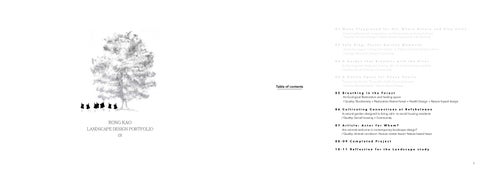
RongKao's Portfolio 2026 (3)

Page 1


01 Moon Playground for All, Where Nature and Play Unite

Fostering Movement, Imagination, and Biodiversity in Yánshuǐ's Heart

/ Quality: Inclusive Design+ Nature-Based Playground + Biodiversity

02 Safe Ring: Pastor Barclay Memorial

Honoring Legacy, Inviting Community – A Tribute to Pastor Barclay’s Vision

/ Quality: Memorial Design+ Commuity

03 A Garden that Breathes with the River

A natural garden designed to bring calm to social housing residents

/ Quality: Social housing + Community

04 A Gentle Space for Heavy Hearts

Therapy Garden For Those Who Suffer From Great Loss

/ Quality: Mental Health+ Nature-Based Design

05 Breathing in the Forest

An Ecological Restoration and healing space

/ Quality: Biodiversity + Restoration Native forest + Health Design + Nature-based design

06 Cultivating Connections at Refshaleøen

A natural garden designed to bring calm to social housing residents

/ Quality: Social housing + Community

07 Article: Actor for Whom?

Are animals welcome in contemporary landscape design?

/ Quality: Animal corridors+ Human-center Issue+ Nature based Issue

08-09 Completed Project 10-11 Reflection for the Landscape study

Quality: Biodiversity + Restoration Native forest + Health Design + Nature-based design

and healing space

Located in the mountains of Nantou, Taiwan, this seven-hectare site—once a betel nut plantation lies within one of the island’s richest ecological zones.

Nantou is home to over 330 species of butterflies, a testament to its exceptional biodiversity.The site located in the Machilus–Castanopsis forest zone (500–1,500 m elevation), Taiwan’s second most widely distributed native forest type, now threatened by fragmentation and human disturbance.

Guided by nature-based design principles, the project seeks to restore the land into a thriving native forest, allowing natural succession to shape its form.Existing rare native plants such as Machilus kusanoi, Engelhardia roxburghiana, Helicia formosana, Melastoma candidum, and Cinnamomum subavenium, form the project’s planting palette, expressing texture, scent, and seasonal rhythm.

This evolving landscape invites people to move, pause, and breathe with the forest, an immersive sensory environment where ecology and design grow as one. A dialogue unfolds between design and ecology, between human presence and the forest’s quiet resilience, revealing the quiet power of ecological balance.

Pause: Healing Workshops in Nature

Among the soft songs of butterflies, cicadas, and birds, the forest composes its moving melody. In this backyard woodland, abundant biodiversity brings forth nature’s tender companionship and healing energy.

Sensory Healing: Herbs, Blossoms, and Trees

Breathe in rhythm with the forest, walk gently among its paths and sense the primordial breath of Sun Moon Lake’s land. In nature’s embrace, wash away the noise of the world and slowly uncover this serene and precious green treasure.

Listening to the Whispers of Nature: Butterflies, Cicadas, and Birds

The flutter of butterflies, the chorus of cicadas, and the songs of birds weave the forest’s living symphony. This woodland garden, rich in biodiversity, offers guests the gentle companionship of nature itself.

The Sound of a Heartbeat: Moments of Solitude Away

Is it possible for every visitor to find a quiet moment of solitude here?

In a gentle, comforting space nestled close to the forest, stillness seeps slowly into the heart. Within the hush of nature’s silence, one can softly listen to the voice that rises from deep innerheart.

Healing room with the concept of listening to the nature
Solitary Healing room

Cultivating Connections at Refshale

Regenerating Nature and Community Through Urban Farming and Water Management

Quality: Urban Farm+ Sea level rises+ storm surge

Project Information

My task in project:

Discussion, Community Gardens, Design Diagrams, and Illustrations.

Location: Copenhagen, DK

Case statue: Design proposal

in a course of ubranism studio.

Participant: Mai Vanessa Davidsen, Lærke Frida

Schiøtt Jensen, Hai-Jung Kao, Victoria Clara Vittrup Nielsen, Tore Rosenkvist Nilsson, and Stine Løngaard Thorshøj

Introdution

The The climate changes have consequences for our future, some of the consequences we already experience today are urban hydrology challenges such as large runoff volumes leading to flooding and sewer overflows. We endeavour to adapt to some of these water volumes, with a vision to design for a spectrum of stormwater events ranging from day-today events of 10mm to an extreme domain of 100mm. The adaptation will expand in the timeframe of 50 years. By redesigning the Urban Main street we try to enhance both stormwater events, rain water, everyday life and the social qualities of urban streetscape.

With the new green recreational main street (naturebased stormwater management) we hope to promote the desire to walk in the city street. At the same time we have been working with combining the existing green areas to expand nature. The green spaces are important for both delaying the rain water and evaporating and infiltrating the water. The main street separates refshaleøen into four zones which are the blue-urban zone, blue-wild zone, green-urban zone, and green-wild zone. They are formed by wild parks, green farms, marine farms. Meanwhile, They provide recreation and food for people.

1. Dealing with the timescale of sea level rise/ rainwater. As the timescale, the sea level rises. Responding to the sea-level crises, we plan to give the wild blue zone back to the sea and plant water-tolerant species in the wild green zone. Meanwhile, using they as a buffer zone to the storm surge. On the other hand, using the existing dike to protect the inner island.

2. Solving the conflict between vistors, tourists and the locals. The green main line could be the line to guide tourists and as an aid to help them enjoy the island. Meanwhile, as the four zones are defined, some are designed as urban zones that can serve both tourists and local people, and some are intended to serve the locals.

3. Turning the island sustainable. Resources recycling is an important concept for the future in the island. Citizens plant seasonal food that they want to have for dishes. Local markets and restaurants can sell the food which is produced on the island. Material resources serve as the building material for recycling use.

Overall Strategy - Nature/ Urban with Green/ Blue

Contemporary Connecting Cultural

The focal point of the project are flows and connection in relation to spatial and ecological aspects:

1. In the people aspect, the green boulevard provides both the local and visitor to walk around.

2. In the nature aspect, the green boulevard connects the main green/ blue space, street and dist ricts of Refshaleøen.

3. In the material aspect, the plan recycles the material from the dike to build new dikes and enale people to produce food to feed themselves.

A layer of definition has been introduced, including parts where water is invited into the landscape (Green wild zone and Blue wild zone) and parts where urban intervention dominates and therefore are protected against sea level rise and storm flood (Green urban zone and Blue urban zone):

1. The Green wild zone: It mainly functions as forests which serves as a recreational place for people.

2. The blue wild zone: It will gradually become an ocean with time and it serves as a buffer zone for sea level rise and storm surge.

3. The Green urban zone: It is primarily used as a living and tourist zone, at the same time providing urban farms for citizens.

4. Blue urban zone: It serves as a temporary living area for the locals and a marine farm for breeding oysters and marine biology.

Cultural Heritage

Connections Connections and Flow of People

Are animals welcome in contemporary landscape design?

Quality: Nature based Issue

Fig. 1. Illustration for “Actor for Whom? Are Animals Welcome in Contemporary Landscape Design?” The physical model was created by Group 9 in the course Theories and Methods in Landscape Architecture. The photo collage is created by the student.

Abstract

Humans are often the primary actors considered when designers create a park plan.

And what about non-human animals? It is a controversial debate about how to position relationships between wildlife and humans: to keep humans as the dominant actor?

Based on ecological terms, this article presents a morphology and praxeology analysis of a design proposal issued by Tredje

Nature. Selecting a specific city animal- to examine whether they are welcomed in contemporary landscape design.

Introduction

In the age of climate change, this era presents a challenge for landscape architects in designing urban spaces. They respond to this challenge with the strategy of the urban ecosystem, which addresses natural

resources to mitigate the increasing heat of the Earth. The urban ecosystem comprises biological components (plants, animals, and other forms of life) and physical components (soil, water, air, climate, and topography), as described by S.T.A. Pickett, an

“Through their movement, animals are able to help the ecosystem.”

expert in the ecology of plants, landscapes, and urban planning. These components interact with one another to form a stable cycle for urban nature. For example, by dispersing seeds, animals help plants to expand, while plants provide animals with habitats, suitable humidity, and food resources.

Copenhagen adopted the Copenhagen Cloudburst Plan in 2012 to address climate change and cloudbursts. The competition for Hans Tavsen’s Park (HTP), as part of this plan, aimed to enhance the city’s resilience and increase water retention. One of the proposals, provided by Tredje Nature, an architectural firm based in Copenhagen, focuses on humans, nature, and climate.

How can a park be designed to genuinely benefit urban nature? As the only mobile

components in the ecosystem, animals help the ecosystem through their movement. Are they welcome in contemporary landscape design, and can they live and commute within it?

Animals are the only mobile elements in the ecosystem that can commute and help the ecosystem through their movement. As a result, this article focuses on animals (excluding humans) as the primary subject to examine whether they can commute within contemporary landscape design proposals. Specifically, it centers on the European hedgehog, a flightless mammal that primarily lives at ground level. The hedgehog has been observed and recorded multiple times in ARTER, a Danish knowledge base about species living in nature. More specifically, this article investigates whether European hedgehogs can live and commute within the contemporary landscape design proposal by Tredje Nature.

This article is written in the course of Theories and Methods in Landscape Architecture at the University of Copenhagen 2024. The design proposals from EFFEKT, SLA, and Tredje Nature are provided in the course. In Group 9, we analyzed the Tredje Nature proposal over a period of five weeks. Examining small corridors in HTP was one of our themes for this course. We believe

man activities and flow. The design proposal is used as a material for examination. The aim of this article is not to evaluate the park as a project, but rather to explore whether animals can be considered as actors capable of living and commuting within the design proposal of contemporary landscape design. and habitats, analyzing the morphology of corridors and terrain, as well as the praxeology of human activities and flow. The design proposal is used as a material for examination. The aim of this article is not to evaluate the park as a project, but rather to explore whether animals can be considered as actors capable of living and commuting within the design proposal of contemporary landscape design.

Urban Context and Corridor

HTP is located in the center of Copenhagen, the capital of Denmark (Fig. 2).

that these corridors present challenges for small animals to commute through. In continuing and deepening our exploration of the corridor theme, this article expands the scope to Assisten Cemetery, selects a specific animal, and applies various methods to examine it. The methods used in this article include citing theories on animal corridors and habitats, analyzing the morphology of corridors and terrain, as well as the praxeology of hu-

As part of the green corridor in the city center, HTP connects three key open green spaces: to the north, it borders Assisten Cemetery, a 25-hectare green space; to the west, a long corridor links it to Nørrebroparken, via Krogerupgade (a park); and to the southeast, it connects to pocket parks and gardens leading to Peblinge Sø, a lake and green space in the city center. This makes HTP an important intersection and connection point for

urban corridors in the city.

Adjacent to HTP (Fig. 3.), there are two primary schools, one on the east side and the other on the west side; apartments to the south and Assisten Cemetery to the north.

European hedgehog and Habitat fragmentation

European hedgehogs are native to and

“What obstacles might they encounter when living in urban areas?”

commonly found in Europe. They hibernate and are nocturnal, resting during the day in nests made of twigs, leaves, grass, pine needles, and other foliage. They are omnivorous, primarily feeding on insects such as beetles, ants, bees, snails, as well as seeds and nuts. In the context of the urban ecosystem, they help control insect pest populations. However, the population of European hedgehogs has declined. As noted in an article by Sophie Lund Rasmussen in 2023, “the likelihood of inbreeding increases as their habitats become fragmented by roads, buildings, fences, and railway tracks, and as population decline restricts the pool of potential mates.” Due to human disturbances to

the habitats of European hedgehogs, their breeding opportunities decrease, leading to a further decline in their population.

Obstacle for European hedgehogs to live in urban areas

To examine the conditions that allow European hedgehogs to live in urban areas, the article raises the following questions: What are the key routines for European hedgehogs to maintain their daily activities? What obstacles might they encounter when living in urban areas? To address these questions, the article identifies two types of challenges: (1) obstacles to commuting and (2) obstacles to habitats.

Obstacle to Commuting

Commuting is important to hedgehogs, as it allows them to move between various green spaces and find food and shelter. What obstacles might European hedgehogs encounter when commuting in urban areas? What factors affect or hinder their movement? In this section, the article examines the impact of corridor morphology and praxeological factors on wildlife.

In response to habitat fragmentation, which prevents animals from accessing their habitats, a corridor was provided to supply wildlife with a connected range of

Fig. 2. The location of the site in a urban context.
Assisten Cemetery
Nørrebroparken Ved Krogerupgade
Peblinge So
Hans Tavsan’s Park
Fig. 3. The neighborhood of the site.
Hans Tavsan’s Park Assisten Cemetery
Primary School
Primary School Apart-

gorizing it into forms: continuous corridors (Fig. 4.A.), which are unbroken stretches of habitat that provide animals with uninterrupted movement; stepping stone corridors (Fig. 4.B.), which are small and scattered patches of habitat that enable small mammals such as squirrels, rabbits, and hedgehogs traveling shorter distances to commute in the fragment of city habitat. In the height categories, there are Green Bridges (Overpasses) (Fig. 4.C.) which are above the ground level to help flightless wildlife commute to habitats avoiding traffic; Tunnels (Underpasses) (Fig. 4.D.) which are underground and usually connect habitats like fields and wetlands for specific amphibians such as frogs and toads. In nature, terms are

river, stream, mountain, and forest as natural corridors; Bridge, tunnels, vegetated road medians…etc as an artificial term.

three clusters of bushes and gardens. Without a continuous green corridor, the movement of hedgehogs could be interrupted by the materials between them (as explained in the next paragraph).

we take the Anthropocene as an indictment rather than triumph, as I think we should, then our exceptionalism must now come under interrogation…

By choosing flightless wildlife as the target, this article begins by analyzing artificial corridors, including continuous corridors, stepping stone corridors, tunnel corridors, and bridge corridors. However, when examining the bushes, learning gardens, shadow gardens, and community gardens in the design proposal, only one type of corridor— stepping stone corridor—is present (Fig. 6.A.). Based on Fig. 6.A., in the southern part near the neighboring apartment, there are clusters and scattered bushes and gardens; on the north side, there are

“Hedgehogs adapt well to urban and suburban areas”

Humans are part of the animal kingdom and possess the power to significantly influence other animals. As Richard J.

Weller writes in The Landscape Project (2023): ‘Extraordinarily, we are also the first species in history to name an entire geological era after itself. But if

A cornerstone of constructing human identity throughout history has been our alleged difference from animals. It is little wonder then that so much recent scholarship has returned to the question of the animal with renewed scrutiny of what it means to be human.’ Conversely, what significance do humans hold for animals, and what is the relationship between humans and wildlife? Building on this perspective, the article re-examines human interference in relation to hedgehogs and focuses on human activities and movement patterns.

Corridor & Intensity of Human Activities in the Design Proposal

Corridor & Human Flow in the Design Proposal

Fig. 6. Corridor analysis: Morphology and praxeology analysis of corridors, along with their overlap.

This section focuses on the overlapping corridors and the intensity of human activities in the design proposal (Fig.

“In the Anthropocene, the age of humankind, design is characterized by a ‘human-centered’

6.B.). Larger and flatter areas can accommodate a greater number of people and activities. As a result, the central terrain

Corridor, Terrain, and Walls in the Design Proposal

Overlap of the corridor, intensity of activities, human flow, and terrain in the design proposal.

and the south side of the entrance plaza

“The lack of design for animals in landscape architecture is matched by a dearth of writing on the topic.”

experience heavy usage. Areas with less activity intensity are located on the south side along the wall and in one area on the north side, where they are surrounded by

either walls or green spaces.As shown in Fig. 6.C., two pavements run along the two long sides of the site: one is proposed in the design, and the other is an existing pathway between the site and the cemetery. The pavements are used by both cyclists and pedestrians, disrupting the continuity of the south-north direction. The flow of human activity in the middle of the proposal divides the site into several areas.

cially in the middle of the two contour lines, varies by up to 2 meters above the ground level and separates the site into northern and southern parts. The remaining terrain contains hollows ranging from 0.5 to 1.5 meters.

In Fig. 6.D., as shown by the corridors and contour lines, the terrain range, espe-

As shown on the overlapped map (Fig6.E.), it reflects the intensity of human activities, human flow, and terrain features, indicating multiple barriers between the green spots, disrupting the corridor.

Fig. 7. Habitat Analysis of the Design Proposal
Fig. 5. The design proposal of Hans Tavsan’s Park was issued by Tredje Nature. The physical model was made by Group 9.

wall; natural grass and wet meadows between the trees and the mowed lawn; in the design proposal (Fig. 7.) reveals that grassland dominates the majority of the open areas. The shrub spaces and multi-layered planting spaces are located along the park’s long side. Moreover, their proportions are smaller compared to the grassland spaces.

depth. Humans and wildlife can present a conflict, but they also represent a relationship that deserves to be discussed. Upon examining the design proposal, the following understanding is presented:

needs, animals are unlikely to inhabit the park by instinct. In terms of habitat, they are excluded from the design proposal.

Conclusion: Actor for whom

Obstacle for habitats

Living in a broad range of habitats, from rural to urban, European hedgehogs thrive in woodlands, gardens, and hedges. Hedgehogs adapt well to urban and suburban areas due to their flexibility in habitat preferences. As a result, it remains unclear what obstacles European hedgehogs may face in finding habitats in urban areas. Are contemporary parks designed to provide suitable habitats for them?

Good habitats provide European hedgehogs with food, safety from predators,

a place to breed, rear their young, and hibernate during winter. The article categorizes open green spaces into three types: grassland, shrub spaces, and multi-layered planting areas. Grassland space consists of common grass, making it easy to spot hedgehogs when they dwell in it. A shrub space refers to an area filled with shrubs, tall grass, or fences. A multi-layered planting space includes grassland, shrubs, and trees. The last two types of spaces provide ideal habitats for hedgehogs in urban areas. An analysis of the green spaces in the design proposal (Fig. 7.) reveals that grassland dominates the majority of the open areas. The shrub spaces and multi-layered planting spaces are located along the park’s long side. Moreover, their proportions are smaller compared to the grassland spaces.

Concerning the plant species composition for the bushes and garden, the design proposal expresses the intention to plant a variety of species, such as fast-growing flowers and climbing plants in the pergola near the school; orchard trees such as almonds, apricots, peaches, pears, and apples on the south

Concerning the plant species composition for the bushes and garden, the design proposal expresses the intention to plant a variety of species, such as fast-growing flowers and climbing plants in the pergola near the school; orchard trees such as almonds, apricots, peaches, pears, and apples on the south wall; natural grass and wet meadows between the trees and the mowed lawn; fruit-bearing shrubs between the playground and along the orchard; and climbing plants on the columns, stairs, and exposed walls. Nevertheless, the design proposal emphasizes the ambition for a green city, rather than providing specific points where the plant species for the bushes and grass are physically included. Consequently, in terms of plant species, the article is unable to examine the specific plants that provide habitats for wildlife.w

Perspective about Actor for humans and wildlife

At the beginning of the design process, landscape architects often face various issues or angles to explore in

Firstly, the concept of a human-centered approach is introduced. In the Anthropocene, the age of humankind, design is characterized by a ‘human-centered’ approach. As Ben Reason writes, ‘Design brings a focus on the needs and experiences of humans.’ The design is viewed through a human-centric lens and focuses on praxeology to address human needs. The design proposal creates spaces for humans. To be more specific, it provides ecology, space, and plants for human benefit, rather than for the sake of the ecosystem or wildlife. By proposing to connect education with nature, the design emphasizes the issue of urban nature. Nevertheless, it focuses on how humans play roles in ecological processes and interact with social ecology, rather than on how wildlife live within it. Furthermore, instead of focusing on equal relations between humans and ecology, it emphasizes human dominance.

Secondly, the design proposal shows disadvantages for animals. Animals such as hedgehogs and rabbits are commonly found in urban areas and can cohabit well with humans. However, most of the plants proposed in the design are not suitable enough to provide shelter or food for these animals. Without meeting these basic

Thirdly, wildlife is rarely discussed as a theme in the design due to a lack of information. “The lack of design for animals in landscape architecture is matched by a dearth of writing on the topic “as noted by Richard Weller and Tatum Hands (2023).

Regarding the design proposal, humans are the only species mentioned, as there is abundant existing knowledge about them, and landscape architects are equipped with the necessary knowledge of praxeology. Furthermore, compared to human data, wildlife of various species with different preferences requires collaboration with ecologists and is difficult to evaluate, especially given the time pressure on designers in a competition.

Lastly, the design proposal is focused on problem-solving. The premise is to address clusters and rainwater management as the main goals of the competition proposed by the Copenhagen municipality. The design proposal focuses on managing water load rather than addressing other ecological issues. Consequently, most of the areas in the middle of the HTP are sunken terrains, which are a response to the competition’s requirements. These areas can be seen as an interruption to commuting or a lack of emphasis on the movement of hedgehogs. In other words, the current issues and perspectives from the municipality form the basis of the design proposal.

In a humankind-dominated world, the actors that represent the dominant culture do not consider wildlife, the disabled, or economically disadvantaged groups. Nevertheless, when examining the design proposal, various factors contributing to the inevitable neglect of animals are presented, such as the design objectives set by the municipality, contemporary urgent issues, and the perspective of the landscape architect. From an analytical perspective, the design proposal creates barriers for the hedgehogs and does not provide an ideal habitat for them. In other words, the design proposal is intended for humans rather than wildlife.

Xinyue Wang; Xindi Zhang; Chenyue Zhang; Muwen Qin; Meisi Wang; Shuyu Wei. (2021) “Wildlife Lives Matter: Hedgehog-Aided Design in Urban Areas.” 2021 ASLA student awards. Dendy, T. (1987). Value of corridors (and design features of same) and small patches of habitat.

Ian F Spellerberg and Martin J Gaywood. (1993). Linear features: linear habitats and wildlife corridors

References

Richard J. Weller (Author), Tatum Hands (Editor) (2023) “The Landscape Project”-Animals

Wanmo Kang & Emily S. Minor & Chan-

Ryul Park & Dowon Lee. (2015). “Effects of habitat structure, human disturbance, and habitat connectivity on urban forest bird communities”. Springer Science+ Business Media New York.

Sophie Lund Rasmussen. (2023) “What Denmark’s dead hedgehogs tell us about their lives – and how we can help them”, The Conversation newsletter, 27.02.2023

Ellen Braae. (2022) “Urban Planning in the Nordic World” Design proposal by Tredje Nature-The Earth is calling!Nordic built ities challengehans Tavsens Park, Bågård School & Korsgade. (2016)

Poster and presentation in the theme of biology by group 9. (2024)

Fig. 8. Illustration for “Actor for Whom? Are Animals Welcome in Contemporary Landscape Design?” The physical model was created by Group 9 in the course Theories and Methods in Landscape Architecture. The photo collage is created by the student.

08 Completed Project- 1

Some small yet meaningful projects

My task in project: Analysis site, concept and design. Location: Tainan,TW

09 Completed Project- 2

Some small yet meaningful projects

My task in project: Analysis site, concept and design. Location: Tainan,TW

Design detail

is a tiny sidewalk loected in a town without parks. Main purpose of design is to not only design a path, but to create a cozy place for the locals to gather.

Due to a limited budget and a focus on environmental friendliness, we reused the materials on-site and made the most of them.

Under construction.
This
Quality: Pocket Park+ Recycled Materials

11 Reflection for the Landscape study

Depictions and reflections on landscape design after school.

Room 6: Nature, Nacadia / 28th Feb. 2025
2: Prospect, Nacadia

Turn static files into dynamic content formats.

Create a flipbook