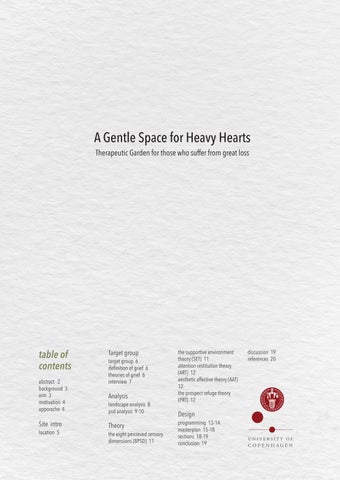
table of contents
abstract 2
background 3 aim 3
motivation 4 apporache 4
Site intro location 5
![]()
table of contents
abstract 2
background 3 aim 3
motivation 4 apporache 4
Site intro location 5
Therapeutic Garden for those who suffer from great loss

Target group target group 6 definition of grief 6 theories of grief 6 interview 7
Analysis landscape analysis 8 psd analysis 9-10
Theory the eight percieved sensory dimensions (8PSD) 11
the supportive environment theory (SET) 11 attention restitution theory (ART) 12
aesthetic affective theory (AAT) 12
the prospect refuge theory (PRT) 12
Design programming 13-14 masterplan 15-18 sections 18-19 conclusion 19
discussion 19 references 20

Grief is a universal human experience, yet its intensity and duration vary widely. While most individuals gradually adapt, approximately 10–20% develop prolonged grief, which may require additional support. This study investigates how nature-based interventions (NBIs) and landscape design can facilitate grief recovery, particularly within therapeutic settings.
Utterslev Mose, a lakeside site known for its tranquil atmosphere, waterfowl, and natural scenery, is selected for its potential to foster reflection and emotional restoration. Grounded in Evidence-Based Health Design in Landscape Architecture (EBHDL), the research applies the Eight Perceived Sensory Dimensions (8PSD) framework and draws on literature review, site analysis, and interviews to explore how landscape design can support individuals coping with significant loss.


Grief is a universal emotional experience, but its expression and duration vary widely among individuals. While some gradually adapt, others experience intense or prolonged emotional responses that can significantly affect their daily lives. Research shows that approximately 80% of individuals experience symptoms of grief or depression following a major loss (APA, 2020). For many, these responses are temporary; however, around 10–20% develop prolonged grief that may require professional support (APA, 2020).
Prolonged grief is often marked by persistent longing, emotional numbness, or difficulty re-engaging with everyday life, lasting well beyond culturally expected timeframes. Studies estimate that roughly one-third of adults will experience long-term grief in their lifetime (Japanese Grief
Association, 2017), with 7–10% showing sustained, high-intensity grief—suggestive of prolonged grief disorder (Szuhany, 2021).
Despite its prevalence across cultures and individuals, therapeutic spaces specifically designed to support grief recovery— such as healing gardens—remain relatively rare .Designing such spaces continues to present both a challenge and an opportunity in landscape architecture.
This study aims to explore the potential of nature-based therapeutic gardens in supporting individuals through the process of grieving and emotional healing.

Utterslev Mose Bispebierg Cemetory.
In my country, Taiwan, grief is often culturally suppressed and seldom openly discussed. During my own period of profound personal loss, my background in landscape architecture revealed to me the therapeutic potential of nature. Reading 〈 Last Child in the Woods 〉 deepened this perspective. Though not directly about grief, the book highlighted how natural environments can alleviate psychological distress, resonating deeply with my experience.
After losing two close relationships in succession, years later, I came to realize that I had regained emotional resilience. This prompted reflections on how others cope with grief. Some adapt, like a woman I knew who, after losing her father, husband, and son in just two years, slowly found her way back to life. Others struggle with prolonged grief disorder, such as a girl who lost her mother at fifteen and continues to experience profound emotional pain.
As a landscape architect, I often ask: how can landscape design support people through grief? Grief is a universal experience—intensely personal, psychologically complex, and often prolonged. Likewise, nature is a universal medium for healing. This intersection inspires my exploration of how landscape architecture can foster emotional recovery.
This study adopts a methodology grounded in Evidence-Based Health Design in Landscape Architecture (EBHDL), following a cyclical and structured research process that integrates evidence-based analysis and iterative evaluation. The Eight Perceived Sensory Dimensions (8PSD) framework is applied as a design tool to assess site potential and guide spatial interventions. Complementary methods include literature reviews, site observations, and semi-structured interviews, which together provide a comprehensive foundation for design development. Additionally, AI-supported tools such as ChatGPT were used to assist with language clarity and to support reflective writing throughout the research process.


The site is located along the edge of Utterslev Mose and extends partially into a nearby cemetery, selected for both its natural and tranquil qualities.
First, the natural landscape of Utterslev Mose offers a calm, biodiverse setting ideal for emotional restoration. Located in the northwest of Copenhagen, the area features bird-rich lakes, expansive reed beds, and wellmaintained parklands. Home to a high variety of bird species, including the greylag geese that have made the area internationally recognized, this protected wetland
One site is located at the edge of Utterslev Mose, where the main therapy will take place, offering target groups a natural and restorative setting.

Another site is located within the Bispebierg Cemetory, where the self healing will take place, providing target groups has prolong grief a personal healing in their everyday lives.
has been preserved within the urban fabric since 2000 (Danmarks Naturfredningsforening, 2025). In the early stages of grief, this landscape can act as a gentle refuge, providing solace without the immediate emotional intensity of a cemetery setting.
Second, positioning part of the site within the cemetery acknowledges the emotional needs of those experiencing prolonged grief. For individuals who may feel emotionally fatigued or disconnected from conventional support systems, these spots allow for quiet reflection and continued healing during personal visits, gently weaving therapeutic care into daily life.
People experiencing grief and people diagnosed as prolonged grief disorder(PGD) are the target groups in this study. This study specifically considers individuals diagnosed with PGD, whose grief tends to be more deeper and prolonged, often impacting their overall well-being. Therefore, the study proposes not just to create a one-time healing space, but to design a place that gently supports PGD over time through their grief.
Prolonged grief disorder (PGD): (WHO: ICD-11, 2021)
1.History of bereavement after the death of a partner, parent, child, or other loved one
2.A persistent and pervasive longing for the deceased, or/and preoccupation with the deceased
3.At least one symptom of intense emotional pain
4.The disturbance causes significant impairment areas of functioning
5.Persisted for more than 6 months at a minimum
Grief is the anguish experienced

after significant loss, usually the death of a beloved person (american psychological association (APA), 2018).
To understand grief, several theoretical frameworks are presented:
model of grief: (kubler-ross, 1969): It outlines five stages of grief—denial, anger, bargaining, depression, and acceptance —which are applied to understand the emotional responses to loss. complicated grief theory (margaret stroebe, henk schut, 1999): A Response To Death That Deviates Significantly From Normal Expectations. Three Different Types Of Complicated Grief Are Posited: Chronic Grief, Which Is Intense, Prolonged, Or Both; Delayed Grief; And Absent Grief. The Most Often Observed Form Of Complicated Grief Is The Pattern In Which The Immediate Response To The Loss Is Exceptionally Devastating And In Which The Passage Of Time Does Not Moderate The Emotional Pain Or Restore Competent Functioning (Apa, 2018).

To better understand the connection between people who have experienced significant loss and outdoor landscapes, and how therapy garden might better meet their needs, this study conducted informal interviews with two individuals.
Questions:
Q1. What relationship you lost and how long ago this occurred?
Q2. What do you do when you find yourself overwhelmed? And what do you think you need?
Q3. How do you cope with this?
Q4. Have you experienced any traditional treatments to deal with your grief? If yes, what were they?
Q5 . Do you find spending time in nature or engaging in nature-based therapies beneficial?
Q6 . What activities would you engage in within nature or a nature-based therapy setting?
Q7 . What sensory experiences (sights, sounds, smells) would make you feel comfortable or at ease?
Q8. Would you prefer a private, secluded space for reflection or an open area where you can engage with others?
Q9. Do you find physical movement (like walking or gardening) helpful in processing grief?
Q10. Would you appreciate having a memorial or commemorative area in the garden?
Q11. Would you prefer an active, engaging garden (with paths, flowers, or interactive elements) or a more tranquil, quiet space (like a meditation garden or sensory garden)?
Answers:
A1. (1) Grandma, 2.5 Years. (2) Mom, 5 years.
A2. (1) Engaging in alternative activities, cognitive
distraction, and exposure to vibrant colors.
(2) Visiting a forest-like green space, engaging in drawing, or reading empowering texts.
A3. (1) Engaging in alternative activities, cognitive distraction, and exposure to vibrant colors.
(2) Visiting a forest-like green space, engaging in drawing, or reading empowering texts.
A4. (1)Experiencing one's grief through similar stimuli, such as music and films, while reflecting on others' similar experiences.
(2) Stop feeling.
A5. (1) No ideas.
(2) At first, it helps. During this stage, i struggle to remember our memories due to the chaos and emotions. However, when i return to nature, it calms me down, and my mind become lighter.
A6. (1) Walking in a forest.
(2) Immerse myself in it, feeling the quiet atmosphere, the interplay of light and shadow, and the presence of trees. They embody stillness and eternity.
A7. (1) Light(but nt too light), sound, smell, temperature.
(2) Light and smells
A8. (1) There should be a certain level of privacy; i don't really want others to know about my grief.
(2) Private space with a beautiful view.
A9. (1) Yes. Having someone accompany you— without the need for conversation.
(2) Maybe? However, i believe inactive activities encourage people to process their emotions.
A10. (1) You'd feel they are still there, as if you could meet them by going there.
(2) No idea right now, but i prefer to go to their grave where their ashes are buried.
A11. (1) It depends on one's mood at the moment, so both dynamic and static activities are important. Dynamic: picking flowers to take home..
(2) Tranquil, quiet space.


The site is easily accessible, with a pathway ( ) along the north side and a road ( ) to the west. The remaining edges are gently embraced by a lake. At times, soft conversations from joggers and walkers drift in from the pathway, while the road occasionally carries the distant hum of passing cars. Waterdowls are often heard near the lake, adding a quiet rhythm to the space.


The site is mostly covered with grass and lacks defined paved paths. However, frequent foot traffic has naturally shaped trails ( )across the lawn. People tend to gather in open areas and near seating.


The site's vegetation is primarily composed of three main types: trees( ), mangroves or large shrubs( ) , and reed beds( ). Trees serve as visual focal points and contribute to spatial definition, predominantly situated in open areas. Mangroves, located near the lakeshore, feature irregular and low-lying branches that create enclosed and sheltered spaces.


To explore how the site’s qualities are perceived and used, its attributes are examined through the PHDS framework. Some overlap spatially. The site's most distinctive feature is its tranquility, enriched by diverse waterfowl and the protective feel of shoreline vegetation.
nature
Nature on the site appears wild and untouched, with freely growing shrubs shaping much of the landscape. The area is largely undisturbed, with minimal human activity and few auditory distractions.
The site features three types of spaces: an open lawn, a lakeside viewing area, and an open space centered around a single, prominent tree. Together, they create an experience that feels like stepping into another world. rich in species
The presence of waterfowl brings a distinct sense of water-based healing to the site. Their calls, echoes, and gentle movements add both liveliness and a sense of distant calm—without requiring human interaction. Native aquatic plants and insects further enrich the natural atmosphere.


Prospect is expressed through broad, open views across well-kept lawns, with few or no trees in sight. This sense of vastness offers feelings of openness and mental clarity.
rufge
Refuges take the form of enclosed spaces, defined by dense shrubs and tall grasses. These areas offer a sense of safety and serve as a gentle backdrop. A few tables and benches are also placed within the site, inviting moments of rest.
The site’s social qualities emerge through a pair of tables and benches set within the open lawn, inviting recreation and casual interaction. Natural waterflows are also preserved, adding to the landscape’s gentle rhythm. serence
Serenity is the site’s most defining quality, reflected in the wide, horizontal view of the lake that evokes calm and peace. The soundscape is gentle and unhurried, with waterfowl calls enhancing the tranquil atmosphere.

Introduced by Grahn and Stigsdotter (2010), 8PSD serves as a theoretical model for assessing human perceptual experiences within urban green spaces. 8PSD highlights key environmental attributes that contribute to mental wellbeing, and restorative experiences (Grahn & Stigsdotter, 2010; Chen, Qiu, & Gao, 2019). 8PSD consists of: Serene (quiet, undisturbed); Space (open, expansive); Nature (lush, organic); Rich in Species (diverse, vibrant); Refuge (sheltered, enclosed); Culture (historic, meaningful); Prospect (clear, far-reaching); Social (interactive, communal).
The Supportive Environment Theory (SET) focuses on how environmental factors shape human engagement and psychological well-being (Sarason, 1974; Stone & Tesluk, 2002). The theory is often applied in therapeutic landscapes, guiding the design of spaces that foster emotional recovery and social connection (Barton et al., 2013). Human engagement identified in SET are: Outgoing Involvement –Energetic engagement with the environment (Thompson & O'Neill, 2017) ; Active Participation –Physical interaction, fostering mind-body connection (Stone & Tesluk, 2002); Emotional Participation – Emotional connection, aiding psychological restoration (Barton et al., 2013) ; Directed Inwards Involvement – Introspective engagement, supporting personal growth and grief healing (Sarason, 1974).


Attention Restoration Theory (ART), proposed by Kaplan & Kaplan (1989, 1995), explains how natural environments restore cognitive function by reducing mental fatigue and enhancing psychological well-being (Kaplan, 2001; Berman, Jonides, & Kaplan, 2008). This framework supports therapeutic landscape design and nature-based interventions (NBIs), offering cognitive recovery, stress reduction, and emotional resilience (Ohly et al., 2016; Stevenson, Dewhurst, & Schilhab, 2019). ART is widely applied in urban planning, healthcare environments, demonstrating its effectiveness in promoting mental clarity and emotional healing (Tennessen & Cimprich, 1995; Jiang, Chang, & Sullivan, 2014).
AAT suggests that the aesthetic quality of a space can positively impact emotional states, fostering restorative experiences and reducing stress (Kaplan, 2001; Berto, 2005). The theory is particularly applicable to therapeutic landscapes, where nature-based interventions aim to engage emotional and aesthetic senses to support recovery and mental clarity.
According to PRT, environments that balance prospect (views of the surroundings) and refuge (protection and enclosure) are optimal for promoting mental restoration and reducing stress (Kaplan, 1995; Herzog, 2001). This theory is often applied in landscape architecture to design spaces that foster visual accessibility and emotional safety (Berto, 2005). PRT identifies two key elements for human engagement: Prospect – Unobstructed views that provide a sense of safety and control over
the environment (Appleton, 1975); Refuge –
Enclosed, sheltered areas that offer protection and a sense of security (Herzog, 2001).

evidence design criteria design solution
Participants had the opportunity to touch plants and plant them (mercedes m. machado &jacqueline m. swank 2018)
Light(but nt too light), sound, smell, temperature (Interview 2025)

During that initial grieving period, my emotions were numb... Yet... blue space provided such a strong kin aesthetic engagement with my bodily feelings. (Emma Boocock 2024)
The counselor should strive to find an area where others will not view or at least not overhear sessions. (Mercedes M. Machado &Jacqueline M. Swank 2018)
The counselor can ensure privacy and make adjustments to help the client feel comfortable and safe in the shared space.
(Mercedes M. Machado &Jacqueline M. Swank 2018)
This place should include plants that invite touch. A variety of plants with leaves, trunks, petals, and shrubs of different textures and sizes—offer rich tactile experiences.
This place should include elements of light, sound, scent, and warmth.
blue material sensory experiences
This space should includes the qualities of blue or water
1.Trees and pavilions are arranged to fill the space with sunlight, creating dappled shadows through the canopy.
2.Deciduous plants bring the gentle sound of falling leaves, while nearby waterbird habitats preserve the soft calls of waterfowl.
3.Aromatic herbs and scented flowers add layers of fragrance.
4.Open areas invite sunlight and warmth, allowing visitors to naturally bask in the light.
Choose a site close to the lake, allowing the expansive water to directly support and reflect emotional experiences.
Provide spaces with different degrees of openness, and this space can be slightly hidden from the public.
1.Providing spaces with different degrees of openness, and using high-density and multi-layer planting and pavilion.
2.This space be slightly away from the main activity area or paths.
The space should be safe, warm and create a great overview of the zones. In addition, there should be spaces that are supported with a backdrop.
The site will offer clear views and an organized layout. Hedges will serve as a soft backdrop for seating areas, adding structure and a sense of enclosure.
You'd feel they ( The deceased) are still there, as if you could meet them by going there.
(Interview 2025)

Walking with someone, but you don't have to talk. (nterview 2025)
Valerie ...sharing that gardening served as both a“distraction from her pain and a cure for her pain.” the counselor may provide seeds or water and encourage the clients to place their hands in the dirt, harvest vegetables, or arrange flowers. (Mercedes M. Machado &Jacqueline M. Swank 2018)
Therefore, the counselor encourages the client to share narratives at different stages throughout the healing journey. (Mercedes M. Machado &Jacqueline M. Swank 2018)
Writing through traumatic experiences can offer individuals a way forward in coping with their experiences (Matthews, Citation2019; Phipps, Citation2018; Wyatt, Citation2010).
This place should offer target group a place to remember their loved one (The deceased).
A letter-writing space will be provided to help users remember their loved ones. Seating will be included to encourage slowing down and staying a little longer.
Physical participation
The space should include walking paths for the target group to move with friends.
Trails should wide enough to allow two people to walk side by side comfortably.
There should be a designated space for a garden where users can sow seeds, water flowers, and even pick them. Additionally, the garden serves as a setting for consultations.
A garden planting area will be established, enabling users to connect with nature. Additionally, each planting section will be designed for easy access, ensuring individual use during consultations.
This space should encourage target group to gather and share their stories to others
Multiple seats are arranged here to encourage users to gather and share their stories.
Prolonged grief disorder involves intense, painful emotions...that persists for more than 1 year in adults. (Schoo, Caroline, Yusra Azhar, Saba Mughal, and Preeti Rout. 2005
This space should encourage users to write.
A quiet space with chairs, letter paper, and pens will be set for users to write letters. This area invites gentle moments of reflection and offers a setting for heartfelt conversations with their loved ones in memory.

Self healing
Over time, this place should support target group in adapting to their losses.
It should offer a self-healing space easily accessible within daily routines of target group, not limited to just the therapy garden. Heartfelt conversations with their loved ones in memory.

The site offers rich ecological features, including a lakeside setting, diverse habitats, and layered forest structures. Guided by the 8PSD Theory, the design strengthens the healing potential of each distinct space by enhancing its inherent qualities. Taking advantage of the site's elongated form and
existing informal paths, vegetation is thoughtfully integrated to guide and refine these user-created trails, making spatial organization more intuitive. The proposed therapeutic garden weaves together social, natural, serene, prospect, spatial, and biodiversityrich elements to support emotional well-being.

Nature is the defining element of this space, marked by untouched reed beds that grow freely and quietly. The narrow, discreet pathway leading in suggests its rarely visited character. A single seat nestled among the tall reeds invites solitude, slowing down, and introspection. To further support personal reflection, a small mailbox and writing materials are placed nearby, encouraging expression through writing.

Space defines the character of this environment, shaped by towering trees that create a sense of scale and openness. The gentle interplay of sunlight and shadow adds a quiet elegance, deepening both the sensory and emotional experience of the site.

Prospect defines the character of this environment, with wide, open views and well-tended wild lawns that evoke a sense of openness and quiet optimism. A dense layer of shrubs forms a soft visual backdrop for seating areas, while a carefully placed shrub offers gentle enclosure.


Refuge defines the essence of this environment, shaped by large shrubs and mangrove vegetation. Their low-hanging branches create a gentle sense of enclosure and psychological safety, nurturing a quiet, introspective atmosphere. A single bench is thoughtfully placed to invite users to slow down and engage with the space in their own time, encouraging personal reflection and emotional restoration.

Social interaction defines the core of this space, supported by multiple benches thoughtfully positioned to encourage face-to-face connection. Each bench is designed at a length of 2 meters, allowing people to sit together while maintaining a comfortable personal distance, fostering both conversation and quiet companionship.

Biodiversity defines the heart of this environment, highlighted by a rich variety of waterfowl and aquatic plants. A bench is thoughtfully placed against a backdrop of shrubs, offering a quiet and sheltered place to rest. The gentle sounds of birds and water life add to a harmonious sensory experience, deepening the site’s restorative and healing qualities.


Serenity is one of the defining characteristics of the site, attributed to its proximity to Utterslev Mose. Serene serves as the primary dimension of this environment, characterized by an expansive lake view that fosters a sense of tranquility and calmness. A bench is strategically positioned against a shrub backdrop, offering a secluded resting space that enhances the site's restorative atmosphere.

The individual healing place is designed to help the target group in continuing their self-healing journey beyond the therapy garden, integrating it into their daily lives. This space can be located anywhere, such as at a cemetery where they visit their loved ones. Its main quality is a quiet, contemplative nook, gently enclosed by shrubs and set away from busy pathways to provide a peaceful retreat.

Based on academic research and the 8PHD framework, this study highlights the restorative power of nature and water for the target group. It focuses on elements such as water, lakesides, existing lakeside shrubs, aquatic plants, and waterfowl Prolonged Grief Disorder (ICD-11, 2021), often chronic, requires ongoing support. Therefore, this study suggests that landscape interventions should extend beyond therapuetic gardens to everyday places such as cemeteries, promoting continuous personal healing.
This study focuses on a lakeside location, where calming elements like water and the sounds of waterfowl contribute to a peaceful atmosphere. However, lakeside environments can sometimes feel cold or windy, which may affect the comfort and emotional state of the target group. Grief unfolds in stages, each marked by unique emotional needs. While not explicity addressed in this study, the design process has continually considered how landscape design might support grief in various stages and emotional dimensions. Grief is emotionally complex, poetic in its spiritual and introspective depth, and narrative in how it becomes part of a person’s life story over time.

