Disclaimer : The content of this souvenir, including profiles of individuals and organisations, has been compiled from the information provided directly by the concerned parties. Some articles were developed through interviews, which have been reviewed and approved by the interviewees.
While every effort has been made to ensure the accuracy and reliability of the content, the publisher accepts no responsibility for any errors or omissions. The information presented is subject to change, and the publisher shall not be held liable for any loss or damage arising from such inaccuracies, whether due to oversight, changes over time, or other unforeseen circumstances.
This publication is intended solely for its stated purpose and should not be used or interpreted beyond that scope. No part of this magazine may be reproduced, stored in a retrieval system, or transmitted in any form or by any means — electronic, mechanical, photocopying, recording or otherwise, without prior written permission from the publisher.
A Souvenir of Collective Memory and Eternal Values
This commemorative book is not merely a chronicle of fifty-three years of Gujarat Samachar. Today, nearly two million people of Indian origin reside in Britain, of whom approximately one million are of Gujarati heritage. Among them, over 90% arrived or were born here within the last five decades. Therefore, this souvenir is not just a narrative, it is a collective treasury of memories, a book of remembrance for all of us.
The individual and community are inseparable. A community is formed by the coming together of individuals, and the holistic integration of individuals is reflected in the capabilities and character of that society. I do not just claim that the Gujarati diaspora in Britain has achieved a distinguished or honourable position. It is, in fact, a conclusion reached through numerous scholarly studies.
In the fields of education, professions, business and industry, Gujaratis have consistently held a leading position, marked by enterprise, generosity, and a deep-rooted affinity for music, art, culture, and charity. Gujaratis are a peace-loving community. Numerous individuals and organisations within our society are engaged in selfless service, supporting the needy regardless of
CB Patel
wealth, caste, or social background.
Service to others without discrimination is a hallmark of Indian-origin communities, and within that, it is a defining identity of Gujaratis. Compared to other diasporic communities, the incidence of crime among Gujaratis is remarkably low.
There are two key reasons for this:
(1) A deep respect for values and virtues
(2) A strong sense of modesty and moral restraint, instinctively guided by what is appropriate and what is not
Over the past four months, our editorial team has repeatedly shared through Gujarat Samachar and Asian Voice that we are preparing a commemorative souvenir. We earnestly invited you to send us your thoughts and reflections. We also requested names and details of remarkable individuals who, in your opinion, have made significant contributions towards strengthening the community.
Many of you have kindly responded by sharing valuable suggestions and noteworthy names, for which we are truly grateful. The
response over the past few months has been overwhelmingly positive, and we consider it our good fortune. In that sense, this souvenir has become a collective archive, a cherished collection of memories from your and our unbroken journey together.
In the past two weeks, we have received an overwhelming amount of information. Due to limitations of time and space, we may not have been able to include every submission, or we may have had to exclude some due to delays in receiving them. To all those affected, we extend our sincere apologies.
As we mark the milestone of fifty-three remarkable years, I offer my heartfelt gratitude to all the creators, visionaries, subscribers, readers, and the wider community whose diverse contributions have shaped and enriched this commemorative volume.
I am especially thankful to those who, by promoting and supporting their own businesses through advertisements and sponsorship, also played a vital role in sustaining and advancing our journey. To each one of you, I remain deeply grateful. This is our humble offering - Gyan Yagna and Seva
Yagna. Without the blessings of parents and elders, the unwavering support of family, the companionship of old and new colleagues, the goodwill of well-wishers, and the discerning readership, this journey would not have been possible. It is through your collective support that we have successfully completed this 53year milestone, and for that, I consider myself truly fortunate.
This is not merely a newspaper delivering news, it is the voice of the community. It serves as the guiding force of society, playing a pivotal role in shaping it, fostering awareness, becoming a source of inspiration, offering leadership when needed, and nurturing new leaders. In numerous initiatives aimed at social upliftment, it has actively participated, while upholding our eternal values and cultural traditions, and fulfilling the sacred duty of journalism without compromise.
The foundation of our journalism has been built upon the eternal principles of Sanatan Dharma.
I truly feel the boundless grace of the Supreme Almighty.
Om Namah Shivay
CB
Publisher/Editor
Gujarat Samachar and Asian Voice
DHAMECHA GROUP
A family’s tale of strength and triumph
In 1850, a small town called Kadegi, nestled near Bantwa-Manavadar in Saurashtra, was home to various communities, including the Lohana, Rajput, Mer, and Acharya families. Among the respected members of this town was Ranchhoddas Bapa Dhamecha, a prosperous and influential figure. He had two daughters and three sons-Dayalji, Sundarji, and Ratanshi. The youngest of them, Ratanshibhai, was born in 1885, and like many in the community, he was ambitious and driven. At a young age, he married Jiviben, the daughter of Valji Punja from Datatrana near Junagadh. The family was well-established, owning a thriving cotton ginning industry. Yet Ratanshibhai’s aspirations stretched far beyond his homeland.
A leap of faith to Africa
were bitterly cold for someone from India, yet Ratanshibhai and his fellow Indian merchants would rise early, carrying lanterns to their shops. They traded with local farmers; purchasing corn, red beans (maragu), peanuts, and simsim (sesame seeds) in exchange for essential goods like clothes, sugar, salt, soap, matchboxes, and kerosene. Through this simple barter system, Indians and Africans together contributed to East Africa’s economic growth.
Ratanshibhai frequently travelled to Kisumu to sell his goods and procure supplies. Over time, he built a reputation as a hardworking, honest, and cooperative businessman. Four years passed in this manner, and by 1910, he had established a stable life. It was time to bring his family to Africa.
In 1906, at the age of 20, Ratanshibhai made a bold decision to cross the ocean in search of new opportunities. Leaving the comforts of home, he journeyed to Porbandar, where he boarded a ship bound for Mombasa, Kenya. It was a long and uncertain voyage during an era when travel by sea was fraught with risks.
Upon reaching Mombasa, Ratanshibhai took a train inland, passing through small towns until he arrived in Kisumu, a remote settlement on the shores of Lake Victoria. At the time, Kisumu was little more than a hamlet with just ten Indian-owned shops. Most Indian settlers there hailed from Saurashtra and other parts of Gujarat. Recognising an opportunity, Ratanshibhai settled in Gambhu, a small town across the lake (now the site of Kisumu airport) and established his business there.
Life in Africa was challenging. The mornings
A new chapter with Laduma
In 1910, Ratanshibhai returned to India to reunite with his wife, Jiviben, and their young daughter, Santokben and brought them back to Africa. With Jiviben by his side, life became a little easier and Ratanshibhai could focus entirely on his growing business.
Fifteen years passed, and in 1925 the family decided to revisit their homeland. They returned to Kadigi, where their loved ones eagerly welcomed them. However, a profoundly personal concern arose during this visit— Jiviben could not conceive other children. This realisation weighted heavily on them.
With understanding and care, the family adapted to this reality, and in later years, Ratanshibhai married Laduma, the daughter of Jadavjibhai and Galalben Makhecha from Porbandar’s Nava Bandar. Laduma stepped
Laduma Ratanshi Dhamecha
into the family with grace and resilience, embracing her new responsibilities with unwavering strength. Little did they know that Laduma’s presence would mark the beginning of a new era for the family. Her wisdom, kindness, and selfless devotion would shape her immediate household and future generations. The family’s legacy flourished through her guidance, blessings, and sacrifices, leaving an indelible mark on history. Her story, one of endurance, strength, and quiet yet profound influence, is a testament to the truth that behind every successful family stands a woman whose quiet strength carries them all forward.
A growing family and an unforeseen tragedy
Laduma and Ratanshibhai were blessed with their first daughter, Labhuben, in 1928 and two years later, their son, Khodidas, was born in Kadigi. That same year, Ratanshibhai took his family back to Kenya, settling in Butere, a small town along the newly built railway line from Kisumu. There, he opened a shop and continued trading with local farmers. Their family grew-Shantilal was born in 1931, followed by Jayantilal in 1934. Life in Butere was not easy, but the determined family thrived. However, fate had other plans and the frequent journeys between Butere
and Kisumu, through the biting cold, took a toll on Ratanshibhai’s health. He contracted pneumonia, and on the day of Holi in 1934, at the age of 50, he passed away in Kisumu.
His sudden departure shattered the family, but even in grief, Jiviben and Laduma stood firm, determined to secure their children’s future.
Two women, one unbreakable bond
Left alone in a foreign land with five young children, the two women did not succumb to despair. With the little savings their husband had left, they made a bold decision and entrusted the money to a trusted businessman in their community for investment. Each month, they withdrew interest and a small additional amount to sustain their household. They were advised to be frugal, as the children’s education and well-being depended on their careful financial management. But Laduma and Jiviben were not only prudent; they were hardworking. They took up small tasks from home to earn an extra income, ensuring their children never felt the weight of their struggles. Despite the hardships, their home remained warm and welcoming. They never let their own troubles overshadow their kindness.
A legacy of strength and success
In 1946, after completing their matriculation
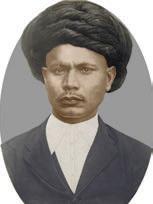
Ratanshibhai R. Dhamecha
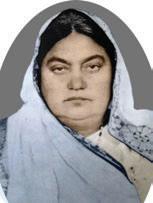
Jiviben Ratanshi Dhamecha
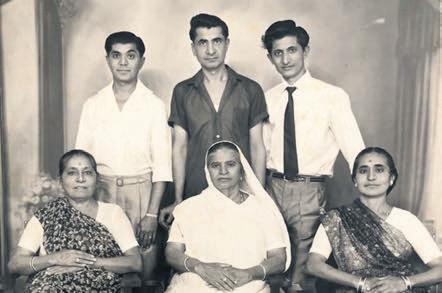
(L-R) Khodidasbhai, Shantibhai, Jayantibhai, Santokben, Laduma, and Labhuben
from Kisumu High School, the three sons Khodidasbhai, Shantibhai and Jayantibhai worked for several years to gain experience in business. By then, Santokben had been married to Maganlal Madhavji Thakerar and Labhuben had married Kalyanji Jivan Ruparellia. Sadly, just two years later, Jiviben passed away from cardiac arrest. She left with the satisfaction of having fulfilled her responsibilities.
Now, the responsibility of the family fell entirely upon Laduma’s shoulders. Despite her loss, she remained steadfast with her faith in God unshaken. She never allowed hardship to take the smile from her face, and her sons –deeply influenced by her unwavering spirit, held her in the highest regard.
With their mother’s blessings, the three brothers got married; Khodidasbhai to Lalitaben Dattani from Mwanza, Shantibhai to Kumudben Suchak from Dar es Salaam, and Jayantibhai to Prabhaben Amlani from Soroti. Later the brothers established their own business, Dhamecha Brothers and
Radium Studio, in Kisumu. They worked with dedication and honesty, quickly gaining respect in the community. Soon, their efforts bore fruit, expanding into wholesale trading, hardware sales, and manufacturing. They even secured dealership rights for various products, including biscuits, beer, and automobiles.
Two decades after their father’s passing, the three sons had built a successful business, a testament to their mother’s resilience and teachings.
A new horizon: Migration to Britain
In 1971, Khodidasbhai moved to Britain with his family, seeking new opportunities and to establish a base for the extended family. Laduma, her sons Shantibhai and Jayantibhai, and their families arrived in London in 1973 to join their elder brother. The brothers traded in real estate for few years. Soon, however, their entrepreneurial spirit led them back to what they did best—trading.
In 1976, Dhamecha Cash & Carry was established in Wembley. What started as a
small venture soon flourished into a well-known wholesale business in London and across the UK. Their reputation for honesty, hard work, and family unity became their greatest asset.
Despite their success, the brothers remained deeply connected to their roots. They lived on the same road in Harrow, supporting one another just as their mother had taught them. The love and respect they held for Laduma never wavered, and in return, she took great joy in watching her sons succeed. She often visited the warehouse, filled with pride as the business flourished.
The spirit of giving and family unity
Laduma’s values were not only reflected in her children’s success in business but also their compassion and generosity. The Dhamecha family believed in giving back to society, donating a portion of their income to social causes.
Their deep-seated family values and cooperation became a cornerstone of their business and social contributions and Laduma stood at the core of this remarkable journey. She was not just a mother but the foundation upon which an entire legacy was built. Her wisdom, courage, and love shaped generations. Even today, Laduma’s presence is deeply felt. Her values of humility, perseverance and
compassion are central to the family’s philosophy.
Laduma endured every hardship with grace and courage and lived to witness the remarkable growth and prosperity of her family The struggles she endured as a young widow, raising her children in a foreign land, had given rise to a flourishing legacy of success and goodwill. She saw her sons build a business empire from the ground up, maintain deeprooted family unity, and gain societal respect.
Even as the family reached great heights, Laduma remained the same— eversmiling, humble, and content, finding her greatest joy not in wealth but in the love and unity of her family.
She had done all she could to give her children and future generations a better life, hoping they would be spared of the struggles she once faced.
On 17th August 1987, the matriarch of the Dhamecha family took her final breath. It was a moment of profound grief and reverence as Laduma departed, leaving a legacy of strength, wisdom, and devotion.
Her passing was deeply symbolic as it occurred on the sacred day of ‘Janmashtami’, the birth anniversary of Lord Krishna.
This auspicious timing was a fitting farewell for a woman who had lived her life with dharma (righteousness), devotion, and selflessness.
Khodidas Ratanshi Dhamecha
Shantilal Ratanshi Dhamecha
Jayantibhai Ratanshi Dhamecha
Laduma’s enduring values: A family united in success
Now in its third generation, the family remains actively involved in the Dhamecha Group business, carrying forward the legacy of their matriarch, Laduma Ratanshibhai Dhamecha. Through seamless coordination, mutual respect, and an unwavering spirit of togetherness, the family functions as a cohesive unit. Their journey, once marked by struggles and sacrifices, has now been transformed into a story of success. The Dhamecha family name has earned widespread recognition, not only in business circles but also within the Lohana, Gujarati, and Indian communities across the world.
Over the past few years, the Dhamecha Group’s business has expanded steadily. What began as a small entrepreneurial venture now spans thirteen locations across the UK, including London and the Midlands. Today, the business is managed by Pradip, son of Khodidasbhai and Manish, son of Shantibhai with their brother in law, Mukesh Vithlani. The third-generation member, Anand, son of Pradip, has now joined the Dhamecha Group ensuring the family’s succession and legacy is set to continue.
In addition, Shantibhai’s other sons, Rupen and Amit, have established successful ventures in the UK’s care home and hospitality sectors, with the next generation, Rishi and Akshay, now actively contributing to the continued growth and success of these businesses.
Jayantibhai’s son, Rakesh, is a deeply devoted follower of Hare Krishna and selflessly runs a hostel to support and serve fellow devotees with great dedication.
Despite their financial success and social recognition, the Dhamecha family has never forgotten its roots. The teachings of Ladumaher compassion, selflessness, and emphasis on giving back to the community—remain deeply ingrained in their philosophy of life and business.
The legacy of Laduma People may depart from this world but their
good deeds and values make them immortal. Such is the spirit of Shri Khodidasbhai Dhamecha, the pillar of the Dhamecha family, whose life was defined by hard work, kindness, and unwavering family unity.
Khodidasbhai passed away just before Covid in early 2020 at his ancestral home in Jamnagar, Gujarat. His presence continues to be felt through the values he instilled in his family and the countless lives he touched. His final moments were spent in the company of his loving family and esteemed Gujarati saints, a testament to the profound respect he commanded in his lifetime.
Khodidasbhai passed away shortly before his brother; Jayantibhai had sadly passed away in 2014 following a period of illness. However the contributions, values, and achievements of the late brothers, along with Shantibhai, continue to inspire all.
The respect they continue to command within the Lohana, Gujarati, and Indian communities is immense, and their legacy remains deeply embedded in the success of their family and business.
Even today, the unity, compassion, and values Laduma nurtured in her family remain unshaken. The Dhamecha family name is not just associated with business success but also with philanthropy, community service, and cultural heritage.
Laduma’s life was a testament to the power of a woman’s love, resilience, and wisdom. She was not just a mother or a wife—she was the heart and soul of a dynasty that continues to flourish, carrying forward her legacy for generations.
In Service of Society:
The Laduma Dhamecha Charitable Trust
As a tribute to their beloved mother, Khodidasbhai, Shantibhai, and Jayantibhai founded the ‘Laduma Dhamecha Charitable Trust’ in the UK. Through this initiative, they have carried their mother’s spirit of social service, offering aid to the needy and underprivileged.
Today, the family actively contributes to
various charitable causes, ensuring that the Dhamecha name remains synonymous with generosity and goodwill. The Trust’s efforts have made a tangible impact in Britain, India, and East Africa, providing essential resources to those in need.
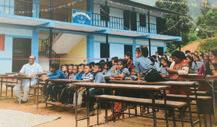
One of the Trust’s significant contributions has been its transformation of Water, Hygiene, and Sanitation infrastructure for thousands of children in rural communities. Their support has helped schools introduce smart classrooms, clean drinking water, and hygienic sanitation facilities-creating an environment that enhances student attendance, enrolment, and overall learning outcomes. The Trust’s contributions to children’s education through their Scholarship programs has been particularly remarkable.
Beyond education, the Dhamecha family has stepped up in times of crisis, particularly during the Covid-19 pandemic, when they donated ventilators, oxygen cylinders, hospital beds, and essential supplies to support relief efforts.
The Dhamecha Group today
A name synonymous with trust, quality, and commitment to the UK’s food and drink industry, Dhamecha Group is a leading wholesaler of FMCG products to thousands of independent retailers in the UK, helping them thrive in an increasingly competitive marketplace. Beyond business, they stand tall as a pillar of social responsibility, actively contributing to the community and fostering economic development. Success in this fastpaced world requires a reliable, strategic wholesale partner that understands the needs of independent retailers. Whether you’re a convenience store owner, an off-license retailer or a CTN business, Dhamecha Group offers everything one needs under one roof.
The company is the backbone of independent retailers in the UK. Much like the values upheld by the family, Dhamecha Group is defined by its unmatched reliability and steadfast commitment to ethical business practices. The Group has evolved over the
years with significant investments made in people, infrastructure and IT systems. This has enabled the Group to enhance the customer experience and establish itself as one of the industry’s leaders.
The family highly values it’s people, both customers and colleagues, some of whom have been with the Group for decades.
Whist the business has grown, the family operates as a nimble operator with swift decision making and empowering it’s senior leadership team. A strategy and vision that the next generation will surely carry forward.
Rooted in values, growing with grace
The Dhamecha family’s story is not just about business success—it is about unwavering unity, compassion, and the spirit of giving.
From Laduma’s sacrifices to Khodidasbhai’s leadership, to the charitable efforts of the younger generations, this family continues to embody the true essence of tradition and progress. The Dhamecha family’s philosophy has always been simple—business success should go hand in hand with community welfare. At the Wembley headquarters of Dhamecha Cash & Carry, a divine picture of Laduma watches over them, her gentle smile serving as a blessing and a reminder of the values that continue to guide her family.
As the future generations step forward, they carry with them not just the Dhamecha name, but a legacy of love, service, and humility.
(L-R) Anand P Dhamecha, Khodidasbhai & Lalitaben
Market Financial Solutions
Where innovation meets financial strength
Market Financial Solutions, we’re proud to say, is a market leader in the specialist finance market. We are at the forefront of the industry, providing brokers and borrowers with unparalleled bespoke products and services. But reaching this point didn’t happen overnight. We launched in 2006 and it’s taken nearly 20 years of hard work, innovating, and entrepreneurialism to get to where we are today.
Our company was started in 2006, then in 2008, we moved into a small rented office in Berkeley Square House. Initially, we were serving borrowers that needed to move more quickly than the high-street lenders could handle. However, seeing that the emerging Credit Crunch was making it increasingly hard for property investors to secure funding, we wanted to offer a solution for struggling brokers and provide tailored bridging
products that could allow them to wade through the uncertainty. We managed to do this with just a small handful of employees and industry insiders.
From the very beginning, we vowed to be as flexible as possible for our clientele. We have always underwritten every
Market Financial Solutions wins Bridging Lender of the Year at the B&C Awards 2025
The Market Financial Solutions team attends the annual Children With Cancer Fundraising Gala as the main sponsor of the event (2024).
The Market Financial Solutions Buy-to-Let team celebrates the second anniversary of the Buy-to-Let mortgage offering (2024).
one of our deals from day one of an enquiry, while also doing everything we can to deliver capital where possible. This clearly stood out in the marketplace as in 2013 – while the global economy was still recovering from an unprecedented financial crisis; we secured our first institutional funding line.
This allowed us to reach new heights over the following years and in 2016, our loan book exceeded £100m for the first time. We continued to go from strength-to-strength from here, as Market Financial Solutions became the first UK based bridging lender to expand into Asia, opening its Singapore office in 2018 – dubbed Market Bridge Solutions. A mere year later, we expanded our bridging capabilities by offering loans of over £10m for the first time.
Unfortunately, we faced our second major crisis in 2020 as Covid-19 emerged and wreaked havoc on the global economy. However, even in the midst of a worldwide lockdown, Market Financial Solutions continued to lend and maintain confidence in a beleaguered marketplace. In fact, despite the outlook, we introduced larger loans of up to £30m in 2021. At the same time, we moved into a new office building and grew our team by 40%.
As we moved into 2022, with the end of the pandemic in sight, we secured another £300m
in funding, and extended our office space to include new premises in London Victoria (which fully opened in 2023), taking our headcount to 64 in the process. Also, in early 2022, we launched our residential Buy-to-Let mortgage product to the whole of market. Bringing bridging like speed and flexibility to the specialist mortgage market, it allowed us to serve expanding landlords from a new and exciting perspective. Not long after this, we secured a further £250m of funding, with the intent to reach £1bn by the end of 2023.
We followed up the launch of our residential Buy-to-Let with the introduction of a new commercial and semi-commercial term mortgage as we approached 2024. Our Bridge Fusion loan came after this, which combined the best elements of our bridging and Buy-to-Let offering in a single product.
Market Financial Solutions team attends the annual NACFB Commercial Finance Expo 2024
Our latest developments, as of mid-2025, include the launch of new bridging loan offer, the introduction of title insurance, and the creation of a new team – keep an eye on our website for more details on this exciting new venture.
All this shows our commitment to our underlying brokers, and the wider markets. Every product launch or service tweak reflects our ability to adapt to the market’s needs.
This ethos has served us, and our stakeholders well. We’ve evolved from a humble, small team making our mark in a burgeoning industry, to a renowned force for good in the market with a team of nearly 200 professionals based in London, who benefit from an extensive network of lending partners, platforms, and brokers. With a loan book nearing £3bn,
Market Financial Solutions hosts a CPD event for brokers, centred around their innovative Bridge Fusion product
we have upsized and extended multiple institutional funding lines to ensure we can accommodate all of the market’s challenges for years to come.
Even after all of this, we are still just getting started.
46 Hertford Street, Mayfair, the current Market Financial Solutions headquarters
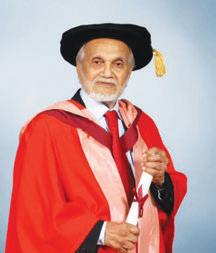
Lord Bhikhu Parekh
A Life Woven Through Cultures, Courage, and Ideas
In the dusty lanes of a small village in Gujarat, India, in 1935, a boy named Bhikhu Parekh was born. No one then could have imagined that this child from a modest goldsmith family would one day sit among Britain’s most respected thinkers in the House of Lords. His life is not merely a tale of academic success; it is a rich, human story of courage, love, migration, and a lifelong quest to understand society, identity, and justice.
Humble Beginnings in Gujarat (1935 - 1950s)
Bhikhu Parekh grew up in a village of merely a thousand people. His father and uncles crafted ornaments for villagers who brought them raw material. The family belonged to the lower-middle class, modest in means but rich in values and aspirations.
As a young boy, Bhikhu attended the village primary school. At that time, his dreams were shaped by his limited surroundings — becoming a head clerk or a teacher was the height of ambition in such a place. But fate had grander plans. Influential mentors began appearing along his path, recognising his potential and encouraging him to aim higher.
After finishing school, his headmaster advised, “Parekh, you can’t stop here. You have to go further.” Following that advice, Bhikhu left for Bombay (now Mumbai) for higher studies — a major leap for a village boy.
Academic Ascent in Bombay (1950s)
In Bombay, he enrolled in college and soon completed his Bachelor’s and Master’s degrees in Economics and Political Science. But again, a mentor — Professor Usha Mehta, a freedom fighter intervened in his life. She saw in Bhikhu the spark of intellectual curiosity and persuaded him, and his hesitant father, to aim for a PhD, not in India, but abroad.
The thought of going to England terrified young Bhikhu. “How would I survive? How would I afford it?” he wondered. His father, despite modest resources, promised to support him as much as he could. And thus, in 1959, Bhikhu Parekh, with his wife Pramila by his side, boarded a ship for London — a journey that would transform their lives forever.
Love, Marriage, and Crossing Boundaries
Bhikhu’s marriage to Pramila itself was a story of courage and love. In conservative
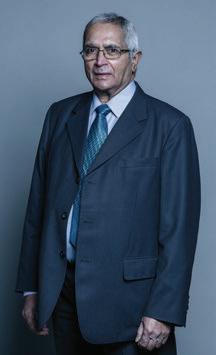
Lord Bhikhu Parekh
1950s India, caste boundaries were rigid. Pramila belonged to a slightly different caste, and their union faced opposition from both families.
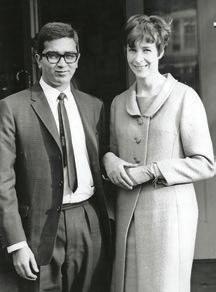
When asked how they met, Lord Parekh smiled and said, “I was a lecturer in Politics and she was a sociology student at a different university. She often came and sought academic advice from me.” The city of Baroda became a witness of their occasional meetings over the next two years. Meanwhile, Lord Parekh’s preparation to go to London to appear for his PhD was going on. Although it was difficult to afford life for two in England, Lord Parekh decided to get married first. Love, determination, and the support of a revolutionary friend helped them overcome societal barriers and on April 14, 1959, they got married in secret and eventually gained family acceptance — a tale that still touches hearts today.
Together, they embarked on their journey to the UK, facing financial struggles, cultural shocks, and racial prejudices, but leaning on each other through it all.
Struggles and Triumphs in London
(1959 - 1965)
Arriving in London in 1959, Bhikhu began his PhD at the prestigious London School of Economics. Racism was a harsh reality. He recalls applying for flats, only to be rejected after landlords heard his Indian accent. In restaurants and shops, they faced subtle — and not-so-subtle — discrimination. Many Indian students returned home within six months, unable to cope. But Bhikhu and Pramila stayed, supporting each other through every difficulty.
Life was far from easy. His father’s limited financial support barely lasted three weeks and the last week of each month was often a scramble for survival. Luckily, they had a generous landlord who often shared food, easing their hardships.
At London School of Economics, Bhikhu found his academic calling. His experiences of
inequality back home, of caste discrimination, untouchability, exclusion, shaped his intellectual interests. He decided to explore the concept of equality, particularly in English political thought.
By 1965, after years of hard work, his thesis was complete, well-received by the academic community, and his journey as a political thinker had truly begun.
Building a life in the UK
(1963 - Present)
Even before finishing his PhD, Bhikhu was offered a lecturer’s position at the University of Glasgow. It provided not only financial stability but also a sense of belonging. Shortly after, he applied for and secured a senior position at the University of Hull., the city that became his home for the next six decades.
At Hull, Bhikhu found an ideal environment for research and writing. His academic work flourished, particularly in the areas of political philosophy, multiculturalism, race, and identity. His landmark book, Rethinking Multiculturalism (2000), published by Harvard University Press, would later be taught in universities worldwide and became a seminal text for academicians.
Lord Bhikhu Parekh with his wife Pramila
Hull also became home to Bhikhu and Pramila’s family. They raised three sons, all of whom won scholarships to Oxford University, a proud testament to the family’s perseverance and commitment to education.
But Bhikhu’s work extended far beyond academia. His experiences as an Indian immigrant in Britain, witnessing racism and cultural clashes, shaped his scholarship and public service. He became Deputy Chair of the Commission for Racial Equality in the UK, championing justice, equality, and harmonious coexistence.
Multiculturalism: A Life’s Mission
Few scholars have influenced global conversations on identity and diversity like Lord Parekh. His idea of multiculturalism goes beyond tolerating differences; it celebrates them, arguing that individuals are shaped by their cultures but also by interactions with others. Multicultural societies, he believes, should respect all cultures while fostering shared values and critical self-reflection.
Sadly, his vision has often been misunderstood. Politicians like Angela Merkel and Margaret Thatcher once declared multiculturalism a failure, wrongly equating it with division or ghettos. Bhikhu Parekh consistently refuted these misconceptions, advocating for multiculturalism built on liberal values of freedom, choice, and community belonging. He believes the liberal ideology and multicultural thinking complement each other.
So, along with working on multiculturalism, how did Lord Parekh maintain his own culture? The process works in symphony. He said “During my early days in London, I noticed that very few Gujaratis accompanied me on this academic path. Generally, Gujaratis showed greater interest in business
and entrepreneurship than in academic achievements, often choosing to pursue degrees in business management or related fields.
“My own circle of friends was mostly limited to fellow Indians, as we shared cultural understanding and customs, knowing instinctively when to reach out to one another for support. In this way, we built a sense of solidarity that helped ease the loneliness of being away from home.
“This, I believe, is a process of cultural symbiosis, not a deliberate effort to adopt British culture, but an organic, often unconscious absorption of it. Like a quiet, subtle influence, culture creeps in and suddenly you are speaking, behaving, and even thinking like an Englishman, without having intended to change. A dual process of engagement and introspection that shaped both my academic journey and my understanding of identity in a multicultural world.”
The Parekh report: Key takeaways
“Britain is not monocultural but multicultural. A nation must reflect the diversity of its people in its institutions and self-image.”
“The task is not assimilation, but mutual belonging and the renegotiation of
Lord Parekh with his 3 sons, (from the left) Prof Anant Parekh, Nitin Parekh and Dr Raj Parekh
Britishness.”
“Racism is not just individual prejudice but also institutional and structural in nature.”
In 1997, Lord Bhikhu Parekh was appointed to chair a landmark Commission established by the Runnymede Trust to examine the implications of Britain’s growing ethnic diversity. Over two years, Lord Parekh led a distinguished panel of 23 individuals from various cultural, academic, and professional backgrounds to investigate key societal areas such as democratic institutions, cultural identity, family, employment, and justice. This extensive effort culminated in the publication of ‘The Future of Multi-Ethnic Britain’ in 2000, now widely known as the Parekh Report.
His leadership was pivotal in framing a bold and progressive vision for an inclusive British identity, one that not only acknowledged the reality of multiculturalism but also called for systemic changes to counter racial inequality and build a “community of communities.” The report remains a foundational document in the discourse on race, citizenship, and national belonging in the UK.
A seat in the House of Lords (2000 - Present)
In 2000, Bhikhu Parekh was appointed to the House of Lords, taking on the title Lord Parekh of Kingston upon Hull. It was a recognition of his lifelong dedication to bridging communities, his academic contributions, and his role in shaping policy.
Yet, he never saw the Lordship as the pinnacle of his achievements. For him, writing, teaching, and public engagement remained equally vital. His work in the Lords, particularly around human rights, cultural rights, and social cohesion, complemented his academic efforts, creating a unique blend of theory and practice.
Reflections on India and the world
Despite making his home in the UK, Lord Parekh remains deeply connected to India. He acknowledges India’s growing economic power
but also expresses concerns about inequality, corruption, and communal tensions.
India, he believes, is inherently multicultural. Its diverse religions, languages, and cultures are part of its DNA. But preserving this pluralism requires constant effort, honest dialogue, and rejection of divisive ideologies.
Similarly, he remains critical of global trends: the rise of populism, erosion of liberal values, and growing political confusion. For young people, he urges resilience, critical thinking, and above all, an understanding that progress comes with patience, struggle, and openness to change.
Today, as a respected scholar, policymaker, and global thinker, Lord Bhikhu Parekh’s journey is an inspiration. From a small village in Gujarat to the halls of LSE, Hull, and the British Parliament, his life exemplifies the power of education, love, perseverance, and intellectual curiosity.
Above all, his work reminds us that understanding and appreciating cultural differences is not a weakness, but a foundation for building a more just, humane world.
From the UK to the World: A Journey of Vision, Resilience and Global Impact
By Rishi Patel, Founder & CEO Interpolitan Money PLC
My story is rooted in the journey of my family, who moved to the UK from East Africa. Originally from India, they had sought opportunity and stability abroad - and like so many who travelled far from home, they carried with them a deep sense of resilience, responsibility, and the desire to build something meaningful for the next generation. Although I was born in the UK, their experiences and sacrifices shaped much of who I am - instilling in me a profound appreciation for hard work, community, and the value of perspective.
Growing up in the UK, I was raised with a blend of British values and Indian heritage, shaped in part by my family’s years in East Africa - a combination that gave me a unique lens on the world. From an early age, I was fascinated by how things worked - especially systems, structures, and the mechanics of commerce and opportunity. That curiosity grew into a driving force that led me into the world of finance and entrepreneurship.
The UK provided a strong foundation for my
development - intellectually, professionally, and culturally. It was here that I gained early exposure to the financial world, and it was here that I first began to notice the systemic gaps within traditional banking, especially for globally active individuals and businesses. These weren’t abstract problems — they were everyday frustrations experienced by real people trying to grow, move capital, or manage cross-border complexity.
That insight ultimately led to the founding of Interpolitan Money, a financial institution built to challenge the limitations of conventional banking and create tailored solutions for clients with global needs. Our mission - empowering global opportunity through alternative banking - reflects a belief that financial services should enable ambition, not restrict it. Whether it’s helping a corporate expand into a new market, assisting a family office in navigating complex structures, or facilitating cross-border escrow for highvalue transactions, we aim to remove friction
“Growing up in the UK, I was raised with a blend of British values and Indian heritage, shaped in part by my family’s years in East Africa - a combination that gave me a unique lens on the world.”
Rishi Patel
and replace it with clarity and confidence.
We started with a clear vision and a client-first mindset. I remember those early days: designing operational frameworks, securing key partnerships, and, above all, listening to clients. Their challenges became our roadmap. Over time, Interpolitan has grown into a global business, with a high-performing team of professionals and a client base that spans more than 50 countries. But even as we’ve scaled, our core remains unchanged — personalised, responsive service delivered with technical expertise and regulatory trust.
While I’m proud of the business growth, what matters most to me is the impact — the real difference we’ve made in the lives and ventures of the people we serve. I’ve seen how our work unlocks doors for entrepreneurs, protects wealth across jurisdictions, and gives clients the confidence to operate freely in an increasingly complex world.
challenge reaffirmed a simple truth: if you stay rooted in purpose and surround yourself with the right people, progress is inevitable.
Alongside that work has been a lifelong commitment to giving back — something deeply embedded in my upbringing and outlook. Whether through mentoring young professionals, supporting education initiatives, or championing inclusion in financial services, I’ve always believed that success should be shared. I’ve also made it a point to support community organisations, both in the UK and abroad, with time, expertise, and resources — because I’ve seen firsthand the ripple effect of even modest contributions.
Of course, like any entrepreneurial journey, there have been setbacks and challenges. The path hasn’t always been linear — building a regulated financial business takes grit, patience, and a steady compass. But each
Throughout it all, the UK has remained central to my identity — not just as the place I was born, but as the place that shaped my sense of what’s possible. Its culture of enterprise, fairness, and resilience continues to influence how I lead, how I make decisions, and how I serve others. Though Interpolitan Money’s reach is global, those British foundations are embedded in everything we do.
As I look ahead, I’m filled with both gratitude and ambition. Grateful for the journey so far — the mentors, the teams, the clients, and the community that have made it meaningful. And ambitious about what still lies ahead — the new markets to reach, the people to support, the problems yet to solve.
Thank you for the opportunity to share my story. I hope it serves as a reminder that where we come from shapes us, but it doesn’t limit us and that the most fulfilling paths are those where we lift others as we climb.
The inspiring journey of Lord Dolar Popat
WhenDolar Popat arrived in London as an 18-year-old refugee, he had little more than determination in his pocket and hope in his heart. Today, as Lord Popat of Harrow, he is not only a successful businessman but also a respected political figure and a devoted community leader. His life is a story of struggle, hard work, faith, and a deep sense of service.
Born in 1953, in Tororo, Uganda, Dolar Popat was part of a modest Gujarati family who had migrated from Gujarat, India, to East Africa in search of better opportunities. Like many Indian families in Uganda, the Popats
worked hard to build a peaceful life. However, peace was short-lived.
In 1971, Uganda’s dictator Idi Amin
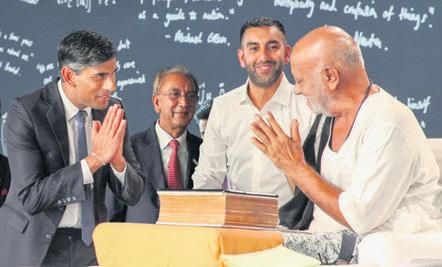
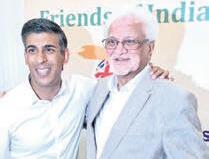
L-R: The Rt Hon Rishi Sunak MP, Lord Dolar Popat, Paavan Popat and Pujya Morari Bapu, during the Ram Katha at Cambridge University
ordered the expulsion of all Asians from the country. Over 70,000 people of Indian origin were forced to leave behind their homes, businesses, and lifelong dreams. Among them was young Dolar, only 18 at the time, who suddenly found himself without a home or a future in the land he grew up in. The Popat family fled to Britain, seeking refuge and a chance to rebuild their lives.
Building life from scratch in Britain
Arriving in London was not easy. The weather was cold, the culture unfamiliar, and the economy tough. Lord Dolar Popat had no connections, no wealth, and only limited
English-speaking skills. But what he had was an unbreakable spirit.
Determined to stand on his own feet, he enrolled in accountancy studies and worked evenings cleaning dishes at restaurants to support himself. It was hard, tiring work, but for Dolar, it was a stepping stone.
He firmly believed success comes only to those willing to get their hands dirty.
In 1973, after two years of juggling studies and jobs, Dolar landed his first proper job as a clerk in a bank. But his ambition stretched far beyond a desk job. Soon, he was offered a position under Peter Parker, the chairman of Rockwell Glass Company.
Peter Parker recognised Dolar’s hard work, honesty, and sharp mind, and encouraged him to pursue his accountancy qualification seriously. This mentorship changed Dolar’s life. By 1977, confident and qualified, Lord Dolar Popat took a bold step and set up his own accountancy practice — Kotecha Popat & Partners. It was more than just a business. For the countless Gujaratis and African Asians arriving in Britain, it became a lifeline.
In 1984, Dolar’s wife, Sandhya, purchased a small
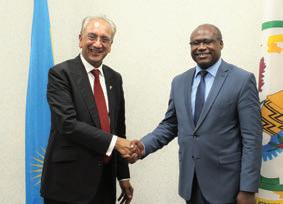
Lord Dolar Popat with Uzziel Ndagijimana
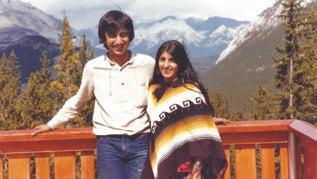
Lord Popat with his wife Sandhya
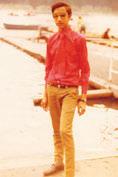
Lord Popat at the age of 17
nursing home. What started as a modest business soon became the foundation of a much larger venture.
Lord Popat recognised the growing demand for quality elderly care in Britain. With vision and careful planning, they expanded the business, building more nursing homes over the years.
Today, they own five nursing homes with a total of 240 beds, employing over 300 staff members, and generating millions of pounds in revenue.
The success of this business wasn’t just financial it provided comfort, dignity, and care to hundreds of elderly residents.
Dolar’s business journey didn’t stop with healthcare. He ventured into the hospitality industry, building two Comfort Inn franchises, and offered business consultancy services, guiding entrepreneurs in market research, financial planning, and feasibility studies.
His reputation as a sharp, honest businessman grew. But despite his success, Lord Dolar Popat remained grounded — his faith and his community always came first.
Rooted in faith and generosity
A devout Hindu, Dolar Popat has always placed spirituality at the heart of his life. His home, whether in Britain, India, or America, echoes with the greeting “Jai Siyaram”, a
Lord Popat with Pothi during Ram Katha by Pujya Morari Bapu at Cambridge University
reflection of the values his family holds dear.
In 1999, Lord Dolar Popat organised a historic Ram Katha by renowned spiritual leader Morari Bapu at the Wembley Exhibition Centre in London. Over 11,000 people attended daily. The arrangements were flawless free parking, delicious meals for thousands, and a spiritual atmosphere that touched hearts.
Lord Popat personally covered all expenses for the event. The proceeds, amounting to ₹5.5 crore, were donated to public welfare projects in Gujarat.
But true to his nature, Lord Dolar Popat never publicised his generosity. His quiet support for temples, religious institutions, and social causes continues to uplift communities across continents.
Moreover, Lord Popat had experienced the struggles of starting over in a foreign land. He understood how hard it was for others in the community who lacked English skills, legal knowledge, or access to finance.
Through his firm, he helped these small businesses secure loans, manage their accounts, and understand the financial system of Britain. His guidance empowered countless families to build businesses, buy homes, and settle down with dignity.
For Dolar, it wasn’t just about numbers — it was about giving back to a community that had suffered displacement, just as he had.
Stepping into politics
Lord Popat always believed that integration was not just about economic success — it required active participation in public life. Shortly after arriving in Britain, he joined the Conservative Party, drawn by its support for business, enterprise, and economic freedom.
Over the years, he rose through the ranks, serving as Secretary of the Anglo-Asian Conservative Association, Chairman of the One Nation Forum, and President of his local Conservative branch.
His work earned him immense respect among party leaders, and his home became a familiar meeting place for senior politicians, including former Prime Minister John Major, Health Minister Virginia Bottomley.
Honoured as Lord Popat of Harrow
In 2010, Dolar Popat was honoured for his contributions to business, politics, and community service by being appointed to the House of Lords, taking the title Lord Popat of Harrow.
It was a moment of immense pride, not just for him, but for thousands of British Indians who saw his journey as proof that no dream is too big — no beginning too humble.
In the House of Lords, Lord Popat has been a tireless advocate for:
• Strengthening UK-India trade relations
• Supporting entrepreneurs and small businesses
• Championing minority communities
• Promoting interfaith dialogue and cultural harmony
He has also served as the UK Prime Minister’s Trade Envoy to Uganda and Rwanda, a role close to his heart, reconnecting him with the land of his childhood.
The voice of a new generation
Lord Popat speaks passionately about the importance of preserving cultural identity while integrating into British society. He often highlights the need for the British Indian community to organise politically, similar
Lord Dolar Popat and former Vice President Specioza Kazibwe (R) after receiving Independence medals from President Museveni
to the Board of Jewish Deputies or the Sikh Council, to ensure their voices are heard in Parliament.
At the same time, he firmly believes in empowering young British Indians to lead the way. Their success in education, business, and politics, he says, is only the beginning.
“Our new generation is articulate, dynamic, and among the most educated communities in Britain today,” he says with pride. “But we must guide them to carry our values forward.”
From washing dishes as a struggling student to serving in the House of Lords, Lord Dolar Popat’s life is a remarkable journey of resilience, faith, and service. His story reminds us that success is not measured by wealth or titles alone but by how many lives we touch along the way.
Lord Popat never forgot where he came from — and because of that, he has never stopped giving back.
As he continues to serve Britain, his community, and the global Indian diaspora, his message remains clear: “We are a community built on hard work, faith, and unity. If we empower the next generation, there is no limit to what we can achieve.”
A Legacy of Innovation, Impact, and Inspiration
Koolesh Shah is an entrepreneur, philanthropist, and now a political bridge-builder, whose journey from humble beginnings to building a multimillion-pound enterprise, and serving the community in everexpanding ways, is a testament to resilience, innovation, and cultural pride.
Born and raised in Britain to a family of Indian heritage, Koolesh grew up immersed in the ethos of the British Asian community— grounded in hard work, family, faith, and a deep respect for tradition. The values of discipline, community spirit, and ambition, deeply rooted in Gujarati culture, became the foundation for a life defined by purposeful action and visionary leadership.
His entrepreneurial journey began not with vast capital, but with sharp insight, relentless determination, and a desire to create something meaningful, not just for himself, but for the community and country he calls home.
In 1988, Koolesh founded London Town Group, laying the cornerstone for what would become one of the UK’s most dynamic and diversified business groups. With early investments in real estate, the Group steadily expanded under his leadership to span three powerful pillars: Real Estate, Technology, and Philanthropy.
From a modest portfolio of properties, Koolesh grew London Town Group into a major force in the UK hospitality market. His developments helped rejuvenate neighbourhoods across cities including London, Leicester, Derby, Nottingham, and Sheffield, and creating opportunities for regeneration and employment. Today, the Group has generated over 600 jobs, helping
stimulate local economies and shape vibrant, inclusive communities.
Koolesh has always maintained a forwardthinking mindset-championing innovation. Under his leadership, London Town Group has ventured boldly into emerging sectors, particularly in technology, where its influence continues to grow.
In a milestone appointment that reflects his expanding role in public life, Koolesh Shah was named Co-Chair of Conservative Friends of India (CF India), alongside The Rt Hon Sir Oliver Dowden CBE MP, Deputy Prime Minister and a steadfast supporter of the British Indian community. CF India serves as a vital bridge between the Conservative Party and the British Indian diaspora. Koolesh’s appointment underscores his reputation not only as a successful businessman and philanthropist, but as a passionate advocate for representation, dialogue, and crosscultural engagement.
As Co-Chair, Koolesh brings a compelling combination of business expertise and public service ethos. His vision is to foster deeper political participation, support the next
Koolesh Shah
generation of British Indian leaders, and ensure the community’s voice is heard and valued at the highest levels of government.
Beyond the business and political spheres, Koolesh Shah’s life is profoundly shaped by his spiritual convictions. A devotee of Sri Aurobindo and The Mother, Koolesh has long championed their teachings as a guiding light for personal and societal transformation. He serves as the Chairman of the Sri Aurobindo Trust, a UK-based charity committed to spreading the integral philosophy of Sri Aurobindo and The Mother.
Under his leadership, the Trust has introduced academic modules at SOAS, University of London, organised educational visits to the Sri Aurobindo Ashram in Pondicherry and Auroville, and continues to promote awareness of the Indian sage’s timeless wisdom. He is a past President of the Jain Social Group and currently serves on the Board of Advisors for the Navnat Vanik Association.
This spiritual underpinning informs all aspects of Koolesh’s philanthropic work. In 2016, he formally established the Koolesh Shah Family Foundation, which focuses on expanding access to education, supporting
mental health initiatives, and mentoring underrepresented youth.
In recognition of these efforts, Koolesh was named Philanthropist of the Year (2022), following his earlier honour as Asian Hotelier of the Year in 2017. But as Koolesh often states, accolades are not the end goal’-they are simply signposts along a larger journey to uplift, inspire, and create lasting value.
Koolesh’s leadership combines commercial excellence with cultural intelligence, and his ventures consistently align business growth with social purpose. Whether preserving historic buildings or launching disruptive technology platforms, he fuses tradition with progress to deliver sustainable and inclusive results.
Despite his many achievements, Koolesh remains deeply grounded in the values that shaped his early life—humility, service, and heritage. He is a passionate advocate for increased British Asian representation across sectors, and he dedicates time to mentoring the next wave of entrepreneurs, changemakers, and civic leaders.
As Gujarat Samachar marks its historic milestone through the Soneri Smruti Granth, Koolesh Shah’s life story offers a powerful reflection of the British Asian experience— one shaped by enterprise, endurance, and empathy.
His journey is more than a narrative of personal success—it is a reminder that when ambition is matched by compassion, and innovation is rooted in timeless values, the future becomes a legacy worth sharing.
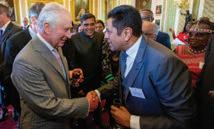
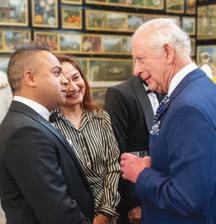
Koolesh Shah in conversation with His Majesty King Charles III
Family members at his father’s Nature Cure Clinic on Marine Drive, Mumbai, 1961
Koolesh at age 6 with Mr Meghji Petraj Shah (MP Shah)
Top of the World
Subhash V Thakrar OBE
‘If ever I am asked about the best scripture that I have read and which has impacted me most, it will be the Bhagwat Gita. I received this when I was 40 years of age, having previously failed to read it. It has revolutionised my life and outlook. The Gita goes back 5000 years, but remarkably still has enormous relevance to our lives. Each time I read it, it brings a new dimension to my life. Its power is limitless and brings lots of joy and value to me’: Subhash V Thakrar
Refugee to Renaissance Man
“When we arrived in the UK, we had nothing. But we had a purpose. That was everything.”
Subhash Thakrar’s story is not just about
rising through the ranks—it’s about rebuilding from ruin. It’s about how a teenage refugee, once stripped of home and homeland, went on to become a visionary leader, a pioneering entrepreneur, and a deeply rooted family man. His journey is an extraordinary account of resilience, reinvention, and responsibility.
Rooted in Ruin, Rising with Resolve
Born in Uganda in the 1950s, Subhash was raised in a thriving Indian business family. But in 1972, his life turned upside down. The brutal regime of Idi Amin expelled the Asian community from Uganda, uprooting their families overnight. At just 16 years old, he found himself a refugee—first in India, and then in Leicester, UK.
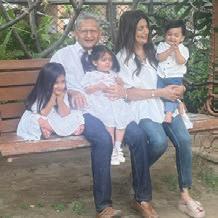
Subhash Thakrar OBE with his wife Rekha, their granddaughters Suri and Riva, and grandson Kaveer (Their other granddaughter, Ananya, is not in the photo)
“We weren’t just poor,” he recalls. “We had nothing. But we still had a purpose.”
Living in cramped conditions with eight people in a small house, survival wasn’t just a
reality—it was a daily lesson in resilience. His family clung to one another, leaning on values, hope, and sacrifice.
Education Funded by Sacrifice
With barely enough to survive, education seemed impossible. But one act of love changed everything. “My sister gave up her savings so I could pay my college fee—just £50. That’s the foundation of everything I’ve built.”
Subhash Thakrar pursued A-levels in maths and physics while attending college during the day. Young Subhash worked tirelessly: cleaning glasses at nightclubs, selling menswear on Saturdays, and pumping gas on Sundays, only to provide money to his father, once a businessman but now working in a warehouse that manufactured socks. His life became a blur of studies and survival, but never once did he complain.
“There was no time to think about what we’d lost. We were too busy building what was next.” He said that there were many families like theirs displaced from the atrocities in Uganda, so that made him optimistic that this time would pass soon.
What motivated him during this period?
Keeping a warm smile on his face, he said: ‘I came with nothing but the belief that purpose matters more than possessions. And there’s no shame in starting small—only in thinking small.’
Turning Point: A Leap into Commerce
Initially set to study engineering, a summer of reflection—and a conversation with a cousin who was a Chartered Accountant—changed his future career. The day before university began, Subhash switched from civil engineering to commerce. An instinctive pivot that would change his life. By 1981, he had earned a B.Com degree with a second-class, 2:1 distinction.
With a government grant and relentless hustle, he powered through university, driven by a mantra he found in the Bhagavad Gita: “You are capable of doing much more than you know.”
Breaking Barriers in British Finance
Subhash Thakrar moved to London and qualified as a Chartered Accountant. After training at Spicer and Pegler (now part of Deloitte), he joined Blackstone Franks. Just three years later, he made history as the first Asian equity partner in the firm. It required a special exemption from the Institute of Chartered Accountants, as he hadn’t completed the usual two-year post-qualification period.
How did he pull it off? “I told them I’d leave in six months if I wasn’t made partner. I meant it”, he said.
Subhash Thakrar’s confidence was earned. As managing partner, he led a major merger with CBW(now Gravitas), creating a top 50 UK firm offering services from tax and finance to corporate recovery.
Subhash attributes his earlier successes to the British environment that was conducive to hard work and opportunity.
A Family Anchored in Faith
In 1983, Subhash married Rekha. It wasn’t a Bollywood love story, but it was built on shared values. “She’s the pillar of our family,” he says. Together, they raised two children and now enjoy the laughter of four grandchildren. For over 30 years, the Thakrar home has hosted monthly prayer gatherings—a living tribute to togetherness. “We kept the tradition so the family would always stay together, no matter what success brought,” he says.
His late father, a man once crushed by circumstance, lived long enough to see Subhash find his footing. “He passed away in 1986,” Subhash says. “But he left proud.”
India: A New Chapter of Ambition
By 1993, the UK was no longer a challenge—it was familiar. Subhash Thakrar looked eastward. Post-liberalisation India was brimming with potential.
He placed an open ad in The Economic Times inviting entrepreneurs to meet him. “I didn’t have an agenda. I just wanted to listen.”
From these conversations, he saw one need repeated: Indian entrepreneurs had ideas, but no capital. He met a few people back and forth in India and the UK to understand the potential and the requirements of funds for the entrepreneurs based in India.
That curiosity led to the founding of India Value Investments Ltd (INVIL)—a Mauritiusbased Indian equity fund. It became one of the oldest and most successful Indian funds outside India, outperforming the markets.
But Subhash Thakrar wasn’t done. He pioneered infrastructure ventures across India: toll roads, shopping malls, and joint ventures with firms from South Africa, the UK and Australia. From real estate architecture to parking management, he brought a global vision to India’s sunrise sectors. He had vision and the drive to create.
A Voice for the Voiceless
Despite his success, Subhash Thakrar saw that Asian entrepreneurs in the UK had little institutional voice. So, in 1995, he founded the Asian Business Association (ABA) under the London Chamber of Commerce. It was the first initiative to connect Asian businesses with mainstream institutions.
“When we started, there were zero Asian members. Today, we’re part of the national conversation.”
Subhash later chaired ABA (2001–2004) and eventually became the first Asian Chairman of the London Chamber of Commerce in its 130-year history.
Diplomat of the Diaspora
As Chairman, he led trade missions to India and Africa alongside Tony Blair, David Cameron, and Boris Johnson. From boardrooms to grassroots, Subhash acted as a bridge between cultures and continents.
“Africa is where I lost everything. Maybe it’s where I was meant to give something back,” he reflects. In Mozambique, he’s helped build 1,200 affordable homes under a publicprivate model. In Uganda, his family now runs successful FMCG and electronics ventures. He
L–R: Grandson Kaveer held by son-in-law Rikin, daughter Kavita, Subhash and Rekha Thakrar, daughter-in-law Ayushi holding Suri, and son Ravi holding Riva
continues to see Africa as the next India. He proudly says, “India gave me a second wind. Africa gave me a second chance.”
Giving with Clarity
Philanthropy, for Subhash Thakrar, is not just about giving—it’s about impact. Disheartened by mismanaged charities, he cofounded Charity Clarity, a watchdog that rates and guides non-profits.
He also supports the Attlee Foundation, 3Rs Trust in Nepal, Pratham (India), Jaspar Foundation and the Oxford Centre for Hindu Studies. From sailing projects for underprivileged children to launching podcasts during lockdown, he finds new ways to give back.
He’s cycled from London to Paris and London to Brighton to raise charity funds—and credits yoga and the Gita for his endurance. “The Gita taught me: you’re capable of more than you know”, he repeats.
Legacy in Motion
In 2024, Subhash was awarded an OBE (Order of the British Empire) for services to the economy and diaspora communities. In 2021, the Institute of Chartered Accountants gave him the prestigious Lifetime Achievement Award. But titles have never defined him.
“Legacy isn’t what people say about you. It’s the lives made better because you lived.”
Now semi-retired, he remains an advisor, a mentor, and a quiet force of inspiration.
“SUCCESS IS THE IMPACT YOU HAVE ON OTHERS”
REMEMBERING JOGINDER SANGER’S LIFE PHILOSOPHY
Shri Joginder Sanger, was a true pioneer and a shining example of the “Indian moving to Britain” dream. Born in India - a true patriothe embarked on a journey to the UK from Punjab in 1961 with humble beginnings, carrying only a few shillings in his pocket. Yet, his determination, resilience, and entrepreneurial spirit propelled him to achieve greatness in any field that crossed his path enduring great humility at the same time.
As a farmer’s son, one of eight siblings and the youngest son, he was not entitled to a full education yet instilled in us all the value of hard work and the importance of giving back what you earnt to the community. He started his journey in the UK as a stoker in a coal factory, but his ambition and vision soon led him to the travel industry. He worked tirelessly to build a successful travel agency, which he eventually took over and expanded into a network of offices across the UK, India, and North America.
Dad’s innovative approach led him to become Air India’s principal agent, introducing the concept of General Sales Agents (GSAs) that revolutionised the aviation industry. His success in the travel sector paved the way for his next venture - real estate and hospitality. In the late 90’s, he invested in hotels in Central London, starting with the iconic Washington Hotel in Mayfair.
As his children (Girish and Reema) joined the family business, he expanded his hospi-
tality portfolio, developing the Courthouse Hotels in Soho and Shoreditch (Former Magistrates Court Buildings), the Bentley Hotel near Knightsbridge and the Heston Hyde Hotel near Heathrow Airport. His legacy is not just about business success; it’s about the countless lives he touched through his philanthropic, social and community work.
Two of his Central London Hotels took the flag of Kempinski Hotels, the first ever in the UK and London, followed by the introduction of the first ever Waldorf Astoria and Doubletree by Hilton in the same city.
He was deeply committed to giving back to his beloved community, supporting various causes and charities. His love for India and its people was evident in everything he did. His selfless dedication to social work and his close connection with India earned him numerous accolades and respect from the community.
His philanthropic endeavors extended to being a patron and trustee of many charitable organizations connected to India. He was particularly passionate about promoting Indian culture in the UK, recognising the importance of preserving heritage for future generations. His association with institutions like the Bharatiya Vidya Bhavan, a renowned organization dedicated to promoting Indian culture, music and education, is a testament to his commitment, spanning over a four decade long association. He also remained trustee of the Indian Gymkhana in Osterly promoting
Shri Joginder Sanger
sports and recreational activities to the wider diaspora community.
Mr Sanger also chaired the UK Kabaddi Association (a talented player himself in his youth) taking the team on several global tournaments in an attempt to recognise the sport and build awareness around it so ultimately it could participate as an event at the Olympics. Sadly this was not recognised by the International Olympic Committee. Through his support, he helped foster a sense of community and cultural identity among Indians in the UK, leaving a lasting impact on the lives of many.
As we reflect on his journey, we are reminded of his words: “Success is not just about achieving your goals, but about the positive impact you have on others.” This quote encapsulates his philosophy and approach to life. He lived by example, demonstrating that true success is measured by the lives we touch and the difference we make.
Joginder Sanger’s settlement in the UK was a defining moment in his life. He arrived in a foreign land with limited resources, but his determination and resilience enabled him to build a thriving business empire. His journey serves as an inspiration to many, showcasing the opportunities that the UK offers to talented and driven individuals.
Throughout his life, he remained deeply connected to his Indian heritage, while embracing the British culture. He believed in the importance of cultural exchange and integration, recognising that diversity is a strength, not a weakness. His legacy serves as a bridge between two cultures, fostering greater understanding and appreciation between India and the UK.
His story is a testament to the power of hard work, determination, and compassion. He will always be remembered for his kindness, generosity, and unwavering commitment to making a difference in the lives of others.
Joginder Sanger’s impact on the Indian
community and his business achievements in the UK is immeasurable. He played a significant role in promoting Indian culture, supporting charitable causes, and empowering future generations. His legacy continues to inspire and motivate others to follow in his footsteps, making a positive impact on their communities.
His most remarkable quality was his selflessness. He always put everyone else before himself, treating everyone with kindness, respect, and equality. Regardless of their background, status, or position, he believed in the inherent worth and dignity of every individual. His humility, empathy, and generosity inspired countless people, and his legacy continues to inspire us to follow in his footsteps. He showed us that true greatness lies not in what we achieve, but in how we treat others and make a positive impact on their lives.
Joginder Sanger’s life is a shining example of what can be achieved through hard work, determination, and a commitment to giving back. His legacy serves as a reminder of the importance of cultural exchange, diversity, and community service. As we celebrate his life and achievements, we’re reminded of the profound impact he had on countless lives, and the enduring legacy he leaves behind.
Mr Joginder Sanger with his family
Following Friends into Pharmacy: The Evolution of Sigma
Imagine a 17-year-old boy leaving behind the comforts of a rural Nairobi secure home and a loving family, travelling alone to the UK in search of a new career. In 1966, three years after Kenya’s independence, Bharat Kumar Hansraj Devraj Shah began his journey from Kenya to the Roman city of Bath. Over half a century later, Bharat Shah CBE has transitioned from a student pursuing a degree in pharmacy to the founder and architect of one of the UK’s leading pharmaceutical wholesalers: Sigma Pharmaceuticals Plc.
Sigma is a family-owned business which was started nearly five decades ago. Founded in the early 1980s by members of the HansrajDevraj family Bharat, Manish and Kamal Shah, Sigma began as a single community pharmacy. Today, it stands as a well-structured corporate entity, operating under the Sigma Group, which includes Sigma Pharmaceuticals, OPD Labs (parallel import business), and RX Farma (generic manufacturing).Moreover, the family owns interest in 17 pharmacies in Uk. From its humble beginnings in Watford, the business now enters its 43rd year of operations.
Following Friends into Pharmacy
Bharat Shah completed his early education in Nairobi and passed his O Levels in Kenya. With limited opportunities to pursue A Levels locally and local universities focusing on arts
courses, he turned to the UK for his studies. Influenced by peer recommendations, he decided on pharmacy. “Someone said they would be studying pharmacy, and I followed. Later, when someone else asked me, I offered the same advice. In a way, it became a cycle. So, you’ll notice most East African professionals of my generation are most likely either accountants or pharmacists,” he shares.
He arrived in Bath in 1966 and completed his degree in pharmacy at the University of Bath. After gaining practical experience with Boots Pharmacy, he returned to Kenya in 1973 but soon realised the business environment wasn’t for him. With encouragement from his father, he returned to the UK in 1975 and started building his entrepreneurial dream.
World War II and the Family’s Migration
The origins of the Hansraj-Devraj family can be traced back to the era of the Second World War, a time when India remained under British colonial rule and was grappling with rampant unemployment, political unrest, and deepening poverty. Like many others from Gujarat and Punjab, the Shah family ventured across the Arabian Sea to the East African coast of Kenya in search of a better life.
A significant number of Indians had arrived on these shores as labourers, initially recruited by the East India Company to construct the
Dr Bharat Shah CBE
King Charless honouring
region’s railways. The harsh realities of the British Raj’s rule in Kenya, coupled with the emotional distance from their homeland, fostered a close-knit and resilient Indian community.
“My father often told me how our community played a crucial role in helping new Asian immigrants settle – be it finding jobs or securing accommodation. Life in those early days was tough – more than a dozen people cramped into a single room. It’s hard to fathom such conditions today,” reflects Bharat.
According to Bharat, a turning point for many East African Asians came with Kenya’s independence from Britain. This shift created a vacuum in administrative and professional roles, which Indians – being generally more experienced at the time – were well-positioned to fill. He recalls how deeply entrenched the caste system shaped the social and economic fabric of the time, with professions often rigidly defined by caste. The Shahs, like many of their community, found themselves in the textile and other trade; Patels gravitated towards administrative roles, while Sikhs commonly worked in mechanical trades, engineering, and garages.
“My parents started a textile shop on their own. While the business was steady, it was just enough to cover the basics – including our education,” he recounts.
Family Support and Business Expansion
Bharat firmly believes his success wouldn’t have been possible without his family’s support. During the early years, his younger brother Manish joined him in London while pursuing
a career in accountancy. After graduating in Economics from Newcastle University in 1979, Manish qualified as a Chartered Accountant in 1981 and assisted with bookkeeping for the business.
By then, Bharat had opened his first shop in Watford (1982), followed by two more in Harrow. Their father later gave Manish a choice — start his own practice or join the family pharmacy business. “It wasn’t a great fit for Manish, as he could only support with accounts or the front shop,” Bharat recalls. “So, we expanded into wholesaling to create more opportunities.”
That decision proved pivotal. The real
breakthrough came when Sigma began dealing in generic medicines—then available in only a few shops. In 1982, as branded drugs under the NHS started going off-patent, Sigma stepped in to supply the generics, marking a major turning point in Bharat’s business journey. Going to Kenya and Post-Marriage Immigration to the UK
After completing his A Levels and Pharmacy
Dr Bharat Shah with CBE
Dr Bharat Shah with his sons Hatul (on the left) and Rajiv (on the right)
degree at the University of Bath in 1971, Bharat trained and worked at Boots for two years, gaining valuable experience. In 1973, following his marriage in Kenya, he spent 18 months in retail and hospital pharmacy—but soon realised it wasn’t for him and joined his father’s textile business.
“My father felt I’d wasted the money he spent on my education,” Bharat says with a smile. He was given two choices: open a pharmacy in Kenya or return to the UK. With encouragement and ambition, Bharat chose to settle in the UK in 1975, despite being unfamiliar with the UK Pharmacy market.
“Retail pharmacy then wasn’t as competitive,” he recalls. Most shops, owned by Europeans, operated limited hours. Asians, however, brought entrepreneurial flair— extending opening hours, diversifying stock, and building strong customer relationships. “That personal touch made all the difference,” Bharat reflects.
Venturing into Generics
“Generic medicines such as Paracetamol and Aspirin were difficult to source as there were limited wholesalers,” Bharat recalls. The NHS was experiencing a shift where branded medicines were coming out of patents, opening the market to generics. Sigma stepped in at the right moment. “We were successful because we had the right products, but more importantly the Asian community supported us,” he explains. This grassroots support, combined with family backing and favourable financing from banks, helped solidify Sigma’s early momentum.
Structuring the Future
In recent years, Sigma has evolved into a more formalised and corporatised organisation. Bharat, Manish, and Kamal have now retired from active management of the core business, handing over responsibility to the next generation. Sigma has embraced corporate governance, establishing a statutory board with external leadership. Mr Marcus Moir serves as Chairman and Mr Mark Hampton as Finance Non-Executive Director.
The next generation of leadership includes Hatul Shah as CEO, Rajesh Haria (a nonfamily member) as Group Managing Director, Bhavin Shah as CFO, and Rajiv Shah as Purchasing Director.
Supporting them are five junior directors who manage operations, HR, IT, exports, and finance. Sigma has also discontinued its veterinary and mobility aid ventures to concentrate on its core pharmaceutical business.
In addition, Manish’s son Sachin now runs a family dental surgery, expanding the professional footprint of the Shah family. Across the family, there are now 5 pharmacists, 3 dentists, 1 doctor, 2 Chartered Accountants, and 1 International Business graduate. Expanding Legacy and Recognition
The family has grown across four generations, from the original 3 to a total of 29 living members (with one deceased). Importantly, the Shahs have formalised their family governance with a written constitution, a practice Bharat recommends for all familyrun businesses.
Dr Bharat Shah with his wife Jayoti
Outside the boardroom, Bharat Shah’s contribution to business and community has not gone unnoticed. In 2014 University of Bath bestowed an Honorary Doctorate in Business Administration and In December 2019, he was given an honour from the UK Government as a Commander of the Order of the British Empire (CBE). The investiture was performed by King Charles.
Sigma Conferences and Industry Impact
Sigma organises annual international Retail Pharmacy Conferences, inviting renowned experts and key industry stakeholders. The 2025 conference was held in Baku, Azerbaijan, and the 2024 Sigma overseas conference took place in Sun City , South Africa. These events reflect Sigma’s commitment to leadership in community pharmacy. During a previous conference in Muscat, Oman, former Prime Minister Theresa May commended the company for fostering collaboration between community pharmacy and the NHS. This year our UK Prime Minister Keir Starmer also commended the Community Pharmacy sector in the UK.
Independent Together
Sigma’s current motto, “Independent
We were successful because we had the right product, but more importantly the Asian community supported us.
Together,” embodies its values. Bharat Shah concludes, “As a family-run independent business, we couldn’t have achieved this success without the help of independent pharmacies. We want to continue this journey — together.”Ugiam ut
Sigma Pharmaceuticals raise £20,000 for Citizens Advice Watford
Manubhai Madhvani: The man who rose beyond empire
Beneath the African sun, on the fertile banks of Lake Victoria, where sugarcane fields once stretched endlessly under blue skies, began a story — not just of wealth or business, but of unshakable faith, loss, exile, and redemption. At its heart stood Manubhai Madhvani, a man who bore the weight of legacy and loss with equal grace, and who, time and again, rose from the ashes to rebuild what others had destroyed.
Humble beginnings with a giant’s legacy
Born on 15 March 1930 in Jinja (Uganda), Manubhai was the second son of Muljibhai Madhvani, a pioneering industrialist who had left Gujarat (India), in 1908 to start a new life in East Africa. From a modest retail shop in Jinja, Muljibhai laid the foundation for what would become Kakira Sugar Works — and eventually the Madhvani Group, a vast industrial empire that shaped Uganda’s economy.
Manubhai’s early years were steeped in discipline and heritage. At the age of ten, he was sent to Mumbai for his education. It was in the bustling streets of India that he encountered a man who would influence his soul forever — Mahatma Gandhi. Drawn to Gandhi’s teachings of non-violence and inner strength, young Manubhai frequently
attended his prayer meetings. He would later describe Gandhi as his spiritual father — a moral compass during some of life’s darkest chapters.
Brothers in business, builders of an empire
Returning to Uganda in 1949, at the age of 19, Manubhai joined his elder brother Jayantbhai to work under their father’s guidance. While Jayantbhai was eloquent, visionary, and politically astute, Manubhai was grounded, reserved, and financially savvy. Their partnership would become one of balance and brilliance.
The two sons began expanding the business beyond sugar. By the early 1950s, the Madhvani Group had added an oil mill, a soap refinery, and cotton ginneries. In 1950, Jayant married Meena Chauhan, and in 1952, Manubhai married Jyoti Pajwani, both unions strengthening family and cultural ties with India. But prosperity did not shield them from sorrow. In 1954, their mother Parvatiben passed away at just 45. Then in 1958, the family’s guiding light — Muljibhai — died. He was cremated on the banks of Lake Victoria. A mausoleum was later built in his memory, a symbol not just of one man’s achievements, but of his ideals.
Independence and an uneasy dawn
With Uganda gaining independence in 1962, the political landscape grew more complex. Jayantbhai joined the Legislative Council, representing the voice of commerce in turbulent times. Together, the brothers launched new ventures like Mulco Textiles (1960) and a steel rolling mill (1964). They became symbols of the Indian diaspora’s contribution to Uganda.
But trouble loomed. Milton Obote, Uganda’s first Prime Minister, began promoting a socialist agenda that included nationalisation of industries and increased control over foreign exchange. The “Common Man’s Charter” was deeply unsettling to families like the Madhvani’s - prosperous, Indian, and successful.’Still, no one could predict the storm that would follow.
The fall: Idi Amin and exile
In 1971, Obote was overthrown by Idi Amin, whose regime would unleash a nightmare. That same year, tragedy struck the Madhvanis when Jayantbhai passed away suddenly in Delhi, leaving 41-year-old Manubhai to lead the family and the empire alone.
Then, in August 1972, Amin expelled over 60,000 Asians, giving them 90 days to leave. The Madhvani Group-decades in the makingwas seized. Their factories were looted, their properties nationalised, and their dreams shattered.
Manubhai’s personal trial deepened when he was arrested and imprisoned in the notorious Singapore Block of Makindye Military Prison. Blood-stained walls, darkness, and terror surrounded him. For three weeks, he faced the very real threat of death.
Yet in the heart of that prison, he found something profound. He formed a prayer group, drawing strength from shared faith — the Gita, the Bible, and the Quran. “I lost my identity in prison,” he would later say, “but I found it again in prayer.”
Manubhai never lost the values instilled by his father. He believed in community over commerce, in faith over fear, and in unity over ego.
Released through international pressure, Manubhai eventually fled for India and UK, joining thousands of other exiled Ugandan Asians. Britain welcomed him and granted citizenship as he had been a Ugandan Citizen. Though he left behind everything, he carried within him the one thing no dictator could steal - resilience.
Rebuilding from nothing
Exile was cruel. The joint family that had once run a business empire began to splinter under the weight of uncertainty. The brothers divided what remained of their assets in India, Kenya, Tanzania and Lebanon. Manubhai bore it all - grief, loss, and the burden of responsibility.
Still, he didn’t waver. “People are my true wealth,” he often said. He gathered a close circle of advisors and began again, quietly, and determinedly.
The
return: A nation reawakens
By the mid-1980s, a new chapter opened for Uganda. Milton Obete had returned to power and the government, recognising the economic cost of expulsion, passed the Expropriated Properties Act, inviting former
business families to reclaim their properties. This Government Policy was enhanced when President Yoweri Museveni later took power.
In 1985, the Madhvani’s returned
What they found in Kakira was devastation: factories in ruins, sugar mills gutted, and the land once fertile now choked by neglect. But where others saw ruin, Manubhai saw possibility.’Backed by institutions like the World Bank and the African Development Bank, and with support from loyal colleagues, Manubhai led the Madhvani Group’s rebirth. Slowly, sugar refineries buzzed again. The fragrance of molasses once more filled the air. Kakira was not just a business reborn — it was a symbol of survival.
One
more blow
In 2006, fate struck again. A glass container factory in Lebanon, owned by the Madhvani Group and generating $ 10 million annually, was reduced to rubble during the conflict. It was another crushing loss.
But by now, Manubhai had learned that the true measure of wealth is not what stands, but what rises after it falls.
A
legacy etched in spirit
Throughout his life, Manubhai never lost the values instilled by his father. He believed in community over commerce, in faith over
fear, and in unity over ego. “He walked with kings but never lost the common touch,” as the 2011 Madhvani Group Magazine memorably described him.
He invested heavily in education, launching one of Uganda’s largest scholarship programmes through the Madhvani Foundation. He saw employees not as workers, but as families. He saw his homeland - even the one that once exiled him - as something to heal, not hate.
On 17 May 2011, Manubhai Madhvani passed away in London at the age of 81. Tributes poured in from around the world. British Foreign Secretary William Hague called him a “fantastically successful industrialist.” But for those who knew him, he was something greater — a man who taught that strength doesn’t come from what you own, but from what you refuse to let go of.
Tide of Fortune: A testament to the soul
Before his death, Manubhai co-authored his memoir, Tide of Fortune, with Giles Foden, author of The Last King of Scotland. It is not just a business story. It is the souletched narrative of a man who stood tall in sunshine and in shadow - and who, no matter the tide, never stopped believing in the shore. His story is not just one of fortune made, lost, and regained - but of spirit tested, broken, and reborn.
The Inspiring Journey of the Patel Brothers: From Struggles to Global Impact
The inspiring journey of the Patel brothers began in the early 1930’s amidst a wave of European and Asian settlers in Africa, where an extraordinary story was about to unfold. In 1937, Bhikhu Patel and Vijay Patel’s father, carrying with him the hopes and dreams of a better future, arrived in Kenya. Armed with a precious matriculation qualification from India, he started work in a general store, in rural Kenya.
His devoted wife, Shantaben joined him in 1942 and together they set up their home in Nairobi. Their three children, Manjula, Bhikhu and Vijay enjoyed an incredibly happy early childhood.
True to his ambition, their father embarked on an entrepreneurial journey with utter unwavering determination, opening both a bookstore and a bicycle shop, in Nairobi.
Soon, the family moved to Eldoret, Western Kenya, in 1952 and their father worked for a timber merchant as a business administrator. In 1955, he set up his own thriving timber business that supplied Mombasa, Kampala, and the Middle East.
Life seemed stable for the Patel family, but fate had a different plan. In a devastating twist, their father passed away suddenly in 1956, at just 42, leaving behind a grieving young widow and three children: Manjula only 11, Bhikhu, just 9, and Vijay, a tender 7 years old.
The comfortable life they had known was shattered instantly due to their father passing and they were forced to leave their
spacious home, moving into a cramped single room dwelling. The transformation from security to struggle was swift and harsh. Yet, in this moment of heartache and uncertainty, their mother’s strength truly appeared. Shantababen’s vision, courage, and confidence became the guiding force that would shape their futures. Her unshakable commitment to providing for her family turned what seemed like insurmountable adversity into a testament to love and perseverance.
Pursuing education against all odds
In the face of overwhelming hardship, Shantaba or Ba, as the Patel brothers lovingly called her, found a way to support her family. Determined to provide for her children, she opened a tiny nursery school in their cramped, one-room, home. The brothers remember those days fondly despite the scarcity of material possessions. “Our belongings were simple,” they recall. “One pair of shoes, two shirts, and two pairs of shorts.” Yet, they never felt the sting of what they lacked because
L-R: Vijay Patel, Neemsha, Anita and Bhikhu Patel
they had everything that mattered most: enough food, the warmth of a loving mother, and the invaluable gift of a sheltered childhood despite the challenges.
Ba taught them the most important life lessons: the power of hard work, the importance of humility, and, above all, the necessity of education. At just nine years old, Bhikhu began working part-time at a clothing store to contribute. By the time he was twelve, he tutored younger children to earn extra money. During school holidays, he worked at a lawyer’s office, making good use of his typing skills while also exploring other avenues, such as learning photography and developing prints.
strengthened his resolve. With a heart full of ambition, he eventually enrolled at Kilburn Polytechnic and later earned a place at Bristol University to study architecture. Despite constant financial struggles, Bhikhu’s work ethic never faltered; by 1973, he had completed his degree. After one year’s practical work experience in London, he returned to Bristol to complete his post graduate diploma in Architecture.
Vijay, too, was determined to carve out a new life for himself. At just 16, he moved to Britain with only £5. His goal was clear: to create a better future through education and hard work.
Vijay, following in his brother’s footsteps, absorbed his mother’s wisdom and dreamed of a brighter future. He too worked in a clothing store and tutored children.
Their tireless work ethic did not stop with their early jobs. Bhikhu’s ambition was to study beyond the limits of Kenya but pursuing higher education seemed impossible. Undeterred, he joined Standard Chartered Bank in Eldoret after finishing his secondary education. There, he worked diligently, saving every penny to fund his dream of studying full-time abroad. It took a year of gruelling work, but by 1966, Bhikhu had saved enough to move to England, armed with nothing but his determination to succeed.
In England, the struggles were immense. Bhikhu juggled multiple jobs — assembling gramophones in a factory, working at a fish and chip shop, often working until the early morning hours. His long trek home, often walking for an hour because he could not afford a taxi, became routine. He faced racial discrimination, but the harsh treatment only
He worked multiple jobs including a restaurant, a photo processing company and in a bar while studying to support himself. His hard work paid off and he gained his degree in pharmacy from De Montfort University in Leicester. In 1975, Vijay and his wife Smita opened their first pharmacy in Leigh-on-Sea, Essex, driven by a deep commitment to serving the community. Their business grew rapidly, expanding to six pharmacies by 1982.
Recognizing the growing demands of his business, Bhikhu joined Vijay, and together, they turned their small venture into a thriving pharmacy chain. Their formula for success was simple yet powerful: exceptional service and an unwavering commitment to community care.
While they were expanding their retail base, they streamlined their operations and were able to offer pharmaceutical products in wholesale, to other pharmacies. In 1984 they created Waymade PLC, a pharmaceutical distribution company, continuing their legacy
Shantaba Patel
of service and innovation. The company expanded rapidly and outgrew the retail operation. In 2001 they sold their chain of pharmacies to Boots but they never let go of their first store, holding onto it until 2016.
Building a legacy in healthcare
The creation of Waymade PLC marked a significant new chapter in the Patel brothers journey. Their company distributed highquality, affordable generic medicines and wound care products to pharmacies, hospitals, and other wholesalers.
They were one of the first companies to take advantage of the free movement of goods, importing medicines from the EU for sale in the UK. There were a lot of struggles, setbacks and obstacles which the Patel brothers overcame through perseverance, tenacity and hard work. The company’s success led to being voted “Ernst & Young UK Entrepreneur of the Year”, in 2001.
While Waymade grew from strength to strength, the brothers started acquiring pharmaceutical brands from multinational companies. They formed Amdipharm in 2003 which initially acquired products for UK and European markets and then increased its footprint to reach the global market.
The company grew rapidly and eventually, sold to a private equity firm, in 2012. However, their dedication to improving healthcare
remained unwavering.
Waymade Capital, the family office of Bhikhu and Vijay, now serves as the investment arm of the Waymade Group was formed in 2012. It covers various sectors, including Pharmaceuticals, Property, Private Equity, Venture Capital and Philanthropy. They formed a new company Atnahs Pharma in 2014 to acquire and distribute branded pharmaceutical products. Atnahs Pharma (subsequently named Pharmanovia) is a global pharmaceutical business operating in 130 countries focusing on the manufacturing and marketing branded prescription medicines. Atnahs Pharma and Waymade PLC made up the pharmaceutical division of Waymade Capital.
In 2019, the family sold a substantial holding of its shares in Atnahs Pharma to a private equity company. Two members of the family, Amit Patel and Neeshe Williams continue to work in the company.
However, Bhikhu and Vijay’s vision for healthcare did not end with business success. Their hearts were deeply committed to giving back to the community, and they sought meaningful ways to change the lives of others through their charity, named after their mother, The Shanta Foundation.
One of their most significant contributions came from supporting the Charutar Arogya
Malindi School
Mandal, a healthcare organization in India. With a generous donation of Rs 10 crores, they funded the creation of the Waymade Critical Care Centre at Shree Krishna Hospital in Karamsad, Gujarat. This stateof-the-art facility, equipped with lifesaving equipment such as ventilators, defibrillators, dialysis machines, and paediatric fibreoptic bronchoscopes, would go on to serve as a beacon of hope for countless patients. The hospital, a multi-speciality teaching institution, quickly became one of rural Gujarat’s most wellequipped healthcare providers for critical care.
When the Covid-19 pandemic struck in early 2020, devastating countries across the globe, India was no exception to its effect. The Charutar Arogya Mandal, which managed the Shree Krishna Hospital and the Waymade Critical Care Centre, played a crucial role during this crisis. As one of the largest charitable private hospitals in the Charutar region, it became a designated Covid hospital supported by the state health authorities. With an overwhelming number of patients in critical condition and an urgent need for oxygen and medical supplies, the hospital opened its doors to everyone in need, even when other hospitals in the state turned them away. This was only possible, thanks to the generous support of many donors and The Shanta Foundation.
The Shanta Foundation ran a unique campaign through the UK’s leading news weekly, Asian Voice and Gujarat Samachar, offering to match pound for pound, the amount donated. The campaign, which ran in 2021, raised an astonishing INR 524.9 Lakh, which was donated to the Charutar Arogya Mandal to strengthen Covid-19 infrastructure at the Shree Krishna Hospital. Their swift and decisive actions, along with the tireless efforts of the hospital staff, earned both local and national recognition. The hospital
received many awards for its remarkable contributions.
Through all their endeavours, Bhikhu and Vijay have lived by a simple but powerful belief: wealth alone is not the measure of success. The ability to impact lives and create lasting change defines one’s legacy. Vijay often advises students to “Pursue excellence in anything you do, and success will follow,” a lesson that echoes through their journey — a journey fuelled by hard work, dedication, and an unwavering commitment to improving the world.
Transforming lives through philanthropy
Bhikhu and Vijay Patel have always expressed that they would prefer to be remembered not as businessmen but as philanthropists.
Their mother, Shantaba, deeply inspired their philanthropic journey. The brothers recall their childhood and how their mother would consistently set aside a small sum for charitable causes. A simple act that sowed the seeds of philanthropy in their hearts. It was at a very young age that Ba instilled in us a passion to give and share. She insisted that there were always people who were in greater need than us. It is a passion that has become deeply ingrained in who we are.
From the early eighties, the brothers worked with and provided funds to Lions Club of Enfield UK in their charitable endeavours. The brothers focus was in transforming lives
Waymade Critical Care Centre
and making a difference to those in need of health, housing, education, and water. They championed many causes, such as polio camps, general medical camps, supporting children’s eye surgery and cataract camps and educational projects in Gujarat. They also extended their support to building a school in Eldoret, Kenya.
In 2005, in honour of the legacy of their mother, the brothers founded The Shanta Foundation, a charitable organisation dedicated to continuing her mission of helping others. They also took on larger projects and were involved in them from start to finish. In 2004 they set up the Waymade College of Education in India, dedicated to training the next generation of teachers in English. Following on from the success of the projects, they supported the building of Waymade School of Ophthalmic Studies in Wankaner, Gujarat.
In the last decade they funded the construction of the Mitra School for children with special needs in Mogri, Gujarat. More recently they have supported Swiss Cottage School, a special needs school in London, through Lions Club of Enfield. Much needed funding was provided for construction of a secondary school in Malindi, Kenya in 2024.
The second generation of the family are now involved in managing philanthropic activities. Nimisha, Bhikhu’s daughter and Anita, Vijay’s daughter in law, have overseen several projects including a housing project in Sierra Leone, research scholarship programme and bursaries through University of Bristol and breast Cancer Research at the Royal Free Hospital in London.
The Patels’ firmly believe in power of education. In 2016, Vijay and his wife, Smita, donated £1 million to De Montfort University, creating the ultramodern Vijay Patel Building. This new building is home to the Faculty of Arts, Design, and Humanities. Approximately 5,000 students use the unparalleled facilities to nurture their creativity and talents. The new Leicester School of Art and the Design Wing
within the building provide an innovative environment where students can explore the full spectrum of visual arts, design, and architecture. It also houses a groundbreaking Digital Arts floor, a space for experimentation and innovation in visual culture, alongside top-tier facilities for traditional drawing. It’s a place where students can truly thrive and express their creativity.
Bhikhu and his wife, Shashi, too, followed in these footsteps, contributing £1 million to Bristol University in support of the Temple Quarter Enterprise Campus. Their gift will help enhance the educational environment for future generations, touching the lives of countless students and aspiring professionals.
Through their philanthropic journey, the Patel brothers have created a legacy far more significant than their business achievements. Their belief in the power of education, healthcare, and community support continues to shape the lives of countless individuals. In every donation, every initiative, and every act of kindness, they’ve honoured their mother’s values and passed on the torch of compassion to future generations. Their story is one of humility, generosity, and a profound commitment to making the world a better place for all.
In 2022 the brothers were the first ones to commit a sum of £1.25m for a much-needed purpose-built Aum Crematorium, that would meet faith-based needs for the entire Hindu, Sikh, Jain and the wider community. The crematorium sited in Denham, Uxbridge is currently under construction.
The most recent achievement was the foundation stone laying ceremony for Waymade Nursing Institute, which was held on 24th January 2024 at the premises of Bhaikaka University, Karamsad. Shri Atul Patel, Chairman of Charotar Arogya Mandal, announced that the forthcoming Waymade Nursing Institute would be possible due to the generous contribution of Rs 7.75 crore from Bhikhubhai Patel and Vijaybhai Patel. The brothers stated that there is a high demand for
nurses on a global scale. He said, “We decided to donate for a much needed nursing college as more students can benefit through education and fulfil the growing demand”.
A legacy of compassion and success
The Patel brothers journey is one of remarkable success, but beneath their billionpound business empire lies an unwavering commitment to their core values: modesty, family, and a deep sense of service to humanity. Their story isn’t about financial triumph but perseverance, hard work, and the profound desire to give back to those in need.
Despite all their achievements, the Patels have never lost sight of what truly matters. Their legacy goes far beyond business; it is about touching lives, uplifting others, and creating a lasting, meaningful impact. The brothers commitment to philanthropy has transformed countless lives, and their story continues to inspire generations. They passionately believe true success lies in empowering others and making a difference.
The Patels offer simple but powerful advice to the younger generation: embrace family values, cherish Indian culture and traditions, and always show respect and care for your parents. Reflecting on their own upbringing, they share a deeply personal memory: “Growing up, we didn’t have a father figure, but our mother did everything she could to fill that void.” Their bond is built on mutual respect, and they quickly acknowledge how important it is to honour the sacrifices made by loved ones.
The brothers also stress the importance of giving, no matter how small the contribution. “We would like to see more people involved in philanthropy,” they say. “It does not have to be large. If you do not have money to spare, give your time. There is a huge demand for volunteers.” Their belief is simple yet powerful: if you are time-poor and money-rich, share your wealth; if you are money-poor and timerich, share your time.
For the Patels, charity begins from home, and their entire family is involved in their
philanthropic efforts. Their sons, Amit and Dipen, have travelled to India with Vijay and his wife, Smita, to participate in eye camps, medical camps, and water well projects. Daughter Nimisha and son Rishi have joined Bhikhu and Shashi in India, working on various charitable projects. Their daughter, Neeshe, spent three months in Mexico caring for orphaned children. Smita and Shashi, too, have been instrumental in organizing fundraising events such as the Gujarat Earthquake Appeal, Heal Cancer Charity and Havens Hospice. Over the last two decades Nimisha, Bhikhu’s daughter and Anita, Vijay’s daughter-in-law, have played an active role in managing projects for The Shanta Foundation.
The Patels generosity knows no bounds. Their giving spans health, education, shelter, and the establishment of essential resources like water wells and medical camps. While their work stretches globally, they focus on India, Africa, and the UK. They continue to make a profound impact through organizations like Sight International, The Princes Trust, The Queen Elizabeth Diamond Jubilee Trust, Heal Cancer Charity, and British Heart Foundation. Through The Shanta Foundation, they fund both UK-based and international projects, focusing on emergency shelter, education, and healthcare. The foundation is a true reflection of their values, a testament to their belief in creating a legacy of compassion that will continue to help communities for generations to come.
The Patels’ story is not just about wealth or business success — it is about family, giving, and leaving a legacy that will make the world a better place for everyone.
Havens Hospice Building and car park
Vision, Heritage and Community The Pankhania Family Story
Ina small village in Gujarat in the early 20th Century, an artisan named Popatbhai made chairs, fine doors, cartwheels and handicrafts, lovingly crafted using traditional methods. He could have lived a simple, quiet life but instead he dreamed of something more. It was this dream that compelled him to leave Patelka, his ancestral home, and board a dhow bound for Zanzibar, to begin a new life. So begins the Pankhania family story.
Our Journey to Britain
A man of deep wisdom, Popatbhai had a sense that life beyond India’s borders might offer something greater. Not for riches. But for purpose. For the dream that his skills could build something larger than a village home. Guided by hope more than certainty, he began a journey to shape the destiny of generations.
Popatbhai eventually settled in Kenya, bringing his family including his son Parshottambhai to join him. Starting from scratch, Parshottambahi worked hard to achieve financial stability, establishing himself as a construction foreman before returning to India to bring his wife and children to join him. It was in Kenya that Popatbhai’s grandson, Vraj Pankhania, was born. Growing up, Vraj experienced firsthand the challenges of poverty, recalling walking barefoot to school
while his peers wore shoes. This early hardship left a lasting impact on him. However, Vraj also had his father’s spirit, and he was equally determined to secure a better future for himself and his family.
In 1969, Vraj made the decision to relocate to the UK, seeking greater opportunities to get on in life and build his own business. Armed with little more than his resolve and a small bank loan, he began his entrepreneurial journey. In 1975, he embarked on his first major project: transforming a property on Westcombe Hill into elegant mews houses. This marked the beginning of what would evolve over time into the Westcombe Group, one of the UK’s premier property development companies.
The Growth of Westcombe Group
Under Vraj’s leadership, the Westcombe Group initially focused on restoring and transforming historic buildings into luxurious homes. The company’s reputation for revitalising Grade I and II listed buildings soon gained widespread recognition, and its portfolio expanded across London and eventually the whole country. Today, the Westcombe Group is renowned for its ability
Kamal and Shraddha Pankhania
to breathe new life into neglected, often historic buildings, turning them into beautiful residential properties, commercial spaces, and hotels. Through the hard work and vision of the Pankhania family, the artisanal spirit of Popatbhai lives on.
Vraj’s vision is simple yet powerful: a building is more than a place to live - it’s where life unfolds. From the earliest days, he sought to create not just beautiful homes, but meaningful communities. That ethos, passed on to his sons, Kamal and Sunil, now forms the bedrock of the Westcombe Group.
After decades of hard work growing the business, in 2003 Vraj handed over the dayto-day management of the Group to Kamal and Sunil. Kamal Pankhania took on the role of CEO, while Sunil became COO. Together, they have continued and built on their father’s vision, leading the company in new ventures, including the development of hotels in partnership with global brands like Hilton, Accor, and IHG. The growth of the Westcombe Group is now focused on hotels, with European expansion planned for this year, as well as exciting projects in the Middle East.
The Westcombe Family
The company’s ongoing success is built not just on business acumen, but on the Pankhania family’s enduring values of courage, trust, and a building a better future. Kamal and Sunil, having worked in the business from a young age, carried forward the principles and values instilled in them by their parents.
They believe in treating employees as family, as reflected in the company’s culture with many of Westcombe’s staff having worked there for over 25 years. Creating an environment where everyone feels valued and invested has been central to the company’s success.
Kamal and Sunil are also committed to ensuring that the next generation of the Pankhania family will continue to lead the business and carry forward the family legacy.
Giving Back: The Westcombe Foundation
Another core Pankhania value has always been giving back to society. Vraj remembers his father in Kenya always giving what he could to help those who were worse off, despite struggling himself. He passed those values down to his sons, leading to the establishment of the Westcombe Foundation in 2008. Since then, the Foundation has supported countless charitable causes both in the UK and abroad.
The Foundation’s work has touched lives in many countries, with significant contributions to disaster relief efforts, healthcare, and
Kamal, Vraj and Sunil Pankhania
Kamal Pankhania with His Majesty King Charles
education. In Kenya, the Foundation has funded wheelchairs and artificial limbs for those affected by accidents, while also supporting the Lions SightFirst Eye Hospital. In Nepal, after the devastating earthquake of 2015, the Foundation’s donation helped rebuild 22 schools and 132 classrooms, helping children get back to school after the tragedy.
In addition to its international work, the Westcombe Foundation has made a significant impact in the UK, partnering with charities such as Crisis and the Trussell Trust to address homelessness and food insecurity. In 2019 the Foundation set up its own housing association to provide affordable housing, the Dholak Partnership.
Today Kamal’s wife Shraddha continues Vraj’s philanthropic legacy. Under her leadership, the Foundation has pivoted its focus to tackling the growing issue of homelessness in the UK, aiming to provide shelter and support to those most in need. In 2023, the family announced plans to create a community hub in the UK, which will offer services such as a homeless shelter and food bank.
The Foundation is also proud to support environmental initiatives, including The Queen’s Green Canopy project.
A Legacy of Aspiration and Community Leadership
The Westcombe Group’s story is one of transformation, both in terms of business success and community impact. Vraj’s humble beginnings, combined with his commitment
to hard work and giving back, have set the stage for a legacy that spans generations. Kamal and Sunil now work to ensure that Westcombe Group continues to thrive, while also expanding the company’s reach through strategic partnerships and innovative developments.
But for the Pankhania family’s, success is not measured by financial achievements alone. Their true measure of success lies in the ability to give back to the communities in which they operate. Whether through the Westcombe Foundation’s work, injecting a new lease of life into properties or by providing affordable housing for frontline workers, the family’s hope is that that their impact is felt far beyond the walls of its developments.
As the Pankhania family built a life and successful business in the UK, they are also proud to contributed to preserving heritage by sensitively restoring and repurposing historic buildings, giving them a new lease of life for the 21st Century and ensuring they remained operational and accessible. Vraj was recognised for this by the Royal Society of Arts who granted him a Fellowship in 2023.
Looking to the future, Kamal plans to continue to build on this legacy, ensuring that Westcombe Group remains not only a leader in property development but also a force for good in the world. The Pankhania family’s journey from humble beginnings to becoming leaders in both business and philanthropy is a powerful reminder that success, when coupled with a commitment to family and community, can leave a lasting impact for generations to come.
Vraj and Kamal Pankhania during the Royal Charity Polo Cup
Vraj Pankhania Foundation
A Journey Etched in Grit: The Tale of
Lord Navnit Dholakia
A child who is not born but is born of a high rank
Once, in the world of myth, Karna stood tall and declared, “Effort is in my hands; my birth is not.” Centuries later, in the truest echo of that spirit, a child born in a modest Tanzanian town began a journey that would ascend not just political ranks, but the heart of two nations—India and Britain.
Navnit Dholakia was born on March 4, 1937, in Tabora, Tanzania, a child of Indian heritage rooted in Gujarat. His family’s history was humble. His grandfather had served as a doctor in Porbandar, while his father, Parmananddas, found work as a railway goods clerk in Tanzania. Life meant frequent transfers, uncertain futures, and packing up to start anew. For young Navnit, every move was a challenge, but also a door to discovery.
Education carved out an upcoming greatness
In the towns of Moshi, Arusha, and Tabora, he learned not only the alphabet but also resilience. His curiosity knew no borders. He absorbed knowledge like a sponge and grew articulate, mastering both English and Gujarati by the time he reached high school in Bhavnagar, India. There, amid the rhythms of school life and the roar of student debates, his voice began to rise—a voice that would one day echo in the House of Lords.
A tough Journey in England
Life called him back to Tanzania in 1955, where he worked as a bank clerk at just 18. Self-reliance was no longer a concept; it was a necessity. He saved diligently, dreaming of a future far beyond what his circumstances suggested. Within a year, he had enough to board a ship bound for England. And in 1959, Navnit arrived in Brighton, the wind of the English Channel perhaps unaware that it now brushed against a future Lord.
It was a hard life at first—part-time classes, long work hours, meagre comforts—but Navnit’s resolve never flinched. He stayed at East Africa House in London, and fate soon placed him at the same dining table as Julius Nyerere, who would become the first President of Tanzania. Their encounter wasn’t
just memorable; it was symbolic. Two sons of Africa, each on the cusp of history.
Politics began calling
At just 21, with courage in his heart and fire in his belly, Navnit ran for local election in Brighton on behalf of the Liberal Party. His opponent was the sitting mayor, a seasoned figure. But when the votes were counted, it was Navnit who stood victorious. His community noticed. His party noticed. Britain noticed.
In the years that followed, Prime Minister Harold Wilson appointed him to a national committee for helping new immigrants—a clear sign that Navnit had become more than an elected official; he had become a bridge between communities, a torchbearer for the Asian diaspora.
Love found its way into the story
It was around 1960 that Navneet Dholakia met a young English woman named Ann. Curious about India, Ann was drawn to Navnit not only for his mind but for the mosaic of heritage he represented. Before their marriage, she visited India in 1966 to meet his family. In Bhavnagar, Ann encountered Shantaben, Navnit’s mother, illiterate but full of grace and warmth. Ann’s recollection of the trip was charming: people crowded the streets to see the fair-skinned visitor, as though a film star had graced the town.
Navnit and Ann built a life rooted in two cultures. They raised their daughters, Anjali and Alene, with deep ties to India, sending them to live with their relatives during holidays and even enrolling them in Indian convent schools. They wanted their children to know not just
their roots but the strength drawn from them.
From Tabora to London, from elocution contests to parliamentary debates, from saving train fares to rewriting party manifestos-his journey is more than inspiring.
When the recommendation reached the Queen By 1997, the world took further notice. Paddy Ashdown, the leader of the Liberal Party, credited Navnit with helping secure 46 seats in the House of Commons.
“I’m sending your name to the Queen,” he told him. But Navnit feared for his colour, and he raised the same. But Ashdown responded that it is because of your mind. And so, Navnit Dholakia became Lord Dholakia—one of five Gujarati Lords in the British Parliament, a rare honour won not by wealth or privilege but by merit.
Lord Navnit Dholakia & Lady Ann wedding in 1967
He stood apart—not just as a token or symbol, but as an active and fierce participant in shaping Britain’s future. In just two and a half years as a peer, he delivered 150 speeches, asked countless questions, and became a front-row spokesperson for the Liberal Party. As whip of the party’s 72 Lords, his presence was not ceremonial—it was commanding.
The
voice of upliftment and equality
Lord Dholakia didn’t stop there. He became a voice for justice, serving as Chairman of the National Committee for the Care and Resettlement of Offenders. He championed racial equality, sat on panels to protect children, advised Britain’s Home Secretary on ethnic issues, and sat on the editorial board of the Harvard Journal. From mental health to criminology, from policy to politics, his footprint grew deeper with every passing year.
The rags to riches story
What made his story shine, however, was never the titles or accolades. It was his grit. The silence of long nights studying by dim lights, the backaches from countless jobs taken to fund a dream, the memories of a mother’s embrace in Bhavnagar, the simplicity of Ann’s first visit to India, the way Parliament members once stumbled over his name—and how they now speak it with respect. Lord Dholakia receives no salary for his work in the House of Lords. Just a modest attendance
allowance, a desk, and a phone. But his reward lies in something grander: legacy.
How merit can defeat lineage
His daughters carry forward his spirit— Anjali, a barrister, and Alene, a doctor. His life, a saga of how intellect can cut through barriers, and how a boy from a railway family in Africa can rise to shape two worlds. Lord Navnit Dholakia remains deeply connected to India. While his passport may be British, his soul beats with a rhythm forged in Gujarat’s dusty lanes and student halls. He once said he believed that the bond between India and the West would one day outshine old rivalries, and his life is the embodiment of that bridge.
From Tabora to London, from elocution contests to parliamentary debates, from saving train fares to rewriting party manifestos—his journey is more than inspiring. It is necessary. It is proof that destiny isn’t given; it is made.
Lord Navnit in his beloved garden with grandson Thomas
Lord Navnit Dholakia & Lady Ann
Shahnaz Husain
UK Connect
I sold the ancient Indian civilization in a jar: Shahnaz Husain
Navigating through memory lane, whenever Shahnaz Husain visits London, her heart warms up and a feeling of nostalgia fills her up. The Covent Garden where she would visit every Sunday, is filled with countless memories of unwinding, great shopping experience and seeking joy in numerous other things with countless memories etched in her heart that she holds fond is where UK holds a special place for her.
It is imperative to say that the English city offered her a lot, it is the very stepping stone to her global success, especially with regard to the Ayurveda journey when she visited it for the first time to establish her brand presence, a testament that London holds a fond place in her heart as her second home.
London Close to the Heart
Whether it is for leisure or for work or education purpose the London connects on a deeper level with Shahnaz who recalls countless trips to the beautiful city that stays forever close to her no matter wherever she travels in the world. A pivotal part of life was spent there when she trained at Helena Rubinstein’s beauty institute in Grafton Street. The charm of the city is something
Timeless Bride - Shahnaz Husain, a radiant bride at 16
Shahnaz Husain with husband Mr. RK Puri
Shahnaz Husain Empowering the Visually Impaired Students by Awarding them Beauty Diplomas
that brings a smile on her face, the Oxford Street being one of her favourite shopping destinations in the world. However, the most essential stepping stone and focal point of her life took place when Shahnaz gained global recognition in this very city, she recalls:
“We entered the international market in the UK as far back as 1982, during the Festival of India when we were given a counter in the Perfumery Section at Selfridges. To stand up alone and sell India’s ancient civilization in a jar was not easy but I was convinced that India will lead the world with Ayurveda and plant power. Today, the West is going back and has got into India in a big way”.
One of the most memorable moments came when a customer at Selfridges made a £4,334 single purchase, setting a store record.
Selfridges pharmacy manager Ann Hart later said it was the “highest sale ever made for a single brand in one day in a single receipt” These were not just sales—they were seismic
shifts in how consumers viewed natural beauty”.
Success at Selfridges opened doors. Husain’s products soon made their way into Harrods, further affirming her elite status in British retail. International expansion followed—with her brand gracing the shelves of Galeries Lafayette in Paris, Seibu in Japan, and department stores in Milan and Spain.
One of Shahnaz Husain’s most esteemed clients was Princess Diana, whose appreciation for natural beauty treatments and elegance made her a perfect match for the Ayurvedic skincare philosophy that Shahnaz championed.
Highlighting Ayurveda and India on Beauty Map
Shahnaz Husain became the trailblazer to highlight Ayurveda and India on the beauty map, her key notes, her wisdom and her immense dedication to Ayurveda driven by her passion to bring awareness to natural and sustainable way of life bought her to the forefront of the beauty industry globally. She
A portrait of power, passion and poise
introduced her products at Selfridges during the Festival of India in 1982, that day marked as the most successful turning point in Shahnaz’s entrepreneurial journey, her products sold out in two days, breaking a 40-year sales record, as an Asian woman she became the first ever to sell at the well-known store and make a record sales.
During a seminar on ‘Ayurveda: A power for health & beauty’, organised by the Indian High Commission in London, Shahnaz Husain was invited for addressing the need of Ayurveda,
she became a key spokesperson who spoke on moving away from chemicals in cosmetics. Her dedication to plant power, her belief on India and the UK working together on promoting the ancient Indian medical science of Ayurveda, she expressed:
“I have therefore dedicated my life to promote Ayurveda to the world and replacing chemicals with herbs.”
Being a successful entrepreneur and advocate for Ayurveda, Shahnaz Husain was always keen on imparting her wisdom regarding back to nature and use of natural ingredients whenever she visited London. She met then UK Prime Minister Boris Johnson at a dinner held in central London to celebrate India and UK relations where she forged an opportunity to discuss the scope of ayurveda and alternative medicine in promoting economic development and trade.
Shahnaz Husain became a key addressee at the House of Lords, London, at an event on Innovation and Entrepreneurship Policy. Earl of Erroll was the one to host the event on behalf of the All Party Parliamentary Group on Entrepreneurship (APPGE).
“I shared the story of how I went from one herbal salon to a global network of salons. The talk also focused on how India will lead the entire world into the next century with the power of Ayurveda.”
Harvard University and Shahnaz Husain
Pioneer in Ayurveda Shahnaz Husain gained recognition world-wide and sold her herbal products without the use of traditional marketing, or using influencer advertisement that highlighted how successful she is as an entrepreneur. This immediately drew attention of Harvard University that became keen on knowing all about her sales and business strategy inviting her to Harvard Conference on Creating Emerging Markets where she became a subject at Harvard.
Shahnaz Husain Brings Chemotherapy
Solutions To UK
Shahnaz Husain is undoubtedly a successful entrepreneur but she is a humanitarian at heart with a pulse that beats for those who are in distress. As a part of CSR or corporate social responsibility initiative, Shahnaz incorporated her Chemoline range at the London’s famous Selfridges store as well as through a local UK distributor, the specialised product line addresses the unique needs of cancer patients aimed at alleviating the effects of chemotherapy on the skin and hair. Her concern can be felt in her act of kindness, in her own words, she expressed:
“It was the extreme distress of cancer patients that prompted me to start working on Ayurvedic ingredients, known for their powerful healing properties. They actually help to set up a healing process in the body and also help calm the nerves and reduce stress.”
“Chemotherapy, the treatment given for cancer, has several side-effects and one of the most visible and distressing is hair loss...Our Chemoline scalp tonic and skin cream help restore the natural balances of the body. I feel grateful that I have had this opportunity to promote Brand India and Ayurveda.”
Shahnaz Husain is epitome of a true leader and an entrepreneur who has paved her way towards globalisation of Ayurveda and its ancient principles, managed to create a purely natural ingredients-based product line at a time when hardly anyone was aware of how chemicals are harmful to the skin.
She made it relevant to the time and today people are waking up to the concept of Ayurveda, holistic lifestyle and wellness, it would be imperative to say that she is the one who laid foundation to it on which the entire beauty industry is now building upon.
UK Honours Shahnaz Husain for Her Ayurvedic Contributions
Shahnaz Husain’s achievements have been recognised with prestigious awards for quality excellence and for her outstanding contributions in the field of Ayurveda in London:
Outstanding
Ayurvedic Innovation Award
Received in the British Parliament from the Indo-British Business Forum at a distinguished Leadership Awards Ceremony.
Excellence Award
Presented at the Ayurveda Day Celebrations at the British Parliament in London, recognising her contributions to for her innovative Chemoline Range for cancer patients at an event for Cancer Survivors.
Confluence
Excellence
Award
For ‘Pioneering Ayurveda Worldwide’ in the British Parliament. The award was presented to her by Baroness Sandy Verma, MP, House of Lords and Mahendra Singh Jadeja, Chairperson Confluence, U.K.
Golden Peacock Entrepreneurial Leadership Award
Presented in London for her innovation in Ayurvedic beauty care at the 14th Annual London Global Convention and Global Business Meet by Rt. Hon. Theresa May, MP Secretary of State for the Home Department, Govt of UK was the Chief Guest at the Function.
Olympia Asia Award
Awarded for outstanding contribution in Ayurveda and plant cosmetics at the Olympia Beauty Show in London.
The impact of Nagrechas Journey rooted in faith, fulfilled through giving
In the heart of East London, within a vibrant multicultural community, stands a quiet yet powerful symbol of faith, legacy, and generosity: the Hariben Bachubhai Nagrecha Charitable Trust. Behind this impactful institution lies the inspiring journey of the Nagrecha family, whose migration from Uganda to the United Kingdom laid the foundation for a legacy rooted in compassion, cultural pride, and community service.
At the heart of this journey is the matriarch, the late Hariben Bachubhai Nagrecha. A woman of deep spirituality, humility, and service, she is remembered as the family’s moral compass. Her principles of selflessness and kindness not only guided her children during their formative years but continue to shape the charitable work done in her memory.
The siblings Vinodrai (affectionately known as Vinubhai), Hasubhai, and Umiben carried their mother’s vision across continents when they left Uganda for the UK. Their early years
in Britain were filled with both the challenges of resettlement and the determination to preserve their cultural and spiritual roots. Settling in the Newham area of East London, they established not only homes and businesses but also community ties that would evolve into lifelong commitments.
Laying the foundation for generational impact
The Nagrecha family arrived in the UK during a time when the Asian diaspora was striving to find its voice in British society. Through sheer hard work, they established themselves in the business world. Yet, it was never just about personal success. They always envisioned giving back to the society that welcomed them, and this vision culminated in the formal establishment of the Hariben Bachubhai Nagrecha Charitable Foundation in 1985. It was their way of institutionalising
Late Vinubhai Nagrecha
Vinubhai Nagrecha, Umiben and Hasubhai Nagrecha
their family values and ensuring their mother’s spirit continued to touch lives.
Based in the borough of Newham, the Trust is housed in the Hariben Bachubhai Nagrecha Hall on Leyton Road, a space that is much more than a community centre. It is a sanctuary of shared memories, spirituality, and cultural celebration. From spiritual gatherings and religious discourses to community outreach programmes and fundraising events, the hall has become a cultural heartbeat for the local Hindu and wider South Asian community.
The Trust’s charitable mission is centred
on promoting Sanatan Dharma, the eternal spiritual path of Hinduism, and offering religious education and services across the UK. The five trustees include Vinubhai, Hasubhai and Umiben, who serve in an active capacity, along with Jayaben and Ushaben. They receive no financial remuneration. Every contribution, every event, and every effort is directed toward furthering the charitable objectives they set out with: to serve the community with honesty, humility, and devotion. In addition to their work in the UK, the family supports multiple goshalas and schools in Gujarat, India, reinforcing their commitment to animal welfare and their deep reverence for life as expressed in Dharmic principles.
Remembering Vinubhai Nagrecha: A life of grace and giving
In June 2025, the Trust hosted one of its most heartfelt tributes, a musical evening titled Chale the Saath Milkar: A Musical Tribute. Held at Nagrecha Hall, the event honoured the memory and spirit of Vinubhai Nagrecha, the eldest sibling, who was the epitome of grace and compassion.
Vinubhai was not only a successful businessman but also a devoted philanthropist,
Vinubhai and Hasubhai
Vinubhai and Hasubhai with the First Lady of Uganda, Janet Museveni
spiritual guide, and pillar of the community. His life’s mission was to serve humanity with humility and integrity. Whether supporting healthcare in the UK, funding education in India and Uganda, or championing women’s empowerment in Africa, his every action reflected the values of unity, charity, and dharma. He was a loving husband, a caring brother, and a cherished uncle.
His loss is felt deeply by many, but his legacy lives on through the countless lives he uplifted.
The tribute evening featured soulful performances by Mitali Nag and Abhijit Rao, whose renditions of timeless Hindi classics moved the audience. It was not merely a night of entertainment but a celebration of a life that continues to inspire.
Continuing this spirit of remembrance and devotion, the Trust organised a spiritual satsang on 2 July 2025, led by the revered Devi Chitralekhaji. Open and free to all, the event was a powerful affirmation of the Trust’s belief in inclusive spirituality. Attendees from all walks of life came together, united by their faith and a shared sense of community. These gatherings have become mainstays in the Trust’s annual calendar, reinforcing its role as a spiritual and cultural anchor in East London.
Giving back to the nation
Another significant moment in the Trust’s history came in October 2023, during the event Badi Door Se Aaye Hain, when more than 800 attendees filled the Temple Hall for an evening of music and remembrance. But the night became unforgettable when the Nagrecha brothers announced an extraordinary donation of £100,000 to the NHS, specifically to University College London Hospital’s Institute of Nuclear Medicine. The donation was dedicated to advancing critical research and treatment in nuclear medicine, drawing heartfelt praise from community leaders and dignitaries.
CB Patel, publisher of Asian Voice and Gujarat Samachar, praised the gesture as a
shining example of public good and deeprooted community values. It stood as yet another demonstration of the Nagrecha family’s ongoing commitment to uplifting not just their immediate community, but society as a whole.
Today, the Nagrecha family’s journey stands as a shining example of how migration, when combined with integrity and intention, can lead to the creation of institutions that serve generations. Their charitable trust may have been built from modest means, but it carries with it an extraordinary wealth of spirit, sacrifice, and service. From the bustling streets of Uganda to the sacred soil of Gujarat and finally to the boroughs of East London, the Nagrecha family has written a story that intertwines faith and philanthropy, family and community, remembrance and legacy. Their journey is far from over, but the values they uphold and the love they inspire have already secured them a place in the hearts of thousands.
In a world often driven by fleeting success and individual pursuits, Vinubhai’s story reminds us that true legacy lies in what we build for others, and in the love, memories, and values we leave behind.
Virendra Sharma
A Statesman of the People: Celebrating Over 50 Years of Public Service
Virendra Sharma is a towering figure in British public life—an embodiment of integrity, community-driven leadership, and unwavering commitment to social justice. From humble beginnings as an immigrant bus conductor in West London to serving five consecutive terms as a Member of Parliament, Sharma’s journey is one of the most remarkable stories of post-war British politics. For over five decades, he has stood as a relentless advocate for equality, human rights, and the advancement of the South Asian community in Britain, while championing deeper India–UK relations on the gflobal stage.
From Hanwell to Westminster: A
Remarkable Journey
Born in Village Mandhali, Punjab, India, into a humble but principled family, Virendra Sharma grew up with strong values of service
and equality instilled in him by his parents. His father, late Dr. Lekh Raj Sharma, was a respected political figure in Punjab known for his commitment to social justice and political reform. That early exposure to civic duty laid the foundation for a life devoted to public service. His mother’s quiet strength and resilience served as a moral compass that grounded his worldview.
In 1968, Virendra migrated to the UK and settled in Hanwell, West London. Like many of his generation, he arrived with modest means and big dreams. He began his working life as a bus conductor on the 207 bus route, serving the same communities that he would one day represent in Parliament. But even then, Virendra’s ambitions were never just economic—he was driven by a deep calling to contribute meaningfully to society. “I had a clear goal in mind: public service was my calling,” he recalls.
A Voice for the Voiceless
Virendra’s early years in Britain were marked by social and political awakening. He witnessed first-hand the challenges faced by migrant communities—racism, economic
inequality, and systemic injustice. These experiences motivated him to join trade unions, the Indian Workers’ Association UK, Ealing Community Relations Council and eventually the Labour Party. His commitment was clear: “I became interested in making Britain an equal and fair place for everyone.”
In 1982, Virendra was elected as a councillor in the London Borough of Ealing, launching a political career that would span more than four decades. He quickly gained a reputation as a grounded and tireless public servant. Over 25 years in local government, he served in a range of influential roles—including Mayor of Ealing in 1994, Chair of Housing, Chair of Personnel, and Chair of the Race Equality Committee. His leadership reflected the growing voice of Britain’s multicultural communities, and he brought policy attention to issues such as housing, race equity, and economic opportunity.
Parliamentarian and Statesman
In 2007, Virendra was selected as the Labour candidate for the Ealing Southall byelection, following the death of Piara Khabra MP. Despite fierce competition and nationallevel campaigning from political opponents, Virendra emerged victorious and would go on to represent his constituency in five consecutive general elections, serving until 2024.
In Parliament, he earned a reputation as
one of the UK’s most accessible and responsive MPs, regularly ranked among the top 10 for constituent service. He served on the Health Select Committee, the Joint Committee on Human Rights, and the International Development Committee. He also held the position of Parliamentary Private Secretary at the Home Office and was elected to the Parliamentary Assembly of the Council of Europe, where he focused on human rights and anti-discrimination work.
He chaired or held senior roles in numerous All-Party Parliamentary Groups (APPGs), including the Indo-British APPG, Global TB APPG, Nepal APPG, and Honour-Based Abuse APPG, and was Vice-Chair of APPGs for Bangladesh, Sri Lanka, and the British Council (South Asia). He was also a champion of the rights of Tamil communities globally and a consistent advocate for vulnerable groups in the UK and beyond.
Leadership with Principle
Unlike many contemporaries, Virendra’s career remained unblemished by scandal. During the 2009 parliamentary expenses crisis, his principled actions stood out. He was one of very few MPs who didn’t claim he was technically entitled to, refusing to claim more than he felt was just. The Telegraph newspaper honoured him as one of Britain’s “50 Saints”—a rare recognition of moral leadership in political life.
Virendra was never one to let religion or ethnicity dominate his politics. “I am not seen as a Hindu, but a Labour MP who happens to come from the Hindu faith,” he stated. His politics were always rooted in secularism, equality, and inclusion—principles that guided him in representing an increasingly diverse constituency.
A Family-Driven Life
Behind every chapter of Virendra’s remarkable journey stands the steady, loving presence of his family. He is deeply grateful for the lifelong support of his wife, Nirmala, whose strength, patience, and encouragement provided the foundation upon which his public
Virendra Sharma - A uniting voice in the local, national and international community
service was built. Through long campaigns, late-night debates, and constant community work, Nirmala remained his unwavering anchor.
Their children, Sanjeev and Monica, have not only been a source of immense personal pride but also active supporters of his work—offering insight, inspiration, and encouragement through every phase of his career. His grandchildren—Aatish, Riah, and Jaiden—have brought joy, perspective, and renewed purpose to his life, reminding him of the future generations his work is meant to serve.
Virendra often reflects that without the sacrifices and patience of his family, none of his public achievements would have been possible. Their belief in his vision, their resilience through the demands of public life, and their emotional strength in the face of political pressure have been central to his journey. “I may have served the public, but my family has served with me,” he often says.
A Lasting Legacy
Over the years, Virendra ‘s extraordinary contributions have been recognised through a host of national and international accolades, including the Bharat Gaurav Award, Hind Rattan Award, Pride of Punjab Award, Parvasi Sansar Award, and the India UK Achievers
Virendra and Nirmala Sharma at mayor making
Honours. These awards honour a life not just of service, but of principle, courage, and enduring relevance.
He also remains a respected community elder and mentor—serving as President of the Indian Workers’ Association UK, Patron of the Labour Asian Society, and Patron of NISAU UK, where he continues to champion young people, diaspora identity, and the cause of inclusive leadership. Virendra Sharma has just returned from a month-long tour of India with NISAU, where he championed a large delegation of 50+ UK universities and educators to promote bilateral student mobility and institutional partnerships
Even after stepping down from Parliament in 2024, Virendra remains an influential figure—frequently called upon to speak, advise, and lend his wisdom to causes that matter. He continues to build bridges—between generations, between nations, and between values and action.
Virendra Sharma’s life story is the story of Britain at its best—a country where someone can arrive with nothing but purpose and values and rise to the highest echelons of public life through service, empathy, and unwavering dedication. He is a living testament to what it means to lead with dignity and to give back more than one takes. As he celebrates over 50 years in public service, his legacy is one of inspiration—not just for South Asians or immigrants, but for anyone who believes that politics can still be a force for good.
Virendra Sharma with his grandchildren
Dhirubhai Sangani & Family
A Legacy of Duty, Devotion and Discipline
Dhirubhai Sangani was born on 9th March 1942 in the Missionary Hospital at Nyakabindi, on the edge of the Serengeti — the largest national wildlife park in the world — what is now Tanzania. His remarkable journey began with the adventurous spirit of his father, who migrated to what was then Tanganyika in 1926, travelling by dhow from Gujarat, India, to trade with the Maasai and Sukuma tribes across the vast savannah plains.
Dhirubhai’s story spans from carefree days spent running barefoot alongside Maasai children to the boardrooms of global industry. His life stands as a testament to the quiet yet resolute power of dreams nurtured by strong values and a deep sense of duty. His early schooling in Mwanza, on the shores of Lake Victoria, helped shape his disciplined character, while his mother and the local temple instilled in him the guiding principles that have defined him for more than eight decades: duty, devotion, and discipline.
Naturally curious, Dhirubhai was fascinated by how things worked and driven by a desire to build a better future not only for himself but for his family and community. At just sixteen, this curiosity carried him far from the dusty village tracks of Nyakabindi to the renowned Vallabh Vidyanagar University in Gujarat, established by the visionary Charutar Patel community. There, he obtained his degree in Mechanical Engineering, complementing it with studies in Industrial Management and Business Organisation. It was here, amidst books,
Dhirubhai & Ushaben
Dhirubhai & Ushaben in Uganda
lectures and the youthful promise of a new life, that two of the greatest milestones of his life unfolded: the foundation of a distinguished professional career and the blossoming of a lifelong love.
At university, Dhirubhai met Ushaben, the love of his life. Their bond, which began in the gardens of the campus, grew deeper over time — rooted in mutual respect, shared values, and an enduring spiritual faith. They married in 1967, marking the start of a beautiful partnership that would span 54 years, enriched with dreams realised, challenges faced, and an unwavering devotion to each other and their family.
Upon completing his studies, Dhirubhai returned to East Africa to begin his career with the renowned Madhvani Group — a business empire instrumental in the industrial development of East Africa. Under the guidance of his mentor, Manubhai Madhvani a towering figure whose leadership and vision deeply shaped his professional ethos — Dhirubhai honed his technical skills and natural leadership. Over more than 55 years, he rose through the ranks with tireless dedication, earning the trust of colleagues and
leaving an indelible mark on the industries he served.
His career would soon carry him far beyond the borders of Tanzania. Alongside Ushaben, Dhirubhai’s journey took him across turbulent continents, witnessing civil wars in Uganda and
Dhirubhai & Ushaben with their Family - Sailesh, Harsha, Sasha-Chandni, Simi, Atul, Nila, Shivam, Deven, Junee, Jaya and Dilan
Dhirubhai with his mentor and inspiration Late Shri Manubhai Madhvani
Lebanon and the Gulf conflicts in the Middle East. From the late 1960s until the 2020s, he managed and expanded industrial operations across East Africa and the Middle East, never losing sight of the values that anchored him through uncertainty and upheaval.
Professionally, Dhirubhai rose to become one of the most respected figures within the glass manufacturing sector in the Middle East and Africa. His strategic vision, unwavering commitment to excellence and calm yet firm leadership style shaped the sector’s growth and reputation. Much more than an executive, he was a mentor and a guide to countless colleagues and employees, just as Manubhai Madhvani had once been to him.
Yet, for all his professional success, family always came first. Dhirubhai and Ushaben were blessed with four children: Hina, Harsha, Atul, and Deven. Their joy was immeasurable, but life tested their resilience when tragedy struck and their beloved daughter Hina passed away at the tender age of two. The loss left a wound that would never fully heal, yet their deep faith and unwavering support for one another gave them the strength to persevere and build a life defined by love, compassion
Receiving divine blessings from HH Pramukh Swami Maharaj. Alongside Late Shri Manubhai Madhvani and Shri Nitinbhai Gadhia
and purpose.
Together, they instilled in their children the same values that shaped their own lives: a sense of duty to family and community; devotion to their faith and to each other; and the discipline to live with integrity and work hard for what truly matters. Their home — wherever it stood, whether in East Africa, the Middle East, or the UK — was always a place where spiritual practice and philanthropy were woven naturally into everyday life.
Beyond boardrooms and business, Dhirubhai and Ushaben dedicated themselves wholeheartedly to causes close to their hearts. Their deep faith in the Hindu tradition inspired them to support temples, community gatherings, and healthcare initiatives, particularly in eye care. They gave generously to institutions such as the VIIO Eye Institute in Bangalore, helping restore the gift of sight to countless people. Dhirubhai’s leadership also extended to organising major spiritual gatherings and kathas, welcoming revered saints like Pujya Morari Bapu and Pujya Rameshbhai Oza. Among his most cherished memories is the Sambhav Katha at Roundwood Park, an event that brought together faith, family and community in profound harmony.
In September 2021, while visiting India, Dhirubhai’s beloved Ushaben sadly lost her
Dhirubhai & Ushben with Pujya Sant Shree Morari Bapu in Cambodia
brave battle with pancreatic cancer. Her passing left a void impossible to fill, yet even in his grief, Dhirubhai found purpose in continuing the work they had begun together — remaining active in charitable causes, community service and, most importantly, nurturing the legacy they built so lovingly over the decades.
Today, Dhirubhai remains the pillar around which his family flourishes. His children and their partners continue to uphold the same values of service, humility and generosity. The family has expanded its ventures into commercial real estate investment, always mindful to use their success as a platform to uplift others and support worthy causes. For Dhirubhai, the greatest joy now comes from spending precious moments with his five beloved grandchildren SashaChandni, Simi, Shivam, Jaya and Dilan. In their bright eyes and boundless potential, he sees the continuation of a journey that began so many years ago in Nyakabindi.
countless memories, lessons and milestones of a life that has seen him travel nearly two million miles across the world. His words are a precious bridge connecting his remarkable past with the generations that follow — a gift of wisdom, hope and inspiration.
To those who know him, Dhirubhai Sangani is much more than a businessman or patriarch. He is an example of how one can rise from the most modest beginnings to touch countless lives through humility, hard work, and a generous heart. His life’s journey — from a small Tanzanian village to boardrooms and temples across the globe — reminds us all that true success is not measured solely by what we build, but by what we give back.
In quieter moments, Dhirubhai dedicates himself to writing his memoirs, capturing the
As he often reminds his family, “Duty, devotion, and discipline are not just words — they are the compass that guides us through life’s trials and triumphs alike.” In this, Dhirubhai Sangani’s story remains not just his own but a living legacy — one that will continue to inspire and uplift generations to come, proving that from the smallest of villages can rise the greatest of dreams.
Dhirubhai with Mr Kamlesh & Shrai Madhvani and the Senior Executive Team at Turner Group, which operated Glass Manufacturing Industries in Middlle East and East Africa
With Pujya Sant Shree Rameshbhai Oza in Bangalore Katha 2000, hosted by Sangani Family & Vaishnav Samaj Bangalore
Aum Care Group and The Aum Foundation: Redefining care through culture, compassion, and community
AumCare Group stands as a leading force in North West London’s healthcare sector, driven by an unwavering commitment to compassionate, culturally sensitive care for the elderly and young adults with learning disabilities and mental health challenges. Founded on principles of integrity, respect, and dignity, Aum Care Group’s leadership is deeply engaged on the front lines, actively listening to families, empowering staff, and ensuring every individual receives personalised, high-quality support.
In recent years, the organisation has achieved remarkable growth, secured critical domiciliary care contracts and forged trusted partnerships with local authorities. This success is anchored not just in expansion, but in the profound trust earned from the communities it serves.
Aum Care Group’s diverse, multilingual workforce reflects the rich multicultural fabric of its clients, enabling truly tailored care that breaks down barriers of stigma and language. The registration of Aum Foundation CIC in 2024 and its launch in 2025 exemplify its bold vision to tackle social isolation, support unpaid carers and promote wellbeing beyond traditional care settings.
Facing immense sector challenges, from the COVID-19 crisis to complex commissioning demands, Aum Care Group has demonstrated exceptional resilience, innovation and leadership. With a purpose-driven, heartled approach, it continues to redefine care standards and strengthen community bonds,
making a lasting impact on every life it touches.
How it all started: A homegrown vision Pranav Vora and Nirav Patel founded the organisation in 2019 with the intention of creating a culturally rich healthcare service. Pranav Vora oversees business strategy, marketing, and sales, while his partner, Nirav Patel, who also serves as the registered manager, is responsible for operations. The team also includes Purvisha Patel, who manages accounts and bookkeeping, and Sweety Vora, who is in charge of finance and human resources. What began as a modest companionship service has since grown into a respected and impactful care organisation.
Aum Care’s leadership is hands-on and deeply involved. Founders Pranav Vora and Nirav Patel still personally carry out client assessments to ensure care is both medically sound and culturally sensitive.
What started with a small team has grown into over 250 dedicated care workers. Initially focused on providing reliable home support, they soon realised a major gap in the sector: a lack of cultural understanding. This insight became Aum Care’s foundation. Drawing from their Indian heritage, Pranav and Nirav built a service that reflects the languages, values, and traditions of the South Asian and East African communities in the UK.
Culturally rooted care
Aum Care’s success comes from its deep understanding of language, culture and
tradition. Many of its elderly clients are from East African Indian backgrounds, where home is sacred and institutional care is often avoided.
To support them, Aum Care provides carers who speak Gujarati, Hindi, Punjabi, Urdu or Swahili— especially important for clients with dementia or Alzheimer’s. Carers are chosen not just for their skills, but for cultural compatibility.
support to unpaid carers.
Training is thorough and twofold: carers receive mandatory CPD training certifications and in-house training led by a veteran NHS nurse, ensuring both professional standards and real-world readiness.
Innovation and Technology
Despite being rooted in tradition, Aum Care is highly adaptive to modern needs. The organisation employs a real-time care management system that logs care visits, activities performed, and staff notes—all visible to family members. This enhances transparency, accountability, and peace of mind.
In 2024, Aum Care is expanding into nursing care services, allowing for more advanced treatments to be delivered in the comfort of clients’ homes. This reduces hospital stays and supports families who want their loved ones cared for in familiar surroundings.
Introducing The Aum Foundation CIC
The success of Aum Care raised a key question: how do we support those beyond traditional care systems? This inspired the creation of The Aum Foundation CIC, officially registered in 2024 and launched in July 2025. Its mission is to promote community wellbeing, mental health awareness and provide vital
While Aum Care provides regulated services, the Foundation acts as a social innovation hub, reaching underserved communities, tackling social isolation and encouraging grassroots leadership. It creates safe spaces for dialogue, healing, and empowerment.
The Foundation also focuses on youth engagement and intergenerational connections. It runs Brain cognitive workshops, cultural outreach, and support groups for carers, volunteers, and community champions.
Together, Aum Care and The Aum Foundation are redefining care, extending it beyond personal support to education, awareness, and true community empowerment.
Looking ahead
The vision of Pranav Vora has grown from a simple idea into a sector-leading care provider and now a community-led foundation, a journey marked by resilience, empathy and bold ambition. As the UK’s care sector faces rising pressures, Aum stands as a model of how care can be both highly professional and deeply human.
Their next steps, including the expansion into nursing care, new tech-enabled services, and Foundation-led public health initiatives, promise to keep Aum at the forefront of compassionate care.
The Quiet Flame: The Remarkable Journey of Induben Mehta
A humble beginning in Gujarat
On a November morning in 1929, in the princely town of Rajpipla, Gujarat, a girl named Induben Hiralal Desai was born. Raised in a traditional Indian household, Induben’s early life was shaped by simplicity, discipline, and a growing spirit of service.
At just 13, dressed in her trademark simple white garments—a symbol of her humility— she participated in the Quit India Movement of 1942. Even at that young age, her unwavering resolve to contribute to society was evident.
A union built on shared values
In May 1950, Induben married Kishorebhai Savailal Mehta, a dedicated teacher from Rajpipla. Their partnership was rooted not just in love but in shared ideals: faith, service, and cultural pride.
Life initially took them to Karamsad, Gujarat, where Kishorebhai taught. But opportunity soon knocked from distant shores.
A new chapter in Africa
In 1954, Kishorebhai accepted a teaching position in Moshi, Tanganyika (modernday Tanzania). The following year, Induben, with immense courage and determination, joined him with their two young children—the youngest barely six months old.
By 1961, the family had moved to Dar-esSalaam, Tanzania’s bustling coastal capital. Here, Induben’s quiet leadership blossomed. In 1964, drawn to her cultural and spiritual roots, she became deeply involved with the Arya Samaj. Alongside her husband, she mastered Vedic chants and rituals, becoming a respected spiritual guide within the Indian community.
Carrying culture across continents
In 1976, amidst political upheaval in East Africa, the Mehta family relocated to the United Kingdom. Many immigrants arrived burdened by loss and uncertainty, but for Induben, it was
Induben Mehta with her family
another chance to serve.
Weekend after weekend, she and Kishorebhai travelled from home to home across Britain, performing Gayatri Havans, reciting sacred Vedic hymns, and teaching the significance of the Gayatri mantra. With the support of the Gayatri Pariwar, they performed over a thousand havans, preserving cultural identity and spiritual traditions for future generations.
A life devoted to service
In 1983, Induben’s vision expanded beyond spiritual guidance. Together with likeminded individuals, she co-founded the Asian Foundation for Help, a registered charity committed to fighting blindness and supporting the poor and vulnerable.
Anupam Mission’s Pragatotsav celebrations, Induben was honoured with the Shaleen Manavratna (Polite Jewel of Humanity) award. The honour celebrated not just her charitable contributions but her embodiment of compassion, humility, and selfless service.
Her spirit of service transcended borders, touching lives in Tanzania, the UK, Germany, the Netherlands, and India. Even into her nineties, her energy, devotion, and sense of purpose remained unwavering.
The final chapter of a life well lived
Funds flowed from generous donors in Britain, and true to her integrity, every rupee reached the needy, especially in her beloved homeland, India. “Donors give with one hand in Britain, and I deliver to the needy with the other,” she often said with characteristic humility.
A legacy that outlived loss
The sudden passing of her life partner, Kishorebhai, in 1989 was a devastating blow. Yet, Induben, driven by unwavering faith and resilience, continued their charitable work for nearly 25 more years—alone, yet never truly alone, upheld by the community she had nurtured.
Her influence stretched beyond Britain. For decades, she divided her time between London and Gujarat, restoring dilapidated temples, supporting the underprivileged, and quietly uplifting those around her. Her work was celebrated in Divyabharti, Gujarat Samachar, and numerous community organisations.
Recognition rooted in humility
Though she never sought attention, recognition found her. In 2008, during
In October 2014, her health began to falter. But the spirit that had carried her across continents, united communities, and uplifted countless lives remained untouched. On 7th January 2015, Induben Mehta passed away, leaving behind a legacy far greater than words can express.
She is survived by four children, eight grandchildren, and six great-grandchildren; each carrying forward her values of humility, compassion, and service.
Induben’s immediate family continue her legacy and has now begun educating children from underprivileged backgrounds via their Sterling Rose Scholarship fund.
An enduring legacy
Beyond family, her true legacy lives on in the lives she touched and the communities she strengthened. Through faith, service, and quiet determination, Induben Mehta lived by the highest principle:
“Seva Parmo Dharma” - Service is the highest duty.
And in doing so, she became not only a guiding light for her family but an inspiration for generations to come.
Induben Mehta
Nimisha Madhvani
A story of endurance, diplomacy and heritage
Born into one of East Africa’s most influential Indian families, Nimisha Madhvani’s life was destined to be extraordinary. But her journey from a privileged childhood in Uganda to becoming one of Africa’s most respected women diplomats is not merely a tale of legacy—it’s a testament to courage, family bonds, cultural pride, and an unshakable commitment to public service.
Ms. Nimisha is extremely grateful to President Museveni for giving her this unbelievable opportunity and putting faith and trust in her to help contribute towards the development of a rebirth of new Uganda after the 1972 expulsion.
A childhood of privilege and tradition (1960s)
Nimisha was born in Uganda to Jayantbhai Madhvani and Meenaben. Her father Jayantbhai who was one of twelve children of Muljibhai Madhvani. Her father married Meenaben. Reflecting on her parents’ love story, Nimisha recalls how their marriage broke social barriers — it was an inter-caste
union, ‘My mother Meenaben, a Rajput and father is Lohana.’ Initially they faced opposition, and the young couple even considered eloping and leave family forever. However, with time, the family accepted their relationship, marking the beginning of their life together. Nimisha describes herself as having been “born with a platinum spoon,” a reference to her family’s remarkable legacy. Her grandfather, Muljibhai Madhvani, along with his brothers, migrated from Porbandar, Gujarat, to East Africa in the early 20th century. They arrived as ambitious pioneers,
Jayant Muljibhai Madhvani
A handsome couple Love at first sight
recognising the business opportunities that came with the British-built railways. Over the years, they laid the foundation for what would become the Madhvani Group, one of East Africa’s largest and most influential industrial empires.
Though Nimisha grew up in luxury, her family remained grounded. Her parents instilled in her the importance of education and discipline. “Money can come and go, but your brain cannot be taken away,” her father would say.
Nimisha’s grandfather, Muljibhai Madhvani, left the world in 1958, while the family and business were still very young and growing. After his demise, as per the insistence of Jayantbhai and Manubhai, all the uncles and aunts who were all very young, sent to the boarding schools in England to get the best education.
A life-changing tragedy (1971)
At just 12 years old, Nimisha’s world changed forever. The family had travelled to India for a religious pilgrimage to Amarnath. But while in Delhi, her father suffered a
massive heart attack and passed away. “We were going to God, but God came to him,” Nimisha reflects.
The tragedy shook the entire family and the whole of Uganda. Her father had grown the Madhvani empire to nearly 80 industries across East Africa, Lebanon, Canada, and India. Though the younger brother of Jayantbhai, uncle Manubhai, took care of her on every step. Ms. Nimisha recalls that, “My mother was in shock but remained strong, but being eldest after my father, Manubhai really became the guiding force with my youngest uncle Mayur, only 18 years old.”
At this time family’s grief was not only personal, but also the looming political turmoil in Uganda under Idi Amin’s regime.
Exile and new beginnings (1972)
The following year, Idi Amin announced the expulsion of Asians from Uganda, a devastating blow for Nimisha’s family and thousands of others. Suddenly, the life they had built was stripped away. But with their international presence and industries in Kenya, India, and the UK, the Madhvani family had options.
Nimisha and her family sought refuge in the UK. Like many Ugandan Asians, they arrived as migrants, starting over in a new country. The Madhvanis and Nanji Kakidas Mehta family were the first to arrive, who were from Porbandar. For Nimisha, who was still in her
HE Nimisha Madhvani with PM Narendra Modi along with other dignitaries
Meenaben with Kamlesh Madhvani (standing) and Ramu Khiroya at her residence in Kakira
teens, this meant adjusting to a new school, a new culture, and the emotional scars of exile. All the kids, siblings, were very young to be sent to boarding school in the UK, but it was destined. Just like their uncles and aunts, all the kids too, were sent to boarding schools in England to receive the best education possible, all while preserving their Gujarati roots and traditions at home. The family gave importance to the academic journey as well as the Gujarati and Ugandan heritage and traditions.
Through all this, Nimisha remained determined. She completed her O-levels and A-levels in England, while keeping family traditions and unity intact.
The American chapter: education and activism
After completing her schooling in the UK, Nimisha pursued higher education at Bryn Mawr College in Pennsylvania, USA. Initially, she dreamt of becoming a French interpreter. But her experiences as a refugee and the injustice her family had witnessed ignited a passion for politics and human rights.
She switched her focus to political science and economics, inspired by her desire to fight for justice. During this time, she also worked in hotels and petrol stations—experiences that taught her humility and the value of hard work.
Her mother, Meenaben, had always emphasised the importance of not only understanding the struggles of others but who had her own struggles too. “Learn how to earn and appreciate the value of money,” she would say. This philosophy shaped Nimisha’s worldview and gave her the strength to persevere.
Diplomacy calls: A new path (1993 - Present)
In 1993, destiny came knocking when Nimisha was offered a role in the Ugandan diplomatic service. It was a groundbreaking appointment—the first Gujarati woman to serve Uganda in such a capacity. She proudly mentions that President Museveni took a
Presenting the letter of Credence to Former President of India, Smt Pratibha Patil in 2007
significant, bold step in putting trust in her.
Starting as First Secretary at the Ugandan Embassy in Washington, Nimisha quickly rose through the diplomatic ranks. Her dedication, cultural sensitivity, and global upbringing made her an ideal representative for Uganda. In 2006, she was appointed Deputy High Commissioner to India, and just a year later, in 2007, she achieved a significant milestone, being promoted to Full High Commissioner and Ambassador, with responsibility for all of South Asia, including Thailand, Bangladesh, Singapore, Malaysia, Indonesia, Sri Lanka, Brunei, and India, in a multi-accredited post covering Southeast Asia. Her work also took her to Paris, the Nordic countries, Emirates, and most recently, London. Throughout her journey, Nimisha saw herself as more than just a public servant — she was a cultural and investment ambassador, building bridges across communities. Her unique identity as a Ugandan at heart, Gujarati by birth, and an African woman allowed her to represent her country with pride and authenticity, playing a key role in shaping Uganda’s global image and fostering cultural and economic ties.
Breaking barriers in a man’s world
Diplomacy is often seen as a maledominated field, but Nimisha never let that deter her. Reflecting on her journey, she acknowledges the challenges women face but remains optimistic.
“In Uganda today, one-third of Parliament
members are women. The First Lady is a minister; the Prime Minister and Vice President are women, and we are twelve women ambassadors. So, Things are changing,” she says.
She acknowledges that Asian and African diplomacy is often male-dominated, and that at times, even families and colleagues may try to undermine a woman’s potential, reducing her identity to just her gender. Yet, despite these challenges, women continue to rise and excel in business and diplomacy, proving their strength and capability. Her confidence and competence shattered stereotypes. Nimisha represented Uganda not just with pride and passion, proving that women can lead, negotiate, and thrive in global diplomacy.
Family: The cornerstone of strength
Behind Nimisha’s success lies the unwavering support of her family, especially her mother. Meenaben’s life was itself a saga of courage. As a young girl at the age of 12, she survived 2 torpedo attacks on the SS Tilawa ship during World War II in 1942, an incident often called the “lost Titanic of India.” Ms. Nimisha recalls this torpedo attack and says, ‘My mother, grandmother and three aunts were the last bunch of women to jump off the ship when it was sinking at the second attack.’ Ironically all women from one family survived the historic deadly attack which killed almost 300 people that time.
Later, Meenaben fought for the rights of Ugandans in exile, even establishing associations in the US to support displaced
communities. Her strength, wisdom, and cultural pride shaped Nimisha into the leader she is today.
Nimisha’s extended family, from her siblings to her uncles, cousins, and nieces, remains close-knit. Their shared experiences of loss, migration, and rebuilding have forged unbreakable bonds.
Uganda: home, heart, and hope
Despite living across the globe, Nimisha’s heart has always belonged to Uganda. She speaks Swahili and Gujarati fluently, understands the local languages, and cherishes the diversity of her homeland. It is now her home, her roots and heaven.
H.E. Nimisha Madhvani Ambassador of the Republic of Uganda, presented her Letters of Credence to the President of Ireland, H.E. Michael D. Higgins
HE Nimisha Madhvani presenting the letter of Credence to His Majesty the King Charles
Uganda’s expulsion of Asians in 1972 was a dark chapter, but under President Yoweri Museveni’s leadership, the nation has healed. The Madhvani family, like many others, returned to rebuild. Today, they contribute to Uganda’s economy, from agriculture to industry, and remain active in national development.
Nimisha proudly promotes Uganda wherever she goes. Whether it’s speaking at global forums or urging investors to explore opportunities, her message is clear: “Uganda is a land of opportunity, natural beauty, robust people, and heaven on earth.”
Uganda’s
High Commissioner to
the UK,
H.E. Nimisha J. Madhvani, during the launch of Uganda Airlines’ new direct route to London
far from done.
A diplomatic legacy rooted in values
When asked about her legacy, Nimisha remains humble. She believes her story is not about titles or positions but about perseverance, doing the right thing, and staying true to one’s roots.
Her philosophy is simple: “Life is a challenge, but never get derailed. Do the right thing with heart and commitment.” It’s a lesson she carries from her family history, her personal struggles, and her years representing Uganda on the world stage. She strongly believes in family union, emotional bond with loved ones and regular prayer to Almighty God whenever she visits the ‘samadhi’, the memorial of her parents, grandparents and uncles on the shores of Lake Victoria, Kakira, situated in Uganda and prays to their departed souls. With tears in her eyes, she says, ‘I am a beneficiary of their hard work.’
Looking ahead: the journey continues
As Nimisha reflects on her life, she acknowledges the twists of fate that shaped her journey, from surviving exile to becoming a leading African woman diplomat. But she’s
When her diplomatic career concludes, she dreams of promoting Uganda further, encouraging young entrepreneurs, and showcasing the nation’s vast potential. From tourism to agriculture, technology to education, Nimisha sees endless possibilities for Uganda to shine on the global stage.
Final words: A message of strength
Nimisha Madhvani’s life is a powerful reminder that success is not simply inherited— it’s earned through resilience, courage, and unwavering belief in oneself. Her life is a living example of how you cope with every challenge that comes your way. Her daily routine includes exercise, diet, she swims regularly, and emphasises maintaining a healthy lifestyle as physical fitness is an extremely important aspect if you want to run an extra mile in life.
To young women, she offers this advice: “A girl is as good as a boy—maybe even better. Don’t give up. Face life’s challenges with determination. Do the right thing, always.”
In every role she has embraced—daughter, diplomat, cultural ambassador, and advocate— Nimisha has embodied strength, grace, and a deep love for her roots. Her story is not just of personal triumph but of a family, a community, and a nation that refused to be broken.
Babubhai Patel
The Quiet Force
Who Reshaped British Asian Enterprise
When East African Indians stepped off the boat in Britain in the 1970s and needed capital, guidance, or courage - they went to Babubhai Patel. He wasn’t just a businessman; he was the beating heart of an entire movement. While the world saw bustling corner shops and CTNs multiply across the UK, few realised the man behind it all - the soft-spoken Gujarati with
a humble office, first on Trafalgar Square and later in Tooting Broadway, who helped launch over 4,000 businesses and personally guaranteed loans for countless more. He was affectionately known in the community as Babu Kaka - a name synonymous with trust, action, and relentless service.
He wasn’t a banker. He wasn’t a politician. But to generations of new arrivals - especially from East Africa and Gujarat - Babubhai Patel was the first port of call when it came to starting a life in Britain.
Within a month of landing, Babubhai had already set up a finance company, BA Finance & Mortgage Co, helping fellow immigrants purchase sub post offices, newsagents, etc. But he didn’t just help Patels buy shops, he taught them how to run them. He would find promising locations, negotiate prices down, arrange finance, hire the accountant and solicitor, secure insurance, and even help train them in his own sub post office - teaching them how to stretch every penny, how to use the post office as a magnet for footfall and how to convert that traffic into sales. “I would monitor their business for six months to make sure it was going well,” he said. And all of this, he did without ever charging a consultation fee.
His approach was deeply personal. He didn’t see clients - he saw families, futures, and communities waiting to take root. CTNs - Confectionery, Tobacco, Newspaper shops - became the symbol of South Asian self-reliance in Britain, and Babubhai was their quiet architect. He was dubbed the Guru of CTNsnot because he claimed the title, but because thousands gave it to him. In a city where migrant communities were often marginalised, CTNs became spaces of security, self-reliance and identity. He helped lay the foundation for this transformation.
Yet Babubhai never sought credit. He wore his success lightly, playing himself down even as the scale of his influence rose. His office looked modest, his voice was soft, but his legacy thundered through every corner shop he helped build.
In an era when most British banks were hesitant to lend to newly arrived migrants, Babubhai became the bridge. NatWest even awarded him recognition “as one market leader to another.” Other banks began visiting
his office to gain access to the community. To them, a loan backed by Babubhai Patel was as good as a signature on file.
In Brideless in Wembley, an entire chapter was devoted to him. One poignant story stands out. A young K.D. Patel once approached him asking for a £550,000 loan for a shop, though he only had £10,000. Babubhai didn’t hesitate. “No problem,” he said - and made it happen. That shop quickly became one of the highestturnover CTNs in the country. “I’ve never seen a banker,” K.D. later said, “I never want to see one. For us, there is only Babu Kaka.” Stories like K.D. Patel’s weren’t rare - they were part of a much larger ripple effect.
The corner shops Babubhai helped finance became more than just businesses - they became cultural outposts, essential to the rhythm of daily life in Britain. At a time when supermarkets closed early and weekends were quiet, Patel-run CTNs were open early, late, and through weekendsthese stores reshaped high streets. They sold the Sun before sunrise, provided milk when supermarkets were shut, and processed utility bills long after the banks closed. He wasn’t interested in building an empire. He was interested in
building people.
His legacy can also be measured by how the community grew beyond those corners. Many of the children whose families he helped establish went on to become doctors, accountants, solicitors, IT professionals, and entrepreneurs in their own right. Babubhai understood that the shop was never the final destination - it was the launchpad.
Outside of business, his life remained rooted in service. He was a prominent figure in the National Association of Patidar Samaj and the Sardar Patel Society, serving as president and later as trustee. Even in these roles, his focus remained the same: empowering others, building structures that would outlast him.
Babubhai’s story begins in the village of Vaso, Gujarat. Raised in a home where simplicity and service went hand in hand, his early life was shaped by values of hard work,
These institutions were created with one goal in mind: to break cycles of disadvantage, especially for girls. He personally visited homes to persuade families to educate their daughters and often paid the fees himself when they couldn’t.
compassion, and moral courage. As a teenager, he supported temple-building efforts and took part in India’s freedom struggle by distributing leaflets and championing Gandhian ideals. These early seeds of community service would define him for decades to come.
And he never forgot his roots. In the 1990s, he returned to his village of Vaso and founded the Sarlaben Babubhai Patel Arts College - named in honour of his late wifeand the BA Patel English-Medium School.
Today, the college is affiliated with Sardar Patel University and offers a full curriculum including master’s programmes, while the school has expanded to teach through to GCSE level. Both institutions continue to create success stories every year - a reflection of Babubhai’s enduring belief that education is the most powerful form of upliftment.
To describe Babubhai Patel simply as a financier or community leader would fall short. He was a multiplier - of opportunity, of trust, and of hope. Through thousands of quiet interventions, he helped turn Britain’s immigrant story into one of economic empowerment and generational success.
His legacy lives on - not just in the CTNs he helped build or the schools he founded, but in the lives of every family he supported and the community he quietly transformed.
A Life Less Ordinary Nitesh Gor
In the vibrant tapestry of the BritishGujarati community, some lives stand out – not just for personal achievement, but for their contribution to a shared journey. Among these is the story of Nitesh Gor, a modern-day philosopher, passionate about rethinking education, spirituality, and social impact. His path has woven together heritage, service, and innovation in remarkable ways.
His story begins not in England, but in the bustling heart of Mumbai, where his parents, Uma and Bipin, both studying dentistry, fell in love and married. A year after suffering the heartbreaking loss of their newborn son, they were gifted a second chance. On 9th January 1975, a son was born to them a child they named Nitesh. Shortly after his birth, the family migrated to the United Kingdom, becoming part of the early wave of Indian professionals who laid down roots in unfamiliar soil.
While growing up in Britain, Nitesh’s connection to his cultural and spiritual background was nurtured by his parents, who remained devoted to their traditions. They even took him out of school for three months to travel across India, fulfilling a personal vow and introducing him to the sacred sites of their heritage a child, Nitesh showed a reflective streak, asking questions that hinted at his deep curiosity about life’s moral and spiritual dimensions. His education balanced both British and Indian influences; he was chosen as head boy at primary school and showed early signs of empathy and leadership.
At age 13, he moved to the United States to live with his uncle, where he first encountered the Bhagavad Gita and the Ramayan. These texts sparked a deeper personal inquiry that would shape his evolving worldview.
Returning to the UK in 1991, Nitesh explored spiritual traditions more seriously. He began engaging with the teachings of A.C. Bhaktivedanta Swami Srila Prabhupada and found resonance in the broader Vedic perspective. What started as an intellectual curiosity developed into a personal commitment to exploring spiritual principles in daily life.
During this time, he met his wife, Nili, a bright and thoughtful woman, driven by similar values. Their partnership would grow into a shared journey of service, community work, and raising a family grounded in mutual respect and purpose.
The early 1990s were also a time of community mobilisation. When Bhaktivedanta
Manor faced closure over planning issues. Nitesh helped organise a youth-led response, co-founding the Pandava Sena Youth Group. Their efforts preserved the temple and energised a new generation of British Hindus around civic engagement and cultural pride.
In 1993, he met Bhakti Charu Swami, a senior figure in the Vaishnava tradition, who would become a significant spiritual guide. Their relationship was one of mutual respect and heartfelt connection, offering Nitesh guidance on his spiritual path.
After initially studying medicine, Nitesh completed a pharmacy degree followed by an MBA from London Business School. His thesis, a business plan for vegetarian restaurants, reflected his desire to bridge ethics, sustainability, and enterprise.
In 2001, Nitesh formalised his spiritual commitments and married Nili. Together, they raised two sons, Ramachandra and Vishnurata, seeking to instil in them the same balance of reflection, service, and cultural grounding that shaped their own lives.
Education became Nitesh’s main focus. In 2008, he founded the Krishna Avanti Primary School, the UK’s first state-funded Hindu
faith school. Designed with environmental principles and a temple at its heart, the school became a model for integrating academic excellence with character development and mindfulness.
Under his leadership, the Avanti Schools Trust expanded to 12 schools, serving over 6,000 students and employing 750 staff. Its emphasis on holistic learning, blending values, wellbeing, and community service, has earned it national recognition.
Complementing this, Govinda’s Catering began providing nourishing vegetarian meals
His life bridges continents, cultures, and generations-a reflection of how tradition and modernity can inform one another meaningfully.
Nitesh Gor with Her Majesty Queen Elizabeth II
Mr Gor interacting with the Indian Prime Minister, Narendra Modi
to schools across the Trust, becoming the UK’s largest sattvic catering initiative. To Nitesh, food was not just sustenance but a way to share values around compassion and health.
In 2010, he authored ‘The Dharma of Capitalism’, a thought-provoking book exploring how ancient ethical frameworks can inform modern economic life. He challenged readers to think about wealth and purpose in broader, more responsible terms.
His work gained national attention. In 2018, he was awarded an MBE by Prince William for contributions to education and community development, an honour recognising not only his accomplishments, but his inclusive and values-driven approach.
Never content to rest on past successes, Nitesh went on to found The Vedanta, a modern retreat centre offering immersive experiences in mindfulness, self-reflection, and Indian philosophy. It exemplifies his mission to make ancient wisdom accessible in contemporary contexts.
In 2024, he published ‘Before Religion: Ancient India’s Vision for Universal Spirituality.’ The book examines how early Indian traditions focused not on institutional religion but on universal themes like oneness, love, and self-inquiry. It offered readers a fresh lens through which to explore spirituality beyond labels.
Throughout his journey, Nitesh has remained closely involved with Bhaktivedanta
Manor as a trustee and mentor and his contributions continue to reflect a deep sense of community and service. But perhaps what stands out most is not the scale of his achievements, but the personal impact he has on those around him. Whether mentoring students, advising leaders, or engaging in quiet acts of service, Nitesh brings presence, empathy, and clarity.
His life bridges continents, cultures, and generations-a reflection of how tradition and modernity can inform one another meaningfully. In celebrating his story, we not only honour a community leader but draw inspiration for our own journeys.
As Soneri Smruti Granth commemorates the shared migration stories of our community, Nitesh Gor’s journey from Mumbai to London, from student to mentor, is a testament of what is possible when heritage, vision, and humility meet.
His story continues-written in schools, families, and community spaces across the country. And in it, we find not only a record of what has been, but a hopeful vision of what lies ahead.
Nitesh recieves his MBE from Prince William
Nitesh Gor addressing attendees at an event
A life intertwined My 50-year journey with CB Patel and his legacy
Iconsider it an honour and a privilege to be invited to contribute to the commemorative souvenir, which recognises the valuable contributions that CB Patel and his newspapers, Gujarat Samachar and Asian Life, have made to life in the United Kingdom over the last 50 years.
Ever since I came here some 50 years ago, my life has been intertwined with that of CB and his newspaper. I have much to be thankful to CB for, especially the support he gave me in getting to where I am today. I was still a student when CB vigorously encouraged me as we organised sports festivals involving South East Asians, both from parts of Africa and South East Asia, as well as those already living here. The concept was quite unique; it was one of the first events where students from that diaspora came together over three days to exchange ideas while participating in various sporting competitions and talent shows. In
Naynesh Desai is a qualified solicitor with over 30 years’ experience in commercial property. He has advised hotelier clients on share and asset transactions and works with major KFC and Starbucks franchisees on property deals. He also serves as President of Middlesex Cricket and is a trustee of several charities, including Beefy’s Charitable Foundation and Working Options.
Naynesh Desai
Naynesh with his friend Vijay
that sense, CB was well ahead of his time.
Those small but crucial events played a huge role in unifying the community, enabling it to face the political and economic challenges of the 1970s and 1980s.
As I became involved in community affairs, the newspapers served as a driving force behind several initiatives that united communities across the length and breadth of the country. CB, I recall, was always running around to honour his commitments to these organisations which was no small feat in those days. He delivered his message with passion and energy and led many important causes. He often got me involved in these initiatives, and along the way, I learnt a great deal from him; lessons that greatly enhanced my career as a lawyer.
Knowing my passion for cricket, CB gave me incredible support and a platform when I sought to manage many stellar cricketers across the globe. I was fortunate to have looked after the interests of cricketing legends such as Lord Ian Botham, Allan Lamb, Devon Malcolm and many more. This also led me to represent other greats from around the world, including Virender Sehwag, Wasim Akram, and Viv Richards, to name just a few. His support was crucial when Devon Malcolm took on the cricketing establishment that maligned him and other people of colour through articles suggesting that those representing England were not truly committed to it. That moment was seminal, not just for sport, but for race relations in general. It helped establish that those who have chosen to make the United Kingdom their home are fully committed to it.
Over the years, I was able to repay some of CB’s generous support by introducing Lord Jeffrey Archer to him. Over time, CB conducted all the charity auctions at ABPL events, a testament to the respect both he and his newspaper command.
My life over the last 50 years, as I say, has been closely tied to the newspapers. I credit many of my achievements to CB and the newspapers. Long may it continue.
With Lord Botham
Naynesh with the West Indies captain
Sir Clive Lloyd
The Remarkable Journey of Kaushik Desai
Early life and childhood
Kaushik Desai was born in Baroda, India, in 1950. He was one of the two siblings and his mother and father were teachers. His father, Jayantilal Desai, worked as a teacher in Badarpur, India. Encouraged by a colleague, his father applied for a teaching job in Kenya, and in 1954, the Desai family moved to Nakuru, Kenya, seeking better opportunities.
Life in Kenya was tough at first. Kaushik’s mother, Savitaben, was an educated woman for those times, having passed her matric exams. To support the family, she also became a teacher. With no car, she and her husband cycled long distances daily for work while the two young children stayed with a nanny. In 1958, after his father’s contract ended, the family moved to Kisumu, on the shores of Lake Victoria, where his father became the principal of Arya Samaj School.
Kaushik completed his primary and secondary education in Kisumu. He excelled academically, scoring A’s in all subjects in his Form 4 (GCSE) exams. His parents hoped he would pursue medicine, but Kaushik realised it wasn’t for him. His father believed his strength in mathematics would suit accountancy, a profession Kaushik knew little about at the time.
Moving to the UK and the start of a career
At the young age of 16, in April 1966, Kaushik moved to London, staying with family friends Balmukund Parikh, fondly called Daddy and Hasumasi and their children. With their help, he secured a position as an
articled clerk, paying him a princely sum of £5 a week with a firm in the city and began his five year journey towards becoming a Chartered Accountant.
Kaushik worked hard, passing all his exams on the first attempt. The firm was reluctant to send him on audits on his own, fearing that the firm might lose clients, a discrimination that was not openly discussed but practised, which he silently suffered. He qualified as a Chartered Accountant in 1971, although he had to wait a few months to be admitted as a member because he was under 21.
Following the trend of gaining experience with big firms, Kaushik joined Spicer and Pegler. But deep down, he regretted missing out on university life. In 1972, he convinced his father to let him pursue an MSc. Although he had offers from prestigious universities like the London School of Economics (LSE), his father preferred a shorter, more affordable course. Kaushik completed his MSc in Accounting and Finance from City University in 1973, with the added support of a grant originally offered by LSE.
Family life and marriage
In 1968, as the UK government tightened immigration rules for British Protected passport holders from Kenya, Kaushik sent a telegram to his mother, urging her to come to London. She arrived in the UK within two days. The family reunited, and with savings that the family had and a mortgage, they bought their first home in Finchley in 1969. Savitaben, who previously worked in a factory in London, despite being qualified, purchased a confectionery shop in 1971, facing initial fears that English customers wouldn’t visit an Indian-owned business. Fortunately, those fears proved wrong.
In 1977, Kaushik travelled to India and married Deepika, a girl from Baroda whose family was known to his family. It was a traditional arranged marriage with just two meetings, but one based on mutual respect and shared values. They have now been happily married for over 48 years. Together, they raised two sons, Mehul and Neel, instilling strong family values.
Kaushik believes that his wife, Deepika, has
been the backbone of the family. She not only left her hometown and country for him but also stood strong by his side whenever he was unavailable for the family and children. She wore his struggles like an ornament and always supported Kaushik’s dreams, encouraging him to pursue his ambitions while she managed both the household and the shop.
The rise in industry
After completing his MSc, Kaushik decided to work in industry instead of practising accountancy. His first role was as Group Accountant at Tioxide, a joint venture between ICI and Cookson Group, a global manufacturer of titanium dioxide employing 5,000 people worldwide. Working for some 25 years at the company, Kaushik rose through the ranks, eventually becoming Chief Financial Officer and part of a seven-member executive management team representing the finance function. Kaushik has always felt that at Tioxide, he was not discriminated against, and this is one of the reasons he reached a dizzy height at Tioxide.
Tioxide was a fascinating place to work.
Kaushik and Deepika‘s wedding
L-R: Kaushik, Savitaben, Jayantilal and Sunil
The company, which had plants in France, Spain, South Africa, Australia and Canada when Kaushik joined in 1973, expanded globally, building a factory in Malaysia, acquiring a plant in Italy and a 50% interest in a plant in the US. But after Cookson Group sold their interest to ICI in 1989, life became dull working in a subsidiary of ICI, and Kaushik decided it was time to move on in 1995.
Building his own practice
With years of experience, Kaushik had the opportunity to start his own firm. Though it was a big risk, especially after the comfort of corporate life, he was ready for the challenge. He joined J F Chown & Company, who were tax advisers to Tioxide, as a consultant, eventually becoming a partner as the firm evolved into Chown Dewhurst LLP.
Chown Dewhurst is a niche tax advisory firm based in London, focusing on high-networth individuals and entrepreneurs. Kaushik, with his business partner John Dewhurst, specialises in international tax, becoming well-respected for his expertise. Despite his success, he believed in constantly learning. At nearly 50, he studied for and qualified as a Chartered Tax Adviser, proving that learning never stops.
Kaushik Desai’s modern and liberal thinking is reflected not only in his professional life and career but also in the way he upholds family values and unity. He is a person with deeprooted traditional values, yet he possesses remarkably progressive thinking for his age.
Family, faith and values
Throughout his journey, Kaushik’s family played a crucial role. After the sudden death of his father in December 1985 due to a
massive heart attack, Deepika stepped in with Kaushik’s mother, Savitaben, to run their shop while Kaushik balanced his demanding career and family life. Their hard work paid off, and Deepika later qualified as an AAT accountant, working alongside Kaushik part-time.
Today, their two sons have carved out successful careers. Mehul runs a travel agency, Caspian Seagull Travels Limited, based in Finchley, his wife, Aartee, works in a GP Surgery, while Neel is a consultant doctor and his wife is a dentist. The couple are proud grandparents to four grandchildren, Anoushka, Prisha, Reyan and little Sienna, and the family remains at the heart of their lives.
Kaushik credits his wife for her unwavering support and his spiritual journey. Deepika’s faith introduced him to temple life, and he believes their shared values have kept them grounded.
Life philosophy and reflections
Kaushik believes that success comes with hard work, resilience, and the ability to adapt. He often quotes his father’s wisdom: “Look down to see how fortunate you are compared
L-R: Mehul, Neel, Kaushik and Deepika
to others, rather than looking up and feeling inadequate.” This outlook, focusing on gratitude rather than comparison, has guided him through life’s ups and downs and made him humble.
He also believes that modern relationships require tolerance, patience, and teamwork. He feels that the younger generation often struggles with this, giving up too quickly when faced with challenges. Kaushik firmly believes in staying close to his children, yet living under separate roofs to maintain love and harmony. Having experienced true freedom himself, he understands the importance of empowering women and children, making him a true gentleman among his generation. Though a man of statistics, mathematics, and numbers, he is also deeply philosophical — a quality shaped by the strong values instilled by his parents and enriched by his own life experiences.
Professional achievements and advisory work
Kaushik is also an active member of the International Tax Specialist Group (ITSG),
connecting with tax experts globally. His work at Chown Dewhurst and ITSG complements his passion for advising entrepreneurial businesses and high net-worth individuals in the UK, Europe, the Middle East, India, and the US. His vast experience in cross-border taxation, wealth management, inheritance tax and the use of trusts in tax planning makes him a sought-after advisor. He encourages young professionals to enter international tax or fund management fields, where they can achieve both financial success and professional satisfaction.
Still going strong
At over 75, Kaushik remains active in his profession, balancing work, family, and leisure. He enjoys travelling, often spending weeks exploring new destinations. His practice continues to thrive because of his reputation and loyal clients.
Kaushik Desai’s life reflects a story of hard work, family values, cultural pride, and professional excellence. From humble beginnings in India to global success in London, his journey is a true inspiration.
Front row: Grandchildren Prisha, Reyan and Anoushka
Second row: Mehul, Aartee, Deepika, Kaushik, Sheena, little Sienna and Neel
A QUIET FLAME
THE JOURNEY OF JAYSHREE RAJKOTIA, MOST ACCOMPLISHED
MEMBER OF THE BRITISH EMPIRE (MBE)
Roots in Rajkot, dreams beyond borders
In the small village of Kanpar near Rajkot, Gujarat, a girl was born in 1944 into a world bursting with tradition, discipline, and dreams. She was the seventh child among thirteen, raised in a joint family of 30 under the wise and warm gaze of her parents, Jamnadas Mulji Sangani and Saraswatiben.
Their home, though crowded, was a heaven of values—tolerance from her mother, leadership from her father, and endless inspiration from the chatter and challenges of a large household. Life was simple, yet full. Jayshree, ever cheerful, ever eager, soaked it all in. Her childhood dreams were painted with colour, music, and rhythm. Yet, her father’s strict views didn’t allow her to pursue dance, her silent longing buried quietly in obedience.
From Mumbai classrooms to London opportunities
A natural leader, she was her School Captain, active in student events and programs like Balkanji Bari. Her life began to stretch beyond the horizon of Kanpar.
In 1968, fate opened a new chapter. She married Vijaybhai Rajkotia, an electronics engineer from London a leap across continents,
cultures, and expectations. Landing in England, on a snowy Christmas day she was met by the warmth of Vijaybhai’s welcome and support that has not faltered in the succeeding 56 years. Alongside raising her children and managing family life, she pursued a diploma in management. They lived in a joint family again, this time in London, a comforting echo of her childhood home. For 12 years, three generations under one roof worked together, loved together, and grew together.
Dreams reawakened through her daughters
The dreams her father once denied found a new life, not for her, but through her daughters. Ami, Pari, and Radha were sent to learn Indian classical dance at Bharatiya Vidya Bhavan. Jayshree watched them, mesmerised and fulfilled. The Bhavan became more than just a school, it became a cultural sanctuary, a second home, and soon, a stage for her own story to blossom.
Through the Bhavan, she found an outlet for her own interest in Indian art and culture
and extending the reach of Indian social organisations throughout the UK. In 1987, she officially joined the Bhavan’s cultural activities. She wasn’t just a mother in the audience anymore. She became a creative force behind the scenes a role that she has continued to occupy for almost 40 years, rising to become Deputy Chair of the Bhavan.
A new role: Artist and director
Jayshree’s work at the Bhavan grew as she evolved into a producer of Indian dance-dramas as well as Gujarati plays. Her productions—Anarkali, Draupadi, Bhagvat Gita, Ragvairag and Krishna Avatar—brought together heritage and emotion with grace and power. She poured herself into every production: finding writers, translating scripts, collating her production team between Mumbai and London, coordinating rehearsals, organising shows, and marketing them across the UK. Such was the appeal of the productions that they toured variously to Europe and the United States – each production requiring a cast of 50 volunteers to tirelessly give their time and effort in pursuit of the cultural vision they were sharing.
Such was her belief in the power of Indian culture to bring joy that she arranged for Bhavan’s teachers to lead satellite classes in Wembley from 1990. She built bridges between generations and continents through the rhythms of culture. Her knowledge of cultural programming found a new outlet when she was chosen as a Founding Trustee of the Arts Depot in Barnet, a multi-million pound Arts Council funded centre in North Finchley.
Becoming a Voice of Justice
Her contributions didn’t stop at the Arts. While her daughters were in school, Jayshree joined the Parents-Teachers Association and
became a Trustee and Governor of Henrietta Barnett School. As she fundraised for the school and helped other parents, a new path quietly revealed itself.
She began volunteering as a translator for Gujarati and Hindi speakers in British courts, helping members of the Asian community navigate a foreign legal system. Her voice brought clarity, her presence brought comfort. And then, the Select Committee for Magistrates took notice. In 1994, Jayshree Rajkotia became the first Gujarati woman Justice of the Peace (J.P.) in England, a position she held for a decade, retiring to focus on her cultural activities.
Through the mid-90s, she also served on the executive committee of the Sangam Women’s Association, championing women’s causes in the community. Whether through policy, performance, or parenting, her goal was simple: to give back, to uplift, to represent.
A Woman of Many Roles, One Purpose
Each chapter of her life is connected by a golden thread: service with grace. From a girl denied dance lessons to a woman producing grand cultural dramas from a student activist in Mumbai to a voice of justice in Britain’s courts and from mother and volunteer to a respected community pillar recognised by King Charles in his New Years’ Honours list in 2024, Jayshree Rajkotia, MBE has lived a life full of quiet victories.
In March 2024 Jayshree was accompanied by her ever loving husband, Vijaybhai and her three daughters to attend her Investiture ceremony at Windsor Castle presided over by Princess Anne. Recognition of her 40 years of service to Indian Arts and Culture in the UK saw the girl from Kanpur, honoured by the highest accolade in the country she has made her home: a fairy tale worthy of one of her own dance dramas.
In the hearts of the Gujarati community, she is a tireless volunteer and torchbearer. A woman who has woven tradition and transformation into one remarkable story.
Red Lotus Events Rangeelu Gujarat
Reviving Gujarati Heritage in the UK
by Pritee Varsani & Mira Salat
In the heart of the UK’s diverse cultural landscape, where British South Asian communities contribute richly to society, a quiet disconnect has persisted, particularly among second and third generation British Gujaratis. Despite their deep rooted ancestral heritage, many younger Gujaratis in the UK have grown up with limited knowledge of their language, traditions and history. This cultural erosion, while subtle, was becoming evident in everything from the fading use of Gujarati in daily life to the limited engagement with traditional art forms.
Recognising this growing gap, Red Lotus Events was founded as a platform to reconnect British Gujaratis with their vibrant cultural identity. Its flagship initiative, Rangeelu Gujarat, was launched in 2016 to celebrate and showcase the richness of Gujarati culture in a dynamic, inclusive and modern format. What began as a response to a cultural crisis quickly evolved into one of the UK’s most celebrated South Asian cultural festivals.
The Mission Behind Red Lotus Events
Red Lotus Events was co founded by Pritee Varsani, a vocalist immersed in Gujarati folk and devotional music, and Mira Salat, a classically trained Kathak dancer. Together, they brought a shared vision: to create meaningful platforms for cultural preservation that would resonate with younger generations in Britain.
Their goal was not simply to host cultural events, but to foster a renewed sense of
heritage pride. They noticed that while festivals like Diwali and Navratri were still widely celebrated, many younger Gujaratis participated without fully understanding the historical and artistic context behind them. There was also a notable lack of representation of authentic Gujarati culture, especially rural traditions, folk music, crafts and language in mainstream cultural programming.
Red Lotus Events was formed to change that narrative. Its guiding principles are simple but
powerful: to celebrate, educate and inspire. The organisation creates events that highlight the diversity within Gujarat’s cultural tapestry from Kutch to Saurashtra, from tribal traditions to classical arts.
The Birth of Rangeelu Gujarat (2016)
Launched in collaboration with Brent Council in 2016, Rangeelu Gujarat (literally “Colourful Gujarat”) was conceived as more than just a one day celebration. It was envisioned as a cultural movement, designed to encourage young British Gujaratis to reconnect with their roots through immersive experiences.
The first edition of the festival was held in Wembley, a borough home to one of the largest Gujarati populations in the UK. Over 30,000 attendees took part in a day that featured traditional music performances, folk dance, heritage storytelling, artisan craft stalls, vegetarian street food and hands on workshops for children and adults alike. It was a vibrant, intergenerational celebration where grandparents and grandchildren could share stories, dance together and rediscover the shared heritage that connects them.
One of the festival’s defining features is its focus on both traditional and contemporary art forms, crafts and folklore. Rangeelu Gujarat celebrates the depth and diversity of Gujarati culture beyond the mainstream lens, offering a platform for authentic expressions and modern interpretations. From heritage crafts to innovative community showcases, the festival brings together a rich tapestry of
cultural identity. All content is thoughtfully curated for a UK audience, ensuring that even those unfamiliar with the culture can participate, engage and develop a deeper understanding of their roots.
Filling the Cultural Gap
The success of the first Rangeelu Gujarat made it clear there was a strong demand for meaningful cultural programming rooted in heritage and identity. Many parents approached the organisers expressing their gratitude, saying it was the first time their children had seen their culture presented with such depth and pride. Teachers, council members and community leaders praised the festival’s ability to bring people together across age, caste and religious lines.
For many British Gujaratis, the festival sparked an awakening. They began asking deeper questions about their ancestry, language and customs. Rangeelu Gujarat had succeeded not just as an event but as a tool for cultural reclamation.
Growing the Movement
Following the success of 2016, Red Lotus Events continued to expand the scope and ambition of Rangeelu Gujarat. Each year, the festival evolved, incorporating more interactive and educational elements. Highlights from subsequent editions included:
● Live performances by artists from India and the diaspora, including folk singers, dhol players and dance troupes
● Heritage walks and exhibitions, featuring information about the history of Gujarati
migration, traditional dress and oral storytelling traditions
● Workshops teaching everything from Gujarati calligraphy and garba steps to kite making and spice blending
● Youth programming, including children’s zones and school engagement projects that brought cultural education into the classroom
The festival also began collaborating with UK based Gujarati musicians and creatives, creating a space for diasporic voices to share their interpretations of tradition.
Representation, Identity and Future Goals
One of the core achievements of Rangeelu Gujarat has been its role in creating visible cultural representation for British Gujaratis. For too long, this community has been underrepresented in broader South Asian cultural programming in the UK, often grouped under a pan Indian identity that does not reflect the distinctiveness of Gujarati heritage.
Red Lotus Events has worked to change this by creating a safe, joyous and dignified space where cultural identity is celebrated, not simplified. The emphasis on folk traditions, ancestral languages and rural arts gives a voice to those parts of Gujarati culture that are often overshadowed by Bollywood or urban narratives.
Looking ahead, Red Lotus Events aims to grow Rangeelu Gujarat into a national and even international movement. Plans are underway to take the festival to other cities with significant Gujarati populations, including Leicester, Birmingham and even
cities outside the UK. The goal is to build a global network of Gujaratis who are connected through heritage and proud of their cultural lineage.
There is also a long term educational aim: to integrate Gujarati history, language and culture into schools and community centres through partnerships, resources and artist residencies. By making culture part of everyday learning, the organisation hopes to support identity formation for future generations.
Conclusion: A Cultural Revival Rooted in Community
At its heart, Red Lotus Events and the Rangeelu Gujarat festival stand as a powerful response to the quiet cultural fading that so many diasporic communities experience. By reviving pride in Gujarati heritage and offering immersive, joyful experiences, the organisation has not only preserved traditions, it has redefined them for a new generation.
In a multicultural society like the UK, where identity is constantly evolving, initiatives like Rangeelu Gujarat remind us that cultural roots are not just something to remember, they are something to celebrate, share and shape into the future.
From Gujarati GCSE to Global Storytelling: A Journey Inspired by CB Patel
Dhiren Katwa
GujaratSamachar and Asian Voice— and especially CB Patel—have played a pivotal role in shaping my career. My journey began several decades ago when, at the age of 11, I achieved an ‘A’ grade in GCSE Gujarati—a remarkable and rare feat at the time. This early achievement was proudly featured in our newsweeklies, thanks in no small part to my grandmother—an avid reader and my most honest, critical friend.
As a child, I regularly contributed to our publications: entering children’s competitions, writing letters in Gujarati to CB himself. What began as a hobby slowly became a passion. After graduating with a degree in Pharmacy, I contemplated taking a gap year to travel. But CB saw in me something I had yet to recognise in myself. “You’re a journalist,” he said—and
invited me to join his news team. That moment changed my life.
CB took me under his wing, training, mentoring and dedicating his time and attention to my growth. Soon, I was encouraged to write a weekly column—Dee Katwa at Random—which quickly became a reader favourite. During my traineeship, I was headhunted and offered a position at the Central Office of Information, part of the Cabinet Office, later known as the Government News Network.
I took immense pride in my column— so much so that I often boasted about it. A colleague once reminded me that I wasn’t formally qualified as a journalist. That prompted me to study for the National Council for the Training of Journalists (NCTJ) qualification, which I passed. The rest, as they say, is history.
What I continue to admire about our newsweeklies is their enduring commitment to community. They remain front and centre of the lives of people both in the UK and abroad—even as digital disruption and AI increasingly dominate our media landscape. Yet through it all, CB Patel has remained a formidable, iconic figure—a role model whose teachings still guide me.
I’ve been fortunate to be part of so
many landmark moments—each one deeply significant. I was there at the inauguration of Karma Yoga Hall at our London offices, opened by Shri Narendra Modi, then Chief Minister of Gujarat. I attended the installation of Lord Adam Patel of Blackburn, joined by the then Home Secretary Jack Straw and MP Keith Vaz. These are just the tip of the iceberg.
I entered journalism to be a voice for the powerless and to report the truth— work that continues to give me deep satisfaction. While I now also contribute to the Mail on Sunday and The Sunday Times, I still write for Gujarat Samachar and Asian Voice whenever I can.
Today, I run my own consultancy, Karma PR, choosing to work only with individuals and organisations whose values reflect my own. Many speak about values—few live and breathe them. This is something I learned from CB.
Our newsweeklies have always been fearless, unapologetically tackling taboo topics and championing causes others shy away from. For decades, CB has supported individuals, organisations, and entire communities, and he continues to do so with the same passion and tenacity.
Shri CB Patel and Kamlabaa
From left: Dhiren Katwa, Subhash Thakrar, Tony Matharu, Lord Jitesh Gadhia
The
KINDNESS, CARE AND RESPECT
The values guiding Harrow’s Madam Mayor
Worshipful Madam Mayor, Councillor
Anjana Patel, is an inspiring figure whose public service journey is a testament to dedication, inclusivity, and vision. From her original roots in India/East Africa to her transformative impact on London’s civic landscape, Cllr Patel has broken barriers and fostered positive change through decades of unwavering commitment to public life.
Born and raised in Dar-es-Salaam, East Africa, Anjana Patel moved to London in 1975, where she balanced family life with a successful 30-year career in banking within the City of London. She is a mother of two sons and grandmother of four.
Despite the demands of a full-time profession, her passion for public service and community building remained strong. In 2002, she was elected as a Conservative Councillor in the London Borough of Harrow, a moment that marked the beginning of an exceptional political career that would span over two decades.
Throughout her political journey, Cllr Patel has held several prominent roles, including Cabinet Member for Environment and Community Safety, and Portfolio Holder for Schools, Children’s Services, and Community & Culture. Her leadership has been characterized by a deep-rooted commitment to education, inspired by her upbringing as the daughter of a teacher. She has worked closely with numerous schools and colleges, serving for 16 years as a dedicated school governor. Her involvement extended beyond local education, as she partnered with a school in Bochasan, India, helping underprivileged children access education and a brighter future.
Anjana Patel’s tenure is marked by her relentless advocacy for inclusivity and
diversity. As the Lead Member for Equality and Diversity at London Councils, she pioneered the “Be a Councillor” campaign, encouraging women, ethnic minorities, and young people to enter local politics. Her groundbreaking role as the first Asian woman to become Chief Whip of the Conservative Group in Harrow exemplifies her trailblazing spirit.
In December 2019, she stood as a parliamentary candidate for Brent North, bringing her voice and values to the national stage. Her influence, however, transcends electoral politics. Cllr Patel has served on numerous boards and charitable
Cllr Anjana Patel
organizations, including the Arts Council London Region, Harrow MENCAP, MIND in Harrow, National Congress of Gujarati Organisations, Sardar Patel Memorial Society UK, and Asian Foundation for Help. Her outreach work has helped build bridges across diverse communities in Harrow and beyond.
In 2025, Anjana Patel was elected as the Worshipful Madam Mayor of Harrow, a crowning achievement that recognizes her lifelong service and leadership. Her mayoralty represents “In Joy of others lies our own” teachings of her Guru Pramukh Swami Maharaj and vibrant celebration of community, culture, and resilience. As a mother, grandmother, and public servant, she continues to embody values of compassion, integrity, and empowerment. Her theme for her mayoral year is kindness, caring and respect.
Cllr Anjana Patel’s life stands as a shining example of how individual dedication can shape collective well-being. Through her work, she continues to uplift communities, open doors for future leaders and inspire generations to come.
“Her mayoralty represents ‘In Joy of others lies our own’ teachings of her Guru Pramukh Swami Maharaj and vibrant celebration of community, culture, and resilience. As a mother, grandmother, and public servant, she continues to embody values of compassion, integrity, and empowerment.”
Cllr Anjana Patel with Gujarat’s Chief Minister Shri Bhupendra Patel
From Disciple to Teacher Meet Daaji, Global Guide of Heartfulness
Amidst the myriad of meditation lineages being shared with eager practitioners around the world, the Heartfulness way stands out as a set of unique, simple and secular practices – including relaxation, meditation, rejuvenation and inner connect – designed to aid a practitioner in cultivating inner peace and grounding amidst the chaos of the world.
Heartfulness is taught to all practitioners, regardless of background, taught free of charge. Encouraging the lifelong benefits of Heartfulness is its current Global Guide, Kamlesh D. Patel, affectionately known as Daaji.
Daaji was born in Kalla Village, in the Bharuch District of Gujurat. From a young age, he developed a keen interest in spirituality, appreciating the literature and practices of spiritual gurus such as Swami Vivekananda and his guru, Shri Ramakrishna Paramhansa, as examples of individuals leading lives of quiet introspection and service.
That inner craving eventually led a nineteenyear-old Daaji, who was studying pharmacy in Gujurat at the time, to a Heartfulness meditation trainer. After experiencing the benefits of Heartfulness meditation, Daaji was introduced in 1977 to the man who
Daaji with his guru, Babuji Maharaj
would become his guru, Shri Ram Chandra of Shahjahanpur, simply known as Babuji, and has followed his teachings and the principles of Heartfulness ever since.
After graduating with honours from L.M. College of Pharmacy in Ahmedabad, Daaji married and moved to New York City. There, he and his wife raised their two sons, while he steadily built a successful pharmacy business. At the same time, Daaji continued to pursue his love of meditation as a devoted disciple of Babuji’s successor, Chariji. Over the years, Daaji played an increasingly active role in the Heartfulness Movement, both organisationally and by spreading its message and teaching its method. In 2011, Chariji selected Daaji as his spiritual successor.
Daaji is an original voice in an ancient tradition. As the leader of the Heartfulness Movement, Daaji now fulfils the many duties of a modern-day guru, travelling widely and extending his support to seekers everywhere. Daaji firmly believes in nourishing today’s youth with practical self-management tools and universal values. Under his guidance, students and faculty in over 50,000 schools, universities, and colleges globally are now benefitting from a portfolio of value-based
Daaji devotes much of his time and energy to his personal research in the field of spirituality and consciousness, and regularly shares his findings through public speaking engagements, his website and social media platforms, and in broadcast, print, and digital media. Daaji’s articles have appeared in various leading publications including Huffington Post, Chicago Tribune, Times of India, and Business Standard. His well-received Radio City Swaran series, Dil Ki Awaaz, ran for twelve episodes.
Daaji advocates bridging ancient tradition with modern scientific understanding, and has assembled a team of one hundred scientists to research the physiological and genetic effects of meditation and yogic transmission. He believes in approaching spirituality with scientific methodology – a practical approach stemming from his own experience and mastery in the field. As he often says, “You are the experimenter, the experiment, and also its result.”
In addition to his commitment to science and spirituality, Daaji is also an environmentalist, and is greatly invested in restoring native, endemic and endangered plant and animal species across India. Through his dedicated vision, Daaji has engineered the creation of of Heartfulness, in Hyderabad, India. Once a
Daaji guiding meditation for over 100,000 people in Kanha Shanti Vanam, global HQ of Heartfulness
barren landscape in the heart of the Deccan Plateau, Kanha Shanti Vanam is now a 1400acre lush green oasis, a tranquil space for visitors to deepen their spiritual journey through simple living in tune with nature. Kanha is also home to the world’s largest meditation hall with a capacity of 100,000 practitioners meditating at a single time.
Under his guidance, Heartfulness has touched over 10 million practitioners in 160 countries, supported by 16,000 volunteer meditation trainers, 5000+ centres and 280 retreats, or Heartspots. In 2023, Daaji was awarded the Padma Bhushan, the thirdhighest civilian award of the Republic of India for Distinguished Service of High Order in the field of spirituality. In March 2024, he was named the Commonwealth’s Global Ambassador for Peacebuilding and Faith by the Commonwealth Secretariat.
Daaji is the author of several bestselling books, including The Heartfulness Way, Designing Destiny, The Wisdom Bridge, Spiritual Anatomy and the latest, The Power of Paradox.
Daaji’s wish is for Heartfulness Meditation to be available to every household around the world. Through this availability of Heartfulness, Daaji hopes for all of us to understand three specific things:
First:
We do not have to negate any part of our material existence to lead a spiritual life. We must balance both the spiritual and material wings of our lives.
Second:
Excellence is the outcome of consistent efforts, as well as an inner craving with an attitude of, “Come what may, I will explore my inner world, too.”
Third: Spirituality is not for sale. It cannot be bought or replaced with monetary things, or available commercially. One cannot explore spirituality without interest and willpower.
Daaji welcomes all to experience the benefits of Heartfulness meditation. To learn more, visit www.heartfulness.org.
Daaji guiding meditation in London
A bridge between worlds: The inspiring legacy of
Lord Rami Ranger
Lord Rami Ranger’s life is a powerful testament to resilience, values, and visionary leadership. From being born into tragedy in newly independent India to becoming a peer in the British House of Lords, his journey is one of courage, relentless hard work, and a deep commitment to building
Her Majesty the Queen congratulating Dr Rami Ranger CBE, Chairman of Sun Mark, on the company winning
The Queen’s Award for Enterprise, International Trade in 2009
bridges: between nations, communities, and cultures.
Lord Ranger’s life began in the shadow of tragedy but blossomed into a story of hope, hard work, and success. Born two months after his father’s death, Rami never got to meet him. His father, Shaheed Nanak Singh, was a visionary who believed in India’s unity and harmony.
Shaheed Nanak Singh was assassinated while trying to save 600 schoolchildren during the communal riots in Multan in 1947. He sacrificed his life for the cause of peace, religious tolerance, and unity between Hindus and Muslims. His dream was of an India that celebrated its diversity, where different religions and communities lived together like the beautiful colours of a rainbow.
After his father’s death, Rami’s family lost everything: their home, livelihood, and sense of security. Rami, along with his seven siblings and their mother, found themselves in a
refugee camp in Patiala, India. It was a tough beginning, filled with uncertainty and struggle. But what they did not lose were courage and values.
Rami’s mother, a schoolteacher, may not have had wealth to offer her children, but she gave them something far more valuable: strong values, education, and resilience. She taught them the importance of hard work, honesty, and respect for others. These lessons stayed with Rami throughout his life and became the foundation of his incredible success.
Looking back, Rami often says, “If my mother had not been educated, I wouldn’t be where I am today.” Her strength and sacrifices became his guiding light.
A
new life in Britain
Years later, Rami moved to the United Kingdom in search of better opportunities. But life wasn’t easy there either. As an immigrant in a new country, he faced struggles and started from scratch. He worked hard, took risks, and never gave up on his dreams.
Through dedication and perseverance, Rami built not just a career but an empire. He is now the Chairman of two of Britain’s fastestgrowing companies: Sun Mark Ltd and Sea, Air & Land Forwarding Ltd. These companies sustain thousands of British jobs and trade with over 130 countries worldwide.
Rami’s efforts have been recognised at the highest levels. His company, Sun Mark, has won an unprecedented five consecutive Queen’s Awards for Enterprise in International Trade, a record no other British company has achieved to date. Former Prime Minister David Cameron personally presented him with the fifth Queen’s Award at his office, a proud moment for Rami and the entire BritishIndian community.
Building bridges in business and politics
Rami’s success isn’t just measured in business achievements. He has always believed that true success means giving back to society and building bridges between communities.
In 1997, Rami co-founded the British
Don’t Break Up India” a biography on the life of Shaheed Nanak Singh was presented to Hon. Shri Narendra Modi, Prime Minister of India, by Lord Rami Ranger CBE
Asian Conservative Link (BACL) to encourage Asians in Britain to become more politically active. At that time, there were no Asian Conservative Members of Parliament. Rami knew that for real change to happen, the voices of all communities needed to be heard in the political system.
Today, thanks to BACL’s work, there are several MPs, Secretaries of State, and other leaders of Indian origin in the Conservative Party, including the current Prime Minister, Rishi Sunak. Rami’s belief is simple: Britain is at its best when everyone, regardless of race or religion, contributes to the country’s success.
He also served as Co-Chairman of the Conservative Friends of India, an organisation that strengthens ties between Britain and India and encourages British Indians to participate in politics.
Proud of his roots, championing diversity
Rami has worked tirelessly to bring communities together. After the London bombings of 2005, he saw how division and fear were growing. To counter this, he launched
the Pakistan, India & UK Friendship Forum, a first-ofits-kind initiative that brought Indians and Pakistanis in Britain together.
In 2007, to mark the 60th Independence Day of both nations, Rami organised a joint celebration, a historic event that promoted unity, peace, and friendship between communities that have often been divided by history.
Rami has never forgotten his roots or the importance of promoting diversity and inclusion. He founded the British Sikh Association to represent the Sikh community and promote interfaith dialogue. He also played a key role in stopping the inappropriate use of Hindu religious images on products like t-shirts and bags in the UK, showing deep respect for religious beliefs.
As a strong supporter of education, Rami has donated generously to universities. His £250,000 donation to London South
Rt. Hon. David Cameron MP presenting an unprecedented fifth consecutive Queen’s Award for Enterprise in International Trade to Lord Rami Ranger, FRSA
Bank University led to the creation of the Lord Rami Ranger Centre for Graduate Entrepreneurship, supporting young people with big dreams, just like he once had. He also donated £200,000 to the University of West London to improve student facilities.
In 2014, Rami donated £100,000 towards the statue of Mahatma Gandhi in London’s Parliament Square, a tribute to the man who inspired the world with his message of peace and non-violence.
A lifetime of giving back
Beyond politics and business, Rami is passionate about supporting charities. From donating £100,000 to Thames Hospice to contributing to cancer research, mental health initiatives for veterans, and disaster relief efforts, he has always used his success to help others.
His work has earned him countless honours, including an Honorary Doctorate from the University of West London, the prestigious Queen’s Awards, and recognition from leaders like David Cameron and Theresa Villiers. He was even made a Freeman of the City of London, a special honour for his contributions to trade, charity, and community service.
Lord Rami Ranger’s life story is a powerful reminder that with hard work, determination, and empathy, it is possible to rise from hardship and make a positive difference in the world. From a refugee camp in India to the House of Lords in Britain, his journey is proof that no obstacle is too great and no dream too distant. As Rami himself often quotes Mahatma Gandhi: “You must be the change you want to see in the world.” And indeed, through his life’s work, Rami Ranger has tried to bring about that change, not just for himself, but for his community, his country, and future generations.
From Exile to Empowerment: The Inspiring Life of of Cardiff, Wales Vimla Harish Patel
In 1972, as political turmoil engulfed Uganda under the brutal dictatorship of Idi Amin, thousands of Asian families were expelled with little more than the clothes on their backs. Among them was a young couple, Vimlaben and Harilal Patel, who would go on to become two of Wales’s most respected community figures.
They arrived in the United Kingdom during a time of great uncertainty, accompanied by Harish’s mother and his elder sister and her family. They were warmly welcomed at the airport with a cup of tea, biscuits, and warm clothes. From there, they were transported to Yeovil Camp, a temporary settlement for refugees.
It was upon their arrival at Yeovil Camp that they discovered they were expecting their first child, an exhilarating yet daunting revelation. While the news brought joy, it was also tempered by the reality of having no income, no home, and no clear future. This moment marked the beginning of a journey shaped by resilience, determination, and unwavering hope.
For Harish and Vimla, this wasn’t just about seeking refuge, it was about building a new life from scratch. What began as forced migration evolved into a life defined by family, community, equality, and quiet, determined leadership.
A life shaped by resilience and service
After staying in Yeovil Camp for two weeks, they moved to Cardiff to reunite with family and begin the search for work and stability in their new life.
Over the past five decades, Harish and Vimla have become pillars of support for countless individuals across Cardiff and Wales. For Vimla, that commitment has focused particularly on supporting women, the elderly, and ethnic minority communities. For Harish, it has been about helping people from all walks of life, providing opportunity, guidance, and support to those most in need, including the
international students.
Their remarkable journey has not only been about personal success but about uplifting others, giving a voice to the underrepresented and ensuring that future generations have opportunities they never had.
Building a life from the ground up
Harish’s journey began with humble beginnings. His first job in the UK involved chopping vegetables in a restaurant, despite never having made a cup of tea during his time in Uganda. With no prior experience in the hospitality sector, he later took on a physically demanding role at GKN Steel, loading lorries with heavy steel bars, a stark contrast to the managerial position he once held back home. Eventually, Harish found work as a forecourt attendant at a petrol station, a role similar to one he had previously undertaken in Uganda. To support his young family, he worked double shifts with unrelenting determination.
Vimla’s professional journey began in 1974 as a typist for the Department of Trade and Industry, a modest but meaningful role that marked her entry into British working life. She later took on casual administrative positions with HM Customs and Excise and the Glamorgan Record Office. These early roles were crucial in helping the family achieve financial stability and establish themselves in a new country. “We had to start from scratch,” Vimla recalls. “It wasn’t easy, but like many others, we had no choice but to adapt.”
In 1981, Harish and Vimla embarked on a new venture together, taking ownership of the petrol station where Harish had once worked as a forecourt attendant. It was a proud and defining moment for him, turning years of perseverance into the realisation of a lifelong dream. As Harish recalls, “I started by filling petrol in the cars, never imagining one day I’d own the place. That moment wasn’t just about business—it was about dignity, progress, and proving to myself that anything is possible with hard work.”
At their peak, they operated five petrol stations across South Wales, creating
employment opportunities for many young people, particularly from ethnic minority communities. For over thirty-five years they worked side by side to grow the business, skillfully balancing the demands of entrepreneurship with a deepening commitment to community service. Harish was appointed a Chair of the BP South Wales Retailer Forum, a role that reflected his leadership and influence in the industry. He was also a Chair of the Riverside Trading Association where he acted as a representative for fellow local business owners, advocating on their behalf in discussions with Cardiff Council on matters affecting their business operations.
Yet, despite their success, both Harish and Vimla remained steadfast in their belief that true fulfillment came from giving back to others.
The founding of the Sanatan Mandir & Hindu Community Centre: A lasting legacy
Since settling in Cardiff, Harish and Vimla, alongside other like-minded members of their community, were deeply moved by the plight of elderly individuals who, having lost everything during the expulsion from Uganda, found themselves isolated in their homes due to language barriers and a lack of communication. They were also deeply
Vimla Patel receives her MBE from Her Majesty Queen Elizabeth II
committed to preserving their cultural and religious identity for future generations.
In response, they took the initiative to establish a temple as a centre for religious, spiritual, and cultural preservation, as well as community support. Thus, the Sanatan Dharma Mandal & Hindu Community Centre was founded in 1984, with Harish and Vimla among its founding members. They played a pivotal role in acquiring the organisation’s original premises at 22 The Parade, Cardiff, and later in securing the Seaview Buildings on Lewis Road as the temple’s new home.
Harish currently serves as Treasurer, overseeing the administration, maintenance, and daily operations of the organisation in collaboration with the Management Committee and dedicated volunteers. Vimla, as General Secretary, leads the planning and coordination of all temple events, with the support of committee members and volunteers.
Building cultural bridges
Recognising the need for unified representation of Hindus in Wales, Vimla, along with like-minded friends, worked tirelessly to establish the Hindu Council of Wales in 2011. Under her leadership as Chair, the council achieved a landmark moment in 2017 with the unveiling of a statue of Mahatma
Gandhi in Cardiff, a lasting symbol of peace and cross-cultural solidarity.
As Founder and Chairperson of the Antim Sanskar Group Wales, Vimla was also instrumental in securing a dedicated site for Hindu and Sikh communities to scatter the ashes of their loved ones, a culturally significant and long-overdue achievement. Turning compassion into action
Vimla’s commitment to ethnic minority community work blossomed further in 1995 when she was employed as one of the first staff members of BAWSO Women’s Aid, an organisation supporting women from black and minority ethnic backgrounds who were victims of domestic violence. As a part-time finance officer, she was key in setting up the office, securing essential funding, and managing project budgets. Her work laid a strong foundation for what would become a vital lifeline for countless women across Wales.
Vimla also served as project manager and finance officer for Minority Ethnic Women’s Network Cymru, driving transformative initiatives that supported older people, promoted healthy outdoor activities in BME communities, and provided refuge for asylumseeking and refugee women who had endured extreme trauma. Her financial expertise and compassion helped these projects thrive, making a lasting difference in many people’s lives.
She also helped launch the Annual Minority Ethnic Community Health Fair in 2006 and has served as Treasurer of the Ethnic Minority Welsh Women Achievement Association (EMWWAA) since 2010. Her many other roles include: member of the ITV Wales Diversity Panel (since 2011), patron of The Mentor Ring, and member of Aurav Disha.
Vimla has also served voluntarily on various boards and committees, including the Asian Women’s Network, Cardiff Community Health Council, the Cardiff Minority Ethnic Elders, and the Communities First Local Partnership Group, always lending her voice to initiatives that uplift and empower ethnic minority
Vimla and Harish Patel pose with their respective honours
communities in Wales.
For Vimla and Harish, however, accolades have always been secondary. “We have always believed in giving back,” they say. “We didn’t set out to be recognised—we just wanted to help where we could.”
Yet recognition came. In 2010, Vimla was honoured with the Welsh Achievement Award by then First Minister Carwyn Jones for her work in promoting equality and tolerance among ethnic minority communities. That same year, she was awarded an MBE by Her Majesty the Queen—an achievement she describes as one of the most humbling and proudest moments of her life.
Her contributions continued to be recognised in the years that followed, including
the MDA Award, the National Congress of Gujarati Organisations Award, the prestigious Swami Vivekanand Award for Selfless Service from the Hindu Council UK and a Certificate of Appreciation from Gujarati Metro, a fitting tribute to a life devoted to serving others.
Meanwhile, Harish’s unwavering commitment to community service was formally recognised in 2020 when he was awarded the British Empire Medal (BEM) by Her Majesty the Queen for his outstanding contributions to his community. His leadership and quiet strength have been foundational to both their shared personal and public journeys.
A life of purpose
Together, Harish and Vimla have built a life defined not by the hardship they escaped, but by the hope they inspired. Through decades of tireless service, they have helped shape a more inclusive, caring, and connected Wales—one project, one person, and one act of kindness at a time. Whether supporting women rebuilding their lives, preserving cultural traditions, advocating for the elderly, or mentoring younger generations, their dedication has remained steadfast.
Reflecting on their journey, from refugees to respected leaders, both Harish and Vimla feel deeply privileged to have been able to make a difference.
“We came to the UK with nothing,” they reflect, “but we were given the opportunity to rebuild, and we chose to create something not just for ourselves, but for others too.”
They continue to attribute their success to the unwavering support of their late parents and grand parents, whose guidance and values laid the foundation for their journey. They are equally grateful to their children, who have been steadfast pillars of strength, and to their extended family, siblings, relatives, and the many volunteers of the Sanatan Mandir, whose encouragement, kindness, and practical support have been invaluable. Above all, they remain deeply thankful for the grace and blessings of God, which has guided them at every step.
The Patel family at the statue of Mahatma Gandhi in Cardiff
Devotional Musical Service by the Raithatha Brothers
ManyGujaratis living in the UK have a deep love for bhajans and kirtans. When divine music is combined with heartfelt devotion, it becomes a joyous spiritual journey. Among the most dedicated and inspiring young artists in this space are the Raithatha brothers, who have left a lasting impression through their commitment to devotional music.
Having performed bhajans from a young age, the Raithatha brothers became household names during the nationwide lockdowns, reaching audiences around the world through their uplifting virtual performances. Their passion for devotional music remains as strong as ever, and they continue to share their art with communities near and far.
Akhil Raithatha (33) and Rikhil Raithatha (30), British-born Gujaratis, were raised in a musical household. Their parents, Bhavnaben and Dilipbhai Raithatha, are both music lovers who nurtured their sons’ early interest in devotional music.
During the pandemic, the Raithatha brothers brought comfort and joy to many through bhajans and kirtans. They performed for temples, community events, and families during times of need, offering spiritual support and connection when it was most needed. They also helped raise funds for several charitable causes through their bhajan sessions, using music as a force for compassion and community upliftment.
As part of the Bapa’s youth community at Shri Jalaram Mandir Greenford, Akhil Raithatha voluntarily taught devotional music classes to children aged 3 to 13. What
set his teaching apart was his focus on explaining the meanings of the bhajans alongside their melodies. More than 30 children, including participants from London, India, and the UAE, joined these Zoom sessions— deepening their connection to bhakti through thoughtful and structured learning.
Rikhil Raithatha is a trained classical Bansuri (bamboo flute) player, having studied under renowned British flautist Shri Clive Bell, with additional training in India under respected teachers. His disciplined classical background enhances the brothers’ performances. Rikhil also teaches music at the Swaminarayan mandir, offering his talents in selfless service. His Bansuri accompaniment has become a distinctive and moving feature of their bhajan offerings.
Today, Akhil and Rikhil Raithatha continue their devotional music service through live events across the UK. They perform at temples, community halls, weddings, garbas, and shradhanjali (memorial) gatherings, offering soulful bhajans and carefully curated devotional sets. Their work blends traditional and modern elements and has become a treasured contribution to religious and cultural life in the diaspora.
They remain deeply engaged with their local spiritual communities, regularly providing musical seva and encouraging youth participation in bhakti sangeet. Their dedication not only preserves cherished traditions but also inspires a new generation to embrace devotional music with pride and enthusiasm.
Rikhil and Akhil Raithatha
A JOURNEY OF FAITH, DEVOTION AND COMMUNITY
Amandir is more than just a place of prayer. It is a space where devotion, reflection, and community come together. For many, it offers a sense of peace, belonging, and connection-with both the divine and with one another. BAPS Shri Swaminarayan Mandir, in London, affectionately known as Neasden Temple, has quietly served as such a space for nearly three decades and this year, celebrates its 30th anniversary on 20th August.
The story of Neasden Temple is one of vision, perseverance, and unity. It was the first traditional Hindu mandir built outside of India, an unprecedented achievement that brought the timeless traditions of India to the Western world. Constructed through the selfless efforts of thousands of volunteers and devotees, the temple is a living testament to the dedication of the Hindu community.
The inspiration for this remarkable journey can be traced back to 1970, when His Holiness Yogiji Maharaj, the fourth spiritual successor of Bhagwan Swaminarayan, envisioned a grand stone mandir in London. During Yogiji Maharaj’s visit to London in 1970, he inaugurated one of Britain’s first Hindu mandirs at 77 Elmore Street, Islington, London.
Under the guidance of his spiritual successor, His Holiness Pramukh Swami Maharaj, a new site in Neasden was acquired in 1982 to meet the spiritual needs of a growing congregation, many of whom had arrived from East Africa in the 1970s.
As the community flourished, so did the dream of a traditional shikharbaddha mandir, a temple built entirely from stone according to ancient Hindu scriptures. In 1991, Pramukh Swami Maharaj laid the foundation stone for what would become the Neasden Temple. The
His Holiness Yogiji Maharaj inaugurating the murtis at Islington Mandir, London on Sunday 14 June 1970
vision took physical form when over 26,000 pieces of intricately hand-carved stone, crafted in India by skilled artisans, were shipped to the UK and assembled by dedicated volunteers. Just two and a half years later, the mandir stood complete, inaugurated in August 1995 in a six-day celebration led by Pramukh Swami Maharaj.
Since its inauguration, Neasden Temple has been more than a site of worship. It has blossomed into a sanctuary of service and a hub of community life. Milestone anniversaries, its 10th, 25th, and now its forthcoming 30th, have offered moments for reflection, gratitude, and renewal. Festivals such as Diwali and Janmashtami attract thousands, transforming the mandir into a vibrant celebration of faith and culture.
His Holiness Pramukh Swami Maharaj at Neasden Temple following completion of the Mandir construction
But Neasden Temple’s light has shone brightest in times of darkness. During the Covid-19 pandemic, under the blessings of His Holiness Mahant Swami Maharaj, the sixth spiritual successor of Bhagwan Swaminarayan, the temple mobilised to support the most vulnerable. Over 29,000 vegetarian meals were prepared and delivered to more than 12,000
His Holiness Pramukh Swami Maharaj overseeing the final stages of the construction of Neasden Temple
households. A 48-hour ‘Cycle to Save Lives’ challenge raised vital funds for pandemic relief efforts in India. Despite lockdowns, the spirit of the mandir remained unshaken—daily rituals, festivals, and community programmes continued online, keeping devotees connected and uplifted.
The temple’s impact reaches far beyond the Hindu community. Over the decades, Neasden Temple has welcomed dignitaries, religious leaders, and heads of state from across the world as well as thousands of school children, as part of their religious education. It has stood as a bridge for interfaith dialogue and a space for mutual understanding and harmony. Education seminars, youth activities, and parenting workshops all form part of the temple’s wider mission: to nurture individual growth while strengthening the social fabric.
Today, under the guidance of His Holiness Mahant Swami Maharaj, Neasden Temple continues to grow as a symbol of community harmony, devotion, and service. From its humble beginnings to its revered status today, it remains a beacon of what can be achieved when vision is met with unwavering faith and a collective spirit.
As Gujarat Samachar celebrates its 53rd anniversary, the whole BAPS Swaminarayan community extends its heartfelt congratulations on this incredible milestone.
THE BRAHMA
KUMARIS IN THE UK
Five Decades of Spiritual Education and Community Service
For over 50 years, the Brahma Kumaris have been quietly influencing individuals, institutions, and communities across the UK through their commitment to personal transformation and values-based living. The essence of their teachings is the principle of ‘soul-consciousness’ - developing an awareness of the self as a spiritual being and a loving connection with the divine. This spiritual path has offered a gentle but powerful presence in British society, helping people navigate life with greater inner clarity and purpose.
Rooted in the ancient wisdom of Raja Yoga meditation, the Brahma Kumaris present a contemporary spiritual framework that emphasises self-mastery, personal responsibility, and peaceful living. They are the only spiritual organisation for men and women that is led by women. Originating in 1936 in Sindh, now part of Pakistan, the Brahma Kumaris community later relocated to Mount Abu, Rajasthan, India in 1950. Following the passing of its founder, Brahma Baba, in 1969, the movement began service abroad. Today, the Brahma Kumaris is a worldwide network of organisations in over 120 countries, with its
spiritual headquarters in Mount Abu.
In the UK, the journey of the Brahma Kumaris has been one of consistent growth, marked by community outreach, interfaith dialogue, and an inclusive approach that resonates with the UK’s multicultural landscape. Since 1975, Brahma Kumaris World Spiritual University (UK) has been a registered charity. Its ethos of volunteer-led service and offering all activities free of charge stems from a deep belief that spirituality is not a luxury but the birthright of every human being.
Arrival in the UK: A modest beginning
The Brahma Kumaris’ presence in the UK began in 1971, when five senior yogis travelled from Mount Abu to London with the aim of establishing a centre in London to introduce Raja Yoga to the British public. They stayed in the family home of Sister Jayanti, who had already dedicated herself to spiritual service and would go on to become a leading figure within the organisation. From a humble flat in Kilburn, North London they offered free meditation courses, public talks, and personal guidance to curious seekers.
Sister Jayanti
The role and Impact of Dadi Janki
A key turning point came with the arrival of Dadi Janki, one of the original group of ‘Dadis’ (elder sisters) entrusted with the running of the organisation, from India in 1974. Despite having no prior experience of living in the West and speaking no English, she came with a clear mission: to share the experience of God’s love so that others could also experience the same.
Over the next forty years, Dadi Janki based herself in the UK, although travelling widely. Her reach extended across the Indian diaspora and the broader British public. Under her guidance, the Brahma Kumaris expanded significantly - in size, credibility and influence. Dadi was regularly invited to speak at international conferences, including at the United Nations and the Parliament of the World’s Religions.
Dadi Janki’s talks, delivered with humour, simplicity, and depth, focused on the power of pure thought, the value of truth, and the importance of living a clean, simple life. Her characteristic opening - saying “Om Shanti” three times - reflected the three fundamental questions of the Raja Yoga path: “Who am I?”, “Who do I belong to?”, and “What do I need to do now?”
In 2007, at the young age of 92, Dadi Janki became the Administrative Head of the Brahma Kumaris worldwide. Despite relocating to India, she continued to visit the UK regularly and travel internationally until her final year. She passed on in March 2020 aged 104, having served the world community tirelessly for more than 80 years. Dadi’s companion for 50 years, London-based Sister Jayanti took on the role of Additional Administrative Head of the Brahma Kumaris after Dadi’s passing and Dadi’s legacy and her presence continue to guide and inspire thousands of people around the world.
Centres of light: Global Co-operation House and beyond Global Co-operation House in Willesden, North-West London, is the cornerstone of the Brahma Kumaris’ presence in the UK. In
Key Milestones
● 1971: First delegation from India arrives in April. The first centre opens in NorthWest London.
● 1974: Dadi Janki arrives in the UK.
● 1975: Registered as a UK charity.
● 1980s: Centres established in cities such as Birmingham, Bradford, Brighton, Cambridge, Cardiff, Edinburgh, Glasgow, Leeds, Nottingham and York.
● 1986: Million Minutes of Peace Appeal, co-ordinated in London, which involved collecting minutes of peace through prayer and meditation, for which the Brahma Kumaris received seven UN Peace Messenger Awards.
● 1991: Global Co-operation House, International Co-ordinating Office, opens in North-West London.
● 1993: The Global Retreat Centre, near Oxford, opens.
● 1995: The first Inner Space opens in Regent Street, London.
● 2006: Launch of the just-a-minute initiative at Wembley Arena, encouraging one-minute meditations for busy lives.
● 2019: BK Shivani UK Awakening Tour in London, Leicester, Manchester and Croydon, attended by nearly 12,000 people with 57,000 live online connections.
● 2020: Passing of Dadi Janki.
● 2021: Dadi’s companion for 50 years, London-based Sister Jayanti becomes Additional Administrative Head of the Brahma Kumaris.
● 2021: Brahma Kumaris celebrate 50 years of service in the UK.
addition to daily gatherings for meditation and religious discourse, it offers hundreds of events each year — in person and online - including introductory meditation and life skills courses, public talks and workshops, interfaith dialogues, leadership seminars and
performing arts.
The Global Retreat Centre, an 18th century country house in beautiful landscaped gardens near Oxford, offers the opportunity for retreats, festivals and other activities in a setting conducive to silence and reflection.
There are now 12 Inner Spaces on high streets around the country, accessible for people living and working in urban areas and regional offices in Glasgow, Leicester, Manchester and Oxfordshire - making a total of around 45 main locations across the UK.
Serving the UK’s ethnically diverse community, courses and events are given in English, Gujarati, Hindi, Nepali, Punjabi, Sindhi, Farsi, Japanese, Portuguese, Spanish and Tamil.
Philosophy
and daily practice
The Brahma Kumaris teach Raja Yoga, a spiritual body of understanding and practice that helps us cultivate a direct relationship with the Divine. It’s not a physical yoga, but a meditation-based approach that helps people reconnect with their original qualities of peace, love and wisdom.
Core teachings include:
● The soul is eternal, pure, and innately peaceful.
● Spiritual identity transcends physical labels like gender, race and nationality.
● Through meditation, we can connect with the Supreme Soul (Shiv Baba) and draw inner power.
● A disciplined lifestyle - including vegetarianism, celibacy, and morning study - supports spiritual growth, but is adopted voluntarily.
● Learning is experience-based and reflective,
rather than ritualistic or dogmatic.
This inclusive and adaptable approach has allowed the Brahma Kumaris to resonate across cultures and belief systems.
Spiritual solutions for a changing world
While the focus is on personal transformation, the organisation is also deeply engaged with global and local challenges:
● Climate change: Active participation in UN climate talks and promotion of sustainable, consciousness-based living.
● Healthcare: Supporting NHS professionals with meditation resources for stress and burnout.
● Prison outreach: Offering Raja Yoga in prisons for emotional and spiritual rehabilitation.
● Youth engagement: Hosting workshops on values, resilience, and decision-making.
● Interreligious friendship: Organising and contributing to UK-wide multi-faith events and dialogue.
A lasting presence
In an increasingly fast-paced and fragmented world, the Brahma Kumaris offer a rare space for silence, self-awareness, and stillness. Their consistent message — that peace begins within — has remained relevant for over 50 years. Their free, accessible model, combined with their emphasis on women’s leadership and ethical living, continues to inspire people from all walks of life.
As they look ahead to the next chapter, Brahma Kumaris (UK) remains committed to quietly nurturing the inner strength, clarity, and peace needed to navigate modern life with dignity and purpose. www.brahmakumaris.uk
Dadi Janki
Shree Swaminarayan Mandir Kingsbury The Journey of
World’s first Eco-Temple
Shree Swaminarayan Mandir Kingsbury is the London branch of a worldwide organisation for spiritual, cultural and social progress; Maninagar Shree Swaminarayan Gadi Sansthan. Shree Swaminarayan Gadi; the true divine throne of Lord Shree Swaminarayan, was handed down by the Lord Himself through a lineage of ascetic spiritual successors, and is today helmed by its sixth successor, Acharya Shree Jitendriyapriya Swamiji Maharaj.
Shree Swaminarayan Gadi’s fourth successor, Jeevanpran Shree Muktajeevan Swamibapa, not only revealed this Gadi’s existence to the world, but He pioneered the spreading of the Swaminarayan Faith all around the world – He was the first leader
of the Faith to set foot outside of India. He inspired His followers to establish a community in London some six decades ago, and at the same time expressed His desire to have a magnificent, authentic temple here. His successor, Acharya Shree Purushottampriya Swamishree Maharaj, led Shree Swaminarayan Gadi for over four decades – growing the Faith all over the world, establishing dozens of such Mandirs – culminating in the establishment of the magnificent Shree Swaminarayan Mandir Kingsbury in 2014, and thus fulfilling His mission to realise His Guru’s vision.
From humble beginnings in community halls in the sixties, to a converted church through the eighties, to this truly majestic Mandir today, the Kingsbury Mandir
community has gone from strength to strength. Today, Kingsbury Mandir is not only a thriving community that adheres to the true principles of Lord Shree Swaminarayan, but under the leadership of Acharya Jitendriyapriya Swamiji Maharaj, the Mandir community delivers incredible societal value, every day, to the surrounding community of Brent, London and the wider UK.
Shree Swaminarayan Mandir Kingbury is the world’s first eco-temple. Designed with environmental sustainability in mind, the monument is a personification of Lord Shree Swaminarayan’s wisdom, “Look after the Earth and it will look after you”.
Modern innovations such as solar power, rainwater harvesting, low energy systems, and sustainable materials and construction, blend seamlessly with traditional Indian architecture - the epitome of modern British values embellishing traditional Hindu ideals, to create this multi-award-winning Mandir.
The Mandir’s founder, Acharya Shree Purushottampriya Swamishree Maharaj advocated “Society Before Self” in all aspects of life. That ethos has gone from strength
to strength with the expanded facilities at Kingbury Mandir and under the continued inspiration from Acharya Shree Jitendriyapriya Swamiji Maharaj.
With a proud history of charitable endeavours, the Mandir stands tall, supporting causes locally, nationally, and globally. The Mandir holds regular blood donation sessions and to date, has collected over 4,400 units and registered over a thousand new donors; in 2021, the Mandir become the first temple in the UK to open a Covid vaccination centre, administering over a thousand doses each day; during the Mandir’s opening festival in 2014, the Mandir community raised and donated £30,000 for the local St Luke’s Hospice – to name just a few from many.
Bringing the wider business and local community together, the Mandir’s annual Summer Fair is a family event that raises vital funds, all with the sole purpose to enable the devotees to help those most in need –most recently, these funds have been used to provide essential support to those facing the hardest times during the cost of living crisis and vulnerable children, and regularly deliver
thousands of hot meals to the homeless.
Beyond a place of worship, Kingsbury Mandir is a vibrant hub for sports, education, Performing Arts & Culture, including the Mandir’s very own world renowned Shree Muktajeevan Swamibapa Pipe Band. Shree Muktajeevan Swamibapa Pipe Band London is a diverse ensemble of over a hundred dedicated volunteers, spanning across all ages and professions from doctors, lawyers and engineers to students. The Band creates a truly unique spectacle that blends militarystyle discipline with entertaining flair and pageantry.
The Band was established in 1972, when a hired Scottish Pipe Band led a Central London parade in honour of Shree Muktajeevan Swamibapa - the organisation’s founder - first visit to the UK in 1970, and left an indelible impression on Him. This inspired His community to establish such a Band in London. Since then, the Band has flourished from performing at global festivals and parades, experienced by millions all over the world.
Today, the Band boasts a total of 250 members across 6 sister Bands across
4 continents. With Shree Muktajeevan Swamibapa Pipe Band London comprising entirely of proud British Indians, they are particularly honoured with their history of performing at Her Majesty Queen Elizabeth II’s Golden, Diamond and Platinum Jubilee celebrations and iconic British events such as the Whitehall Cenotaph to mark the centenary of the Armistice.
Most recently the Band performed at Westminster Abbey during the 2025 Commonwealth Day Celebrations and at Buckingham Palace for the launch of the King’s Baton Relay.
Inspired by Shree Muktajeevan Swamibapa, the Band continues to uphold His teachings of selfless service, cultural pride, and devotion through their performances on prestigious global stages.
Shree Swaminarayan Mandir Kingsbury is at once a haven of tranquility as well as a beacon to inspire the community. Thousands of visitors walk through the doors of this magnificent Mandir throughout the year not only to find spiritual peace of mind, but to experience a vast array of cultural, wellbeing and charitable activities.
A dream taking shape in the heart of the community
The vision behind the temple
Once upon a time, in the quiet town of Aylesbury, a small group of people carried a big dream in their hearts. They dreamed of building a place where everyone, young and old, could come together to pray, celebrate and learn, a place filled with peace, love, and joy. That dream is called Aylesbury Hindu Temple.
The story started in 2018, when a few families in Aylesbury came together. They wanted to create more than just a building. They wanted a space that could bring the community closer, where the rich traditions of Hinduism could be celebrated, and where their children could grow up with pride in their culture. Later that same year, they officially registered as a charity. Their mission was clear: to establish a Hindu temple and community centre in Aylesbury.
For them, a temple is not just about worship. It is about unity, learning, and service. They believe that a Mandir (temple) is like a lighthouse, it guides people, brings them together, and spreads light in every direction.
Their vision is simple yet powerful:
“To establish a Hindu Mandir in Aylesbury.”
Their mission is to bring people together through cultural events, educational activities,
and spiritual gatherings — all while promoting kindness, peace, and understanding.
Making a difference in the community
Over the years, Aylesbury Hindu Temple (also called AHT) has done many wonderful things for the community:
• Recognition: Their hard work has been noticed. They were awarded by Heart of Bucks for their positive contribution to the local area.
• Teaching tradition: They organise regular workshops for both children and adults to learn about Hindu traditions, arts, and values.
• Festivals for all: AHT has brought the colourful joy of festivals like Holi, Navratri, and Diwali to the heart of Aylesbury. These events welcome people of all cultures to celebrate together.
• School visits: The temple team visits schools to teach children about Hindu beliefs and ways of life. This helps build respect and understanding in the wider community.
• Spiritual home: Through prayer gatherings, cultural events, and discussions, the temple has become a place for people to reflect, grow, and connect.
Why A mandir in Aylesbury matters
The Hindu community in Aylesbury is growing, with more families moving to the area and bringing their hopes and dreams with them. As celebrations grow larger and the
need for space increases, the vision of a permanent Mandir is becoming more vital than ever. Such a Mandir would be far more than just bricks and mortar, it would be a vibrant centre for community life. It would offer a place to make new friends and lifelong connections, a hall for cultural events, learning, and family gatherings, and a welcoming space where children can connect with their roots and traditions. It would provide a haven for the elderly to share stories and enjoy companionship, and serve as an inclusive space for students, teachers, and local leaders to learn about Hindu culture and values. Above all, it would be a spiritual sanctuary for prayers, rituals, and inner peace, and a powerful platform for serving the
wider community through food banks, health initiatives, and charitable projects.
Building a Mandir is not easy. It takes time, effort, and support from people like you. AHT invites everyone, not just Hindus, but all wellwishers, to be part of this special journey.
Every pound, big or small, brings the Mandir one step closer to reality. You can make one-time donations or set up monthly support.
Together, We Can Build This Dream
The team behind Aylesbury Hindu Temple works with love, honesty, and dedication. They believe that when a community comes together, even the biggest dreams can come true.
Their message is simple: “With your help, this Mandir will become a place where generations to come will feel at home.”
Bhakta Prahalada Play performed by kids
Health and first aid workshop
Kitchen crew and volunteers during Ganeshutsav
Shree Swaminarayan Temple, Willesden
honours Gujarat Samachar’s 53-year journey
Shree Swaminarayan Temple, Willesden, proudly honors Gujarat Samachar as they celebrate 53 years of excellence in journalism, championing trusted news and empowering the Gujarati diaspora in the UK.
The Temple shares Gujarat Samachar’s dedication to cultural promotion, community harmony, and prosperity across generations. Together with its sister publication, Asian Voice, Gujarat Samachar has fostered connections between the UK, India, and the global community. With deep admiration, the Temple salutes the publication’s lasting impact and looks forward to continuing their shared journey of excellence.
Acharya Shree Tejendraprasadji Maharajshree with saints performing Mahayagna and Pooja in 1988 for the installation of Shree
The Temple celebrated its 50th Golden Jubilee in July 2025. This moment presented a truly special opportunity for us to pause and reflect on the incredible journey that has brought us to this milestone. Over the past five decades, we have grown, evolved, and achieved remarkable successes. We have grown from humble beginnings into the strong community we are today.
This Golden Jubilee wasn’t just a celebration of longevity, but a testament to the hard work, vision, and perseverance that have propelled us forward. We honour the contributions of
Ghanshyam Maharaj
Acharya Shree Tejendraprasadji Maharajshree at the groundbreaking of Shree Swaminarayan Mandir Willesden, built on the site of a former church
past and present devotees who have played a role in shaping our legacy, and we recognise the challenges that have made us stronger.
The Swaminarayan faith, founded by Lord Shree Swaminarayan in Gujarat, India, stands as one of the largest and most prominent sects within Hinduism (Sanatan Dharma). Rooted in the timeless Vedic Hindu tradition, which spans thousands of years, Hinduism has provided the world with yoga, ayurveda, meditation and the number system, among many other contributions; and continues to thrive today and be a guiding force in the spiritual lives of countless individuals around the world seeking a path to the divine.
Lord Swaminarayan emphasised the profound beauty of spiritual excellence, advocating kindness toward all beings and upholding a deep moral respect for every soul. His teachings encapsulated the principles of love, non-violence, compassion, and a commitment to purity in thought, speech, and actions. These values form the foundation of the Swaminarayan faith, fostering a life of virtue and harmony among its followers.
Aligned with the enduring precepts
established by Lord Swaminarayan, the Temple embodies its faith through three essential pillars:
● Worship: Offering devotion and gratitude to the divine, fostering a connection with the higher self.
● Community & Wellbeing: Creating a supportive and inclusive environment that nurtures the holistic well-being of all devotees.
● Growth: Encouraging spiritual, personal, and social development to lead a fulfilling and purposeful life. Together, these pillars not only uphold the teachings of Lord Swaminarayan but also inspire a way of life that resonates with universal values and timeless wisdom. We
Esteemed Bhuj saints at the inauguration of the temple in 1975
The temple offers dynamic cultural heritage programs
enclose with this letter a summary of the core pillars at the heart of the Temple.
The Temple stands as a shining example of selfless service and compassion, extending its support to a wide range of charitable causes at local, national and global levels. It has become a cornerstone of hope and aid, working tirelessly to uplift those in need and make a positive impact on the world. Below are some of our initiatives:
● Charity Bike Ride (Ahmedabad to Bhuj):
In March 2025, we raised over £230,000 in partnership with two established charities.
● Serving the local community: Helping hands: We provide free food items to over 150 people each week through our food bank and serve the displaced with warm food and essentials every month.
● Education and culture: weekly lessons for
Temple sports teams triumph with standout wins in football and cycling
over 300 students to promote Gujarati language, Indian culture and arts.
● Music heritage: Launched 10 albums to celebrate our rich musical legacy.
For five decades, the Temple has stood as more than just a sacred space for worshipit has been the beating heart of a thriving, inclusive community. It is a place where individuals come together to serve selflessly, grow spiritually, and build meaningful connections with kindred souls. Through these bonds, it has become a sanctuary of shared values and a beacon of harmony.
The Temple has guided countless individuals on their journeys of self-discovery and spiritual enlightenment. By nurturing love, inspiration, and mutual growth, it has cultivated a community that uplifts and empowers its devotees, celebrating the beauty of human connection and shared purpose.
As we reflect on this remarkable milestone of 50 years, we honor the legacy of dedication, unity, and spiritual progress that defines the Temple. Looking back on our roots and achievements fills us with gratitude and pride. Today, we take a moment to cherish this journey and celebrate a half-century of unwavering faith, communal support, and inspiring growth—a legacy to carry forward into the future.
Bhaktivedanta Manor
A Spiritual Legacy
Rooted in Devotion and Determination
Establishment and Growth (1969-1976)
His Divine Grace A.C. Bhaktivedanta Swami Prabhupada, founder of ISKCON, established London’s first Radha-Krishna temple in 1969. The original temple at Bury Place in Bloomsbury became overcrowded as young Westerners embraced Krishna consciousness. George Harrison, aware of the situation, offered to fund the purchase of a country estate, leading to the search for a new home.
At the same time, 90,000 Indians were expelled from East Africa, many settling in Britain with a strong devotion to Lord Krishna, which further strengthened the community, especially in North London.
In 1973, Piggot’s Manor near Watford became the new home for Krishna in Britain. The deities Radha-Gokulananda were installed, and Srila Prabhupada provided guidance. In 1975, the first public Janmashtami and Diwali festivals were held, featuring a Ramayana drama and fireworks. Prabhupada encouraged the use of theatre to spread Krishna consciousness, and a room was converted into a theater for regular performances.
By 1976, many devotees were traveling across Britain, distributing thousands of books weekly. Indian families began visiting the Manor, reconnecting with their spiritual culture. A Mahabharata Cultural Association and Youth Club were formed, attracting youth
from Wembley and Southall, with summer camps and a Life Membership program introduced.
In 1980, the deities of Sita, Rama, Lakshman, and Hanuman were installed, and media coverage increased. Devotees built relationships with journalists and faith leaders, but growing crowds led to a council enforcement notice banning public festivals. It took 15 years of legal and political efforts to resolve this issue…
Campaign Years and Struggle to Keep the Temple Open (1982-1996)
In spring 1982, Akhandadhi Das became temple president. The Janmashtami festival that year was held in a big-top tent, but the Manor could only host six festivals per year with attendance capped at 1,000. Devotees strengthened ties with thought leaders and expanded prasadam distribution to the homeless.
Homes were purchased in nearby Letchmore Heath village, but complaints grew, especially after a large Janmashtami festival caused traffic jams. By 1986, the local council began monitoring visitor numbers and
A. C. Bhaktivedanta Swami Prabhupada
initiated litigation. A new kitchen was built, and connections with vegetarian and interfaith groups expanded, including a public debate with the National Secular Society.
In 1987, the Manor was featured on the BBC children’s show Blue Peter, marking public acceptance. However, the local council issued an enforcement notice banning all public worship, though they suggested building a new temple nearby. Despite these efforts, planning permission was later denied, leading to a major legal battle.
Despite challenges, preaching continued through book distribution, kirtan, and prasadam. The London Rathayatra drew thousands to Battersea Park. The first Janmashtami souvenir book was published, and a Diwali concert with singer Anup Jalota raised funds for legal battles. Support grew with cricket star Sunil Gavaskar and actor Rishi Kapoor leading a sponsored walk from Wembley to the Manor, raising thousands. The Manor Youth Forum (MYF) was launched to engage the next generation.
In 1990, the Department of the Environment ruled against the Manor, requiring public worship to cease within two years. A High Court appeal followed, with 2,000 supporters demonstrating in Trafalgar
Square. Akhandadhi Das was invited to join BBC and ITV advisory panels on religious broadcasting.
In 1991, Boy George released the single “Bow Down Mister”, and devotees made TV appearances. Meanwhile, the High Court rejected the Temple’s appeal, and protests continued, gaining media attention.
CB Patel, editor of Asian Voice and Gujarat Samachar, provided essential publicity for the campaign to save the Manor. Bhaktivedanta Manor remains thankful to him and all his staff for this important contribution.
By 1991, devotees reflected on ISKCON’s two-decade journey, leading to the establishment of the Oxford Centre for Hindu Studies and Bhaktivedanta College in Belgium. Facing the threat of closure, devotees proposed building a new access road through neighbouring land and launched the “Saviours of the Temple” campaign to raise funds.
In February 1994, the newly formed Pandava Sena held Sunday worship on the village green. In March, 36,000 Hindus marched through London accompanied by Sikhs and Jains, drawing political and media attention. Another demonstration in May saw 10,000 Hindus lobby Parliament, halting rush-hour traffic.
Prabhupada installing the deities at the Manor in 1973 (Sri Sri Radha Gokulananda)
The campaign to save Bhaktivedanta Manor
In early 1995, a Public Inquiry was held to review the Manor’s appeal. The “Srila Prabhupada’s Dream” fundraising event raised significant funds for land, road, and legal costs. Despite setbacks, the Manor remained open for worship, and its sacred status was preserved.
In May 1996, Labour won control of Hertsmere Council, and the Public Inquiry ruled in favour of Bhaktivedanta Manor. The new access road was completed in time for a jubilant Janmashtami celebration, and the Manor produced its first hay crop to feed its growing herd of cows.
It was, as recounted in the Asian Voice’s special magazine that was to be later published ‘The Turning Point’. Not only for Bhaktivedanta Manor, but for the entire Hindu community in the UK.
Expansion and Modernization (1998-2020)
The Manor’s herd grew to 24 cows and oxen, producing over 12,000 litres of milk used for sweets like burfi and khir. Oxen ploughed fields and gave cart rides. School groups increasingly visited, fulfilling Religious Studies
curriculum needs, with attendance reaching 25,000 annually.
By the early 2000s, the Manor grew in residents, staff and volunteers. It launched the Radha-Krishna Deaf Association, where deaf members created devotional signs in British Sign Language. In 2001, following George Harrison’s passing, the Manor dedicated the George Harrison Garden in his memory.
In 2002, the Sabbatical Programme began, offering young people six months at the Manor followed by six months in India.
In 2004, the “Meet the Monks” tour visited 14 towns, and Channel 4 aired Tempting Faith, featuring the devotees.
With increasing visitors and EU regulations, Health and Safety became a focus. The Manor developed procedures to manage risks. The growing herd of cows (43 by 2005) led to plans for a new Goshala. Channel 4 filmed Preachers to Be, a documentary watched by 3 million
Her Majesty the Queen unveiling a piece of tapestry during her visit to the Krishna Avanti Primary School in Edgware
The goshalla (a sanctuary to cows, bulls and oxen)
viewers.
In 2007, governmentfunded schools inspired by the Bhagavad-gita opened, starting with Krishna-Avanti Primary School in Harrow. Interfaith activities expanded, and the Manor partnered with initiatives like Mitzvah Day and Feed the 5000 in Trafalgar Square, where Mayor Boris Johnson served prasadam.
In 2009, Krishna-Avanti gained national acclaim. The Manor’s ashram underwent major renovations, and fresh milk from its cows was delivered to the London temple. In 2012, Her Majesty visited Krishna-Avanti during the Queen’s Diamond Jubilee.
By 2016, after 15 years of campaigning, Hertsmere Council granted planning permission for an ancillary hall, with Prime Minister David Cameron attending the groundbreaking ceremony. The ‘Krishna Wisdom’ department was established to reach new communities.
The Manor continued to grow, with the ‘Sri
Krishna Haveli’ community complex project launched in 2017 and two new Avanti schools opened.
Recent years
In 2020, the Covid-19 pandemic impacted the Manor, but thanks to the new Sri Krishna Haveli, darshan continued under strict guidelines. The Lotus Trust raised funds for Covid relief in India, treating 1,800 patients and serving 30,000 meals.
By 2021, religious services gradually returned, with online events becoming the norm. The Manor’s harinam sankirtan team performed at 125 London Underground stations, and 70 trees were planted for the Queen’s Canopy initiative. In 2022, the Manor marked the 20th anniversary of its Sunday evening kirtans, and political figures, including Keir Starmer and Rishi Sunak, visited the Manor.
The Manor’s growth reflects the vision of Bhaktivinoda Thakur, Bhaktisiddhanta Saraswati, and Srila Prabhupada, with heartfelt thanks to all devotees, supporters, and volunteers. May Lord Krishna’s blessings continue.
The Oxford Centre for Hindu Studies - an independent academic institute
The Shri Krishna Haveli, built on the grounds of Bhaktivedanta Manor in 2020.
SERVING COMMUNITIES THROUGH COMPASSION
Anoopam Mission UK, under the spiritual guidance of Guruvarya Sant Bhagwant Sahebji, is a Hindu-based faith organisation whose spiritual tradition follows the teachings of Lord Swaminarayan. While rooted in deep devotion and cultural heritage, Anoopam Mission’s identity is powerfully expressed through compassionate action by uplifting communities through meaningful, sustained service.
The guiding philosophy of the Mission is simple yet profound: “To serve humanity is to serve God.”
Community Impact Across the UK
At the heart of Anoopam Mission UK’s work is a strong commitment to improving the lives of others. Based in Denham, Buckinghamshire, the Mission has become an active partner in addressing local and regional social needs. The contributions of its volunteers are especially noteworthy; collectively its volunteers offering thousands of hours each year in service to society.
In August 2025, Anoopam Mission UK will celebrate the 10th anniversary of its temple inauguration with five days of vibrant celebrations. This milestone event will host devotees, guests, and dignitaries from various religious and community organisations, as
well as representatives from local and national governments. Attendees from across the UK, India, Canada, USA, Australia, New Zealand, UAE, and Ireland will come together in harmony as one global community united in shared values and devotion.
Key initiatives include:
v Food Security: During Covid-19 pandemic the Mission provided over 1,000 essential food and hygiene parcels to vulnerable households. Ongoing foodbank support totalling over 200kg during Diwali celebrations, demonstrating the Hindu virtues of charity, compassion, and giving to those in need during auspicious times.
v Emergency and Family Support: Anoopam
Royal Airforce – Multi-faith Charity Song launch at Anoopam Mission UK
Mission has worked with Buckinghamshire County Council to provide Emergency Food Parcels and welfare assistance, collaborating with Early Help and Family Support teams to reach families facing hardship.
v Festive and Civic Engagements: The Mission actively fosters community spirit by hosting events such as an annual Christmas party, bringing together people from all backgrounds. It also celebrates Indian Independence Day with participation from local communities, councillors, MPs, and mayors, reflecting the Mission’s deep civic involvement and cultural pride.
v Fundraising: Members have led and supported charity fundraisers by organizing sponsored walks, bicycle rides, fire walks, and musical concerts in response to global and national emergencies offering aid to victims of natural disasters, both at home and abroad and raising funds for charities such as Cancer Research UK and British Heart Foundation.
v Medical Outreach: The Mission has organised free medical camps, offering health screenings, wellness education, and blood donation drives, making vital health services more accessible to the public.
v Youth Development and Education: Children and teens participate in annual summer camps, which focus on Hindu values, meditation, culture, and personal development. These camps provide a nurturing space for young people to build confidence, character, and community.
v Sports for Unity: The Monte Memorial Football Tournament, running since 1989, and other sporting events like volleyball and cricket tournaments, help foster health, camaraderie, and cross-cultural engagement.
v Care for the Elderly: Visits to care homes provide much-needed companionship and joy to the elderly, sharing festive cheer, gifts, and music. Volunteers organizing outings to places of worship and community events including trips to Isle of Wight, picnics and other appropriate places.
v Environmental Action: The Mission continues to champion tree planting programmes having planted 26 trees with of plan to plant a further 1500+ trees working with the Woodland Trust along with campus sustainability, and environmental education among its members.
Aum Crematorium: A Landmark in Community Service
Among Anoopam Mission’s most significant community endeavours is the development of the Aum Crematorium—the UK’s first dedicated facility purpose-built to serve the ceremonial and spiritual needs of Hindu, Sikh, and Jain communities.
Located within the Mission’s Denham campus, this landmark project addresses a longstanding need for culturally appropriate end-of-life services and will provide:
- Traditional ceremonial spaces that respect dharmic rites and customs,
- A serene natural environment conducive to prayer and reflection,
Annual Summer Youth Camp and Volunteers
- Inclusive access for diverse faith communities.
This initiative goes beyond infrastructure—it represents a commitment to dignity, compassion, and the preservation of cultural values at life’s most sacred threshold. Once completed, the Aum Crematorium will be a lasting testament to Anoopam Mission UK’s vision of selfless service and community care.
Interfaith and Civic Engagement
Anoopam Mission is a bridge between cultures and communities. It has hosted civic services and interfaith gatherings, including:
- A national remembrance service for Her Majesty Queen Elizabeth II
- Community celebrations with a tea party and summer fair during the Coronation of His Majesty King Charles III
- An inter-faith charity CD ‘One Voice’ launched by Royal Air Force Northolt, celebrating harmony and community peace through music and shared purpose.
- Hosting summer fairs, bake-off competitions, sports days, concerts and many social events bring together communities from different backgrounds & walks of life both young and old in
celebrating life with an abundance of joy as one big family.
These efforts exemplify the Mission’s role in promoting dialogue, inclusion, and mutual respect in society.
Service as a Way of Life
Guruvarya Sant Bhagwant Sahebji has travelled to the UK for more than fifty years. His love, devotion and dedication to his own Guru, Yogiji Maharaj has expressed itself in the selfless service that he has inspired, through Anoopam Mission.
Anoopam Mission UK demonstrates that seva (selfless service) is a continuous calling. Whether through food drives, youth mentorship, or interfaith outreach, the Mission stands as a living testament to the idea that spiritual growth and community care are deeply intertwined. Its model rooted in humility, discipline, and universal love continues to inspire thousands to lead lives dedicated not just to personal success, but to the betterment of all. Anoopam Mission heartily congratulates Gujarat Samachar on their 53 years of outstanding service to the community, acknowledging the leadership and foresight of a great leader such as Mr. C. B. Patel, Editor & Chairman of the publishing group.
Summer Youth Camp tea Party and Bake-off competition
Kitchen Volunteers preparing Diwali food items for Anakot display
VYO UK: Illuminating the Path of Grace
VYO UK was founded in August 2015 under the spiritual guidance of Pujya Shri Vrajrajkumarji Mahodayshri, since its inception,VYO UK has shone a light on the path of grace and stands proud and successful under Pujya Shri Vrajrajkumarji Mahodayshri’s guidance.
A new dawn rose for the UK’s Pushti Margiya community on a cold yet radiant December day in 2016, when VYO UK formally came into being. While Pujya Goswami Shree Indira Betiji had already nurtured the spiritual growth of the senior Vaishnav community through satsang mandals across cities, there remained a growing need to connect with the younger generation—children and youth who, often due to language and cultural gaps, were distanced from their heritage. Many were being raised by busy parents or in households where grandparents could not easily communicate deeper spiritual values.
It was Jiji’s dream that these very young and divine souls are guided onto the path of grace (Pushtimarg ) before they are led astray through peer pressure.
This mammoth and seemingly impossible task was embraced by Pujya Shri Vrajrajkumarji Mahodayshri.
Like a pebble in a pond, which creates a large ripple, VYOUK has taken giant leaps in the six years and today stands proud and successful under Pujya Shri Vrajrajkumarji Mahodayshri’s guidance and leadership. Whether it be spirituality or philanthropy, be it for the young or old the UK stands shoulder to shoulder with the best of the rest.
VYO UK is a non- profit organisation registered with the Charities commission. All our activities are executed by the enthusiasm of our dedicated volunteers and wholly supported by generous donations from the public. VYO UK exists to follow the path laid out by Pujya Jeje and to raise awareness of the important role that faith can play in overcoming hardships and improving mental health.
A Spiritual Mission Rooted in Service
At its core, VYO UK is more than just a spiritual organisation—it is a movement.
Our mission is to invigorate the future generations on a spiritual journey, to understand the philosophy of and continue the legacy of Shri Mahaprabhuji whilst living a virtuous life according to the principles of Hinduism in general and Pushtimarg in particular.
Our monthly “Prabhu Padhramni Satsangs ” are informative, enlightening, enjoyable and provide a blissful opportunity to meet like-minded people.
Our engaging and fun filled education classes for children aged 6 to 16 are run by an army of committed volunteer teachers. Here, children gain the knowledge and awareness of Hinduism, the ideology of Pushtimarg, and appreciation of our culture.
Pushtimarg is a path of grace, love and compassion. We believe that showing compassion towards people who have not enjoyed the same life privileges as ours goes a long way towards building a better world, brick by brick. Alongside compassion and duty towards others, many of our projects are related to care and respect for the environment.
Festivals, Celebrations & Community
Our UK centres, including our VYO Shrinathji Haveli, are hubs of joyous celebration, marking key Hindu festivals such as Pavitra Dwadashi, Holi, Janmashtami, Navratri, Sharad Purnima, Shri Mahaprabhuji’s Pragatya Utsav, Annakut, and many more, with colour, energy, and devotion.
We also reach beyond the spiritual to connect with the wider community. A notable highlight was when Pujya Jeje Shri mesmerised audiences at the UK House of Lords with a thought-provoking talk titled “House of the Lord or the Lord’s House?”, demonstrating that Pushtimarg is far from traditional or rigid—it is inclusive, relevant, and deeply transformative.
Leading with Vision Through Crisis
During the Covid-19 pandemic, while the world was engulfed in uncertainty and hardship, Pujya Jeje Shri stood as a pillar of hope and positivity. He turned despair into action, galvanising the community to become “Corona Warriors” and embrace seva as a spiritual duty.
VYO UK played a leading role during the pandemic. We raised funds for 5,000 digital smart sticks to assist the visually impaired in India and continued our seva efforts closer to home. From meal and hygiene kit distributions at Croydon Nightwatch to food bank replenishments, Christmas gift bags for victims of domestic abuse, fruit donations to local hospitals, and free tiffin services through Sewa Kitchen, our teams worked tirelessly to serve.
Our Balham Mandir, managed by VYO South London, continues this seva to this day. Meanwhile, VYO North London regularly hosts satsangs and contributes to charities like Freecycle and emergency disaster response funds. Their annual Garba nights have become signature community events—vibrant, popular, and always oversubscribed.
Recognised for Impact
In 2021, VYO UK was selected as one of the top 11 charities in the UK—out of more than 100—for its extraordinary contributions during the pandemic, a testament to the collective effort, compassion, and dedication of our volunteers and supporters.
As an integral pillar of Hindu society in the UK, VYO UK offers more than faith—it offers comfort, belonging, and support in a fast-paced world. For many, especially during times of personal hardship or low mental health, VYO UK is a guiding light. Through shared belief, community spirit, and service, we help our devotees build resilience and find peace.
SANATAN DHARMA MANDIR,
CARDIFF: A LEGACY OF RESILIENCE, FAITH, AND COMMUNITY
In the shadows of uncertainty, far from the lands they once called home, many Hindu families arrived in Wales during the late 1960s and early 1970s. Some came as refugees from East Africa, forced to leave behind everything they had built, carrying only memories and hope. Others came from India and Sri Lanka, seeking a better life, a steady job, and a future for their children.
Their arrival was not marked by comfort or certainty but by quiet strength. These early years were hard language barriers, unfamiliar customs, and the struggle to find work made daily life a challenge. But amid the hardship was a deeper longing to preserve their faith, their culture, and their sense of belonging.
It was out of this longing that the seeds
of the Sanatan Dharma Mandir were planted in late 1970s, not in marble halls or grand buildings, but in modest gatherings and whispered prayers at a devotee’s house. From there on, with the kind support of Cardiff City Council, Sunday prayers and cultural activities were held at 28 The Parade, offered rent-free, a gesture that gave the community a temporary home and a sense of dignity.
In 1984, a committee was formed and with time, commitment, and collective effort, the community registered as a charity and began shaping its future.
The committee decided to buy their own premises. With time, commitment, and collective effort; bolstered by generous donations and driven by purpose, they
purchased their first premises at 22 The Parade. A dedicated committee of trustees and board members worked tirelessly to transform the space into a temple, not just a place of worship, but a symbol of identity and unity.
To the Hindu community, a Mandir is more than a temple. It is a sanctuary of peace—often referred to as “a place of no anxiety.” It’s where prayers are sung, festivals are celebrated, elders are honoured, and the younger generation learns who they are and where they come from.
As the community flourished, so did the temple’s role. In 2011, recognising the growing needs of its members, the Mandir moved to a larger four-storey building – Seaview Building on Lewis Road, Cardiff, CF24 5EB. Today, it welcomes over 1,000 devotees, offering a vibrant calendar of devotional events—bhajans, kirtans, aratis—alongside educational, cultural, and social programmes.
None of this would have been possible without the generous donations from members and visitors, as well as the unwavering dedication of volunteers, who continue to serve with love and humility.
The story of the Sanatan Dharma Mandir in Cardiff is not one of privilege or ease, it is a story of perseverance, of people who came with little, but who gave everything they could to create something meaningful. It is a story of a community that refused to let its roots wither in unfamiliar soil, choosing instead to grow, to thrive, and to give back.
From hardship to harmony, and displacement to devotion, this temple stands
as a living legacy of resilience, faith, and the power of coming together.
Today, the Sanatan Dharma Mandir and Hindu Community Centre (SDMHCC) is more than just a place of worship, it is the heartbeat of a vibrant and deeply rooted community.
Among its most cherished contributions is the Elderly Day Centre, serving the community for over three decades. For many senior members-some of whom gave up everything to start anew-this space offers more than activities; it offers respect, connection, and care. Through yoga, health talks, warm meals, and laughter, it has become a place of healing and companionship.
At the heart of our ongoing efforts lies a commitment to future generations. Every fortnight, we host Balgokulam sessions led by the Hindu Swayamsevak Sangh (HSS), designed especially for children. Through stories, games, and interactive activities, these gatherings pass down essential cultural values in an atmosphere of joy and learning.
We are equally proud of our festival celebrations, or Utsavs, a Sanskrit word meaning “the mother of devotion.” These are not just ritual observances. They are expressions of joy, unity, and service. Each festival brings together people of all ages to celebrate through storytelling, dance, music, and communal meals. Children play a central role, participating in special programmes that help them connect meaningfully with their heritage, while also learning how these traditions coexist within the diverse fabric of modern Wales. They are not simply classes, they are threads in the fabric of identity, gently tying young minds to centuries of tradition.
Our festivals are more than religious events—they are moments where past and future meet in the present. They serve as powerful reminders of who we are, where we come from, and where we are going.
Our doors remain open to over 1,000
devotees and many more visitors from across Wales and the wider UK. Throughout the year, we welcome local schools, faith groups, and civic leaders, reaffirming our place as an active and respected part of Welsh society. Whether it’s through our Elderly Day Centre, our Sunday cultural sessions for families, or Wednesday yoga and wellness programmes, we are constantly finding ways to bring people together across generations.
Voluntary service, or seva, is a cornerstone of Hindu philosophy, a form of devotion where serving others becomes an offering to the divine. This spirit of selfless giving is what sustains us. Our centre is run entirely by volunteers, who handle everything from management and operations to preparing meals, cleaning, and maintenance. Their tireless efforts reflect not only dedication but also a quiet humility— working not for recognition, but for the wellbeing of the community.
Our engagement doesn’t stop at our doorstep. SDMHCC proudly represents the Hindu community in several civic and interfaith spaces. We are active members of the Hindu Council of Wales, Cardiff Third Sector Council, the local Interfaith Group, the Hindu Council UK, and the National Council of Hindu Temples.
As part of this wider involvement, we have hosted Hindu Council of Wales events that bridge communities and cultures. During
the annual Raksha Bandhan celebration’, symbolising love, protection, and unity, we welcomed members of the Royal Navy, UK Armed Forces, police, and other uniformed services. Our presence is also felt at Welsh civic events including St David’s Day, Health Fairs, Remembrance Day, and White Ribbon Day, where we stand shoulder-to-shoulder with fellow citizens in solidarity and service.
One of our proudest achievements is how we nurture young minds, not just spiritually, but professionally. Our network offers young people access to mentors across fields like medicine, engineering, pharmacy, and business-many of whom are successful entrepreneurs contributing meaningfully to the Welsh economy. These community leaders model resilience, excellence, and the values of hard work and integrity.
Though we are a relatively small organisation, our reach and impact are substantial. Our services provide tangible social, cultural, and economic value to the local authority, and our activities contribute to the broader visibility and cohesion of Cardiff and Wales.’None of this would have been possible without the generous donations from our members and visitors, as well as the selfless dedication of our volunteers. To each and every one of them, from cooks to caretakers, event organisers to youth mentors, administrators to decorators, we extend our deepest and most heartfelt gratitude. Their unwavering devotion not only sustains our temple but allows it to flourish.”
The Sanatan Dharma Mandir and Hindu Community Centre stands today as a living legacy, born from struggle, nurtured with devotion, and sustained through service. It is a home for the soul, a bridge between generations, and a testament to what a community can achieve when it comes together with purpose and love.
HINDUISM
A diaspora seeking spiritual wellbeing and community harmony
India is a land of spirituality and wisdom that binds people I of good will and compassion. It is where 94% of the global Hindu population lives. While Hinduism has been called the oldest religion in the world it has also been described by the modern term Sanatana Dharma.
With nearly 1.2 billion Hindus worldwide, they are the world’s third-largest religious group after Christians and Muslims. In 2021, the Hindu population in England and Wales was 1.03 million, representing 1.7% of the total population.
In the early 1970s many people of Hindu faith began to make the London Borough of Brent as their permanent home. The famous Ealing Road, known to be hub of Gujarati high street shops, full of India culture and tradition has been unbelievably transformed from its humble beginning over 50 years ago.
The decade attracted many Gujarati families who arrived from Uganda, Kenya and other parts of Africa to change political instability in the region. In 1976 Brent Indian Association-
Community Centre was established to provide .a cultural community focal point in the Borough.
It was not long before a Sanatan Dharma Mandal group was initiated in the late 70s with a larger aspiration to establish a ‘Hindu Temple’. Its founding General Secretary Buddhdev Pandya MBE announced at a grand event held at the then famous Brent Town Hall that it was intended to build a Hindu Temple with Indian architectural features in Wembley.
Later, the Mandal was integrated with Vallabh Nidhi UK, a charity established in June 1979 with administrative responsibilities. Both late Sri Nalinikant Pandya MBE and Late Sri Ramanbhai Patel and Late Sri Jobanputra took the leadership role in putting forward the plan for constructing this unique temple.
In collaboration with the Mandal, one of the largest festivals at Roundwood Park was organised under the blessings of Late Guru Sri Kirshna Shakar Shastri ji. In June 1980, Srinathji Mandir in Leytonstone was
Narendra Thakrar is the Chairman of Shree Sanatan Hindu Mandir, Wembley and a prominent Hindu leader in the London Borough of Brent.
inaugurated with chanting of Bhagwat Katha.
In July, Pujya Moraribapu laid a foundation stone at the Leytonstone Ram Mandir, attended by Sri Krishna Shankar Shastriji, Acharya Kanubhai Desai, Indira Betiji (her first Katha in the UK) and her sister Nikunjlata Betiji. In June 1982, the Pran Prathistha ceremony was held, presided over by Dadaji Sri Krishna Shanakar Shastriji, for the Leytonstone Mandir as a part of the organisation’s initiative.
After extensive negotiations, the Wembley site, formally used by the Brent Teachers’ Centre, was acquired for the construction of Sri Sanatan Hindu Mandir near Alperton Station.
The project faced considerable hurdles and obstacles, but the resilience and commitment of its workers and management carried it through. It began in 1995 with the acquisition of the Wembley site, and later in 1996 the foundation stone was laid for the Shree Sanatan Hindu Mandir.
It ook approximately 14 years to complete as its intricately carved stones were prepared by skilled artisans in Gujarat, and then shipped to the UK for polishing and assembly. The entire structure was built using traditional construction, without any steel, and features hand-carved limestone and marble, making it a unique architectural and spiritual landmark in Europe.
families from Uganda and Kenya in the 1970s. Over the years, at least two generations have grown up in this multiracial society, navigating the complexities of racial and religious diversity.
The Shree Sanatan Hindu Mandir now stands as a remarkable monument, a symbol of the migration journey and the successful integration of the Hindu community into British social and cultural life. For this borough, it represents a landmark of diversity, reflecting how the Hindu community has become an integral part of the wider mosaic of cultures.
At the core of this success lies spiritual wisdom, deeply rooted in our sacred texts such as the Shrimad Bhagavad Gita and the Upanishads.
These scriptures teach the time less philosophy of Vasudhaiva Kutumbakam, a phrase from the Maha Upanishad, meaning: “The world is one family.” This principle continues to guide the Hindu diaspora as it seeks spiritual well-being.communal harmony, and cohesive coexistence with others in society.
Frm a once small minority, Brent Borough has now become one of the most popular destinations for visitors and a thriving hub for Gujarati cultural and spiritual activities. According to the 2011 Census, the borough’s three largest religious groups are Christian (41%), Muslim (19%), and Hindu (18%).
In total, 82% of residents identify with a religion the fourth highest rate in England and Wales. The borough is home to the secondlargest Hindu population and the tenth-highest Muslim population in England and Wales. The struggles for equality and recognition have evolved greatly since the early arrival of Indian
We owe our deepest gratitude to the political leadership of the Borough, to the officers, and to all those who have made voluntary contributions, given their time and expertise, and played a role in the successful management of this historic project.
I am privileged and proud to have an opportunity to lead this noble spiritual cause. It is, indeed, a collective achievement that reflects our various management team’s shared commitment to building a harmonious and inclusive society. We are indebted, as without the support from our ‘donors’ it would not have been possible to construct such an architectural monument in Britain.
I warmly invite you to visit our magnificent temple, a unique example of Hindu architecture, where the essence of peace, spirituality, and tranquillity can be truly felt.
THE JOURNEY OF THE INDIA LEAGUE
Bridging Two Nations and Inspiring Generations
As President of the India League, I am honored to reflect on our organisation’s remarkable journey and enduring legacy. This year, as Gujarat Samachar marks 53 years of connecting the UK, India and the diaspora through trusted journalism, it is fitting to celebrate how the India League has similarly served as a bridge between our communities. Founded nearly a century ago with a mission of justice and equality, the India League’s story is one of visionary activism, community empowerment, and the ever-strengthening ties between Britain and India.
Founding Vision: India’s freedom and a bridge to Britain
The India League was established in 1928 by the charismatic lawyer and activist V. K. Krishna Menon, with the bold aim of securing nothing less than full independence and selfgovernance for India. At a time when the British Raj still ruled, Menon transformed a small advocacy group into what historians have called “the principal organisation promoting Indian nationalism in pre-war Britain”. He and his colleagues understood that winning India’s freedom required winning hearts and minds in Britain. The League became a crucial bridge, informing the British public about colonial injustices and rallying support among Britons and South Asians alike for India’s selfdetermination.
From its earliest days, the India League forged unlikely alliances across British society. Menon took the case for India’s freedom to Parliament, political parties, trade unions, women’s groups and even church congregations. He galvanised support from a broad coalition of influential Britons – from progressive thinkers like Bertrand Russell and Harold Laski to sympathetic aristocrats like Countess Mountbatten. This diverse support base gave the Indian cause a powerful voice
Alpesh B Patel OBE President of the India League
in Britain. Mahatma Gandhi himself praised the League’s energetic efforts, admiring its “hurricane propaganda” that alerted the world to India’s bondage under colonial rule. Such recognition from India’s foremost leader affirmed the League’s impact in the independence movement.
Rallying for independence:
Advocacy and milestones
During the 1930s and 1940s, with Menon at the helm, the India League campaigned tirelessly as India’s advocate in Britain. The organisation expanded rapidly, establishing branches in cities across the UK – from London to Liverpool, Birmingham to Belfast – wherever supporters could be found. Volunteers ran committees focusing on Parliament, women’s outreach, workers’ rights and more. Members of Parliament spoke on the League’s behalf in the House of Commons, and the League even arranged for Indian leaders to address MPs directly.
Through public meetings, rallies and publications, the League strove to raise British public consciousness about the injustice of colonial rule. It published numerous pamphlets, newsletters and articles exposing the dire conditions in India, thereby countering official propaganda with truth.
One of the League’s landmark initiatives came in 1932, when Menon organised a fact-finding delegation of British citizens, including parliamentarians Monica Whately, Ellen Wilkinson, and Leonard Matters – to visit India. This delegation’s report, published as ‘The Condition of India’, documented shocking evidence of political repression, torture and famine under colonial policies. (Not surprisingly, the British Raj banned the book in India as “seditious” reading!) By having Britons bear witness to these injustices, the India League powerfully validated what Indian voices alone had struggled to make heard. Such efforts strengthened the moral case for India’s freedom on the world stage.
Throughout this period, the League kept close ties with leaders of India’s own freedom struggle. In fact, former League chairman Julius Silverman fondly called the India League the “sister organisation of the Indian National Congress”. Jawaharlal Nehru, who would later become independent India’s first Prime Minister, was a personal friend of Menon and was hosted by the League on his
1930s visits to Britain. The League held public celebrations of key Indian milestones such as marking “Independence Day” (the declaration of Indian independence by Congress in 1930), commemorating the martyrdom of those in the 1919 Jallianwala Bagh (Amritsar) massacre, and even celebrating cultural icons like Rabindranath Tagore’s birthday. These events kept the flame of Indian nationalism alive in Britain and united the diaspora with sympathetic Britons in common cause.
By the mid-1940s, the India League had grown into a robust movement. It boasted around 1,400 members by 1944, with dozens of affiliated trade unions and other organisations lending support. When India finally achieved independence in 1947, a dream the League had worked towards for two decades, it was a moment of triumph and vindication. Our founder, Krishna Menon, had the honour of becoming free India’s first High Commissioner to the United Kingdom, symbolically cementing the very ties between India and Britain that the League had long fostered. The India League’s original mission was accomplished – but its story was far from over.
New horizons: Supporting the diaspora and fostering UK–India friendship
After 1947, the India League reinvented itself to serve new needs in a changing world. With India free, the League turned its focus to supporting the Indian diaspora in Britain and nurturing friendship between our two nations. Post-war Britain saw an influx of Indian and South Asian immigrants, and the League welcomed these newcomers and advocated for their rights and integration.
It provided a social and cultural hub through regular meetings at the famous India Club in London, a venue whose founding members fittingly included Jawaharlal Nehru and Lady Mountbatten, bridging Indian and British leadership. The League’s activities in these decades ranged from helping Indian workers adapt to British society, to hosting dialogues
on how the UK and India could cooperate as equal partners in the Commonwealth.
Importantly, the India League never lost sight of its broader values of equality, anticolonialism and social justice. Even after Indian independence, the League remained internationalist in outlook seeing India’s freedom as part of a larger global struggle against racism, imperialism and oppression. The organisation stood in solidarity with other anti-colonial and civil rights movements worldwide, working “towards the emancipation of people across the globe”. Many leading figures in the League, such as Lord Fenner Brockway and Bishop Trevor Huddleston, were also prominent champions of racial equality and human rights in Britain and beyond. Their involvement meant that the India League’s voice was often heard in campaigns to end discrimination, whether in opposing the apartheid regime abroad or calling for equal rights legislation at home. In these ways, the India League evolved from a single-issue lobby into a broader community institution embodying the ideals of justice, unity and multiculturalism.
One shining example of the League’s postindependence impact came in the late 1960s. When it spearheaded the effort to install a permanent statue of Mahatma Gandhi in the heart of London – to honour the Mahatma’s legacy and inspire future generations in our adopted homeland. Working with the Indian High Commission and local authorities, the League secured a site in Tavistock Square (near Euston) and raised funds for a bronze Gandhi statue by sculptor Fredda Brilliant (unveiled 1968) a lasting symbol of India’s message of peace on British soil. Unveiled by British Prime Minister Harold Wilson in 1968, this statue was one of the first commemorations of an Indian leader in the UK. It stands to this day as a testament to the India League’s role in bringing Indian heritage into the British public landscape. For decades, the League has been organising annual ceremonies at the Gandhi statue – on Gandhi’s birthday (2nd
“The India League never lost sight of its broader values of equality, anti-colonialism and social justice. Even after Indian independence, the League remained internationalist in outlook – seeing India’s freedom as part of a larger global struggle against racism, imperialism and oppression.”
October) and anniversary of his martyrdom (30th January) – attended by the Indian High Commissioner, local British dignitaries (such as the Mayor of Camden), and India League representatives. These gatherings have become a cherished tradition, celebrating Mahatma Gandhi’s ideals of peace and justice and reinforcing the enduring bonds between our communities.
Continuing relevance: India League in the 21st century
As the India League approaches its own centenary, its mission remains as vital as ever. In recent years we have rejuvenated the League to serve the needs of today’s 1.5 millionstrong British Indian diaspora. I assumed the presidency of the League five years ago with a commitment to carry forward our founders’ legacy in a modern context. I’ve been inspired by our dedicated Advisory Board, chief amongst them being CB Patel, without whom the League would not have survived.
One of our first initiatives was to partner with academics at Oxford University to survey the British Indian community, in order to better understand “who we are” in terms of demographics, experiences and needs. This
community-driven research, covering topics from media representation to experiences of racial abuse and even the impact of the Covid-19 pandemic, has provided valuable insights to guide our work. It exemplifies how the revived India League aims to be a platform for dialogue and understanding, staying above partisan politics while uniting people across generations and backgrounds.
In the spirit of building bridges, the India League today works hand-in-hand with partners old and new. We continue to host and participate in events at the UK Parliament, echoing the days when our early leaders lobbied MPs, but now focusing on contemporary issues that matter to British Indians, from cultural celebrations to policy discussions. We collaborate closely with the High Commission of India in London and friends in the UK government to mark important occasions – whether it’s celebrating India’s Republic Day in Britain or convening roundtables on education, business and technology exchange. By sharing these events widely through social media and community outreach, we hope to involve young British Asians in our mission and inspire them with the League’s storied history. Seeing the achievements of British Indians in every field, from politics and public service to arts and entrepreneurship, gives us renewed motivation to continue our work. We take great pride in celebrating these accomplishments and highlighting how far our community has come, even as we acknowledge the challenges that remain.
Today, the strategic partnership between the UK and India is reaching new heights, and the India League strives to reinforce that “living bridge” between our two countries. The landmark UK–India Free Trade Agreement underscore the importance of close ties in the economic realm, but equally crucial are the people-to-people ties that our organisation has championed since the 1920s. The friendship and understanding between Britons and Indians, between the diaspora and the motherland, remain the foundation
of a fruitful relationship in this 21st century. Our role, as we see it, is to nurture these human connections through dialogue, cultural exchange and mutual support.
A Legacy of community and justice
Reflecting on the India League’s journey, I feel humbled by the giants on whose shoulders we stand – from Krishna Menon and his band of idealists, to the generations of volunteers who kept the flame alive through wartime, independence, and beyond. What began as a quest for India’s freedom evolved into a lifelong commitment to community, equality and international friendship.
In many ways, the League’s values mirror those upheld by Asian Voice and Gujarat Samachar over the past five decades: bringing communities together, advocating for social justice, and celebrating the contributions of British Asians.
We are proud to count these publications as allies in the cause we all serve.
As President of the India League, I am encouraged to see how our historic organisation has stayed relevant to new generations. By remembering our history and embracing the future, we ensure that the India League remains, in the words of our commemorative theme, a timeless treasure. We will continue to draw inspiration from our past milestones – whether it’s the memory of a 1930s rally in Trafalgar Square or an annual gathering at Gandhi’s statue – to guide our path forward. Above all, we remain dedicated to being a steadfast bridge between the UK, India and the wider diaspora, just as we have always been. In doing so, we honour the legacy of those who came before us and leave a stronger foundation for those who will follow.
Jai Hind. (Long live the friendship between India and Britain!) Alpesh B Patel OBE President of the India League (2020–Present)
The Bhavan and its positive impact on Indian art and culture in the UK
The Bharatiya Vidya Bhavan was founded in India in 1938 by Dr K. M. Munshi is a comprehensive movement dedicated to art, culture, and education. The Bhavan in London is one of its five centres established outside India. A registered charity in the UK, The Bhavan London is a dynamic cultural and educational centre which has been at the forefront of classical Indian arts education in the UK since its humble beginnings in 1972 as a flagship centre outside India in a small premises on New Oxford Street.
Even today it is the only place in the UK, and one of only a few places outside India, that teaches and nurtures the understanding of the whole spectrum of traditional Indian arts in the age-old traditional Indian way, the guru-shisya tradition. Bharat Ratna Pt Ravi Shankar who was a friend and Patron of The Bhavan said, “If there is one place in the UK where Indian art and culture is taught and practised in the true traditional sense, it is without doubt the Bharatiya Vidya Bhavan”. The Bhavan has played a key role in fostering greater understanding and appreciation of Indian traditions, from classical music and dance to literature, philosophy, and yoga.
Here’s an overview of its impact
1.
Promotion of Indian Arts and Culture
The Bhavan is one of the leading institutions in the UK that showcases traditional Indian arts and culture. Through a diverse range of programs and performances, including classical music, dance, visual arts, and theatre, The Bhavan brings the richness of Indian arts and culture to UK audiences while resonating with modern sensibilities but remaining deeply rooted in traditional methods and crafts. It offers an avenue for artists, especially in the diaspora, to showcase their
Dr M.N. Nandakumara MBE
talents while preserving traditional forms. Each year, The Bhavan presents over 100 live performance events of Indian music, dance, workshops, talks, lectures and exhibitions in its 300-seat auditorium and purpose-built art gallery. This is the largest number of South Asian performing and visual arts events by any organisation in the UK. The Bhavan also archives music recordings for anyone wanting to research.
2. Educational Influence
As the UK’s principal venue for Indian cultural education, The Bhavan has been delivering classical training in Indian dance, music, art history, yoga, and languages for students both young and old, Indian, and nonIndian. It is the only organisation in the UK that provides such a wide variety of traditional Indian cultural activities under one roof, holding classes in over 23 different subjects, which allows for great cross-fertilisation across the art-forms. Students are trained to become teachers in a continuous legacy.
3.
Cultural Exchange and Integration
The Bhavan has facilitated cultural exchange between India and the UK
through collaborations with various arts and educational institutions in the UK and in India, including organising UK-India International art conferences on contemporary art, opportunities for training in classical arts via Summer Schools programmes, collaborating with outreach programmes of several museums, to name a few. The Bhavan hosts annual memorial lectures by eminent speakers on a variety of topics.
By fostering strong community relations and bringing communities together, it has helped British audiences and people of Indian origin better understand each other, encouraging integration and mutual respect. It has not only enriched the cultural knowledge of its students but has also been instrumental
in spreading Indian philosophies like Vedanta and Yoga, which have gained considerable interest in the West.
4. Influence on Younger Generations
For younger generations of the Indian diaspora in the UK, The Bhavan has served as a cultural anchor, allowing them to stay connected to their roots while living in a multicultural environment. The institution offers a sense of identity, helping young people embrace their heritage while also integrating into British society.
5. International Recognition
Over the years, The Bhavan has gained recognition not just within the UK as a National Portfolio Organisation by the Arts Council of England, but also internationally.
It has become a symbol of cultural excellence and has garnered partnerships with various global organizations to host cultural events and exchange programs, further enhancing its reputation as an ambassador for Indian culture abroad.
In conclusion, The Bhavan in London has made a significant and enduring impact by promoting Indian culture, arts, and philosophy, fostering cultural understanding, and creating a space for spiritual and educational growth. It continues to play an important role in bridging the gap between India and the UK, offering a place for both artistic expression and spiritual exploration.
All this has been possible thanks to numerous supporters and well-wishers who have contributed to making it this dynamic and vibrant cultural hub today. From Mrs MP Birla, Sri S Ramakrishan, Lord Raj Bagri, Lord Swarj Paul, Chellaram Foundation, Joginder Sanger family, Chanrai family, Chandaria family, Madhwani family to name a few of its earliest sponsors and supporters to more recently Smt Sudha Murty, Arts Council of England, SBI UK, Kamini and Vindi Banga Trust and thousands of members and supporters, have all showered their blessings on this great institution. Mr Subhanu Saxena, Chairman and Dr Nandakumara MBE, Executive Director are continuing the legacy of strong leadership set by their predecessors, Mr Maneck Dalal OBE and Mr Joginder Sanger, alongside Executive Director Padma Shri Mathoor Krishnamurthy, who played pivotal roles in establishing and nurturing the institution.
The Heartwarming Journey of the Oshwal Community and 20 Glorious Years of the Temple
by: Jyotsna Shah
It all began over 2,000 years ago, not in the West, but in the desert city of Oshiya in Rajasthan, India. It was here that a great transformation took place-when Jain Acharya Shri Ratnaprabhasuriji Maharaj inspired thousands of people, including kings and warriors, to embrace the path of nonviolence and spiritual awakening taught by Lord Mahavir. These new followers came to be known as Oshwals, and that moment lit a flame of devotion and discipline that would carry across continents and centuries. But the Oshwal journey was never a straight line. It was marked by movement by necessity, adventure, and dreams of a better life.
Migration Through the Centuries
As the centuries passed, wars, famine, and unstable political conditions forced these once-settled communities to move again and
again. From Rajasthan, they travelled to Sindh and Punjab, and later to the coastal lands of Kutch in Gujarat. Then, in the 16th century, they followed King Jam Rawal to the region of Jamnagar, where many Oshwal families settled in 52 nearby villages, becoming known as the Halari Visha Oshwals.
Mostly farmers and small traders, they lived humble lives. But the land was rocky, and water was scarce. It was not long before new horizons called once more.
Bold Ventures into East Africa
In the late 1800s, as the British Empire built railways across East Africa, a small group of adventurous Oshwal youth—some barely in their teens—set sail across the Indian Ocean. Their destination: Madagascar, Mombasa, Nairobi, and beyond. They didn’t have degrees or wealth—just courage and an unbreakable spirit. Many worked on the railway, but
soon they ventured into trade, business, and even community leadership. Over the decades, their influence grew. But the journey didn’t stop there.
First Footsteps in the United Kingdom
In the 1930s, a handful of Oshwal youths came to the UK for education. They were the first to set foot on British soil. Though they returned home after completing their studies, their footsteps left a mark. In 1955, a significant moment came when Kishorilal Bharmal Nagda—fondly remembered as Kishorbhai Virani—became the first to settle permanently in London. He was soon followed by 468 others. The foundation had been laid.
Ekta Centre
the independence movements and political changes in countries like Uganda and Kenya.
The Rise of a Connected Community
Building Lives and Legacies in Britain
The community grew stronger with every passing year. They worked hard in catering, opened corner shops, dabbled in wholesaling, and slowly became respected business owners and professionals. The 1960s and 70s saw even more migration from East Africa due to
From Luton to Leicester, from Wellingborough to North West London, Oshwals spread across the country. They didn’t just bring their skills and determination—they brought with them a way of life. A way that blended spirituality, social unity, and service to others.
Formation of the Oshwal Association UK (OAUK)
And so, in 1968, the Oshwal Association of the UK (OAUK) was officially formed—a
milestone that gave structure to a scattered but united people. In 1974, it became a registered charity. And then, in 1980, something magical happened.
Pooling their resources and hearts, the community purchased a breathtaking 80-acre estate in Potters Bar, complete with a historic mansion and vast open grounds. It was the perfect place to build not just a meeting space, but a home for the soul.
Oshwal Shakti Centre
2005: A Dream Realised in White Marble
And in August 2005, the dream became real. With marble walls and delicate carvings, the first-ever Shikharbandhi Jain Derasar in London opened its doors. Dedicated to Lord Mahavir, the temple is not just a spiritual centre—it is the crown jewel of the community. A symbol of everything the Oshwals endured and achieved. From dusty villages in India to sacred white marble in England, their story came full circle.
This year, as the community celebrates 20 years since the opening of this divine temple, emotions run high.
Honouring Elders, Embracing the Future
It’s a celebration of faith and family. Of elders who walked through storms so that their children could walk with pride. Of women who held traditions close while adapting to a new land. Of young professionals who now shine as doctors, lawyers, engineers, and entrepreneurs. And of leaders whose vision turned distant dreams into lasting legacies.
Growth Beyond Potters Bar
Over the years, the OAUK has grown beyond Potters Bar. With over 16,000 life members, it now includes vibrant centres
such as the Ekta Centre in Kingsbury, Shakti Centre in Hounslow and the Wallington Sports and Social Club in South London. These hubs serve thousands with everything from religious classes and yoga to wedding venues and charity events.
Oshwals today are part of Britain’s success story. From mega-pharma companies like Sigma Pharmaceuticals to the booming food brand Top-Up-Food, from community doctors to Queen’s Birthday Honours recipients, their contributions are everywhere, quietly shaping the fabric of multicultural Britain.
The Derasar: Heart of a Community
But at the heart of it all stands the Derasar in Potters Bar. For 20 years, it has been a place of peace, where generations come together in prayer, where children learn the meaning of compassion, and where the story of migration transforms into a story of unity and triumph. As the community looks to the future, they carry with them the words etched in their hearts for centuries: humility, hard work, and harmony.
Here’s to 20 years of the Derasar. Here’s to a community that turned challenge into opportunity and migration into a miracle.
Jai Oshwal.
SANGAT CENTRE THE COMMUNITY HUB
Many Members of UK’s richly-diverse communities rely on help and advice provided by voluntary groups. The Sangat Advice Centre in Harrow has a long and impressive record of accomplishment.
In 1960 the Asian community in Harrow comprised just 42 people; today it boasts some 78,000. The borough now has one of the largest non-white populations in the country.
Immigration from the Indian subcontinent began to gather pace from the late 1960s and in 1972, numbers were boosted when thousands of Ugandans were expelled by ldi Amin and came to settle in Britain.
A number of concerned Asians set up Harrow’s first Asian voluntary organisation, the Anglo-Indian Circle, after seeing elderly Asians meeting up on public benches in the cold because there was nowhere else for them
The centre was officially opened by the Earl and Countess of Wessex on the 26th June 2002
The Sangat Advice Centre in Harrow
were not able to fill in the forms properly. The situation was the same as it is now.”
In 1981, the circle was able to buy a dilapidated council owned hut dating back to the Second World War and used as a shelter for the Territorial Army. It was not without difficulty: a petition signed by 60 residents around the centre said that there was “already a Citizens Advice Bureau for the benefit of all members in the community”. Despite this and other opposition, the plan was approved.
The centre has also pioneered projects like vegetarian meals-on-wheels, Asian language books in libraries, Gujarati language classes, hostel for elderly Asians etc.
In 1997, the advice service was consolidated as the Sangat Advice Centre - the word means friendship in Gujarati - giving advice across the board, from welfare benefits housing work and debt counselling to discrimination and immigration casework, and constantly expanding its range and expertise.
For many years, Sangat’s work has been supported almost by donations’ contributions and fundraising by the voluntary management committee. This culminated in 2000 when members of the community raised £270,000 to match a grant from the Millennium Commission towards the new £650,000 Sangat Centre, on the same site, Which was opened in 2002 by the Earl and Countess of Wessex.
The centre now hosts training schemes,
to go. Some 40 years later, this has now become the Sangat Centre.
The centre was a focus for cultural and religious activities, but also took up welfare issues from the start. “There was a great need for somebody to provide legal advice, particularly for members of the Asian community where there was a language barrier,” said advice worker Kanti Nagda. “People had nowhere to go and they were being turned down when they were seeking services simply because they
Sangat Centre ran a food bank for four months and provided 9648 cups of tea/ coffee, 642 packs of biscuits and 3109 hot lunches coupled with social entertainment and educational activities.
The Main Hall
IT Training Suite
Conference/Boardroom
community and social events. The organisation works on community development.
The aims of the centre are to:
1. Ensure that local Asian community have information about the law to enforce their rights to welfare benefits, debt, Immigration, discrimination, etc.
2. Help prevent homelessness through advice and advocacy.
3. Ensure that, via advocacy, elderly, frail, people with learning disabilities, people with mental health difficulties and disabled people get access to statutory services.
4. Provide information, advice, advocacy and casework on issues of concern to the Asian community in particular and to the community at large.
MANAGEMENT
A Board of Directors oversees the management of the centre. Members are elected at the annual general meeting onto the board. The Board members are committed to the services and give significant personal time in managing the affairs of the centre. Individual members play an important role in securing the effectiveness of the centre. They have a reputation for speaking with authority on the basis of their direct experience and knowledge of the views and opinions of service users. The present board consists of a qualified accountant, social worker, businessperson, community worker, and people with fund raising and project planning skills and many other expertise.
We also have volunteers who have agreed to offer their honorary services in the field of law, banking, tax consultancy etc.
FUNDING
We charge nominal fees to cover administrative costs for the services we provide. We also rely on donations and fundraising activities under taken by the committee members and supporters. Our accounts are approved by members at the annual general meeting and audited, as legally required by the Companies Acts.
CLIENT GROUP
We serve the deprived, needy and inarticulate members of the Asian community and other minority communities living in Harrow and neighbouring boroughs. If we cannot assist a client or provide a particular service needed, we will either sign post or refer the case to an appropriate agency. We work closely with the statutory services, housing hssociations, benefit agency, and a number of voluntary organisations.
But the advice centre remains at its heart, and Sangat now handles some 1200 cases a year, with clients from all over the UK.
The Centre offers a full assessment appointment within a few days to all clients, and refers those it cannot help to other appropriate agencies.
It was the first voluntary organisation in North West London to achieve the Quality Mark from the Legal Services Commission, and is also accredited with Level 3 by the office of the Immigration Services Commissioner, which under the Immigration and Asylum Act 1999, regulates agencies giving immigration advice.
Unlike a number of advice agencies, Sangat will represent clients at appeals tribunals and currently has a success record standing at 80 per cent.
For one recent client, the work of the centre meant a successful claim for £18,000 in back payments of disability living allowance, and for one elderly couple, the centre successfully challenged housing benefit unreasonably withheld, which would have seen them left with £8,000 rent arrears and facing homelessness. Its hard work, says Kanti: “But for us it’s the utmost pleasure to see the client going away very happy.”
SANGAT ADVICE CENTRE
28 Sancroft Road, Harrow HA3 7NS
Telephone: 020 8427 0659
Fax: 020 8863 2196
Email: info@sangat.org.uk
CARRYING THE LEGACY FORWARD
Sharad Parikh and the Gita
The story of the Gita Foundation is deeply rooted in the extraordinary journey of its founder, Shri Balmukund Parikh. Born in 1914 in Baroda, India, Balmukund came from an ordinary middle-class family. A passionate teacher with a deep commitment to education and spirituality, he sailed to Kenya in 1946 to help establish schools at the request of an English education officer.
In Kenya, and later in the UK, his work expanded beyond classrooms. Alongside his wife, Hasumatiben, Balmukund Parikh opened their home in Golders Green to students arriving from India and Africa, unable to afford accommodation. His life’s mission revolved around the teachings of the Bhagavad Gita and the principle that “True service is lighting another candle, nothing is lost, but the light doubles.”
Balmukund Parikh’s spiritual journey took him to global stages. His association with Yogi Maharaj and Pramukh Swami of BAPS, Swami Prabhupada of ISKCON, and even global icons like George Harrison of The Beatles brought Hindu philosophy to international audiences. Notably, he was instrumental in acquiring Bhaktivedanta Manor near Watford for the Hare Krishna Movement and led the mass movement that saved the temple from closure.
In 1995, Balmukund Parikh formally established the Hasumati Balmukund Parikh Gita Association, now known as the Gita Foundation, to spread the Gita’s message and promote humanitarian causes.
On behalf of the Sanatan Mandir Cultural Centre’s Board of Directors and Trustees, Gitu Parikh received a letter following the demise of his father, Balmukund Parikh.
Foundation
because of his love and dedication to teaching the Gita.” The letter further stated that Swami Gita’s work and values would continue to serve as a source of inspiration. The testimonial in the letter highlighted the dream of Balmukund Parikh, also known as Swami Gita: “He wished to see the Gita in every household. He travelled
extensively across Europe, America, and Canada to spread the teachings of the Gita. May his work continue, and may many follow in the footsteps of Swami Gita.”
Sharad Parikh: Continuing the torch When Balmukund Parikh passed away on December 31, 2000, it was his youngest son, Sharad Parikh, who stepped in to carry forward the legacy. As his brother, Gitu Parikh, recalls, “For the last 25 years, he has been the one handling the Gita Foundation. He was completely dedicated.”
“Let’s do good today, so others can have a better tomorrow.”
– Sharad Parikh
“Balmukund Parikh, who was fondly known as Swami Gita — a name given to him
Sharad’s journey began at the age of seven when he moved to London in 1954, living with his elder siblings while their parents remained in Kenya. Despite his young age, Sharad displayed remarkable responsibility — helping
Sharad Parikh with Rt Hon Priti Patel MP
run the household, managing chores, and maintaining discipline.
Sharad pursued his education in the UK, eventually entering the pharmacy profession. Though he was not a pharmacist, he managed Roundshaw Pharmacy with his wife Aruna who was a pharmacist. He had amazing management and marketing skills and was a very successful businessman until he and his wife retired in 2007. Since retirement, he applied these business skills well while serving various charities and not for profit organisations. Even as a student, he independently managed a small pharmacy, becoming well-versed in the complexities of healthcare and medications. His early years of self-reliance and hard work shaped his unwavering commitment to community service.
Sharad’s involvement with the Gita Foundation and broader Indian community initiatives deepened over time. His upbringing, combined with constant exposure to his father’s spiritual work, from meeting Indira Gandhi in Kenya to witnessing his father’s global lectures, laid the foundation for his life’s purpose.
Leadership, service and global impact
From 2001 onwards, Sharad Parikh became the driving force behind the Gita Foundation’s UK operations. His influence extended far beyond religious ceremonies. As his daughter Purvi reflects, “Once he retired, he was more active than ever. Whether it was meetings at Downing Street, the Gandhi Walks, or raising funds, he was everywhere.”
One of Sharad’s key achievements was his
Sharad with his wife Aruna, 3 children Krishna, Jay, Lali and their spouses together with grand children
tireless advocacy for the Indian community in the UK. He worked closely with the Indian High Commission to address travel challenges and played a crucial role in establishing direct flights from London to Ahmedabad, a lifeline for many Gujaratis.
Under his leadership, the Gita Foundation in association NCGO (National Council of Gujarati Organisations in the UK) flourished. Sharad represented the community’s interests, tackling issues ranging from cultural preservation to support for Gujarati artists and community events.
His work extended internationally. He was instrumental in raising funds for Shree Krishna Hospital in Karamsad, Gujarat, and supported projects like the Kisumu Lions Sight in Kenya, restoring eyesight for underprivileged children. The Foundation also contributed to building cancer hospitals, supporting women’s education, and promoting senior citizen welfare through partnerships with institutions like Muni Seva Ashram.
Despite being based in England, Sharad’s influence reached far, from Toronto, where he helped establish Sanatan Mandir, to Anand Ashram in New York and spiritual centres in Ireland. His ability to inspire and mobilise communities worldwide reflected his father’s global outlook.
CB Patel, reflecting on the legacy of the Parikh family, shared: , “I have always had the highest regard for Balmukund Parikh Saheb and his son, Sharadbhai. Their lifelong commitment to Sanatan values, selfless service, and community upliftment has been
L-R: Kaushik Desai, Shreekumar Parikh, Sharad Parikh and CB Patel
truly inspiring. The Parikh family has led with humility and dedication and it’s heartening to see the next generation now carrying this noble legacy forward through the Gita Foundation. Their work continues to light the way for many.”
The Gita Foundation today: serving with purpose
Even after Sharad’s passing in January 2023, the Gita Foundation remains steadfast in its mission to promote the timeless teachings of the Bhagavad Gita and continue its humanitarian work. Its initiatives span across spiritual education, distributing copies of the Gita and related literature globally, alongside supporting girls’ education in Gujarat, promoting IT learning and aiding educational reforms. In healthcare, the Foundation contributes ambulances, supports hospitals and partners with international organisations to deliver essential medical services. In the UK, it runs food banks, assists the elderly and organises cultural events that foster unity. Inspired by Gandhian values, it also leads peace marches and promotes nonviolence and social harmony. As Gitu Parikh highlights, “The website still provides live Gita recordings, explanations of verses, a source of knowledge that connects people worldwide.”
A legacy to protect: The road ahead
The future of the Gita Foundation remains closely tied to the extended Parikh family and Kaushik Desai, whom Gitu Parikh considered more than family. As Gitu Parikh affirms, “The family will continue the work. I may not be in the UK, but I’ll work like crazy to support it.
Grandkids of my father are eager to step in, and Kaushik is there to guide them.”
Younger generations are also stepping forward. Sharad Parikh’s son Krishna in Australia has expressed interest in becoming a trustee, ensuring the Foundation’s work continues globally. Challenges persist, from attacks on Hindu temples to the need for greater youth engagement. But the Foundation remains steadfast, guided by Sharad Parikh’s enduring motto: “Let’s do good today, so others can have a better tomorrow.”
In these words lies the spirit that built the Gita Foundation, and the promise that its light will continue to shine for generations to come. Your support and donation to this charity will enable to actively continue these efforts. Please send the donation to :
Gitu Parikh
Gita Foundation, 10 BRIAR HILL, PURLEY 07540 691 538
During Mahtma Gandhi walk
Building a Stronger Community
NCGO UK
The National Council of Gujarati Organisations UK (NCGO UK) is the umbrella body representing Gujarati organisations across the UK. Established in 1986 to address divisions within the community, NCGO UK works to unite, empower, and advocate for Gujaratis at both national and international levels. Through cultural preservation, education, advocacy, and community-building, NCGO UK is committed to safeguarding the identity, values, and future of the Gujarati community for generations to come.
FORMATION OF NCGO UK
Gujarati Community migration to UK started since1956, initially as students and thereafter as economic migration. Gujarati Community arriving from East Africa from 1968 had huge problems to find housing and jobs due to racialism which was ripe. In 1972 influx of Asians from Uganda created great deal of racialism and housing issues. Gujaratis being self-reliant established into corner shops having regards for their children’s education as prime concern. Life for Gujaratis was hectic, parents either in full time jobs or in business working endless hours to make a living and to give brighter future for their children. No regard was given to form Pressure Group to address the concerns of the Gujarati Community with the Local Government nor with the National Government instead each community started their own caste organisations.
In 1986, concerned by divisions within the community, a few visionary Gujarati elders founded the National Congress of Gujarati Organisations UK, now known as the National Council of Gujarati Organisations UK (NCGO UK). Since then, many Gujarati organisations have joined as members to work together for the community’s progress. NCGO UK Executive Committee, Advisory Committee and Patron Committee was formed to address the issues of the Gujarati Community. This is how the current NCGO UK formed and the history of it.
HOW CAN THE COMMUNITY HELP NCGO UK
The community can support NCGO UK in several meaningful ways. Non-affiliated organisations are encouraged to join NCGO UK and become part of a unified voice
representing the Gujarati community. Member organisations should actively communicate the concerns and needs of their members to NCGO UK, while also sharing NCGO UK’s messages and updates within their networks. The business community can contribute by offering financial support or sponsoring NCGO UK events. All organisations are urged to promote and participate in NCGO UK initiatives, and to seek nominations during the AGM, putting forward individuals who are committed and capable of contributing to NCGO UK’s mission. While NCGO UK can raise important issues, its ability to drive meaningful change depends on the collective support and engagement of the wider community. A strong, well-resourced NCGO UK-with the
right talent, capacity, and financial backing— is essential for safeguarding the future of the Gujarati community in the UK, particularly for the younger generation. Therefore, NCGO UK calls upon all Gujarati organisations to affiliate and take an active role in shaping and securing that future.
NCGO UK- VISION STATEMENT.
We at NCGO UK, would like to express our heartfelt gratitude for your unwavering support in our mission to promote and preserve Gujarati culture, language, and traditions. Together, we have achieved remarkable milestones and made a significant impact within our Gujarati community. Looking ahead, I am thrilled to announce that we have some incredible initiatives lined up for these coming years. Our focus will be on innovation, growth, and creating unparalleled value for our members.
Enhanced Member Benefits:
We are constantly striving to improve your membership experience. In the coming months, we will make your membership even more rewarding.
Celebrating Our Cultural Heritage:
In the coming months, we have an exciting line-up of events planned to celebrate our rich
NCGO UK marks 50 years of Gujarat Samachar
L to R: Jitu Patel, Gujarat CM Shri Bhupendra Patel and Vimalji Odedra
cultural, religious, and social traditions. From vibrant festivals to language teaching programs, we aim to preserve and promote Gujarati culture in all its glory.
Fighting for Our Rights:
It is with great concern that we address the formation of the British Gujarati - APPG (All-Party Parliamentary Group). We firmly stand against any entity that claims to represent our community without proper consultation or understanding of our needs. Rest assured, we will actively voice our objections and work towards ensuring that authentic Gujarati organisations are given due recognition and representation.
Language Preservation:
NCGO UK receives recognition at the Houses of Parliament by The World Book Records
we ensure that future generations can connect with their roots.
Formation of Gujarati Organisations:
The Gujarati language is at the core of our identity. We believe that language is not just a means of communication but also an essential part of preserving our identity. We are committed to providing resources and support for teaching Gujarati language classes within our community. By nurturing linguistic skills among young learners and adults alike,
We understand the importance of unity within our community. Our organization actively encourages the formation of new Gujarati organisations by providing guidance, mentorship, and resources. Together, we can amplify our collective voice and work towards common goals.
Expanded Networking Opportunities:
Networking is at the heart of our community. Building strong connections across different
Gujarati organisations is vital for collaboration and growth. We facilitate networking events where members can interact with like-minded individuals from various sectors such as business, education, arts, healthcare etc., creating opportunities for partnerships that benefit us all.
Representation in Government:
To safeguard the interests of the Gujarati community at local and national levels of governance is one of our key responsibilities. We strive to establish open channels of communication with governmental bodies so that our concerns are heard effectively.
Join Us in Making a Difference:
We invite you all to join hands with us as we strive towards building a brighter future for the Gujarati community. Together, we can make our voices heard, preserve our cultural heritage, and create opportunities for growth and prosperity.
Advocacy and Support:
Your success is our priority. We will continue advocating for your interests at local, regional, and national levels while also offering guidance and support whenever needed. Your voice matters! We are dedicated to advocating for your interests at every level – be it legislative changes or industry-wide initiatives that impact our community directly. Rest assured that your concerns will be heard loud and clear as we work tirelessly on your behalf.
In conclusion, we are immensely proud of what we have achieved together so far but there is still much more to accomplish. With your continued support and active participation, we are confident that we will reach new heights of success.
As we move forward into this new chapter together, I encourage you to actively participate in our upcoming events, share your thoughts and ideas, and contribute towards the betterment of our community.
Your involvement will not only benefit you personally but also contribute to the collective growth and prosperity of our community.
As always, our door is open to your feedback, suggestions, and concerns. Feel free to reach out directly to our president Vimalji Odedra on 07718 539114 or Secretary General – Sanjaybhai Odedra on 07956 332916 with any thoughts you may have. Thank you once again for your continued support. Together, we will overcome any challenges that come our way and emerge stronger than ever before. Let us continue working hand in hand towards building an even stronger Gujarati community— one that thrives on unity, inclusivity, and progress.
AIMS AND OBJECTIVES OF NCGO UK
The aims and objectives of NCGO UK, while remaining unaffiliated with any political party, are to serve as the national organisation representing the Gujarati community in the UK. Its purpose is to identify and address the cultural, religious, social, educational, linguistic, and economic needs of all sections of the Gujarati community, and to promote initiatives that effectively meet these needs.
NCGO UK seeks to encourage and support the formation of local Gujarati organisations in areas where they do not currently exist. It also functions as an ombudsman, helping resolve grievances or disputes within or between members and member organisations (MOs) of the Gujarati community.
In addition, the organisation aims to foster harmony and mutual understanding within the community and promote good relations with other racial and ethnic groups.
NCGO UK represents the interests of the Gujarati community at a national level in the UK and internationally, engaging with government bodies to advocate on behalf of its members. It also organises seminars on key issues and maintains dialogue with the Government of Gujarat to promote the welfare and visibility of Gujaratis in the UK and around the world.
Gujarat
Gujarat Hindu Society
A Legacy of Unity, Culture, and Service
Hindu Society (GHS) in Preston stands as a beacon of cultural pride, spiritual heritage, and community unity. Its roots can be traced back to the early migration of Hindus to Preston during the 1950s and 1960s, when the town’s thriving cotton mills and engineering industries attracted South Asian workers seeking better opportunities. Among them were Gujarati Hindus, who gradually began to lay the foundations of a close-knit community.
A pivotal moment came in 1965 during the Indo-Pakistan War. The Gujarati community in Preston rallied together, raising funds to support the Indian war effort. This act of solidarity and patriotism paved the way for the formal establishment of the Gujarat Hindu Society. What began as a simple coming together of like-minded individuals, soon grew into a structured organization, collecting member subscriptions and hosting modest celebrations for Navratri, Diwali, India’s Republic Day, and Independence Day.
The early 1970s brought momentous change. A large influx of East African Asians, particularly from Uganda following Idi Amin’s expulsion decree in 1972, enriched and expanded the community. This sudden
increase in numbers created a pressing need for a dedicated space where religious, cultural, and educational activities could flourish.
In 1974, an old school building St. Stephen’s School in Broadgate was identified as a potential community centre. The purchase cost was £17,100. With only £950 in the bank, the Society secured a bank loan of £16,000. Four dedicated trustees courageously put forward their house deeds as guarantees. This marked the official beginning of the Gujarat Hindu Society’s permanent home.
An important relationship was established with Gujarat Samachar in 1975. when the centre was first purchased Since C.B. Patel took over Gujarat Samachar, he played a key role in supporting the society in fundraising efforts and regularly published the society’s activities in the newspaper. During Pujya Morari Bapu’s Katha, he ensured the event
Radha Krishna Murti
Appointment of John Turner and Sons
received extensive coverage and helped us raise funds from across the UK. C.B. Patel also played a pivotal role in the redevelopment of the new centre by connecting the society with several philanthropists in London, many of whom made significant contributions. Fifty years on, C.B. Patel and Gujarat Samachar continue to support the society—a relationship that remains a tremendous asset to us.
After a £5,000 refurbishment, the building was transformed into a functional space through the efforts of fifty dedicated volunteers. In August 1975, Radhakrishna murti was installed, infusing the space with spiritual significance. The revered Pujya Ram Bhakta played a key role in fundraising and inspiring the community. Over time, the centre became a bustling hub for local youth, hosting clubs three nights a week and participating in RaasGarba competitions. Visitors began referring to it as “Vrindavan Dham” on their way to Blackpool, further enhancing its reputation.
With growing momentum, the Society planned its first extension to support Gujarati language school. In 1978, murtis of Lord Shiva and Goddess Ambe were added, expanding the temple’s spiritual offering. A crowning moment came in 1981 when His Royal Highness Prince Charles visited the centre, on the recommendation of Lord Lieutenant Sir Simon Towneley. He officially inaugurated the newly constructed Gita Hall, which became a key facility for community and educational events.
From 1982 to 1990, the youth club became increasingly dynamic, organizing intertemple sports festivals that brought together over three hundred young participants from various towns. These festivals not only promoted physical fitness and cultural pride, but also fostered intergenerational leadership, with youth being encouraged to join the management and planning teams.
During the 1980s and 1990s, the temple was honoured by visits from many sadhus and saints, who offered blessings to the community. GHS also became an active
From Left to Right, Swami Vishnupuri with his disciple, Late Pujya Krishna Shanker Shastri and Swami Sachidanandji from Dantali - Foundation stone laying ceremony - Aug97
participant in Preston’s Guild celebrations, a civic event held every 20 years, marking three proud appearances in the processions.
In 1988, the Society hosted Pujya Morari Bapu’s katha to raise funds for drought relief in India. The community rallied to raise a
Mercedes Car draw for fundraising for new centre 1998
Gujarati School at the old mandir
remarkable £108,000, funding the installation of wells and pumps in remote regions of India. In 1991, a katha by Pujya Bhai Shri raised £25,000 to purchase land behind the existing centre, allowing for future expansion.
By the mid-1990s, the society recognised need to update the century old premise to meet the growing needs of the Society. Three feasibility studies at a cost of £15,000 were commissioned by the executive to explore building a new purpose-built centre for the approaching Millennium. Encouraged by local leaders, the Society applied for a grant from the Millennium Commission, engaging a consultant to lead the application process.
The Society secured a £1.64 million grant toward the £3.64 million total cost. An Indian architect and skilled artisans were engaged to create an authentic and beautiful Hindu temple. Fundraising and a bank loan of £1 million helped cover the remaining costs. Temple construction began in April 1998 and was completed by November 1999. The official opening was held on 1st January 2000 through a Vastu Yagna, with Dashrathbhai and family as Yajmans.
The transition from a 6,000 square foot building to a 24,500 square foot modern cultural and spiritual complex marked a new era. The centre featured a magnificent shikharstyle temple, six well-equipped classrooms for Gujarati language education, and multifunctional spaces for conferences, recreation, and events. In August 2000, the installation
of the Lord Rama’s murti further enriched the temple’s spiritual ambiance.
The new centre received widespread acclaim. Three full-time staff were hired to manage daily operations, and within just six years, the entire £1 million loan was repaid—a testament to the strong financial planning, good management and community support.
Today, Gujarat Hindu Society is a multifaceted organisation running a wide array of activities.
• Religious festivals and spiritual gatherings
• A luncheon club for the elderly, held twice weekly.
• Gujarati school education up to GCSE level
• Youth clubs, which remain a cornerstone of engagement.
• Yoga and classical dance classes
• Charity fundraising for both local and international causes
Health & Well being
The society actively promotes Health seminars at the centre and were also instrumental in setting up National Forum for Health & Wellbeing who deliver Health Mela each year so members of the Comuunity have a Health MOT check on regular basis.
GHS Enterprise - Conference & Seminar facilities
The centre is used by public & private sector organisations for meeting & conferences which in turn generates revenue for the centre.A manager is employed to look after this activity.
All this is made possible through the dedication of its members and the unwavering support of volunteers. The Society continues to thrive, guided by its enduring motto:
“Coming together is a beginning, working together is progress, and staying together is success.”
From humble beginnings to a leading cultural institution, Gujarat Hindu Society in Preston is a shining example of what a united community can achieve through vision, hard work, and devotion.
Visit by HRH Prince Charles May 1981
50 YEARS OF SERVICE
The Legacy of the LIONS CLUB OF ENFIELD
In early 1974, a group of dedicated and passionate individuals-many of whom had previously served with Lions Clubs International in East Africa-came together with a shared vision: to serve. From this vision, the Lions Club of Enfield was born, with 38 Charter Members forming the foundation of what would become one of the most respected clubs in District 105A.
Driven by the Lions’ motto, “We Serve,” the founding members set out to establish a club that not only upheld the values of Lionism but also exemplified them through action. Over the last five decades, the Lions Club of Enfield has done just that-serving communities both locally in the UK and internationally in India and Africa.
From its inception, the club has emphasised unity, humility, and unwavering service. Members have continually set aside personal interests to focus on collective goals, working tirelessly to advance the principles of Lionism and uplift those in need.
The club’s journey has been marked by significant accolades. It has been recognised as a Melvin Jones Club, and uniquely, it was named the only Model Club in Europe during the Lions International Sight First campaign. Such recognition is a testament to the dedication and consistency with which our members have served.
A history of impact: 1975–2025
• 1970s: In its formative years, the club raised funds for a mobile eye unit in Gujarat,
"Driven by the Lions’ motto, 'We Serve', the founding members set out to establish a club that not only upheld the values of Lionism but also exemplified them through action."
bringing essential eye care to underserved communities. Shortly thereafter, efforts turned toward improving access to clean drinking water in Kenya.
• 1980s–1990s: The club began supporting UK hospitals and helped fund the creation of charitable trusts in Haryana, India, including support for hospital construction. During this period, we were especially grateful for the generosity and leadership of philanthropist Mr. Fakru Suterwalla and his family, whose contributions were instrumental.
• 2000s: Major projects included funding a Blood Bank in Ahmedabad and significant donations to Prostate Action Charity in the UK, supporting a hospital cancer and kidney laboratory.
• 2010s: The club supported an eye hospital in India, further expanding its medical outreach. Under the stewardship of various club presidents, these efforts grew in scale and impact.
• Recent years: A school was built in Hyderabad with donations from our club. In the UK, institutions like Noah’s Ark
Children’s Hospice and the Swiss Cottage School have benefitted from our fundraising efforts. During times of crisis-such as the Nepal earthquake-our members mobilised quickly, raising funds for disaster relief. Throughout the years, we have been fortunate to have the ongoing support of friends and partners such as Mr. Bhikhubhai and Mr. Vijaybhai of the Shanta Foundation, whose personal generosity and commitment have amplified our club’s impact.
LOOKING FORWARD
As we celebrate our Golden Jubilee, we do so with immense pride in our past and renewed determination for the future. The Lions Club of Enfield stands today as a testament to what can be achieved when service, compassion, and community come together. Our history is not just a list of projects-it is a living tribute to the communities we’ve touched and the Lions and Lionesses who made it all possible. Here’s to the next 50 years of service, fellowship, and transformation.
We Serve. Always. Lion President Dr Mukund Patel.
Om Shakti Centre:
Cherishing Life at Every Age
A Home Away from Home for Our Elderly Community
Every Wednesday, from 10:00 AM to 2:00 PM, the Masefield Suite at Harrow Leisure Centre becomes a haven of joy, friendship, and purpose — thanks to the dedicated work of Om Shakti Centre, founded by the inspirational Ranjanben Manek MBE.
Open to both men and women, the Om Shakti Centre is more than just a weekly gathering — it’s a second home for our elderly, a place where they can find connection, purpose, and joy. Entirely self-funded, the centre offers a safe and inclusive environment where elders are honoured and cared for with dignity and love.
With the dedicated support of Treasurer Bina Halai, Assistant Coordinators Chandubhai Patel and Manjuben Khokhani, and a committed team of volunteers, the centre offers a vibrant and enriching experience every week.
Why Join Om Shakti?
At Om Shakti, members have the opportunity to make new friends and enjoy genuine companionship in a warm, welcoming environment. Each session offers a variety of engaging activities including gentle yoga, lively dance, interactive games, and wellness talks that promote physical and mental wellbeing. The group also celebrates cultural festivals, hears from inspiring guest speakers, and enjoys occasional day trips and outings.
Every Wednesday begins with movement and mindfulness, followed by a comforting cup of masala chai and meaningful social interaction. The morning concludes with a lovingly prepared Gujarati lunch, shared in a relaxed, family-style atmosphere that truly feels like home.
Seva from the Heart
Ranjanben’s spirit of seva (selfless service) also reaches Gau Shala projects in India, providing food and care for cows. Members proudly support these causes, showing compassion has no age or boundary.
Supporting Our Elders
Too often, the elderly are overlooked despite their lifelong contributions. Om Shakti Centre honours and uplifts them, offering joy, purpose, and heartfelt recognition.
Get Involved
Whether you’d like to join, volunteer, sponsor an activity, or donate, your support helps sustain this vibrant community.
Bank Details for Donations & Sponsorship:
Account Name: Om Shakti Centre
Account Number: 88095371
Sort Code: 60‐10‐16
Contact: Ranjanben Manek MBE – 07930 335978
RANJAN MANEK Honored By H.M.Queen Elizabeth with M.B.E
Om Shakti Centre honours and uplifts our elderly men and women, offering them joy, purpose, and heartfelt recognition
The Journey of SHISHUKUNJ
Shishukunj, a Sanskrit term meaning
“Children’s Garden,” has blossomed into a global movement dedicated to the holistic development of children. Its origins trace back to Karachi, Pakistan, in 1941, where the seeds of this vision were first sown. However, it was in 1955 that the concept began to take root more widely, particularly in East Africa, marking the beginning of a significant phase in its expansion.
In 1941, the need for a child-centric approach to gamat sathe gnaan (learning through fun) was recognised. The visionary conceptualised a space where children could learn, grow, and develop values that would shape them into responsible and compassionate individuals. This vision led to the formation of the first Shishukunj Centre, starting a journey that would transcend borders.
The concept of Shishukunj found fertile ground in East Africa in the mid-20th century. In 1955, centres were established across the region. These centres aimed to provide children with an environment that nurtured their physical, mental, and moral development, aligning with the core principles
of Shishukunj.
The late 1960s and early 1970s witnessed a migration of individuals from East Africa to London. Many of these migrants were Karyakars (field workers) who had been actively involved in Shishukunj activities. They sought to continue their mission in a new land, despite the challenges posed by cultural differences and the unfamiliar environment of London. Settling in London presented its own set of challenges. The cultural environment was markedly different from that of Kenya, with distinct weather patterns and customs. However, the determination of the Karyakars remained unwavering. They were committed to establishing Shishukunj-type activities, believing in the need for child development programs.
In 1977, the vision began to take tangible form with the establishment of the first regular activities centre, known as a “Kendra,” in Turnpike Lane, London. Starting with just 25 members, the Kendra served as a hub for various activities aimed at the holistic development of children. It became a place where children could engage in educational, cultural, and moral activities, laying the
foundation for future Kendras. Currently, Shishukunj London operates two Kendrasone in Harrow and another in Mill Hill-with approximately 200 children in attendance. These Kendras continue to be the focal points where core activities are carried out, embodying the principles and values of Shishukunj.
Our vision is bold yet simple: to create a world where principled, compassionate citizens enrich their communities with humility, service, and integrity. At a time when the digital world often fosters comparison over connection, distraction over reflection, and performance over purpose, Shishukunj gives children what they need most — grounding.
Our mission is to develop children into morally grounded, socially responsible
individuals through the richness of Indian culture. Just as Montessori taught that education must be guided by the inner needs of the child, Shishukunj creates learning environments where curiosity, creativity, and conscience flourish.
Thousands of individuals throughout history have been inspired to work with children, ensuring that future generations are given every opportunity to thrive in a constantly changing world. Dedicated teachers and devoted parents have all worked with the belief that the right environment can shape children into responsible and compassionate individuals.
Reflecting on Shishukunj London’s journey evokes a sense of joy, pride, and fulfilment.
From its humble beginnings in Turnpike Lane to its current presence in Harrow and Mill Hill, Shishukunj London has grown from strength to strength, instrumental in promoting its philosophy worldwide.
One unique strength that Shishukunj London has developed is the ability to empower young members to take on leadership roles as they grow older. This approach not only ensures the continuity of the Shishukunj, it also instils a sense of responsibility and leadership in the younger generation.
The journey of Shishukunj from Karachi to London is a testament to the enduring power of a vision rooted in the holistic development of children. What began as a small initiative in 1941 has blossomed into a global legacy, touching the lives of thousands. As Shishukunj continues to grow and evolve, it remains steadfast in its commitment to nurturing the leaders of tomorrow, ensuring that the garden of children continues to flourish.
Hindu Forum of Britain
Finding a Voice in a New Home
Whenfamilies from India, Nepal, Sri Lanka, and other parts of South Asia first arrived in the UK decades ago, many brought little more than memories, beliefs, and hopes for a better future. They worked hard to build lives, communities and mandirs. But as they settled in, another challenge became clear: while they remained devoted to their values, their voices were scattered. No single platform existed to speak for British Hindus as a united group.
The community was reminded in stark terms how vulnerable it was when on 25 October 2003, two men entered the Vallabh Nidhi Sanatan Mandir on Ealing Road and damaged the murti’s of Radha Krishna ji. Those in attendance challenged the intruders, including Mina Parmar, who also gave testimony in the courts against the culprits.
The unwarranted attack on Hindus, the most peaceful faith community in the UK, rocked the very foundations of belief in the integrity of this nation.
This need for representation, for a stronger, shared voice is what gave birth to the Hindu Forum of Britain (HFB). The HFB was established in December 2003. The formal launch was on Wednesday 26th May 2004 at the Boothroyd Room in the House of Commons. Leading members of our community came together, united in purpose to become sevaks who would be charged the sacred duty to become the voice of British Hindus. Legends of our community like CB Patel, Manubhai Madhvani, Joginder Sanger, Ramesh Kallidai, Kapil Dudakia, Truptiben Patel, Gauri Dasa prabhu, Ishwerbhai Tailor MBE, Jyotsna Thanki, Swami Nirliptananda,
Raman Barber, Chhotabhai Limbachia, Mahendra Pattni and many many more. There are too many to name, but what is important to note is that they, and those who followed to keep alive the work of the forum, are silent karmic sevaks who have served our community with total dedication.
The HFB found huge support from many quarters. Asian Voice and Gujarat Samachar became the conduit that took the word and work of the HFB to the masses. CB Patel in particular expended a lot of energy, and his vast network to make sure Hindus would no longer be ignored or pushed in the background. Kapil Dudakia being the first PR Officer of the forum took the message to legacy media, news media and to the international media.
Instead, it recognises the richness of Hindu culture—a culture that celebrates difference while staying rooted in deep values: nonviolence, respect for all living beings, inclusion, and spiritual growth. These principles shape HFB’s work and guide its vision.
In a matter of just one year, they made the HFB the de facto organisations for all Hindus. The government made the HFB their primary source of advice on Hindu issues, a forum for consultation, and representative on key policy forums. Today, HFB stands as the largest umbrella body of Hindu organisations in the UK, representing over 300 member organisations from all regions and representing the diversity of Sanathan Dharma. It is not just an organisation, but a growing family, united by faith, diversity, and shared values.
Uniting a Diverse Community
One of the most remarkable things about the Hindu Forum of Britain is how it brings together such a wide range of people. Hindus in Britain speak many languages, follow different Dharmic traditions, and come from many countries. Yet, through HFB, they are united in a spirit of respect, dialogue, and shared purpose.
HFB doesn’t ask everyone to be the same.
Under this vision, HFB works to support British Hindus in every part of life: from education and employment to integration and participation in civic life. Whether it’s helping a community deal with religious issues at school or representing Hindus in government consultations, HFB is always at the table, making sure that voices from our community are heard.
Standing Up, Speaking Out
One of the most important roles of the Hindu Forum of Britain is to advocate on issues that impact the Hindu community. Over the years, the organisation has actively engaged in formal consultations with the UK Government, local authorities, and national institutions. These discussions have addressed a range of significant concerns, including equality law and the sensitive matter of caste discrimination, the need for proper crematorium facilities that honour Hindu traditions, opposition to currency paper made from animal products which conflict with Hindu values, and immigration
Diwali and Annakut Celebrations House of Commons 2016
rules affecting the entry of Hindu religious leaders into the UK.
Each of these topics might seem small to some, but to the families affected by them, they are deeply personal and important. When Hindus are left out of the conversation, it sends the message that their beliefs and needs don’t matter. HFB refuses to let that happen. By bringing these matters to public attention and pushing for fair treatment, the forum is protecting the dignity and rights of British Hindus.
Building Bridges with Other Communities
The UK is a diverse country, and HFB strongly believes that community harmony grows through understanding. That’s why one of its core missions is to build stronger links between Hindus and other faith groups. Whether it’s through interfaith conferences, community events, or educational workshops, HFB works hard to promote mutual respect and learning.
This work isn’t always visible, but it’s crucial. Behind the scenes, HFB collaborates with organisations like the Interfaith Network and the Religious Education Council. These partnerships help break down barriers and
open doors for dialogue. Through such efforts, HFB is not just defending Hindu interests; it is also playing an active role in shaping a more inclusive and respectful British society.
Empowering the Next Generation
It’s easy to forget that while elders may be the keepers of tradition, young British Hindus are the future. The Hindu Forum of Britain understands this and is working to help the next generation feel confident and connected to both their heritage and the world around them.
By supporting youth events, education campaigns, and awareness projects, HFB is helping young people feel seen and supported. It also encourages them to get involved in community service, politics, and civic engagement. The goal is simple: to raise strong, proud British Hindus who are rooted in Dharmic values and active in society.
Celebrating Culture in the Public Eye
Every year, HFB helps organise public Diwali celebrations, including those held at the UK Parliament. These events are not just festivals, they are expression of our faith and culture. They say: we are here, we belong, and we are proud of our faith. Culture, when celebrated openly, becomes a bridge between communities. It invites curiosity, joy, and shared celebration. HFB understands the need for cultural diplomacy. They bring different parts of British society together and allow people to see the beauty and meaning behind Hindu traditions.
A Team Rooted in Service
At the heart of HFB is a team of dedicated individuals who give their time, expertise, and energy to this cause. From the President, Mrs Trupti Patel, to the trustees, advisors, and volunteers, this is a team that believes deeply in seva—selfless service. Their motivation isn’t profit or power. Its love: love for the community, love for the values they uphold,
President Er.Trupti Patel : Commonwealth Service at Westminster Abbey 2024
and love for the country they call home.
The forum is supported by Patrons from various fields and companies like Vascroft and Transputec. This structure allows HFB to combine grassroots knowledge with professional strength, helping it operate effectively at every level, from local community needs to national policy discussions.
Key Contributions and Advocacy for the Hindu Community
The organisation has spearheaded numerous initiatives to support and represent the Hindu community across the UK. This includes providing safety and security training, such as Protection of Places of Worship, Martyn’s Law, and safeguarding protocols. It has actively advocated for the inclusion of Hindu crematoria through cremation consultations and has raised awareness on critical issues including grooming gangs and caste discrimination. The organisation has delivered environmental management training to mandirs and samajs, and has consistently engaged with the government on matters such as Hindu hate. It has represented the Hindu community at the Faith & Belief Forum and at an international faith conference in 2022. During the Covid-19 pandemic, it collaborated with the NHS and provided vital support to the community. It continues to promote interfaith cohesion through multi-faith partnerships, including participation in the Commonwealth Service. In the field of education, the
organisation has worked with the Religious Education Council to help shape the Hinduism syllabus for AQA and has participated in Local SACREs (Standing Advisory Councils on Religious Education). It also played a key role in the Office for National Statistics (ONS) campaigns during the 2001 and 2011 censuses to ensure accurate representation of the Hindu community.
The Way Forward
The Hindu Forum of Britain isn’t just about reacting to challenges. It’s about building a better future. As Britain changes, so do the needs of its communities. That’s why HFB is committed to growing its network, expanding its youth outreach, strengthening interfaith ties, and continuing its advocacy work. The goal isn’t just visibility. It’s a true representation. Through strong partnerships, thoughtful leadership, and the commitment of its members, HFB is laying the foundation for a confident, united, and respected Hindu voice in British society.
Diwali celebrations at the parliament
The Legacy of Shree Prajapati Association (SPA) UK A Journey of Unity, Vision and Progress
by: Piyush Ambalalbhai Mistry - President, Shree Prajapati Association UK
In the wake of political uncertainty across East Africa between 1955 and 1970, members of the Prajapati community together with other Gujarati communities —armed with their British passports — began relocating to the United Kingdom. Many settled in towns and cities where family and friends provided crucial support, enabling them to rebuild their lives in a new land.
As the UK gradually became home, a new chapter began. The focus shifted from survival to settlement, from adjustment to aspiration. However, with the coming of age of their children, practical challenges emerged—particularly the significant financial and logistical burdens of traditional wedding ceremonies. These concerns sparked dialogue across families and communities, prompting collective introspection about how best to preserve cultural customs in a sustainable and unified way.
The Birth of a National Vision (1975) What began as informal conversations quickly gathered momentum. Prajapati community members in Coventry convened to address broader cultural and ceremonial issues such as marriages, births, and funerals. Recognising this as a nationwide concern, Tameside took the lead
in rallying Prajapati community leaders from various towns across the UK. A historic meeting was held on 23 February 1975 in Tameside, marking the inception of a formalised effort.
This pivotal gathering led to the establishment of a working committee, with Vasantbhai R. Mistry (Rugby) appointed as President, Lallubhai J. Mistry (Leicester) as Secretary, and Thakorbhai P. Mistry (London) as Treasurer.
Enthusiasm surged across branches, each eager to contribute and host future meetings. The SPA Coventry branch passed a key resolution, laying the groundwork for the creation of a headquarters entity called the Shree Prajapati Association UK — an umbrella organisation to unite, support, and guide the Shree Prajapati Associations branches across the UK.
Members of the SPA UK Executive Committee in 1993
Building the Framework: Constitution and Governance
The newly formed working committee immediately began crafting a constitution to define the community’s ethos and operational guidelines. Following a series of meetings across various locations, an intensive two-day session on 27 July 1975 culminated in the ratification of SPA UK’s first constitution.
To foster unity and celebration, SPA UK committed to an annual flagship event. The inaugural Grand Variety Show held at De Montfort Hall, Leicester on 4 March 1978, marked the beginning of a cherished tradition.
Shri Uttambhai Mistry from Bolton was appointed as the national Charity Commission Coordinator.
Establishing Charitable Status (1989)
Understanding the importance of formal recognition, SPA UK translated its constitution into English and submitted an application to the Charity Commission. On 21 May 1989, SPA UK was officially registered as a UK charity (Charity No. 802570).
Under this new structure, elected officials at both the national and branch levels were designated as charity trustees, while custodian trustees, elected for five-year terms, were entrusted with oversight of community assets.
Charitable status empowered SPA UK to assist its branches in securing their own registrations. This autonomy allowed branches—such as Bradford (the first to acquire premises), followed by Leicester, London, and Birmingham—to purchase properties using a model constitution and access support via loans from SPA UK.
The Formation of ITF and Global Engagement
In 1999, SPA UK formed the International Trustee Forum (ITF) to strengthen governance. As custodian trustees had limited operational roles, it was agreed they would transition into ITF Trustees. Later that year, trustees from Nairobi were also welcomed, further enriching this global alliance.
SPA UK played a pivotal role in the First International Prajapati Conference, held in Bilimora, India, in 2007. This four-day event attracted over 2,000 attendees daily from the UK, USA, Canada, South Africa, and beyond. The conference ignited a global conversation on cultural evolution and collective upliftment, and further cemented SPA UK’s status as a bridge between diaspora and homeland for the Prajapati community.
SPA UK HQ Sports Day in the year 1977
Children’s performance at Mahila Samelan in 2017
Strategic Visioning and Branch Expansion (2009–2011)
In 2009, SPA UK held a transformative Strategy Weekend, designed to re-examine its core mission. Facilitated by external moderators, attendees engaged in deep, honest dialogues, sharing branch-specific challenges and identifying collaborative solutions. This inclusive approach reinforced SPA UK’s commitment to transparency, growth, and responsiveness.
By 2011, SPA UK expanded to include 14 branches with the addition of the East London Mandal, joining established branches in Birmingham, Bolton, Bradford, Coventry, Leicester, London, Loughborough, Luton, Preston, Rugby, Tameside, Walsall, and Wellingborough.
A Voice in Culture and Politics
SPA UK is more than a cultural organisation— it is an active participant in shaping the future of British Hindu communities. We engage with broader Hindu and civic organisations, contributing to political discussions that reflect and protect our cultural heritage.
Rich tapestries of events
SPA UK has organised several events over the years including annual Mahila Samelans, Senior Sneh Milans for the elderly, Youth Sports Days, “Single Lets Mingle” events
aimed at providing a platform for young single prajapatis to meet, charity fund raisers for notable global events – the most recent one being significant fund raising for COVID to support the needy in India.
Annual Sandesh
Since its inception in 1976, Sandesh has been the voice of SPA UK—evolving from a modest A5 biannual publication into a powerful A4 magazine since 2009. It chronicles the achievements, events, and milestones of SPA UK and its branches, supported by a dedicated editorial team led by visionary editors like Dineshbhai Mistry of Preston. With special editions, thoughtful themes, and a strong community spirit, Sandesh remains a proud testament to the shared journey of SPA UK. Its companion, “Samachar,” once served as a vital newsletter, while legacy projects like the Bhajan Book and Lagna Geet book continue to reflect our cultural commitment and collective pride.
Looking Forward
SPA UK stands as a testament to what can be achieved through unity, shared values, and visionary leadership. From its humble beginnings born out of necessity, to its prominent role in national and international forums, SPA UK continues to empower, uplift, and connect Prajapati communities across the globe.
Dance performance at Senior Sneh Milan in 2017
Children performing at Mahila Samelan
Gujarat Cultural Society
Brighton : A Heritage of Celebration, Connection and Contribution
Celebrate. Connect. Contribute.
These three pillars define our mission. Through every event, gathering, and initiative, we strive to:
• Celebrate our rich and diverse heritage with authenticity and enthusiasm
• Connect communities across backgrounds and generations
• Contribute meaningfully to the social and cultural fabric of Brighton
GCS is unique in its ethos — uniting people from across India under one inclusive umbrella, fostering the feeling of a united family away from home.
Founding Years and Pioneers
Though the Brighton chapter of GCS was formally established in the early 1980s, the seeds of cultural unity were sown in the 1970s. Much of our early success can be attributed to a devoted group of Vadils (elders), whose passion and selfless service laid a strong foundation. We express heartfelt gratitude to pioneers such as JJ Pandit, JJ Mehta, Ramanbhai Patel, Vilasbhai, Dr Amrut Shah, and many others who tirelessly organised Diwali, Navratri, and community get-togethers that brought warmth and joy to so many.
Since its inception in the 1980s, the Gujarat Cultural Society (GCS) in Brighton has stood as a vibrant symbol of cultural unity, community spirit, and Indian heritage in the UK. Our vision has always been clear — to bring the joy of Indian festivals and traditions to the forefront, fostering a strong sense of identity and togetherness for generations to come.
Generational Strength and Evolving Leadership
As the years progressed, a new wave of dedicated individuals continued the momentum. Names like Dr Bhanubhai, Meeraben Vagharia, Jagdishbhai, Dr Milind Jani, Pravinbhai Limbachia, Ramanbhai Shah, Navin Patel, and Varshaben stand out among many who devoted their time and talents to the society.
Musical and cultural evenings — especially our traditional Garba — were central to GCS’s events. Renowned voices like Dhirubhai Gadhvi, Hamirbhai Gadhvi, Ramaben,
Current Committee of GCS
and Sweta, with musical support from Ramanbhai of Crawley, turned every function into a cherished memory.
Numerous families have continuously supported GCS, notably the Chotai, Mashroo, Agnihotri, Suchak, and Anilbhai Patel families, who embody the spirit of seva (selfless service).
Special mention must go to Ramanbhai Patel, the founding torchbearer of GCS. Today, his legacy continues proudly through his granddaughter-in-law, Meera Patel, the current President of GCS. Under her leadership, the present committee thrives with the efforts of Pinnal, Tejal, Bijal, Dhirubhai Gadhvi, Mahendra Chauhan, Dhansukh & Heena, and Dr Shah Ramanbhai Shah.
Honouring the Past, Embracing the Present
We also pay tribute to the many past Presidents and committee members who played pivotal roles — including Anita, Jignesh, Dr Jani, Meeraben, Navin Patel, Pravinbhai Limbachia, Pratap Joshi, Anjuben Chauhan, Anuben, Aditay, Dr Ketan Desai, Varshaben
Beginning of GCS Brighton Hove in the year 1980
Gadhvi Ex President and Entertainment Secretary
Patel, Anant Suchak, Suresh Patel, Gopal Patel, and Chandrakantbhai, among many others. Our sincere apologies if any names have been unintentionally missed — your contributions are equally valued.
During the challenging Covid-19 pandemic, GCS adapted seamlessly. Thanks to Dhirubhai Gadhvi’s initiative and digital leadership, and with generous support from CB Patel of Gujarat Samachar and Vimalbhai Odedara of NCGO, we successfully organised a series of virtual programmes to keep the community connected.
GCS and the Mandir: United in Purpose
We are fortunate to have the Swaminarayan Mandir in Brighton, which works closely with GCS to co-host many programmes throughout the year. We acknowledge the efforts of Prakashbhai and the Mandir committee, whose collaboration enriches our shared cultural landscape.
Looking Ahead
As a registered charity since its founding days, Gujarat Cultural Society continues to serve as a beacon of culture, unity, and service. Today’s committee, empowered by youth and guided by experience, remains committed to our founding principles — with a fresh spirit to reach greater heights.
Dhiru
Meera Patel President Dr Amrut Shah Trustee
Navnat
Navnat’s legacy of community, culture and service
Vanik Association of the UK was officially established in 1970. However, some of us had been working for the community since 1967. I was one of them, working alongside Jayantilal H Kothari, Amratlal B Mavani, Kantilal S Sanghrajka, and Chotalal Kothari (who came to the UK in 1964). The first three became the founding members.
Navnat’s roots were in East Africa, and when many Indians opted to migrate to the UK, it was decided to continue the community’s cultural and religious activities under the same name for Vaniks. Our first president in 1970 was Shree Navnitray K Sheth. Since then, we have had 11 presidents, with the current president being Jaswantrai R Doshi, serving since 2024. Having moved from a small church hall on Masons Avenue in Harrow, we acquired a large centre in Hayes in May 2005. This has been a blessing for us, as we now have ample free parking and an excellent sports area. This was made possible due to the tremendous help from Yogesh Mehta and our Building 2000 Committee. Yogesh and the Mehta Parivar have always been great supporters of Navnat and inaugurated the opening.
We extended the dining hall during the COVID period, and it can now seat 450 people at once. We coach cricket to children every Sunday in collaboration with the English Cricket Board and have partnered with a local cricket club to promote cricket and play badminton three nights a week.
We have various activities throughout the year, covering religious, cultural, community, sports, and music, Gujarat and dance classes for the youngsters. Our affiliate bodies consist of :
1. Navnat Vadil Mandal
This group supports our elderly community every Friday and is often referred to as “the
talk of the town.” Meals are lovingly prepared by Shakuben (Annapurna Devi) and her dedicated team of volunteers. No matter the weather—rain, shine, or snow—they turn up to cook and serve delicious meals for over 600 senior members.
The Vadil Mandal also organises a variety of events, the most important of which is the honouring of members who reach the age of 85 with a shawl or jacket and a memento. Those who turn 90 are granted free membership. Every member receives a birthday card on their special day.
Fridays begin with yoga and include activities such as carrom, table tennis, choopat, and cards, followed by prayers and announcements. Lunch is served thereafter, and the day continues with talks, bingo, or antakshari, ending with tea, biscuits, or ice cream. The group’s beloved “Navras Cook Book”, featuring popular recipes, has had two successful print runs.
L-R: Hasmita Doshi, Navnat President Jashwant Doshi, Arjun Ram Meghwal, Minister of Law and Justice of India, Natu Mehta, President of Vadil Mandal, Kalpna Doshi and other members of Navnat Vanik Association
2. Navnat Bhagini Samaj (Ladies’ Group)
A dynamic and successful body with a large membership, the Bhagini Samaj is renowned for its overseas trips and much-anticipated Christmas party for children. The group also organises ladies-only events such as Triveni Sangam, garbas, and cooking demonstrations, and actively supports other affiliate bodies.
3. Navnat Bridge Club
With over 120 members, the Bridge Club meets on Wednesday evenings and weekends, often with sumptuous dinners. Bridge is not only a social game but is widely praised for its mental health benefits, helping to keep the mind sharp and combat conditions such as Alzheimer’s.
4. Navnat Golf Society
The only affiliate that operates entirely off-site, the Golf Society has grown steadily and continues to thrive on the golf course, representing Navnat with great pride.
5. Navnat Social Group
A newly formed group dedicated to supporting lonely and vulnerable adults, offering similar activities to the Vadil Mandal but on a smaller scale, with a maximum of
150 members. Navnat continually supports the local community through initiatives like a food bank and regular contributions to UK and Indian charities.
Navnat is also active in interfaith work, collaborating with Hillingdon Council and the Hayes Township Partnership. Our versatile facilities are hired for weddings, sangeet evenings, conferences, civil marriages, and even government functions such as EU voting. Our expansive fields can accommodate over 5,000 people, making them ideal for major community gatherings.
For the past six years, Navnat has proudly hosted India Independence Day celebrations in collaboration with the Indian High Commission, attended by dignitaries, Members of Parliament, and councillors.
Among our most beloved events are the Janmashtami Mela and Navratri celebrations, which draw large crowds from across the UK. We have been honoured to have Jyotsnaben Shah from Gujarat Samachar as a regular guest and supporter, frequently reporting on our activities.
In fact, we were proud to celebrate the 53rd anniversary of Gujarat Samachar right here at Navnat, a memorable event enjoyed by all.
As CB Patel often says, “Navnat is the best community centre in London.”
Garba programme at Navnat
CB : A thinking Patel
by: Sheela Bhatt
CB is not, merely, a Patel. He is an institution. If you ask me “do you know CB Patel?” I will get confused. I know CB. It’s difficult to judge CB one-final-time and put a full-stop. He is dynamic, evolving and a thinking Patel. CB entered a bit early in my life.
I was around 23. He met me with my husband and distinguished journalist Kanti Bhatt. CB and Kanti didn’t have much in common except one thing.
Both knew well what’s a good news story to share with a wider audience.
CB extended an invitation to me and Kanti to visit London and work for Gujarat Samachar.
In India of the early 80s that was a rare opportunity that helped women build her exclusive dreams. Actually, it was a privilege, indeed. The offer of CB opened up the window for me to the Western world. I got a head-start compared to my contemporaries. It gave me loads of confidence.
Sheela Bhatt
I can’t thank CB enough. That one flight I took to work in Gujarat Samachar broke down my inhibitions, I got freedom from limitations imposed on me by the Indian social traditions and I understood, much early in life, that without becoming financially independent I can’t be a truly independent human.
I went to London on a short term assignment. My ideas got in shape, here, while walking around London School of Economics and seeing the cosmopolitan crowd around the Broadway and British Parliament.
I stayed at Tottenham Court road at the home of Ramesh Patel, CB’s family friend. While staying in London I revamped Gujarat Samachar. Started a column Hinchke Bethan. Made many friends including Pushpaben, Sarojben and Kokila Patel.
CB and I would go for long walks. CB had a habit of smoking and after a few puffs he would get all kinds of thoughts to fly high and higher. CB gets genuine delight if he can inspire young minds.
Sheela Bhatt is a seasoned journalist based in Delhi, with an illustrious career spanning 46 years. Over the decades, she has reported extensively on civic issues, the stock market, urban crime, social trends, the Indian economy, development matters, politics and current affairs. She is also the founder-editor of Abhiyaan magazine.
He would propose great ideas to me to write books on struggles of Uganda-based Gujaratis migration to Britain, life and times of American Indians, why Indians are successful in America, why do we dare to immigrate, what’s our core identity after we immigrate to a new country etc. CB can go into micro details like a sarpanch of a gram panchayat and CB can discuss diplomacy and strategic issues with successive British Prime ministers. He has introduced me to three PM candidates in the last three decades.
CB is, quintessentially, a doer. The Karmath. He believes in karma. His “Om Namo Shivay, Jay Swaminarayan, Jai Shri Krishna” greetings over telephone is his trademark. He is a typical Gujarati with skill of jugaad.
His networking in London of the 80s and 90s was enviable. His business instincts are sharp and it helped stabilise Gujarat Samachar. CB may not like to accept it but he knows well in London’s Gujarati community “paiso bole che” and CB has ensured his passion for journalism and his need to make money are well taken care of.
In the early 80s with the kind help of Kokila Patel we brought out a thick publication on Indians in Britain’s Businesses and Professions. CB was a great motivator behind it, besides paying the expenses of my travel!
I have many times fought with CB and have entered into heated arguments but the best part of CB is he never takes refuge in silence. He argues a lot, he would stick to his position but he would patiently hear views he dislikes. Most people who know CB tells me that “CB is dosto ka dost (best friend) but it’s best to avoid animosity with him.”
I would say CB is one of the most forward looking publishers. He can flaunt his ego sometimes but he can be damn serious in welcoming a great idea. After a bitter fight I have engaged with him for many creative purposes. The most central to CB is to remain positive. These current trends of “be positive”, “be Yogic” and “health is a new luxury” etc, are quite old themes in CB’s life.
At 88, he is much healthier than I am at 60 plus. CB’s discipline, day after day planning of activities and his sharp focus on health have made him THE CB!
He loves his family, he understands his wife Pushpaben has given him the solid platform to build the edifice of his public career.
CB is like all of us….not perfect but not difficult to decode. He has lived life taking interest in society, has participated in socioeconomic issues, has engaged with women of all ages, he would give special attention to children and young minds.
However, CB will never do anything at the cost of his health and his routine.
If he is forced to change his fixed schedule it spoils his mood. How cleverly this Patel has crossed boundaries of his Gujarati identity.
I have seen over the years that this Gujarati truly wishes well for Britain. He is truly a global man rooted in the wisdom of Bhadran as his heart beats for the Indian value system.
The most important characteristic of CB Patel is that he has never been bearish in his life.
CB’s full form is Confident Bull!
The Two Faces of a Newspaper Truth and Service
by Kanti Nagda MBE
Active involvement in public life often teaches a person many things-sometimes subtly, sometimes profoundly. I speak from experience. My direct association with society, spanning nearly five and a half decades, has taught me a great deal-both directly and indirectly. It would not be wrong to say so.
I’ve witnessed that this world is made up of all kinds of people, come alive in its truest sense. As many heads, so many opinions. Each person carries a unique perspective, and every situation comes with its own complexities.
But today, I want to talk about journalistic ethics and social responsibility. After all, newspapers are an inseparable part of public life, aren’t they?
On the occasion is the 53rd anniversary of Gujarat Samachar, and with it, the publication of the special commemorative issue ‘Soneri Smruti Granth: A Timeless Treasure’.
My dear friend CB, in his invitation (with request), has said, “Kantibhai, you have been active in public life for so many decades— why not write with heartfelt honesty about journalistic ethics and the social role of newspapers? It will offer something valuable to all of us, Gujarat Samachar, and its readers, to learn, understand, and reflect upon.”
And so, I have picked up the pen… not to teach, explain, or inform you of anything new, but simply to present my own perspective.
Based on my experiences in public life, I can confidently say this: Whether a newspaper is daily, weekly, or fortnightly, if it lacks a foundation of truth and social commitment, then it holds little value.
News must be fact-based and truthful, there should be no mixing of personal
opinions within it. Just as importantly, a sense of responsibility towards society is essential in journalism. Newspapers must give voice to the small and large issues affecting the community, and where needed, they should be ready to raise their voice and advocate for solutions.
If a newspaper is positive and value-driven, it can contribute to society in many meaningful ways. It creates dialogue with the community, fosters the exchange of ideas and acts as a bridge between society and the government. When needed, it can also offer mutual support, the newspaper aiding the community, and the community supporting the newspaper. This standard applies especially to newspapers published with a particular
Kanti Nagda MBE
community or social group in mind.
However, when a newspaper goes astray, it creates a distressing situation for both the publisher and the reader. When a publisher misuses press freedom and adopts a selfserving or reckless approach, it gives rise to yellow journalism.
Unfortunately, some narrow-minded or self-interested editors or journalists, in an attempt to boost their influence or serve personal agendas, publish fabricated or misleading stories. As a result, the targeted individuals are often forced into silence or submission out of fear of defamation.
Such an approach by any newspaper is dangerous for society.
My friends, I do not write this lightly. I speak from my personal experience — I myself have been a victim of yellow journalism. That is why I feel it is important to express these thoughts and share my experiences with all of you.
At present, only two Gujarati news weeklies are being published for our community in the UK. In the past, many weeklies and monthlies came and went. Among the many reasons for their disappearance, one notable factor may be that our Gujarati community does not take a strong interest in newspapers published in our cherished mother tongue.
In a population of 800,000, if only 2,000 to 10,000 copies are being printed, it raises serious concerns. For the preservation and nurturing of our traditions, heritage and culture, the most fundamental requirement is a strong and unbreakable connection with our mother tongue. Sadly, our bond with the Gujarati language appears to be weakening, a warning sign that must be recognised and taken seriously by all.
When I came to London in 1972, three Gujarati news weeklies were being published. But instead of healthy competition, there was intense hostility between them. One weekly openly challenged the circulation figures of another and even offered thousands of pounds to prove the numbers. However,
nothing ever came of it, nothing was proven or substantiated.
Due to my active involvement in community services, I naturally had good relationships with various media outlets, always in the interest of public service. During this time, a public event was being organised to benefit a certain organisation. I proposed that all three local newspapers be given advertisements at the same rate.
Immediately, I received a call from the Owner-Editor of one of the newspapers. He said, “You are our friend… so why are you treating everyone equally?”
I explained to him that the funds belonged to the organisation, not me personally. The decision had been made by the committee, and I was merely conveying it.
However, he had no interest in hearing my reasoning. Instead, he directly threatened me, saying, “Remember this — we will defame you.”
I was initially stunned to hear such words from a newspaper owner-editor. But then I stood my ground and accepted the challenge. I replied, “So be it… we will think of something too.”
CB Patel
For six consecutive weeks, that newspaper continued a barrage of personal attacks against me. However, what was even more surprising was that these attacks had absolutely no effect on the public.
Instead of the expected 1,200 attendees, the event saw 1,700 people in attendance, and the nine-day programme was conducted with great enthusiasm, colour, and success.
Now it was my turn. After the conclusion of the event, I approached a lawyer friend of mine. After thorough discussion, we decided to file a defamation case against the newspaper. My lawyer sent a legal notice to the owner-editor of the paper, warning that if the baseless and false allegations did not stop, we would have no choice but to take the matter to court.
That very same week, the editor published a story in the newspaper stating, “Look at this! Now these people are threatening us with legal action.”
Immediately after that, we initiated formal legal proceedings. A High Court notice was sent regarding the defamation claim, and the editor (reluctantly) began to soften his stance. The false propaganda against me was stopped.
During this time, I came to know that the same owner-editor had already received defamation notices in two other cases. It became clear to me that this individual had a long history of such misconduct. One wrong move, and their case could easily fall apart.
Observing weaknesses in my own barrister’s approach, I promptly replaced him with a specialist barrister experienced in defamation law. As a result, the case progressed swiftly.
Now the editor truly realised the gravity of the situation — “This time, I’m in real trouble.”
He was fully aware that the allegations he had published were entirely false. But in the greed for a bit more advertising money, he had now landed himself in a situation where he might have to pay a heavy price. He immediately began making efforts to withdraw the case. He pulled strings, tried to use personal contacts, pleaded, and tried every possible approach. But I refused to budge an
inch, because this was a matter of self-respect. He had spared no effort in defaming me with his false accusations.
Finally, the High Court delivered its verdict: The owner-editor of the newspaper had defamed Kanti Nagda. The court ordered the newspaper to pay a substantial amount in damages to me, along with covering my solicitor’s full legal costs, amounting to between £80,000 and £85,000. In addition, the judgment included a directive to publish a written apology in the newspaper.
I donated the compensation amount I received to charity and felt proud to have won a battle against injustice.
It is also worth noting that this very same newspaper and its owner-editor had suffered similar defeats in two other defamation cases.
Lord Navnit Dholakia is widely recognised in the UK as a prominent Gujarati voice and a senior leader of the Liberal Democrats, serving as the Deputy Leader in the House of Lords. There was a time when Navnitbhai was very supportive of the same earlier-mentioned newspaper. On one occasion, following the principle of fairness, he shared a news report with all three local newspapers.
Seeing this, the arrogant owner-editor of that particular paper was enraged. Jealous and incensed, he began publishing defamatory articles against Navnitbhai. Despite Navnitbhai warning him to stop, the intoxicated ego of the editor refused to listen.
Eventually, Navnitbhai filed a defamation case in the High Court. And, as expected, the verdict was delivered in his favour. The ownereditor lost the case and was ordered to pay Lord Navnit Dholakia approximately £100,000, including barrister’s fees and damages for defamation.
Let me share another case, one that readers should know about regarding the misconduct of that same newspaper owner-editor, this time directed at Gujarat Samachar and its editor-publisher, CB Patel.
In 1979, the devastating Morbi dam disaster occurred. The owner-editor’s newspaper
launched a large-scale fundraising campaign claiming to collect funds to aid the flood victims of Morbi. However, for nearly one and a half to two years, no use of the collected funds was reported.
Eventually, a well-known organisation, through Gujarat Samachar, publicly raised a question:
“What happened to the funds collected for the flood victims?”
Provoked by this direct and uncomfortable question, the said owner-editor became furious and sent a defamation notice to Gujarat Samachar.
Six years passed, yet there was still no action or visible effort made to utilise the funds for the flood victims. In response, Gujarat Samachar and CB Patel challenged the notice and took the matter to the High Court. The High Court ruled that the defamation notice issued by the other newspaper was baseless and unjustified. The court ordered the opposing newspaper to pay all costs, including the barrister’s fees, incurred by CB Patel.
A similar incident occurred in Leicester, where, during a katha, a Gujarati sister tragically passed away. At the time, that same newspaper, completely disregarding any sense of responsibility or ethics, published a sensational report accusing certain individuals of orchestrating her murder or being responsible for her death. The baseless allegations created significant public uproar.
In contrast, Gujarat Samachar took a legally sound and measured approach. The Leicester Coroner’s Court labelled that weekly newspaper as belonging to the “gutter press”. When Gujarat Samachar reported this fact, the other newspaper, infuriated, issued a defamation notice — but never followed through with a case. Ultimately, CB Patel recovered the legal costs.
This was not an isolated incident. The same newspaper and its owner-editor made highly defamatory allegations against Gujarat Samachar and CB Patel on at least three separate occasions. On each occasion, CB Patel
took the matter to the High Court, and in all three cases, the court ruled in his favour and awarded him compensation.
In one of those cases, CB Patel received the highest compensation of £27,500, which he donated to the Gujarat Hindu Society’s Community Centre in Preston. The compensation from the other cases was also donated to various charitable organisations.
In total, that newspaper was ordered to pay over £100,000 across the three defamation cases against CB Patel.
Well, the said owner-editor has now passed away, but all these cases still come up in discussions from time to time.
In another incident, CB was detained at Mumbai Airport and subjected to considerable harassment. A separate article has been published on that episode, do read it if you get the chance.
While these events are in the past, they are worth recalling to remind readers to stay aware and vigilant. No matter how influential or overbearing an editor or journalist may seem, if you stand on the side of truth, there is no need to yield.
In the end, truth always prevails—that remains certain.
Lord Navnit Dholakia
Celebrating Gujarat Samachar: A Steadfast Beacon for Society
Nilesh Parmar
Bureau Chief - Gujarat Samachar
Ayoungman born in the humble village of Bhadran in Central Gujarat sets foot in the continent of Africa, later settles in London. He takes up a job, establishes a chain of shops and properties, and then-leaving behind this thriving business-chooses to follow the path shown by his ascetic father. He enters the noble but challenging world of newspaper publishing.
To serve society, he dons the mantle of Gyan Yagna and Seva Yagna (the pursuit of knowledge and service).
Shri CB Patel is a shining example of how far a person can go with the wealth of the written word.
Friends, having served as Bureau Chief at the Ahmedabad office of Gujarat Samachar for the past 18 years,I’ve had the privilege of connecting with many of you on numerous occasions. Today, however, I write to you on a different note—this moment is special, and so is the message I wish to share.
It is about the seed of Gyan Yagna and Seva Yagna that was sown 53 years ago in the firm soil of Britain. That seed has today blossomed into a vast banyan tree known as Gujarat Samachar.
The credit for nurturing this mighty tree goes to Shri CB Patel. It would not be an exaggeration to say that he has cultivated Gujarat Samachar with his sweat and toil—his blood, quite literally, nourishing its roots. Be
it a pressing issue or the demand of the times, a matter of social injustice or the rights of Indians—Gujarat Samachar has always placed public interest above all else.
Shri CB Patel and Gujarat Samachar have consistently spoken out through the power of the pen—fearlessly and selflessly—without ever weighing matters in terms of profit or loss.’In the words of Pujya Swami Sachchidanandji: “Today, there are many writers, storytellers, and literary figures—but most tend to write or speak based on what they think people will like. Rare are those who, regardless of whether it pleases the masses or not, choose to write, speak, and publish only what is true and in the public interest—believing it to be their moral duty.” Among those rare few, we can surely count our very own Shri CB Patel.
Let us understand this with a few telling examples: At a time when many newspapers rely heavily on advertisements from astrologers and dubious spiritual consultants as a major source of income, Gujarat Samachar has consciously chosen not to publish any such ads—despite incurring losses worth thousands
of pounds—because such content undermines eternal values. There was a time when other publications would charge hefty amounts— up to £15,000—for promoting the events or discourses of revered saints like Pujya Morari Bapu and Pujya ‘Bhaishri’ Rameshbhai Oza. In contrast, Gujarat Samachar, keeping the broader interest of readers in mind, gave generous and completely free coverage to the same. Who isn’t familiar with the landmark campaigns for the Watford Hare Krishna Mandir and the London-Ahmedabad direct flight? The Hare Krishna Temple in Watford, once on the verge of closure, now flourishes with the footfall of thousands of devotees. And the relentless campaign led by Gujarat Samachar and Shri CB Patel for the direct flight was so impactful that it earned public appreciation-even from none other than Prime Minister Shri Narendra Modi himself.
In the past, I’ve had the opportunity to work with notable publications in the field of Gujarati journalism such as India Today, Sambhaav, IANS (India Abroad News Service), Garavi Gujarat, among others. But the experience of working here has been something truly unique.
During my tenure with Gujarat Samachar, I had the chance to visit Britain. It was during this visit that I gained a deep and invaluable insight-not only into Gujarat Samachar as a newspaper, but also into the personal commitment of Shri CB Patel and his remarkable rapport with the community.
Be it any relationship, achievement, or distinguished position-nothing ever comes overnight. Likewise, Gujarat Samachar has earned its place in people’s hearts through years of hard work, sincerity, and dedication.
And at the very foundation of that position lie three pillars: Truth, unwavering reader loyalty, and a deep sense of social responsibility.
Not just through publishing efforts, but also through generous financial contributions, the CB Patel family has continuously played a significant role in social upliftment.
The family has donated close to half a million pounds towards noble causes. Substantial
contributions—of £25,000 or more—have been made to several key organisations including the Preston Mandir, Akshaya Patra, Food for Life Vrindavan, and Krishna Hospital. For any modest family, these are extraordinary acts of generosity.
When one’s principles and intentions are noble, it’s only natural that support and goodwill follow. Gujarat Samachar has received immense love and wholehearted support from the community.
Readers have supported the paper by purchasing copies and subscribing annually, advertisers have contributed through placements, and countless other kindhearted well-wishers have extended their help in various ways. This collective support is something truly worth acknowledging and celebrating. We all know that today, the newspaper industry is grappling with numerous challenges. And yet, driven by principles and values, the CB Patel family continues to publish Gujarat Samachar—even while bearing financial losses.
This journey of publication is being wholeheartedly supported by my senior colleagues-Jyotsnaben Shah, Kokilaben Patel, Poojaben Raval, Cecil Soans, Kishorbhai Parmar, Surendrabhai Patel, Shrijit Rajan, and Hardik Shah.
Together, as a committed and united team, we are striving to build a structure that not only safeguards the publishing legacy of CB Patel but also ensures that our service to the community continues, uninterrupted and with full dedication. Overcoming countless challenges and struggles, Gujarat Samachar has continued to march forward—steadfast in its mission of Gyan Yagna and Seva Yagna. To keep this sacred flame burning bright, your support is not just welcome, it is essential.
After all, there’s deep truth in the old saying: “Many hands make light work.”
Gujarat Samachar is, in every sense, the people’s newspaper—and with your continued support, it shall remain the people’s voice for generations to come.
Our strength is in our existence
Rupanjana Dutta
Managing Editor - Asian Voice
Fifty-three years ago, Gujarat Samachar was founded with the intention of bridging our community with the British society that looked at immigrants as enemies. Whether they came from Punjab to work in the factories to rebuild a nation torn by two world wars, or arrived from Uganda in the 70s with nothing but a twinkle of hope in their eyes, for a better and safer life for their children and financial stability, after losing everything they had ever known as their own, they all sought a new beginning in Britain.
Our Editor, CB Patel, and his family held the hands of many, telling stories, campaigning for rights - creating a legacy that we are going to celebrate with the launch of this souvenir magazine.
In the last five decades, Britain has changed quite a bit. Politics has evolved too. The Tebbit test is no longer relevant, yet nothing could save Britain’s first ever Indian-origin Prime Minister from the lashes of identity politics!
In my last 18 years with Asian Voice, in various roles and now as the Managing Editor, I have witnessed a few changes of government, met three Labour and five Tory Prime Ministers, and interviewed six.
In the days before the 2024 general elections in the UK, amidst widespread misinformation and fake (as well as deepfake) news and videos making rounds on social media, a community newspaper like ours served as a window of conscientious news-gathering and community
voices. As CB always says, “we are a paper of record keeping,” and with mainstream media approaching us for data on ethnic candidates nearer to the election date, the significance of newspapers like ours was never clearer.
There is a lot of focus on new and emerging media. In AI- and technology-driven societies, where almost everyone owns a smartphone, newspapers often look prehistoric or irrelevant. But Asian Voice and Gujarat Samachar have stood the test of time again and again - proving there is no alternative to this medium when it comes to fostering community engagement and providing a break from non-stop screen time. While youngsters are increasingly encouraged to read books in print (and not digital copies), newspapers are the answer for adults.
The mission for our two newsweeklies, supported by events and various magazines such as British Asian Women, British Tamils, British Punjabis, our flagship Diwali magazine, or this particular souvenir, has been only one: to serve the community better.
During Covid-19, many magazines and newspapers went purely digital or suspended publication to cut costs. We continued to print the papers, helping the government reach the community with the right messages. From fighting misinformation to busting myths, our goal was to serve and be the voice for the voiceless.
With the second- and third-generation British Asians increasingly becoming a part of the mainstream, the question arises if ethnic, Asian, or community media still has relevance beyond the news of Bollywood, curries, and Bhangra.
Asian Voice and Gujarat Samachar have stood the test of time again and again - proving there is no alternative to this medium when it comes to fostering community engagement and providing a break from non-stop screen time.
We may no longer have the skinheads on the prowl, but we are just a click away from a misunderstanding starting a race riot, spreading like wildfire, as we witnessed recently in the North.
Prime Minister Keir Starmer gave a speech in May 2025, calling the country an “island of strangers” as he competed with the Reform Party’s fast-gaining popularity under Nigel Farage.
As the government grapples with the small boats arriving across the Channel with refugees from war-torn countries, legal immigrants continue to face constant hostility. With the cost-of-living crisis and shortage of workforce, Britain is standing on very thin ice. Despite the historic FTA with India, and all the excitement around it, history is indeed repeating itself.
Our newspapers every week feature articles and letters with voices from the community. There are opinions and interviews with politicians, critics, academics, experts, and letters from our readers (see article from Tanisha Gujarathi). Whether it’s the 10-year
health plan of the Labour Party, the recent Air India crash in Ahmedabad, or the Post Office scandal - different perspectives, cultureappropriate analysis, and exclusives give our 250,000+ readers of every age group something to choose from. However, the biggest challenge print media faces today, besides subscriptions, is advertising revenue. From 2016 to now, it has halved globally. While a lot of advertising revenue is going to social media, radio, and television, mainly due to their higher audiovisual appeal, there is nothing more effective and credible than print when it comes to brand awareness, targeted campaigns, and the ability to engage multiple senses through tangibility.
Though environmentally conscious people have rightly questioned the sustainability of print media, advancements in eco-friendly methods mean that even the print industry is getting much greener than before. Moreover, paper can be recycled and repurposed - unlike digital campaigns that are fleeting, full of distractions, and constantly consuming energy and resources.
Community (and ethnic) newspapers mostly have a smaller but targeted readership. So they are highly effective and quicker in reaching select audiences in a much more culturally appropriate and relevant way. The power of print remains undeniably strong and resonates with the audience much better than other means.
Remember, our Asian community is definitely more conservative in its approach than others. They trust their own newspapers and magazines more than wider campaigns. So leveraging that is key for brands that want to succeed through advertising or outreach.
Inspirational Journey of Gujarat Samachar
by Kokila Patel
The Gujarat Samachar and Asian Voice represent Gujarat and Gujaratis in England, along with a wide readership around the world, including Europe. The golden anniversary of Gujarat Samachar is being celebrated, it is natural that we want to know about its struggles and successful journey. Since 1983, taking responsibility as the Managing Director from being the typesetter, my association with Gujarat Samachar has lasted for almost four decades (40 years). I have seen the entire journey of how Gujarat Samachar has arrived to such a height of success. At such a moment, I feel a sense of pride in presenting the development
process of both Gujarat Samachar and Asian Voice. As we mark five decades of service, it’s worth reflecting on how CB Patel became the Publisher and Editor, and how he navigated numerous challenges and turning points along the way. With a belief that “After my preferred deity, Lord Shiva, I believe that my readers are my God,” CB has been showered with immense love, respect, admiration, and cooperation from his readers. CB hasn’t just focused on financial gains in the newspaper business, but has also created a platform to address societal issues. Through impartial, fearless, and ethical journalism, the persona of
CB Patel, who is not just an individualistic figure today but has become a figure for the whole society, has been moulded. In 1960, CB went to Dar-e-Salaam from Vadodara. Starting as an accounts clerk and later working as a clerk in civil service, he simultaneously studied for his LLB and Bar-at-Law. In 1966, with a strong desire for further studies, CB Patel arrived in London, along with a firm determination to carve out his own path in the country amidst challenging circumstances. He
In 1983, Former Deputy PM William White Law presenting the first issue of Britain Gujaratis to CB’s mother Pujya Kamlaba
Gujarat Samachar being printed on offset machines, under the inspection of Sumanbhai and Kaushikbhai Patel
became financially secure and ventured into the grocery store business, with the support of his family members, relentless hard work, and by facing challenges head on, he gradually began to experience the blessings of prosperity. During academic days, he used to read many books. While living in Dar-e-Salaam, he came in contact with Randhirbhai Thakar, who ran a Swahili newspaper, an idealistic and enthusiastic journalist-publisher. CB realised that Public Welfare Work through newspapers
In 2011, the ABPL Group and NCGO (UK) jointly organised the launch of Vishnubhai Pandya’s book Gujarati Kranti Tirtho. The event, held in Ahmedabad as part of an NRI meet, featured addresses by renowned Ramkatha preacher Morari Bapu and Shri Narendra Modi
CB and Pushpaben with Margaret Thatcher
After getting permission for a new road outside Letchmore Heath to facilitate devdarshan at Bhaktivedanta Manor ISKCON priests, devotees and other leading Hindu leaders organised a yagna on the land of the New Road. CB Patel and Frank Ward (Arjundas) at the yagna
Shri Narendra Modi inaugurates Shakti Hall in Karma Yoga House on 20 August 2003
is a very effective medium. This realisation drew him towards the publishing field. In 1973, when CB Patel went to celebrate Diwali with his family, he met his ascetic father after 13 years. His father explained that not only is accumulating wealth important in life, but it is equally important to set aside something for public welfare. This insightful advice from his father brightened CB’s future and determined his journey in the publishing field.
On May 5, 1972, Kusumben Shah, Pranlal Sheth, Nalinikant Pandya, Balwant Kapoor, and Yudhveer came together in London to initiate ‘Gujarat Samachar’. As the team gradually dispersed, it became challenging for Kusumben to manage the responsibilities on her own. With few readers, CB took over the reins of Gujarat Samachar.
After some time, they shifted the newspaper’s operations to the basement of a building on Cheesik High Road in Southall. At that time, Sukhlal uncle and Soma uncle worked together to assemble the blocks and create the typeset for the newspaper. CB cherishes the dedication of these elders. Once in January, when it was snowing heavily, and Sukhlal uncle’s hand got fractured, it became difficult to publish the newspaper. Sukhlal uncle, undeterred, continued to compose with one hand, and the newspaper was eventually published on the scheduled day. In 1980, CB purchased a building with four floors on 8-16 Coronet Street, near Old Street, London. This building, Karmyoga, became the office of Gujarat Samachar. Around this time, the idea for a new English weekly newspaper called New Life was born. With the support of everyone, New Life gained popularity in the local council and parliament, CB fearlessly addressed the questions and concerns of Asian-Gujaratis who had recently arrived from East Africa.
He wrote articles that provided candid and impactful responses to issues faced by Asian immigrants,covering topics ranging from family, social, educational, to business matters. Through these efforts, the reader base of Gujarat Samachar and New Life
became strong in the community. Especially for Gujarati and Indian families in Britain, these periodicals became their favourite. In 8-16 Coronet Street, the initiation of Gujarati typesetting began on a Linoterm machine. This Germanmade computerised phototypesetting machine was used for preparing matter, graphic work of newspaper was also done manually. In July 1983, Jyotsnaben Shah joined the journalists’ team, and in November, I (Kokila Patel) became a Gujarati typesetter in this publication group. CB Patel’s office accounts were transferred, and the staff was increased. Due to lack of the latest technology and the availability of basic equipment, work continued in the office until late at night. Yet no signs of fatigue or unfamiliarity were seen on anyone’s faces. It was like a united family working together. Just like preparations for Ashtami’s Navratri, in Gujarat Samachar all the office members used to start working to give readers a Diwali edition full of different content. The cover page of the Diwali special edition, adorned with creative painting by the late Ram Bhakta, was appreciated with the “Best Special Issue” award from the Mumbai Gujarati Journalists’ Association. CB Patel used to consider the members of
May 2010 Shri
Interaction between Shri Jinabhai Darji from Gujarat Congress with Sarojben Patel in the presence of Davekaka (L) and Jitubhai Dhruv (far right)
In August 1981, future Indian Prime Minister Atal Bihari Vajpayee visited the Gujarat Samachar offices. Seated on the dais (from left): Shri Satyanarayanji, Sharmaji, Ramanbhai Khatri, Pranlal Sheth, and CB Patel
Gujarat Samachar and New Life as family. When it came to work, he communicated with precision, both through words and gestures. He valued the collaborative effort of the team. Every Monday, Wednesday, and Friday, he held meetings with the typesetting team to discuss news updates. This routine has been followed for years and continues to this day. They all gathered to analyse the news and keep the typesetting team informed and engaged, providing them with inspirational mantras like “Awareness through Thoughts” to stay alert.
In
Narendra Modi released the coffee table book ‘Love Gujarat’
In 1984, a grand event with an attendance of 1000 invited guests marked the rebirth of Gujarat Samachar and New Life in tabloid size format, transitioning from A4- sized magazines. In 1985, on the occasion of the 14th anniversary of Gujarat Samachar, a special edition titled “Gujarati Business in Britain” authored by journalist Sheila Bhatt gained recognition. The release was inaugurated by the Liberal Democratic party leader, David Steel. In the following year, there was modernisation of office equipment and work processes with the introduction of Lineotronic typesetting machines in place of Linotype machines. As the circulation of the weekly publications increased, more customers emerged, leading to an increase in workforce.
During this period, Iswar Vasa took on the responsibility of managing editor, while Jyotsna ben served as assistant editor for “Gujarat Samachar”. In 1986, on the occasion of Gujarat Samachar’s anniversary, a special edition titled “Gujarati Women in Britain” was celebrated. The publication was released by the leader of the Labour Party, now Lord Dr David Owen. After Jyotsnaben Shah’s visit to India in 1987, Kokilaben Patel took on the role of Managing Editor and, with the support and collaboration of Hiralal Shah and Jagdish Dave,
managed the operations of the editorial team. During this time, approximately 25 columns were included in 24 pages, adding diverse content. The 5th of May marks the anniversary of Gujarat Samachar. On this occasion, special editions focusing on specific topics are published. In 1987, the special edition “Asians in Britain’s Economy”, in 1988, “Who is Who in Britain”, in 1995, a special edition on weddings, in 1997, a special edition commemorating the 25th anniversary, and “Golden Jubilee of Independence Day”, in 1999, “Discovering India”, in 2001, the 30th anniversary of “Gujarat Samachar”, in 2003, the “Wedding Special”, in 2005, “British Gujaratis: Process of Transformation”, and similar informative special editions became well-known. In the difficult times, CB Patel faced challenges with courage and determination. With the support of his family, including his wife Pushpaben, he sold two luxurious bungalows in Ealing and bought the third floor of a four-story building in the office of Gujarat Samachar. Even during financial difficulties, CB Patel ensured that every member of the family received their salary on the first day of each month. He always said, “I am not just responsible for my workers, but also for their families.”
CB honoured with NRI SPET Ratna Awards 2024
CB honoured with Pravasi Bharatiya Samman Awards 2023 by Indian President Shri Droupadi Murmu
Eventually, difficult times passed. CB never forgot the colleagues and well-wishers who stood by him. In 1991, Gujarat Samachar witnessed the emergence of Asian Voice (formerly known as New Life) along with several English pages. In 1993, Jyotsnaben Shah took on the responsibility of Managing Editor at Gujarat Samachar. The entire team significantly popularised Asian Voice among the youth. Starting from 1995, the ABPL Group became computerised. Work began on Apple Macintosh computer systems. CB’s Cambridge graduate son Merulbhai developed a program for Gujarati fonts and all sections were also computerised.
In 1999, the new construction of the office building at 8/16 Coronet Street was initiated. The inauguration took place in the presence of Swamishri Sachidanandji. On the sacred day of Dussehra in 2001, CB’s mother Kamalaba and leaders of all religions blessed CB with a ceremonial entry into the 12 Hoxton Market, inaugurated “Karma Yoga House”. On the ground floor of the newly constructed “Karma Yoga House,” a “Shakti Hall” was inaugurated by the then Chief Minister of Gujarat and the present Prime Minister of India, Shri Narendra Modi. The world saw a revolution in the field of technology, and the advent of email and internet led to the creation of a “Global Village” in true
Resuming of the Direct Flight LondonAhmedabad-London in December 2015
Vadilotsav celebrated at Sangat Community Centre in 2011
sense. The ABPL Group also joined the wave of change and in 2001, they collaborated with India’s leading news agency, IANS, to provide readers with comprehensive news and reports. In 2004, they entered into an agreement with the ‘Samabhav’ group based in Ahmedabad. Driven by the aim of satisfying the readers’ interests and demands, the Board of Directors of the ABPL Group took a decision to establish their own office in India, reflecting their commitment to greater contentment among their readers. On February 16, 2006, with the support of senior journalist and CB’s old friend Bhupatbhai Parekh and his cancer specialist son Bhaveshbhai, the office was inaugurated at the Shalibhadra Complex (Nehru Nagar Circle, Ambawadi) in Ahmedabad, Gujarat. The teams of London and Ahmedabad offices are working with enthusiasm in collaboration with each other. I am greatly honoured to have received guidance and inspiration from my respected CB Sir. Following his guidance, I have also served Gujarat Samachar devotedly –a knowledge offering, and have been providing diverse reading materials to readers for 40 years. I take immense pride in this. Moreover, it fills me with joy to have received love and respect not only from society but also from readers. It has been an incredibly gratifying experience to collaborate and cooperate with everyone until now. I extend my heartfelt wishes for the continued success of Gujarat Samachar and Asian Voice.
The Shocking Detention of CB Patel A Fight for Justice, Dignity and Free Speech
Archival newspaper cutting from ‘The Times of India’, dated November 28, 1986
How one man’s unjust detention shook the diaspora and united a community in protest
On the morning of 28th November 1986, a deeply unsettling incident unfolded at Mumbai’s international airport. CB Patel, the publisher and editor of Gujarat Samachar and New Life (now Asian Voice), was detained without explanation by immigration officers shortly after deboarding from a British Airways flight from London.
Though he held a valid Indian visa, granted after direct intervention from the Indian High Commissioner in London, Dr P C Alexander, CB was suddenly surrounded by eight to ten officers, stripped of basic rights, and denied
communication, water, and even access to the toilet, despite his medical condition as a diabetic.
A respected voice, silenced CB Patel was no stranger to the Indian establishment. He was a regular guest at official briefings, a voice for the British Indian community, and a tireless advocate for justice and cultural preservation. In fact, just two years prior, he had visited India as a guest of the Government of India. Yet on that day, he was treated not as a patriot or professional, but as a suspect—without cause, charge or
justification. His meeting with industrialist Dhirubhai Ambani at Mumbai, scheduled that afternoon, was derailed as he was held incommunicado for nearly nine hours.
A phone call, a lifeline
It was a fellow passenger, recognising CB, who alerted his family in London with a simple but urgent message: “CB koi takleef ma chhe” (CB seems to be in trouble). That one call triggered a flurry of action across the UK. CB’s family, friends, media colleagues and prominent figures rallied instantly.
Dr Alexander swiftly contacted officials in New Delhi. Media houses covered the story, while the Indian High Commission in London was besieged by concerned supporters and journalists demanding answers.
Community leaders immediately organised rallies. Hundreds gathered outside the Indian High Commission, London demanding his immediate release.” Protestors carried placards with slogans like “Justice for CB Patel” and “Freedom for Journalist.”
His supporters viewed it as part of a larger pattern of harassment against journalists and political activists. The community’s anger was palpable; they felt it was an attack on free speech and democracy.
the information of stooges in the UK against stalwart patriots of the Union of India like CB, then this will not foster the good relations between the Indian community here and their motherland, which are so necessary.”
His words struck a chord with many who saw this as not just an error, but a betrayal of trust between the diaspora and the Indian authorities.
A note, a shopkeeper and a journalist’s swift intervention
While still detained, CB noticed a shop near the immigration area run by a Gujarati gentleman. Desperate and determined, he scribbled a brief note on a scrap of paper: “Please inform Sheela Bhatt that CB Patel from London of Gujarat Samachar has been detained.”
The shopkeeper, sensing the urgency, bravely agreed to pass on the message. Soon after, journalist Sheela Bhatt arrived at the airport, confronted the authorities, and firmly explained CB’s background, his integrity, and the serious mistake they were making. Her timely intervention added significant pressure on the authorities, already under scrutiny from media, and diplomatic circles.
One of the most heartfelt reactions came from Waltham Forest’s first Asian Mayor, Cllr Mohammed Khan, who said: “If a pure, dedicated Indian patriot can be stopped at the airport, anybody can! Mr Patel had a valid visa, then why this treatment?” He went on to warn: “If the Indian Government can act on
And just as the release was being arranged, CB received a personal phone call from the then Union Home Minister, Shri Buta Singh. In a striking gesture, the Minister acknowledged the “big misunderstanding,” offered an official apology, and assured CB of his “unconditional release.” It was a moment of rare political
accountability, and an affirmation that the truth had prevailed, at least this time.
A battle behind the scenes
Though no official reason for the detention was ever offered, many suspected motivated moves. Internal sources hinted at “machinations” from rivals within the Asian community, media and individuals who held some grudge against CB.
Months earlier, Anne Hoose, then Managing Editor of New Life, warned that someone was actively undermining the publication in Delhi. At the time, such concerns seemed far-fetched. But the events of 28th November lent them grim credibility. Sources from India House were quoted saying, “CB must have an enemy who has the ear of important people.”
A journalist’s ordeal
Recounting the trauma of that day, CB described how he repeatedly pleaded with the authorities for access to the toilet, explaining that he was diabetic and it was a medical necessity. Yet, every request was met with cold denial. He later reflected on the experience with a heavy heart, noting how fortunate he was to have contacts in high places. Without such connections, he feared that someone in his position, especially an ordinary traveller without influence, could have easily been lost in the system, without explanation or support.
A Turning Point in Diaspora Activism and a Legacy of Courage
For the community, CB Patel’s ordeal became more than just a shocking incident, it evolved into a powerful rallying cry. It reminded people of the fundamental importance of press freedom, diaspora dignity, and the courage to speak truth to power. His safe return to Britain was not merely a personal relief but a symbolic victory for everyone who believed in justice and democratic values.
Upon his return, CB was welcomed with warmth and admiration, hailed not only as a survivor but as a champion of the community.
Rather than being discouraged, the experience fuelled his resolve to continue campaigning for the rights of the Indian diaspora with renewed energy and unwavering conviction.
At the annual dinner of the Indian Journalists Association, Labour Party leader Neil Kinnock affectionately referred to CB as “Community Bound.”
Today, his detention is remembered not as an act of defeat, but as a defining moment in the history of Indian diaspora activism. It stands as a testament to the power of collective community action, diplomatic pressure, and journalistic integrity. Perhaps most importantly, it underlined an enduring truth: no government, however powerful, can silence a just voice forever.
The incident also triggered wider scrutiny of visa denials, bureaucratic overreach, and press intimidation, sparking important conversations in both the UK and India about the treatment of NRIs and the role of independent journalism in democratic societies.
When Dr PC Alexander returned to India after serving as the High Commissioner in the UK, he was appointed as the Governor of Maharashtra. He later authored a widely acclaimed book titled ‘Through the Corridors of Power’, which detailed significant experiences from his distinguished career in public service. In the book, he devoted a page to the incident involving the detention of CB Patel at Mumbai Airport.
Dr Alexander revealed that the detention was the result of a conspiracy planned by certain individuals from both India and London.
According to the information available, a London-based Gujarati journalist and a socalled community leader played key roles in spreading false and malicious allegations, falsely portraying CB as anti-India, proPakistan, and pro-Khalistan.
CB’s story is not just history, it’s a reminder: when injustice strikes, unity, truth and courage are our greatest tools.
A Story of Finding Identity and Pursuing Dreams
by: Pooja Raval
On paper, there was no reason for me to struggle—financial security, education, and opportunity surrounded me. But as the third daughter in a society that prized sons over daughters, I quickly learned that identity is not handed to you. You have to build it from the ground up.
I was born in 1982 in Palanpur, Gujarat, the youngest daughter in a privileged household. My father, Rajendrabhai Jani, was a respected government officer. My mother, Mrudulaben, a homemaker, had the soul of a warrior. Society often dismissed her for “failing” to bear a son. But she never buckled under the weight of that judgment. Instead, she rose—educating herself, empowering other women, and advocating for healthcare and independence. She raised us not just “like sons,” but better—with integrity, ambition, and a deep sense of purpose.
In 2003, I married Nileshkumar Raval—my soulmate—in a love-cum-arranged marriage. With the support of a loving husband and warm in-laws, I could have easily embraced the traditional role of wife and mother. But that was never enough for me.
In 2004, after the birth of my son, Yax, I started teaching computer classes at a local school. Yet my heart longed for more growth, for the unknown, for a future beyond the familiar. I dreamt of studying abroad, of expanding my world.
When the chance to study in London came, the reality of high tuition fees nearly ended the dream. But my father, who had recently retired and had no son to “secure” his future, believed in me. He gave me ₹12,00,000 from his Provident Fund—not just money, but trust. A sacred investment in his daughter’s dream.
It was from this fire that my journey began, not just to live, but to prove that being a woman was never a limitation. It was my starting point.
As a child, I was full of curiosity and drive. I excelled academically, but my passions were wide-ranging. I pursued music, sports, and the arts. By the time I completed my Bachelor’s in Commerce and a Postgraduate Diploma in Computer Applications, I had also earned a black belt in karate, won state-level badminton tournaments, trained in Bharatanatyam, completed Upantya Visharad in vocal music, and acted in dramatic performances. These weren’t just achievements—they were declarations of who I was becoming.
In 2010, I moved to London with my husband and son. What awaited us was not glamour but grit. Cultural shocks, financial crunches, and job rejections tested every fiber of my being. I handed out leaflets, washed industrial pots at catering gigs, and did whatever it took. Every moment of hard work was a repayment of my father’s belief in me and a laying of the foundation for a new life.
I pursued my studies relentlessly, starting with a course in Business at LSBF, and then completing an MBA from London Metropolitan University. Just when I was stretched thin, destiny offered a lifeline: an old colleague referred me for a temporary role at Gujarat Samachar UK. That “temporary”
Pooja Raval
opportunity turned into the turning point of my career.
At Gujarat Samachar, I found mentors who helped shape my path, CB Patel Sir, Saroj Aunty, Pushpa Aunty, and Merulbhai. I am equally grateful to Raginiben Nayak, who taught me the fundamental values of customer service. Most of all, CB Sir didn’t just hire me, he believed in me. Under his guidance, I learned far more than journalism. I learned the meaning of purposeful service, the importance of community connection, and the depth of preserving culture through words. The unwavering support of the ABPL family empowered me to grow, to lead, and to continue his legacy of Gnan Yagna (Knowledge Mission) and Seva Yagna (Service Mission). I am forever grateful for the trust and opportunities I received at Gujarat Samachar. Even today, at the age of 88, CB Sir continues to inspire. Under his guidance, the Gujarat Samachar teams in both the UK and India work tirelessly for the betterment of the community, the preservation of the Gujarati language, and the upholding of our cultural values.
While building a career, I also raised a family. In 2014, I gave birth to my
daughter, Aryana, completing our world. I juggled motherhood, work, and ambition with unwavering devotion. Through every challenge, my son Yax, now thriving in an apprenticeship at JP Morgan, would say, “Mum can never give up.” And I never did.
Even though I came from comfort, my life wasn’t defined by it. It was shaped by choices—the choice to rise when it was easier to stay down, to chase dreams others said weren’t mine to chase, to lead with courage when silence was expected.
Mine is not a story of someone who had to struggle—it’s the story of someone who chose to. Choose to rise. Choose to fight. Choose to live with intention.
I walk in the footsteps of my mother’s quiet revolution, my father’s fearless love, and my children’s unshakable belief in me. And in my journey, I hope other women find inspiration— not because they have to prove something, but because they deserve to pursue every dream with their head held high.
It was from this fire that my journey began, not just to live, but to prove that being a woman was never a limitation. It was my starting point.
Pooja Raval with her family
READERS
The Lifeblood of Our Legacy
At the very core of any newspaper lies not just newsprint or ink, but the voices, values and vision of its readers. The launch of ‘Soneri Smruti Granth – A Timeless Treasure’ is more than a commemorative milestone; it is a heartfelt tribute to those who have continuously shaped and sustained us, our readers.
In a fast moving world of headlines, we pause to recognise what truly gives a newspaper its soul, is the voices of our readers. This book celebrates our loyal letter writers, thoughtful commentators and everyday readers whose words have brought our pages to life.
For us, our aim was never just to report news. Our vision was to build a bridge, between cultures, across generations and most importantly, between the press and the people. From the outset, we believed that a newspaper must not simply speak to its readers, but listen to and learn from them.
The Readers’ Voice column was a turning point for our newspapers. Inspired by our values of Seva Yagna and Gyan Yagna, it created an open space where readers could express their views, share ideas and be part of important conversations.
Week after week, your letters made our pages a platform for discussion, debate and inspiration. The Readers’ Voice became the guiding light of our papers, reflecting the thoughts, concerns and hopes of the British Asian community.
Many of your names are well known, your handwriting familiar and your words deeply valued. Thinkers like Kapil Dudakia and Arunbhai Vaidyanathan, eloquent voices like Ragini (BBC) and poets like Yogesh Patel (Kavi) have all added richness to our pages. Long-time supporters like Kantaben P Patel (formerly Dave), Jagdish Dave, Bhupendra Gandhi and T P Suchak have stood by us for
decades. Who could forget the sharp insights of Randhir Singh Bains from Gants Hill, whose recent letter in the Financial Times on the Dalai Lama’s birthday and Tibet’s spiritual freedom resonated with many? Or the thoughtful writings of Dr Narsinhbhai Patel, Truptiben Patel, Bharat Sachania and Pankaj Vora, who brought depth and variety to our pages?
From Joginder Singh and Jubel D’Cruz to Suresh and Bhavna Patel and Hitesh Hingu, your letters haven’t just reacted to the news, they have helped shape it. Your words have sparked debates, challenged leaders, inspired action and celebrated our culture, covering everything from global politics to everyday life. What makes this relationship so rare and so precious is its consistency and authenticity. You have stood by us, not as silent subscribers, but as partners in publishing. In return, we have promised to amplify your voice, uphold journalistic integrity and never take your engagement for granted.
With Soneri Smruti Granth, we look back with gratitude and ahead with fresh purpose. This book is more than a record of our journey, it’s proof that our readers are not just audience members, but active voices who help shape our community and society.
A newspaper without its readers is like a theatre without its audience, echoing but empty. You have ensured our stage remains vibrant, thoughtful and relevant. So here’s to you, the readers. To your pens, your minds, your courage and your convictions. You have made our newspapers not only informative, but inspired.
May this journey continue, hand in hand, page by page.
Community Development through Sri Nama Hatta Nottingham The Market place for the Holy Nama
by Dr Heenakumari Ghanshyambhai Patel and Dr Paul Oliver
In 1980, my husband and I graduated as medical doctors from the University of Nottingham Medical School. Shortly after, we met a Hare Krishna monk who said to us, “now you are doctors of the body, become doctors of the soul”. Whilst I, blessed with Gujarati upbringing, was familiar with the word “atma” or soul; my husband blessed by a devoted Catholic Christian family didn’t, and neither of us had much clue as to how to become doctors of the soul. The Swami told us that curing body and mind would remain temporary treatment, for every body eventually dies. It is only the soul, he alerted, that never dies. Hence, treating the soul is the priority. Moreover, it is elevation of the consciousness of the soul that impacts our next life.
My husband and I were excited! This was far beyond what we had learnt at medical school. Looking back as I write today, clinching the Swami’s instruction becomes our biggest realisation, even though at the time he gave it, it seemed to go against the grain of what society expected of us.
His Holiness Srila Sivarama Swami, the monk above, recommended that in parallel to our medical service, we regularly study the Bhagavad Gita As It Is by His Divine Grace
A.C.
Bhaktivedanta Swami Prabhupada,
and share the knowledge with others. We were guided to develop a group for local people -anyone who wanted to come and meet on a weekly basis to cultivate transcendental knowledge of the soul that Sri Krishna imparts to Arjuna, that we are each individual spirit soul; a part and parcel of Sri Krishna, the Supreme Personality of Godhead. Whilst due care of the material body and the mind are essential, the cultivation of the soul cannot be left to the fag end of our lives.By then, it’s too late to understand and put into practice for holistic healthy living. The benefit lies in actuating the understanding of the soul early on in our daily lives, enabling peaceful communities to grow and live together in harmony, in a spirit of spiritually realised equality. Every ounce of youthful energy and attention spent in this venture brings focus to decisions we make! Left too late in life, for want of material glitter, one ignorantly risks becoming cheated by ones very own indifference.
The last four decades show that our group, called Nama Hatta has continued to grow, attracting the young, the old and many students from our two Universities in town. IT engineers, doctors, nurses .. from abroad on placements nearby came as they
heard about us. People of all faith, or none, and from a whole variety of ethnicities look forward to these Friday evening meetings called the Nama Hatta, sharing food for the soul/spirit; philosophical education about the soul; combined with singing and dancing in kirtan of the Hare Krishna Mahamantra; followed by delicious pure foods cooked at home to offer for the Lord’s pleasure and then relished amongst ourselves ..the party was such fun that late after the centres closed, the group members would be spotted discussing the philosophy of Krishna Consciousness, and it’s life application- in the car parks late into Friday nights..even in freezing conditions.
What is Nama Hatta? Nama means name, hatta means market in Bengali. It is simply a market place for contacting the Holy Name of the Lord. Anyone can come with some faith, or none, and simply hear the Holy Nama, and participate as much or as little as they like. The result is like proof of the pudding, one’s own
stomach and heart reveal the score.
Though my husband and I have now retired, Sri Nama Hatta Nottingham runs strong, raising future generations of Krishna Conscious persons, people who will contribute significance to the United Nations of the world wherever they go. Already Nama Hatta alumni are spread out in different continents, many running their own Nama Hatta programmes.
Nama Hatta began in late 15th century India when Lord Nityananda( Balaram) was sent by Lord Krishna Caitanya to make His teachings accessible to folk at community or grass root level. Local Markets release the power of the Mahamantra, alongside developing individuals in sound transcendental knowledge by study of the Bhagavad Gita As It Is, Srimad Bhagavatam, and other books written by the Professors of Krishna Consciousness, a whole legacy that Srila Prabhupada personally came west to impart for the widespread benefit of everyone.
Dr Gautam Bodiwala - CBE, DL, JP
A
Lifeline to Emergency Medicine Across the World
In the heart of every bustling emergency room—where life teeters between chaos and calm—there exists a quiet, unwavering force: a leader, a healer, and a visionary. Few individuals have shaped the course of Emergency Medicine like Dr Gautam Bodiwala. His name today echoes through the halls of Leicester Royal Infirmary and across continents, where his legacy has transformed the way critical care is delivered.
Born and educated in India, Dr Bodiwala qualified as a doctor in 1966 and pursued a Master of Surgery by 1969 in Ahmedabad, Gujarat. His early career was rooted in surgical precision, a craft he had mastered with discipline and dedication. But destiny had other plans as it often does with extraordinary lives.
During a holiday in the UK, a serendipitous meeting with Mr John Collins—a Consultant in Accident and Emergency in Derby—redirected the course of his career. Mr. Collins saw in Gautam not just talent but purpose. He invited him to join the world of Emergency Medicine, a field that was, at the time, in its nascent form in the UK.
By 1976, Dr Bodiwala had become a consultant in Derby, where his forwardthinking ideas began to bloom. But his move to Leicester Royal Infirmary in 1977 would mark the start of a revolution. He established one of Europe’s largest and most respected Accident and Emergency Departments. His vision? To treat not just trauma but the broken systems behind them. Over the next 25 years, he would lead the department with unparalleled passion.
Under his guidance, Leicester’s A&E department became a model for the nation. In 1983, the Audit Commission declared it the finest in the country. But for Dr Bodiwala,
success was never about accolades. It was about people. He introduced nurse-led triage systems, pioneered the development of mobile medical teams, and helped drive the national computerization of medical data—a feat far ahead of its time. These innovations saved lives not by luck but by thoughtful, systemic design.
By the time he retired in 2003, Dr Bodiwala had not only redefined the scope of emergency care in the UK but had also earned the rare honour of having the department renamed after him—the “Gautam Bodiwala Emergency Department”—a tribute reserved for those whose impact defies measurement. He is a proud recipient of 32 awards and accolades, including nine Fellowships from Royal and International Medical Colleges and three Lifetime Achievement Awards.
Beyond the walls of his hospital, Dr Bodiwala’s influence expanded like ripples across the water. He was instrumental in forming the Royal College of Emergency Medicine and serving on the Casualty Surgeons Association and national training boards. His tireless efforts shaped the curriculum for future emergency doctors and brought structure, examination, and dignity to a speciality often
Receiving CBE in 2000 (First in the UK in Emergency Medicine)
misunderstood.
But his mission was never confined to Britain.
With a global mindset and an open heart, Dr Bodiwala served as the International Coordinator for Emergency Medicine in the UK, pushing boundaries and breaking ground across borders. He envisioned a global alliance that could unify emergency medicine practitioners under one banner. That dream became reality as he helped establish what we now know as the International Federation for Emergency Medicine (IFEM)—a historic step in global health collaboration.
The Bodiwala Family, Gautam with his wife, son, daughter, daughter in Law and grand children
2006 he was elected World President of IFEM, becoming the first person to hold this post. His leadership extended far beyond titles. He organized and spoke at over 100 conferences in over 35 countries—from South Africa to Singapore, Uganda to Hong Kong. His keynote speeches weren’t just about policies and procedures but about people, compassion, and hope.
In 2000, IFEM honoured him with its highest order. But in 2013, it went even further: it created a new award—the Gautam Bodiwala Lifetime Leadership Achievement Award—bestowed upon global leaders who, like him, had dedicated their lives to advancing emergency care. It was not just a name on a plaque; it was the immortalization of a life’s purpose.
He also pivotally took Emergency Medicine to global institutions such as the World Health Organisation. He helped countries like India, Kenya, South Africa, and others establish their own emergency systems. Dr Bodiwala led with a rare blend of humility and brilliance, whether advising ministers or mentoring students.
Academically, he was prolific—publishing over 90 peer-reviewed papers and authoring a book. He also served as an examiner for some of the most prestigious medical colleges, including the Royal College of Emergency Medicine, the Royal College of Surgeons of
Edinburgh, and the Society of Apothecaries, helping maintain high standards in medical training.
His achievements were many, but perhaps none as personally meaningful as the honour bestowed by Queen Elizabeth II, who appointed him a Commander of the Order of the British Empire (CBE) in 2000. He also served as a Justice of the Peace for nearly three decades. He was appointed Deputy Lieutenant for Leicestershire, carrying his sense of civic duty into the legal realm with dignity.
Yet behind every remarkable man is a family that fuels his fire. Dr Bodiwala’s wife, retired teacher Gita, has been his lifelong companion. Their children, Dhaval, a consultant urological surgeon, and Janki, a senior dental surgeon, carry the family’s medical legacy forward. With three beloved grandchildren, his legacy is not only preserved through institutions and accolades but also through generations of inspired minds.
His interests—reading, travelling, classical music—reflect the soul of a man who treated emergencies and appreciated life’s quiet moments.
Today, his name resonates through hospital corridors, across international conferences, and in the hearts of colleagues, students, and patients alike. Dr Gautam Bodiwala is not just a pioneer in Emergency Medicine—he is its heartbeat.
From Malawi to London - A Life of Vikesh Vanzara Dedicated to Service
My story begins in Blantyre, Malawi, where I was born into a hardworking Indian family. My father, Mr. Keshavlal Velsi Vanzara, was originally from Kotda Pitha, Gujarat, India, and my mother, Muktaben, was from Jamjodhpur, also in Gujarat.
In 1952, my father made a courageous journey from India to Malawi, then called Nyasaland. Imagine spending three months at sea on a windsail boat, driven by hope for a better future. He was invited by my uncle, V. V. Rajani, in search of greener pastures. Life wasn’t easy, but with determination, my father started as a shopkeeper in Port Herald (now Nsanje).
Five years later, my mother and elder sister joined him, and together they opened a small grocery shop in a village called Mbenje. That’s where I was born, followed by my younger brother and sister. Our life was simple but full of warmth. We had no electricity, no cinemas, but we had community. The local Hindu families felt like one big family—we sang bhajans together, shared food, and supported each other.
One of my fondest childhood memories is going to the railway station every Friday. We would bring snacks and tea for passengers travelling to Beira to board ships to India. Those moments taught me the value of selfless service.
Moving to the City
In 1976, our family moved to Blantyre City, where my father restarted his trading business. After school, my siblings and I would help out in the shop. Our parents made sure that faith remained central to our lives. Every Sunday, without fail, we visited Shree Satyanarayan Mandir, offering prayers and volunteering at temple events.
Starting My Own Business
After finishing secondary school, I followed my entrepreneurial spirit and opened a retail showroom, selling clothing, footwear, and general merchandise. Our business quickly grew, becoming a household name in Malawi. My wife, Ina, daughter of Chandulal Manji Savjani from Jamjodhpur, India, has been my strongest support in this journey. Together, we’ve built not just a business, but a life. We are blessed with our daughter, Riya, who brings joy and pride to our lives.
Lions Club of Blantyre - 1987 Onwards
Do not ask what your country can do for you. Instead, ask what you can do for your country and its people.
In 1987, I joined the Lions Club of Blantyre, a global charity organisation. I was the youngest member back then. Over the years, I have served in various roles, including President four times, and worked on projects across Malawi, Zimbabwe, Botswana, and Mozambique. One project close to my heart was contributing to the Lions Eye Sight Hospital, with the support of Lions Club International.
The satisfaction of seeing lives change is beyond words. I’ve been honoured with multiple awards from Lions Club International Presidents for my service.
Even after moving to London, my connection with the Lions Club remains strong.
Satyanarayan Mandir & Hindu Seva Mandal - 1988 Onwards
In 1988, I joined Shree Satyanarayan Mandir and Hindu Seva Mandal as a committee member. Over the years, I served in different capacities, including Chairman for nearly nine years. Our mission was simple yet powerful— to keep our community united, celebrate our traditions, and promote harmony. We
organised festivals, spiritual gatherings, and cultural programs.
It was a blessing to receive the good wishes and blessings from revered saints and spiritual leaders, including Pramuk Swami Maharaj, Hariprashad Swami, Lakhabhai Gadhavi, Shri Dwarkeshlalji Mahoday Shri, and many others. Their blessings and teachings have been a guiding light in my life.
Supporting the Indian Community
Before Malawi had a full Indian Embassy, I offered honorary services to the Indian High Commission, helping Indian citizens with consular forms and processes when everything was done manually. I had the honour of working closely with several Indian High Commissioners to Malawi and was humbled to receive the Bharatiya Pravasi Award from His Excellency Suresh Menon, the Indian High Commissioner.
British Warden & Community Service
For over 15 years, I served as an Honorary British Warden, assisting British citizens in Malawi and working with different British High Commissioners.
My passion for service also led me to become a trustee with the Children’s Fund of Malawi Trust and a member of organisations like the Malawi Council for the Handicapped, Red Cross Society of Malawi, and Cheshire Homes.
A New Chapter in London
Since moving to London, I’ve continued my commitment to community service. I actively volunteer at temples and help during religious discourses organised by various spiritual groups. Serving the community gives me immense peace and satisfaction—it has been one of the greatest joys of my life.
My Life Philosophy
If there’s one lesson I’ve learned, it’s this: “Do not ask what your country can do for you. Instead, ask what you can do for your country and its people.”
That belief continues to shape my journey—a journey of gratitude, service, and unity.
Panna Raja
A woman of vision, voice and values
Born in Jinja, Uganda, to Mr Dhiraglal and Mrs Nirmadaben Bhuptani, Panna Raja is the youngest of nine siblings. She spent her formative years in Uganda before being forced to relocate to the United Kingdom in 1972 during the expulsion of Asians under Idi Amin’s regime. Despite the challenges of displacement, Panna adapted with grace and determination, pursuing further education in the UK and achieving first-class results in nine subjects under the Royal Society of Arts Examination Board.
Panna began her professional journey in the fashion industry before transitioning into the financial sector, where she served in an international bank for 15 years as PA to an Investment CEO. Later, alongside her husband Dipak Raja, she embarked on a successful entrepreneurial path, managing a range of ventures, from a newsagent and greeting card distribution business to operating a digital photographic studio & digital lab and lastly at a milkshake bar.
A devoted mother and proud grandmother of two boys, Panna’s greatest passion lies in community service. Her commitment began in 1999 with the Lohana Community North London (LCNL), where she took on numerous responsibilities, including Secretary of the organisation, and was instrumental in organising religious, cultural, and sporting events, as well as international community trips. She represented LCNL in forums such as the Hindu Forum of Great Britain and Brent Indian Association. Panna’s leadership journey continued as she joined the Lohana Community United Kingdom (LCUK), where she served as Chairperson of the Mahila Mandal and later as Secretary General. She
made history as the first and only woman to be elected President of LCUK, a tenure marked by notable accomplishments, including the publication of the fifth Lohana Members Directory, cataloguing nearly 6,500 members across the UK. She currently continues her dedicated service in several key leadership roles, including Chairperson of Trustees for Lohana Community United Kingdom (LCUK), Chairperson of the LCUK Mahila Mandal, and Mahila Representative to Shree Lohana Mahaparishad. Additionally, she serves as the Deputy Chairperson of the International Awards Committee, representing LCUK on a global platform.
Panna also ventured into local politics, standing as a candidate in the 2014 London local elections, a testament to her drive to make a broader impact.
In her younger years, she was an enthusiastic sportsperson, playing badminton and netball, and coaching netball teams at community festivals. Her love for sport continues to inspire her involvement in youth and women’s activities within the community.
With over 25 years of voluntary service, Panna Raja stands as a role model for selfless dedication. She believes that willingness, commitment, enthusiasm, optimism, and humility are the cornerstones of meaningful service. For her, community work is not just a responsibility—it is a profound source of joy, purpose, and belonging.
blends science, spirit and soul Sanatan Dharma
by Kunjal Buch
Shreemad Bhagawat Geeta in the very first verse of 15th Chapter, Shee Krushna explains the pinnacle of the ancient knowledge inherited by us. Urdhvamoolamadhah shakham. Inspired by such succinct symbolism of our infinite and eternal ocean of knowledge, I made a humble attempt to create the visual to bring so many aspects in one visual.
Let’s first try to first define this knowledge bank as ‘IKS - Indian Knowledge System’. Prachin Bharteeya Gnaan Pranali / Parampara.
IKS is a buzz word nowadays. There is revived interest, confidence and exchanges in everything to do with ancient, and Sanatan. Be it sustainable economy through Sanatan, Principle and strategy for the warcraft, empowering indigenous industries, traditional treatment, holistic health and yog to name a few.
Kunjal Buch
Let us start by focusing on the word Ancient – Prachin: when it comes to antiquity, it is an unarguable fact that Ved is the most ancient literature and Rigved as the first and most ancient book of knowledge. It is a Gem of a book for an entire humanity. According to the concept of yug and calculation of time, it is 31 k years since it is being implemented through changing yugas through Manvantara.
Bharateeya: Bharat as in Akhand-Bharat or Bharat-Varsh that spread across the present day national boundaries. It is here where evolved and with purest of consciousness the
rishis received the knowledge and imparted it. Knowledge / Gnaan: Knowledge is that which reveals the mysteries of creation itself. It enlightens jeevanta and enables transformation into Parmatama. The curious minds take the dip in this divine ocean of spirituality and find a gem or two every single time. It brings clarity towards goals and actions be it Dharmik or Karmic. It is experiential knowledge that cannot be contained in the book. There is a clear difference between real knowledge and passing information to handle temporary affairs of life.
System: It is a structure and methodology to access the corpus of knowledge. It is a great task to collate, group logically, codify, and classify the available knowledge into framework.
It allows easy access to subjects of your choice with its eco system. The one who organises the knowledge bank is nominated as Vyas. Hence Krushna Badarayan is known popularly as Ved Vyas – he organised the Ved and Puran.
Urdhvamoolam shloka depicts this entire inherited knowledge bank as a Tree. The tree with its roots in the cosmos and it branches out towards us in varied systems and subjects. Individuals in their own quest and need can pursue anything and reach the ultimate height in the same subject. To give an example; those interested in architecture, sculpture, form and beauty can refer to Sthapatya Ved. Those reverberating musically can go deeper into Gandharva Ved. Those interested in healing can go deeper into Ayurved. Those curious about managing mind and psychology can access Yog Sutra by Patanjali. Those working in law and justice can refer to Nyay Darshan by Gautama. Those eager to follow the universe, planets and solar system can follow Jyotish and Mathematicians such as Aryabhatta. What this shows is that one can fancy any science or subject but beyond a point, a more subtle aspect, higher vantage point can be acquired through what is already explained in Ved.
Coming to the image, the top part shows Shruti. Shruti is that which is heard. Revered Rishis heard and imparted. All four Vedas; Rig, Yajur, Sam and Atharva are at the top. Each Ved has its own Sub, Ved or Upved focusing on a specific subject. Further, each Ved was
a short ready reckoner known as Upanishad. Each main Ved is divided into four sections where Samhita offers coded mantra, Brahman book lists methodology and techniques, the Aranyak granth gives alternate method of upasana as dhyana in forest. This is because sanatan recommends 4 ashrams for 4 stages of life and there must be provision for continued spiritual ascension in every stage of life; be it Grahasthashram or Vaanprasthashram. And lastly, the fourth section of Ved is Upanishad where the highest of human thoughts are expressed and discussed and evaluated.
Closer to the roots, on the tree trunk Vedmata Gayatri is depicted with the thought
that she has five faces and mounts on the swan to glide. It is associated with 6 vedangas. These vedangas must have tools to acquire knowledge from the Ved. The first is Jyotish, considered as an eye. One needs orientation followed by where and when for the task. The second is Shiksha, the ability to grasp. Third, Nirukta is the ability to interpret as it should in a particular context. Sometimes we receive thanks from people but the word does not carry gratitude is the ability to interpret the same set of words in context. Next comes the Grammer, that enables structured format to express. The chhand is equally important as Sanskrit is a language that is mostly sung. Melodious words are easily memorised hence our culture survived even with invasions of all finds for centuries. And Kalp is prescribed methodology to do anything.
Anyone ever says, Hinduism is full of myth. Just feel confident and with pride and composure of rishi and coolness of Pita Himalaya respond that Philosophical thought of ancient Bharat is very well recorded.
puranas to suit individual devotion and comfort. For example, Shiv Purana, Vishnu Puran, Saur Puran, Ganesh Purana etc. one may embark on only one puran of own choice and find all other knowledge of the universe around and still follow the same laws of nature and truth.
Philosophies: Darshan is that which reveals, philosophy is not an accurate translation of the word Darshan. Having said that, there are six philosophies that stem from Ved. We are gifted with two types of vision. First of observing a surrounding with a gross body and another one by subtle and divine internal eyes. They are known as Gnan Chakshu. We evaluate and evolve with inner eyes only and Darshan Shastra enables reasoning.
Smruti: The lower half of the painting is recorded literature. It encompasses History, Purana, Philosophies, Tantra, Panchratra etc.
Puranas: There are more than 100. However, listed 18 Maha Purana and 18 Upa Purana are written and organised by Ved Vyas himself. Some are available, some are partially and some purana are found in references only. Purana is also called pancham ved – firth ved due to life science it explains. Each purana has the genealogy of kings, lineage of Rishis, Geography of Teerth, astrological events, major social events like war, health and herbs, Pooja vidhi etc. They also explain scientific principles and the origin of the universe. They are historical chronicles that log everything that matters for the generations to come. Puranas are democracy in spirituality also. There are
The Nyay shastra by Gautama Muni. The Samkhya by Kapil Muni. The Vaisheshik by Kanad. The Yog Sutra by Patanjali. The Poorv Mimansa by Jaimini and Uttar Mimansa by Shri Badrayan.
History: The epic poem books of Ramayan and Mahabharat are history books. Many other countries also have their own version of Ramayana and Mahabharat has multiple Geeta.
Anyone ever says, Hinduism is full of myth. Just feel confident and with pride and composure of rishi and coolness of Maa Himalaya respond that Philosophical thought of ancient Bharat is very well recorded. We are able to quote the verses with numbers on zero force of gravity and more from the spectrum of research output given to us.
Satya Sanatan Sahitya ki Jay.
A Lifelong Commitment to Healing and Heritage Dr Sureshbhai and Late Dr Miraben Parikh
In 1966, Dr Sureshbhai Parikh and his beloved wife, the late Dr Miraben Parikh, made the life-changing journey from Calcutta, India to the United Kingdom, arriving as young junior doctors with aspirations to further their medical training and serve the community abroad. Both were graduates of medicine from the prestigious National Medical College in Calcutta. In the UK, Dr Suresh Parikh specialised in anaesthetics and Dr Mira Parikh in Obstetrics and Gynaecology.
Settling in Little Lever, Bolton, Lancashire, they went on to establish a joint general medical practice, where they served generations of patients with dedication, compassion, and professional excellence. Their reputation as trusted family doctors quickly grew, making them a respected pillar of the local and wider Indian community in Bolton and beyond.
But their contribution did not end at medicine. Dr Sureshbhai and Dr Miraben were also passionate custodians of Indian culture, believing deeply in the importance of preserving and promoting the rich artistic traditions of their homeland. They founded “Kala-Niketan” — a vibrant cultural academy offering weekly classes in Indian classical music and dance, taught by a team of dedicated and talented teachers.
Bolton, nurturing young talent and offering a space where Indian heritage could thrive. The Parikhs regularly organised charitable performances, taking the entire troupe of musicians and dancers across the North of England and Scotland, sharing the beauty of Indian art while supporting noble causes.
Kala-Niketan became a cultural beacon in
Through their twin passions, medicine and music, the Parikhs touched countless lives. Their enduring legacy continues to inspire, reminding us of the profound impact one couple can make by living a life rooted in service, culture, and community.
A Legacy of Service, Sacrifice, and Community Spirit Raman Barber
In the heart of Leicester, a city known for its diversity and vibrant South Asian community, one name echoes with quiet dignity and lifelong dedication, Raman Barber MBE DL. His story is not just of personal success but rather his life’s work, built upon decades of tireless voluntary service, cultural preservation, leadership, and building bridges between communities reflects a deep commitment, interfaith harmony, and civic engagement. He stands as a pillar of the Hindu and wider South Asian community in Leicester and beyond.
Born in India, Raman Barber spent his early years in Kenya there before life brought him to the United Kingdom in 1964. It was a time when the South Asian community in Leicester was still finding its footing. Young, determined, and eager to contribute, Raman began his professional life as a dispatch clerk with the British United Shoe Machinery Company. His journey later led him to serve as a supplier’s officer at Glenfrith Hospital, and eventually, as a senior administrative assistant with the Social Services Department of Leicester City Council.
Yet, beyond his day job, something far greater was quietly taking shape: a lifelong mission to serve, unite, and uplift the community.
Sowing the seeds of culture and faith
Recognising the importance of preserving language, tradition, and culture for future generations, Mr Raman became one of the founder members of the Indian Education Society in 1964. He began teaching Gujarati to children, sowing the seeds of cultural pride and identity among the younger generation.
His commitment deepened in 1970, with the formation of Shree Sanatan Mandir
which would become one of the largest Hindu temples in the UK. Raman Barber was there from the very beginning. While working fulltime, he devoted his evenings and weekends to the temple’s development. His dedication earned him the role of founding Secretary in 1971, a position he held with distinction for three decades before becoming the temple’s President. Today, he continues to guide its future as a Trustee.
Leading with humility and vision
Raman’s leadership extended beyond the temple walls. He became a key figure in Leicester’s broader Hindu and South Asian community, serving as Secretary of the Leicester Hindu Council and playing an instrumental role in establishing Leicester’s Navratri and Diwali celebrations events that today are the largest of their kind outside of India. The year 2005 marked a proud moment when he was invited to perform the ceremonial switching on of Leicester’s Diwali lights, a glowing symbol of unity and cultural pride for all.
Beyond festivals, his leadership has been felt through countless charitable initiatives, from fundraising for Children in Need and Age Concern to supporting numerous local causes.
His work has not gone unnoticed. In 2010, Raman Barber was awarded the prestigious MBE (Member of the Order of the British Empire) by Her Majesty the Queen for his exceptional voluntary service. In 2013, he was appointed as Deputy Lieutenant of Leicestershire, a further acknowledgment of his dedication to the community.
DLs engagement at the Lord Mayors office with his wife Nila (Khushmanben)
Building bridges of faith and understanding Raman Barber’s influence has always reached beyond the Hindu community. He has been a champion of interfaith dialogue, working to promote understanding and unity among Leicester’s diverse communities.
He has served as Spiritual Advisor to the Lord Mayor of Leicester and has been a key figure in the Leicester Council of Faiths since its inception. His roles with the Interfaith Network UK and the Hindu-Christian Forum UK have been instrumental in fostering respect and cooperation among people of different faiths.
Whether welcoming high-profile visitors like Prince Edward , Duke of Edinburgh, the Archbishop of Canterbury or organising religious education tours for young people, Raman has worked tirelessly to break down barriers and promote harmony.
A voice for the community Raman’s work has also extended to the airwaves. He has been a familiar voice on Hindu Sanskar Radio and Sabras Radio, sharing religious teachings, cultural insights, and important community news. His broadcasts
have helped strengthen cultural identity and keep the community connected.
Today, his leadership continues across various organisations. He is a Trustee and former President of Shree Sanatan Mandir, Deputy Lieutenant of Leicestershire, and Spiritual Advisor to the Lord Mayor. He serves as a Trustee of the Hindu Forum of Britain, Founder Member and Vice President of the Indian Education Society, Executive Member of the Leicester Council of Faiths, and a Trustee of the Shree Limbachia Gnati Federation UK, among others.
Recognition, yet grounded in service
Throughout his journey, Raman Barber MBE has remained deeply grounded, guided by humility and a belief in unity. His many accolades, including recognition from Gujarat Samachar as one of the “7 Leading Gujaratis in the UK” and a Certificate of Recognition from Voluntary Action Leicester for 25 years of service, reflect a life lived in quiet but impactful service.
A legacy that lights the way
Mr Raman Barber’s story is a reminder that change doesn’t always happen with grand gestures. Sometimes, it happens with small, steady acts of service, carried out with heart and humility, day after day, year after year.
Through education, cultural preservation, interfaith dialogue, and unwavering dedication, Raman has helped build a Leicester — and a Britain — where diversity is not just accepted but celebrated. His wife Nila (Khushmanben) great supportive figure in his success.
For the generations that follow, his life stands as proof that ordinary people can achieve extraordinary things when driven by the simple belief in community, compassion, and unity.
A life that bridged two worlds Sir Jayvantsinh Gohel
The extraordinary life of Sir Jayvantsinh
Gohel is not just a tale of personal achievement, but a story of courage, transformation, and the power of belonging. His journey, from a young Indian law student navigating the unfamiliar streets of London during the 1930s to an honoured knight shaping Britain’s multicultural future, reflects not only his undefeated spirit but also the evolution of two great nations: India and the United Kingdom.
A
student in colonial Britain (1934–1939)
It was 1934 when a determined young man named Jayvantsinh Gohel arrived in Britain to study law at Middle Temple, one of the prestigious Inns of Court. The world he entered was unwelcoming and foreign. Britain was a mighty colonial empire — rigid, predominantly white, and closed to outsiders. Indians on British soil were rare; mostly students, or the privileged few from royal families. Acceptance was elusive, and the vibrant multicultural Britain we know today was still a distant dream.
Far from home, Mr Gohel found shelter with an English family, as most Indian students did in those days. Life at Middle Temple came with its own traditions — students wore formal gowns over business suits for dinner, and tailcoats were mandatory at dance balls and grand galas. The sights and sounds of India were scarce. There were no temples, no cultural organisations, and no colourful saris fluttering in the streets. London had just one Indian restaurant — Shaffi, tucked away near
Leicester Square, its spicy aroma the only familiar comfort to guide homesick souls. In those years, the term “immigration” was hardly spoken of. Britain remained firmly “Colonial Britain of the White Britons.” Yet, in this unfamiliar, often unwelcoming land, Jayvantsinh Gohel quietly carved his space, absorbing the intricacies of British law and society. Little did the world know that these experiences would later serve both his homeland and his adopted country.
Return to India and service to the nation
Armed with knowledge and determination, Jayvantsinh Gohel returned to India and briefly practiced law in Mumbai. But greater responsibilities awaited him. He was appointed Diwan of Morvi State, serving under the British Raj — a role demanding both intellect and diplomacy. After India’s hardwon independence in 1947, he was chosen for the very first batch of Indian Administrative Service (IAS) officers, a monumental achievement that placed him among the nation’s pioneers. He served as the Collector of Jamnagar and later Idar District in Gujarat. His service extended far beyond district boundaries. On the recommendation of Shrimati Vijaya Lakshmi Pandit and
Mr Gohel as a law student in London 1937
appointment by her brother, Prime Minister Jawaharlal Nehru, Mr Gohel became Head of the Indo-China Peace Commission, a United Nations body formed during the tense conflict between North and South Vietnam. In this historic role, he communicated directly with Ho Chi Minh — the revered leader of North Vietnam, often called the “Gandhi of IndoChina.” India chaired the commission, joined by Canada and Russia, and Mr Gohel’s steady diplomacy helped nurture fragile peace during turbulent times.
A return to Britain: from barrister to knight (1960–1995)
In 1960, destiny brought Sir Gohel back to Britain, invited by industrialist Shri Meghji Pethraj Shah to join the Meghraj Group of Companies in London. But the Britain he returned to was no longer the same. Under Prime Minister Harold Macmillan’s leadership, the nation was blossoming in postwar prosperity — a time when “You’ve never had it so good,” became the optimistic refrain.
Gone was the Britain of rigid racial barriers. The first wave of Indian immigrants had filled factories and manned the Underground, but by the 1970s and 1980s, Indians were stepping into boardrooms, newsrooms, hospitals, and Parliament itself. In this evolving society, Mr Gohel — now Sir Jay — etched his name in history as the first Indian to be knighted in Britain. It was more than a personal honour; it was a milestone for the entire Indian community, symbolising acceptance, respect, and possibility.
But Sir Jay’s ambitions reached beyond personal accolades. Noticing the lack of connection between the British Conservative Party and the Asian community, he founded the Anglo-Asian Association, which later became the One Nation
Forum. His tireless efforts built bridges, fostered understanding, and opened doors for Asians in British public life. Such was the regard for him that even after his passing, former Prime Minister Margaret Thatcher continued to send Christmas cards to Lady Gohel — a quiet tribute to a remarkable man.
A witness to a changing Britain
Sir Jayvantsinh Gohel was more than a participant in Britain’s transformation; he was a living witness to it. He watched fish-andchip Fridays share space with curry nights, ballroom dances give way to discos, and social walls crumble in favour of genuine integration. He saw Indian corner shops blossom into supermarket chains, and Asian doctors, entrepreneurs, and politicians reshape British society.
Sir Jay believed that Britain’s future could be renewed by embracing the Indian community — much like the Indian-American contribution strengthened the United States. He carried this vision with pride and worked tirelessly to realise it.
A legacy of service
Across continents and decades, Sir Jayvantsinh Gohel embodied a rare fusion of Indian heritage and British public service. His life’s work — spanning law, governance, diplomacy, business, and community leadership — reflected not only his talents but his unwavering belief in unity, respect, and shared progress. Today, as we remember Sir Jay, his legacy reminds us that one life, rooted in culture and fuelled by service, can indeed shape the destiny of nations. His story is a powerful reminder that identity is not a barrier but a bridge — one that connects people, ideas, and hearts across the world.
Sir Jay Gohel at Buckingham Palace after receiving Knighthood
A Lifetime of Service: Unwavering Devotion to the Gujarati Community
by: Kanu R Patel
I am 83 years old, and although some memories may have faded, my dear friend Shree CB Patel requested that I write about my life for the 53rd anniversary of Gujarat Samachar magazine. As a loyal subscriber throughout these years, I share my experiences with the younger generation, hoping they will appreciate the struggles our elders faced while settling in a new country.
In our journey through life, we often ponder why we must face challenges and how best to overcome them. In the late 1960s, we migrated from the subcontinent to this country, seeking to establish ourselves among hardworking individuals who valued community and shared principles. Our contributions to economic and social progress were substantial, and we never imposed a burden on the nation. Instead, we celebrated each other’s achievements, not for personal gain, but with the purpose of imparting essential values to the next generation.
I entered this world in Mombasa, Kenya, back in 1941. My father’s work on the railway meant frequent transfers to different stations, but my young age of 8 left me with hazy memories. In 1948, my father suffered a stroke, leaving him paralysed. Seeking a warmer climate for his recovery, we went to India, where unfortunately, he did not regain his health. He retired on medical grounds, and our new home became Vaso, Gujarat.
During those times (around 1947), life in Vaso was challenging. Basic amenities like electricity and water were scarce, and expenses ran high. India had just gained independence, yet the division by the British government into two separate nations left a void. Despite my youth, I frequented Gopaldas Haveli with
a friend, where I had the privilege of meeting Bhaktiba, the wife of Darbar Gopaldas from Limdi, India. Bhaktiba embodied forgiveness and unwavering determination, inspiring all who heard her speak about matters concerning our nation.
After some time, my grandmother suffered a stroke, leaving her paralysed. With no maternal uncle (mama) to assist, we brought my grandparents (Baa and Dada) to Vaso. At the age of 13, I was fortunate to secure admission to New Houses’ ‘Jay Hind Boarding.’ There, I crossed paths with Manubhai J Patel,
Jayantibhai M Patel, and Vinodbhai M Patel, fellow students in the 10th standard. They followed the metric system, and after two years, they pursued university education and eventually married, relocating to Africa.
In the absence of a teacher, I was appointed as the captain of our 20-student boarding house. We maintained a strong connection with the High School, and I took charge of tending to the school garden. Additionally, I passed two drawing exams, which led to my role as a drawing instructor after regular school hours. My relations with the headmaster and drawing teacher were excellent.
At our house in Vaso, we maintained two buffaloes for milk and ghee, while my father received a small pension, so I needed to help with household chores and engaged in farming activities, which occupied much of my time. To support the family, I began creating Ganpati drawings for weddings and shop signboards. When electricity finally reached Vaso, I learned electrical work and started fitting lights during my holidays.
Life rooted in community and compassion
In 1958, I passed my matric exam, and my father encouraged me to move to Kenya in 1959. There, I co-founded Paramount Grocer in Nairobi with friends, and the business thrived. In 1966, I married Niranjana, and our son Hamendra was born in 1969. As the exodus began, I handed over the shop to my
partner and relocated to the UK. In 1970, I purchased a post office and grocery store in Richmond, Surrey. Despite limited funds, I managed the business, buying goods during lunchtime and evenings.
Until 2003, I managed that business, aligning my work hours with the post office schedule to allow time for community service. My commitment extended beyond business hours—I believed in helping our community. With my estate car, I picked up friends and family who arrived from Africa at the airport, ensuring their smooth transition. In the evenings, after dinner, I would help those that arrived from abroad and take them to their destinations. In 1971, my second son, Rashmi, came into our lives.
I frequented Shree C B Patel’s store in Chiswick for evening Garba sessions, as more people arrived in and around Richmond, we started Richmond Nagrik Mandal, a charity organisation, where we would hold numerous social events for the local community. During this time, National Association of Patidar Samaj was also founded, with good supporters like Narubhai, Babubhai, Jashbhai S Patel, C B Patel, Pravinbhai Amin, Janakbhai Patel, Natubhai C Patel, Ranjitbhai Amin, Rasikaben, Pravinaben, Snehlataben, and Sulochanaben, we successfully organised many events including several programs at the Wembley Conference Centre.
In 1977, with generous donors including
Kanu Patel’s family
CB Patel, Nareshbhai M Patel, K D Patel, Sharadbhai Patel, and R J Patel, we acquired a hall for PatidarSamaj in Archway. We established six branches and welcomed numerous life members, donors, and patrons.
Shortly thereafter, C B Patel acquired Gujarat Samachar. During my visits there, I encountered Narubhai Patel, whom I had known since my time in Kenya. The printing process was primarily manual at that time, and drawing on my experience, I often assisted with various tasks. I also had the pleasure of meeting Sarojben, Narendrabhai, Pravinaben, Kishorbhai, and sharing lunches provided by Pushpaben, CB’s wife
I’ve organised Raas Garba events with Patidar Samaj West London and Richmond Nagrik Mandal at Hammersmith Town Hall (1982-1998), as well as other programs to raise funds. From these funds, we have contributed to the Patidar Samaj building fund, Swaminarayan Building fund, and the Women’s Association building fund in Edgware. Additionally, we have made donations to local hospitals and international organisations, these include Save the Children, Red Cross, Fund for the Blind, Sudan Emergency, Morbi Flood relief, Kerala Flood relief, and two free eye camps in India. Personally, I’ve funded the construction of two Montessori schools in Vaso and Pij, Gujarat, and established several education trusts that I’ve handed over to the Education Society. Recently, I also donated £5,000 to Great Ormond Children’s Hospital and Epsom & St. Helier Hospital.
Over the years, I have actively participated in various community organisations. I served as the convenor for Vaso Nagrik Mandal for 25 years, treasurer for Patidar Samaj for 15 years, and treasurer for Six Gam Nagrik Mandal for 17 years. Additionally, I contributed to the Six Gam Lagna Sahayak Samiti for 20 years, Bhartiya Vidya Bahvan’s drama department, the Sub Postmaster Committee, and the Ethnic Minority Advocacy Group in Richmond. My commitment to these activities was balanced with running my own business, allowing me
to foster strong community relations and encourage positive contributions from those around me.
Throughout this journey, I’ve received several honours from institutions such as the Post Office, Giro Bank, Social Services, Vaso Education Society, Six Gam Nagrik Mandal, and Milan Group Wallington. Notably, in 2020, I was honoured with the British Empire Medal by HRH Queen Elizabeth II for my community services in South West London and Surrey. None of this would have been possible without the unwavering support of my wife and sons. In 1995 Hamendra married Vanshree, and in 1998 Rashmi married Pratibha, we have three grandchildren, Ishan, Elina and Shreya.
President of Bharat, Shree Narendrabhai Modi, has observed that Muslims tend to prioritise their religion and community over material wealth, whereas Hindus often focus on affordability—seeking the cheapest vegetables, petrol, and living conditions— without much consideration for their religion or society.
What we are seeing is that numerous organisations were founded for the benefit of the community, but unfortunately, some have already closed, and others are now on the brink of closure. The root cause lies in internal competition—organisations undermining each other when one outperforms the other. As a result, both suffer, leading to the departure of good dedicated voluntary workers. Consequently, in my view our community’s progress is hindered.
Since our arrival, our children are well settled, generally financially stable and successful. They are intelligent, but due to internal politics, they prefer not to participate in our community events and instead spend significant amounts of money organising their own occasions elsewhere. Unfortunately, instead of extending the foundations and broadening our society for future generations, the older generation are now seeing all this good work being dissolved and are now having to accept this situation.
Appreciating The Pigeon (Kapota), God’s Wonderful Creation
By Tarla Modha
The animal kingdom is a remarkable part of God’s wonderful creation. Alongside us humans, there exist countless creatures. Each has their own fascinating personalities. One example is the pigeon (kapota) - a simple yet superb bird.
They say beauty is in the eye of the beholder, but the pigeon’s charm is clear to see. Its smooth, shiny feathers and soft, fluffy underside shine in the sunlight, with colourful patterns on its neck and eyes that sparkle like gems. With strong wings and a fan-like tail, it soars gracefully through the sky.
Tarla Modha
The pigeon’s behaviour is both sweet and fascinating. Like a curious child, it tilts its head at whatever catches its eye and coos warmly to greet the morning. Often found perched on rooftops or in gardens, it gently bobs along in search of food. Simple and content, the pigeon lives happily on grains, nuts, berries, beans and clean water.
Pigeons are known to have religious and spiritual significance. In the Hindu scripture, Skanda Purana, it is told that Lord Shiva once performed severe penance. He refrained from eating and drinking; avoided all activities, and lived on air. Consequently, Lord Shiva shrank into the form of a pigeon (Kapota). Kapoteswara and Kapota Ishwara are, therefore, mentioned as names of Lord Shiva. In another Puranic story, Goddess Parvati once asked Lord Shiva about the secret of immortality. Lord Shiva wished to reveal this closely guarded secret to Goddess Parvati in complete privacy, since whoever heard the secret would become immortal. Lord Shiva, therefore, took Goddess Parvati to an isolated location: the Amarnath cave in the
Himalayas. During Lord Shiva’s narration of the secret, Goddess Parvati succumbed to fatigue and fell asleep. Lord Shiva, unaware of this, suddenly heard the sound of cooing. Lord Shiva searched the cave; He saw two pigeons dwelling in the cave that had been listening attentively to the secret. Both pigeons were the unintended recipients to the secret of immortality, rather than Goddess Parvati. Lord Shiva was furious; He considered punishing the pigeons. The pigeons pleaded with Lord Shiva, saying their death would make the story of immortality untrue. Moved by their words, Lord Shiva blessed them with immortality, allowing them to live at the Amarnath cave as symbols of Lord Shiva and Goddess Parvati. Devotees believe the pigeons still live there in the Himalayas. Pigeons are also mentioned in the Ramayana, where Lord Rama is said to have used them to send messages to Goddess Sita while she was held by Ravana.
Pigeons are gentle, peaceful creatures that symbolise innocence, humility and simplicity. In today’s age of stress and conflict, their calm nature is a refreshing reminder of harmony. But with growing threats from climate change and overconsumption, nature and wildlife are under serious risk. As part of God’s creation, animals deserve our love, care, and protection. Particularly, the Srimad Bhagavatam 7.14.9 states: “One should treat animals such as deer, camels, asses, monkeys, mice, snakes, birds and flies exactly like one’s own son. How little difference there actually is between children and these innocent animals.” I hope that everyone’s life is as peaceful and uncomplicated as that of the pigeon.
Living the Gita, Healing the World: A Doctor’s Sacred Smaranyatra
Dr Heenakumari Ghanshyambhai Patel
This story starts with the publication of my photograph* on the front page of the Gujarat Samachar of Friday, 5th September 1980. The publication, in it’s 9th year, and CB sir entitled my photo, “ Siddha nu smita”. My parents, both now departed, were over-joyed. They shared the newspaper with many friends and family both at home here in the UK, and abroad in India, and the USA. The University of Nottingham Medical school had decided to award my BM BS -Bachelor of Medicine, Bachelor of Surgery degree with Honours, something that is only rarely bestowed. My smile shows pleasant surprise!
I also owe a special debt to Gujarati, my mother tongue. UK Medical school entry required a second language as well as proficiency in English. Upon arrival from Uganda, I had joined a secondary school in Croydon, where the other students had been studying French or German. The Headmistress kindly requested the Gujarati examination papers from the University of Cambridge just for me- but she could find no Gujarati teacher!
My father who at the time had been obliged to remain in Kakira, Uganda stepped in, taking responsibility to teach and he prepared me by exchanges of letters. The whole school rejoiced when I obtained an A* in Gujarati!
Little did I know, when I entered University medical
education, in 1975, that I would become very close and eventually marry one of my contemporaries.
English born, of Irish Catholic heritage, he had met the Hare Krishnas, the Hare Krishna Mahamantra and he had purchased Srimad Bhagavatam Books to study. Despite odds, we committed to spending our life together, increasing and improving our Krishna consciousness, and raising a Krishna Conscious family. Both of us, with our scientific minds could relate to Srila Prabhupada’s writings, especially in the Bhagavad Gita As It Is. We found answers to dilemmas we met not only in our own life challenges, but also in understanding innumerable ethical challenges raised daily in our medical work. My husband and I became lecturer and Clinical tutor to our undergraduate medical students. What Sri Krishna, the Supreme Personality of Godhead has been teaching repeatedly over times immemorial in the Bhagavad Gita, the Srimad Bhagavatam, and other books of the great teachers in disciplic succession became reference source for ourselves, and to share with our students.
My husband and I were married in the Nottingham Hindu Temple in October 1982. Then, 1983, 86, and 1988 saw the birth of our three sons- who are now dentist, and doctors in their own right, married
to sincere and beautiful people who are all working hard to support our British National Health Service day and night. The Times news paper published our family photo with the three young boys back in 1997 outside the Westminster Abbey following the thanksgiving service there, observing the 25th year of the arrival of the Ugandan Asians following their expulsion by Idi Amin. Prime Minister Edward Heath, who readers may remember being the Prime Minister during those tricky times -we also met at that function.
Following our obligatory medical training, my husband and I were eventually able to establish and grow a healthy Integrated General Practice caring for nearly six thousand patients. Our practice, with a staff of some twenty six professionals focused on restoring health to the body, mind and spirit; a philosophy that promoted treating patients as we would like our family treated. We took great individual and personal care of every patient, and ours practice population stretched from the affluent to the very deprived areas, comprised of a rich mix of diversity of families coming from indigenous English, Irish, Scottish, Welsh stock, to people from Jamaica, and other Afro-Caribbean nations, from Africa, India, Pakistan, Italy, Greece, Poland, etc..Our practice team was highly acclaimed by all different groups of patients in the feedback they regularly submitted.
The key to our approach to life and development was, and remains the life and philosophy of Lord Sri Krishna Caitanya. He appeared as recently as 1486, Krishna Himself, coming with the magnanimous loving sentiments of Srimati Radharani. Lord Caitanya walked the length and breath of India as the Personality of Godhead, teaching this science of how to live with a joyful healthy spirit in body, mind and soul. Under the instruction
of our Spiritual Master, His Holiness Srila Sivarama Swami, a direct disciple of His Divine Grace
Srila Prabhupada, we took bona-fide instructions in the 1980s; receiving first and second diksha/initiations in 1996, and 1999.
With our Gurumaharaj’s advice and guidance, we developed a local Krishna conscious community in Nottinghamshire(called Nama Hatta, or market-place for the Holy Name); and this we did for 35 years until our retirement.
Currently retired from medical service, we remain active in deepening our Krishna consciousness, again under the instruction of our spiritual master. Our mandate is also to write to help support and inform others of the importance of not forgetting their spirituality in general, and more specifically developing a scientific Krishna Conscious understanding. Building the attitude and aptitude to get out of the materialistic world conception to overcome the painful repeated cycle of birth, disease, old age, and death.
If you have a copy of Srila Prabhupada’s Bhagavad Gita As It Is, please read it, and read it again, study it well enough to understand itget help if you don’t.
We took lots of help! Understand the opportunity you have in this life time because life-times give opportunities. The best opportunity is to make the most of the one that is with you now. Please Don’t miss this opportunity, Hare Krishna.
Akshar Gyan: How media, defiance and service shaped my life and work
by CB Patel
Icame(Light a lamp with another, flow with the river of love, Embrace have nots along your way, Embrace everyone by spreading kindness as you move.)
across this song much later, but it echoes deeply within me, especially when people ask me questions, I hear quite often: “You have such a unique background; how did you transit into media? Why do you work so hard at your age? Why not retire?” These are thoughtful questions, and I am not surprised they come up. I have shared my perspective in one of my columns of “Jeevan Panth” in Gujarat Samachar, and many of my friends are aware of it too.
My journey into media wasn’t purely accidental, nor was it meticulously planned, it was simply a case of one thing leading to another. When I was young, my parents subscribed to a Gujarati daily newspaper, and even at the age of four, I found myself flipping through its pages. There were also children’s magazines like Bal Jeevan and Bal Mitra, which introduced me to the joy of reading. I soon realised that reading was not just fun but also rewarding. By the time I was 12, in 1949, the daily newspaper Sandesh, which my parents received, published a special Diwali edition titled Arogya-Tanannu, Manannu, Dhananu (Health: Body, Mind and Wealth). It was beautifully presented with captivating visuals. I was amazed, thinking: My God! There is so much to learn, so much to enjoy and so much to share! I eagerly discussed what I had learned about health and the human body with my school friends and neighbours, sparking
my lifelong love for knowledge and sharing. As life moved forward, reading newspapers, magazines and books became an integral part of my daily routine, a source of nourishment and in many ways, sustenance.
In an article published in our special book “Eyes of Tomorrow” in 2023, I shared how the inspiration for this passion came from my father, a Sanyasi. He reminded me that
Srila Prabhupada
while money is important, it is not everything. He encouraged me to pursue something meaningful, saying, “If you want to make a difference, do it through Akshar Gyan (knowledge of words). Spread knowledge through written words.” He firmly believed that words held a unique significance and power within. And with that power came responsibility, that he passed on to me.
Before, we took over Gujarat Samachar, I faced a challenging period of introspection. To gain clarity on what, how and when I should proceed in the field of print media, I attended a three-day retreat at the Theosophical Lodge in Camberley, Surrey. This was followed by a week long training at the Thomson Foundation in Reading in 1977. The experience introduced me to the legacy of Lord Thomson, and for anyone interested in learning about him, I recommend his book, “After I Was Sixty” by Lord Thomson of Fleet. It offers profound insight into his life and philosophy.
Akshar Gyan represents the principle of
standing by your readers and your community. This belief was further solidified during two brief yet profound encounters with Srila Prabhupada at the ISKCON Temple in 7 Bury Place, Central London. Though our exchange was brief, his words left a lasting impact. Here was a man, despite his health challenges and other obstacles, creating something truly remarkable and transformative. Inspired by our conversation, I read the Bhagavad Gita As It Is, a copy he personally gave me. That reading was a revelation, it taught me that every action, whether as an employee, a spouse, or a politician, is a form of service. This understanding profoundly shaped my perspective and I embraced service to my readers and my community as my life’s motto.
When we took over Gujarat Samachar, during the Emergency in India, a time when fundamental rights were suspended, media censorship was enforced, and prominent political leaders were arrested. The press, often regarded as the fourth pillar of democracy,
Hare Krishna Temple Movement
suffered greatly under these restrictions. Our very first campaign was a bold stand against Indira Gandhi’s Emergency, rooted firmly within the bounds of the law but aggressively strong in its message. Defying the constraints, we published Rabindranath Tagore’s iconic poem from Gitanjali, “Where the mind is without fear and the head is held high.” This act of defiance led to India House barring my entry, as the Indian government, under Indira Gandhi had prohibited the publication of that very poem. It was a reminder of the power of written words and the resilience required to uphold democratic values.
Defiance has always been an intrinsic part of media and campaigning has been at the heart of Asian Voice and Gujarat Samachar’s mission. Over the years, we have consistently supported causes that serve our community, whether addressing health issues, tackling difficulties with nationality or immigration laws or resolving challenges with local governments. I am proud to say that in Britain, whenever we have initiated a campaign, we have mostly succeeded. However, I cannot say the same about campaigns concerning issues in India. For instance, while our campaign for a Direct Flight between the UK and Ahmedabad was successful, thanks to the support of Prime Minister Narendrabhai Modi, but other efforts, such as addressing property fraud, hijacked properties or land disputes affecting NRIs, did not yield results. Despite preparing detailed memorandum, these issues remain unresolved.
In the UK, though, success has been more achievable, provided politicians are reminded and public opinion is mobilised. Take the Hare Krishna Temple campaign in 1994. It wasn’t just Hindus who supported it, Jains, Sikhs, some Muslims, many Christians and members of the Jewish community joined forces. With their collective support, the campaign achieved its goal in May 1996, showcasing the power of unity and persistence.
I must say that the Indian diaspora, especially in the UK, is incredibly vibrant
and active. Whenever we presented a well thought out proposal for a campaign or cause, we received overwhelming support. Without the backing of my readers, the community, organisational leaders and even some philanthropists, none of our achievements would have been possible. However, it’s not for me to judge whether we have served our community properly, that’s for others to decide. What I can confidently say is that I have always tried my best, putting service before self, at least in the public domain. I am not perfect, and I have openly admitted in one of my columns that I don’t have the courage or honesty to write my autobiography. That said, I can assure you that the content of Asian Voice (previously New Life) and Gujarat Samachar, as well as our other special magazines is rooted in truth, with the simple intention of serving our community to the best of our ability.
India House and the legacy of diplomacy
by: CB Patel
India House in Aldwych, the present-day building under the authority of the Indian government, has a very long history.
It is held on a long leasehold by the Indian government, surrounded by institutions steeped in traditions such as legal hubs for lawyers and barristers like Lincoln’s Inn or Gray’s Inn, the prestigious King’s College London, esteemed colleges for surgeons, the Royal Court of Justice and even the seats of power at the Palace of Westminster, Whitehall and Downing Street are nearby.
In 1928, during a discussion at the House of Commons in the British Parliament, on the Bardoli Satyagraha, brilliantly led by Vallabhbhai Patel (later known as Sardar Patel), a member of the House of Commons remarked, “What will happen if the whole of India is ‘Bardolised’, embracing the noncooperation movement?”
The British realised that after the First World War, the UK was nearly equal to the USA as the world’s leading power. They have a unique sense of innovation, a strong ability to correct themselves in necessary course, and the ability to continuously improvise.
In 1900, when the Labour Party was established, Shyamji Krishna Verma, a barrister from Mandvi, Kutch, Gujarat, who had recently settled in the UK, was one of its generous supporters. He contributed £1,000 at the time, which would be roughly 120 times more now. Shyamji also started an anticolonialist newspaper, ‘The Indian Sociologist’ (a bilingual English and Gujarati publication).
In 1905, Shyamji Krishna Verma founded a student residence named “India House” at 65 Cromwell Avenue, Highgate, North London. This institution was established to promote nationalist views among Indian students in Britain and offered scholarships to Indian
youths for higher studies in England. The building quickly became a hub for political activism and one of the most prominent centers for overseas revolutionary Indian nationalism. “India House” informally referred to the nationalist organisations that operated within it over time.
After Shyamji Krishna Verma’s departure, the leadership of the organisation passed to Vinayak Damodar Savarkar, a law student who arrived in London in 1906 on a scholarship from Krishna Verma. Under Savarkar’s leadership, India House was transformed into the headquarters of the Indian revolutionary movement in Britain. The members of this movement were young men and women from all over India, with significant numbers hailing from Bengal, Punjab, Bombay, and Maharashtra. Following the assassination of Sir William H. Curzon by Madanlal Dhingra in 1909, India House was swiftly shut down. (A century later, the Gujarat government commissioned a life-size replica of the London India House in Mandvi, known as Kranti Tirth, to honour its legacy).
Shyamji Krishna Verma
The British perception was quite clear, they recognised the significance, reputation, and emotional attachment associated with the name “India House.” It’s likely that the India House in Aldwych was named with this historical background in mind. Like the new Consulate of India in Newcastle-upon-Tyne, inaugurated by Indian High Commissioner His Excellency Vikram K Doraiswami on 30 August is also named ‘India House’ (for more see p9).
We should remember that India, a vast country nearly half the size of the Western Europe, was governed by the British through the Colonial Office and the Viceroy of India.
However, India House in Aldwych had no role in governing India, instead, it functioned as the purchasing hub for the Indian colonial government and all its provinces. When I arrived in the UK in 1966, I was informed that India House wasn’t confined to just that building; there were additional premises where staff worked. At the time, around 700 people were employed there, and every import from India, from paper clips to railway engines, were supplied by Britain. This served to extend British economic dominance. After India’s independence in 1947, the situation reversed, and V. K. Krishna Menon became the first High Commissioner of India after Independence.
Many of the High Commissioners appointed to London were stalwarts of the Indian independence movement, brilliant lawyers, and individuals with close connections to the Nehru and Gandhi families.
I had the privilege of knowing High Commissioner, M. C. Chagla, a brilliant lawyer from the Ismaili community who later became India’s Minister of Education.
Before Independence, Sir
Zafarullah Khan, who later became Pakistan’s Foreign Minister and served as President of the UN General Assembly and the International Court of Justice, represented Pakistan in the United Nations Security Council. V. K. Krishna Menon represented India at that time. During times when Western countries often aligned with Pakistan, it was only the Russian veto that helped to safeguard India.
Interestingly, Zafarullah Khan was an Ahmadiyya Muslim, a group not recognised as Muslims by the Pakistani government. Equally notable is that the founder of Pakistan, Muhammad Ali Jinnah, was born into an Ismaili Shia Muslim family but later converted to Shia Isnasheri.
When I arrived in the UK, Dr Jivraj Mehta was the Indian High Commissioner. I had the opportunity to meet him once, but I also had the privilege of meeting his wife, Dr Hansaben Mehta. She was the Vice-Chancellor of Maharaja Sayajirao University of Baroda and the daughter of Shri Manubhai Mehta, who served as the Diwan of both Gaekwad Baroda and Bikaner states. . Manubhai Mehta played a crucial role in the integration of Indian states, particularly when the Nawab of Bhopal, some
Appa Saheb Pant launched the Gujarat
newsweekly on May 5, 1972
Samachar
Maharajas of Saurashtra, and the Maharaja of Baroda were contemplating joining Pakistan. Thanks to Manubhai Mehta’s advice, these Maharajas reconsidered their plans and decided against it.
Dr Hansa Mehta completed her graduation in Philosophy from Baroda College and later studied Journalism and Sociology in England. Upon her return, she became President of the ‘Bhagini Samaj’ and was actively involved in the campaign against the Simon Commission, earning two prison sentences for her activism. She later served as a member of the Constituent Assembly, President of the All India Women’s Conference, and represented India in the Joint Human Rights Commission and the working committee of UNESCO. I was fortunate to interact with her, my Vice Chancellor when I was General Secretary of the Student’s Union.
Appa Saheb Pant and N G Gore were my closest contacts among the Indian High Commissioners. Appa Saheb hailed from a small state called Aundh in Maharashtra. His father gave away the state to the ‘Praja Mandal’ in 1924, following Gandhiji’s advocacy of trusteeship. Appa Saheb was appointed as the Indian High Commissioner in Kenya in 1951 and during the Indian government support for African emancipation in terms of supplying support to Kenya African National Union of Jomo Kenyatta, which relied on funds, gifts and publicity budget. During the
tumultuous days of the Mau Mau movement, which saw the deaths of thousands of Africans and some settlers, the British government, under Duncan Sandys, managed to persuade Jawaharlal Nehru to recall Appa Saheb from his position as High Commissioner in Nairobi, Kenya. It’s important to note that India at that time was not the India of 1971 or 1972, but a different country altogether.
India had no choice but to recall Appa Saheb, but after the 1971 war, Smt. Indira Gandhi, with her elephantine memory and determination, made it clear that India would stand firm on its own. Consequently, Appa Saheb was appointed as the High Commissioner of India in London. Despite initial reluctance from the British government, Indira Gandhi insisted there was no other suitable candidate. Eventually, Appa Saheb Pant was appointed and served successfully in London. He also launched the Gujarat Samachar newsweekly on May 5, 1972. He was also a unique spiritual figure, closely connected with the Dalai Lama.
Regarding Nana Saheb Gore, he was a significant inspiration to me in 1955 when I was a student activist at MS University Baroda, particularly during the Goa liberation campaign. N G Gore and others undertook a march to Goa, which left a lasting impression on me. Nana Saheb’s son-in-law, a friend from my NCC days, further connected me to him. Nana Saheb was a man of great honour. When
Dr Jivraj Mehta
Dr Laxmi Mall Singhvi
N G Gore
Morarji Desai was ousted due to internal factionalism within the Janata Dal, N G Gore resigned immediately. Whenever I visited Mumbai, I would make a point to travel to Pune to visit both N G Gore and Appa Saheb Pant in those days.
Another High Commissioner with whom I had close contact was Kuldip Nayar, whose “Between the Lines” column was published in New Life, the predecessor of Asian Voice, for several years. I was close to him and his wife, Bhartiben, whose father was a prominent Congress leader during Mahatma Gandhi’s era and served as Chief Minister of Punjab in the early years of Independence.
My most significant contact was with Dr Laxmi Mall Singhvi, who came to London in 1990. During his first week, he organised a press meeting for Indian journalists. I was deeply impressed by his insights, and shortly thereafter, an event for the Sardar Vallabhbhai Patel Memorial Society was scheduled. I requested Dr Singhvi to address the occasion, and he graciously accepted. He immediately agreed and addressed a meeting of 400 people in South London, and met so many leaders of our Indian communities, like Shanto Ruparel, I K Patel, B K Joshi , his son Jashwant, (his grandson Shravan, who is now the head of the planning committee of the City of London), Lord Gulam Noon, Pranlal Sheth, Kanti Nagda, Pravin Amin and others.
Dr Singhvi served as the High Commissioner in London for seven years, the longest tenure of any Indian High Commissioner or Ambassador in London. His time in London was highly impactful; he excelled in building connections with community organisations, British intellectuals, and the judiciary, and traveled extensively across the UK. I had the privilege of arranging his visits to Preston, Birmingham, Leicester, Brighton, various other parts of
London and the UK. He truly was a bridge-builder. In the latter half of the 1990s, High Commissioner Singhvi and Minister for Coordination Ajit Doval formed an exceptional team.
Ajit Doval, our current National Security Advisor, collaborated closely with Dr Singhvi. I recall several initiatives from that period, including one in 1994 where Dr Singhvi suggested organising a lavish banquet to address concerns about a statement by Robin Cook, then Shadow Foreign Secretary of the British Labour Party. Gujarat Samachar and New Life (now Asian Voice) arranged the event under the Indian Councillors’ Organisation with Robin Cook as the chief guest, seated between Dr Singhvi and Prof. Lord Bhikhu Parekh. During his speech, Cook provided corrective commentary on India’s democratic stance, which later sparked controversy.
This event showcased Dr Singhvi’s diplomatic skills and negotiation abilities. I also had the opportunity to travel with him to Stanford University in the US for a week, where I witnessed his dedication to Indian culture and his unique blend of Jain and Hindu identity.
We should also consider the writings of William Dalrymple and Mark Tully, which reflect how the British ruled, exploited, and often mistreated India. Their works provide valuable insights into the complexities and consequences of colonial rule.
Reflecting on the legacy of India House and its key figures, help us appreciate the rich history of Indo-British relations. Their efforts went beyond diplomacy, creating lasting connections between nations and communities and deepening our understanding of shared heritage. As we celebrate their contributions, we honour the enduring impact of their works and the bridges they built between continents.
Ajit Doval
A journey of legacy, heritage and progress
by: CB Patel
Asthe year draw to a close and a new one begins, it is a universal tradition across society to pause, reflect on the past and plan for the future. This practice is not new, it dates back to the time when our ancestors emerged from caves and jungles, striving to improve their lives, cultivate a better mindset and ensure greater wellbeing. They constantly evaluated their progress, seeking ways to make life better.
In this spirit of reflection and foresight, I urge all our readers to take advantage of these last ten days of the year, especially with the addition of Asian Voice and Gujarat Samachar to your reading routine. Dedicate some time to look back, appreciate how far you and your ancestors have come and acknowledge the collective efforts that have carved out a brighter future for your families and your own golden years, a journey we call the future.
This idea of building a legacy resonates with what the Indian Prime Minister Honourable Shri Narendra Modiji while paying tribute to the legendary filmmaker Raj Kapoor on his 100th birth anniversary called Raj Kapoor a visionary filmmaker and cultural ambassador, recalling the immortal words from the song “Hum na rahenge, tum na rahoge, fir bhi rahengi nishaniyan” from the film Shri 420. That touching scene, set by the seaside with Raj Kapoor and Nargis under an umbrella in the rain symbolised a timeless message about aspirations for the future and leaving behind a legacy.
In the same spirit, we have been working on something deeply meaningful: Soneri Smaranyatra – Along the Memory Lane. This project is not just about us as a team, it is a shared journey with all of you, our valued
readers and supporters. It is a collective effort to reflect, preserve and celebrate the memories and milestones that define us.
India has truly turned a significant corner in its journey. The last 75 years of independence have witnessed a remarkable transformation, not just in physical infrastructure, but also in our collective mindset and aspirations. India’s global standing has evolved tremendously and perhaps the most profound change is visible in our younger generation. No longer are they fixated on the colonial past. Instead, they focus on the India of today, a dynamic, thriving nation shaping its own destiny. This confidence resonates not only within the country but also across the Indian diaspora worldwide. Indians have left their mark in nearly every corner of the globe, creating vibrant communities of varying sizes in almost every nation. This evolution is a testament to India’s resilience and the boundless potential of its people, both at home and abroad. I firmly believe that each one of us has the capacity to achieve more and contribute better, not only individually but also collectively as a community or diaspora. Together, we can reflect on our personal journeys and our family legacies, drawing strength and wisdom from them.
In the British Indian community, many are thriving, some remarkably so, but it’s also true that around 15–20% face significant challenges. Whether it is due to hidden struggles or visible circumstances, this segment finds itself in the lower-income group, where financial limitations and overall wellbeing are closely linked. Yet, those at the pinnacle of success, many of whom I have the privilege of knowing, are deeply public spirited. They not only excel in their respective fields but
also generously share their experiences and contribute significantly to society through their philanthropic efforts. It is inspiring to see the enormous resources they dedicate to improving the lives of others.
Having witnessed this ethos of caring and sharing both in Tanzania, where I spent six and half years of my life and here in England, where I have lived for over 58 years, I can confidently say that this spirit of generosity defines the Indian diaspora. Indians worldwide excel in education, entrepreneurship and the professions while also making their mark in philanthropy, art, culture and other soft powers that amplify India’s global influence. If I say we are thriving as a community, it is no exaggeration. This is just the beginning of a greater journey ahead, a march towards even greater accomplishments.
So, my respected elders and dear readers, let me humbly ask: as you reflect on your life’s journey, is there a story you wish to share?
Let your experiences inspire others through the pages of Asian Voice and Gujarat Samachar, the largest diasporic publication with paid subscribers outside India. Together, let us celebrate our shared heritage and achievements while continuing to uplift one another.
Trust me when I say this, our reach extends far beyond just our hard copies. Supported by our online edition, accessible to anyone
with internet access, we ensure that our content is available to readers worldwide. Additionally, our Soneri Sangat program has become a benchmark of excellence, airing every Thursday at 3PM UK time and accessible on YouTube. These platforms allow us to share news and views with anyone, anywhere who seeks them.
As the saying goes, knowledge is power and our success is a testament to the collective efforts of many. I owe this achievement to our loyal readers, subscribers, advertisers, sponsors, patrons and the esteemed members of Team ABPL. I am proud to acknowledge scores of individuals, families and businesses who have made exceptional contributions
On 18th March 1977,
CB Patel launched New Life, later renamed as Asian Voice
In 1985, Gujarat Samachar was visited by the late Anil Pota, former president of BJP London; Narendra Modi, then a BJP worker from Gujarat and now the Prime Minister of India; and Chandrakant
to help us achieve our current standing. At the same time, it is with a heavy heart that I note some once successful individuals and families have faced setbacks and challenges over the years. Their stories remind us of the unpredictable nature of life and the resilience needed to overcome adversities. Without naming individuals, it is a sad reality that some families have faced tragedies, whether through serious mis-judgements, gambling, substance abuse or criminal activities. Thankfully, such cases are rare, but they do exist. While our memory lane project will not focus on these unfortunate instances, we acknowledge their presence as part of the larger tapestry of our community’s experiences. Our team of writers and journalists has consciously chosen to keep this initiative constructive and positive. It is about celebrating achievements, drawing inspiration from the past and setting the tone for a brighter future.
On 5 May 2025, one of our flagship newspapers- Gujarat Samachar will proudly mark 53 years of dedicated service. This long and meaningful journey has been made possible by the unwavering support of countless individuals, families and businesses. This milestone is not just a moment of celebration but also an opportunity to reflect, to learn
from the past as we chart the future journey for our community, readers and the society. It is a chance to honour the legacy we have built together and to strengthen the foundations for the road ahead. I warmly encourage all of you (our valued subscribers), to share your personal observations, whether about your own family or another’s, by submitting a writeup of 700 to 800 words by the end of January 2025. We have already appointed a panel of three distinguished individuals to carefully review these submissions and select 10 profiles for inclusion in our upcoming magazine.
Additionally, we are working on a detailed study and narration about some remarkable families who have given our community its identity in East Africa and the UK. These are families that rose from humble beginnings to build thriving business empires outside India. Their children, grandchildren and even the fourth generation continue to carry their legacy forward in countries like the UK, USA, Canada, Australia, the Emirates and the Middle East. I also want to express my heartfelt gratitude to all our readers, subscribers, advertisers and the veterans and service providers from spiritual, religious, cultural and other organisations. Together, you have helped elevate the name of Indians, making it glorious and respected worldwide.
I wish you and your loved ones a Merry Christmas and a Happy New Year! Let us also take a moment to appreciate the freedom, opportunities and sense of inclusivity we enjoy in this beautiful Christian country that we proudly call home.
The warmth of this festive season reminds us to celebrate not only our own traditions but also the shared values of unity, kindness and respect that bind us together as a multicultural society. May the new year bring joy, prosperity, and good health to all of us and may we continue to work collectively to strengthen the bonds of our community, honour our shared heritage and inspire the next generation to carry forward the torch of excellence and humanity.
Shukla
Gujarat, Modi and The Economist
by: CB Patel
As a decade-long subscriber to The Economist, I have always regarded it as one of the world’s finest publications, a truly global magazine, respected for its commitment to balanced journalism, rigorous analysis and a clear-eyed view of the world. It is not an inexpensive subscription, but it is worth every penny, thanks to the values, vision and editorial standards laid down by its founding figure, James Wilson, and legendary editor Walter Bagehot. By and large, I must say that The Economist of today, with its wide global editions have maintained the standards over the years and still pay tribute to that enduring legacy.
But I was deeply disappointed by a recent article in the magazine’s Banyan column titled “Promises made, promise kept.” The piece examines how Prime Minister Narendra Modi’s leadership has shaped India in the mould of Gujarat, highlighting economic growth, improved infrastructure and administrative efficiency, while also attributing to it rising communal segregation, religious tensions and a decline in cosmopolitan values. It also reflects on Gujarat’s complex historical identity beyond its reputation for commerce.
From its very first paragraph, the article strikes a trembling tone. Referring to Sardar Vallabhbhai Patel, India’s first Deputy Prime Minister and also the first Home Minister of India, as having “cajoled (or bullied) 565 princely states” into the Union, shows neither respect nor accuracy. To regard Sardar Patel with such contempt undermines the extraordinary role he has played in uniting a newly independent nation. With the full cooperation of Lord Mountbatten, the British government’s last
Viceroy to India, Sardar Vallabhbhai Patel played a pivotal role in securing the accession of over 560 princely states to the Indian Dominion under the Indian Independence Act of 1947. His leadership was instrumental in laying the foundation for a strong, united India. It is, therefore, disappointing to see a publication of The Economist’s stature making remarks that are not only short of their editorial standards but also lacking in historical accuracy and cultural sensitivity.
The article then writes “When Mr Modi became the prime minister in 2014, he flew to Delhi in Mr Adani’s private jet.” This detail is not only irrelevant but also appears to be inserted with implication rather than purpose. Again, describing Gujaratis as “laggards” reveals a similar lack of historical and cultural awareness. Before making such claims, one must acknowledge the farreaching contributions of Gujaratis across the globe. The statement that “India’s idea of itself was built by an Anglophile and Bengaliheavy intellectual class” is, at best, one-sided. While Bengali and Anglophile intellectuals undeniably played a significant role in shaping modern India, to ignore the profound contributions of Gujaratis, as well as other Indian entrepreneurs, reformers, political
leaders and industrialists is misleading. Ironically, the article itself later admits the global prominence of Gujaratis in commerce and community-building, from Mumbai to Africa, Europe to America.
Furthermore, the piece focuses on cultural irrelevancies, such as vegetarianism versus non-vegetarianism, which is insignificant in the context of governance and development. Sanatan values and tradition play a very important part in the life of Gujaratis and other Indians both at home and abroad. More concerning is the way Gujarat’s history of communal violence has been portrayed. The writer refers vaguely to unrest dating back to the 19th century but offers no verified data or nuanced understanding. Over the last 25 years, Gujarat has enjoyed communal harmony and has progressed remarkably, both socially and economically.
The portrayal of Narendra Modi’s nearly 13-year tenure as Gujarat’s Chief Minister also lacks balance. While the article reluctantly acknowledges the state’s economic growth, infrastructure advances and ease of doing business, it cannot resist framing this against the backdrop of the 2002 riots, without due mention of the tragic Godhra train burning that triggered the violence. An honest account must acknowledge both cause and consequence. Selective reporting damages credibility. One date is too many. No communal incident can ever be justified. The tragic events of 2002 remain deeply painful, and it is equally distressing to see The Economist repeatedly revisiting this episode in reference to one community, often without the full context. It is important to recall that during the UPA government led by Dr Manmohan Singh and under the leadership of Smt Sonia Gandhi, then Gujarat Chief Minister Narendra Modi was subjected to extensive investigation. He was interrogated for over nine hours by top-level officials appointed by the UPA government. Eventually, a comprehensive report was submitted to the Indian Parliament, clearing Modi of any direct or indirect involvement in
the 2002 riots. That official report still stands as a matter of public record. This is not about defending a political figure or representing a particular community, Gujarati or otherwise. It is about upholding the core values of truth and responsible journalism.
May I respectfully remind the Editor of The Economist that facts and truth have always been the cornerstone of a publication’s reputation. While some may view its tone as bold or even judgemental, that is a matter of style. What truly matters is the commitment to accuracy and fairness. Editorial content should not reflect bias, rather offer a balanced and well-researched perspective.
The article’s take on Gujarati identity is confused. It praises Gujaratis for their cosmopolitanism and entrepreneurship yet also accuses them of parochialism and cultural decline. These mixed messages weaken the argument instead of strengthening it.
To suggest that Gujarat today epitomises “growing communal segregation” is not only misleading but echoes past misjudgements by the magazine. In the early 2000s, The Economist quite often described Gujarat as a site of “genocide” and Modi as a Hindu nationalist demagogue. I wrote several letters to the editor at that time and also published about this report in Asian Voice and Gujarat Samachar. To the magazine’s credit, they responded, and a senior journalist of The Economist visited my office, observing firsthand the progress and the ground realities. Economist also sent a Senior Journalist from their Mumbai office to the Vibrant Gujarat event in 2010 and we both were staying at the same hotel. That correspondent saw a very different Gujarat, one of development, optimism, and coexistence, far removed from the caricature often presented in international media.
Fading Modi-momentum?
Unusually, the same Banyan column on the 14th of June 2025 issue carried another critical salvo against Prime Minister Modi.
This second piece, titled “Fading Modimomentum,” repeats earlier negative points, appearing more like an attempt to discredit a popular and visionary leader than offer fresh analysis. While it briefly mentions India’s economic growth and international progress, the overall tone remains negative and dismissive. The article also ignores the broader transformation India has witnessed under Modi’s leadership, digital inclusion, decisive foreign policy, empowerment schemes and a shift towards national self-confidence. To see this second piece, in such proximity to the first, also raises questions about the magazine’s editorial intentions towards Gujarat, India and Prime Minister Modi.
The global Indian community, particularly Gujaratis, stand as a symbol of India’s entrepreneurial spirit and cultural resilience. From East Africa to the UK, the United States to the Middle East and across Australia and Canada, Gujaratis have consistently excelled as business leaders, professionals, and philanthropists. Their contributions go far beyond economics. Through the establishment of places of worship, community centres and the vibrant celebration of festivals such as Navratri and Diwali, they have preserved and promoted Indian culture abroad. Moreover, their support for Indian art, music, yoga and meditation on a global scale has played a significant role in enhancing India’s soft power and international image. Gujaratis are also deeply committed to humanitarian causes, offering substantial support to relief and development efforts not only in India but also in the other parts of the world.
Likewise, Prime Minister Modi’s leadership must not be reduced to his regional roots i.e. Gujarat. It reflects a larger, pan-Indian aspiration. Under his leadership, India has seen record infrastructure growth, digital innovation and improved ease of doing business. His firm response to the 2016 Uri terror attack, followed by the surgical strikes, was a turning point, marking the emergence of a new, confident India unwilling to tolerate
provocation. More recently, Operation Sindoor, reinforced India’s status as a selfassured, proactive global actor. Modi has redefined India’s place in the world, not just as a rising economy, but as a fearless and proactive nation. He represents the transformation of India from a cautious regional player into a sovereign voice of power, values, and pride. Seeing Modi only as a byproduct of Gujarat, or viewing Gujarati contributions in isolation, overlooks the bigger picture of India’s unity in diversity and its growing role on the world stage.
This article contradicts its own intent, on one hand raising unfounded and misleading critiques, and on the other, half-heartedly praising development. Given The Economist’s past engagement with these issues and its own history of reflection, it is disheartening to see it revert to outdated stereotypes. The magazine must uphold its founding principles, respect for facts, intellectual honesty, and evenhanded reporting. The legacy of Wilson and Bagehot demands no less.
In an age of polarised media and oversimplified narratives, The Economist must remain a beacon of thoughtful and balanced journalism. Narendra Modi is no longer just a name, he represents the Brand India, embodying the nation’s remarkable transformation. I recollect an extensive December 2015 feature of the Economist, “The Gujarati Way: Going Global”. It celebrated the global influence of Gujaratis with depth and appreciation. One can’t help but wonder what has prompted the recent shift in tone towards Gujarat and Gujaratis in their recent article.
The Economist rightly understands that the Indian diaspora prioritises education, entrepreneurship, and integration into mainstream society. Above all, they are lawabiding citizens who actively contribute to the countries they call home. Let us celebrate India’s rich diversity, recognise the profound contributions of Gujarat and its people globally, and continue to share the evolving story of this great nation with accuracy, honesty, and grace!
A walk through the memory lane: Indian Republic Day, the India League and IJA legacy
by: CB Patel
In1967, I was exploring potential venues in London to attend the Republic Day celebration.
I was informed that, with the support of India House and in collaboration with the Indian Journalists’ Association, Republic Day flag-raising ceremony is arranged at the Commonwealth Institute in Kensington.
On 26 January 1967, I had the privilege of attending the first Republic Day celebration in London. There were about 200 people present, mostly from India, though some had come from East Africa or Aden, all sharing a deep sense of “Indianness” in their hearts. The ceremony was very short, followed by light refreshments. On that day, two White police officers seemed rather amused, if not surprised, to see so many Indians celebrating Republic Day so far from their homeland.
Interestingly, there were no major community organisations in existence back then. By 1980, according to the Commission for Racial Equality (CRE), there were over 500 community organisations.
However, this development came a few years after the large migration of Indians from East Africa. Significant events like the Kenyan exodus in 1963, the Ugandan expulsion in 1972, and the migration from Aden and Fiji during the intervening years contributed to the rise of these community organisations.
Indian Journalists’ Association
Indian Journalists’ Association or the IJA was officially established in 1947, with correspondents or representatives from Indian print publications such as the Times of India, The Statesman, Amrita Bazar Patrika, and the Deccan Herald. Among the prominent figures were stalwarts like Dr Shalvankar, Dr Tarapada Basu, Peter Pansey and a few others residing in Britain at the time.
I would like to especially highlight Dr Tarapada Basu, a Bengali and Indian nationalist who earned his doctorate from Sorbonne University, Paris. Though a Francophile, he remained thoroughly Indian, with his Bengali temperament always evident. In the 1990s, during one of Tony Blair’s press conferences, the topic of Jammu and Kashmir
arose. Dr Basu didn’t hesitate to speak his mind, offering a candid and much-needed perspective on the issue.
My connection with this group came about through my acquaintance with Bishop Trevor Huddleston, whom I had known since my time in Dar-es-Salaam. Bishop Trevor Huddleston served in Dar-es-Salaam, but was deeply involved in the African Liberation Movement. His wife, Ethel, if I recall correctly, was from Tabora. As a young man of 24 or 25, I volunteered for the Anti-Apartheid Movement in Dar-es-Salaam, inspired by Julius Nyerere, who encouraged such efforts. I was also a supporter of the Tanganyika African National Union.
Let me provide some context about the situation in East Africa. Tanzania gained
L-R:
Kusoom Vadgama (Author, historian and co-founder of Indo-British Heritage Trust), Dr Tarapada Basu, Dr Shalvankar, Trevor Turner (standing)
independence in 1961, followed by Kenya in 1963, and later Uganda. While Tanzania had the largest geographical area, Kenya, particularly Nairobi, became the primary hub for the African continent, attracting many European and American private companies, as well as international organisations. Uganda faced challenges, largely due to the forced union of four distinct regions during colonialism in the late 19 century. Kenya, on the other hand, had long-standing tensions, particularly between the Kikuyu and Luo, along with other tribes. Tanzania, however, was comparatively less divided along tribal lines, with its significant Muslim and larger Christian communities coexisting more harmoniously.
The greater stroke of fortune was Mwalimu (teacher) Julius Nyerere, who was deeply committed to non-violence and the peaceful use of power. His policies greatly inspired me and Bishop Trevor Huddleston served as my contact. As the years passed and I was at the University of London, I found that the next building over housed the SOAS (School of Oriental and African Studies). There, students from all over the world, including Indians and Africans, would gather in a cafe and I had the opportunity to meet many of them. I
reconnected with Bishop Trevor Huddleston, who encouraged me to undertake some small volunteer work. During that period, I met several Indian correspondent journalists and the Indian Journalists’ Association (IJA) became my point of contact. Although I was not a media professional, this connection provided valuable opportunities.
At that time, Bishop Trevor Huddleston was based in Stepney, not far from the university campus. When I visited him, his wife would offer me light refreshments, and we would exchange a few words in Swahili. When I arrived in Dares-Salaam in the 1960s and joined the Civil Service, there was a special incentive to learn Swahili language. Classes were offered at DA Girls’ School, and achieving certain proficiency levels could result in a 3 to 4% salary increase.
India League
India League was founded by V K Krishna Menon. He was also the first High Commissioner of India to the UK after Independence. India League was affiliated with the Indian Home Rule League, which was founded by Annie Besant in London in 1916. Annie Besant was a remarkable figure, and her work was supported by various supporters, including members of the Russian aristocracy who backed her philosophy. In 1889, Annie Besant embraced the teachings of Helena Blavatsky, a Russian-born religious mystic and co-founder of the Theosophical Society. Besant became deeply involved in Theosophical work, engaging in extensive lecturing and writing. This commitment to Theosophy influenced her founding of the Indian Home Rule League, an organisation that sought to support India’s struggle for self-rule and gain international attention for its cause.
While studying at Madras Law College,
V K Krishna Menon became involved with Theosophy and was closely associated with Annie Besant and the Home Rule Movement. Known for his intelligence, and brilliance, Menon played a key role in helping Jawaharlal Nehru succeed Mahatma Gandhi as the moral leader and executive of the Indian independence movement. He also supported Nehru’s rise as the first Prime Minister of independent India. In 1928, he founded the India League as a lobbying group in the British Parliament, successfully turning British sentiment towards supporting Indian independence. He also served as a Councillor in the London Borough of St Pancras.
I became a member of the India League in June 1967, through my connection with Dr Tarapada Basu. At that time, prominent figures like Michael Foot, Bishop Trevor Huddleston, Lord Fenner Brockway, and others were actively involved with the India League, and some were also engaged with the Indian Journalists Association.
Back in 1962-63, Pandit Nehru had expressed his desire at a London event for a statue of Mahatma Gandhi to be placed in Central London, where Gandhiji had qualified as a lawyer and participated in public activities.
They approached several councils, but without success. However, thanks to Krishna Menon’s influence, Camden Council became more cooperative. At just 31 years old, and through the encouragement of Dr Basu and
V. K. Krishna Menon (L) with US President Richard M. Nixon (R)
others, I joined a discussion involving Camden Council, the India League and the India House. Soon after, the London Borough of Camden provided a prime location near Russell Square, at Tavistock Square Garden, for Gandhiji’s statue. The India League was responsible for raising funds, while India House became a partner in the agreement, committing to host two annual events every year, on Gandhiji’s birthday (2 October) and on his Nirvan Day (30 January), as well as maintaining the statue. This significant statue was unveiled by Prime Minister Harold Wilson in 1968.
Every year ceremonies were held in the presence of the Indian High Commissioner, the Mayor of Camden, and the Chairman of the India League. I was privileged, to be the Chairman of the India League for 10 years, to attend these events until 2020-21. However, on 30 January 2024, I noticed that Camden Borough Council was not involved. Typically, the Mayor or Deputy Mayor of Camden Council participates in this ceremony. There might have been a notable reason for their absence. I kindly request that the High Commissioner to ensure that the ceremonies on 2 October and 30 January continue to be conducted in the presence of the Indian High Commissioner, Mayor of Camden and India League, so that we can uphold and continue this important legacy.
Faith and Football: Faith in your mission and the faith in yourself
by: CB Patel
On14 November 2024, I had the privilege of witnessing an extraordinary and unprecedented event. The Football Association (FA) celebrated Diwali at Wembley Stadium as part of its ‘Faith and Football Series,’ with joint support from BAPS Neasden Temple.
Today, BAPS is far more than just a spiritual or religious organisation, and not limited to Gujarat or India only. It has become an international and multiracial embodiment of Sanatan faith, a profound thought and concept. BAPS and its spiritual teachings have touched hearts across nearly every continent, inspiring people with its timeless values and wisdom.
I share a deep and personal connection with BAPS, as my grandfather was involved even before HH Shastriji Maharaj laid the foundation of this remarkable organisation. I am also blessed to be among the fortunate few who had the privilege of having physical darshan of Param Pujya Shastriji Maharaj, Param Pujya Yogiji Maharaj and Param Pujya Pramukh Swami Maharaj in Bochasan.
I vividly recall the profound moment on 26 September 2007, during the BAPS centenary celebrations at the Neasden Swaminarayan Temple in London. Addressing the gathering of devotees, I felt truly blissful when Pujya Pramukh Swami Maharaj spoke for nearly 20 minutes, recounting his special relationship with my grandfather Manibhai, my father Babubhai and my uncle Apakaka. He also graciously acknowledged, if I may humbly add, my own small contributions.
Remembering Shri Poonambhai Patel
Returning from Wembley Stadium after my prayers, I couldn’t help but reminisce about a moment from March 1967, when
Shri Poonambhai Patel invited me to a small prayer gathering. To elaborate, I had arrived in London for the first time just a few months earlier, on 19 November 1966.
At that time, I had to arrange tickets for my wife to join me from India. A one-way ticket from Mumbai to London cost around £100, a significant sum. Back then, there was no social media, no internet and no ethnic or Indian newspapers, everything relied on word of mouth.
Someone mentioned about Shri Poonambhai Patel in East London and shared his phone number with me. In those days, making a call on a landline while living in a small bedsit was a challenge. The telephone operated on 3 pence coins, which seem insignificant today. To continue a conversation, you had to keep inserting coins into the machine.
I spoke to Poonambhai and he greeted me with such warmth and kindness. He invited me to visit his place and shared his address. Those days, I lived in Archway, while he lived near Forest Gate.
Shri Poonambhai was a staunch devotee of the Swaminarayan Movement. When I visited
CB Patel blessed by HH Pujya Pramukh Swami Maharaj
him, he welcomed me with warm hospitality. He encouraged me to stay focused on my studies and suggested I use the British Library, humorously adding that it was warm inside, so I wouldn’t have to worry about heating cost in my bedsit. He then said, “Why don’t you, on a Saturday evening after your studies, visit our gathering at an address in Seymour Place? A few friends and I hold a small satsang there, just 7 or 8 people. You will meet our community and afterwards, we always have some warm Gujarati food.” I will be honest, while I enjoyed satsang, living far from my family in a foreign country made the prospect of warm Gujarati food made it all the more enticing. It was an offer I couldn’t resist!
Meeting Param Pujya Pramukh
Swamiji Maharaj
I fondly remember visiting a small flat where a gentleman Mr P K Patel, with an equally big heart, served as the host. He organised the satsang and provided a delicious meal, creating an atmosphere filled with warmth
In 1979, H H Pujya Pramukhswami visits Gujarat Samachar offices in Chiswick to give his blessings
and conversation. It truly felt like home away from home.
Over the years, that small group of 7–10 individuals, if I recall some names correctly, including Mr Meghani, Dr Shah, Mahindrabhai Patel (then a barrister-in-training) and a few others, embarked on an incredible journey. By 1970, their collective efforts culminated in the establishment of the first BAPS Hindu Temple in Islington, North London.
I recollect, I was present during a momentous occasion in 1974 when I had a face-to-face darshan with Param Pujya Pramukh Swamiji Maharaj. He was visiting London and a satsang was held at a family residence near Queensbury Circle in Brent, hosted by Mr Jayantibhai Patel of Vaso. Jayantibhai was a remarkable individual, a humble soul who at that time used to work in a factory yet pursued his passion for teaching Gujarati. Over time, he became a prominent Gujarati teacher at the Swaminarayan Mandir. I attended the satsang as part of the audience and through Jayantibhai’s introduction, I had the privilege of meeting Pramukh Swamiji.
Swamiji’s unique style of interaction left a lasting impression. In Gujarati, he warmly asked, “Shu naam che? (What is your name?), Kona dikra? (Who is your father?), Kaya gaam na cho? (Which village are you from?)”
Sadhu Shri Pujya Babubhai Patel
When I mentioned that I am the son of Babubhai Patel from Bhadran village, Swamiji immediately called me closer and embraced me with immense affection. His gratitude and heartfelt remembrance of my father, Babubhai, were overwhelming, so profound that I still lack the words to fully express the moment’s significance.
When Pramukh Swamiji Maharaj was around 12 years old, he attended a Sanskrit pathshala (school) in Bhadran. During that time, an unfortunate incident occurred where he and another young Sadhu, just 11 years old, were mistreated in a religious premises. Someone who disapproved of the spiritual movement became enraged, forcibly evicting both young Sadhus from the temple. Their belongings were thrown out and they were made to stand outside in humiliation.
When my father learned of this, he rushed to the scene, deeply upset and angered by what had happened. He took immediate action, restoring their dignity and confidence. Not only did he ensure they stayed at the temple, but he also confronted those responsible for the mistreatment, compelling them to apologise and allow the young Sadhus back inside.
Pujya Pramukh Swamiji Maharaj
mentioned this incident during his address in 2007, recalling it with heartfelt gratitude. Over the years, whether in the UK, India or America, whenever I was fortunate enough to meet him, he never failed to recount his experience in Bhadran and my father’s unwavering support during that challenging time. There is a valuable lesson here: no matter how high you climb in life, always remember your roots, the challenges you faced and most importantly, the people who stood by you.
Inclusivity in faith
Returning to the topic at hand, BAPS has a thriving sports activity, which is quite commendable. Similarly, I have had the pleasure of visiting the Navnat Vanik Centre in Hayes on several occasions. They also offer a unique approach to spirituality. It’s the only place where one half of the temple is dedicated to a Hindu Mandir and the other half to the Jain “Tirthankar” tradition. Here, they greet visitors with both “Jay Shree Krishna” and “Jay Jinendra.” This pleasant blend of traditions speaks volumes about the inclusivity of Indian faith.
Jainism, as ancient as Hinduism, co-exists harmoniously with it, with no distinction between Jains and Jainetar’s (non-Jains). There are numerous inspiring examples of this unity. This is what makes Sanatan Dharma (Hinduism, Jainism, Sikhism and Buddhism) so remarkable. These religions, all originating or evolving in India, share a history of peaceful coexistence. The belief in one God with many names, along with a deep respect for all religions, non-violence, service to all living things, forms a core principle. One of the common factors across all Indic faiths is the recitation of the Shanti Path (Peace Prayer).
In our tradition, we not only revere the divine but also nature, our rivers, mountains, stones and other natural resources. Today, when the world discusses sustainability, climate and nature, it aligns closely with the Sanatan principles that have been cherished for thousands of years.
Manibhai Motibhai Patel
A journey of dedication and delivery
by: CB Patel
In February this year, I had the pleasure of welcoming David Dabydeen to my home, accompanied by Mike Nicholson from Cambridge University. David is one of the foremost creative writers on the Indian indentured experience in the Caribbean.
For over two decades, he served at the University of Warwick’s Yesu Persaud Centre for Caribbean Studies. An award-winning poet and novelist, David has written extensively on themes of migration, belonging, and identity. He has also served as Guyana’s Ambassador and Permanent Delegate to UNESCO and Guyana’s Ambassador to China. During his visit, he presented me with his book “We Mark Your Memory - Writings from the Descendants of Indenture.”
I have known David for many years, our connection deepening after a meeting in 2021 organised by Prof. Lord Bhikhu Parekh. Held in the Speaker’s Room of the House of Lords, the event introduced an initiative led by David and his colleagues, focusing on the recollections of descendants of indentured labourers, particularly in Guyana and the Caribbean. Many prominent figures participated in this significant gathering.
During their visit, David and Mike spent several hours with me, engaging in an extensive and insightful discussion. They sought my cooperation on various projects they are involved with at Cambridge University, particularly those related to the descendants of indenture. In a previous meeting, David mentioned that he would like to assign one
or two scholars from Cambridge to engage in a detailed conversation with me, with the intention of preparing a book about the transformation of the UK.
During our conversation, I shared my reflections on how the UK, particularly London, was back in November 1966 and the remarkable transformation it has undergone over the past 58 years. While some may be interested in hearing about my personal autobiography, that isn’t something I feel inclined to pursue. I don’t believe I possess the honesty or courage to delve deeply into my own story. However, the subject of the UK’s transformation is indeed fascinating. Yet, it’s also a complex topic that requires significant time, preparation, and research. I would need to revisit my notes, archives of Asian Voice, Gujarat Samachar, our special magazines etc, and gather a lot of material to do it justice, so I don’t want to rush into it. In a way, my column, “As I See It,” touches on selective topics from the past and present, with a hint of what the future may hold, offering a short reflection on such themes.
L - R: Prof David Dabydeen, CB Patel, Lord Bhikhu Parekh and Dr Shailaja Fennell
I recall attending a dinner at the Indian Gymkhana, where I met a young, successful dentist in his early fifties. Interestingly, I had known both his father and grandfather. During our conversation, he liked my Gujarati column Jeevan Panth in Gujarat Samachar. He also encouraged me to write in English, particularly about my journey of settling in the UK. He felt it would be valuable to share stories, anecdote from my childhood, my experiences growing up in Gujarat and my time in school.
All of these topics are certainly interesting, but they require a significant amount of time and my current work commitments simply don’t allow it. But, I must admit, the response from readers has been very encouraging.
So far, we have only touched on a few subjects, and even then, only in a broad outline. For the full details, readers will have to wait for the book and two years is not a long time. Prof. David even cautioned me, saying, “Look, CB, you’ve got a great memory and all your faculties are still sharp, but you should dedicate more time to this subject.” He was referring to the academic liberties that come with relying on memory, eyesight, hearing, and other such aspects.
I am grateful to everyone who appreciates and adds value to the topics I select. However, I am limited by the amount of time and space available to me, as the Asian Voice is a comprehensive weekly publication.
The book “We Mark Your Memory” is both informative and enlightening, perhaps even self-reflective. It highlights not only what we have gained but also what we have lost. In particular, it sheds light on the struggles endured by people of Indian and African origin from the Caribbean, many of whom faced significant hardships during the Windrush saga.
Similarly, many East Africans, particularly those from Uganda, Tanganyika, and Kenya, faced significant challenges, especially after the 1968 “Rivers of Blood” speech by British politician Enoch Powell. The UK had already passed the Immigration Act of 1962, which
restricted people from Commonwealth countries from settling in the UK without limitations. However, in the early 1960s— 1961, 1962, and 1963, a large number of East African Asians, primarily Indians (Gujaratis and Punjabis) from Tanzania, Kenya, and Uganda, migrated to the UK. They arrived full of hope, carrying with them not only skills but also aspirations and other valuable resources.
In a short time, many of these East African migrants made their mark, progressing from humble jobs to becoming successful entrepreneurs. It all began with small businesses like selling groceries and provisions to predominantly Asian consumers. I recall a few notable examples, including a shop in Liverpool Street, East London, owned by a Gujarati Bohra gentleman known to me as Sutharwala Saheb. His shop was a primary source for many of our kitchen essentials. Today, his children and grandchildren have built a vast empire, including Sutharwala Cash and Carry, Sutharwala Properties, and several other enterprises.
In November 1966, on a misty morning, I arrived at Victoria Terminus after taking a coach from Heathrow Airport. I was warmly received by my friends from Dar-es-Salaam, Manubhai Thakkar and Rasikbhai Lavingiya. We shared a single room for five months before I began to find my footing in the UK.
While both of them worked full time, I attended college for lectures and courses at various London institutes. However, since my schedule wasn’t too intense, I took on the role of cook. Our typical three tinned course dinner consisted of roasted papad, warm soups, and slices of bread with butter and cheese, accompanied by a cup of coffee or tea. As time went on, I eventually learned to cook simple dishes like Mug Bhat (green gram and rice) among a few other basic preparations.
Someone once mentioned to us that there was a shop near Euston Station that sold tinned Patra, and Manubhai was eager to check it out. So, we visited the shop that was around in December 1966. It was a small establishment
run by Lakubhai Pathak, selling groceries, samosas, and other snacks. Within a few years, Patak Spices and Patak Enterprises had grown into a major operation, transforming British tastes. Instead of the traditional fish and chips, people began embracing curries and other Indian dishes I also remember meeting Gulambhai Noon of Noon Products and several other notable entrepreneurs later on. This shift from serving the internal community to reaching the wider host community has grown on a large scale.
My greatest joy came from witnessing how Ugandan Asians, primarily Indians, who were forced to arrive in the cold winter of 1972-73, quickly became shop owners. I remember during that time, my friends and I had a chain of five shops in Chiswick, supplied with newspapers by W H Smith, John Menzies, and James Mayell. Each week, they reported that more Patels, Shahs, and Singhs were popping up along Chiswick High Road and Hammersmith Road, a long stretch between the Hammersmith and Chiswick roundabouts. One day, as I travelled nearly two miles along that road, I counted 37 shops owned by Ugandans. Not only were they thriving, but they also served their customers with smiles and an innovative approach.
per week.
This story is not just about my experience; many Ugandan and East African Asians, along with other migrants, learned the skills of transformation and improvisation during this time.
In 1990, I interviewed Prime Minister Margaret Thatcher and she wrote in Asian Business magazine, one of my then publications, that Asian entrepreneurship has made huge impacts on retailing and helped to transform the streets of London, Leicester, Birmingham, Harrow and various other places without any government help. Additionally, with various businesses developed by Asian, supported the local government through tax.
I find immense joy in the dedication of these shopkeepers, both husbands and wives, along with their relatives, who worked incredibly long hours. A report published by Mr Rampton, the Chairman of the Commission for Racial Equality, highlighted this effort. The dedication of these shopkeepers— husbands, wives, and their relatives, who put in extraordinarily long hours was commendable.
I particularly remember one shop we took over, that had only been selling groceries. It was a sizable space, 18 feet wide and 40 feet long. The previous owner was content with a few vegetables in the front 12 feet, while the rest was essentially a stockroom. With the support of my bank and friends, we transformed it into a self-service store. We invested in shop front, flooring, gondolas, shelving, and lighting. This transformation took about five weeks and the turnover skyrocketed from £170 to over £600
His study on Inner London education across twelve boroughs also featured an article from New Life. Mr Rampton noted that many shopkeepers and individuals from East Africa, especially those of Indian origin, demonstrated remarkable hard work and commitment to sending their children to private schools. I know several examples where they laboured tirelessly to ensure their children received private education. Today, those children have reached higher levels in various walks of life. This truly captures the incredible sacrifices, dedication, potential and bright future that lies ahead.
From Adversity to Achievement : Exploring the common threads of Indian and Jewish History
by: CB Patel
Ioncehad the privilege of attending a seminar in Ahmedabad focused on the water crisis in regions of Gujarat, such as North Gujarat and Kutch. The discussions revolved around critical issues like rainfall scarcity, water shortages and the challenges faced due to the absence of resources like the Narmada River water, which were not available at that time.
During the seminar, I had the opportunity to meet Reuben David and other members of the Jewish community, who shared insights about Israel’s experiences in addressing similar challenges. Reuben was born into a Bene Israel Jewish family in Ahmedabad. He was the founder of the well-known Kankaria Zoo, now called the Kamala Nehru Zoological Garden, as well as the Chacha Nehru Balvatika in Ahmedabad.
It was fascinating to hear how Israel, which came into existence on 14 May 1948 as a small nation covering just 8,630 square miles, managed to overcome significant obstacles in its formative years. Their innovative approaches and resourcefulness offered valuable lessons for addressing water crises.
David Ben-Gurion, head of the Jewish Agency, declared the establishment of the State of Israel in accordance with the United Nations’ plan to partition Palestine into separate Jewish and Arab states. At that time, much of the land in Israel was barren, with limited natural resources and the population included approximately 650,000 Jewish people, while Arabs made up the majority in the region.
For over 2,000 years, the Jewish people lived as a stateless diaspora, often facing
discrimination and expulsion. In medieval Europe, entire Jewish communities were frequently expelled by monarchs or governments, including in England, where King Edward I issued the Edict of Expulsion in 1290, forcing Jews to leave the country. Similar expulsions occurred in other nations, such as Spain in 1492 during the Spanish Inquisition. Despite being scattered across Europe and other parts of the world, often without a homeland or secure roots, the Jewish people maintained their cultural and religious identity.
Zaki Cooper, Co-Chair, BIJA
This perseverance laid the foundation for their eventual return to the land of Israel in the 20th century, culminating in the establishment of the State of Israel in 1948.
Today, nearly 74% of Israel’s population is Jewish and the country has undergone an extraordinary transformation. Through innovative techniques such as drip irrigation, desalination, and advanced agricultural practices, Israel has turned its once arid and rocky terrain into fertile farmland, making it a global leader in water management and agricultural technology. In addition to agriculture, Israel is now a highly developed nation with a thriving IT industry, a world-renowned defence sector and a per capita income of over $55,000.
CB Patel receiving the award from David Pannick, a distinguished British barrister, crossbencher in the House of Lords, and member of Blackstone Chambers, during the 25th Anniversary celebration of BIJA
During the seminar in Ahmedabad, I was deeply impressed not only to learn about Israel’s innovative approaches to water management but also about the history of the Jewish people and the Jewish diaspora. I also learnt that during the 17th and 18th centuries, Jewish scholars and thinkers began shaping the idea of a Jewish homeland, which later evolved into Zionism.
I came to know more about the Jewish community when I moved to London as a student at Lincoln’s Inn. In June 1967, during the Six-Day War between Israel and its neighbouring countries, there was extensive coverage in the British press, which sparked my interest in the Jewish people and their history. I also had the opportunity to know a Jewish student at the time and through our conversations, I gained insight into the unique challenges faced by the Jewish community,
both political and social. Historically, Jews are part of the Abrahamic faith tradition, Jesus Christ was born into a Jewish family and Prophet Muhammad is also believed to have descended from the same Abrahamic lineage. What fascinated me the most is the extraordinary achievements of the Jewish people despite their small numbers. A significant number of Nobel laureates are Jewish and their contributions span fields like science, literature and peace. In India, figures like Lieutenant General J. F. R. Jacob, a key leader in the 1971 Bangladesh Liberation War and Jewish contributions to academia and cinema stand out.
The Jewish diaspora and formation of IJA (now BIJA)
Like other diasporas, such as the Indian
and Gujarati communities, the Jewish diaspora has also achieved remarkable success across various fields. Their accomplishments in science, business, politics, arts and humanitarian work are a testament to their resilience and contributions to the global community. Their success reminds me of our Zoroastrian friends, another small yet remarkably accomplished community.
In 1982, I had the opportunity to meet some Jewish friends through Leicester MP Greville Janner, who was also a columnist for New Life for several years. Along with individuals like Pranlal Sheth, Anil Pota, Arjun Lal Sharma and others, we discussed the many similarities between the Indian and Jewish communities, particularly in their way of life, culture and traditions. This led to the idea of creating a socio-cultural organisation to foster closer ties between the two communities. The Indian Jewish Association (IJA) was founded in 1996 to facilitate the friendship between the Indian and Jewish communities with the support of Jewish leaders. Mike Whine MBE and John Levy were involved for many years, before handing over the co-chairing to Zaki Cooper and Dr Peter S Chadha. Anil Rajani and many others have been dedicated to the
cause of BIJA and continues to work tirelessly to advance its mission.
I was privileged to have a small contribution in IJA’s founding. Interestingly, the name IJA had already been in use since 1947 by the Indian Journalists’ Association, a different organisation representing Indian journalists. So, the organisation was named the British Indian Jewish Association (BIJA), focusing on social, cultural and other areas of collaboration to help both communities learn from one another and progress together. This initiative aimed to strengthen ties, acknowledging the shared challenges and values between the Indian and Jewish communities.
It is important to recognise that the Jewish community has faced unique challenges, including the Holocaust and the ongoing experiences of being a diaspora. In the 1960s and 1970s, there were dozens of Jewish MPs in the British Parliament and by the 1980s, there were at times three to four Jewish cabinet ministers across different political parties. This was a reflection of the community’s brilliance and contribution to British society. Even today prominent British Indians like Lord Dolar Popat, Lord Jitesh Gadhia, Reena Ranger OBE, Ameet Jogia MBE, Amrit S Maan, Anil Rajani, Dr Peter Chadha, Alpesh Patel, Kapil Dudakia and others continue to do exceptional work for their respective communities, ensuring that the legacy of Indian and Jewish achievements remains strong. The creation of BIJA stands as an example of how communities can come together to support and learn from each other. It highlights the deep and enduring ties between the Indian and Jewish communities, both of whom have shared histories of overcoming adversity, and creating meaningful legacies.
Padma Shri Reuben David founder of Kankaria Zoo at Ahmedabad
From Gujarat to the global stage
by CB Patel
Every week, thousands of readers engage with Asian Voice and Gujarat Samachar, through print, online or social media, gaining something valuable. This realisation brings immense joy to my colleagues and me, and we remain deeply grateful for your unwavering support.
Whether one fully understands Gujarati, speaks it or reads it, a person of Gujarati origin is still undeniably a Gujarati. A mother tongue knows no boundaries. To me, being Gujarati means having roots and lineage that are grounded in Gujarat. Irrespective of any differences - they all are Gujaratis.
Today, the Gujarati diaspora is a global powerhouse, excelling in business, politics, culture and philanthropy. Their contributions have not only shaped the regions they live in
but have also strengthened India’s standing on the world stage. With their indomitable spirit, strong entrepreneurial spirit, adaptability and community-driven values, Gujaratis continue to be torchbearers of India’s success and progress worldwide.
Dominating key industries in the UK, USA, Canada, UAE, Kenya and South Africa, they drive economic growth and innovation. Beyond business, they preserve Gujarati literature, music and traditions while holding influential social and political roles, shaping policies and strengthening diplomacy.
Last fortnight, the top officials of the newly appointed President Donald Trump’s government in the US assumed office. Prior to that, they had appeared before the Senate committee for a cross-examination. This
CB Patel interacting with PM Modi at Wembley Stadium in 2015 when he made the announcement of resuming the direct flight London-Ahmedabad-London
investigation seems designed to unsettle even the most respected figures. Among these stalwarts, you have undoubtedly come across the dynamic Gujaratiorigin, Kashyap (Kash) Patel. President Trump has entrusted Kash Patel, a young man with roots in the outskirts of central Gujarat, with the reins of America’s top investigative body –the FBI (Federal Bureau of Investigation).
The US Constitution has granted the FBI immense authority to investigate criminal cases within and outside the United States, regardless of whether the individuals involved are American or foreign. According to the most recent available data, more than 38,500 people work for the FBI and its annual budget stands at a staggering 11 billion pounds. Kash Patel has been entrusted with the responsibility of leading this powerful organisation, marking the first time that an individual of Indian origin has ascended to such a high position within the US government.
Let us extend our heartfelt congratulations to Kash Patel on his prestigious appointment, and at the same time, express our sincere gratitude to his parents, Anjanaben and Pramodbhai Patel. Why gratitude? Because, as Kash himself says, the values of Indian culture are clearly reflected in him, thanks to the upbringing by his parents.
As Kash Patel began his speech before the Senate, he first introduced his parents and sister, Nisha, acknowledging their presence. He shared that his parents had travelled from India and his sister from overseas to witness this momentous occasion. With gratitude, he greeted them with “Jay Shree Krishna.”
Just imagine the vast, diverse, and multicultural circle of friends that someone in such a prestigious position within the American
President’s inner circle must have, surrounded by the prevalence of Western lifestyles. Yet, amidst all of this, he has managed to preserve his Indian and Gujarati roots.
In my nearly sixty years in public life, I have met thousands of people from all walks of life. I have even met those who came to Britain from Gujarat and elsewhere just a few years ago and have become so absorbed in Western culture that they seem just like the English. But Kash Patel is truly one of a kind. He remains very proud to be Gujarati. In a recent interview, he said, “I can say with pride that I am a Gujarati.” The Chairman of the Senate Committee also stated while delivering his address that Kash Patel is Gujarati. As he spoke, there was a clear sense of respect, emotion, hope and expectation towards the Gujarati community in his words.
You all will recall that in November 2015, our beloved Prime Minister of India Shri Narendra Modi visited Britain. During this visit, while addressing a massive crowd of 60,000 Indian community members at Wembley Stadium in London, he announced the resumption of the direct London-Ahmedabad-London flight and had mentioned my name.
After the programme, I was backstage when a person approached me and introduced himself as a senior journalist with The
Kashyap ‘Kash’ Patel appearance before the Senate Committee
Economist. He said, “I heard your name mentioned in the Prime Minister’s speech, and I would like to have a conversation to gather some information.” I replied that, given the noise of such a large audience, it would be difficult to talk then, and suggested, “Come to the office tomorrow, and we can speak in peace.” The next day, he arrived at the Karma Yoga House office and started interrogating me with questions like: “Who are you? What is your background? How do you know Narendra Modi? What is your connection with him? And what is the secret behind the Gujarati community’s success in various fields?” And so on.
I managed to calm him down and spoke to him factually and respectfully. My goal was simple: to ensure that the British journalist received accurate information about PM Narendra Modi and our Gujarati community. The conversation went on for quite some time. In December, a 5,000-word article titled “Going Global- Secrets of the world’s best businesspeople” was published in The Economist. This detailed piece, complete with multiple photographs, celebrated Gujarat and the Gujarati identity. It stands as global recognition of our name and a proud testament to us as Gujaratis (without my photo or name!).
Ambition with restraint—that’s the Gujarati way. Hardworking yet generous, Gujaratis value both wealth and charity. Charity is at the very heart of Gujarat’s spirit, embodying our core values and culture. Many notable figures come to mind who, for one reason or another, left a significant mark on Gujarat. Lord Krishna had to travel here and Lord Rama, in his quest to find Sita, also travelled through the Dangs, where he savoured the sweet berries offered by Shabari. The British entered India through Gujarat, spreading imperialism
via Rander in Surat, but it was a Gujarati, Mohandas Karamchand Gandhi, our revered champion of truth and non-violence, seated by the Sabarmati River, who ultimately led them to retreat. Gujarat may be small in both area and population within India, yet its influence is immense, and it has built a unique identity, much like a tiny mustard seed brimming with potential.
When it comes to the generous heroes of Gujarat, countless names come to my mind.
There’s Ahmedabad’s Sheth Hathisingh and the legendary Bhamashah Jagdusha from the Rana Pratap era, along with Deepchand Gardi, Ratan Tata, Azim Premji and many others. In East Africa, Karimjee Jivanjee, Muljibhai Madhavani and Nanji Kalidas Mehta stand out, not to mention our very own Dhamecha, Vadera, Patels, Bhudia in Britain. These renowned and other families in the UK and many such unsung heroes continue to shine brightly through their generosities. They have always ensured that the community is treated with utmost dignity, never allowing it to suffer even in times of scarcity. You might call it the Gujarati self-respect or culture, but it is truly our identity.
Our identity is more than just a heritage, it’s a way of life. We work hard, earn, spend and share, always contributing to our society. Our values grow stronger with every act of kindness. For us, charity isn’t just about money; it’s about giving time, showing empathy and helping those in need. Whether supporting the poor, uplifting the marginalised, or simply offering a helping hand, we believe in making a difference. This spirit of generosity keeps our community strong. It connects our past, strengthens our present, and paves the way for a future where our values shine across the world.
પથ
‘SYNCHEM’
Life is not about finding yourself.
Life is creating yourself.
- George Bernard Shaw
સરોલંકી,
રાજિી
Racial Councils and Women's Equality
Councilને
જુલાઈ, 1984
ભાષાવવજ્ઞાનની દ્રવિએ અભ્યાસ (socio linguistic study of Gujaratis in UK) કરવા માટે છ માસ
આLearning Gujarati / લવનુંગ
TEAM ABPL
ASIAN BUSINESS PUBLICATIONS LTD
Harrow Business Centre, 429-433 Pinner Road, North Harrow, Middlesex, HA1 4HN.