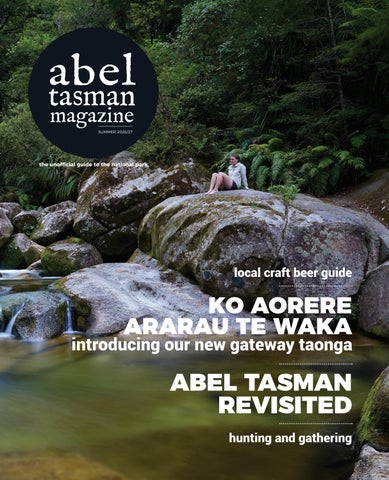
magazine SUMMER 2026/27
the unofficial guide to the national park
local craft beer guide
KO AORERE ARARAU TE WAKA
introducing our new gateway taonga
ABEL TASMAN REVISITED hunting and gathering
1
The Astrolabe Roadstead.
magazine SUMMER 2026/27
CONTENTS the unofficial guide to the national park
EDITORS’ INTRODUCTION................................................................................. 2
FEATURES
ABEL TASMAN REVISITED................................................................................ 4 A LOCAL MOVEMENT GATHERING STRENGTH.................................... 10 HUNTING AND GATHERING........................................................................... 14 HAVE YOU GOT YOUR SHIT TOGETHER?.................................................18
TRAVEL
A GUIDE TO THE ABEL TASMAN FOR THE TIME-POOR....................22 OVER THE HILL, INTO THE BAY....................................................................26 OFF THE LEASH................................................................................................... 32 WHAKATŪ NELSON - LIVING BIG IN A SMALL CITY........................... 36
FOOD
MY FAVOURITE NELSON/TASMAN CRAFT BEERS.............................. 44 LOCAL RECIPES................................................................................................... 48
ART & ENTERTAINMENT
KO AORERE ARARAU TE WAKA................................................................. 52 A LITTLE GALLERY WITH A BIG LOCAL STORY.................................... 58 ON THE TRAIL OF MURDERERS...................................................................60 HURIAWA: KAITIAKI O NGĀ PUNA WAI O WAIKOROPŪPŪ........... 64 BIRD OF THE MOMENT: TUI........................................................................... 66 QUIZ PAGE............................................................................................................. 67
INFORMATION
PACKING LIST AND MAP................................................................................. 68
Photography credits: Lightstyle Photography, Brodie Knox, Simon Wilson, Sarah Burton, Eskil Frøding, Nelson Provincial Museum Pupuri Taonga o Te Taiao, Make/Shift Spaces, Brendan Alborn, Johny O’Donnell, Jade Alborn, Neat Places, nelsontasman.nz, Tim Cuff Photography, Rachael Brown Photography Design and artwork: Mat Tait mattait@mattait.com. Contributors: Johny O’Donnell, Brendan Alborn, Glen Stringer, Jade Alborn, Eskil Frøding, Tom Collins, Mark Alderson, Sally Kidson. Produced and published by: Alborn Enterprises Ltd, 8 Franklin Street, Mārahau 7197, RD2 Motueka, New Zealand. Email: feedback@ abeltasman.com Tel: 03 527 8559. For more local insights and stories, as well as digital editions of this magazine, head to abeltasman.com
1
EDITORS’ INTRODUCTION Writing this editorial each year prompts me to review the year that has been, and that always causes me to pause for a moment of reflection. I am not somebody who thinks too much about the past and instead, find myself constantly planning for what comes next. As soon as a task is done, I’m straight on to the next thing, so a moment of reflection is a good thing.
T
he most significant project for our business over the past year has been the opening of the newly expanded and refurbished Abel Tasman Centre, our booking office, general store, gift shop and holiday park office on the Mārahau waterfront. This is usually where customers have their first in-person interaction with our business, so it made sense to do everything possible to make that experience as positive as possible. The positive feedback we have received on an almost daily basis from visitors and locals has exceeded my wildest expectations. This has only added fuel to my desire to do this type of renovation and transformation project, particularly as I forget how much work was involved almost from the moment each one is finished. As a result, I now find myself deep in another refurbishment project, this time involving our cafe, Hooked, located in the same building as the Abel Tasman Centre. Although my original intent was to give Hooked a bit of a refresh and perhaps some new paint, the scope of the project quickly expanded. As these things tend to go, once you start one aspect of a project, it makes sense to rip things apart and do them properly. By the time you’re reading this magazine, the new Hooked will be open and that project will be another one with a tick in the ‘done’ box. A project that won’t be as quick to tick off is our plan for the 6.5-hectare site that begins at the end of Newhaven Crescent. We’re hoping to develop that land into a mix of visitor and seasonal accommodation, commercial storage and a wellness centre. Planning for this project started more than two years ago, but we are only now getting to the stage where the concept has solidified enough for us to begin engaging with the Mārahau community and other stakeholders. The complexity, time and cost of the analysis required from a large team of expert consultants to establish whether this development is even feasible has come as somewhat of an unwelcome surprise to me. So it was more than a
2
small relief to receive advice that there are no physical, geographical or technical reasons we can’t develop the land as we intend to. While there are no certainties with these things, I am hoping other stakeholders feel as positively about the impact of the development on the community as I do. Only time will tell. To me, none of these projects are really about bricks and mortar. Instead, they are entirely about improving the experience our customers have with our business. I am obsessed with providing a truly incredible and thrilling experience for every person who chooses to interact with our businesses. Whenever I start to wonder if I’m obsessing too much about new projects and implementing new ideas, I like to recall something my late father, Peter, often said to me: “In business, if you’re not moving forward, then you’re going backwards.”
Brendan Alborn Owner Operator Alborn Enterprises Ltd.
Kia ora tātou! We are lucky. Every year we get to pack these pages with places, people and stories we love. Clever people contribute photographs and stories that become a wealth of local insight, in the form of the Abel Tasman Magazine.
T
he amazing Mat Tait gives every edition his design and illustrative edge, providing its unmistakable character and visual distinctiveness. And most importantly, Brendan and I get to live out our own dreams of being magazine editors when we grow up. Seven editions in and I’m pleased to report that the joy of co-producing this magazine has not worn off. If anything, I feel increasingly grateful that we get to keep doing it. Brendan and the Alborn whānau make the generous decision to keep investing in making it happen, season after season. She lives a great life, this magazine. She resides on coffee tables and in baches. She’s perched proudly on café counters. She effortlessly outperforms her colleagues in waiting rooms. She can sit quietly beside a half-finished flat white or keep a cold beer company in the afternoon sun. I get the impression people love her as we do. And that’s what makes it all worth doing, season after season. This year’s edition takes us from the Abel Tasman into Nelson, Golden Bay, the high country and plenty of interesting places in between. There are stories about art, food, history, adventure, conservation, community and the people whose work gives this place its character. I’ve contributed a stroll through Nelson, a little city I have become very fond of over time. It is my entirely biased collection of places to eat, drink, wander, swim, listen to music and spend far longer than intended. Nelson has a habit of hiding some of its best work down laneways, behind modest frontages and inside old buildings, so consider it encouragement to have a proper look around.
Sally Kidson takes us into a very different part of Nelson’s history with the new A Bridge Too Far audio trail. The Maungatapu Murders remain one of the region’s most infamous stories, complete with stolen gold, suspicious townspeople, public hangings and international attention. The trail brings that history back to life along Bridge Street, with Mark Hadlow narrating the grisly proceedings. Food also returns to these pages, this time with guest recipes from two people whose cooking I rate enormously. James Rutherford from Hardy Street Eatery shares his halloumi and charred broccoli. Marianne Navon from Little Dove contributes kuku sabzi, a herby Persian dish made for sharing. A huge thank you to them both for handing over recipes from two of Nelson’s best-loved kitchens. We hope you enjoy this edition. There is something increasingly rare and a bit romantic about making a print magazine. Print requires a great deal of planning and collaboration, but seven editions in, we still believe it is worth both. We hope you do too. Seven editions. Bloody marvellous. Mauri ora!
Johny O’Donnell (JOD).
Another story particularly close to my heart profiles Aorere Ararau, the magnificent waka now suspended above the arrivals and departures hall of Nelson Airport. I was fortunate enough to be involved in the team that brought the project together and to witness the extraordinary care, skill and collaboration behind it. The finished work is beautiful, ambitious and deeply grounded in the stories and identity of this place and its people. I am enormously proud to share its story in this edition.
3
FEATURE
ABEL TASMAN
REVISITED Words and photography: Eskil Frøding
Thirty-five years ago, I had caught only a fleeting glimpse of the Abel Tasman National Park. In December 2026, however, I returned to experience the landscape that had lingered in my memory since my first youthful encounter with New Zealand all of those years ago.
Natural water slide, Cleopatra’s Pool.
4
I
n 1991 I travelled from Denmark to New Zealand carrying hiking boots, a backpack, and an openness to whatever lay ahead. I was 19 years old. After a few months working on a sheep farm in the North Island, I crossed by ferry to the South Island, drawn by stories of its vast and dramatic landscapes. The Abel Tasman became my first encounter with the island’s scenery. A boat dropped me on a white sand beach in the southern part of the park, almost unreal in its beauty, and later that same day I walked back through the fern forest to my car in Mārahau. It was enough to lodge itself in my memory, but not enough to satisfy my curiosity. This time would be different. This time, I intended to slow down, and to finally experience the Abel Tasman in its full length and depth. An Abel Tasman AquaTaxi put me ashore at Tōtaranui in the northern part of the park, from where I would hike for four days through native forest and along pristine golden-sand beaches. I was on a photographic mission and had borrowed a tent and camping gear from a good friend. The evening before, we went through the equipment, and I suggested we try pitching the tent as I had very little experience as a camper. He looked at me, puzzled, and declined. It was, he said, “a piece of cake” and “very easy.” After the first day’s hike, I arrived at the campsite in Awaroa Bay. It was low tide, making it easy to take a shortcut across the estuary. I was among the first to arrive and could choose my spot freely. As I unpacked my backpack, I was soon surrounded by a couple of weka who resembled small dinosaurs more than birds, and were entirely lacking in personal boundaries. While I wrestled with tent poles, guyropes and pegs that made no sense to me whatsoever, and were in no way, “a piece of cake”, to assemble the weka crept closer. In the middle of my muttered curses, I heard pecking sounds coming from my backpack. The weka had (cont’d)
5
me, it took seven. I was in no hurry and constantly stopped to explore interesting details and motifs in the landscape. I don’t want to miss a thing, so I followed a simple rule: I take every side trail that presents itself, as long as it is less than a 30-minute detour from the main route, hence my slow progress.
Above: Abel Tasman AquaTaxi, Bark Bay.
discovered my freeze-dried meals and were already hard at work puncturing the packets. I dropped everything and rushed over, trying to scare them off with shouts and wild gestures. I thought I did rather well, but the birds were unimpressed. They barely moved, simply staring back at me with an expression that showed no trace of fear. These were such disrespectful birds. For the next half hour, I ran back and forth between a hopelessly complicated tent project and a group of stubborn birds I was trying to protect my dinner from. The tent eventually went up, although in a somewhat improvised fashion, and as the campsite gradually filled with taut canvas and perfectly tensioned guyropes, my own construction looked increasingly pathetic. The following nights would be much better. I eventually managed to pitch the tent reasonably well, and when the wind picked up on the third day, it stood firm and secure. But with the tent finally up on day one, dinner had to be prepared before I set out with my camera to explore the area in the soft evening light. I boiled water on my small gascooker, and just as I was about to pour it into the pouch of freeze-dried noodles, I noticed the holes left by the weka’s beaks. I cursed the birds once more for taking advantage of an inexperienced camper. Instead, I poured the dry food into a cup and added the water. I stirred the mixture for 30 seconds and waited 10 minutes - exactly as stated on the now-perforated instructions - and dinner was ready. The meal was well-earned, and surprisingly tasty. Then it was off on my photography mission before the sun dipped below the horizon, before I finally crawled into my sleeping bag. Day 2: Ancient forest, tides, and untouched beaches From Awaroa, my journey continued the next morning to Bark Bay along a well-marked trail through dense undergrowth of mānuka trees and tree ferns, giving the landscape an almost subtropical character. The walk is estimated to take around four hours for an average hiker. For
6
When I arrived at Bark Bay I stumbled across one of the most beautiful places I have ever visited in my life. The bay unfolds with soft, golden sand, crystal-clear turquoise water, and a perfect semicircle of forest-covered hills. The contrast between the dense, green ancient forest and the vivid colours of the sea is both calming and breathtaking, especially in the early morning light or late in the day.
T
he bay unfolds with soft, golden sand, crystal-clear turquoise water, and a perfect semicircle of forest-covered hills. My pack on the hike to Bark Bay contained nothing more than my camera bag. Abel Tasman AquaTaxi, who transported me into the park, offers an invaluable service they call a bag transfer for people travelling on their water taxis. In practice, this means leaving your bag with clothing, food, and camping gear at an agreed spot on the beach where you have been staying. They then collect the bag and deliver it to your next campsite. This allows you to hike unencumbered and move more freely through the national park, a service I can highly recommend. At Bark Bay I had pitched my tent about 50 metres from the shoreline, safely above the high-water mark. From the tent, I could look out across the bay and its turquoise-green waters, while the trees above provided welcome shade from the sun. Birdlife was everywhere, and at dusk and again at dawn, the gentle lap of the waves blended with a birdsong chorus from another world. I could not recognise a single phrase from the familiar repertoire of Danish songbirds. It was deeply impressive, and the sheer volume of birdsong was astonishing. I don’t know exactly why they sing so loudly, but perhaps it has something to do with communicating across greater distances in more rugged terrain. Perhaps they are voices evolved for something closer to a stadium concert. The tūī, in particular, has a distinctive and remarkably varied vocal range, often sounding like a medley of borrowed melodies. It is an exceptional mimic, capable of imitating
other songbirds with ease. Then there is the kākā, New Zealand’s native forest parrot, whose harsh calls can dominate the soundscape. In Bark Bay, the species had nearly disappeared until it was reintroduced a few years ago. Today, kākā are breeding in the area and are slowly reclaiming their natural place in the forest.
over my gear for the next transfer to Anchorage Bay. By nine o’clock, I was back on the trail.
Tired and richly nourished by the day’s experiences in nature, I crawled into my sleeping bag. After listening to and admiring the evening concert from the treetops, I reached for my earplugs and drifted off to sleep.
The hike continued along the coastal route, and I stuck to my detour-first philosophy, a choice I would not come to regret. Before long, I was joined by fellow hikers from England and Germany, both travelling New Zealand by campervan, one for three months, the other for a full year. As a solo traveller, company is always welcome, and as we walked and chatted about this and that, my eyes were constantly scanning the landscape for potential motifs.
Day 3. A World-Class Detour When you don’t plan too much and allow experiences to unfold on a whim, they often feel more genuine. Perhaps because there are no expectations, you simply take things as they come. One such detour on the third day turned out to be truly unforgettable.
The terrain offered steady climbs and descents, encounters with trickling waterfalls, weka foraging on the forest floor, and raucous birds blasting sound from the treetops. The sky was blue, the trails dry and easy to walk, and now and then the route led across suspension bridges spanning deep gorges in the landscape.
It was seven in the morning. A few pieces of bread with peanut butter were pulled from my backpack while the coffee water boiled on the gascooker. Breakfast was enjoyed sitting on a tree stump with my gaze fixed on the crystal-clear waters of Bark Bay. I packed up camp and handed
We reached Torrent Bay later in the morning, having timed the tide to perfection. The water was low enough for us to cross the estuary, sparing ourselves the detour inland. Shortly after reaching the southern side of the estuary, a sign appeared pointing to a detour to Cleopatra’s Pool.
Easy walking on the Abel Tasman track.
7
A handful of other hikers as well as a few families with young children were already at Cleopatra’s Pool when I arrived, where small natural swimming holes provided the perfect setting for a well-earned break. My fellow hikers settled down for lunch on a rock beside the rushing river, while I began exploring the area in search of interesting compositions. Not long afterwards, I said goodbye to my companions as they needed to push on because a long hike still lay ahead of them, leading back to their campervans on the edge of the national park. I stayed on for a couple of hours in this magical place, which reminded me strongly of a river in a tropical rainforest. The water was cold, but on a warm summer day a dip in the river is exactly what most people need. In one spot, the water rushed down a naturally sculpted rock chute, serving as a makeshift waterslide for the swimmers. In the gently flowing river, sore feet were soothed and sweaty bodies cooled. After a couple of hours by the river, photographing and unwinding, I set off in the late afternoon toward the campsite in Anchorage Bay. My legs were in surprisingly good shape, but the blisters on the soles of my feet were becoming increasingly hard to ignore.
My third day of hiking had come to an end. It was time for a simple dinner, some much-needed foot care, and a quick wash in the clear waters of the bay before switching off the headlamp and letting darkness settle inside the tent. Day Four: Departures and Final Thoughts The final stage of my trip began early. Supplies were running low, and fatigue had set in, but progress continued south toward Mārahau. The landscape gradually opened, trails widened, and the number of day visitors increased. Blackened tree trunks seen along the route were not signs of fire damage but the result of dark lichens growing in the coastal climate, an indicator of ecological stability rather than decline.
A
s evening settled in, the wind gradually eased, and the soft light of dusk spread a calm, golden glow across the bay. My walking pace slowed as breaks became more frequent. After nearly eight hours on the trail, I reached Mārahau and stopped at Hooked on the waterfront. Covered in dust and dirt, I ordered a smash burger and a beer. An elderly couple seated nearby asked whether I had just walked through the park. I think the question was rhetorical. I reflected on how the tides in the Abel Tasman set the rhythm for both life and landscape in the national park. Along the coast, sea levels can rise and fall by around five metres between low and high tide. As a result, beaches, sandbanks, and tidal lagoons may be completely submerged at high tide, only to transform into wide expanses of sand when the water recedes. This tidal dynamic plays a crucial role in planning hikes and timing the crossing of river mouths along the route through the park.
Above: Kāruhiruhi/Pied Shags.
When I reached my pack at the campsite in Anchorage Bay later that afternoon, the wind had picked up and was whipping the water into a frenzy, forcing both sailboats and sea kayaks to seek shelter. Once again, pitching my tent proved challenging, this time battling the strong winds, turning the task into a minor ordeal. Eventually, the tent was up, even if my late arrival left me with what was probably the most exposed spot in the camp. As evening settled in, the wind gradually eased, and the soft light of dusk spread a calm, golden glow across the bay.
8
When the tide retreats, oystercatchers, with their distinctive long orange bills, become busy diners along the shoreline. They feed primarily on small shellfish, taking full advantage of the briefly exposed coastal buffet. On my previous travels, I have visited several of New Zealand’s national parks, but the Abel Tasman stood out clearly among them. It is the country’s smallest national park, its most visited, and the only one where trails wind through dense ancient forest that merges seamlessly with exotic beaches.
T
he Abel Tasman had lingered in my memory for decades after my first brief encounter so many years ago. Despite its modest size on paper, the park certainly does not feel small. The terrain is fairly rugged, rising from sea level to just over 1,100 metres from the coast to the inland ridgelines, meaning the routes involve plenty of ascents and descents along the way. Despite the park’s popularity, I experienced no sense of crowding, and long stretches passed between encounters with other hikers on the trails. I often try to include people in my photographs, as they help convey our longing for nature while also providing a tangible sense of scale within the landscape. In the Abel Tasman, however, I frequently had to wait a long time before other visitors appeared and could naturally become part of my compositions. The Abel Tasman had lingered in my memory for decades after my first brief encounter so many years ago. Walking its length provided the context that was missing the first time.
9
FEATURE
A LOCAL MOVEMENT
GATHERING
STRENGTH
Words: Johny O’Donnell
Return readers of this magazine will be no strangers to the Mārahau Pledge. It’s an initiative we’ve shamelessly profiled in every issue of the magazine - tracking its progress from idea to reality and now to an effective and enduring model supporting the Mārahau community and environment.
10
J
ust four years since it was first established, the Pledge has moved well beyond being a promising idea. Collectively, the partners have raised over $500k in new investment for Mārahau, supporting strategic investment and community grants for the benefit of Mārahau. It is now an operational local fund, supporting worthwhile projects and ensuring that every ticketed experience from Mārahau has a direct contribution back to the village from which it operates.
They remain competitors, of course, though they’re a friendly bunch. What they agree on is that caring for Mārahau is one area where cooperation achieves far more than ten businesses acting alone. That decision sits at the heart of the Pledge. It wasn’t a programme brought in from somewhere else, or rolled out nationally with overcooked PR. It was created here, by locals, in response to the opportunities and responsibilities that come with operating in this extraordinary place.
Having been involved in shaping the Pledge, what excites me now is not simply that it exists. It is that it is working exactly as we intended - and that its potential is only beginning to emerge.
A contribution from every journey The way it works is refreshingly straightforward. Each participating activity operator contributes $1.44 whenever a visitor crosses the Mārahau foreshore. The accommodation provider contributes the same amount for every guest night. (cont’d)
The Pledge was signed in 2022 by nine activity operators and one accommodation provider. All are locally owned, collectively employ over 100 people and form a large part of the visitor sector at the southern entrance to Abel Tasman National Park.
11
A portion supports the work required for participating businesses to measure and offset their carbon emissions to become certified zero-carbon. The remainder is held by the Mārahau Environmental Trust and made available for projects that strengthen the local environment, biodiversity and community. The levy forms part of the wider Environmental Access Fee for each trip into the park. That fee also includes the concession payments made to the Department of Conservation and the voluntary donation local operators have made to the Abel Tasman Birdsong Trust since 2007. Mārahau is a small community of around 200 residents, yet it is the main southern gateway to a national park that receives roughly 250,000 visitors a year. The village carries a level of activity and infrastructure well beyond what its permanent population might suggest. The visitor sector brings jobs, income and vibrancy to the village. It also depends entirely on the health of the natural environment and the community it sits within. The Pledge brings those two things closer together and helps strengthen the connective tissue between the sector and the place. There is now a system collecting contributions from thousands of visitor journeys. There is a local trust able to direct those contributions into worthwhile projects. There are businesses cooperating around a shared purpose and a growing record of results on the ground. That creates enormous potential. As the fund grows, it can support more projects and help existing ones go further. It can provide early backing for ideas that may later attract larger investment. It can help connect groups working on related
12
challenges and give local people greater confidence that a good idea has somewhere to go. The Pledge has made dozens of grants and investments in Mārahau. Here are just a few of them: Bringing the māra back to Mārahau On customary lands in Mārahau, Mike and Toya Piggott have spent the last few years building an impressive māra (garden), in a project supported by the Pledge alongside Wakatū Incorporation. Working to a no-dig kaupapa, Mike built raised garden beds and put up a tunnel house so seedlings can be raised year-round. Old mussel floats have been repurposed into growing containers; a water system now keeps the garden alive through summer; and a compost system diverts food scraps to landfill. Mike and Toya share kai with their community, hold wānanga with whānau, and share seedlings and plants at Wakatū AGMs, as well as working with local schools to help tamariki grow their own kai. Restoring the wetlands at Otūwhero Some of the most important work happens out of sight, in the wetlands and valleys that ring the village - led by dedicated volunteers, who raise plants, run traplines and spray weeds season after season. Last season brought a bumper breeding season for mātātā (fern birds), supported by mist-netting and banding by the Nelson Ornithological Society and volunteers, along with a
rise in known whitebait spawning sites.
volunteers.
Keeping it going is relentless work - floods bury the traps in silt and wash in fresh waves of weed, from willow and gorse to old man’s beard and convolvulus that threatens to smother new plantings. Pledge grants help maintain the traplines and pay for the spraying that clears ground for each season’s planting.
The Pledge is one of the many players building on that collective momentum. It creates a dependable, locally owned stream of support around the gateway to the park. It can strengthen the wetlands, valleys, habitats and communities surrounding the park boundary. It also gives the visitor sector a clear and continuing role in protecting the place from which it draws so much value.
Joining the dots Last season the Pledge was the main funder behind the establishment of Project Kororā, standing up the work needed to knit local trapping groups between Mārahau and Tapu Bay into a collective network.
The Pledge makes it possible to do even more. And it focuses on areas that are too often overlooked.
The driver for the network was that groups had sprung up right around the southern gateway, but each was working its own patch - and pests don’t respect those boundaries. A gap in one place undoes the effort on either side of it. Kororā exists to close those gaps - to turn a scatter of individual traplines into one continuous protective halo around the southern edge of the park. Coordinated by Te Tauihu Environment Trust, the network now brings together more than a dozen trapping groups and local stakeholders. In less than one year, the network has notched up over 2,600 hours, 5,600 trap checks and 1,700 pest removals. The next chapter for restoration That cooperation is especially important as we recognise the formal conclusion of Project Janszoon after 14 years of remarkable work in Abel Tasman National Park. Since 2012, Project Janszoon has invested more than $21 million in the park and worked alongside the Department of Conservation, mana whenua, the Abel Tasman Birdsong Trust, schools, researchers, volunteers and the wider community. Its achievements are extraordinary. Kākā are breeding again and being seen along the coast. Whio, pāteke, kākāriki and toutouwai have returned to parts of the park. Wilding conifers have been brought under control, pressure from predators and browsing animals has been reduced, and more than 10,000 students have been involved in education programmes. Project Janszoon deserves enormous credit, along with Neal and Annette Plowman and the many people who have carried out the work over the past 14 years. Its formal conclusion does not mean the restoration effort is over. Under the Tomorrow Accord, the Department of Conservation will maintain agreed ecological gains, supported by the ongoing work of mana whenua, the Abel Tasman Birdsong Trust, landowners, community organisations and
Built here, for here The most encouraging thing about the Mārahau Pledge is that it feels entirely at home here. It is practical. It is locally owned. It supports people who are already doing the work. It turns thousands of small contributions into something the community can see, use and build upon. It also demonstrates that tourism and conservation do not have to sit on opposite sides of a conversation. When local businesses step up, work together and make deliberate moves, every visitor journey can help strengthen the place that made it possible. The Pledge has gone from strength to strength because the model makes sense. The money stays close to where it was generated. Local people help decide where it can make a difference. Good projects receive support, produce results and create confidence for whatever comes next. Ten local businesses began by agreeing they could achieve more together. They have since created a growing fund, backed some excellent projects and shown what a small community can do when it takes ownership of its future. The success is already visible. The potential is even greater. There is still plenty to develop, but the foundations are now firmly in place.
13
HUNTING AND
FEATURE
Words & Photography: Brendan Alborn
I seem to have a notion way back in my brain that is constantly nagging at me that I don’t spend enough time in the wilderness. After a while, it moves towards a conscious yearning until I prioritise an adventure over the many other ways I could spend my time, as well as my commitments to family, work and various other things. I have a group of mates who have the same desire to get away into the wilderness, so we inevitably get to a point where dates are decided upon, those dates are logged into our calendars and then we make them happen. We divide up the organisational tasks according to each person’s skill set and, before you know it, the wheels are in motion.
M
y assigned tasks are usually very specific, as my hunting mates tactfully exclude me from anything that requires careful analysis of topo maps or, indeed, anything that requires a good natural sense of direction. From experience, they have found that my geographical skills are so poor I would struggle to find my own butt crack in a shit storm. I once booked us into some accommodation to which I planned to drive, only to discover it was accessible only by boat. By contrast, my mate Biscuit is like a walking GPS, with the ability to point north at any given moment (even at night when it is as dark as the inside of a cow), tell you exactly which direction a barely discernible soft breeze is coming from and determine exactly where we need to position our tents for maximum sunlight at any time of the year. Back in March, a group of four of us took a helicopter to the top of a mountain on the edge of Nelson Lakes National Park, where we camped for three nights while hunting for deer. In terms of planning trips that involve helicopters, at one end of the spectrum we have Roids, who administers a spreadsheet to calculate the weight of his gear to the very gram. He does this to enable precise load calcs so we don’t exceed helicopter weight limits. The spreadsheet is so detailed it includes the weight of his undies, 13 g, now that you’ve asked, and every other shred of clothing, cooking, camping and hunting gear he is likely to need in the bush, right down to his titanium camping spork at 5 g. At the other end of the spectrum is Biscuit, who flat-out refuses to fill out any spreadsheet or do any load calcs at all. Biscuit’s
14
argument is that he uses spreadsheets every day in his work, so the last thing he wants to do in his spare time is fill out Roidy’s bloody spreadsheet. In reality, though, Biscuit simply enjoys winding Roids up. He takes any opportunity to remind Roids about the time he presented his spreadsheet to a particularly grumpy receptionist before we were due to fly into the South Westland wilderness, only to be told she wasn’t interested in it. She reiterated her point by telling Roids, who was standing there with his laptop proffered and the spreadsheet ready for her inspection, to get the hell away from her. Instead of making an effort to keep his gear to a minimum, Biscuit will bring a whole pile of gear, miscellaneous tools of questionable use and in varying states of disrepair, an old camp cooker he’s had since before he had any hairs under his arms, as well as biblical quantities of food, beer and wine of every imaginable variety from a host of regions and vintages. On this trip, Roids was concerned not only that we would exceed the helicopter’s load limit, but also about the effort required to move the metric shit tonne of gear from the landing spot to our campsite, 1 km away and 150 m lower. (cont’d)
D GATHERING
15
The banter about what we should and should not have brought was quite amusing until we had to carry everything down the hill to the campsite. That was hard enough, but we were also conscious that this all needed to be done in reverse - except uphill - in three days’ time, when we needed to get it all back to the same landing site. These reservations did fade away on the first night as we sat in our canvas mountain tent in front of the wood fire, at 2,000 metres on top of a mountain, eating pan-fried crayfish tails, drinking cold beer and enjoying a wine that paired perfectly with the crayfish. We were particularly satisfied with ourselves that first evening, having already bagged a deer. We had sat on the rim of an enormous basin, each glassing the area with our binoculars, until we spotted a yearling about 700 metres away across some not-so-gently undulating ground. While Reds and I stalked the deer, Biscuit stayed in place to keep an eye on its movements, which he could relay to us via radio. After about 20 minutes, we regained some elevation and therefore came back into the line of sight of our sentinel. We heard through our earpieces that the deer was just below us in the next small basin. We prepared our rifles and crawled to the top of the knoll. Reds spotted the
16
Above: Luxury accommodation at 2,000m.
deer moments before I did, but from my position beside him, and slightly lower down, he seemed to have his rifle sighted well above the animal. I took aim and looked back at Reds, who seemed to have a look of confusion on his face.
T
he banter about what we should and should not have brought was quite amusing until we had to carry everything down the hill to the campsite. I took the shot and hit the deer, and it was only during the debrief later that I learned he had been about to do the same. While I tried to explain that I had been confused by
the expression of confusion on his face, he quite rightly pointed out that this was his default look as he wandered through life looking and feeling confused. I apologised, but he did bag a nice hind on our final morning, so it all worked out okay in the end.
The carry is never easy.
The hunting over the following days was challenging, and the area did not contain the number of deer we had expected. We ended up shooting four between us, which we boned out ready to take home on our final afternoon. The conditions could not have been better, with the sun shining brightly each day and only a couple of periods of high winds, which should be expected on mountain tops. At one point, Biscuit and I were perched on the edge of another basin while four deer fed a bit over 400 yards below and across from us, but were only just visible above the long mountain grasses. We unleashed a volley of leadbased fury at the deer and were confident an animal had been hit. Biscuit stayed on the elevated vantage point so he could guide me by radio to where he believed the deer would have fallen. We struck a problem after I finally got down the scree slope and into the basin. I heard Biscuit’s voice over the radio, but it was as though he was speaking in a language only R2-D2 would understand. I would say, “Should I look to the left or the right?” and then he would reply with something like, “Blip, blop, beep, bop, bippy-bop.” Below: More gear than strictly necessary.
I would say, “What was that, Biscuit?” and he would respond with another string of nonsense. It turned out that earlier, in the heat of battle, he had accidentally knocked his radio into scramble mode. Our campsite had been specially selected to offer protection in windy conditions and because it was between two tarns, one of which was designated for drinking and the other for personal hygiene. However, the only personal hygiene I completed or even witnessed was the brushing of teeth and the washing of excess dirt and blood from hands and faces. Reds had blood spots all over his face after we had shot and processed the yearling on the first afternoon, but they did fade after a couple of days. As is always the case, the spectacular scenery and the time spent eating, drinking and talking around the fire with close mates were the highlights of the trip. These times are spent catching up on everybody’s news, discussing any struggles they’ve had with any aspect of our lives and engaging in a lot of good-natured banter. Each night, our bodies would remind us that we’re getting older and, as we won’t be able to do this stuff forever, we’d better organise more of these trips while we are still physically capable of covering rough, inhospitable country and carrying heavy loads on our backs.
17
ARTS & ENTERTAINMENT
HAVE YOU GOT YOUR
SHIT TOGETHER? Ten Tips to Avoid a Rookie Error. Words: Jade Alborn Illustration: Mat Tait
Coming into my sixth season working at the Abel Tasman Centre, I believe I have witnessed the full spectrum of “preparedness.”
T
o illustrate the two extremes of this sliding scale, at one end you have the guy who stumbled into the Abel Tasman Centre after walking 12 kilometres back from Anchorage and recounted his regrettable decision not to bring any food or water with him. He then asked me where he could find something to eat. I simply motioned around at the shop full of groceries he was standing in the middle of.
so you’ll need to bring your own gas cooker if you want to heat your food. Trust me, you’ll want a hot meal after a long day of walking. You can buy gas canisters, hire gas cookers and pick up snacks or cabinet food at the Abel Tasman Centre before heading into the park.
At the other end, you have my family standing in a sea of luggage, waiting to head to Torrent Bay for a week-long stay at a bach. Each bag weighs upwards of 20 kilograms, eliminating any possibility of forgotten provisions. My dad is an expert in overpacking or, as he would call it, preparedness (what level of preparation requires two guitars?) Fortunately, there is a happy medium. Here are my top ten expert tips to ensure you have your shit together before heading into the Abel Tasman.
1. What’s the Plan? Every successful adventure begins with a plan. Are you embarking on a day trip or a multi-day mission? If you’re staying overnight, have you booked your campsites or huts? Does your walk involve a tidal crossing? Do you know which direction you’re walking? Have you informed your potentially grumpy children of the length of the walk? (This may be best done once you’re already in the park.) Sorting out these logistical conundrums before you begin means you’ll be starting your Abel Tasman adventure on the right foot.
2. Have You Packed Your Kai? The Abel Tasman is a bit of a BYO situation when it comes to food. During summer, you can score a meal at Awaroa Lodge, but the rest of the track offers no such luxuries. This means you’ll need to bring enough food and snacks to last your entire day or multi-day trip. There are also no gas cooking facilities in the Abel Tasman,
18
3. Can You Drink the Water? There are taps at every campsite in the Abel Tasman, but the water supplied is untreated. The Department of Conservation recommends boiling, filtering or treating it before use. Water-treatment tablets such as Aquatabs are an easy option. If you’re spending several days in the park, make sure you have a reliable way to make the water safe to drink. If you’re only heading in for the day, I recommend bringing all the water you’ll need with you.
4. Don’t Get Cold Feet If you’re taking a water taxi during your Abel Tasman trip,
be prepared to get your feet wet. Due to the tidal nature of the coastline, walking through water can sometimes be required when getting on or off the boat. Unless you’ve mastered the skilful “jump onto the beach as the water recedes” technique (I’ve attempted this many times at the expense of my dry shoes), I recommend taking off your hiking shoes and bringing a small towel with you. Once you’re off the boat, simply find a log, dry your feet and put your shoes back on. Problem solved!
5. Slip, Slop, Slap and Wrap The New Zealand sun is a beast not to be messed with. Even on a cloudy day, you’re risking a seriously uncomfortable sunburn situation if you don’t come prepared. Sunscreen, a hat, sunglasses and a light layer to cover your arms are always a good idea. Avoid the pain and the beet-red walk of shame to purchase aloe vera.
shouldn’t bother you too much while you’re walking. I recommend regularly lathering yourself in insect repellent. Repellents containing DEET are proven to work, while some plant-based products can also be effective, you just have to find what works for you. Tragically, some of us are much more appealing to sandflies than others.
8. Weka or Kiwi? For this tip, being unprepared is less about survival and more about saving face. Before visiting the Abel Tasman or even before setting foot in New Zealand, I recommend doing a Google image search for kiwi and weka, and then comparing the two. There is nothing worse than having to gently let down an excited tourist who believes they have encountered hordes of kiwi in the park when actually they have come across the far more common and evil (in the personal opinion of the author) weka. Weka are foragers and thieves who live without fear. They will unzip bags, tear into tents and even steal phones or jewellery, all in an endless quest for food. Kiwi, on the other hand, are shyer, rounder and nocturnal. You are also extremely unlikely to encounter one in the Abel Tasman. I’ll finish with a final warning: BEWARE THE WEKA.
9. Digital Detox Phone reception is patchy at best in the Abel Tasman. You may pick up a few bars while standing on a hill, but prepare to step back in time and unplug from the digital realm. Download any maps and screenshot your campsite bookings before setting off.
6. Tidy Kiwi Make sure you pack a few rubbish bags, as there are no rubbish bins along the track. Whatever you carry in, you must carry back out. I recommend double-bagging to avoid an accidental rubbish spill inside your pack. Trust me, nothing is worse than last night’s dinner leftovers stewing in your bag.
7. The Sandfly Survival Guide The sandfly, or namu, may be New Zealand’s most feared predator. Despite their small size, these little black flies can inflict a seriously itchy bite. In the Abel Tasman, they tend to cause the most trouble while you’re sitting still on the beach. They find moving targets a little harder, so they
This digital detox may lead to some frightening situations, such as having to talk to your travel companions. If you have a high-flying corporate job, make sure that out-of-office reply is ready to go.
10. Exit Strategy Have you organised your way into or, more importantly, out of the park? It’s best to book your water taxi before setting off to avoid an unexpected stranding situation. Pop into the Abel Tasman Centre before beginning your walk to organise a water taxi to collect you at the end of your hike. Alternatively, you can take a water taxi into the park and walk back. The team can also answer any last-minute questions, ensuring you reach levels of preparation once thought impossible.
19
Tonga Island.
20
21
TRAVEL
MSK’s Half Day Blast Kayaking Trip.
22
A GUIDE TO THE ABEL
TASMAN FOR THE
TIME-POOR The Abel Tasman is as beautiful as we marketing types state in our marketing guff. The succession of crescent-shaped bays we talk about are indeed crescent-shaped, and when we talk about golden-sand beaches, that’s because the sand is indeed a shade of gold. With the Abel Tasman, you get what is written on the packet, so to speak.
O
ne of the other major reasons the Abel Tasman is Aotearoa’s most popular national park is that it is so accessible. Mārahau is only an easy drive of an hour and a bit from the centre of Nelson, and from Mārahau you’re only a walk, water taxi or kayak paddle away from the park itself. In fact, you can see a decent chunk of the southern end of the Abel Tasman from the Mārahau waterfront, including the high leading ridge and thick bush of the inland area, the coast track as far as Gilbert Point, and Fisherman and Adele Islands in the Astrolabe Roadstead. With the Abel Tasman so close and so many ways to get into the park, a day trip, or even a half-day trip, is eminently doable. MĀRAHAU TO ANCHORAGE: ONE-WAY AQUATAXI TRIP Arguably the best-value half-day or full-day trip in this entire country is the classic one-way water taxi trip to
Anchorage. For a touch over $60 per person, you start your trip by jumping onto an AquaTaxi while it is still on its trailer, coupled to a tractor. With you sitting comfortably in the water taxi, a tractor driver will take you down the road and across the foreshore to the waterline to launch the boat. At this point, the tractor driver will transform into your boat skipper, the water taxi will slide off the trailer and you’ll be launched into the sea. The first phase of the boat trip starts with a quick ride back to the south to view a local landmark, Split Apple Rock Toka Ngawhā. Here, you’ll hear the skipper’s version of the story of how this rock came to be split into two even pieces and left sitting rather nicely on its display plinth. Such stories may involve a karate chop by Chuck Norris, the rock being a prop from the set of The Lord of the Rings films, or the result of a fight between Tāne, god of the forest and birds, and Tangaroa, god of the sea. The AquaTaxi skipper will point the boat back to the (cont’d)
23
Visiting Split Apple Rock via Aqua Taxi.
north, where you will pass a succession of beaches and bays before you alight at the first major coastal access point in the Abel Tasman, Anchorage. Including the detour to Split Apple Rock and another short stop for the skipper to provide some information on the history and ecology of the park, you’ll have your feet on the sand within 45 minutes of leaving Mārahau. If you’re on the first water taxi sailing of the morning, this equates to a touchdown on the beach before 10 am. If you’ve only got half a day, depending on how fast you walk and how interested you are in stopping at any of the beaches you passed in the AquaTaxi on your way up the coast, you’ll be back in Mārahau by 1-2 pm. If you’ve got the full day, you can take the rest of the day to walk more slowly, stop more often, have a leisurely lunch break on a beach and maybe even take a refreshing swim. PITT HEAD WALK: MĀRAHAU - ANCHORAGE MĀRAHAU WATER TAXI PACKAGE Depending on how long you have available, this can be either a half-day or full-day trip. It is effectively a return water taxi trip from Mārahau to Anchorage and back again. You can book your departure and pick-up times to spend as
24
little or as much time in the park as you want. For example, if you’ve only got a short time available, you can travel north from Mārahau at 9 am, arrive at Anchorage about 45 minutes later, and book your pick-up for as early as 1 pm or as late as 4 pm. The options for spending your time range from cruisy and relaxed to more active and adventurous walks and other outdoor activities. As Anchorage is a long, sweeping bay, even at the peak of the summer season you’ll be able to find your own little stretch of beach for a picnic, a swim or even a nap on the sand. At the southern end of the beach, a track leads over a short rise to Te Pukatea, a lovely little beach fringed by native bush, about a 20-minute walk each way. From Te Pukatea, you can either walk directly back to Anchorage or complete the loop track around Pitt Head, extending the walk to a bit over an hour. This area has been one of the focal points of the wonderful Abel Tasman Birdsong Trust’s work for more than 20 years, so the birdlife is among the best in the park. The elevated views of Te Pukatea Bay, from the end of Pitt Head and from the cliffs on the northern side of the little peninsula, looking back towards Anchorage and across to Torrent Bay, are outstanding. Another more adventurous activity involves a 30-minute
walk from the northern end of Anchorage Beach around the estuary towards Torrent Bay, then along the short side track to Cleopatra’s Pool. Here, you’ll find a wonderful swimming hole in the Torrent River, complete with a naturally formed water slide. HALF-DAY BLAST: GUIDED KAYAKING TRIP The Abel Tasman is the country’s premier location for sea kayaking, and you can get a good taste of this amazing experience even if your itinerary can only accommodate a half-day. Departing at either 9 am or 11.30 am, the trip starts with a water taxi ride from Mārahau to Observation Beach, a tiny but lovely bay at the southern end of the park, in the middle of the Astrolabe Roadstead. For the next couple of hours, you’ll paddle your kayak back to Mārahau with your guide, first visiting the NZ fur seal colony at the northern end of Adele Island and then paddling past the succession of tree-fringed beaches that line the Astrolabe Roadstead. If the tide is high, you might even have time to investigate some of the caves that have formed naturally in the Separation Granite along the coastline. Below: Crossing the Torrent River.
FREEDOM ISLANDS: KAYAK RENTAL This is the second contender for the best-value full-day trip in a glorious country chock-full of awesome outdoor experiences. For around $130 per person, you get a double kayak and all the gear you need for a full-day adventure paddling around the sheltered southern end of the Abel Tasman. This includes a full briefing on how to paddle and navigate your kayak, how to stay safe on the water, and some great intel on all the best places to go. Once you’re suitably equipped, you head down onto the Mārahau foreshore and launch your kayak. Your next stop will be, well, wherever you fancy stopping. The small but picturesque Coquille Bay, the longer Apple Tree Bay with its tidal inlet, or any of the other beaches along the way that catch your eye as you paddle past. You will also have plenty of time to check out either or both of the islands, the smaller of the two being Fisherman and the larger, lumpier one being Adele Island. Adele has a wonderful little beach on its southern tip with a tropical-island vibe. On the inland side, a sand spit emerges at lower tides and makes a perfect place for a picnic. There is also a colony of NZ fur seals at the northern tip of Adele. In the afternoon, you paddle back to Mārahau, just in time for a tasty cold beverage at Hooked, the cafe right on the waterfront, from where you can see the location of your day’s adventure. This is what winning at life looks like, people!
25
TRAVEL
OVER THE HILL,
INTO THE BAY Words: Brendan Alborn, Photography: Eskil Frøding and Brendan Alborn.
In October 2025 we regained access to a family holiday house in Golden Bay. The property had been rented out to full-time tenants since early 2020, so our frequent visits to the bay during that five-year period were spent in our trusty campervan. Once we regained access to the rambling, spacious and secluded waterfront property, we pretty much moved into the place for most of last summer. During this extended period and our many weekend visits over the winter, I began to feel less like an interloper from over the hill. We had spent a lot of time at the bach before it was rented out, so we had a good idea of what we had been missing. When it became available to the family again, I was so excited I almost passed out. There is nothing that makes me feel more appreciative than getting a precious thing back that once seemed lost.
Wharariki Beach, Mohua Golden Bay.
26
E
electricians, builders, arborists, gardeners and our neighbours.
More recently, however, I have made something of a psychological switch, engaging with the local community at a level I had not previously, even as a frequent visitor. I have suddenly needed to work out where to get a chainsaw repaired (at the motorbike shop) and have had dealings with internet installers, plumbers,
Meeting a bunch of new people has reminded me just how diverse the Golden Bay community is. Like the rest of the Nelson-Tasman District, Golden Bay is a place where many people consciously choose to locate themselves. Like many others in this district, I have been fortunate enough to see and experience most of the regions in this country, as well as spending many years living overseas in far-flung places. Moving to this district was therefore an informed decision, rather than something that happened by default. When we finally moved back here from overseas at the end of 2010, I was thrilled to find the district brimming with people who had also decided this was a great place to live: people with backgrounds and experiences similar to my own who seem to share a similar ethos and attitude to the universe.
ven after having visited the place as a child and having explored the place more intensely as an adult, I still find the diversity of Golden Bay’s unique small communities, locations, outstanding geographical features and vastly different landscapes particularly thrilling and enduringly surprising.
I would be prepared to wager that Golden Bay has the highest concentration of campervans and house trucks in the world featuring dreamcatcher (cont’d)
27
hangings and similar adornments. It also has a core of multigenerational residents who have been there since their ancestors arrived by waka or sailing vessel. It makes for a fascinating mix of people who, at one end of the spectrum, don’t seem to own even a single pair of shoes and, at the other end of our imaginary shoe-owner’s spectrum, own only two types of footwear: jandals and gumboots. There’s also an eclectic mix of immigrants from around the globe who have moved to Golden Bay because it reminds them of other places and sweeter bygone eras, such as California in the 1970s. Last winter, I saw a post on social media asking whether there would be any drumming events for the upcoming full moon, something I didn’t even know was a thing. Later that same night, when I wandered out of the bach, I was thrilled to hear drumming and chanting. It sounded so close I thought it was emanating from our paddock, but when I wandered that way I discovered it was several hundred metres away.
L
ater that same night, when I wandered out of the bach, I was thrilled to hear drumming and chanting. So, now that I’m trying to class myself as some sort of Golden Bay semi-resident, what new things have I learnt about the place? Firstly, the Kiwi Distillery in Motupipi is a great place to hang out at any time of year. Although the distillery is worth a visit in its own right, in January 2024 it was transformed into a wonderful hospitality venue with great energy, outstanding and unique cocktails, and a tapas-based menu perfect for sharing, courtesy of the Cheeky Goat, an outdoor food cart located on-site. They run a packed schedule of organised events, with DJs, tasting menus, special cocktails and other reasons to call in, although any time is a good time for a visit. Further down the road in Pōhara is Molly B’s, another great place for a drink with a casual, beachy, summery vibe. With a selection of craft beers on tap, the place is positively humming when the sun is out and a live cover band
28
or solo performer is playing tunes. Molly B’s is also open during the winter months, with regular specials and events, including televising major sporting events. I’ve also discovered two outstanding sources of fully fledged farm-to-fork meat and smallgoods that taste so different from the stuff you can buy in any supermarket they may as well be from another planet. The Butcheress is a store located in the main street of Tākaka, where you’ll find amazing meat products, excellent sausages, other smallgoods and locally produced deli items, all sourced directly from local farms and producers. Motupipi’s Ellis Farms sells its own born-and-raised beef directly to the public. These products are so good it is hard to imagine anything better being available anywhere else in the world, or, if there is, I haven’t tasted it yet. As well as being
available from the farm itself, you’ll see their mobile cart at places such as the Saturday market in Tākaka, the Sunday market in Motueka and the car park beside the Telegraph Hotel, opposite Bacca Bakery. Bacca is another place to get exceptional artisan food. We discovered Bacca’s amazing sourdough bread many years ago when it was based in Onekakā, so seeing the business grow and its product range expand has been a wonder to witness. Most of my Saturday mornings in the bay begin with the short drive into town to pick up a loaf of sourdough, a couple of bagels and, most likely, a selection of pastries, with a feijoa-featured sweet treat being a personal favourite.
Above: Bacca Bakery, Takaka.
If I’m in the mood for a day trip a bit further afield from the ranch at Rototai, I’ll head north, further around the bay towards the more remote areas around Farewell Spit.
B
acca is another place to get exceptional artisan food.
Below: the Cheeky Goat food cart, Takaka.
At the northernmost end of the bay, Wharariki gets a surprisingly high number of visitors. I’m not sure whether it was already a popular destination before it was featured as a default screensaver for Microsoft Windows 10, but it certainly is now. I’m not sure why, but the walk from the car park across the farmland and down to the beach is always further than I remember. The long, sweeping beach is majestic and dramatic in any conditions, which is just as well because it is more often than not buffeted by high winds. The rocky outcrops, caves and huge expanses of sand dunes give the whole place an ethereal feeling of remote beauty and isolation, and a strong wind only adds to the vibe. For me, it looks and feels like the set of Dune as depicted in Denis Villeneuve’s recent films.
29
On the way back from Wharariki, it is customary to call into Collingwood for a bite or a tasty beverage. The Courthouse Cafe always has excellent coffee, decent food and the added bonus of being home to Sue Dasler’s wonderful pottery studio. The Collingwood Tavern, or Tinky’s, has an excellent
outdoor area right beside the sea for a pint in the sun or a traditional Kiwi pub meal. Just along the road in Onekakā is the Mussel Inn, and if you simply drive past this icon without calling in, you really should reassess your priorities and promise yourself to try harder in the future.
A
dventurous types swim across the river, climb the rock faces and jump into the deep pools below... They brew their own beers, ales, ciders and soft drinks. These are unique, handmade craft brews featuring local honey and other products. There is Left: The a genuine adventure to be had while Langford Store’s sampling these offerings, so if you’re not charming interior. up for a bit of mystery, perhaps stick to
30
drinking your commercial beer back at Tinky’s. A drive to Langford Store and Salisbury Falls, about 20 minutes from Collingwood, is another favourite day trip. I often mistakenly refer to this local icon as the Bainham Below: Rawhiti Cave.
Store because it is located in that tiny, blink-and-you’llmiss-it settlement. This charming general store and historic post office has been around since 1928 and is now a fantastic place to pick up a locally made Kiwiana gift item or a classic Kiwi antique. If we’re there in summer we will have a hot drink and a scone with whipped cream and berry jam before driving the short distance to the Aorere River for a swim at Salisbury Falls. Adventurous types swim across the river, climb the rock faces and jump into the deep pools below, but I tend to swim for a bit and then spend my time trying to skim the abundant flat pebbles across the river in an attempt to reach the opposite side. Golden Bay is overly blessed with places to visit and things to do, many of them free: swimming holes such as Paines Ford; walks to Wainui Falls, Te Waikoropupū Springs or the Pupū Hydro Walkway further up the same valley; the Grove; and Rawhiti Cave in the Clifton/ Motupipi area. The list goes on and on, and I love the sense of places, people and scenes as yet undiscovered.
31
OFF THE
TRAVEL
LEASH Words and Photography: Brendan Alborn.
Even though I hinted at it in this column last year, I am still disappointed to report that my running buddy for the last nine years, Maggie the Border Collie, has been forced to retire from our daily ritual. Therefore, rather than describing any new running routes, this feature is more of an ode to the high-energy, highly-strung, attention-demanding, epileptic, incontinent, food-thieving menace whose vet bills necessitated the sale of my left kidney. I will also recap what became our favourite spots over the years and will outline why we’ve returned to them regularly.
Maggie wanders the low tide, Golden Bay
32
I
t became obvious as early as January 2026 that our daily running routine for so long was coming to an end. Almost every morning would start with a run along Pōhara beach during which Maggie would lag behind after the first few kilometres. At first I thought it was just because she was too hot, insisting as she does on running in her fur coat. But even when I stopped for her to have a dip in the sea she would soon tire and begin to lag behind again. As a younger dog she could run 12 km or more and only minutes later would find her rope for a game of tug-of-war. I started doing my longer runs without her and only took her a couple of times each week for shorter distances. We’d have to stop often so she could have a rest, but leaving her behind when I headed out for a run by myself wasn’t easy either. As soon as I showed the vaguest interest in putting on my running shoes, Maggie looked at me expectantly. When I left her behind, she would stare directly into my soul with a gaze of bewilderment and disappointment. She was not a happy camper. Once, I left her in the canopy on the back of my truck before I set off for a run at Motupipi. I made sure I’d left the side windows open so the canopy had plenty of ventilation. As the openings in the canopy windows measure only 160 mm x 200 mm and are located 1.6 m off the ground, I got a hell of a fright when she ran up beside me on the trail only minutes into the run. In early April 2026 she finally succeeded in rupturing the cruciate ligament in her left hind leg. This was the final event that spelled the end of an era that started back in
early 2018 when Maggie was old enough to run with me every day. Since that time we have run roughly 14,000 km together and having Maggie accompany me has always added purpose and importance to the activity. Maggie came into my life at a time when I was struggling with some of my longstanding personal relationships, (cont’d)
33
so I particularly appreciated her companionship. Ever since my teenage years, long-distance running has been an important component of my mental wellbeing, allowing me to meditate, process my thoughts and, for at least part of each day, slow down what is a pretty frantic and overly active brain. Last December an old friend of mine, Eskil, came over from Denmark for a visit. We decided to drive down to Motueka Quay where I would go for a run while he took Maggie for a walk. I told Eskil I would run along the waterfront, he could follow behind me with Maggie on her lead, and then when I returned we would meet up. Halfway through the run I
foolishly decided not to come back the way I had come and instead to run around the estuary and meet them back at my truck. I was surprised that Eskil and Maggie were not already there to meet me and even more surprised to see how many calls I had missed from Eskil. When I called him back I learnt that he could not get Maggie to walk in any direction except for the direction in which she had seen me go, which was away from the truck. He couldn’t even drag her back by pulling on her lead so I had to drive to where they were. This is the sort of thing dog owners mean when they say their companion is loyal, and working-dog breeds such as Collies are famous for being undyingly loyal to one human, and that is their boss, end of story.
MOTUEKA WATERFRONT My go-to run with Maggie would typically start at the carpark at the end of Staples Street just outside of Motueka in the area locals call The Kumaras, or officially The Raumanuka Reserve. We’d start by heading south along the waterfront and if the tide was low enough we’d leave the track just before the golf course starts to cut across the estuary to the beach where we would run along the Motueka Sandspit. Dogs are permitted along the first few kilometres of the beach to a point that is marked with a DOC sign. The stretch of beach after that is reserved for the abundant birdlife along the spit. If the tide was high we would avoid the sandspit as there isn’t enough hard sand to run on comfortably. For me, running on soft sand turns what should be a pleasant, meditative experience into a SAS-style training exercise that I can do without. So, we’d continue past the golf course along Motueka Quay, past the old wharf to the wonderful path that runs along the waterfront parallel to Trewavas Street, past the saltwater baths and to the Talley’s factory. I would sometimes park at the southern end and run this in reverse if the wind was blowing from the north so I could run the first leg into the wind and then have the wind at my back for the return leg. I’d also run in that direction if I wanted to swim at that southern end which is a nicer spot for a dip and even has an outdoor shower to wash the salt and sand away.
34
GOLDEN BAY BEACHES My only gripe about Golden Bay, one of my favourite places in the known universe, is the distinct lack of reserves, parks or other public spaces available to exercise dogs. Even more so than in the rest of the Nelson-Tasman District, Golden Bay has had a succession of district councillors and other advocates for the banning of dogs from almost every public place. Although the reasons for these bans are purportedly for the protection of wildlife, a truly noble objective, there is little to no evidence these bans were necessary to protect our precious native birds and other critters. Some people just don’t like dogs in principle and don’t want to share their favourite public spaces with our furry friends. With Golden Bay bordered inland by Kahurangi National Park, which is also a no-go zone for dogs, we’re left with a few beaches to exercise our dogs, with many others having either time-based or permanent bans. This all means that dog owners are basically restricted to a narrow strip of coastline where they can roam freely with their K9s. My favourite stretches of beach are at Pākawau, Milnthorpe, Patons Rock and Pōhara. The latter is the closest to our family bach at Rototai and became my favourite place to run with Maggie. We would park at the Tennyson Street carpark then run along the beach towards the Motupipi River mouth until we came to the sign that designates the end of the stretch where dogs are allowed. Then on the return leg we’d often run back along the formed track starting at the golf course, through a patch of wetland and then parallel to Selwyn Street.
MOTUEKA ESTUARY WALK This is another trail that we have run hundreds of times. I typically park at the Motueka cemetery and then run around the estuary in a clockwise direction, running south along the track, down Wharf Road to the other side along Old Wharf Road, past the BMX track and back to the cemetery. I like this track because the views across the estuary are nice and it is mostly lined with trees, so it is sheltered from the wind, making it a nice, easy 5 km loop. There are a couple of sections beside the road, so I have always tried to keep Maggie close by when running along those roads, and I’ve also learnt to keep her under close control at the tidal gates on Wharf Road. Once while running past those gates I found myself thinking back to seeing a warning on social media from somebody who had watched as their dog was swept from the estuary side into the tidal gates as the tide rushed out, requiring rescuing. As Maggie and I ran towards those gates I did not register quickly enough that the water was moving swiftly through them. As she did every single time we ran past there, Maggie raced into the water for a dip, and even though she was trying to swim back to me as I called her, the strong current swept her through the culvert. Luckily the gates were open and after being swept under the water, she miraculously popped up out the other side, slightly shaken but totally unharmed and ready to continue our run. I chalked this up as her 99th near-death experience, a list that includes headbutting a moving trailer, going into anaphylactic shock after being stung in the mouth by wasps, attempting to poison herself by eating chocolate, Christmas cake and her own medication (including the foil packaging), stabbing herself in the mouth with a stick and throwing herself into other fast-flowing waterways, even as a small puppy. Thinking back, perhaps this column would have been better named The Death-Defying Adventures of Captain Chaos and His Equally Challenged Sidekick.
35
WHAKATŪ
TRAVEL
NELSON
Whakatū Nelson is a city that rewards curiosity. Spend a day here, and you might leave thinking it is pleasant enough. Stay a little longer, and the place begins to reveal itself. It does not perform for you. There is no single attraction demanding your attention. Nelson trusts you to work it out. Its character accumulates through side streets, chance encounters, old buildings with new lives and places you could easily walk past. The reward is not finding the one thing everybody talks about. It is realising how many small things quietly exceed expectation.
P
erhaps that is because Nelson has always been a city of makers. Not only artists, although there are plenty of those, but people devoted to the patient pursuit of their craft - roasters, brewers, chefs, designers, musicians, growers, boatbuilders and craftspeople. There is an uncommon respect here for the long game. Reputations are built slowly, and quality has a habit of outlasting novelty. For a city of modest proportions, it carries an outsized offering. Not because it has everything, but because it has just enough. Living and working here means constantly negotiating that threshold. Some days you become convinced the place is dying, then remember it is simply winter. Other days it feels like a bustling metropolis, before you realise there is actually just an event on. The luxury of Nelson is not an abundance of anything. It is the proximity of everything. The city fits comfortably inside
36
an ordinary afternoon. Coffee, art, a river swim, a decent feed and a hilltop view can all happen without a traffic report, a parking strategy or a packed lunch. Everything exists at a human scale - walkable, relaxed and slightly suspicious of anyone in too much of a hurry. Nelson is still discovering the boundaries of what a provincial city can be. Sometimes it falls short. Sometimes it surprises itself. More often than not, it exceeds expectation by becoming a more complete version of itself. Look twice Nelson rewards people prepared to look twice. Its best bits have a habit of hiding in the spaces between - down laneways, through arcades and behind frontages that give absolutely nothing away. Kirby Lane is the obvious place to begin, although ‘obvious’ is doing some fairly heavy lifting for a tucked-away courtyard off Bridge Street. It comes into its own at lunchtime
LIVING BIG IN A SMALL CITY
Words: Johny O’Donnell
when Victus Coffee & Eatery and the food carts draw workers, regulars and people following their noses. Mister Karaage remains a personal weakness; the black pepper karaage is one of those orders that renders the rest of the menu irrelevant. Slurp! supplies the sort of deeply comforting ramen that makes a grey day feel like a deliberate culinary condition. Below: a quiet moment for the coffee machine at Victus.
Victus is the anchor. Co-owner Nick has collected enough specialty coffee awards to make the point, but I love the fact that serious coffee lives beside gloriously unserious nostalgia - lolly cake, custard squares and the sort of cabinet treats capable of undoing your most disciplined intentions. A few doors away, Bridge Street Studios offers another reason to abandon the main route. The expanded hub now houses more than twenty makers, designers, artisans and small businesses, with Sublime Coffee roasting at its centre. Part studio, part retail lane, part gallery and part caffeinated village square, it feels alive with work. You can see people making things, talk to them about why, buy something with a story attached and drink coffee roasted within sniffing distance. That is a very Nelson combination. Bridge Street itself is in the middle of a substantial physical and psychological rebuild. Infrastructure work is rarely anyone’s idea of a good time, particularly if you are trying to operate a small business behind the road cones, but there is a growing sense of optimism about what’s emerging here as part of an upgraded streetscape and inner-city experience. (cont’d) Spread: The sun sets behind the Centre of New Zealand.
37
Elsewhere, Iko Sushi is exactly the kind of place you can miss if you are not paying attention. The salmon sashimi with miso soup is served with quiet confidence and no need for theatre. Tern Coffee House, tucked down Church Street, is another little sanctuary - calm, considered and consistently good. Taste the city Spend long enough eating your way around Nelson and another pattern emerges. This is a city with enormous respect for people who care deeply about their craft.
Marty’s Meat Burgers took the grassroots route to hospitality fame, first proving itself from a humble and overwhelmingly successful burger cart, then going all in with their own premises. The smash burgers look deceptively casual, but the process behind them is borderline obsessive. The beef is cut, dried, minced, portioned and rested over the course of a week. This is what Nelson does well - serious craft.
T
The standout café remains Hardy St Eatery, and I say that as someone who takes brunch rather too seriously. The menu changes with the seasons, the produce is treated properly, and the whole operation is just one big standing ovation. If the bacon butty with chilli jam and a fried egg sounds appealing to you, order it. It is an audible experience. Their sourdough deserves its own story. Another day, perhaps.
his is a city with enormous respect for people who care deeply about their craft.
Down by the Mahitahi River on Collingwood Street, Little Dove is easy-going and understated, but the Middle Eastern-inspired food is anything but forgettable. It is a small pocket of unassuming goodness - generous flavours,
At the other end of the evening, Bar Rosa brings beautifully executed Mediterranean sharing plates and a handsome fit-out to Hardy Street. Arden continues to be an outrageously good bar and restaurant for a city this size, partly because it refuses to sit still. Pop-up galleries, workshops,
Below: The nightlife at Kismet Whiskey and Cocktail Bar.
38
genuinely excellent food and coffee that holds its own.
collaborations, events - Arden keeps finding new reasons for people to gather. Then there are the institutions. The Indian Café in its Collingwood Street villa remains hard to beat for an excellent-value group lunch. New Asia, Salvito’s and Penguino’s belong in that dependable category of places locals return to without needing hesitation.
Above: Musicians at the Nelson Market, Montgomery Square.
and the Flavourtorium brewery operating from a shipping container. The ingredients sound slightly chaotic, and the result feels completely inevitable. More importantly, it is a true community, and we all love it passionately, as an extension of our local living room.
And Bobby Franks deserves a confession from me. Because it sits slightly outside my usual circuit, I have a habit of forgetting it exists, only to rediscover it and become evangelical all over again. If you do not understand the fuss about matcha, this place will sort you out. Pull up a seat A city is not made by its shopfronts alone. It is made by the places where people are allowed to linger. DeVille has somehow become both one of Nelson’s defining cafés and one of its defining live-music venues, without either identity appearing to trouble the other. Slow brunches and afternoon coffees simply give way to gigs and parties. Neither seems to compete with the other. The Free House is, as far as I am concerned, one of the best pubs in the country. I am happy to hear counterarguments, although I am unlikely to change my mind. An old church, a garden, a rotating line-up of independent beer
Above: Sampling the local goods at the Nelson Market.
When the night calls for one more, Kismet Whisky and Cocktail Bar is dangerously easy to disappear into. The whisky collection is extraordinary, the people behind the bar know exactly what they are doing and leaving at the
39
art, culture and memory. The Nelson Provincial Museum is the place to begin if you want to understand how this region came to be what it is. The Suter Art Gallery Te Aratoi o Whakatū pairs the work of artists from this place with a thoughtful programme of exhibitions from elsewhere. The Nelson Centre of Musical Arts has acoustics and a programme worthy of a much larger city, while the Theatre Royal remains one of our enduring cultural anchors. More quietly remarkable is Cultural Conversations, a community arts hub built with former refugee and migrant communities around music, art, storytelling and enterprise. Its retail work is beautiful, but the deeper offering is connection and a place where people can share culture on their own terms. Step outside For a city, Nelson wears its wildness and natural features remarkably close to the surface. The walk up Botanical Hill to the Centre of New Zealand is the classic reset. Walk it, run it, drag the kids up it, then stand at the top and look across Te Tai o Aorere. The marker is not, despite generations of enthusiastic interpretation, the geographical centre of the country. Fortunately, the view is real enough. Above: Waterfall at Brook Waimārama Sanctuary.
sensible time requires a level of personal strength I do not always possess. For more than forty years, the Nelson Market in Montgomery Square has been the city’s great weekly ritual - growers, bakers, makers, foodies, buskers, dogs and half the people you meant to text back. An unhurried Saturday morning there will tell you more about Nelson than most brochures could manage. Follow the story Nelson has always thought of itself as a city of makers, and nowhere is that clearer than in the spaces it keeps for
40
Only minutes from town, the Brook Waimārama Sanctuary feels improbably remote. The pest-proof fence encloses a recovering world of native forest and birdsong, offering not simply a pleasant walk but a glimpse of what sustained restoration can return to a place, not least of all - the brown spotted kiwi! At Tāhunanui, the city relaxes into the sea. F&C from Fishy Business on Roto Street, eaten on the beach while the sun sets, is a perfect evening. No booking required. No dress code. Yet the finest of dining. Running through the middle of the city and still somehow hidden in plain sight is the Maitai River. It boasts an
Above: Cycling the Mahitahi (Maitai) River trail.
accessible path, swimming holes upstream and a ribbon of green that stitches the city to the hills. Most cities would make a tremendous fuss about a river like this, but it comes naturally to Nelson.
F
or a city, Nelson wears its wildness and natural features remarkably close to the surface. Down on the waterfront, the Boathouse remains one of the city’s loveliest places to hear music, standing out over the water as the tide moves underneath. Nearby, a feed at Styx comes with the sort of outlook that makes you wonder
why you do not come down here more often. Take your time There is no definitive guide to Nelson. Ask five locals where to eat, drink or spend an afternoon, and you will get seven answers, three disagreements and at least one place somebody refuses to tell you about because it is already busy enough. That is the point. The best version of Nelson is not a checklist. It is a rhythm. Start with coffee. Follow a laneway. Talk to the person making the thing. Order the dish they are proudest of. Leave enough room in the day for the river, the hill or the sea. Stay when the music starts. Soon enough, you will discover that Nelson does not rush. Its slowness can be alarming at first, then disarming, and eventually deeply endearing. Stop resisting it. Look twice. The city has been here all along, waiting for you to notice.
41
42
Onetahuti Beach.
43
FOOD
MY FAVOURITE NELSON/TASMAN
CRAFT
BEERS Words and Photography: Brendan Alborn.
There may well be other regions around Aotearoa that would attempt to bill themselves as the craft beer capitals of the country. I wouldn’t even trouble myself with the debate. For anybody who wants to question my region’s claim to this title, I would simply point to the hops growing over the fence from my home in Riwaka. If the upstart claiming craft beer supremacy was left in any doubt, I would offer them a ride during late summer down the Motueka Valley, through Tapawera and all the way to the Matakitaki, just north of Murchison.
I
would challenge them to count the rows of hops. I would insist the car windows were down so they could smell the hoppy goodness in the wind. They would weep and admit defeat, but I would make it up to them with a tour of the amazing taprooms, microbreweries and pubs serving the outstanding beers produced right here in Te Tauihu. Over the past few years, I have taken up brewing my own beer and, after a rocky start, I’ve learnt a lot about what is
44
required to make beer that tastes good. I can tell you honestly that my homebrew is nothing (nothing, I tell you!) like the turgid, murky, musty swill that passed for homebrew back in the 1980s and 1990s.
My first experience with anything that could be classed as craft beer was Mac’s Gold and Black Macs while at university in Palmerston North in the late 1980s.
L
ike any Kiwi beer drinker over the age of about 40, I remember the dark ages of New Zealand beer.
Above: Fresh local hops.
Like any Kiwi beer drinker over the age of about 40, I remember the dark ages of New Zealand beer. These were the days when everybody had their local favourite: Lion Red in Auckland, Waikato Draught in and around the Tron, Tui in the middle of the North Island, Canterbury Draught and Speight’s in the South Island, with a smattering of national brands distributed by DB and Lion. Over time, it became public knowledge that, if these brews weren’t absolutely identical, they were at least closely related.
When I shifted south to Dunedin, I discovered Otago Strong. The advantage of drinking stout, which I only did while attending gigs, was that I could only possibly drink one or two pints of the stuff, and that was all I had the money for anyway. Roughly midway through that second pint, I would find myself feeling a bit bloated, and any further drinking was to put myself at even greater risk of waking later in the night to an eruption of flatulence that would singe my nose hairs. It was safe to say my girlfriend at the time wasn’t keen on stout, or more specifically, the results of me drinking the stuff. Anyway, while that may have put you off beer entirely, my picks from the plethora of local craft beers are below. (cont’d)
45
On the Lighter Side During summer, after either a hard day of work sitting at my desk or, more to the point, some physical exercise, I will reach for a pilsner or a crisp lager. Hop Federation was one of the first craft breweries in this area to propel the quality of our local beers into the stratosphere. The Hop Federation Pilsner was one of those initial offerings and has stood the test of time, as have its Lager and Pale Ale. I’m also partial to the Body Czech Pilsner from Golden Bear, particularly when the sun is shining and there is a band playing at its venue on the Māpua wharf. Sprig & Fern’s O.G. Pilsner is also crisp and tasty, taking another spot in this category of lighter, more refreshing brews.
What Ales You, Boy? Pale ale is my favourite style of beer. If I’m stranded on a tropical island, I’ll be taking Aliment Brewing’s Bathgate Pale Ale with me. (Just in case you were wondering, my
46
tropical island of choice would be Adele Island in the Astrolabe Roadstead, so I could get a ride back to Mārahau on an AquaTaxi when the beer runs out.) A recent and rather welcome addition to the local beer scene, Riwaka-based Aliment Brewing’s pale ale was my very first pick when deciding which beer we would have on tap at Hooked, our cafe in Mārahau. My second favourite is Townend’s Aotearoa Pale Ale, followed closely by Sprig & Fern’s Nectron Pale Ale. These brews are perfection in a glass: crisp, but with a perfect balance of hoppiness.
Still a bit hazy? A mate of mine reckons that unfiltered beer is an abomination that should be relegated to the past from whence it came. He would tell you beer was originally brewed by ancient monks and it was hazy, murky and probably had lumps in it. Then Freddie Heineken finally worked out how to brew clear, filtered and consistent beer. He would say this is perfect beer, and you
fully and tastes even better, particularly during winter with the fire roaring. Onekakā-based Mussel Inn’s Captain Cooker, a mānuka-tip-infused beer, will reward the adventurous with a unique flavour all of its own. Almost every craft brewery in the district will brew up a limited edition, fresh-hop seasonal brew in late summer and early autumn, shortly after the hop harvest. Fresh hopped beer is a thing of natural wonder and beauty to me, tasting unlike anything else. The fresh pilsners are my favourites, with the Hop Federation and Sprig & Fern versions usually vying for top place each year. It’s just a pity the brews are different every year, so I have to trouble myself with retrying all of them again to decide if I have a new favourite. It’s a dirty job but one that I will begrudgingly take on. You’re welcome.
Above: A selection of local favourites.
shouldn’t be mucking around with something that is already perfect. In fact, any beer with even a hint of hoppiness makes him angry. Hoppiness does not lead to happiness for my mate, only anger and an urge to throw me and the hoppy beer I have brewed out of his man cave. After going through something of a hazy beer phase over the past few years, I have toned things down a bit on my own haziness scale. As such, Aliment’s Cloud Busting Unfiltered Pale has become my new favourite. Eddyline’s Sippin’ on Sunshine Hazy Pale Ale is another beer to make it through my cull of hazy beers, and I’m still partial to Hop Federation’s Fields of Green Hazy IPA when the mood is right.
And Now for Something Completely Different... Townend’s Extra Special Bitter is an English-style, malty ale that pours wonder-
Right: The hop gardens are where the magic begins.
47
FOOD
LOCAL CHEFS
LOCAL RECIPES Words: Johny O’Donnell, James Rutherford, & Marianne Navon.
We’re pretty spoilt around here. Our region is home to passionate, clever and downright talented chefs, with an abundance of good local produce to keep them inspired. For this edition, we asked two chefs we admire to share a favourite dish from their kitchens. Fortunately for us, they said yes.
At Hardy St Eatery, chef and owner James Rutherford is known for seasonal produce, bold flavours and the kind of generous, unfussy food that keeps people coming back. He shares one of the eatery’s menu staples: fried halloumi with charred broccoli, preserved lemon, garlic, chilli and almonds. Over at Little Dove, co-owner Marianne Navon brings the flavours of the eastern Mediterranean and the Levant to a soulful, predominantly plant-based menu. Her KuKu Sabzi is a vibrant Iranian omelette packed with fresh herbs, spinach, walnuts, spices and tart barberries. Two distinctive chefs, two much-loved Nelson kitchens and two recipes, generously shared for you to have a crack at at home. Hardy St Eatery Halloumi with charred broccoli, preserved lemon, garlic, chilli and almonds
T
his is a Hardy St Eatery classic, with the technique for frying the halloumi coming from my days at Nikau café working under the amazing and talented Kelda Hains. Halloumi – 100 gm per person. Now not all halloumi is made equal. For me a good salt content is a must with a melting point on the inside. Let’s think less squeaky cheese and more crispy on the outside and delightfully soft in the centre. A great New Zealand product is Zany Zeus which you can pick up at a number of supermarkets. We like to fry in a neutral oil at medium temp. Portion your halloumi into generous 100gm pieces, give them a good toss in flour and fry until golden. Now the most important part is to hurry the halloumi to the table promptly to enjoy that soft centre. There is no time for last minute top ups of vino here. Time is of the essence
For the salad we like to have a dressing of the preserved lemon, chilli and garlic made up. This is a great asset to any fridge. Slice 6 cloves of garlic as thin as possible and fry slowly in a good glug of olive oil. Once a jammy sweet consistency remove it from the heat and add the chopped flesh of 1 preserved lemon and a pinch of chilli flakes.
Little Dove KuKu Sabzi Iranian Omelette
K
uKu Sabzi is a traditional Iranian omelette packed with herbs, spinach, walnuts and spices. Our version is a variation of the traditional dish, created as individual omelettes. These are wonderful served with thick yoghurt and toasted bread. Iranians love their food tangy, barberries are tart little dried fruits that are tangy and fruity. Use them sparingly if tang isn’t your thing, but they add a beautiful lift to this dish. Makes two Omelettes Ingredients: • 200 grams of fresh spinach leaves, thinly chopped • a few sprigs each of your favourite fresh herbs like dill, chervil, parsley and coriander, mint, finely chopped • 2-3 spring onions, sliced thinly • 2 tbsps chopped walnuts • 2 teaspoons of dried barberries or small unsweetened black currants • KuKu spice mix (can be stored in a small jar for future use) • 1 tbsp allspice • 3/4 tbsp turmeric • 1 tsp paprika • 1/2 tsp black pepper • 1/2 tsp cinnamon • 1/4 tsp nutmeg • 2 tbsps vegetable oil • Thick yoghurt Preheat your oven or a toaster oven to 180°C. Mix the spinach, herbs and spring onion in a large bowl and set aside. In each of two small bowls place: a healthy handful of the spinach mixture 1/2 teaspoon of spice a tbsp of chopped walnuts a generous pinch of barberries or minced black currants. A pinch or two of salt 2 eggs
Blanch healthy sized florets of broccoli for 2 mins in generously salted water, toss in a little olive oil and BBQ until charred. Pour over your dressing, a small handful of chopped toasted almonds and a good squeeze of lemon. All that is left to do is get your hands on a good fresh loaf of sourdough, a local chardonnay and some bloody good company. On the stove, in a small pan that is ovenproof, add a tablespoon of oil and coat the bottom well, wait for the pan to get hot.Now vigorously mix your ingredients in the bowl to aerate the mixture well then pour it into the pan of hot oil, spread evenly. Let the bottom brown for a minute then place it in the hot oven for approximately 4-5 minutes. Remove it when it is firm and golden. Loosen the bottom with a spatula and slide it onto your plate. Serve with a generous dollop of thick plain yoghurt and bread of your choice.
The march of the Oyster Catcher.
50
51
ARTS & ENTERTAINMENT
KO AORERE
ARARAU TE WAKA
Introducing our new Gateway Taonga. Words: Johny O’Donnell. Photography: Simon Wilson and Sarah Burton.
52
Airports occupy a curious place in our lives. We pass through them without thinking too much about them, yet they are among the most significant civic spaces we experience. They are places of transition, anticipation and return. Places where one chapter ends and another begins. In many ways, they are the hinge between local life and the wider world.
T
hey also perform another role. They introduce us to a place. Before we’ve wandered its streets, swum in its waters, or even met its people, the airport has already begun saying something about the place in which we’ve arrived. It is our first encounter with a region, and for some, our departing memory. That carries a certain responsibility. The best airports understand this. They offer a sense of arrival. They reveal something of the place, the people who belong to it, and the stories that have shaped it. They
remind you that you’ve arrived somewhere distinct, not simply another terminal in another city. Our much-loved and ever-popular regional gateway, Nelson Airport, has embraced that responsibility in a truly special and remarkable way. The next time you find yourself passing through, pause before making a beeline for the baggage or your gate. Look up. Beneath the timber ceiling of the terminal building is a waka unlike any other. Twenty-two metres in length and weighing over 1.3 tonnes, the waka – Aorere Ararau stretches the span of the arrivals and departures area, following the line of the angled ridgepole of the terminal and lifting skyward towards the runway and beyond to Te Tai o Aorere. (cont’d)
53
Aorere Ararau is suspended above the arrivals and departures area of Nelson Airport.
It is, in my admittedly biased opinion, one of the most beautiful pieces of public art in Aotearoa. Before we go any further, a declaration is probably in order. I was fortunate enough to be part of the team that brought Aorere Ararau together. That means what follows comes with a healthy dose of bias and emotional investment. I did briefly wonder whether that disqualified me from writing about it altogether. In the end, I decided the opposite. I had the privilege of watching this project take shape from its earliest conversations through to the dawn blessing. I’ve sat in the meetings, heard the deliberations, watched the process unfold and been a witness to the extraordinary care and passion that went into creating such a special taonga for our region. For generations, the stories of tangata whenua (people of the land) have been largely excluded from many of our public spaces. Visitors could arrive here, spend a week exploring the region and leave again having learnt very little about the people who have known this place longest. That absence wasn’t the result of a single decision, but a deliberate effort to suppress the presence of tangata whenua from this place. When our redeveloped terminal was completed back in
54
2018, local iwi leaders issued a challenge to Nelson Airport and their regional partners, that it ought to work with them on ensuring that the presence, stories and identity of tangata whenua were expressed within this place. This recognition was well overdue, and the place-inspired architecture of the terminal provided the perfect canvas for such an expression to take hold. The original conversations weren’t actually about building a waka at all. They centred on the idea of a tomokanga — a spatial threshold. A tomokanga marks the transition from one space to another. It prepares you for where you are about to arrive. It tells you that you are crossing from one zone into another, complete with its own ways and protocols. The idea resonated and gave way to the concept of a waka functioning as a tomokanga. An innovative way of utilising a recognisable symbol and bestowing upon it a cultural function. It was one of those ideas that, once spoken aloud, felt strangely inevitable. In many ways, the symbolism of the waka couldn’t be more fitting. Te Tauihu takes its very name from the prow of Māui’s waka. Our histories are inseparable from the moana. The journeys of our tūpuna across Te Moana-nui-
Above: From left to right, Ben Larkin, Tyrone Ohia, Fayne Robinson, Rōpata Taylor, and Johny O’Donnell
a-Kiwa are stories of extraordinary navigation, courage and discovery. The waka is an apt expression of movement, arrival and belonging. A timeless practice of journeying that continues to this day.
I
t is, in my admittedly biased opinion, one of the most beautiful pieces of public art in Aotearoa. The name, Aorere Ararau, was gifted by Rōpata Taylor and beautifully captures that idea. It speaks of this place and of movement through it. Of skies, horizons and pathways. Of journeys that stretch from the great migrations of our ancestors through to the planes taking off today. It gently reminds us that travel has always shaped who we are.Along its length, the kōwhaiwhai designed by Fayne Robinson represents each of the eight iwi of the region, alongside motifs acknowledging manuhiri (visitors) and tauiwi (those who have also made this place home). The story is one of belonging.
It recognises those who have always been here and embraces those who now share it. Some of the earliest inspirations for the form came from an unlikely source. Among the pages of Codrington’s sketchbook — a collection of thirty-two sketches of life in and around Nelson from the early 1800s — is a drawing of a waka from what is now known as Golden Bay. You can tell from its markings and the visual clues worked into its design that this was a vessel whose lineage traced directly back to the great migrations from the Pacific. That form is, quite simply, extraordinary, and it offered a tangible link between the waka we were imagining and the waka that once moved through these very waters. It is worth pausing on just how deep that continuity runs. On the remote north-western coast of Te Tauihu, at Anaweka, a waka was rediscovered and dated to around the fourteenth century, among the earliest found anywhere in Aotearoa. The same coast. The same water. A direct and tangible statement of the navigational mastery of the tūpuna who crossed Te Moana-nui-a-Kiwa to arrive here. To stand beneath Aorere Ararau is to stand within that long line of journeying, the continuum of time made visible overhead.
55
What I found most compelling about the journey is that there was no single artist behind the work. Aorere Ararau emerged over fourteen months and more than a thousand hours of work, through discussions with iwi, cultural practitioners, designers, engineers and fabricators. Narrative, form, structure and visual language all evolved together. Nothing was created in isolation, and the integrity of the finished work flows directly from the strength of that shared process. As one of the key contributors, master carver and renowned artist Fayne Robinson puts it, “because everyone was working towards the same outcomes, it looks as though it was simply always meant to be.”
terminal’s folded roofline already gestured towards the landscape it sits within, its angled ridge and clerestory windows opening the space towards Te Tai o Aorere. The waka does not sit apart from that architecture so much as complete it, lending the tāhuhu the weight it always seemed to be reaching for. There is even a quiet visual echo where the geometry of the ceiling meets the curve of the hull — a hint of the great triangular sails that once carried our tūpuna across the open ocean.
orere Ararau emerged over fourteen months and more than a thousand hours of work...
Rōpata Taylor describes the work as putting a pou in the ground — an assertion, to everyone who arrives, that you are in Te Tauihu, you are in Aotearoa, you are here and part of the great expanse of Polynesia. And he roots it in something every one of us understands. We all know what it is to stand in an airport and farewell someone we love, or to wait there for the return of someone we have missed. Those feelings are part of the human experience, the world over. Aorere Ararau takes that universal moment and anchors it, unmistakably, here. It really does feel, as he says, like this is Aotearoa.
Part of what makes Aorere Ararau so affecting is how completely it belongs to the building that holds it. The
Justin Carter, Chief Executive of Te Ātiawa o te Waka-aMāui, puts it plainly: “Aorere Ararau celebrates our origins and our identity as people of Te Tauihu. To have our story
A
The complex installation, led by ArtFetiche, took place over several nights between the last flight of the day and the first flight of the next day.
56
reflected with such quality and confidence, in one of our most important civic spaces, is significant for us as iwi.” It is, he says, a taonga to be shared “with our whole community and all those who pass through our rohe.” Aorere Ararau is the flagship initiative of Kōpū, an iwi-led programme restoring the presence, stories and identity of tangata whenua to the public spaces of Nelson City - the very work of reimagining a city through design that we explored during our last magazine edition. If you want a measure of how far that vision has come, you need only stand in the arrivals hall and look up. The airport sees the work as inseparable from the responsibility it carries. Nelson Airport Chief Executive Brendan Cook notes that, for many people, the airport is the first and last impression of the region. “Aorere Ararau ensures that experience is grounded in the culture, stories and identity of this place,” he says, “and it does so with a beauty and sophistication we are immensely proud of. That is a testament to the strength of the partnership we have built with Ngā Iwi o Te Tauihu.” Below: Rōpata Taylor speaks at the dawn blessing.
Above: Aorere Ararau greets arrivals with its luminous glow at golden hour
So the next time you find yourself at the airport - rushing for a flight, waiting on a bag, or gathering someone into your arms after too long away - take a moment. Look up. There is a whole world held above you - of how we came to be here, of how we move through the world, and of how this place travels with us wherever we go.
57
ARTS & ENTERTAINMENT
A LITTLE GALLERY WITH
A BIG LOCAL STORY
Words and Photography: Mark Alderson and Brendan Alborn.
For somebody who is not very good at gift shopping, Māpua has saved my skin on more than one occasion. When the time I had available to buy a gift for somebody has evaporated, and I’ve put myself under pressure to get something that is not clearly a last minute purchase, like flowers from a service station or a box of chocolates from the supermarket, I’ve made a rapid trip to Māpua.
M
āpua has always been an excellent place to access arts and crafts produced by local creatives, and the recent addition of the Māpua Gallery has strengthened the argument that Māpua is something of a regional hub for the local visual arts scene. What was previously little more than a storage room tucked beneath the old Māpua School House, is now a gallery displaying the collective works of ten Nelson-Tasman artists. Māpua Gallery opened its doors in October 2025, but its
58
story began earlier that year when local artist Sarah Williamson floated the idea of a group of local artists coming together to create a gallery of their own. The response was immediate, with ten local artists joining forces, bringing with them not only their work, but their time, enthusiasm and a shared belief that art should feel approachable and connected to the community in which it is created. Settling on a home for the gallery was a challenge with several possibilities considered before the group discov-
Above: “Hens” by Bonnie Stretton.
ered an unlikely space beneath the entrance stairs of the old Māpua School House, now home to the Sprig & Fern Tavern. With imagination, determination and plenty of elbow grease, the former storeroom was transformed, and Māpua Gallery was born. What makes the gallery engaging is that the person welcoming you through the door is also likely to be one of the people whose work is hanging on the wall or sitting on a plinth. The ten artists take turns looking after the gallery, giving visitors the opportunity to talk directly with the people who create the work. Those personal connections are at the heart of the gallery. The collective brings together an eclectic mix of creative styles and personalities. Oils, watercolours, acrylics, pastels, encaustic work and textiles sit alongside ceramics and papier-mâché, with each artist bringing their own interBelow: Painting by Kaye Williams.
Above: “Lady Kōwhai” by Mary-Jane Steffens.
pretation of colour, texture, landscape and form. Because the artists are continually creating, the gallery never stays the same for long. Work is regularly changing with new pieces appearing throughout the year, so visitors returning a few months later may discover an entirely different collection. This summer promises to be particularly busy. Māpua Gallery will take part in Clay Week in October, while several of the collective’s artists will feature in additional exhibitions throughout the season, including a showcase of encaustic work. Later in the year, Māpua artist Paul Deacon will also join the collective, bringing another creative voice to the space. For the artists themselves, Māpua Gallery has become more than simply somewhere to display their work. It is a shared project, created and run by locals, and a place where visitors can make a genuine connection with some of the creative talent found across the region. The gallery’s beginnings in a once-forgotten storeroom seem rather fitting. After all, sometimes the most interesting things are found in unexpected places.
59
ON THE TRAIL OF
MURDERERS A bridge to a murderous past. Words: Sally Kidson, Photography: Tim Cuff, Illustration: Audrey Anderson.
Nelson’s Bridge Street is currently undergoing major reconstruction, but 160 years ago it was a bustling thoroughfare, lined with hotels, eating establishments and official buildings.
I
n 1866, the street was also a key link to one of colonial New Zealand’s most ghastly crimes, the grisly killing of five men that culminated in a public hanging of the murderers. Known as the Maungatapu Murders, the crime caused a sensation around the world, even catching the attention of American writer Mark Twain. Now that dark chapter of the street’s history is being brought to life via a free audio/visual guided walk that anyone can follow on their mobile phones. The storytelling project is a collaboration between Make/Shift Spaces, The Nelson Civic Trust and the Nelson City Council. The result, “A Bridge Too Far: Maungatapu Murders,” leads visitors down Bridge St as the gripping tale of the Maungatapu Murderers and their downfall unfolds. Using narration, video and historic photos, users learn more about the killings and the central role Bridge St played in the saga. As a dyed-in-the-wool Nelsonian, the Maungatapu Murders is a story that has intrigued me since primary school. Like
60
many of my peers, I spent weeks learning about the criminals, their crimes and their downfall. I remember writing news articles, mine, penned from the angle of the hangman’s rope, and making wanted posters for the murderers. In a nod to the plaster of Paris death masks of the murderers held at the Nelson Provincial Museum – we even made effigies of the killers, stuffing old stockings with newspapers and decorating the resulting head-shaped balls. My older sister can still recite a clever rhyming poem she wrote about the murders with my father’s aid. The self-guided walk starts at 1 Bridge St and ends near the Suter Art Gallery Te Aratoi o Whakatū at the historic and slightly eerie Fire Engine House, where the bodies of the murdered men were laid out in a makeshift morgue. It’s hard to imagine now, but in 1866 the sea came up behind the Red Gallery where the story begins. And at the back of this historic building, the hardened criminals, Richard Burgess, Philip Levy, Thomas Kelly and Joseph Sullivan, found a quiet spot to plot their next crime. With-
Visitors on the free self-guided audio/visual tour.
out spoiling the story, the men, later known as the Burgess Gang, decided to rob a Picton bank. They left for Picton via the steep Maungatapu Track – the main land route out of Nelson at that time.
A
s a dyed-in-thewool Nelsonian, the Maungatapu Murders is a story that has intrigued me since primary school.
morning, the gang hid behind what is now called ‘Murderers Rock’. Mathieu and his companions were robbed and murdered “in a bloody mayhem of shootings, stabbings and strangulation”. With their newfound riches burning holes in their pockets, the gang slinks back into Nelson, wet and muddy, to find lodgings on Bridge St. After raising the suspicion of the good folk of Nelson, the gang is eventually arrested and hanged. As the story has fascinated us since childhood my sisters were the natural choice to join me when I experienced A Bridge Too Far on a sunny Nelson afternoon. As (cont’d) Mabille, T. [1866]. The Maungatapu murders: Illustrated by twenty different views and portraits from sketches taken on the spot with a correct map of the road from Deep Creek to Nelson. Nelson, N.Z.: The Author. Nelson Provincial Museum: NN2014.252-28
During a stop in Canvastown, the men learned of a party travelling to Nelson carrying a significant amount of gold and cash, so they ditched their plans to target the bank. They decided instead to rob publican Felix Mathieu and his associates, James Dudley, John Kempthorne and James De Pontius, as they walked to Nelson with their gold. While the Burgess Gang were waiting for their victims on the Maungatapu Track, a hapless flaxfarmer walked past, and swiftly became the first murder victim. The next
61
well as the nostalgia of reacquainting ourselves with the Burgess Gang, my sisters and I agreed the guide was a great way to spend an hour or two and was a fascinating insight into a period of Nelson’s history at a time when some of our first ancestors arrived in the city. As parochial Nelsonians, we also loved learning about the part the wily town folk played in bringing the Burgess Gang to justice. My older sister was amazed that the town had raised the equivalent of tens of thousands of dollars in today’s terms to pay for a search party and monument for the victims. While my twin enjoyed that a daring young hotelier’s daughter had been so brave and helped lead police to the villains. We agreed the guide easily holds your attention with the story ripping along in 1-2 minute segments. The story is narrated by New Zealand actor and Nelsonian Mark Hadlow. Mark’s acting and accent skills are top-tier and he easily brings the clatter and chaos of the frontier town to life.
The Nelson Evening Mail Office around the time of the murders.
Nelson Evening Mail Office, Bridge Street. Nelson Provincial Museum, Tyree Studio Collection: 32964
62
A
long Bridge St the gang splash their bloodied cash at pubs, buy flash new clothes, get haircuts, and get brought to justice... Another reason the guide works so well is that so much relates back to the street. Along Bridge St the gang splash their bloodied cash at pubs, buy flash new clothes, get haircuts, and get brought to justice by Nelsonians who are looking for the missing Mathieu party. Make/Shift Spaces General Manager Anne Rush said the idea to tell more of the city’s stories and bring people into the CBD came out of What If Nelson, a 2023 initiative looking for ways to revitalise the CBD.
Bridge St is currently being ripped up in the $78m Bridge to Better project, an urban revitalisation and infrastructure upgrade. The project is timely as it hopes to attract more people to the historic street as it undergoes another chapter in its long history. “This wasn’t just a local story; it got national news as well as international news – and helped boost the readership of the Nelson Mail as it was just getting going in 1866. It’s almost like our Ned Kelly story,” Anne says. There are plans to bring other stories from the city to life, including its rich Māori history. One project underway is to tell the history of Nelson’s Church Steps and Piki Mai, the hill where Nelson Cathedral sits. “These stories are not just for tourists,” Anne says. “They are also for locals to discover.” The fact the audio guide can be used “24/7, 365 days of the year” and doesn’t need to be booked makes it a great activity for people to do when they can, Anne says. The guide’s project manager and creative director, Make/ Shift Space’s Audrey Anderson, says the story has all the elements of a gripping crime series on Netflix or podcast. “There are many stories, but the whole idea of picking this particular story is the huge interest the murders caused, which makes it more available to a wider audience than just historians.” In 1866, Nelson was home to 5,000 people and had “the energy of a wild west town”. New Zealand was gripped by gold fever, and itinerant gold miners hoping to strike it rich were travelling the country. Below: Using the Maungatapu Murders app.
Audrey says the way the town bandied together and responded to the crime is a key part of the story. Hearing Mathieu and his associates had not arrived in Nelson, the townsfolk raised 500 pounds – a huge amount for the day – for a search party and quickly realised the Burgess Gang were suspicious. “The gang were arrested in a few days. The speed of that only happened because of the community,” Audrey says. “It was sort of like a wild west situation where the murderers expected nobody to know each other and they thought they could get away with it.” Publicity around the app has unearthed lots of links of current Nelsonians to the crimes, with one Bridge St business owner saying he was only alive as the murderers let his pregnant great grandmother past. Researching the murders I discovered an old school friend’s family also had a close link to the crimes, her great-great grandfather, a farmer at Pelorus, John Bown, was a key Crown witness in the trial, as he passed along the Maungatapu Track shortly after the victims vanished. There’s been such interest in the guide and story that a tourist operator specialising in adventure transport, Scottish Express, now offers trips up the Maungatapu Saddle and Track taking participants “into the very landscape where New Zealand’s most infamous crime unfolded in June 1866.” . If you listen to the audio guide, make sure to set aside some time at the end to talk about your experiences. My sisters and I needed a debrief over a cold bevvy after our trip back in time. We found ourselves so deep into the experience we also decided to explore Hallowell Cemetery – a 5- to 10- minute walk from town near the old jail where the men were hanged. The Burgess Gang were buried outside the cemetery, and the names of the murderers Burgess, Levy and Kelly are noted on the board. It was a tangible and slightly haunting connection to the story. If you have a spare hour or two, I highly recommend plugging into the audio guide and taking a trip to Nelson’s wild west past. But beware, its fascinating story and characters will leave you wanting more. How to listen: https://www.pickpath.com/play/287 Look for the QR Code at the start of the adventure on 1 Bridge St. Follow the steps to use the guide. For the best experience headphones are recommended. If you can’t make it to Bridge St you can view the experience online or return to it if you missed something.
63
HURIAWA
ARTS & ENTERTAINMENT
Kaitiaki of Ngā Puna Wai o Te Waikoropūpū
Words and Artwork by Glen Stringer.
With dancing sands and some of the clearest water in the world, Waikoropupū Springs near Takaka in Mohua (Golden Bay) are the largest cold water springs in the Southern Hemisphere.
L
ocal iwi have said of the springs, “The waters of Waikoropupū represent the lifeblood of Papatūānuku (earth) and the tears of Ranginui (sky), symbolising the link between past and present” The kaitiaki, or guardian, of the springs is a taniwha called Huriawa. She was called down from Parapara maunga by the ancestor Rākaihautu to protect the sacred waters of Mohua. This peaceful, brave and industrious taniwha resides in Waikoropupū Springs and the surrounding waterways and underground aquifers. She travels the waterways, underground caves and limestone passages keeping them clear of debris, ensuring the water stays pure and flowing. Legend tells of her warning locals of impending natural disasters like earthquakes and volcanoes with her ability to raise and lower surrounding water levels. Pulsing river or tide levels foretold a future event. The children of Huriawa are the tiny stygofauna, minute crustaceans, that help purify the waters by ridding it of polluting organic matter and bacteria. Waikoropupū Springs are fed by three aquifers, the largest being the Wharepapa (Mount Arthur) marble aquifer. In 2023 a water conservation order (WCO) came into effect for the Wharepapa Arthur marble aquifer and Te Waikoropupū Springs - the highest legal protection available for a body of water. Sources: https://en.wikipedia.org. Information signage at Waikoropupū Springs.
64
65
ARTS & ENTERTAINMENT
BIRD
OF THE
MOMENT
TUI
The notoriously boisterous tui, or parson bird, is found in native forest and scrub throughout the Abel Tasman region and Aotearoa, feeding on the nectar, honeydew and fruit our native flora has to offer. The distinct white tuft feathers (poi) on the throat of the tui gave rise to its early colonial name of “parson bird”. These aggressive little birds are part of the Meliphagidae family - or honeyeaters, and will fiercely defend their food resources of various nectar trees and shrubs. A notch in their eighth primary (flight feather) causes that feather to vibrate loudly in flight, aiding in their intimidation tactics! They play an important role as pollinators for many of our native plants, like harakeke, and can often be seen sporting the telltale orange smear of pollen on the bridge of their beaks from their feeding. Like other songbirds, tui have a double voice box (syrinx) allowing them to sing two notes at once. Their calls are a mix of rich bell like chimes, clicks, wheezes and unusual whirs, helping to distinguish them from other native songbirds. They are masters of mimicry and have been heard imitating other birds, machinery, ringtones and human speech! Looking black from a distance, up close in sunlight the magnificent, iridescent blues and greens of the tui’s plumage can be seen, along with its fine, white neck filament feathers and distinct poi. Long may these boisterous little birds be seen and heard in our forests and local parks. Sources: nzbirdsonline.org.nz and en.wikipedia.org Photo by Glen Stringer
66
QUIZ PAGE By Tom Collins.
Take the weight off your aching feet O, Weary Traveller - the Park offers great beauty and grand escapade, but also demands much of a casual adventurer such as yourself, so why not sit ye down and test your hard won local knowledge with our short but remarkably well-crafted multiple choice questionnaire dedicated to our unique indigenous wildlife, feathered and otherwise. Q1: Often confused for Kiwi, which flightless bird is perhaps most well known for stealing snacks from tourists?
A: Weka B: Kereru C: Kea D: Sooty shearwater
Q2: With striking blue plumage and a distinctive whistling call, what waterfowl makes its home in Abel Tasman’s fast-flowing rivers?
A: Blackback gull B: Whistling duck C: Whio D: Paradise duck
Q3: What unusual feature of Nelson green gecko’s lifecycle makes them unique among other reptiles?
A: Golden Bay B: Anchorage Bay C: Torrent Bay D: Bark Bay Q7: The kōtuku, or white heron, is an exceptionally rare bird in Aotearoa New Zealand, and can occasionally be seen roosting in the Abel Tasman. A proverb references it - “He kōtuku rerenga tahi”. What does this translate to in English?
A: The white heron of sudden flight B: The white heron with a large beak C: The white heron of a single flight D: The white heron of radiant wings
Q8: Kererū are plump pigeons who make themselves at home in the Abel Tasman’s forests. During the hot summer months, what can Kerurū be seen doing?
A: They are vegetarians B: They give birth to live young. C: They are nocturnal D: They can change colour to camouflage themselves
A: Getting drunk on berries B: Fanning each other with their wings C: Breaking into dairies to steal ice cream D: Holding dance parties with each other
Q4: According to Maori legend, why do piwakawaka (fantails) have their distinctive fanned tail?
Q9: Kekeno, or New Zealand fur seal, can be found sunbathing on Abel Tasman rocks. What spectacular talent sets them apart from other fur seals?
A: They were used by Maui to fan himself on a hot day B: They refused to tell Maui the location of fire, so he squeezed them so hard their tails popped out C: They acted as a sundial to help Maui tell the time D: There is no legend around piwakawaka’s tail
Q5: Kororā, or little blue penguin, is the smallest penguin in the world. How tall are they on average?
A: 55cm B: 44cm C: 33cm D: 22cm
Q6: Glowworms, or titiwai, are one of few creatures in the world with bioluminescence. By which bay is the best place to find them in the Abel Tasman?
A: They can stand colder temperatures than any other fur seal B: They have the strongest bite of any known fur seal C: They’ve been taught New Zealand Sign Language D: They can dive deeper and longer than any other fur seal Q10: A frequent pollinator across the Abel Tasman’s plantlife, the tūī is an excellent imitator - even capable of the amazing feat of replicating human speech. One particular tūī became famous for this act - what was his name?
A: Pleakley B: Lilo C: Stitch D: Jumba
Answers Q1: A, Q2 C, Q3 B, Q4 B, Q5 C, Q6 B, Q7 C, Q8 A, Q9 D, Q10 A.
67
INFORMATION
PACKING LIST You don’t need a lot of gear to enjoy the Park, and what you don’t have can be rented from the Abel Tasman Centre in Mārahau.
I
f you’re going anywhere at all in the great New Zealand outdoors, take a warm outer layer. Our weather gods just love messing with people. There are no pharmacies in the park, so you need to take your own personal medication if required. There is only one café in the Park, at Awaroa, and that is only open during the summer, so you need to take your own food. There is fresh water available at various spots along the Coastal Track but you shouldn’t count on this being available. Much of the water available needs to be boiled before it is safe to drink so you should take your own water for the day.
DAY TRIPS
If you’re on a day trip, your gear check list is as follows...
MULTI-DAY TRIPS
*
If you’re on a multi-day trip that includes overnight stays at camp sites, your gear should include:
*
*
Shoes or open-toed shoes (we call ‘em jandals) Hat * Sunscreen * Insect repellent * Water bottle * A warmer outer layer and/or a raincoat * Any personal medication * Towel and swimwear if you fancy a swim
The stuff you’ll be wearing: sturdy shoes or tramping boots, shorts and a t-shirt * Long pants * Tramping pack (50-70lt) * Pack liner (to stop your gear from getting wet if it rains) * Medium size dry bag for sleeping bags & things * Sleeping bag * Bowl * Spoon * Cup * Camp shoes - jandals - optional * Spare pair of socks * Polypropylene or wool base layer, short or long sleeved * Fleece or woollen pullover * Bullet-proof rain jacket * Woolly hat * Sun hat/cap * Gloves/mittens - wool or fleece * Sunglasses - optional * Torch or headlamp * Toiletries * Water bottle - at least 1lt * Cooker, fuel and something to light it with * Food * Insect repellent * Sunscreen If you’re not staying in a hut you’ll also need: * A sleeping mat (huts have mattresses) * A tent Carrying a 20kg pack is quite tolerable for most people, although it will tire you out eventually. But if your pack weighs more than that, start taking stuff out! If you haven’t got your own outdoor gear then you can rent gear from the Abel Tasman Centre which is located at the start of the Park, on the Mārahau waterfront. They have: * *
68
Sleeping bags Sleeping mats
* *
Tents Gas cookers
Separation Point Mutton Cove
Whariwharangi Hut
Anapai Bay Wainui Bay
P To Takaka
Tōtaranui
COASTAL TRACK
INFORMATION
Goat Bay
Waiharakeke Bay
Awaroa
TIDAL CROSSINGS
WALKING TIMES Mārahau - Anchorage Hut Anchorage Hut - Torrent Bay High tide route Low tide route Torrent Bay - Bark Bay Hut Bark Bay Hut - Onetahuti Onetahuti - Awaroa Hut Awaroa Hut - Tōtaranui Tōtaranui - Whariwharangi Hut Whariwharangi Hut - Wainui Car Park
3-4hrs 12.4km
Tinline Nature Walk (Tinline Bay) Pitt Head Cleopatra’s Pool Falls River Falls Separation Point (from Coastal Track) Tōtaranui to Whariwharangi (Gibbs Hill Track)
20 min return 40 min - 1.5 hrs 40 min return 3hrs return 1hr return 3hrs
SIDE TRIPS
Abel Head
P
Awaroa Lodge
Awaroa Inlet
Awaroa Hut
Awaroa River
Shag Harbour
check tide times Onetahuti Beach
Onetahuti
1-1.5hrs 4km 20 min 0.9km 2-3hrs 7.8km 2hrs 6.1km 2.5hrs 7.1km 2.5-3hrs 7.1km 3.5hrs 9.8 km 2hrs 5.7km
e ine Reserv nd Mar a Isla Tong
Tide times at Awaroa Inlet must be checked carefully. The inlet may only be crossed within 1hr 30mins before and 2hrs after low tide so please make careful note of these times. Outside of these times the crossing is dangerous. There are other tidal crossings in the Park (Torrent Bay, Bark Bay) but all have alternate high tide routes.
All marine life within the reserve is protected. No fishing.
Tonga Island Seal Colony Tonga Quarry Tonga Arches
Foul Point
Mosquito Bay
Bark Bay
Medlands Beach Falls River
Sandfly Bay
Pinnacle Island Frenchman Bay North Head
KAYAKING TIMES
Boundary Bay
Torrent Bay
3hrs 4hrs 2hrs 1.5hrs
Mārahau - Observation Mārahau to Anchorage Anchorage to Bark Bay Bark Bay - Onetahuti
Pitt Head
Anchorage Te Pukatea
Cleopatra’s Pool Inland Track
Torrent River Watering Cove
Observation Beach
To Castle Rock Hill
Cyathea Cove
tea ds Stillwell Bay a
d
P
Ro
Akersten Bay
- car park
- hut
- track
- water taxi pick-up/drop-off
- tidal track
- kayak retrieval point
- sealed road
- drinking water
- unsealed road
Astro lab e
- campsite
KEY
Apple Tree Bay
Start of track
Gilbert Point Coquille Bay Tinline Bay Aqua Taxi Base 275 Sandy Bay - Marahau Road.
- telephone To Motueka/Kaiteriteri Takaka/Nelson
P
Adele Island
Fisherman Island
N
Mārahau
The Abel Tasman Centre cnr Franklin St and the Mārahau waterfront.
Split Apple Rock
Kaiteriteri
69
70
Boats anchored in the shelter of Adele Island, Abel Tasman National Park.
71
72